


 Скачать презентацию Lecture 8 Antonyms Plan Antonyms definition and criteria
Antonymy.pptx
- Количество слайдов: 15
 Lecture 8 Antonyms Plan: Antonyms: definition and criteria. Antonymy and polysemy. Classification of antonyms.
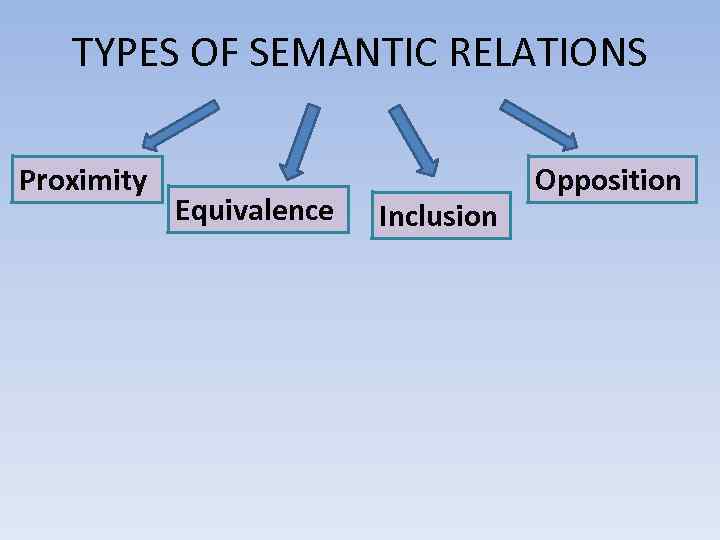 TYPES OF SEMANTIC RELATIONS Proximity Equivalence Inclusion Opposition
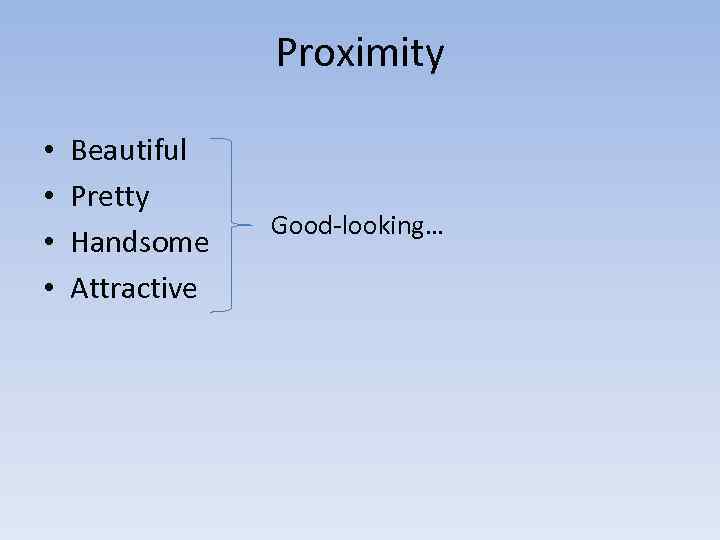 Proximity • • Beautiful Pretty Handsome Attractive Good-looking…
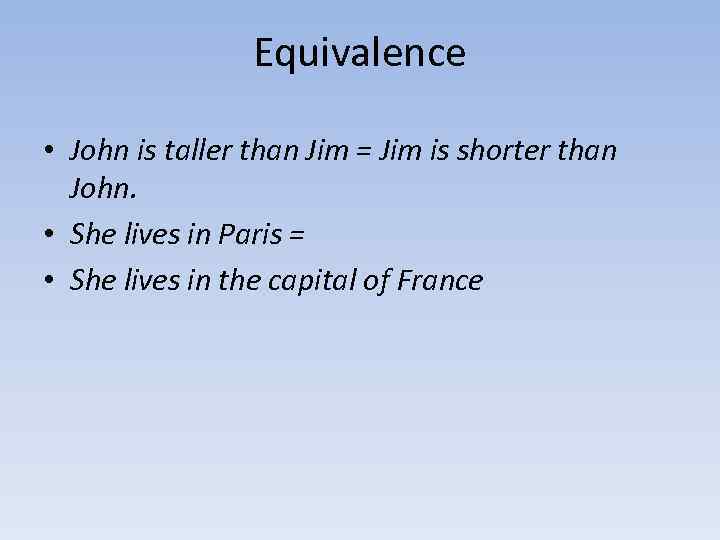 Equivalence • John is taller than Jim = Jim is shorter than John. • She lives in Paris = • She lives in the capital of France
 Opposition • Black – white • Rich – poor • To arrive – to leave.
 ANTONYMY E. M. Dubenetz Antonyms are words belonging to the same part of speech, identical in style, expressing contrary or contradictory notions
 Antonyms are usually believed to appear in pairs: storm − calm beginning − ending up − down glorious − shameful drunkenness − soberness white − black
 **Antonyms represent the language’s important expressive means **often used as a stylistic device of contrast A man is known by the company he keeps. A woman is known by the company she keeps out of (O. Wilde) Знание человека возвышает, а невежество унижает
 2. ANTONYMY AND POLYSEMY Different meanings of a word may have different antonyms: dull interesting, amusing, entertaining (deficient in interest) clever, bright, capable (deficient in intellect) active (deficient in activity)
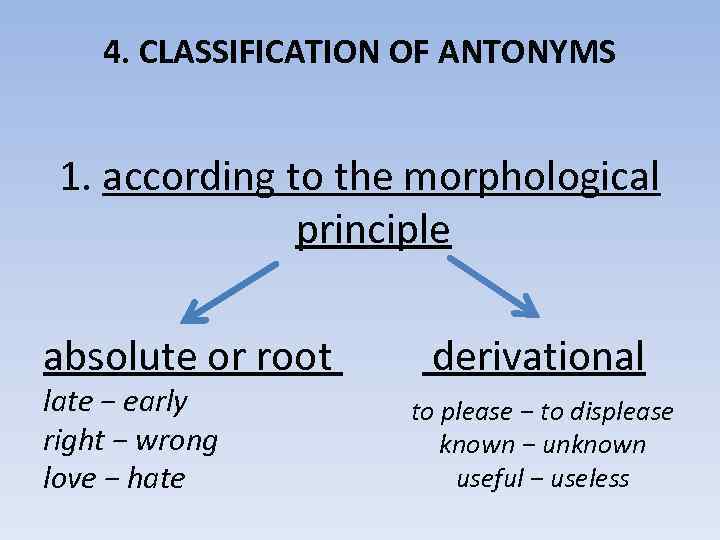 4. CLASSIFICATION OF ANTONYMS 1. according to the morphological principle absolute or root late − early right − wrong love − hate derivational to please − to displease known − unknown useful − useless
 2. according to the underlying logical categories 1. Contradictories 2. Contraries 3. Incompatibles
 1. Contradictories are mutually opposed and denying one another (J. Lyons and L. Lipka call them complementary antonyms): alive − dead impatient − patient single − married perfect − imperfect male − female
 2. Contraries are also mutually opposed but they are gradable (J. Lyons calls such words antonyms proper): hot − warm− cool − cold beautiful − simple − ugly old − middle-aged − young
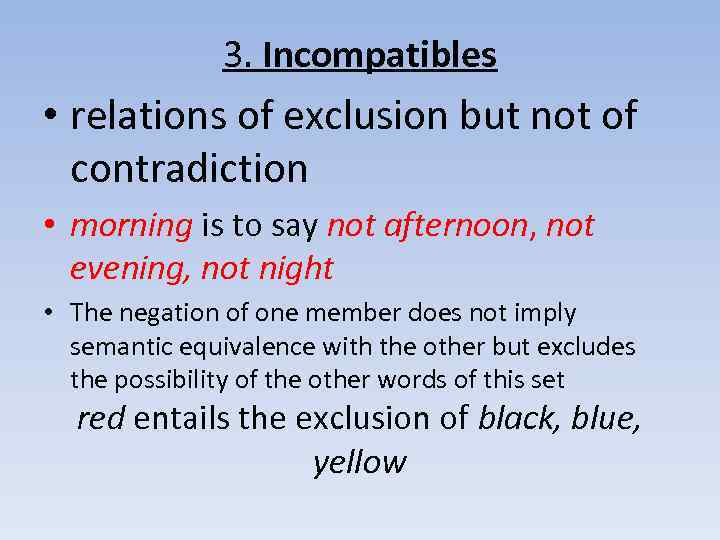 3. Incompatibles • relations of exclusion but not of contradiction • morning is to say not afternoon, not evening, not night • The negation of one member does not imply semantic equivalence with the other but excludes the possibility of the other words of this set red entails the exclusion of black, blue, yellow
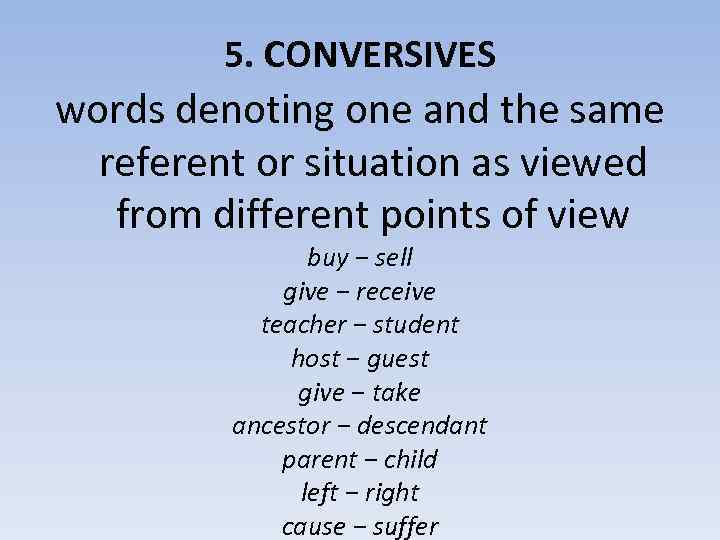 5. CONVERSIVES words denoting one and the same referent or situation as viewed from different points of view buy − sell give − receive teacher − student host − guest give − take ancestor − descendant parent − child left − right cause − suffer