


 Скачать презентацию Lecture 7_New product development CHAPTER DEVELOPING NEW PRODUCTS
Question 28 - Lecture07.ppt
- Количество слайдов: 41
 Lecture 7_New product development CHAPTER DEVELOPING NEW PRODUCTS AND SERVICES Associate professor of Plekhanov REA Marketing department Irina I. Skorobogatykh (Ph. D) Marketing, lecture 7 ass. prof. I. I. Skorobogatykh (Ph. D) 1 Slide 10 -2
 LECTURE QUESTIONS: • Identify the consumer and business goods and services are classified and marketed. • Explain the effects of different ways of viewing “newness” in new products and services. Marketing, lecture 7 ass. prof. I. I. Skorobogatykh (Ph. D) 2 Slide 10 -5
 LECTURE QUESTIONS: • Analyze the factors that contribute to the success or failure of a product or service. • Describe the purposes of each step of the new-product process. Marketing, lecture 7 ass. prof. I. I. Skorobogatykh (Ph. D) 3 Slide 10 -6
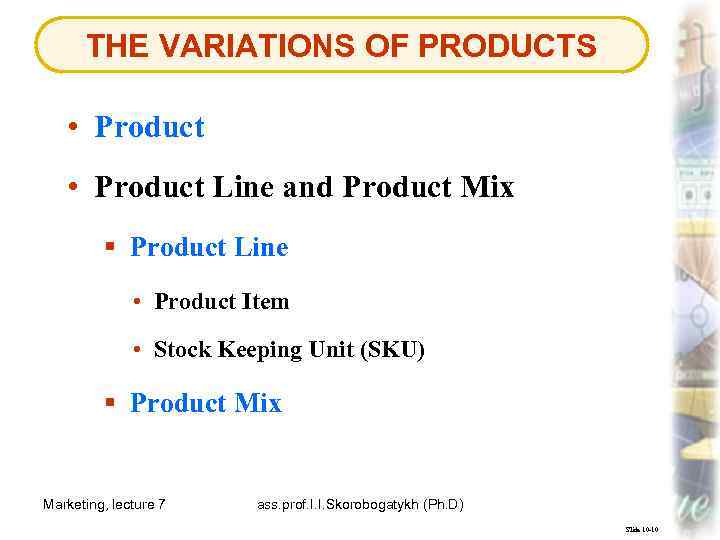 THE VARIATIONS OF PRODUCTS • Product Line and Product Mix § Product Line • Product Item • Stock Keeping Unit (SKU) § Product Mix Marketing, lecture 7 ass. prof. I. I. Skorobogatykh (Ph. D) 4 Slide 10 -10
 Product A product is a good, service, or idea consisting of a bundle of tangible and intangible attributes that satisfies consumers and is received in exchange for money or some other unit of value. Marketing, lecture 7 ass. prof. I. I. Skorobogatykh (Ph. D) 5 Slide 10 -92
 Product Line A product line is a group of products— goods or services—that are closely related because they satisfy a class of needs, are used together, are sold to the same customer group, are distributed through the same type of outlets, or fall w/in a given price range. Marketing, lecture 7 ass. prof. I. I. Skorobogatykh (Ph. D) 6 Slide 10 -93
 Product Mix The product mix is the number of product lines offered by a company. Marketing, lecture 7 ass. prof. I. I. Skorobogatykh (Ph. D) 7 Slide 10 -94
 THE VARIATIONS OF PRODUCTS • Classifying Products § Type of User • Consumer Goods • Business Goods § Degree of Tangibility • Nondurable Good • Durable Good • Services Marketing, lecture 7 ass. prof. I. I. Skorobogatykh (Ph. D) 8 Slide 10 -12
 Consumer Goods Consumer goods are products purchased by the ultimate consumer. Marketing, lecture 7 ass. prof. I. I. Skorobogatykh (Ph. D) 9 Slide 10 -95
 Business Goods Business goods are products that assist directly or indirectly in providing products for resale. Marketing, lecture 7 ass. prof. I. I. Skorobogatykh (Ph. D) 10 Slide 10 -96
 THE VARIATIONS OF PRODUCTS • The Uniqueness of Services § Intangibility § Inconsistency § Inseparability § Inventory • Idle Production Capacity Marketing, lecture 7 ass. prof. I. I. Skorobogatykh (Ph. D) 11 Slide 10 -14
 Idle Production Capacity Idle production capacity is when the service provider is available but there is no demand. Marketing, lecture 7 ass. prof. I. I. Skorobogatykh (Ph. D) 12 Slide 10 -97
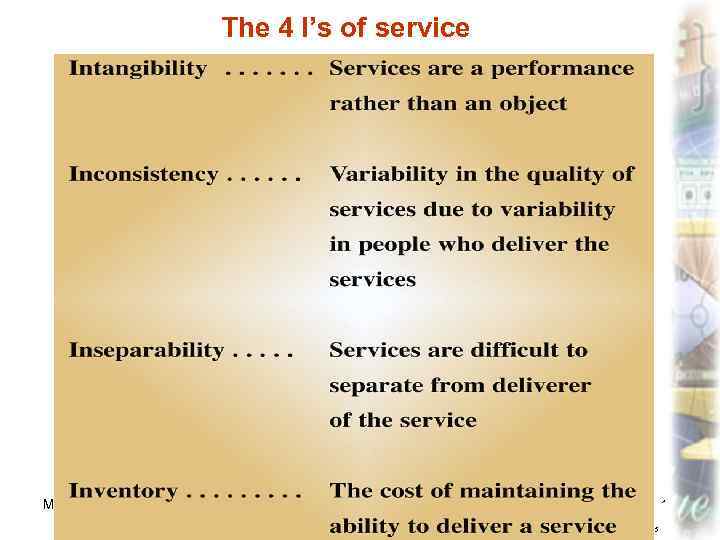 The 4 I’s of service Marketing, lecture 7 ass. prof. I. I. Skorobogatykh (Ph. D) 13 Slide 10 -15
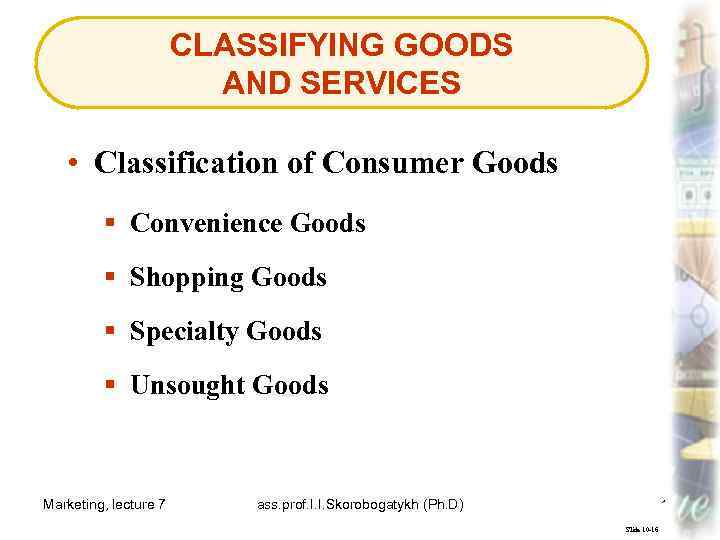 CLASSIFYING GOODS AND SERVICES • Classification of Consumer Goods § Convenience Goods § Shopping Goods § Specialty Goods § Unsought Goods Marketing, lecture 7 ass. prof. I. I. Skorobogatykh (Ph. D) 14 Slide 10 -16
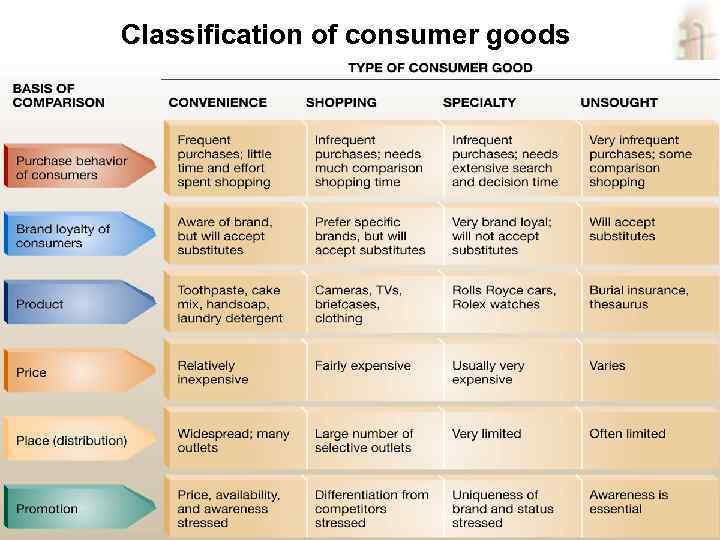 Classification of consumer goods Marketing, lecture 7 ass. prof. I. I. Skorobogatykh (Ph. D) 15 Slide 10 -17
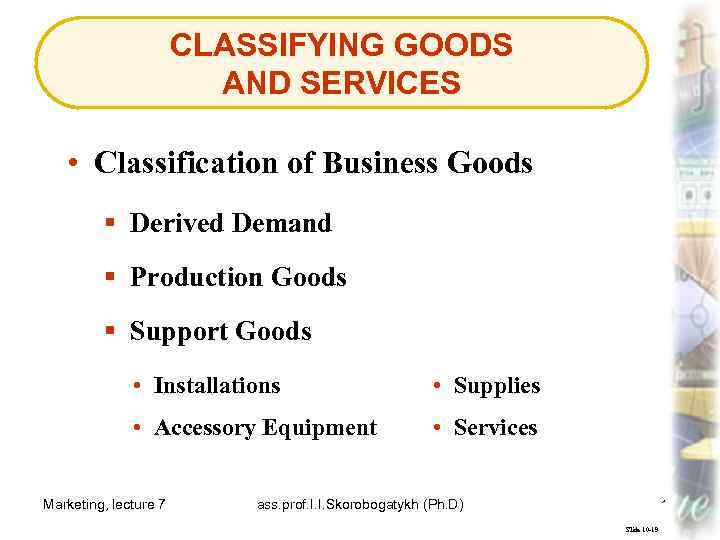 CLASSIFYING GOODS AND SERVICES • Classification of Business Goods § Derived Demand § Production Goods § Support Goods • Installations • Supplies • Accessory Equipment • Services Marketing, lecture 7 ass. prof. I. I. Skorobogatykh (Ph. D) 16 Slide 10 -19
 CLASSIFYING GOODS AND SERVICES • Classification of Services § Delivery by People or Equipment § Profit or Not-for-Profit Organizations § Government Sponsored or Not Marketing, lecture 7 ass. prof. I. I. Skorobogatykh (Ph. D) 17 Slide 10 -20
 Concept Check 1. Explain the difference between product mix and product line. A: The product mix is the number of product lines offered by a company. A product line is a group of products or services that: satisfy a class of needs, are used together, are sold to the same customer group, are distributed through the same outlets, or fall Marketing, lecture 7 within a given price (Ph. D) ass. prof. I. I. Skorobogatykh range. Slide 10 -23 18
 Concept Check 2. What are the four main types of consumer goods? A: Convenience goods, shopping goods, specialty goods, and unsought goods. Marketing, lecture 7 ass. prof. I. I. Skorobogatykh (Ph. D) 19 Slide 10 -24
 Concept Check 3. What are three ways to classify services? A: Delivery by people or equipment, profit or not-for-profit organizations, and government sponsored or not. Marketing, lecture 7 ass. prof. I. I. Skorobogatykh (Ph. D) 20 Slide 10 -25
 NEW PRODUCTS AND WHY THEY SUCCEED OR FAIL • What is a New Product? § The Term “New” § Continuous Innovation § Dynamically Continuous Innovation § Discontinuous Innovation Marketing, lecture 7 ass. prof. I. I. Skorobogatykh (Ph. D) 21 Slide 10 -26
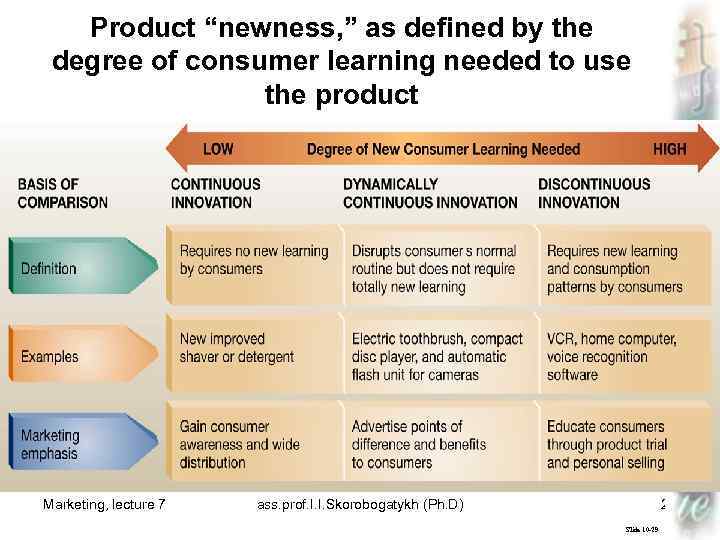 Product “newness, ” as defined by the degree of consumer learning needed to use the product Marketing, lecture 7 ass. prof. I. I. Skorobogatykh (Ph. D) 22 Slide 10 -29
 NEW PRODUCTS AND WHY THEY SUCCEED OR FAIL • Why Products Succeed or Fail § Marketing Reasons for New-Product Failures • Insignificant Point of Difference • Incomplete Market and Product Definition Before Product Development Starts Marketing, lecture 7 ass. prof. I. I. Skorobogatykh (Ph. D) 23 Slide 10 -30
 NEW PRODUCTS AND WHY THEY SUCCEED OR FAIL • Why Products Succeed or Fail § Marketing Reasons for New-Product Failures • Too Little Market Attractiveness • Poor Execution of the Marketing Mix • Poor Product Quality or Insensitivity to Customer Needs on Critical Factors Marketing, lecture 7 ass. prof. I. I. Skorobogatykh (Ph. D) 24 Slide 10 -34
 NEW PRODUCTS AND WHY THEY SUCCEED OR FAIL • Why Products Succeed or Fail § Marketing Reasons for New-Product Failures • Bad Timing • No Economic Access to Buyers § A Look at Some Failures Marketing, lecture 7 ass. prof. I. I. Skorobogatykh (Ph. D) 25 Slide 10 -35
 Concept Check 1. Describe three kinds of innovations that marketers use to categorize new products. A: Continuous innovation, dynamically continuous innovation, and discontinuous innovation. Marketing, lecture 7 ass. prof. I. I. Skorobogatykh (Ph. D) 26 Slide 10 -39
 Concept Check 2. What does “insignificant point of difference” mean as a reason for newproduct failure? A: The product’s characteristics did not deliver benefits to the user that were uniquely superior to those of competitors or were not deemed important to users. Marketing, lecture 7 ass. prof. I. I. Skorobogatykh (Ph. D) 27 Slide 10 -40
 THE NEW-PRODUCT DEVELOPMENT PROCESS • New-Product Development Process • New-Product Strategy Development § Identifying Markets and Strategic Roles § Cross-Functional Teams and New-Product Development • Cross-Functional Teams Marketing, lecture 7 ass. prof. I. I. Skorobogatykh (Ph. D) 28 Slide 10 -41
 New-Product Development Process The new-product development process consists of seven stages a firm goes through to identify business opportunities and convert them to a salable good or service. Marketing, lecture 7 ass. prof. I. I. Skorobogatykh (Ph. D) 29 Slide 10 -98
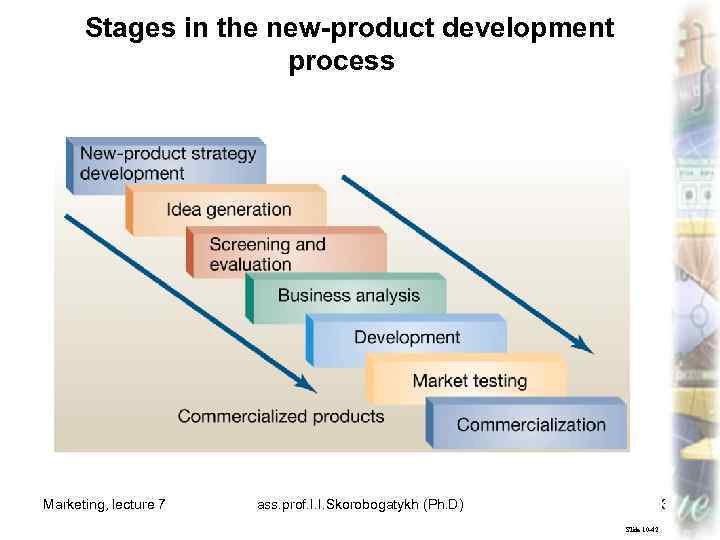 Stages in the new-product development process Marketing, lecture 7 ass. prof. I. I. Skorobogatykh (Ph. D) 30 Slide 10 -42
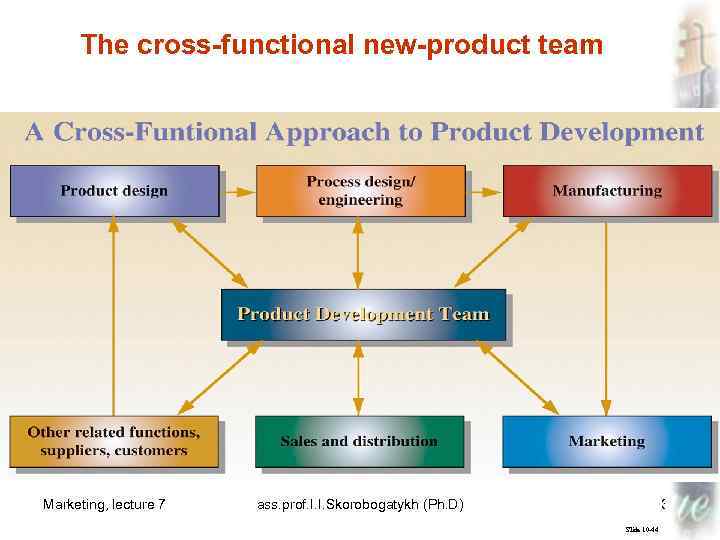 The cross-functional new-product team Marketing, lecture 7 ass. prof. I. I. Skorobogatykh (Ph. D) 31 Slide 10 -44
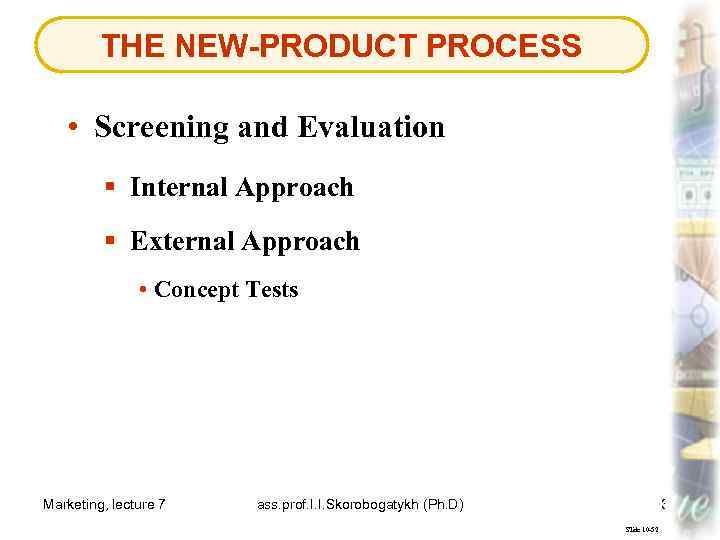 THE NEW-PRODUCT PROCESS • Screening and Evaluation § Internal Approach § External Approach • Concept Tests Marketing, lecture 7 ass. prof. I. I. Skorobogatykh (Ph. D) 32 Slide 10 -52
 Concept Check 1. What step in the new-product process has been added in recent years? A: New-product strategy development has been added recently by many companies to provide focus for ideas and concepts developed in later stages. Marketing, lecture 7 ass. prof. I. I. Skorobogatykh (Ph. D) 33 Slide 10 -54
 Concept Check 2. What are four sources of new-product ideas? A: Customer and supplier suggestions, employee suggestions, R&D breakthroughs, and competitive products. Marketing, lecture 7 ass. prof. I. I. Skorobogatykh (Ph. D) 34 Slide 10 -55
 THE NEW-PRODUCT PROCESS • Business Analysis § Prototype § Assessing the “Business Fit” of the New Product § Big G Plus Pillsbury: Increasing Emphasis on Synergies and Segments Marketing, lecture 7 ass. prof. I. I. Skorobogatykh (Ph. D) 35 Slide 10 -56
 THE NEW-PRODUCT PROCESS • Development • Market Testing § Test Marketing § When Test Markets Don’t Work Marketing, lecture 7 ass. prof. I. I. Skorobogatykh (Ph. D) 36 Slide 10 -58
 THE NEW-PRODUCT PROCESS • Commercialization § Burger King’s French Fries: The Complexities of Commercialization § The Risks and Uncertainties of the Commercialization Stage § Speed as a Factor in New-Product Success • Time to Market (Tt. M) Marketing, lecture 7 • Parallel Development ass. prof. I. I. Skorobogatykh (Ph. D) 37 Slide 10 -61
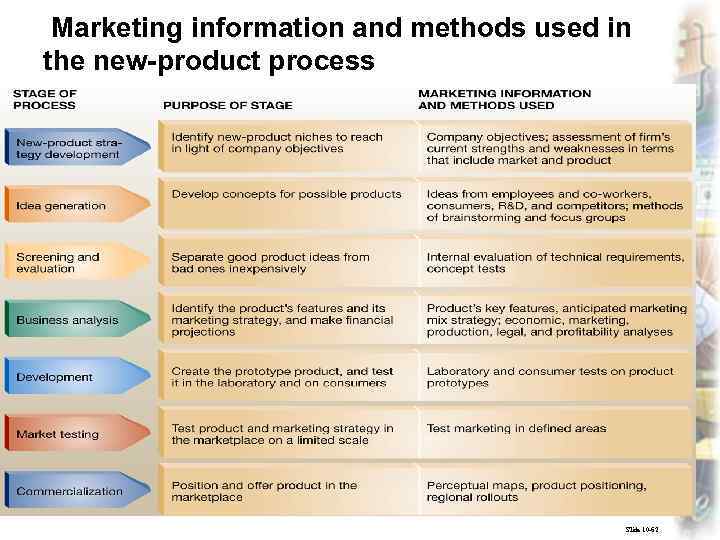 Marketing information and methods used in the new-product process Marketing, lecture 7 ass. prof. I. I. Skorobogatykh (Ph. D) 38 Slide 10 -62
 Concept Check 1. Describe the business analysis stage of the new-product process. A: Business analysis involves specifying the features of the product and the marketing strategy needed to commercialize it—bring it to market—and making financial projections. Marketing, lecture 7 ass. prof. I. I. Skorobogatykh (Ph. D) 39 Slide 10 -65
 Concept Check 2. What is a test market? A: A test market is a city that is viewed as being representative of U. S. consumers in terms of demographics and brand purchase patterns, is far enough from big markets to allow low-cost advertising, and has tracking systems to measure sales. Marketing, lecture 7 ass. prof. I. I. Skorobogatykh (Ph. D) 40 Slide 10 -66
 Concept Check 3. What is commercialization of a new product? A: Commercialization involves positioning and launching a new product in full-scale production and sales and is the most expensive stage for most new products. Marketing, lecture 7 ass. prof. I. I. Skorobogatykh (Ph. D) 41 Slide 10 -67