


 Скачать презентацию Lecture 7 Understanding and Measuring Transaction Costs
364d0071c62e3bb7e74e08cbb1bd6500.ppt
- Количество слайдов: 19
 Lecture 7 Understanding and Measuring Transaction Costs
 Trading Cost l Cost of implementing a trading strategy l Contractual cost l Market impact l Difference between the trade price and the underlying fundamental value at the time of the trade l Lost opportunity cost l Trading cost depends on the order size. l Time to execute the order is also important. l Retail investors vs. Institutional investors
 Contractual Costs l Commissions (deregulated in 1975 in the US). l For retail investors. l Online brokers are cheaper (~$5 -20 / trade) l l Full-service brokers are much more expensive, but are bundled with services l l Merrill, Dean Witter, A. G. Edwards, Edward Jones etc. For institutional investors (usually fixed per share). l l l E*Trade, Ameri. Trade, Schwab etc. For listed stocks, it is 2 -5 cents per share. For Nasdaq stocks, commissions were built into prices as brokers often filled these orders on a principal basis (“net” trading). Since the late 1990’s brokers started trading on the agency basis as well. Market fees (small) l l Super. DOT fee ECN access fee
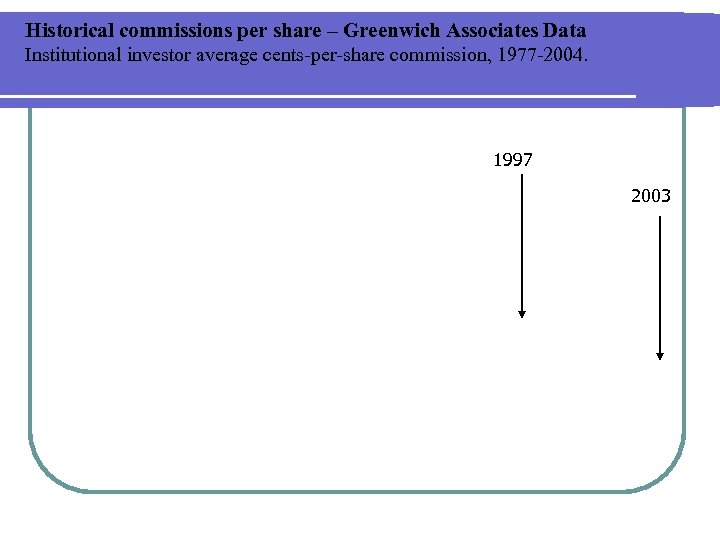 Historical commissions per share – Greenwich Associates Data Institutional investor average cents-per-share commission, 1977 -2004. 1997 2003
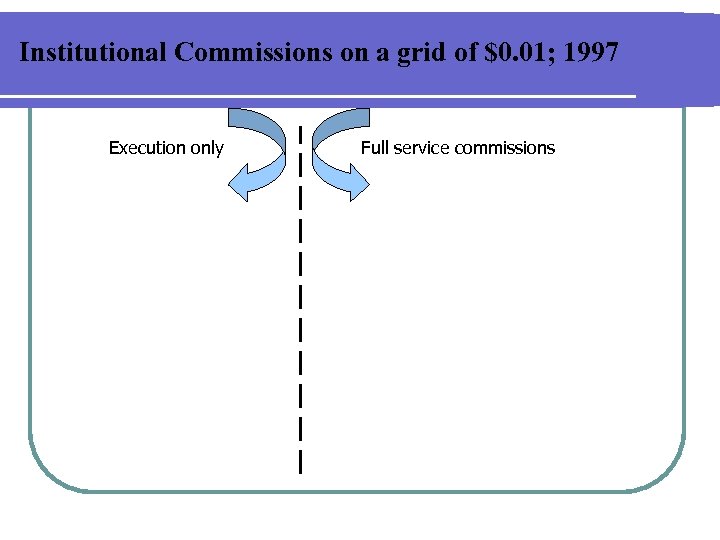 Institutional Commissions on a grid of $0. 01; 1997 Execution only Full service commissions
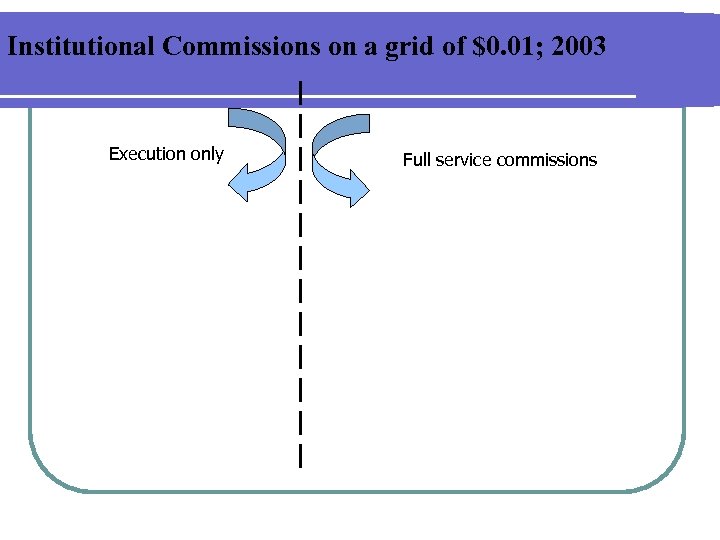 Institutional Commissions on a grid of $0. 01; 2003 Execution only Full service commissions
 Evolution of Commissions l Commissions were traditionally paying for other services (e. g. research, IPO) as well. l Over time there is a proliferation of alternative trading systems that only provide execution. l Unbundling of the execution from research. l Decline in commission revenue for the large institutional brokers.
 Soft Dollars l Accounts into which brokers deposit excess commissions and from which the manager can pay for research, equipment, sales expenses, l l Potential conflicts of interest and failure of the fiduciary duty of the broker to get the best execution. Mutual funds rarely publish trading cost information l l SEC is investigating this practice, but has not ruled yet. UK has already banned the practice for mutual funds.
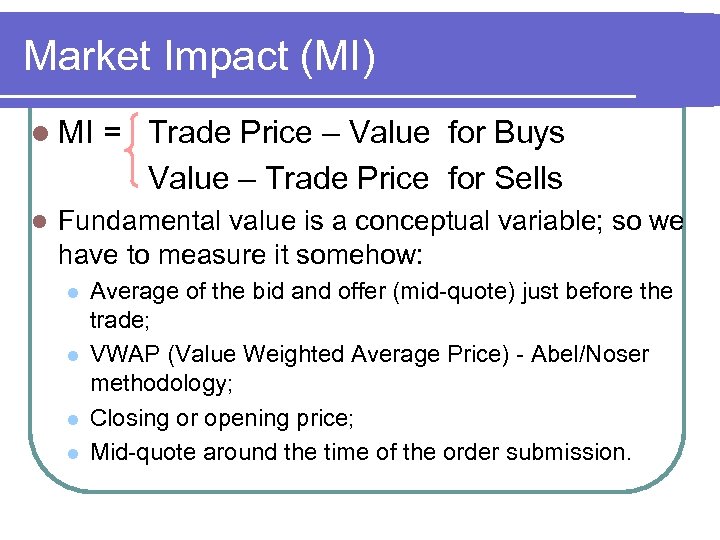 Market Impact (MI) l MI l = Trade Price – Value for Buys Value – Trade Price for Sells Fundamental value is a conceptual variable; so we have to measure it somehow: l l Average of the bid and offer (mid-quote) just before the trade; VWAP (Value Weighted Average Price) - Abel/Noser methodology; Closing or opening price; Mid-quote around the time of the order submission.
 Lost Opportunity Costs l Delay cost l Cost of not executing on time (important for traders with information and for hedgers – impatient) l l l Prices can become unfavorable; Liquidity may dry up. Unfilled order cost l Cost of not filling the desired quantity on time l l Higher transaction costs later on. Unfavorable change in fundamental parameters.
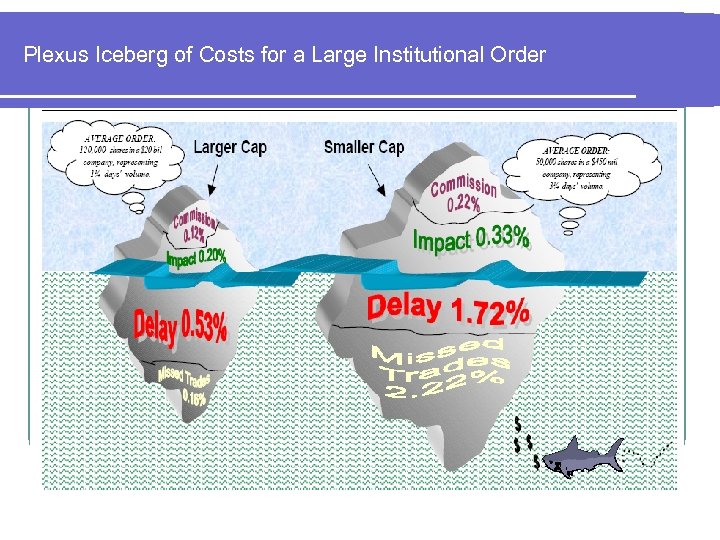 Plexus Iceberg of Costs for a Large Institutional Order
 Implementation Shortfall (IS) Identify the value of a paper portfolio using the mid-quote at the time the decision is made l IS = Difference between the value of the paper portfolio and the actual portfolio l l Transaction costs l l l Timing = change in mid-quote between the decision and the first execution. Market impact = difference between the first execution mid -quote and the average trade price. Lost opportunity costs l Actual portfolio value only includes the value of the completed trades
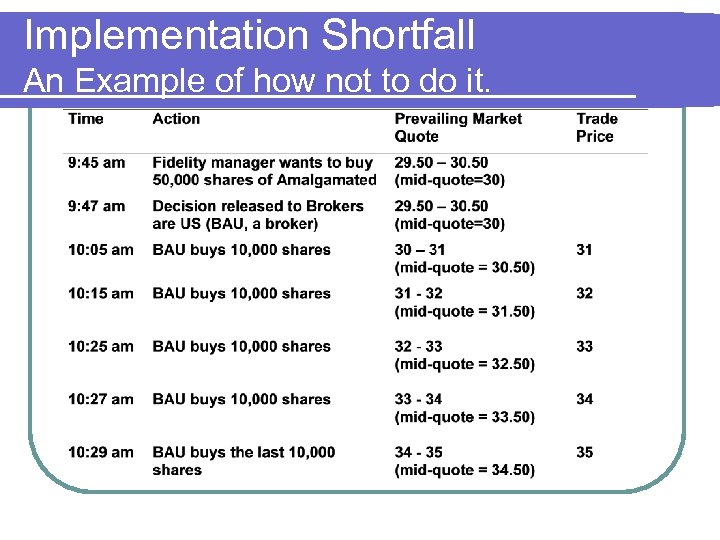 Implementation Shortfall An Example of how not to do it.
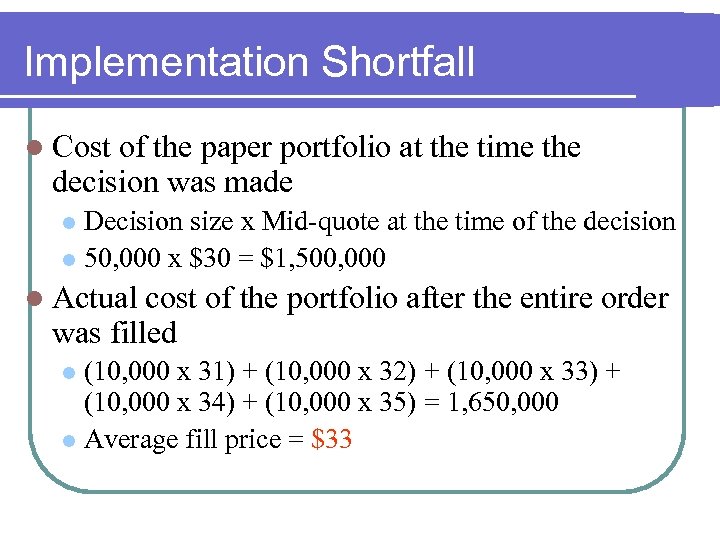 Implementation Shortfall l Cost of the paper portfolio at the time the decision was made Decision size x Mid-quote at the time of the decision l 50, 000 x $30 = $1, 500, 000 l l Actual cost of the portfolio after the entire order was filled (10, 000 x 31) + (10, 000 x 32) + (10, 000 x 33) + (10, 000 x 34) + (10, 000 x 35) = 1, 650, 000 l Average fill price = $33 l
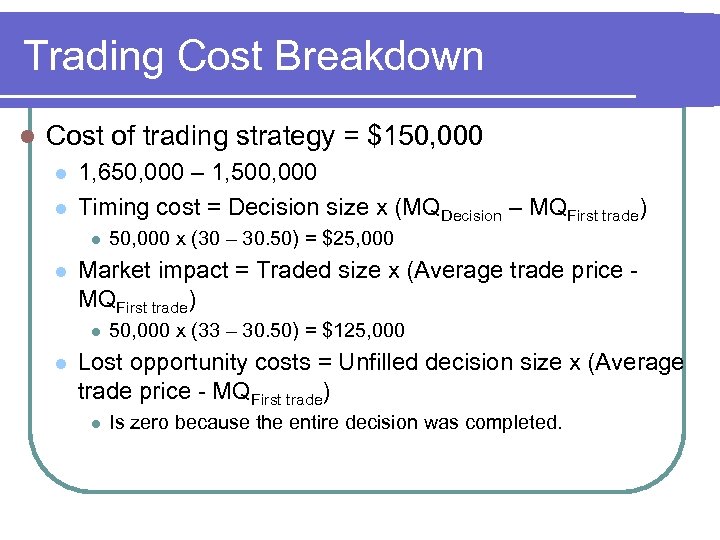 Trading Cost Breakdown l Cost of trading strategy = $150, 000 l l 1, 650, 000 – 1, 500, 000 Timing cost = Decision size x (MQDecision – MQFirst trade) l l Market impact = Traded size x (Average trade price MQFirst trade) l l 50, 000 x (30 – 30. 50) = $25, 000 50, 000 x (33 – 30. 50) = $125, 000 Lost opportunity costs = Unfilled decision size x (Average trade price - MQFirst trade) l Is zero because the entire decision was completed.
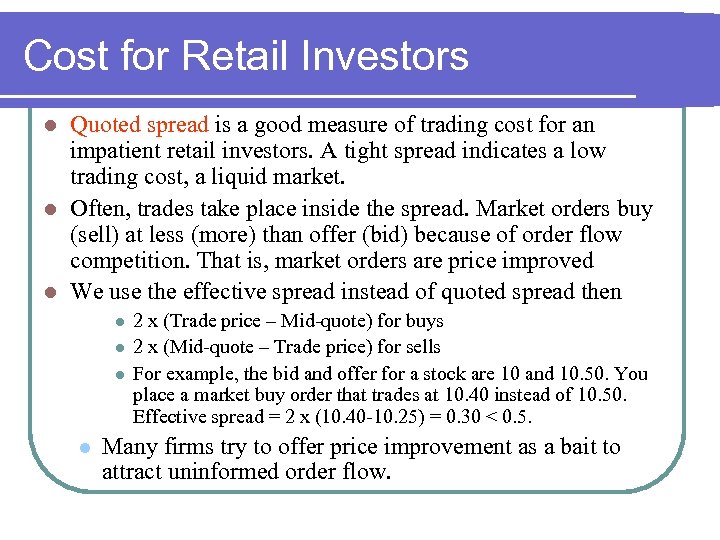 Cost for Retail Investors Quoted spread is a good measure of trading cost for an impatient retail investors. A tight spread indicates a low trading cost, a liquid market. l Often, trades take place inside the spread. Market orders buy (sell) at less (more) than offer (bid) because of order flow competition. That is, market orders are price improved l We use the effective spread instead of quoted spread then l l l 2 x (Trade price – Mid-quote) for buys 2 x (Mid-quote – Trade price) for sells For example, the bid and offer for a stock are 10 and 10. 50. You place a market buy order that trades at 10. 40 instead of 10. 50. Effective spread = 2 x (10. 40 -10. 25) = 0. 30 < 0. 5. Many firms try to offer price improvement as a bait to attract uninformed order flow.
 New Rules on Disclosure of Execution Quality SEC Rule 11 Ac 1 -5 Each market center / participant is obligated to publish information about effective spreads for different order sizes/types for each stock on a monthly basis
 Difficulties l Quoted spreads are much easier to calculate by an outside observer (econometrician) than the effective ones. l Effective spreads require matching of the time of trades and quotes: Time stamps may be off; l How do one know which trade was a buy? l l Internal calculations are much more accurate.
 Summary l In the last decade the trading costs became the focal point of the institutional investors, at the expense of research. l We are witnessing the reduction of these costs along with proliferation of new conceptually different trading venues. l The trend is likely to continue, yet the decline in transaction costs is likely to stop soon.