


 Скачать презентацию Lecture 7 Some fundamentals of theory of translation
Lecture 7.ppt
- Количество слайдов: 16
 Lecture 7 Some fundamentals of theory of translation
 Thegoalof translation to transform a text in the is Source Language (SL) into a text in the Target Language (TL). This means that the message produced by the translator should call forth a reaction from the TL receptor similar to that called forth by the original message from the SL receptor. Equivalent texts in the two languages are not necessarily upof semantically made identical and signs grammatical structures equivalence should not and be confused with identity.
 Equivalence the reproduction a SL text by TL is of means. Equivalence is not a constant but a variable quantity and the range of variability is considerable. The degree of equivalence depends on the linguistic means used in the SL texts and on the functional style to which the text belongs. Early December brought a brief respite when temperatures fell and the ground hardened, but a quick thaw followed. -
 Types of equivalence First Type – Formal Equivalence. The content, the structure of the sentence and the semantic components (language units) are similar. Each element of the SL text has a corresponding one in the TL text. But such cases of complete similarity are rather rare. Children go to school every morning. -
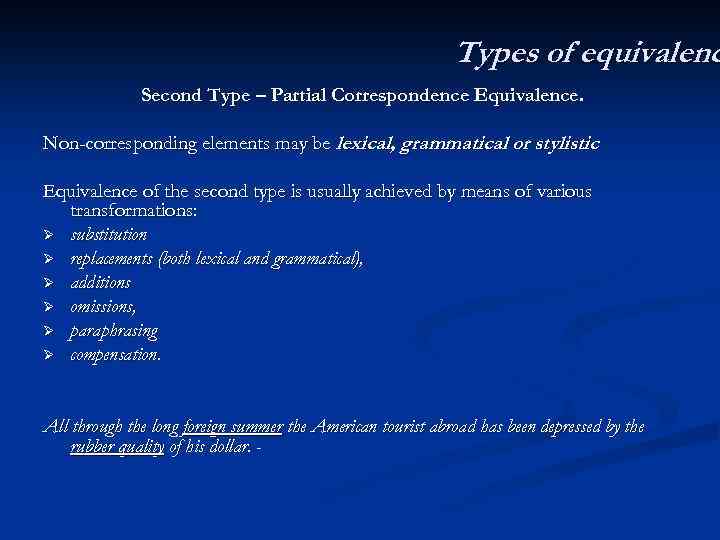 Types of equivalenc Second Type – Partial Correspondence Equivalence. Non-corresponding elements may be lexical, grammatical or stylistic. Equivalence of the second type is usually achieved by means of various transformations: Ø substitution Ø replacements (both lexical and grammatical), Ø additions Ø omissions, Ø paraphrasing Ø compensation. All through the long foreign summer the American tourist abroad has been depressed by the rubber quality of his dollar. -
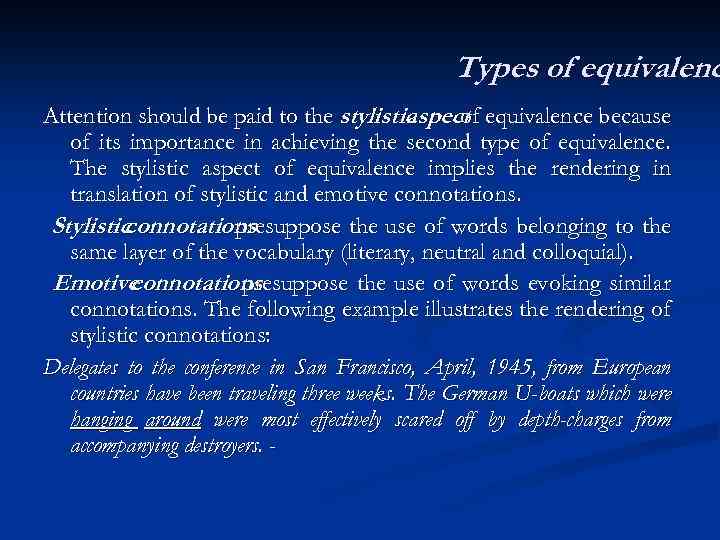 Types of equivalenc Attention should be paid to the stylistic aspect equivalence because of of its importance in achieving the second type of equivalence. The stylistic aspect of equivalence implies the rendering in translation of stylistic and emotive connotations. Stylistic connotations presuppose the use of words belonging to the same layer of the vocabulary (literary, neutral and colloquial). Emotive connotations presuppose the use of words evoking similar connotations. The following example illustrates the rendering of stylistic connotations: Delegates to the conference in San Francisco, April, 1945, from European countries have been traveling three weeks. The German U-boats which were hanging around were most effectively scared off by depth-charges from accompanying destroyers. -
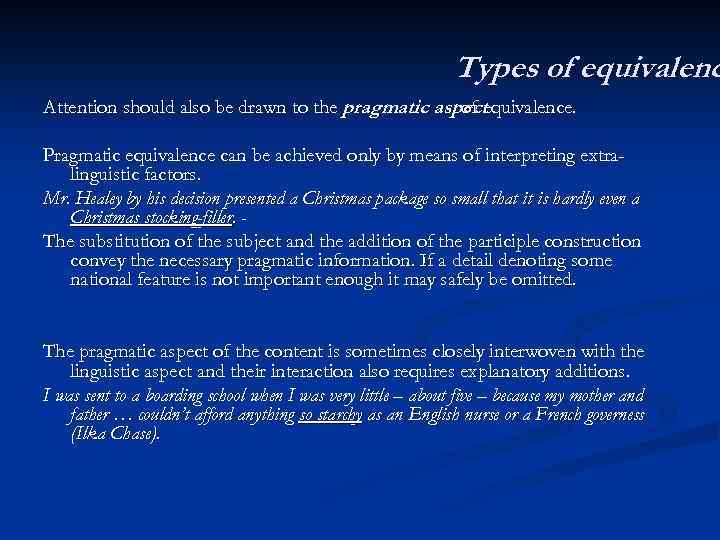 Types of equivalenc Attention should also be drawn to the pragmatic aspect of equivalence. Pragmatic equivalence can be achieved only by means of interpreting extralinguistic factors. Mr. Healey by his decision presented a Christmas package so small that it is hardly even a Christmas stocking-filler. The substitution of the subject and the addition of the participle construction convey the necessary pragmatic information. If a detail denoting some national feature is not important enough it may safely be omitted. The pragmatic aspect of the content is sometimes closely interwoven with the linguistic aspect and their interaction also requires explanatory additions. I was sent to a boarding school when I was very little – about five – because my mother and father … couldn’t afford anything so starchy as an English nurse or a French governess (Ilka Chase).
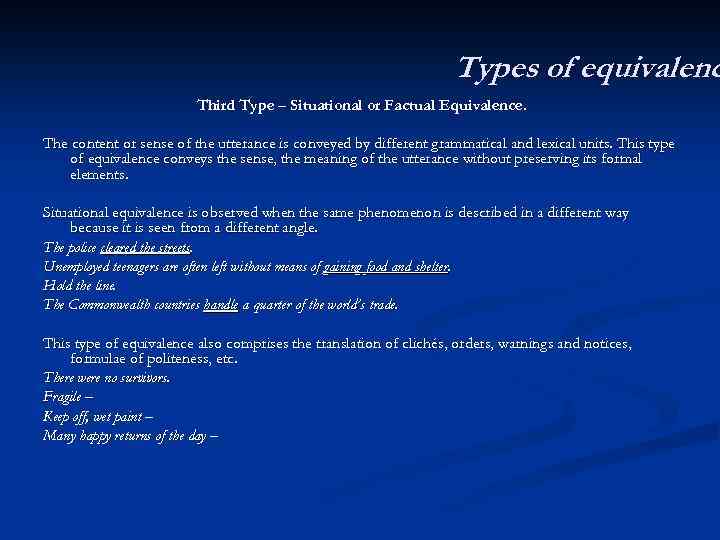 Types of equivalenc Third Type – Situational or Factual Equivalence. The content or sense of the utterance is conveyed by different grammatical and lexical units. This type of equivalence conveys the sense, the meaning of the utterance without preserving its formal elements. Situational equivalence is observed when the same phenomenon is described in a different way because it is seen from a different angle. The police cleared the streets. Unemployed teenagers are often left without means of gaining food and shelter. Hold the line. The Commonwealth countries handle a quarter of the world’s trade. This type of equivalence also comprises the translation of clichés, orders, warnings and notices, formulae of politeness, etc. There were no survivors. Fragile – Keep off, wet paint – Many happy returns of the day –
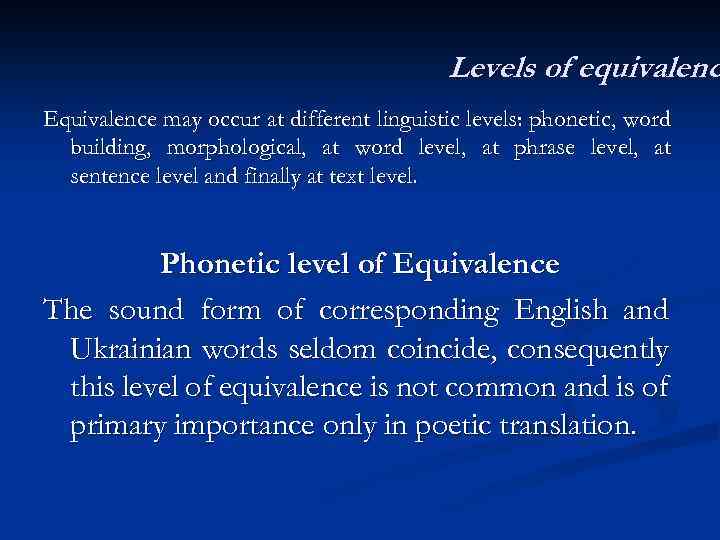 Levels of equivalenc Equivalence may occur at different linguistic levels: phonetic, word building, morphological, at word level, at phrase level, at sentence level and finally at text level. Phonetic level of Equivalence The sound form of corresponding English and Ukrainian words seldom coincide, consequently this level of equivalence is not common and is of primary importance only in poetic translation.
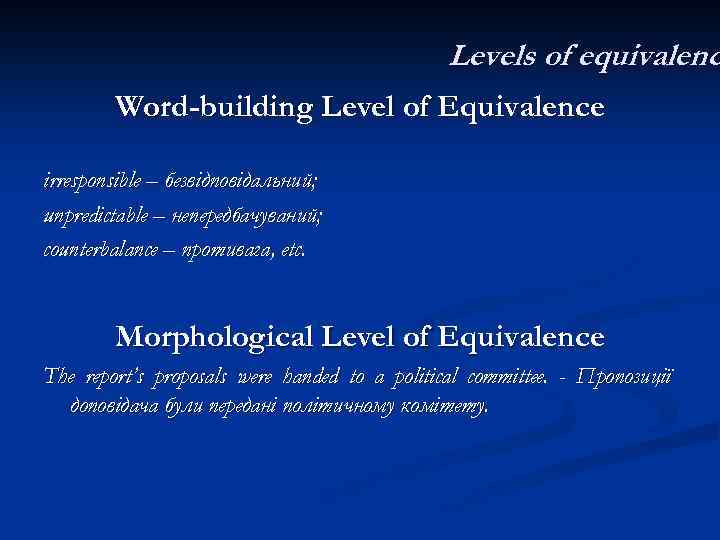 Levels of equivalenc Word-building Level of Equivalence irresponsible – безвідповідальний; unpredictable – непередбачуваний; counterbalance – противага, еtс. Morphological Level of Equivalence The report’s proposals were handed to a political committee. - Пропозиції доповідача були передані політичному комітету.
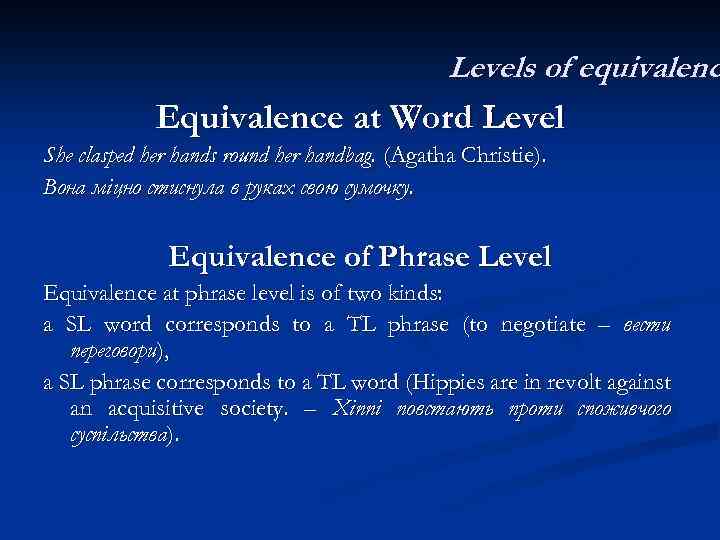 Levels of equivalenc Equivalence at Word Level She clasped her hands round her handbag. (Agatha Christie). Вона міцно стиснула в руках свою сумочку. Equivalence of Phrase Level Equivalence at phrase level is of two kinds: a SL word corresponds to a TL phrase (to negotiate – вести переговори), a SL phrase corresponds to a TL word (Hippies are in revolt against an acquisitive society. – Хіппі повстають проти споживчого суспільства).
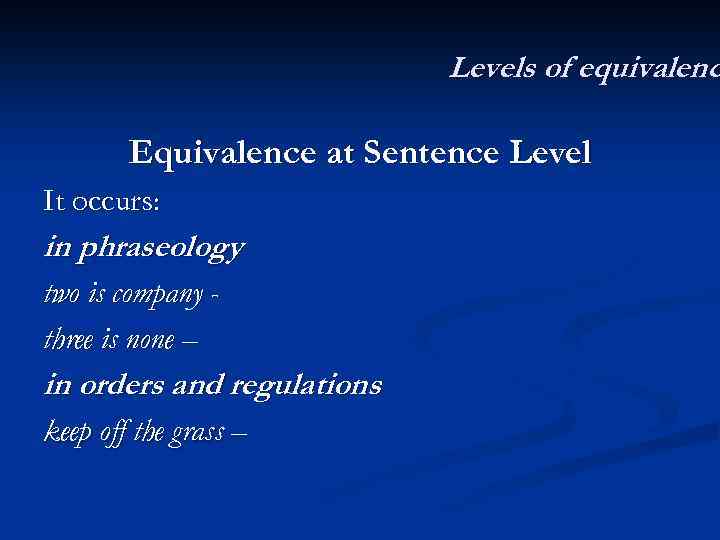 Levels of equivalenc Equivalence at Sentence Level It occurs: in phraseology two is company three is none – in orders and regulations keep off the grass –
 Types of translation The following three types of translation can be distinguished: equivalent translation, literal translation free translation. Equivalent translation Achieving equivalence is the goal aimed at in translation.
 Types of translation Literal translation In spite of the fact that there are cases of semantic and structural coincidences they are rather an exception. A literal or word translation is obviously unacceptable because it results in a violation of form, or a distortion of sense, or both. Literal translation imposes upon the TL text alien lexical and grammatical structures, alien collocability, alien connotations and alien stylistic norms. In literal translation form prevails over content and the meaning of the text is distorted. Literalism may be lexical, grammatical or stylistic. He wagged a grateful tail and climbed on the seat (Georgetta Heyer). She was letting her temper go by inches (Monica Dickens). The pragmatic aspect of translation does not admit literalism either – and requires interpreting translation or substitution. The Tory Team, however, aren’t all batting on the same wicket. (The metaphor is taken from cricket, a very popular game in Britain but hardly known to Ukrainian readers. ) -
 Types of translation Translation Loans Literal translation should not be confused with translation loans. A translation loan is a peculiar form of word - borrowing by means of literal translation. Translation loans are built on the pattern of foreign words or phrases with the elements of the borrowing language, e. g. oil dollars – goodneighbourly relations –
 Types of translation First interpretation Free Translation Free translation, that is, paraphrasing is a special type of translation used as a rule in annotations, précis, abstracts, etc. free translation is rendering of meaning regardless of form. The aim of such translation is to convey information to people in other countries in a most compact and condensed manner. Second interpretation The translator in this case considers himself as co-author and takes great liberties with the original text resorting to unjustified expansion or omissions. The three parameters of translation are: rendering of contents rendering of form observance of TL norms. These fundamentals are of equal significance and are to be duly taken into account in the process of translation.