


 Скачать презентацию Lecture 7 Negotiating access and research ethics Mukhametzhan
Lecture_7.pptx
- Количество слайдов: 20
 Lecture 7: Negotiating access and research ethics Mukhametzhan Seitzhapparuly seitzhapparuly 1@gmail. com Research Methods
 Objectives of the lecture • Be aware of the issues related to gaining access and research ethics • Be able to evaluate a range of strategies to help you to gain access to participants and individual participants • Be able to anticipate ethical issues at each stage of your research process • To evaluate ethical issues associated with particular data collection methods, so that you can consider these in relation to your proposed research methods
 Introduction • Many students want to start their research as soon as they have identified a topic area, forgetting that access and ethics are critical aspects for the success of any research project. • You will need to think about how you are going to gain access to the data you need (hopefully not by sorting through an organisation’s rubbish bins!) and how you are going to explain to those from whom you are obtaining data why you need that data. You need to think carefully about how you will gain access to undertake your research and about possible ethical concerns that could arise in relation to the conduct of your entire research project. • In thinking about these aspects you need to be aware that most universities, as well as an increasing number of organisations, require researchers to obtain formal Research Ethics Committee approval for their proposed research, including their data collection methods, prior to granting access. • In this chapter we start by considering the types and levels of access and the issues associated with these. • Your ability to obtain both primary and secondary data will depend on your gaining access to an appropriate source, or sources where there is a choice. The appropriateness of a source will, of course, depend on your research question, related objectives and research design.
 Physical access • The first level of access is physical access or entry (Gummesson 2000). Whilst the Internet has undoubtedly made accessing some secondary data easier, for much secondary and primary data gaining physical access can be still be difficult. • First, organisations, groups or individuals may not be prepared to engage in additional, voluntary activities because of the time and resources required. Many organisations receive frequent student requests for access and cooperation and would find it impossible to agree to all or even some of these. • Second, the request for access and cooperation may fail to interest the person who receives it, reasons: 1. a lack of perceived value in relation to the work of the organisation, group or the individual; 2. the nature of the topic because of its potential sensitivity, or because of concerns about the confidentiality of the information that would be required; 3. perceptions about your credibility and doubts about your competence. Where you are unable to gain this type of access, you will need to find another organisation or group, or even to modify your research question and objectives.
 Continuing process Many writers see access as a continuing process and not just an initial or single event (Gummesson 2000; Marshall and Rossman 2006; Okumus et al. 2007). This may take two forms: 1) access may be an iterative process, so that you gain entry to carry out the initial part of your research and then seek further access in order to conduct another part. 2) those from whom you wish to collect data may be a different set of people from those agreed with your gatekeeper in your request for access. For example, it will also be necessary for you to gain acceptance and consent from intended participants within the organisation or group in order to gain access to the data that they are able to provide (Robson 2002).
 Cognitive access The participants must understand their social reality The feasibility will determine the construction or refinement of your research questions and objectives Is influenced by your status as an: - external researcher. Demonstrate competence, integrity, show benefits - internal (participant) researcher. No problems with physical access. Also problems with access to data
 Cognitive access • Access may impact upon your ability to select a representative sample of participants, or secondary data, in order to attempt to answer your research question and meet your objectives in an unbiased way and to produce reliable and valid data. This broader meaning of access is referred to as cognitive access. • Simply obtaining physical access to an organisation is likely to be inadequate unless you are also able to negotiate yourself into a position where you can collect data that reveal the reality of what is occurring in relation to your research question and objectives. • The issue of feasibility will determine the construction or refinement of your research question and objectives, and may sometimes lead to a clash with these hallmarks of good research. This has been recognised by Buchanan et al. (1988: 53– 4): Fieldwork is permeated with the conflict between what is theoretically desirable on the one hand what is practically possible on the other. It is desirable to ensure representativeness in the sample, uniformity of interview procedures, adequate data collection across the range of topics to be explored, and so on. But the members of organisations block access to information, constrain the time allowed for interviews, lose your questionnaires, go on holiday, and join other organisations in the middle of your unfinished study. In the conflict between the desirable and the possible, the possible always wins.
 External researcher The nature of problems of access may also vary in relation to your status as either a fulltime or a part-time student. As a full-time student, you are likely to be approaching an organisation or group where you have little or no prior contact, you will be seeking to operate in the role of an external researcher. You will need to negotiate access at each level discussed above (physical, continuing and cognitive). Your ability to demonstrate clearly your research competence and integrity, and in particular your ability to explain your research project clearly and concisely, will also be critical at each level of access. Where you are able to demonstrate competence and integrity, your role as an external researcher may prove to be beneficial. This is because participants are willing to accept you as being objective and without a covert, often organisationally focused, agenda. In doing this your gatekeeper can play an important role, adding credibility and introducing you and your research project to the relevant people and creating an awareness of your research.
 Internal/Participant researcher • As an organisational employee or group member operating in the role of an internal researcher or a participant researcher, perhaps adopting an action research strategy, you are still likely to face problems of access to data, although these may vary in relation to those faced by external researchers. (Easy access to data, however some problems: ) • 1)As an internal researcher you may still face the problem associated with negotiating physical or continuing access, and may still need to obtain formal approval to undertake research in your organisation or group. • 2)In addition, your status in the organisation or group may pose particular problems in relation to cognitive access. This may be related to suspicions about why you are undertaking your research project and the use that will be made of the data, perceptions about the part of the organisation for which you work, and your grade status in relation to those whom you wish to be your research participants. For example, issue about which management would like to implement change. This is particularly likely to be the case where resulting change is perceived as being harmful to those whom you would wish to be your research participants. Therefore, it means internal researches must also concern Ethical Issues.
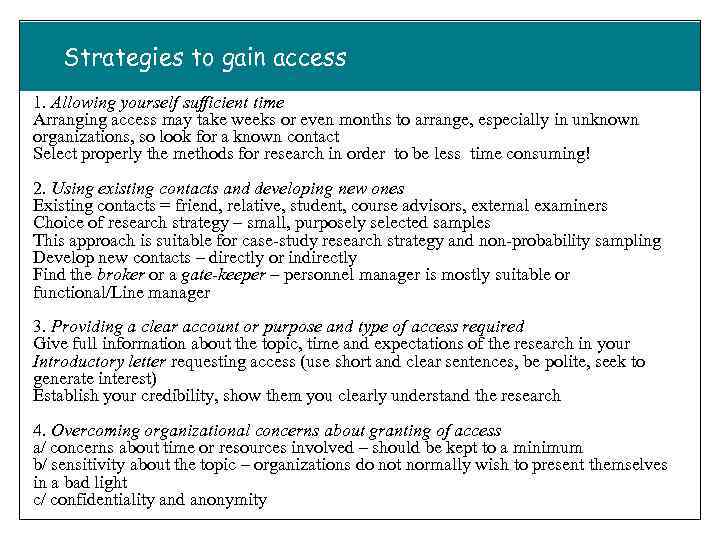 Strategies to gain access 1. Allowing yourself sufficient time Arranging access may take weeks or even months to arrange, especially in unknown organizations, so look for a known contact Select properly the methods for research in order to be less time consuming! 2. Using existing contacts and developing new ones Existing contacts = friend, relative, student, course advisors, external examiners Choice of research strategy – small, purposely selected samples This approach is suitable for case-study research strategy and non-probability sampling Develop new contacts – directly or indirectly Find the broker or a gate-keeper – personnel manager is mostly suitable or functional/Line manager 3. Providing a clear account or purpose and type of access required Give full information about the topic, time and expectations of the research in your Introductory letter requesting access (use short and clear sentences, be polite, seek to generate interest) Establish your credibility, show them you clearly understand the research 4. Overcoming organizational concerns about granting of access a/ concerns about time or resources involved – should be kept to a minimum b/ sensitivity about the topic – organizations do not normally wish to present themselves in a bad light c/ confidentiality and anonymity
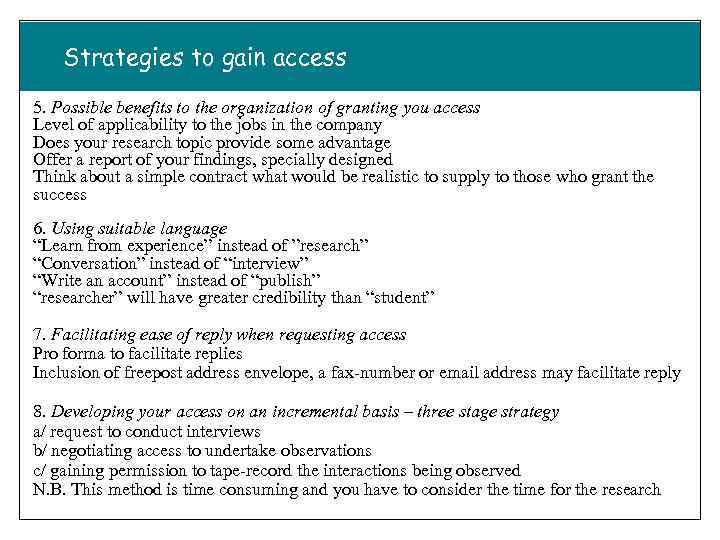 Strategies to gain access 5. Possible benefits to the organization of granting you access Level of applicability to the jobs in the company Does your research topic provide some advantage Offer a report of your findings, specially designed Think about a simple contract what would be realistic to supply to those who grant the success 6. Using suitable language “Learn from experience” instead of ”research” “Conversation” instead of “interview” “Write an account” instead of “publish” “researcher” will have greater credibility than “student” 7. Facilitating ease of reply when requesting access Pro forma to facilitate replies Inclusion of freepost address envelope, a fax-number or email address may facilitate reply 8. Developing your access on an incremental basis – three stage strategy a/ request to conduct interviews b/ negotiating access to undertake observations c/ gaining permission to tape-record the interactions being observed N. B. This method is time consuming and you have to consider the time for the research
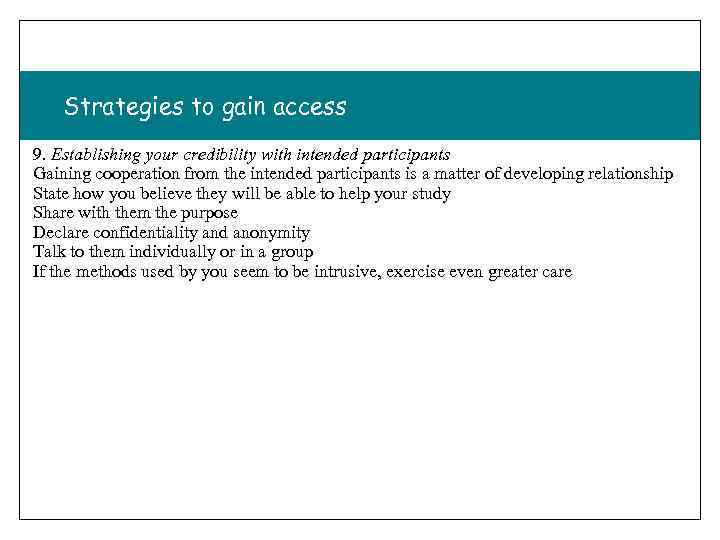 Strategies to gain access 9. Establishing your credibility with intended participants Gaining cooperation from the intended participants is a matter of developing relationship State how you believe they will be able to help your study Share with them the purpose Declare confidentiality and anonymity Talk to them individually or in a group If the methods used by you seem to be intrusive, exercise even greater care
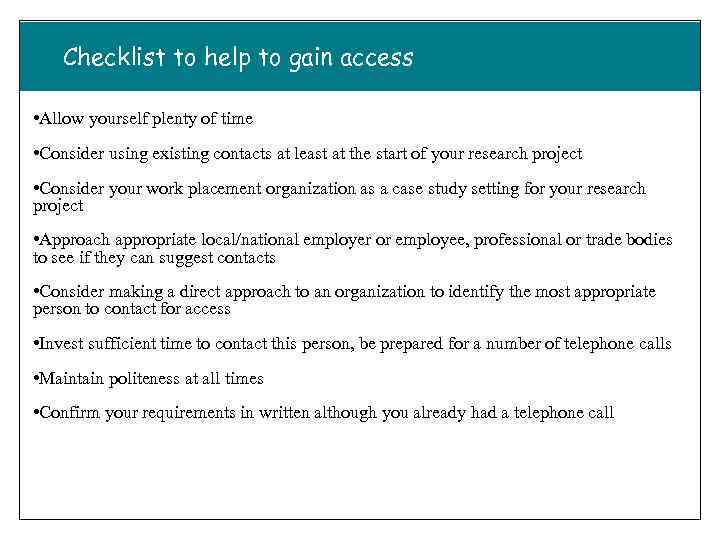 Checklist to help to gain access • Allow yourself plenty of time • Consider using existing contacts at least at the start of your research project • Consider your work placement organization as a case study setting for your research project • Approach appropriate local/national employer or employee, professional or trade bodies to see if they can suggest contacts • Consider making a direct approach to an organization to identify the most appropriate person to contact for access • Invest sufficient time to contact this person, be prepared for a number of telephone calls • Maintain politeness at all times • Confirm your requirements in written although you already had a telephone call
 Checklist to help to gain access • Demonstrate clarity of thought to establish your credibility, outline the purpose of your research project • The construction, tone and presentation of an introductory letter will assist the establishment of your credibility • Consider organizational concerns relating to the amount of time or resources, confidentiality and anonymity • Consider possible benefits of the organization • Exercise care and attention in your language, do not sound boring or threatening • Include a simple pro forma for recipients to use as a means to reply • Be prepared to attend a meeting to present and discuss your request • Work through organizational gatekeepers • Develop your access in incremental basis
 Part III. Research ethics and why you should act ethically • Ethics refers to the appropriateness of your behaviour in relation to the rights of those who become the subject of your work, or are affected by it. • Research ethics therefore relates to questions about how we formulate and clarify our research topic, design our research and gain access, collect data, process and store our data, analyse data and write up our research findings in a moral and responsible way. • Within business and management research, there are two dominant philosophical standpoints: deontology and teleology.
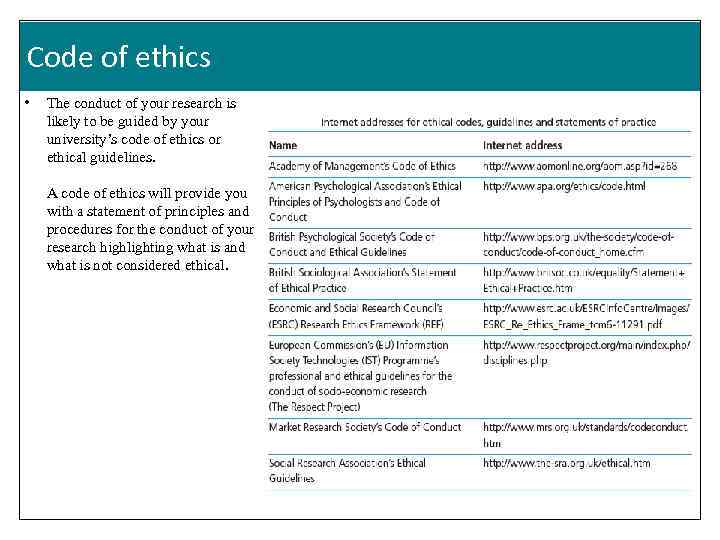 Code of ethics • The conduct of your research is likely to be guided by your university’s code of ethics or ethical guidelines. A code of ethics will provide you with a statement of principles and procedures for the conduct of your research highlighting what is and what is not considered ethical.
 Research ethics committee • You may also be required to submit your research proposal to a research ethics committee. Research ethics committees fulfill a number of objectives. One of these may be a proactive or educational role, which would include constructing an ethical code and disseminating advice about the ethical implications of design aspects of research. A research ethics committee is likely to be composed of experienced researchers from a variety of backgrounds, who are able to draw on their range of experience and knowledge of different ethical perspectives to provide advice. In some cases you may also have to satisfy the requirements of an ethics committee established in your host organisation as well as your university
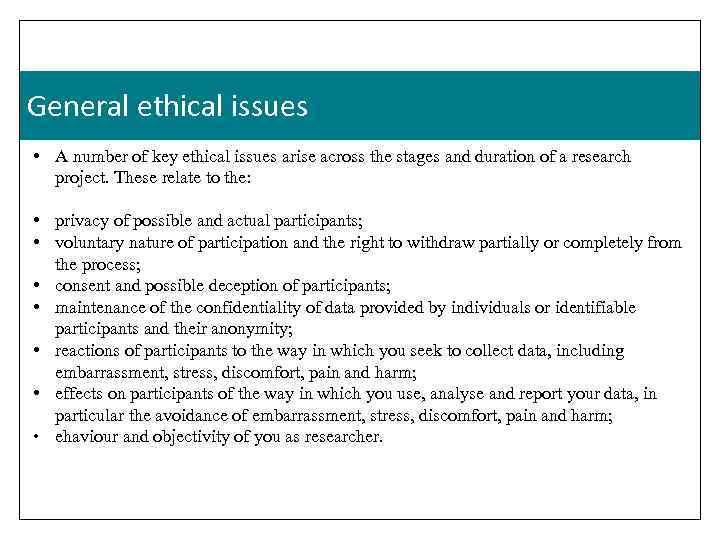 General ethical issues • A number of key ethical issues arise across the stages and duration of a research project. These relate to the: • privacy of possible and actual participants; • voluntary nature of participation and the right to withdraw partially or completely from the process; • consent and possible deception of participants; • maintenance of the confidentiality of data provided by individuals or identifiable participants and their anonymity; • reactions of participants to the way in which you seek to collect data, including embarrassment, stress, discomfort, pain and harm; • effects on participants of the way in which you use, analyse and report your data, in particular the avoidance of embarrassment, stress, discomfort, pain and harm; • ehaviour and objectivity of you as researcher.
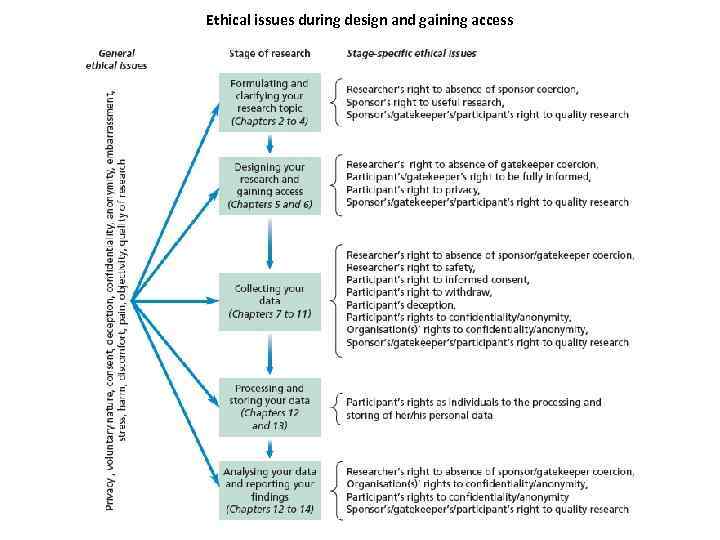 Ethical issues during design and gaining access
 Reading Materials Read Chapter 6. Negotiating access and research ethics, 168 -209 pages. Book: M. Saunders, P. Lewis, and A. Thornhill, 2009, Research methods for business students, 5 th ed. , Harlow: Pearson Education Limited