


 Скачать презентацию Lecture 6 Individually-typological features of personality 1 TEMPERAMENT
L 6 Individual-typological.ppt
- Количество слайдов: 48
 Lecture 6 Individually-typological features of personality 1 TEMPERAMENT 2. I. PAVLOV ‘S THEORY 3. EYSENCK’S THREE DIMENSIONS OF PERSONALITY 4. SHELDON'S THEORY: BODY AND TEMPERAMENT TYPES 5. CHARACTER 6. GORDON ALLPORT’S TRAIT THEORY 7. ACCENTUATION OF CHARACTER
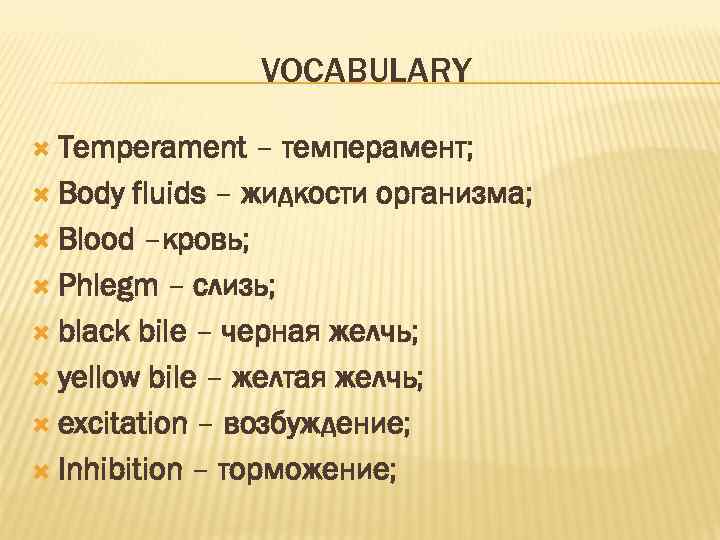 VOCABULARY Temperament – темперамент; Body fluids – жидкости организма; Blood –кровь; Phlegm – слизь; black bile – черная желчь; yellow bile – желтая желчь; excitation – возбуждение; Inhibition – торможение;
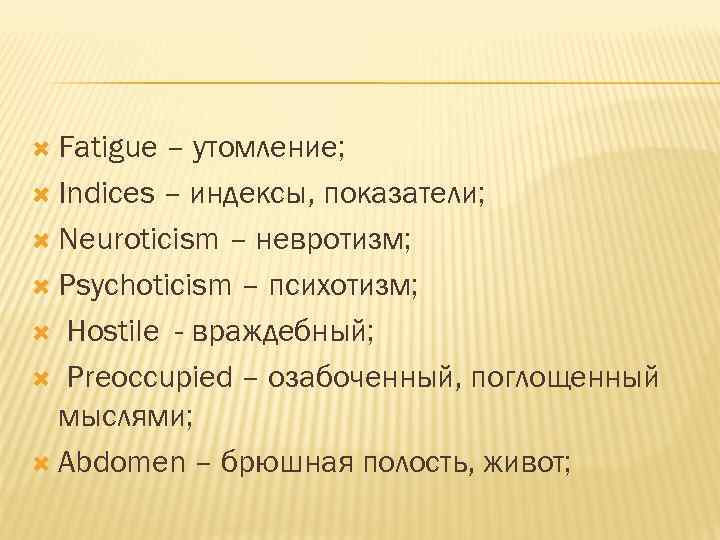 Fatigue – утомление; Indices – индексы, показатели; Neuroticism – невротизм; Psychoticism – психотизм; Hostile - враждебный; Preoccupied – озабоченный, поглощенный мыслями; Abdomen – брюшная полость, живот;
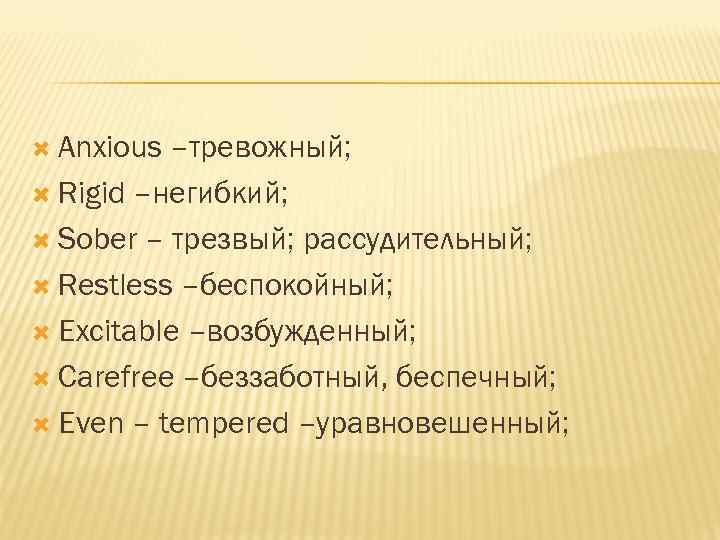 Anxious –тревожный; Rigid –негибкий; Sober – трезвый; рассудительный; Restless –беспокойный; Excitable –возбужденный; Carefree –беззаботный, беспечный; Even – tempered –уравновешенный;
 WHAT IS TEMPERAMENT? WHERE DO THE CHARACTERISTICS COME FROM? Temperament is behavioural style: the how of behaviour rather than the what or why. Temperamental differences are present at birth; they influence how children behave toward individuals and objects in their environments and how they are affected by the environment. Temperament characteristics explain in part how individuals with many stresses may do well while some with little or no stress have difficulty
 TEMPERAMENT According to the Encyclopedia Britannica, in psychology, temperament is the aspect of personality concerned with emotional dispositions and reactions and their speed and intensity; the term often is used to refer to the prevailing mood or mood pattern of a person. The notion of temperament in this sense originated with Hippocrates and Galen who developed it from an earlier physiological theory of four basic body fluids (humours): blood, phlegm, black bile, and yellow bile. According to their relative predominance in the individual, they were supposed to produce, respectively, temperaments designated sanguine (warm, pleasant), phlegmatic (slow-moving, apathetic), melancholic (depressed, sad), and choleric (quick to react, hot tempered).
 TYPE OF NERVOUS SYSTEM AFTER I. P. PAVLOV I. P. Pavlov classifies types of higher nervous activity according to several attributes that considered as most reliable indices of higher nervous activity. These were intensity of the excitation and inhibition, the ratio of these processes in central nervous system and their mobility, that is rate at which excitation was replaced by inhibition and wise versa. In experimental practice the following four principle types of higher nervous activity are met: 1) strong unbalanced type, characterized by predominance of excitation over inhibition; 2) strong well-balanced active type, characterized by high mobility of nerve processes; 3) strong well-balanced passive type, characterized by low mobility of nerve processes; 4) weak type, characterized by extremely weak development of both excitation and inhibition, which cause fatigue and low workability.
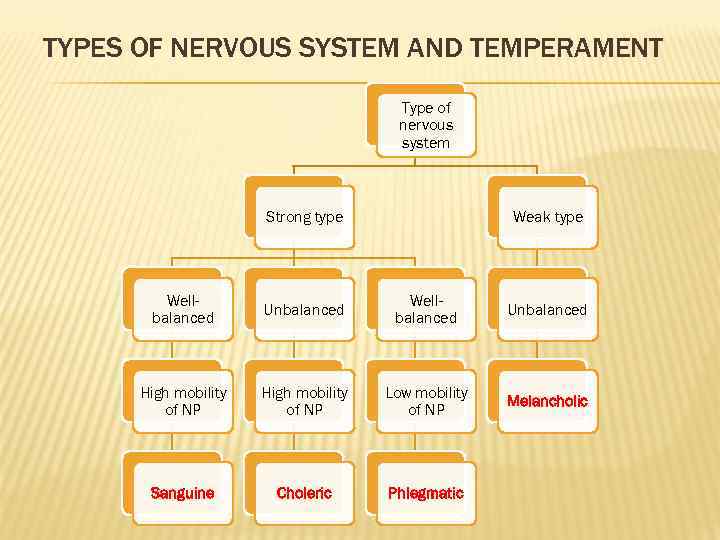 TYPES OF NERVOUS SYSTEM AND TEMPERAMENT Type of nervous system Strong type Weak type Wellbalanced Unbalanced High mobility of NP Low mobility of NP Melancholic Sanguine Choleric Phlegmatic
 EYSENCK’S THREE DIMENSIONS OF PERSONALITY. British psychologist Hans Eysenck developed a model of personality based upon just three universal trails: Introversion/Extraversion: Introversion involves directing attention on inner experiences, while extraversion relates to focusing attention outward on other people and the environment. So, a person high in introversion might be quiet and reserved, while an individual high in extraversion might be sociable and outgoing.
 EYSENCK’S THREE DIMENSIONS OF PERSONALITY. Neuroticism/Emotional Stability: This dimension of Eysenck’s trait theory is related to moodiness versus even-temperedness. Neuroticism refers to an individual’s tendency to become upset or emotional, while stability refers to the tendency to remain emotionally constant.
 EYSENCK’S THREE DIMENSIONS OF PERSONALITY. Psychoticism: Later, after studying individuals suffering from mental illness, Eysenck added a personality dimension he called psychoticism to his trait theory. Individuals who are high on this trait tend to have difficulty dealing with reality and may be antisocial, hostile, non-empathetic and manipulative.
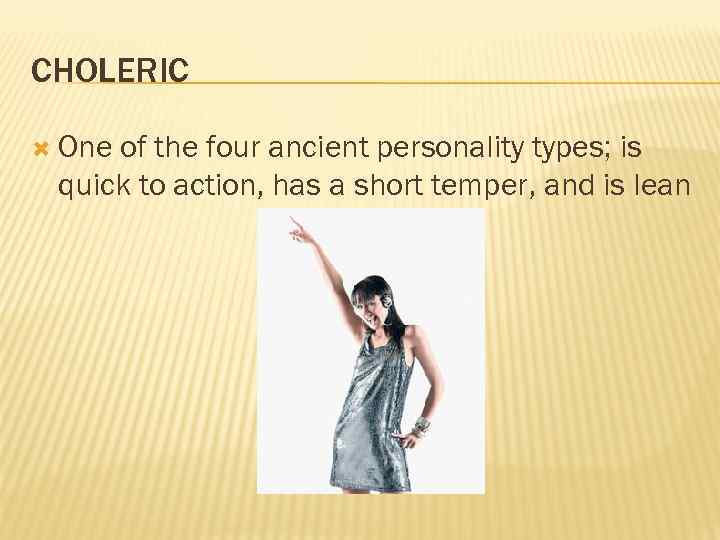 CHOLERIC One of the four ancient personality types; is quick to action, has a short temper, and is lean
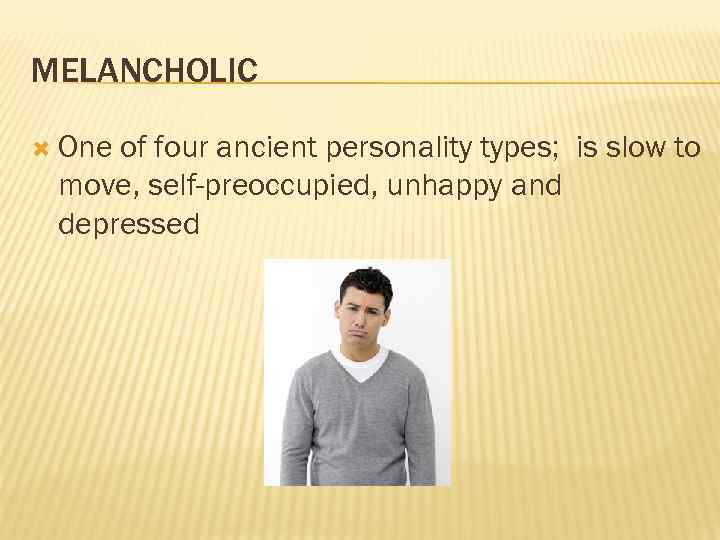 MELANCHOLIC One of four ancient personality types; is slow to move, self-preoccupied, unhappy and depressed
 SANGUINE One of four ancient personality types; is cheerful, lively, and easy-going.
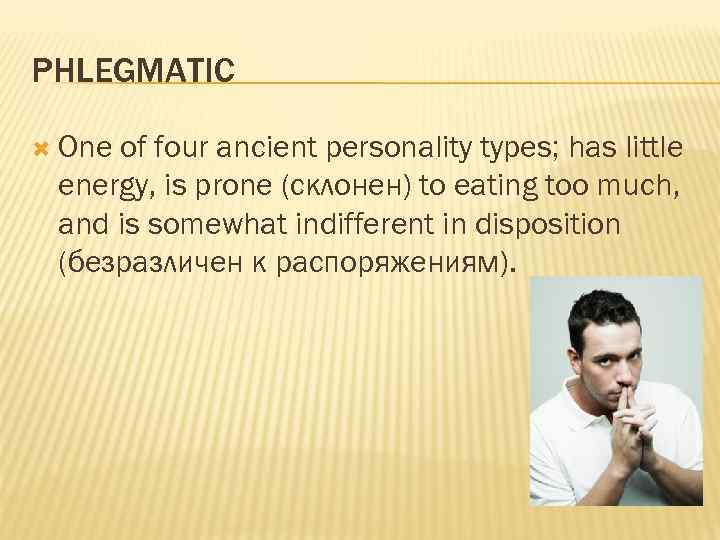 PHLEGMATIC One of four ancient personality types; has little energy, is prone (склонен) to eating too much, and is somewhat indifferent in disposition (безразличен к распоряжениям).
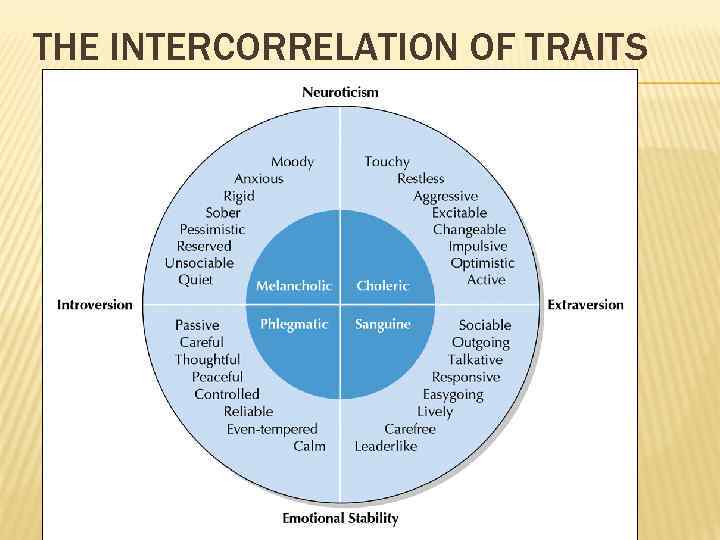 THE INTERCORRELATION OF TRAITS
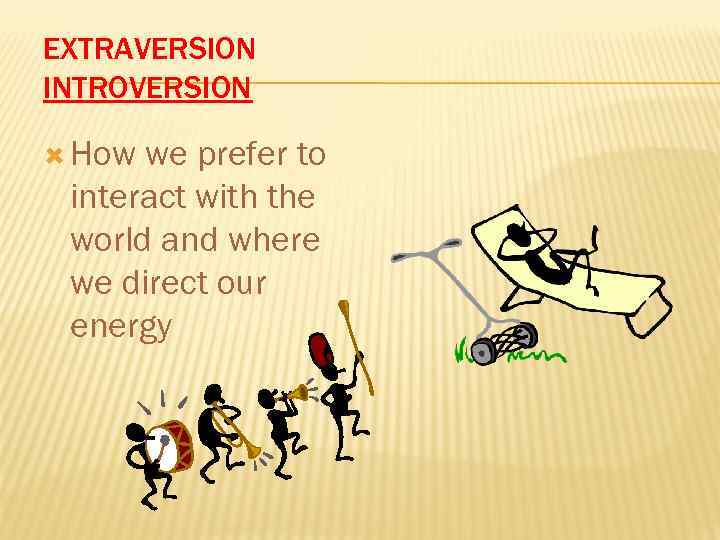 EXTRAVERSION INTROVERSION How we prefer to interact with the world and where we direct our energy
 EXTRAVERSION Focus attention and energy on the world outside of themselves. Talk/act first, think later Think out loud - brainstorming Communicate with enthusiasm Respond quickly – enjoy a fast pace Talk more than listen Dominate conversations Like being the center of attention
 EXTRAVERSION Know a lot of people Have lots of friends Are very approachable Reveal personal information Prefer to work with groups Prefer breadth to depth Motto: READY, FIRE, AIM !!!!!
 INTROVERSION Focus attention and energy on the world inside of themselves. Think, then act Rehearse things before speaking Listen more than talk Avoid being the center of attention Are energized by spending time alone Need to recharge after group interaction
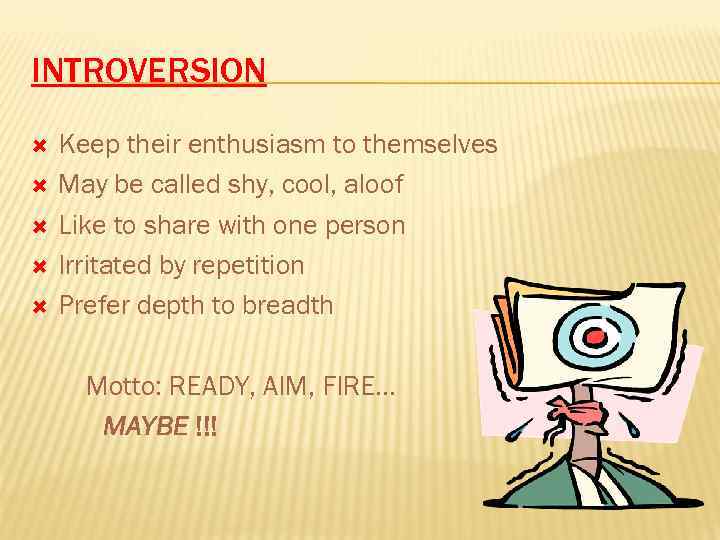 INTROVERSION Keep their enthusiasm to themselves May be called shy, cool, aloof Like to share with one person Irritated by repetition Prefer depth to breadth Motto: READY, AIM, FIRE… MAYBE !!!
 YOUR BODY AND YOUR PERSONALITY Sometime during the early 1900's a German psychiatrist named Ernst Kretschmer was probably the first person ever, to observe a correlation between people's body build and some of their fundamental behavior patterns. He established 3 personality-types based on his theory, and named them Athletic, Pyknic, and Asthenic. He then recorded his observations in a book titled, "Physique and Character“
 A PERSON'S BODY TYPE Endomorphy is centered on the abdomen, and the whole digestive system. Mesomorphy is focused on the muscles and the circulatory system. Ectomorphy is related to the brain and the nervous system.
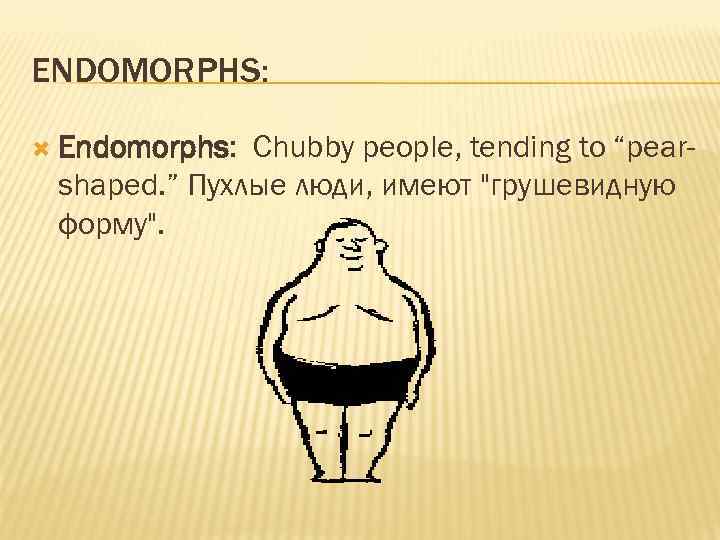 ENDOMORPHS: Endomorphs: Chubby people, tending to “pearshaped. ” Пухлые люди, имеют "грушевидную форму".
 ENDOMORPHS: the Endomorph's priority functions center around other people, emotions, and the digestive system ENDOMORPHS TEND TO BE: 1. interactive. . 2. compliant. . 3. romantic. . 4. emotional 5. talkative. . 6. sedentary. . 7. followers. . 8. organized 9. dependent. . 10. caregivers. . 11. indiscriminate. . 12. kind 13. imaginative. . 14. accepting. . 15. fearful. . 16. overweight 17. involved. . 18. depressive. . 19. approaching. . 20. joiners ENDOMORPHS are advised to avoid eating too many fatty foods, and to then resort to health-damaging crash-diets. They might want to engage in aerobic activities like jogging and bicycle-riding, more often. 2. уступчивый; 6. малоподвижный; 10 попечитель; 11 не избирателен; 15 пугливый;
 MESOMORPHS: Mesomorphs: Stockier people, with broad shoulders and good musculature. Коренастые люди, с широкими плечами и хорошей мускулатурой.
 MESOMORPHS: The Mesomorph's priority functions center around physical activity, the muscles, and the circulatory system 1. extroverts. . 2. aggressive. . 3. adventurous. . 4. dynamic 5. noisy. . 6. active. . 7. leaders. . 8. careless 9. competitive. . 10. warriors. . 11. callous. . 12. dominant 13. logical. . 14. opposing. . 15. courageous. . 16. chunky 17. athletic. . 18. manic. . 19. confronting. . 20. achievers MESOMORPHS are advised to consume less fat. They might want to engage in restful activities like playing cards, more often, consume healthier foods, and learn to channel their excessive energy into building and fixing things. 8 неосторожный; 10 борец; 11 черствый; 16 коренастый;
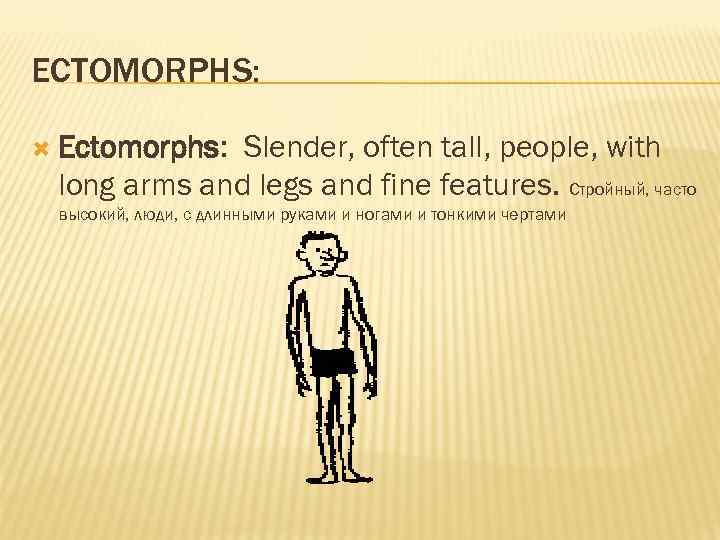 ECTOMORPHS: Ectomorphs: Slender, often tall, people, with long arms and legs and fine features. Стройный, часто высокий, люди, с длинными руками и ногами и тонкими чертами
 ECTOMORPHS: the Ectomorph's priority functions center around solitude, the brain, and the nervous system ECTOMORPHS TEND TO BE: 1. introverts. . 2. apprehensive. . 3. rational. . 4. intellectual 5. quiet. . 6. restless. . 7. self-starters. . 8. compulsive 9. autonomous. . 10. observers. . 11. analytical. . 12. solitary 13. perceptive. . 14. avoiding. . 15. unpredictable. . 16. skinny 17. creative. . 18. detached. . 19. retreating. . 20. inventors ECTOMORPHS are advised to add more protein and olive oil to their diet. They might want to keep aerobic activities to a minimum, and confine their work-out sessions to static forms of muscle-building, instead. 2 боязливый; 12. отшельник; 18 обособленный 19 отступающий
 WHAT IS CHARACTER? Character is the set of psychological traits and mechanisms within the individual that is organized and relatively enduring (устойчивых) and that influences his or her interactions with, and adaptations to, the environment (including the intrapsychic, physical, and social environment).
 GORDON ALLPORT’S TRAIT THEORY In 1936, psychologist Gordon Allport found that one English-language dictionary alone contained more than 4, 000 words describing different personality traits. He categorized these traits into three levels: Cardinals Traits: Traits that dominate an individual’s whole life, often to the point that the person becomes known specifically for these traits. People with such personalities often become so known for these traits that their names are often synonymous with these qualities.
 GORDON ALLPORT’S TRAIT THEORY Central Traits: These are the general characteristics that form the basic foundations of personality. These central traits, while not as dominating as cardinal traits, are the major characteristics you might use to describe another person. Terms such as intelligent, honest, shy and anxious are considered central traits.
 GORDON ALLPORT’S TRAIT THEORY Secondary Traits: These are the traits that are sometimes related to attitudes or preferences and often appear only in certain situations or under specific circumstances. Some examples would be getting anxious when speaking to a group or impatient while waiting in line.
 ACCENTUATION OF CHARACTER Accentuation of character - it's over-expression of individual traits and their combinations, representing the extreme variants of normal.
 ACCENTUATION OF CHARACTER (K. LEONHARD) Demonstrative or hysterical type is the anomalous ability to displace, pretending used to attract attention to themselves Pedantic type, in contrast demonstrative in mental activity only poorly represented mechanisms displacement. If the hysterical behavior characterized by a lack of reasonable weighting, the pedants "pull" with the decision, even when the stage Pre deliberation finalized. They want before begin to act again to make sure that the best solution can not be found that more appropriate ones do not exist. Pedant not able to displace a doubt, but This hinders its action.
 ACCENTUATION OF CHARACTER (K. LEONHARD) Stuck personality, paranoid, type accentuation of personality is the pathological resistance passion. I stuck the individual situation is different: the action stops much passion slowly, and need only to return in thought to the incident, both immediately come to life stress and the accompanying emotions. The affect of such a person holds a very long time, although no new experiences do not activate it.
 ACCENTUATION OF CHARACTER (K. LEONHARD) Excitable personality. very interesting person with a lack of controllability nature. This is manifested in the fact that crucial for life and human behavior are often not prudent, not logical weighing of their actions, and desires, instincts, uncontrollable impulses. What is suggested by reason, not taken into attention. Reactions excitable and impulsive personalities.
 ACCENTUATION OF CHARACTER (K. LEONHARD) Hyperthymic personality. Hyperthymic nature outlook on life always optimistic, easily overcome with sadness, in general they are not difficult live in the world. Elation combined with the thirst activity, increased talkativeness and the tendency to constantly deviate on the topic, which sometimes leads to racing thoughts.
 ACCENTUATION OF CHARACTER (K. LEONHARD) Dysthymic type is contrary giperthymic type. Personalities of this type by nature serious and usually focus on the darker, melancholy side of life in a much greater extent than happy. The events that have shaken them deeply, can bring this serious pessimism sentiments to the state of reactive depression.
 ACCENTUATION OF CHARACTER (K. LEONHARD) Cyclothymic type- phase sequence of good and bad mood. Curious that happy events are such people not only joyful emotions, but accompanied by an overall picture hyperthymia: a thirst for action, increased proud, jump ideas. Sad events cause depression, as well as the slowness reaction and thinking.
 ACCENTUATION OF CHARACTER (K. LEONHARD) Affective - exalted type can be called temperament, anxiety and happiness. This name emphasizes its close relationship with psychosis anxiety and happiness, which is accompanied by sharp mood swings.
 ACCENTUATION OF CHARACTER (K. LEONHARD) Anxiety (fearful) type - these people are different timidity, self-doubt, a component of the submission, humiliation. Possible overcompensation in a self-confident or even arrogant behavior, but the unnaturalness of his immediately strikes the eye, fearful shyness can sometimes go to the trust, which betrays a request: "Be friendly with me. " From time to timidity associates timidity.
 ACCENTUATION OF CHARACTER (K. LEONHARD) Emotive type - emotiveness characterized by sensitivity and deep reactions in the field of subtle emotions. No serious sense of concern people, and those that we associate with the soul of humanity and compassion. Usually such people are called kind hearted. They are more compassionate than others, more amenable to emotion, feel a special joy in communion with nature, with works of art. They are sometimes described as soulful people.
 ACCENTUATION OF CHARACTER By definition, A. E. Lichko, accentuation of character - these are extreme variants of rules under which individual traits excessive force, causing selective vulnerability is detected in respect of certain types of psychogenic effects. Each type has its accentuation of "weakness" and is the most sensitive and vulnerable to specific impacts.
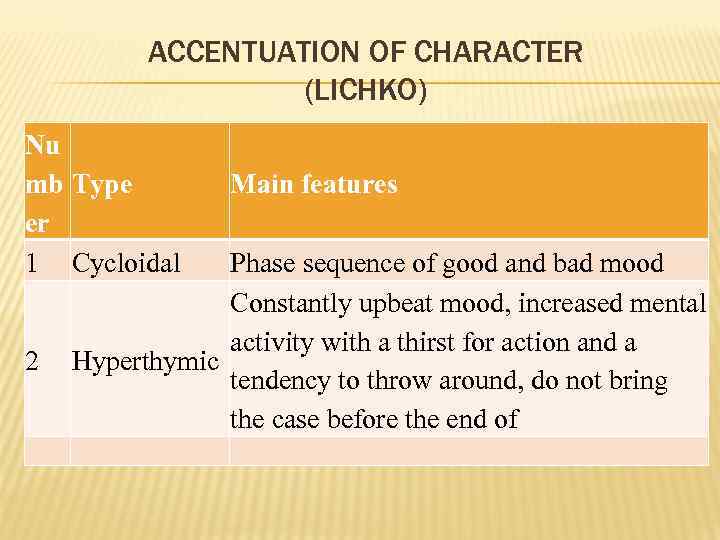 ACCENTUATION OF CHARACTER (LICHKO) Nu mb Type er 1 Cycloidal 2 Main features Phase sequence of good and bad mood Constantly upbeat mood, increased mental activity with a thirst for action and a Hyperthymic tendency to throw around, do not bring the case before the end of
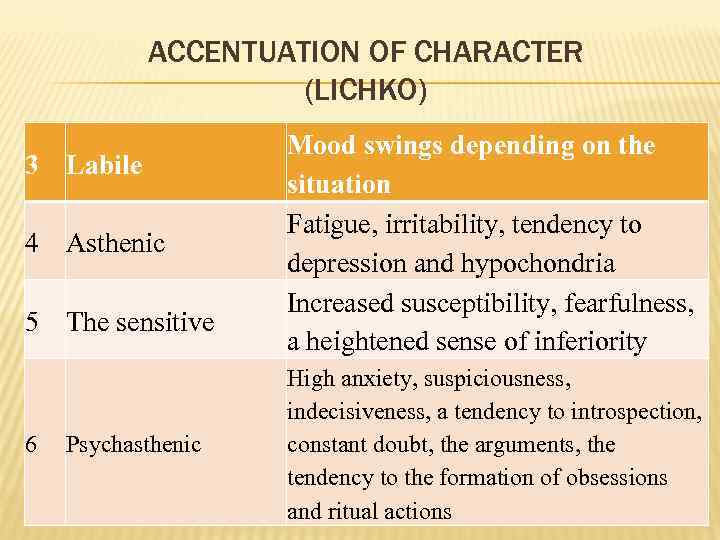 ACCENTUATION OF CHARACTER (LICHKO) 3 Labile 4 Asthenic 5 The sensitive 6 Psychasthenic Mood swings depending on the situation Fatigue, irritability, tendency to depression and hypochondria Increased susceptibility, fearfulness, a heightened sense of inferiority High anxiety, suspiciousness, indecisiveness, a tendency to introspection, constant doubt, the arguments, the tendency to the formation of obsessions and ritual actions
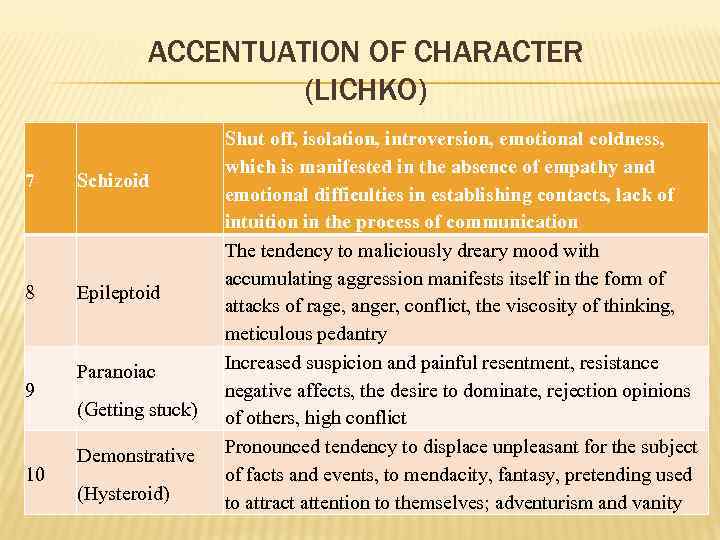 ACCENTUATION OF CHARACTER (LICHKO) 7 Schizoid 8 Epileptoid 9 10 Paranoiac (Getting stuck) Demonstrative (Hysteroid) Shut off, isolation, introversion, emotional coldness, which is manifested in the absence of empathy and emotional difficulties in establishing contacts, lack of intuition in the process of communication The tendency to maliciously dreary mood with accumulating aggression manifests itself in the form of attacks of rage, anger, conflict, the viscosity of thinking, meticulous pedantry Increased suspicion and painful resentment, resistance negative affects, the desire to dominate, rejection opinions of others, high conflict Pronounced tendency to displace unpleasant for the subject of facts and events, to mendacity, fantasy, pretending used to attract attention to themselves; adventurism and vanity
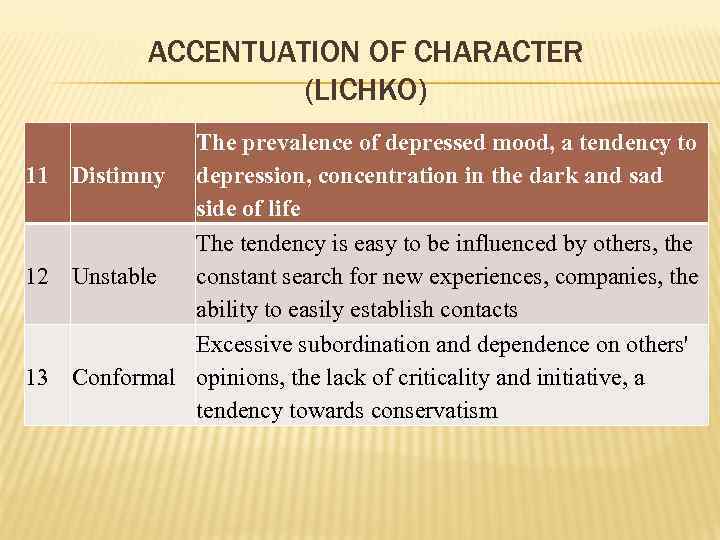 ACCENTUATION OF CHARACTER (LICHKO) The prevalence of depressed mood, a tendency to 11 Distimny depression, concentration in the dark and sad side of life The tendency is easy to be influenced by others, the constant search for new experiences, companies, the 12 Unstable ability to easily establish contacts Excessive subordination and dependence on others' 13 Conformal opinions, the lack of criticality and initiative, a tendency towards conservatism