


 Скачать презентацию Lecture 6 Efficient Markets and Excess Volatility
5b49e090ebe915dd04c2cf494cd97203.ppt
- Количество слайдов: 26
 Lecture 6: Efficient Markets and Excess Volatility
 The Efficient Markets Hypothesis • • • History of the Hypothesis Reasons to think markets are efficient Reasons to doubt markets are efficient Technical analysis Empirical evidence in literature Homework assignment and regressions
 Earliest Known Statement “When shares become publicly known in an open market, the value which they acquire there may be regarded as the judgement of the best intelligence concerning them. ” - George Gibson, The Stock Exchanges of London Paris and New York, G. P. Putnman & Sons, New York, 1889
 Intuition of Efficiency • Reuter’s pigeons and the telegraph • Beepers & the internet • Must be hard to get rich
 Textbook Version Today As one of the six most important ideas in finance: “Security prices accurately reflect available information, and respond rapidly to new information as soon as it becomes available” Richard Brealey & Stewart Myers, Principles of Corporate Finance, 1996
 Harry Roberts, 1967 • Weak form efficiency: prices incorporate information about past prices • Semi-strong form: incorporate all publicly available information • Strong form: all information, including inside information
 Price as PDV of Expected Dividends • If earnings equal dividends and if dividends grow at long-run rate g, then by growing consol model P=E/(r-g), P/E=1/(r-g). (Gordon Model) • So, efficient markets theory purports to explain why P/E varies across stocks • PEG ratio is popular indicator = g’/(P/E), where g’ is short-run growth rate; popular rule of thumb: buy if PEG<0. 5 • PEG rule of thumb makes sense only if g’ bears a certain relation to g; not a sensible rule. • Efficient markets denies that any rule works
 Reasons to Think Markets Ought to Be Efficient • Marginal investor determines prices • Smart money dominates trading • Survival of fittest
 Reasons to Doubt these Reasons • Marginal investor: wealth matters • Smart money: matter of degree. Limits to arbitrage theory • Survival of fittest: life cycle renews
 Psychological Factors • Gambling behavior • Overconfidence • Slowness to make money, futility of career trying to prove others of one’s ability • Siegel and Peter Lynch
 Popular Doubters of Efficiency • Peter Lynch: Elementary school children beat professionals • Beardstown Ladies • Robert Kiyosaki Rich Dad, Poor Dad • Motley Fool
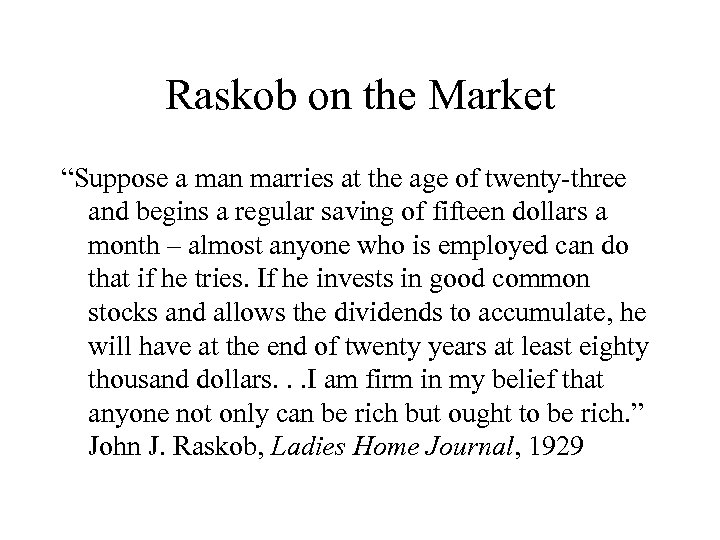 Raskob on the Market “Suppose a man marries at the age of twenty-three and begins a regular saving of fifteen dollars a month – almost anyone who is employed can do that if he tries. If he invests in good common stocks and allows the dividends to accumulate, he will have at the end of twenty years at least eighty thousand dollars. . . I am firm in my belief that anyone not only can be rich but ought to be rich. ” John J. Raskob, Ladies Home Journal, 1929
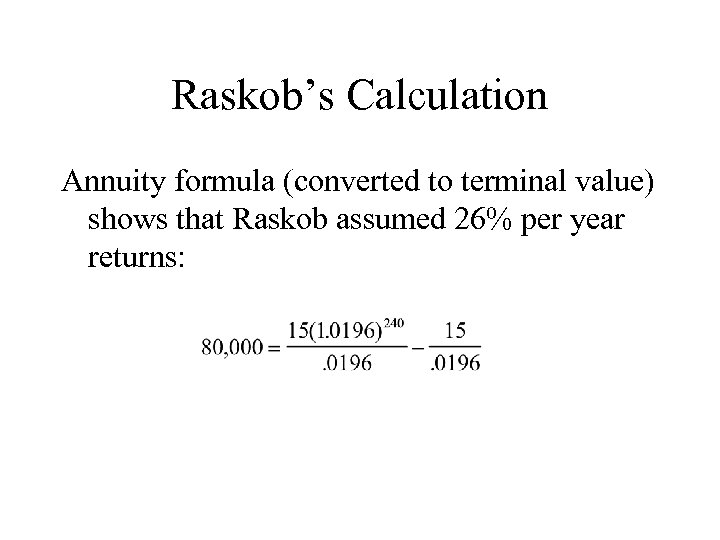 Raskob’s Calculation Annuity formula (converted to terminal value) shows that Raskob assumed 26% per year returns:
 Technical Analysis • Robert D. Edwards & John Magee, Technical Analysis of Stock Trends, 1948. • Hand drawing of charts, judgmental interpretation of patterns • Difficult to test success of technical analysis • Harry Mamaysky, SOM finds some success in their methods.
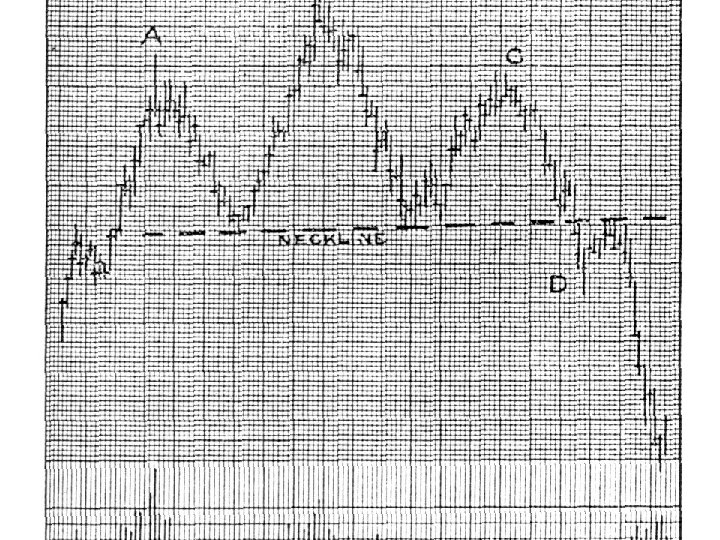
 Head & Shoulders Pattern • Initial advance attracts traders, upward momentum. Smart money begins to distribute stock, trying not to kill demand. • Eventually downturn, but smart money comes in to support demand, manipulation. (left shoulder) • Upward momentum resumes, ends when smart money has distributed all shares; market drops. • New traders try to exploit well-known tendency to rally. New weak rally, right shoulder, then a breakout. (Edwards & Magee)
 Random Walk Hypothesis • Karl Pearson, Nature, 72: 294, July 27, 1905. Aug 10, 1905, walk of drunk • Burton Malkiel, A Random Walk Down Wall Street, 1973.
 Random Walk & AR-1 Models • Random Walk: xt=xt-1+ t • First-order autoregressive (AR-1) Model: xt=100+ (xt-1 -100)+ t. Mean reverting (to 100), 0< <1. • Random walk as approximate implication of unpredictability of returns • Similarity of both random walk and AR-1 to actual stock prices
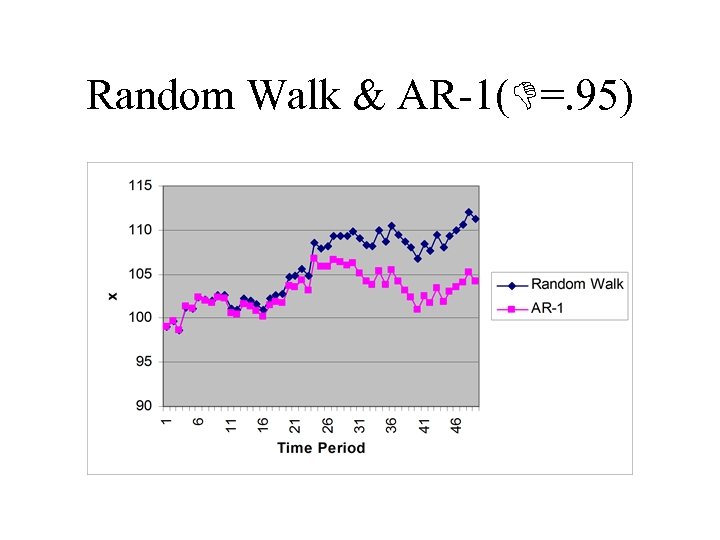 Random Walk & AR-1( =. 95)
 Obvious Examples of Inefficiency • • Jeremy Siegel – Nifty-fifty did well Rebalancing Most closed out Polaroid and Edwin Land
 Tulipmania • • Holland, 1630 s. Peter Garber, Famous First Bubbles Mosaic virus, random-walk look Free press began in Holland then.
 Dot Com Bubble • Toys. com: Had disadvantage relative to bricks & mortar retailers starting web sites • Lastminute. com: travel agency, sales in fourth quarter of 1999 were $650, 000, market value in IPO ins March 2000 was $1 billion.
 Problem Set #3: Forecast the Market • Step 1: Get stock price data on spreadsheet, as from yahoo. com. • Step 2: Create new column showing percentage price changes • Step 3: Create new Column(s) containing forecasting variables • Step 4: Test for significance and interpret results.
 Significance Test in Regression • Use the R 2 which is the fraction of the variance of the dependent variable that is explained by the regression. • Compute F statistic (k, n-k-1 degrees of freedom, and check that it is above critical value for significance at 5% level. • Issues of data mining, etc.
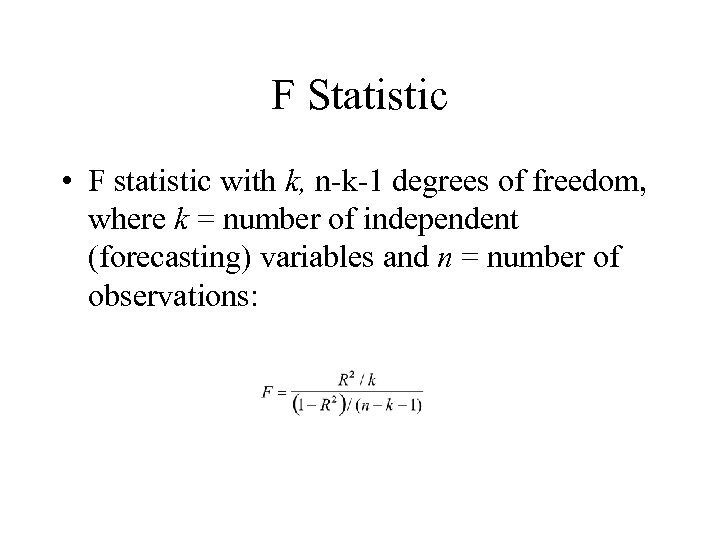 F Statistic • F statistic with k, n-k-1 degrees of freedom, where k = number of independent (forecasting) variables and n = number of observations:
 Regression Output - Excel • • Intercept, X Variable T statistic, P value F statistic, P value R squared