


 Скачать презентацию Lecture 6 Current and Resistance Chp 27
38c3ffedce206d90cf2c372ed3da1696.ppt
- Количество слайдов: 26
 Lecture 6 Current and Resistance Chp. 27 • • • Cartoon -Invention of the battery and Voltaic Cell Opening Demo - Lemon Battery Warm-up problem Physlet Topics • Demos – Lemon Battery estimate internal resistance – Ohms Law demo on overhead projector – T dependence of resistance – Three 100 Watt light bulbs Puzzles • – Resistor network figure out equivalent resistance
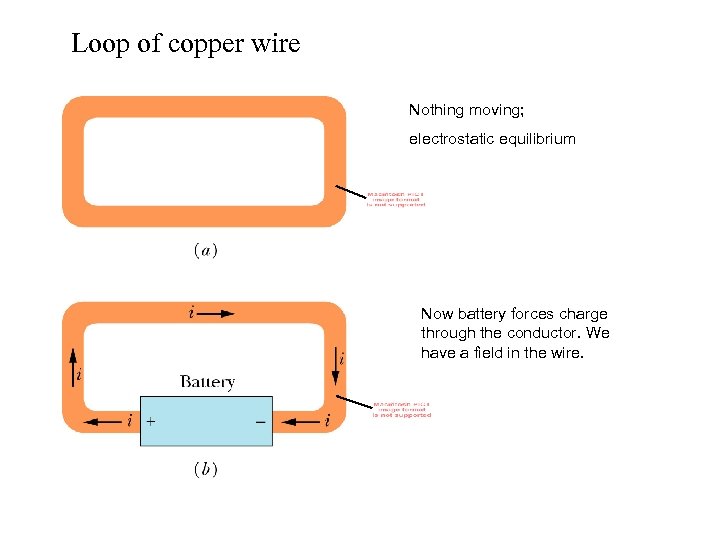 Loop of copper wire Nothing moving; electrostatic equilibrium Now battery forces charge through the conductor. We have a field in the wire.
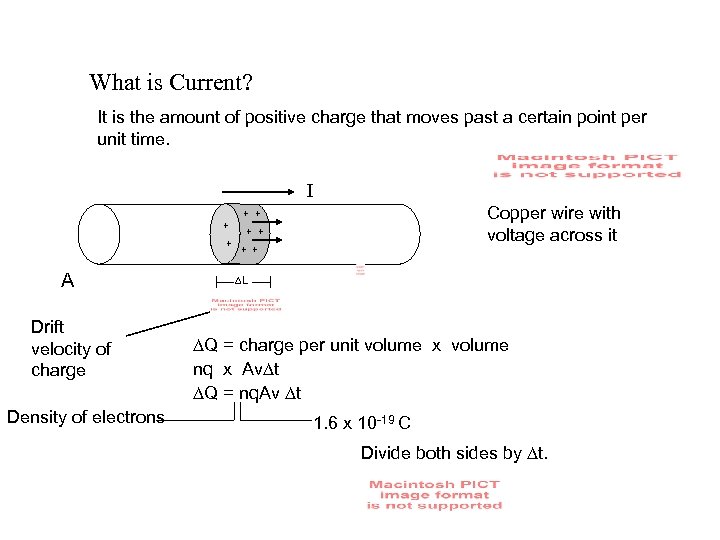 What is Current? It is the amount of positive charge that moves past a certain point per unit time. I Copper wire with voltage across it + + A Drift velocity of charge Density of electrons + + L Q = charge per unit volume x volume nq x Av t Q = nq. Av t 1. 6 x 10 -19 C Divide both sides by t.
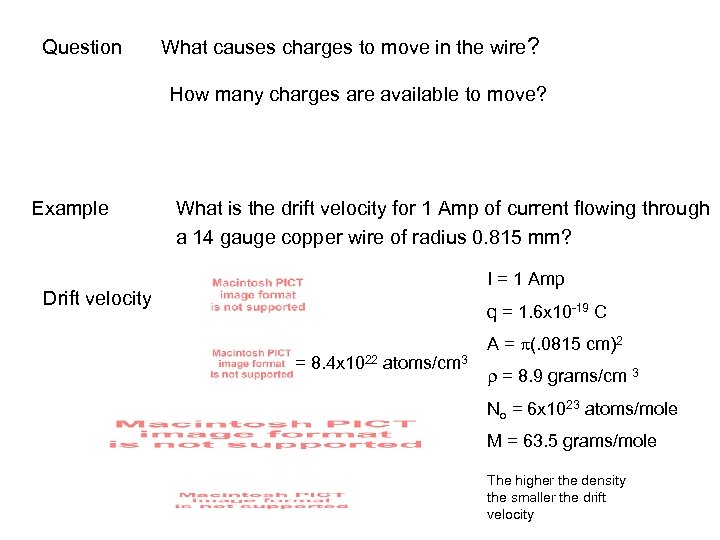 Question What causes charges to move in the wire? How many charges are available to move? Example What is the drift velocity for 1 Amp of current flowing through a 14 gauge copper wire of radius 0. 815 mm? I = 1 Amp Drift velocity q = 1. 6 x 10 -19 C = 8. 4 x 10²² atoms/cm 3 A = (. 0815 cm)2 = 8. 9 grams/cm 3 No = 6 x 10²³ atoms/mole M = 63. 5 grams/mole The higher the density the smaller the drift velocity
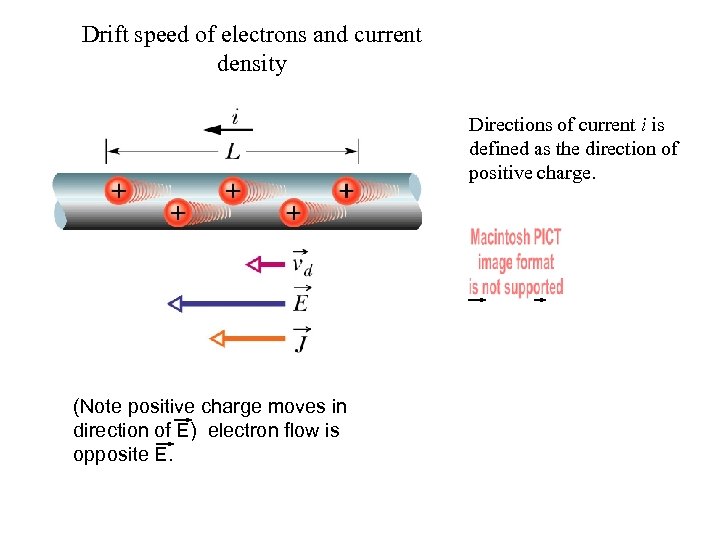 Drift speed of electrons and current density Directions of current i is defined as the direction of positive charge. (Note positive charge moves in direction of E) electron flow is opposite E.
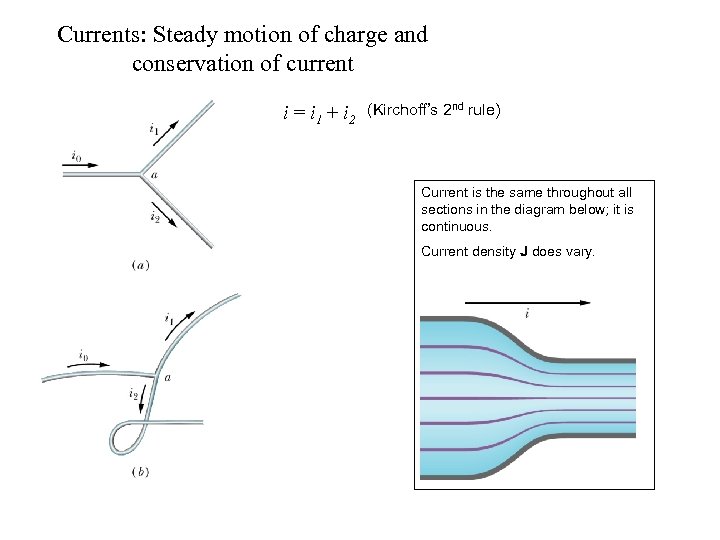 Currents: Steady motion of charge and conservation of current i = i 1 + i 2 (Kirchoff’s 2 nd rule) Current is the same throughout all sections in the diagram below; it is continuous. Current density J does vary.
 Question: How does the drift speed compare to the instantaneous speed? Instantaneous speed 106 m/s vd 3. 5 x 10 -11 • vinstant (This tiny ratio is why Ohm’s Law works so well for metals. ) At this drift speed 3. 5 x 10 -5 m/s, it would take an electron 8 hours to go 1 meter. Question: So why does the light come on immediately when you turn on the light switch? It’s like when the hose is full of water and you turn the faucet on, it immediately comes out the ends. The charge in the wire is like the water. A wave of electric field travels very rapidly down the wire, causing the free charges to begin drifting. Example: Recall typical TV tube, CRT, or PC monitor. The electron beam has a speed 5 x 10 7 m/s. If the current is I = 100 microamps, what is n? Take A = 1 mm 2 = (10 -3)2 = 10 -6 m 2 For CRT n = 1. 2 x 10¹³ e/m 3 = 1. 2 x 10⁷ e/cm 3 For Copper n = 8. 5 x 10²² e/cm 3 The lower the density the higher the speed.
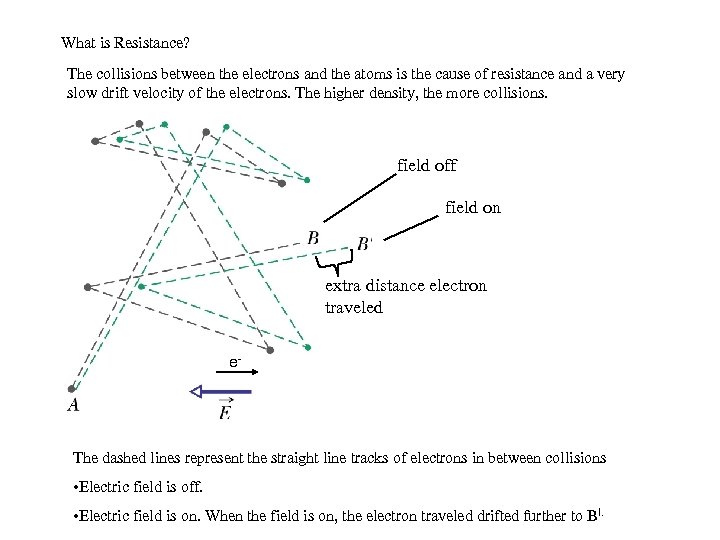 What is Resistance? The collisions between the electrons and the atoms is the cause of resistance and a very slow drift velocity of the electrons. The higher density, the more collisions. field off field on extra distance electron traveled e- The dashed lines represent the straight line tracks of electrons in between collisions • Electric field is off. • Electric field is on. When the field is on, the electron traveled drifted further to B I.
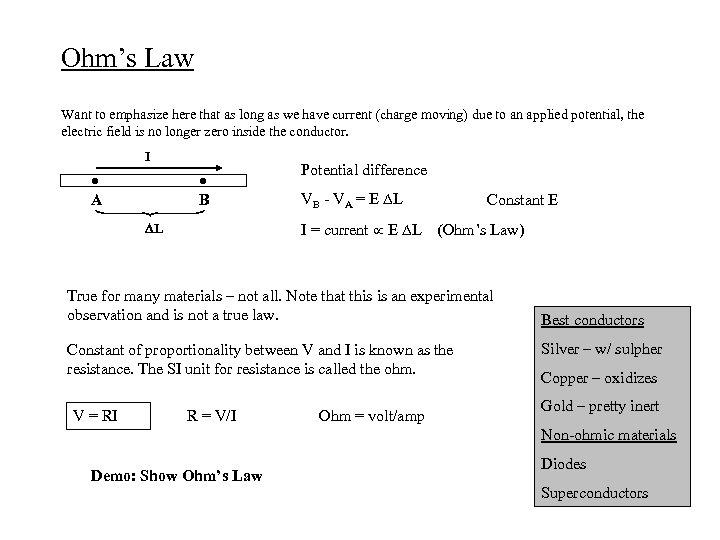 Ohm’s Law Want to emphasize here that as long as we have current (charge moving) due to an applied potential, the electric field is no longer zero inside the conductor. I • • A B Potential difference VB - VA = E L I = current E L L Constant E (Ohm’s Law) True for many materials – not all. Note that this is an experimental observation and is not a true law. Constant of proportionality between V and I is known as the resistance. The SI unit for resistance is called the ohm. V = RI R = V/I Ohm = volt/amp Best conductors Silver – w/ sulpher Copper – oxidizes Gold – pretty inert Non-ohmic materials Demo: Show Ohm’s Law Diodes Superconductors
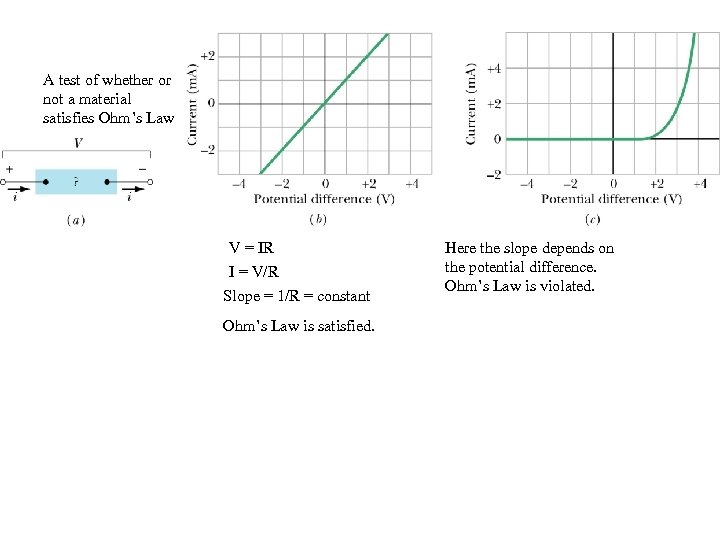 A test of whether or not a material satisfies Ohm’s Law V = IR I = V/R Slope = 1/R = constant Ohm’s Law is satisfied. Here the slope depends on the potential difference. Ohm’s Law is violated.
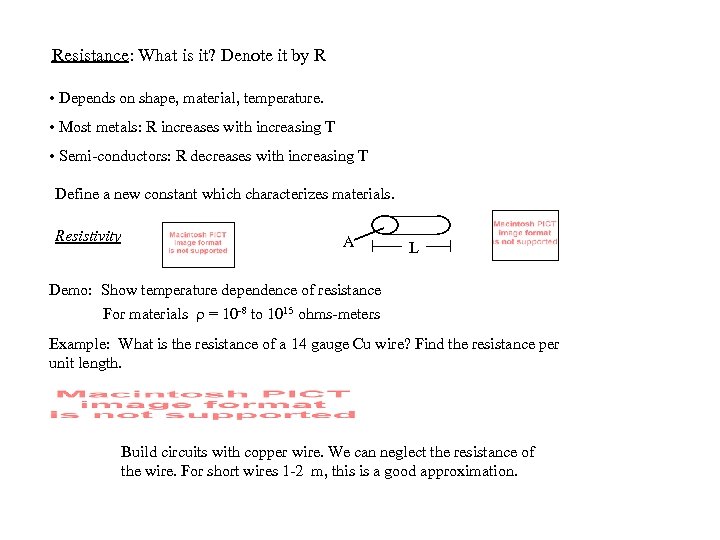 Resistance: What is it? Denote it by R • Depends on shape, material, temperature. • Most metals: R increases with increasing T • Semi-conductors: R decreases with increasing T Define a new constant which characterizes materials. Resistivity A L Demo: Show temperature dependence of resistance For materials = 10 -8 to 1015 ohms-meters Example: What is the resistance of a 14 gauge Cu wire? Find the resistance per unit length. Build circuits with copper wire. We can neglect the resistance of the wire. For short wires 1 -2 m, this is a good approximation.
![Example Temperature variation of resistivity. = 20 [ 1 + (T-20) ] can be](https://present5.com/presentation/38c3ffedce206d90cf2c372ed3da1696/image-12.jpg "Example Temperature variation of resistivity. = 20 [ 1 + (T-20) ] can be") Example Temperature variation of resistivity. = 20 [ 1 + (T-20) ] can be positive or negative Consider two examples of materials at T = 20 o. C. ( -m) (k-1) L Area R (20 o. C) Fe 10 -7 . 005 6 x 10⁶ m 1 mm 2(10 -6 m 2) 60, 000 Si 640 -. 075 1 m 1 m 2 640 Fe – conductor - a long 6 x 10⁶ m wire. Si – insulator - a cube of Si 1 m on each side Question: You might ask is there a temperature where a conductor and insulator are one and the same? Condition: RFe = RSi at what temperature? Set RFe = RSi and solve for T Use = 20 [ 1 + (T-20) ] RFe = 10 -7 -m [ 1 +. 005 (T-20)] RSi = 640 -m [ 1 +. 075 (T-20)] T – 20 = -196 C T = -176 C (pretty low temperature)
Example Temperature variation of resistivity. = 20 [ 1 + (T-20) ] can be positive or negative Consider two examples of materials at T = 20 o. C. ( -m) (k-1) L Area R (20 o. C) Fe 10 -7 . 005 6 x 10⁶ m 1 mm 2(10 -6 m 2) 60, 000 Si 640 -. 075 1 m 1 m 2 640 Fe – conductor - a long 6 x 10⁶ m wire. Si – insulator - a cube of Si 1 m on each side Question: You might ask is there a temperature where a conductor and insulator are one and the same? Condition: RFe = RSi at what temperature? Set RFe = RSi and solve for T Use = 20 [ 1 + (T-20) ] RFe = 10 -7 -m [ 1 +. 005 (T-20)] RSi = 640 -m [ 1 +. 075 (T-20)] T – 20 = -196 C T = -176 C (pretty low temperature)
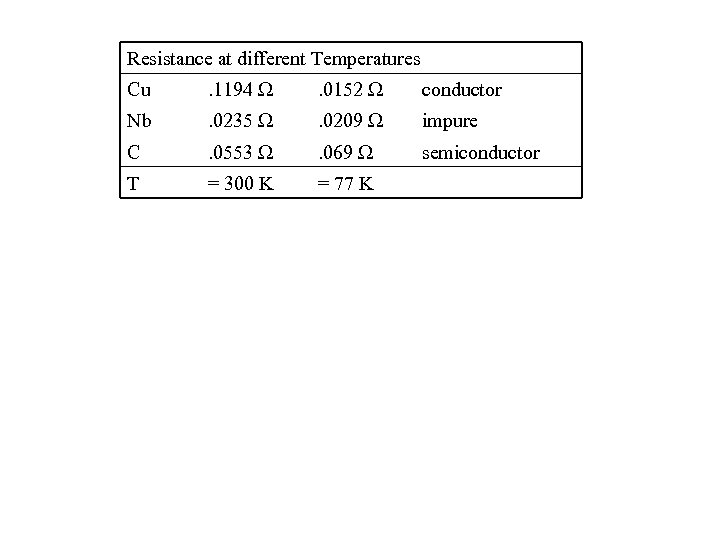 Resistance at different Temperatures Cu . 1194 . 0152 conductor Nb . 0235 . 0209 impure C . 0553 . 069 semiconductor T = 300 K = 77 K
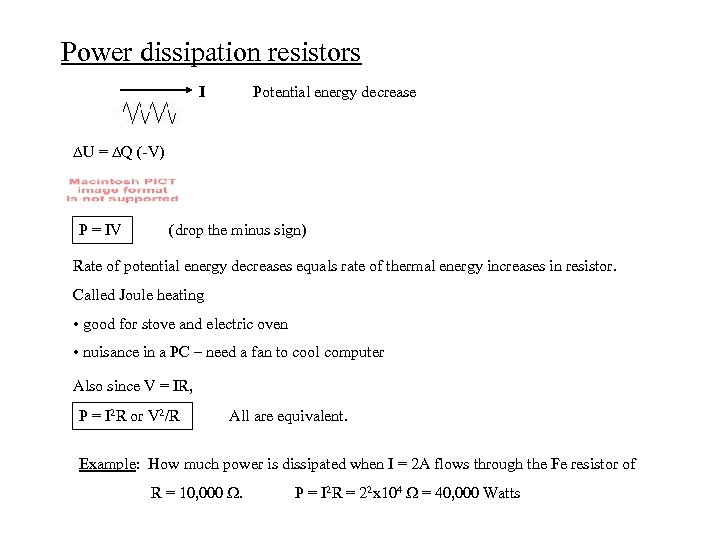 Power dissipation resistors I Potential energy decrease U = Q (-V) P = IV (drop the minus sign) Rate of potential energy decreases equals rate of thermal energy increases in resistor. Called Joule heating • good for stove and electric oven • nuisance in a PC – need a fan to cool computer Also since V = IR, P = I 2 R or V 2/R All are equivalent. Example: How much power is dissipated when I = 2 A flows through the Fe resistor of R = 10, 000 . P = I 2 R = 22 x 104 = 40, 000 Watts
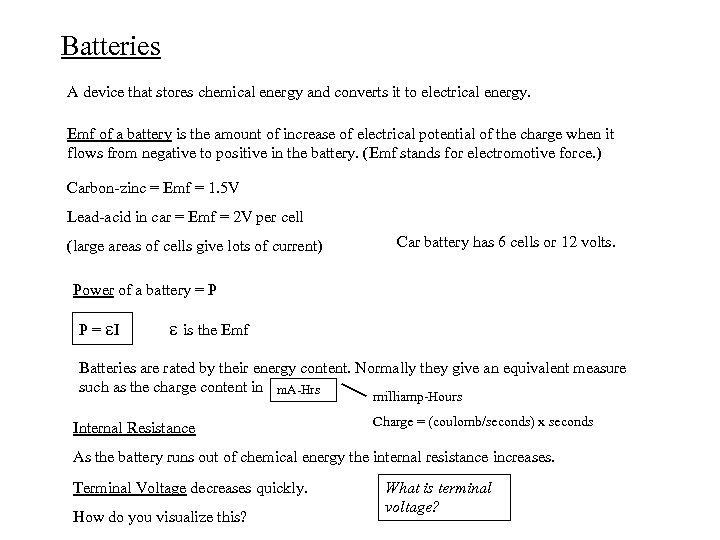 Batteries A device that stores chemical energy and converts it to electrical energy. Emf of a battery is the amount of increase of electrical potential of the charge when it flows from negative to positive in the battery. (Emf stands for electromotive force. ) Carbon-zinc = Emf = 1. 5 V Lead-acid in car = Emf = 2 V per cell (large areas of cells give lots of current) Car battery has 6 cells or 12 volts. Power of a battery = P P = I is the Emf Batteries are rated by their energy content. Normally they give an equivalent measure such as the charge content in m. A-Hrs milliamp-Hours Internal Resistance Charge = (coulomb/seconds) x seconds As the battery runs out of chemical energy the internal resistance increases. Terminal Voltage decreases quickly. How do you visualize this? What is terminal voltage?
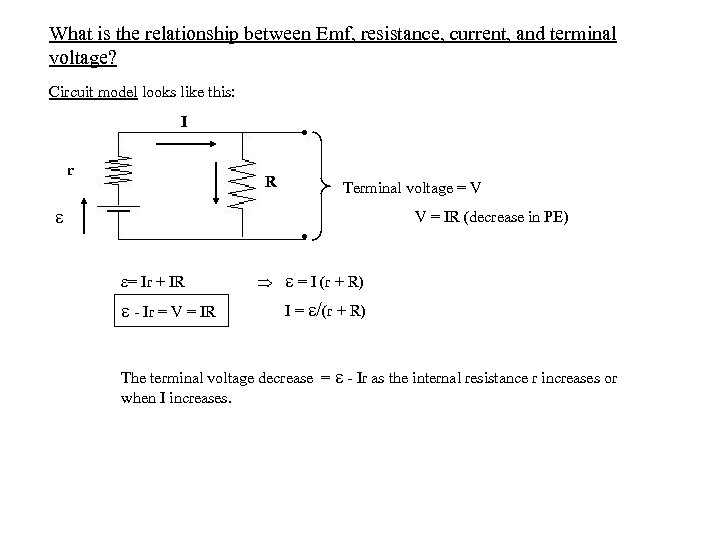 What is the relationship between Emf, resistance, current, and terminal voltage? Circuit model looks like this: I r • R Terminal voltage = V V = IR (decrease in PE) • = Ir + IR - Ir = V = IR = I (r + R) I = /(r + R) The terminal voltage decrease = - Ir as the internal resistance r increases or when I increases.
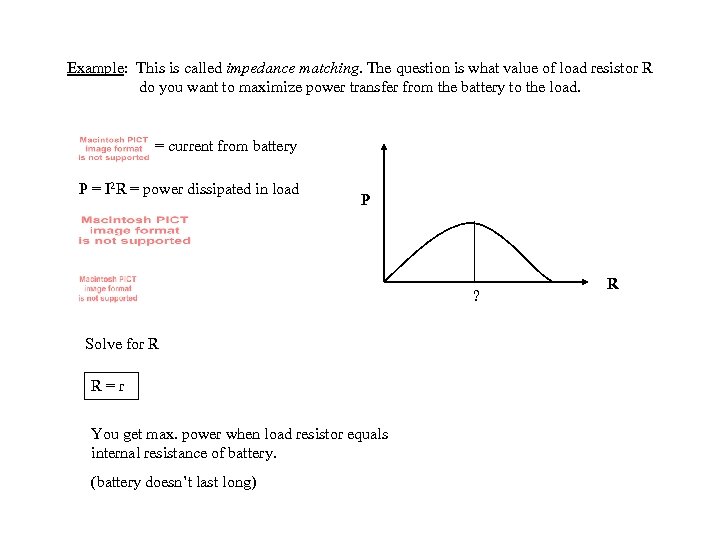 Example: This is called impedance matching. The question is what value of load resistor R do you want to maximize power transfer from the battery to the load. = current from battery P = I 2 R = power dissipated in load P ? Solve for R R=r You get max. power when load resistor equals internal resistance of battery. (battery doesn’t last long) R
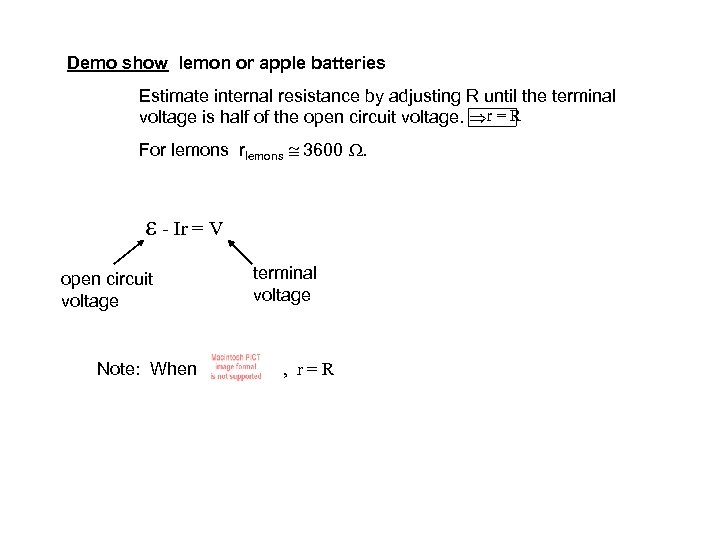 Demo show lemon or apple batteries Estimate internal resistance by adjusting R until the terminal voltage is half of the open circuit voltage. r = R For lemons rlemons 3600 . - Ir = V open circuit voltage Note: When terminal voltage , r=R
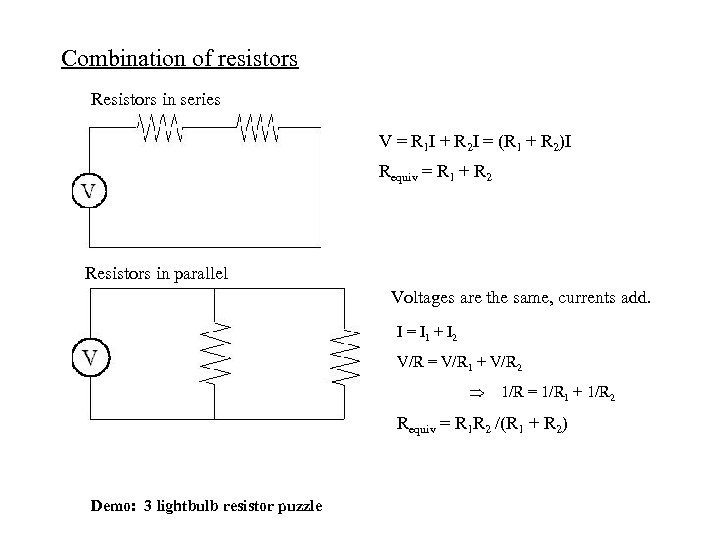 Combination of resistors Resistors in series V = R 1 I + R 2 I = (R 1 + R 2)I Requiv = R 1 + R 2 Resistors in parallel Voltages are the same, currents add. I = I 1 + I 2 V/R = V/R 1 + V/R 2 1/R = 1/R 1 + 1/R 2 Requiv = R 1 R 2 /(R 1 + R 2) Demo: 3 lightbulb resistor puzzle
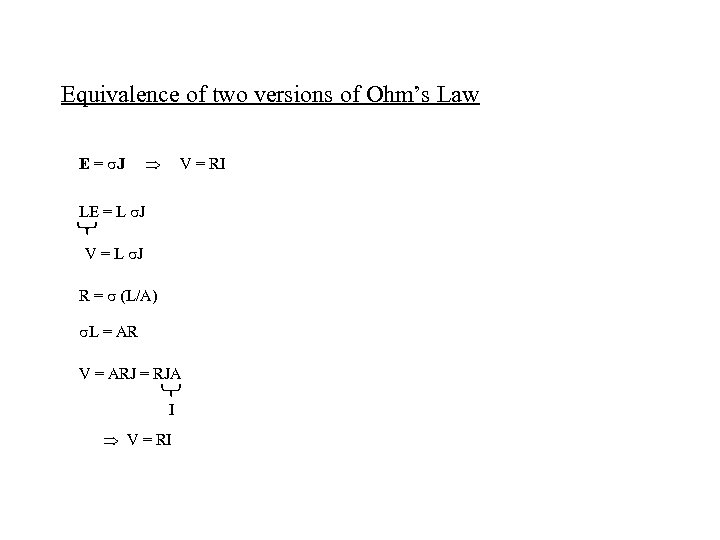 Equivalence of two versions of Ohm’s Law E = J V = RI LE = L J V = L J R = (L/A) L = AR V = ARJ = RJA I V = RI
![Warm-up Set 6 1. HRW 6 27. TB. 08. [119812] Current is a measure](https://present5.com/presentation/38c3ffedce206d90cf2c372ed3da1696/image-21.jpg "Warm-up Set 6 1. HRW 6 27. TB. 08. [119812] Current is a measure") Warm-up Set 6 1. HRW 6 27. TB. 08. [119812] Current is a measure of: amount of charge that moves past a point per unit time force that moves a charge past a point energy used to move a charge past a point speed with which a charge moves past a point resistance to the movement of a charge past a point 2. HRW 6 27. TB. 14. [119818] In a conductor carrying a current we expect the electron drift speed to be: about the same as the average electron speed much less than the average electron speed less than the electron speed at high temperature and greater than the electron speed at low temperature less than the electron speed at low temperature and greater than the electron speed at high temperature much greater than the average electron speed 3. HRW 6 27. TB. 49. [119853] You buy a "75 W" light bulb. The label means that: the bulb is expected to "burn out" after you use up its 75 watts none of these no matter how you use the bulb, the power will be 75 W the bulb was filled with 75 W at the factory the actual power dissipated will be much higher than 75 W since most of the power appears as heat
Warm-up Set 6 1. HRW 6 27. TB. 08. [119812] Current is a measure of: amount of charge that moves past a point per unit time force that moves a charge past a point energy used to move a charge past a point speed with which a charge moves past a point resistance to the movement of a charge past a point 2. HRW 6 27. TB. 14. [119818] In a conductor carrying a current we expect the electron drift speed to be: about the same as the average electron speed much less than the average electron speed less than the electron speed at high temperature and greater than the electron speed at low temperature less than the electron speed at low temperature and greater than the electron speed at high temperature much greater than the average electron speed 3. HRW 6 27. TB. 49. [119853] You buy a "75 W" light bulb. The label means that: the bulb is expected to "burn out" after you use up its 75 watts none of these no matter how you use the bulb, the power will be 75 W the bulb was filled with 75 W at the factory the actual power dissipated will be much higher than 75 W since most of the power appears as heat
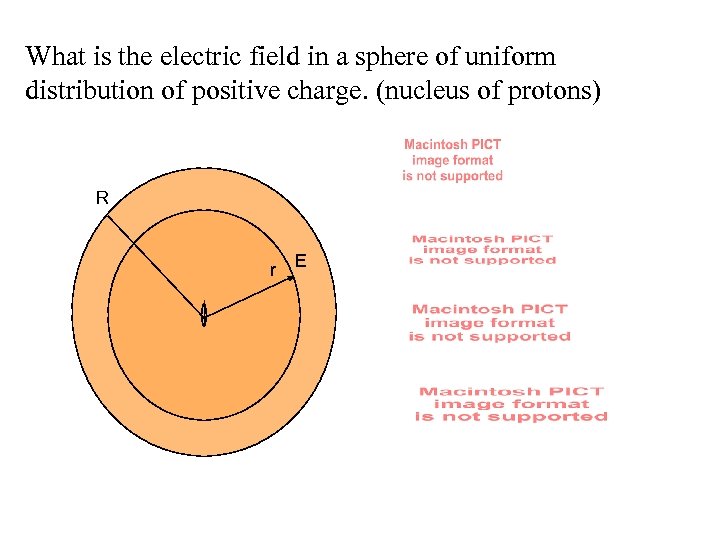 What is the electric field in a sphere of uniform distribution of positive charge. (nucleus of protons) R r E
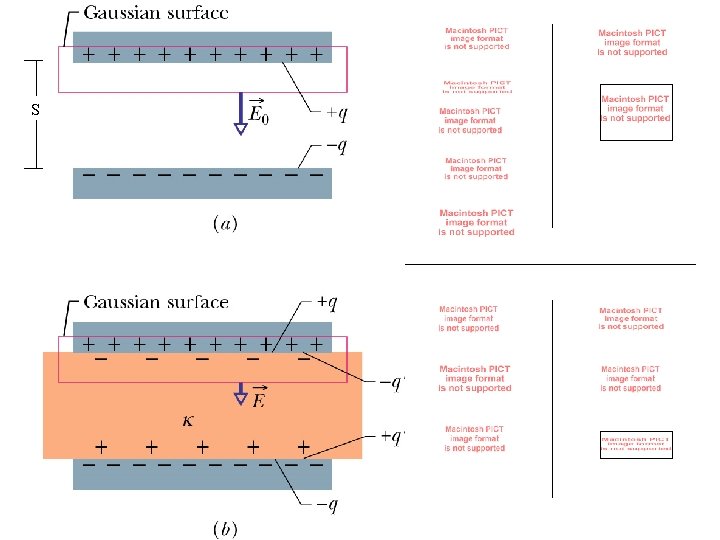 S
S
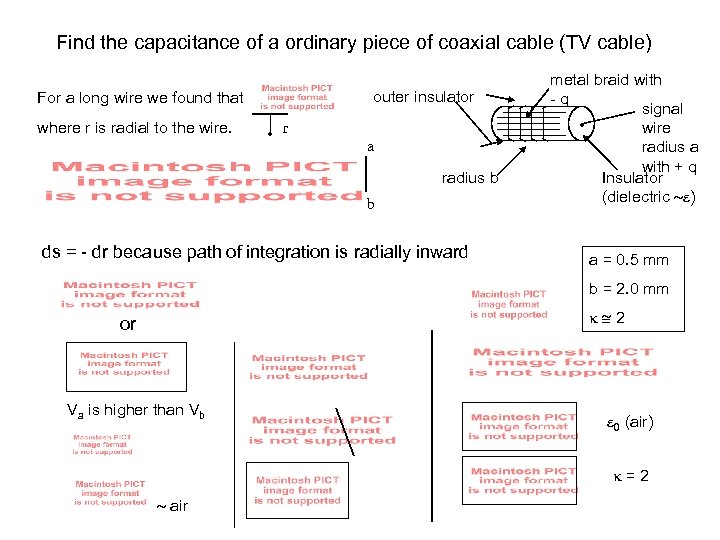 Find the capacitance of a ordinary piece of coaxial cable (TV cable) outer insulator For a long wire we found that where r is radial to the wire. • r a radius b b ds = - dr because path of integration is radially inward metal braid with -q signal • wire radius a with + q Insulator (dielectric ) a = 0. 5 mm b = 2. 0 mm 2 or Va is higher than Vb 0 (air) =2 air
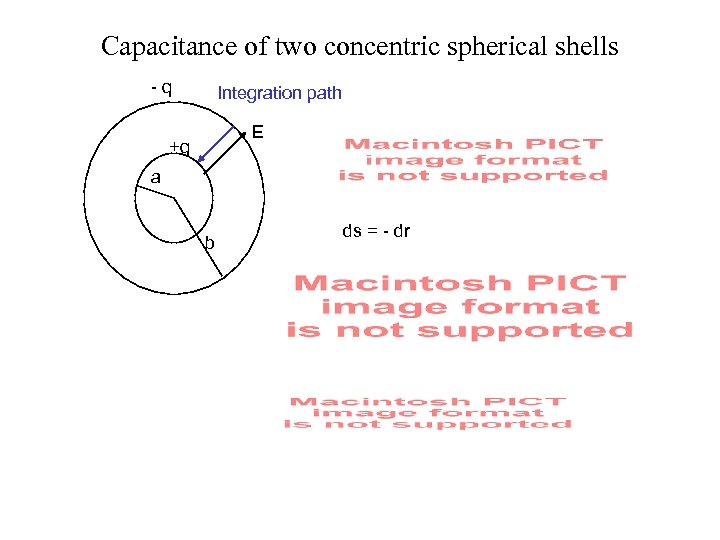 Capacitance of two concentric spherical shells -q Integration path E +q a b ds = - dr
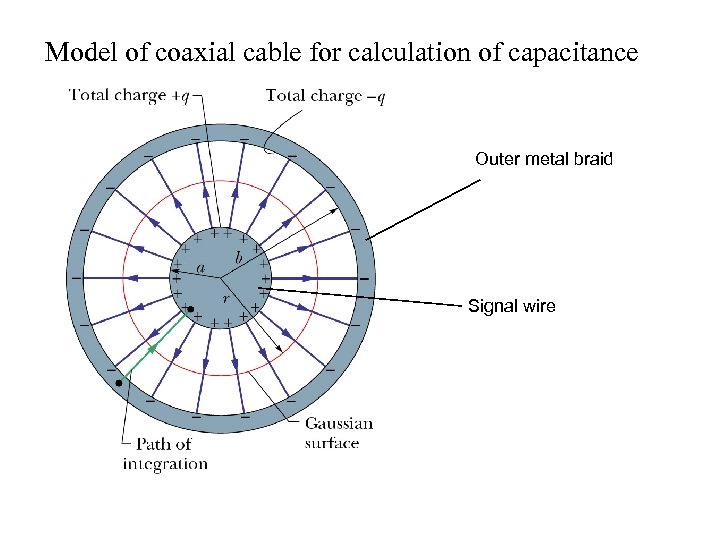 Model of coaxial cable for calculation of capacitance Outer metal braid Signal wire