


 Скачать презентацию Lecture 5 aid and development Aid from the
d932282511f73ca69f5cfdfa3219548a.ppt
- Количество слайдов: 13
 Lecture 5 aid and development Aid (from the french word aide, also known as international aid, overseas aid, or foreign aid, Development aid or development cooperation (also development assistance, technical assistance, international aid, overseas aid or foreign aid) is aid given by governments and other agencies to support the economic, social and political development BY DEFINITION is a voluntary transfer of resources from one country to another, given at least partly with the objective of benefiting the recipient country Aid denoted the transfer of goods and servises between international actors on a concessionary basis. it is a general term that covers both grants and loans, bilateral and multilateral both governmental and private it excludes specifically commercial transactions were the makes no concessions
 Lecture 5 aid and development HISTORY OF AID Aid existed in ancient times. More recently, in the nineteenth century, some private aid flowed from the Western countries to the rest of the world; missionary schools are an example. In the nineteenth and early twentieth centuries, aid from governments was tiny compared to present levels, consisting mostly of occasional humanitarian crisis relief. Some transfers that would now be counted as aid, however, came under the purview of colonial office budgets. It was at the end of World War Two, in the contexts of European reconstruction, decolonisation, and cold war rivalry for influence in the third world, that aid became the major activity that it is today. SOURCES OF AID- About 80 to 85 per cent of developmental aid comes from government sources. The remaining 15 to 20 per cent comes from private organisations such as "Nongovernmental organisations" (NGOs) and other development charities (eg. Oxfam). This is not counting remittances by individuals in developed countries to family members in developing countries. Bilateral Aid is given by the government of one country directly to another. Many dedicated governmental aid agencies dispense bilateral aid, for example USAID, 'donor to recipient country'. Multilateral aid is given from the government of a country to an international agency, such as the World
 Lecture 5 aid and development Donations from private individuals and for-profit companies are another significant type of aid. The practice of giving such donations, especially on the part of wealthy individuals, is known as philanthropy Many immigrants move to areas of increased economic opportunity, and send money to friends and family members who still live in the countries they left. These payments are known as remittances (rather than philanthropy) and constitute a significant portion of international monetary transfers. However, they appear to constitute a large proportion of the flows of money between developed and developing countries, although the exact amounts are uncertain because remittances are poorly tracked. World Bank estimates for remittance flows to developing countries in 2004 totaled $122 billion; however, this number is expected to change upwards in the next few years as the formulas used to calculate remittance flows are modified. The exact nature and effects of remittance money remain contested, however in at least 36 of the 153 countries tracked remittance sums were second only to FDI and outnumbered both public and private aid donations. The IMF has reported that private remittances may have a negative impact on economic growth, as they are often used for private consumption of individuals and families, not for economic development of the region or country.
 Lecture 5 aid and development NGOs) play a major role in distributing aid examples include Action. Aid, Oxfam, and the Mercy Corps. Many non-profit charitable organizations solicit donations from the public to support their work; charitable foundations often oversee an endowment which they invest and use the proceeds to support aid organizations and other causes. Aid organizations may provide both humanitarian and development aid, or specialize in one or the other. A number of aid NGOs have an affiliation with a religious denomination. Many NGOs conduct their own international operations distributing food and water, building pipelines and homes, teaching, providing health care, lending money, etc. Some
 Lecture 5 aid and development OTHER Project aid: Aid is given for a specific purpose e. g. building materials for a new school. Programme aid: Aid is given for a specific sector e. g. funding of the education sector of a country. Budget support Sectorwide Approaches (SWAPs): A combination of Project aid and Programme aid/Budget Support e. g. support for the education sector in a country will include both funding of education projects (like school buildings) and provide funds to maintain them (like school books). Food aid Untied Aid: The country receiving the aid, can spend the money as they chose. Tied aid The aid must be used to purchase products from the country that donated it or a specified group of countries. Technical assistance Educated personnel, such as doctors are moved into developing countries to assist with a program of development. Can be both programme and project aid
 Lecture 5 aid and development 2 Aid is disbursed in variety of forms e. g project aid, cash aid, capital aid and trade and investment, concessions and credits. Oftenly aid categories and objectives overlap exacerbating the difficulty neat conceptual definitions and explanation in several social science disciplines The concept of aid has elicited a considerable amount of controversy in international political economy discourse. There is hardly any consensus as to the meaning, let alone the objectives and motives of both the donour and the recipient state. Too often researchers have tended to pay too much attention to the publicised progressed economic and humanitarian objectives of aid and the expense of subtle less forcefully articulated but significant political motives. It should be noted that foreign aid was born out of the political and ideological rivarly, the primacy of politics should have pervaded the analysis. Hyter and Payer have seen aid for what exactly is ‘merely the smooth face of imperialism’
 Lecture 5 aid and development 3 Origins and objectives of aid can only be understood within the global political context. This context include cold war, hostility and super power divisions or the globe into first and 3 rd Worlds after WW 1. Since all politics is the struggle for power- major post war powers used aid as one of their principal economic instruments to impress and win over the uncommitted Third nation-states to their ideological side. This role is aptly captured by Liska’s statement that ‘foreign aid is an instrument of foreign policy’ The US 1961 Foreign Assistance Act openly agreed to this when its preamble stated that its purpose was to promote ‘the foreign policy and general warfare of the US’ Provision of aid to the south originally started as a programme to facilitate the short term war recovery of both western and eastern Europe after second world war. This recovery was facilitated through the Marshall plan 1948 -52. Beneath the visible economic recovery objective was a subtle clear cut political objective to rebuild Europe strong enough to resist the menace of communism. Simply the US wanted to check the spread of communism in Europe by stabilising their economic conditions so as to create powerful and attractive alternative to the soviet economic system. Throughout the cold war period politics emanated to be the major motivating principle of aid regime.
 Lecture 5 aid and development 4 During the early 1950 s the US government authorised technical, military and economic assistance package for Greece and Turkey then relatively poor countries bordering on communist world and perceived to be highly vulnerable. South Korea and the Philippines were also included in the programme at a latter stage The third phase was ushered by the disintegration of colonial empires and the proliferation of the newly independent states of Asia and Africa. Cold war struggle were extended to these countries. In the struggle foreign aid was extensively used by the major powers in the contest to win the minds of the new states. Scholars like Hans Morgenthau have equated this practice to bribery. The west initially used the aid to buttress resistance to commit military of subversive aggression and was gradually extended to reward friends and punish enemies, gain influence over forceful governments in the south, retain influence once achieved and preventing communist donors from succeeding. The Word Bank and other multilateral agencies also expended their foreign assistance programmes. The end of the cold war in the early 1990 s marked the fourth and contemporary phase of aid regime. There is a change and a search for new rationale for disbursement of aid. Griffin, however maintains that aid will continue to go where national self interest are at most. According to Todaro Donors give Aid primarily because it is in their political, strategic or economic self-interest to do so. Some are motivated by moral and
 Lecture 5 aid and development 5 However, there is no historical evidence to suggest that over long periods of time donor nations assist others without expecting some corresponding benefits (political, economic, military and in return) Have been by far the most important for aid granting nations especially the US has viewed aid from its begging in the 1940 s as a means of containing international spread of communism. With the shift of cold war interest to 3 rd world in the mid 1950 s the policy of containment embodied the US aid programme dictated a shift in emphasis towards political, economic and military support for friendly less developed nations especially those considered to be geographically strategic. Thus most aid to developing countries was therefore oriented towards purchasing security and propping up their sometimes shaky regimes than promoting long term social and economic development. Successive shifts in emphasis of US aid reflects changes in its strategic and political interests more than changing evaluations of economic need. With very few exceptions the western donor countries by and large used foreign aid as political lever to prop up friendly political regimes whose continued experience they perceived as being in their national security interests.
 Lecture 5 aid and development 6 Donors tend to benefit economically. Giving aid- loans and grants to boast exports of donor countries. This often lead to debt payment burdens. 3 reasons can be identified to explain. 1. Is largely based on recipients acceptance of donor’s perceptions of what the poor country require to promote their economic development. This is supported by the success cases of Taiwan Israel and south Korea to the exclusion of many more failures- thus aid is portrayed by donor countries as a crucial and essential ingredient in the development process. 2. The recipient state see aid as providing greater political leverage to the existing leadership to suppress opposition and maintain itself in power. In such cases assistance takes not only financial resources transfers but of military and internal security reinforcements as well. Once such aid is accepted the ability of the recipient state to extricate themselves from implied political and economic obligations to donor and prevent donor governments from interfering in internal affairs can be greatly diminished. 3. Moral obligation- many proponents of foreign aid in both developing and developed nations believe the rich nations have an obligation to support the economic and social development of the Third world. There is a belief that the rich nations owe the poor nations conscience and money for past exploitation.
 Lecture 5 aid and development 7 AID EFFECTIVENESS Aid effectiveness is the degree to which development aid works, and is a subject of significant disagreement. Dissident economists such as Peter Bauer and Milton Friedman argued in the 1960 s that aid is ineffective. Many econometric studies in recent years have supported the view that development aid has no effect on the speed with which countries develop. Negative side effects of aid can include an unbalanced appreciation of the recipient's currency (known as Dutch Disease), increasing corruption, and adverse political effects such as postponements of necessary economic and democratic reforms. It has been argued that much government-to-government aid was ineffective because it was merely a way to support strategically important leaders. A good example of this is the former dictator of Zaire, Mobuto Sese Seko, who lost
 Lecture 5 aid and development 8 A id has also been ineffective in young recipient countries in which ethnic tensions are strong: sometimes ethnic conflicts have prevented efficient delivery of aid. In some cases, western surpluses that resulted from faulty agriculture- or other policies have been dumped in poor countries, thus wiping out local production and increasing dependency. In several instances, loans that were considered irretrievable (for instance because funds had been embezzled by a dictator who has already died or disappeared), have been written off by donor countries, who subsequently booked this as development aid. In many cases, Western governments placed orders with Western companies as a form of subsidizing them, and later shipped these goods to poor countries who often had no use for them. These projects are sometimes called 'white elephants'. According to Martijn Nitzsche, another problem is the way on how development projects are sometimes constructed and how they are maintained by the local population. Often, projects are made with technology that is hard to understand too difficult to repair, resulting in unavoidable failure over time. Also, in some cases the local population is not very interested in seeing the project to
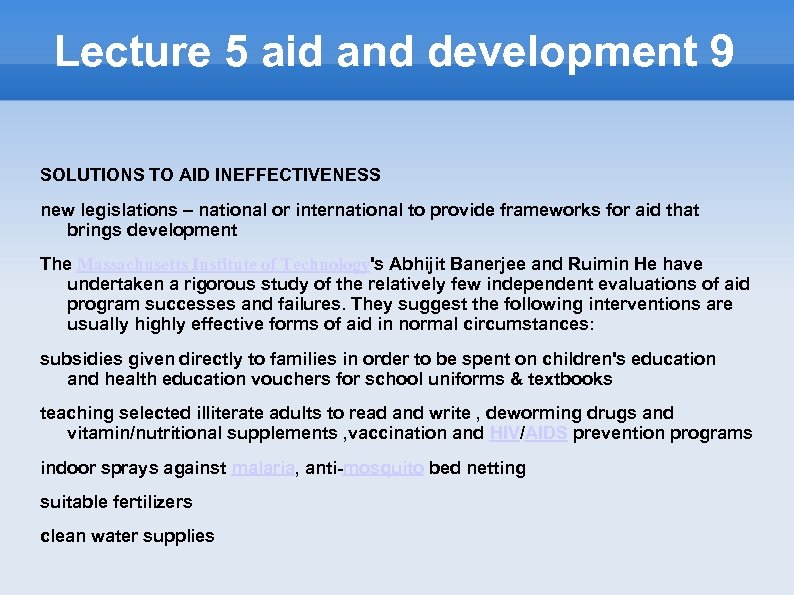 Lecture 5 aid and development 9 SOLUTIONS TO AID INEFFECTIVENESS new legislations – national or international to provide frameworks for aid that brings development The Massachusetts Institute of Technology's Abhijit Banerjee and Ruimin He have undertaken a rigorous study of the relatively few independent evaluations of aid program successes and failures. They suggest the following interventions are usually highly effective forms of aid in normal circumstances: subsidies given directly to families in order to be spent on children's education and health education vouchers for school uniforms & textbooks teaching selected illiterate adults to read and write , deworming drugs and vitamin/nutritional supplements , vaccination and HIV/AIDS prevention programs indoor sprays against malaria, anti-mosquito bed netting suitable fertilizers clean water supplies