


 Скачать презентацию Lecture 4 Wages 1 The essence of wages
Lecture 4. Political economy.pptx
- Количество слайдов: 14
 Lecture 4. Wages 1. The essence of wages 2. Forms and systems of wages 3. The magnitude of wages and mechanism of its changes
 Glossary of terms • Wages – заработная плата • Price of labour – цена труда • Time-Wages – повременная заработная плата • Piece-Wages – сдельная заработная плата
 Glossary of terms • Nominal wages – номинальная заработная плата • Real wages – реальная заработная плата • Systems of wages – системы заработной платы • Standard of living – уровень жизни
 Manifestation of wages • On the surface of the capitalistic society wages manifests itself as a price of labor. • Such illusion appears because wages as a rule is paid after the process of labor is done. • But K. Marx proved that labor is isn`t a commodity according to such reasons:
 Why labor is isn`t a commodity: • 1. To be sold as a commodity labor should exist till the moment of sale. But if worker was able to give to his labor independent existence he would sell a commodity created by his labor but not labor itself. • 2. As any commodity labor has to have its own value. But labor is a measure of value itself, so it doesn`t have its own value. • 3. If labor was a commodity capitalist won`t receive surplus value, because in such case he should pay for the whole labor embodied on commodities.
 Essence of wages • In reality, hired worker sells not labor but just his ability to work – labor power. • Value of labor power expressed in money is wages. • So, wages is a transformed form of labor power value.
 Transformed category • - category, which manifests itself in another way than it actually is. • So, on the surface wages manifests itself as a payment for labor, but in reality is – payment for labor power.
 Forms of wages • 1. Time wages • 2. Piece wages
 Time wages • - wages paid according particular number of hours. • Historically it was a first form of wages. • The magnitude of time wages can be estimated with the help "price of labor".
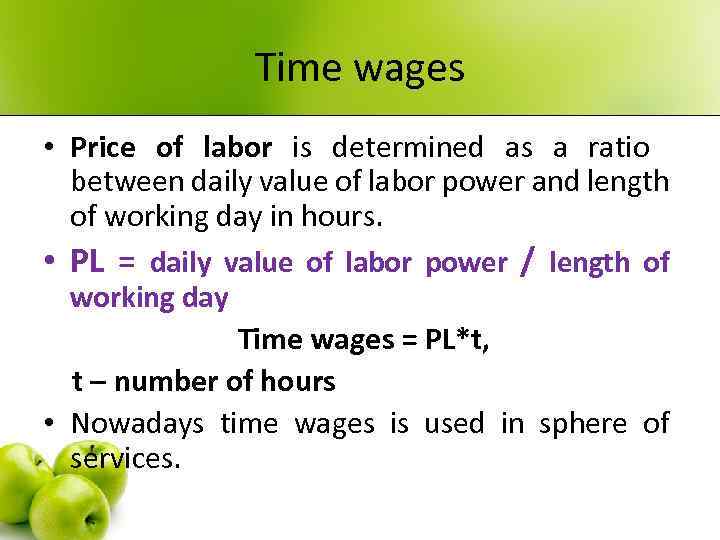 Time wages • Price of labor is determined as a ratio between daily value of labor power and length of working day in hours. • PL = daily value of labor power / length of working day Time wages = PL*t, t – number of hours • Nowadays time wages is used in sphere of services.
 Piece wages • - transformed form of time wages which is paid according to particular number of units produced. • To calculate the amount of piece wages “rate per unit of output” is used. • Rate per unit of output (Run) is set on the base of norm of production and price of labor (PL).
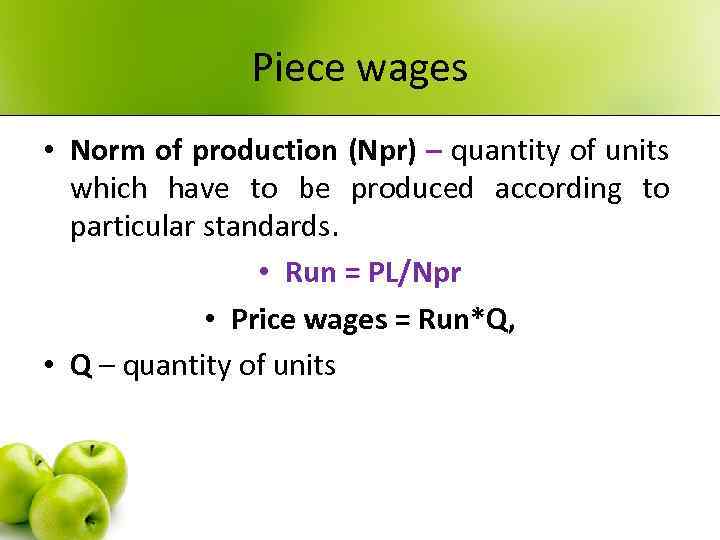 Piece wages • Norm of production (Npr) – quantity of units which have to be produced according to particular standards. • Run = PL/Npr • Price wages = Run*Q, • Q – quantity of units
 Nominal and real wages • Nominal wages - is amount of money which worker receives for his labor power from capitalist. • Real wages - is amount of goods and services which worker is able to buy on his nominal wages.
 Factors, which determine the magnitude of real wages • • 1. The magnitude of the nominal wages 2. The level of prices of goods and services 3. The level of income tax 4. The level and structure laborers needs 5. The level of unemployment 6. The level of economic growth 7. The level of labor productivity 8. The state policy in the sphere of wages