


 Скачать презентацию Lecture 4 The World Economy Lecture 4
4 The World Economy.pptx
- Количество слайдов: 47
 Lecture 4 The World Economy
 Lecture 4 Overview of the World Economy • “Globalization” • Elements of the World Economy • Ways that Countries Interact – Trade – Capital Flows – Migration • Policies that Affect Others 2
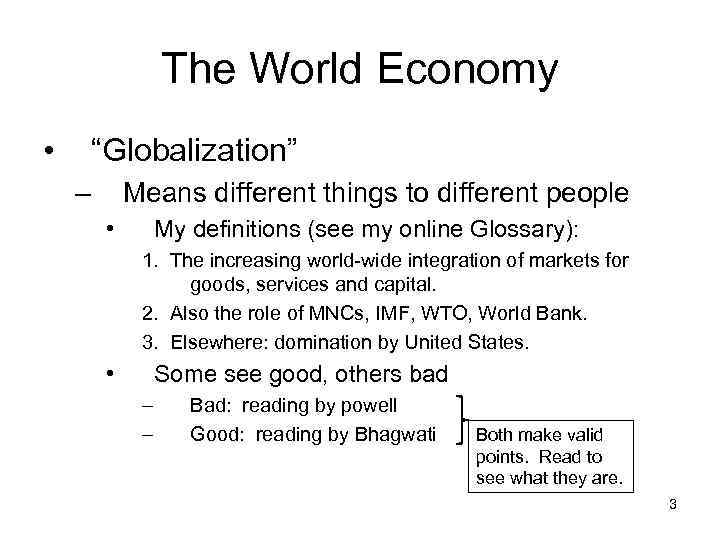 The World Economy • “Globalization” – Means different things to different people • My definitions (see my online Glossary): 1. The increasing world-wide integration of markets for goods, services and capital. 2. Also the role of MNCs, IMF, WTO, World Bank. 3. Elsewhere: domination by United States. • Some see good, others bad – – Bad: reading by powell Good: reading by Bhagwati Both make valid points. Read to see what they are. 3
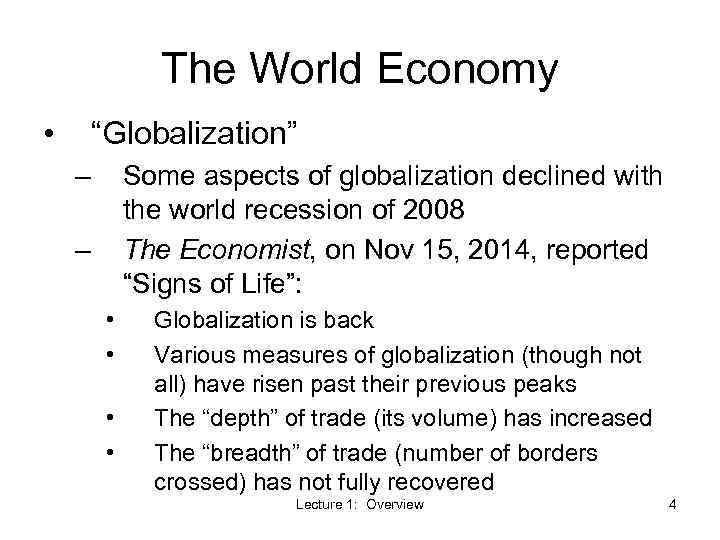 The World Economy • “Globalization” – Some aspects of globalization declined with the world recession of 2008 The Economist, on Nov 15, 2014, reported “Signs of Life”: – • • Globalization is back Various measures of globalization (though not all) have risen past their previous peaks The “depth” of trade (its volume) has increased The “breadth” of trade (number of borders crossed) has not fully recovered Lecture 1: Overview 4
 The World Economy • International Economics – Is NOT about countries – It IS about interactions among countries 5
 Lecture 4 Overview of the World Economy • “Globalization” • Elements of the World Economy • Ways that Countries Interact – Trade – Capital Flows – Migration • Policies that Affect Others 6
 The World Economy • World Economy consists of – Countries: a few hundred (CIA lists about 240) (WTO has 160 members) – People: over 7 billion (7. 216 b. 1/5/15, compare 320 m. US) – Land: about 15 times the US 7
 (Aside, on getting information) An excellent source of information about countries is the CIA World Fact Book (Just Google “fact book”) 8
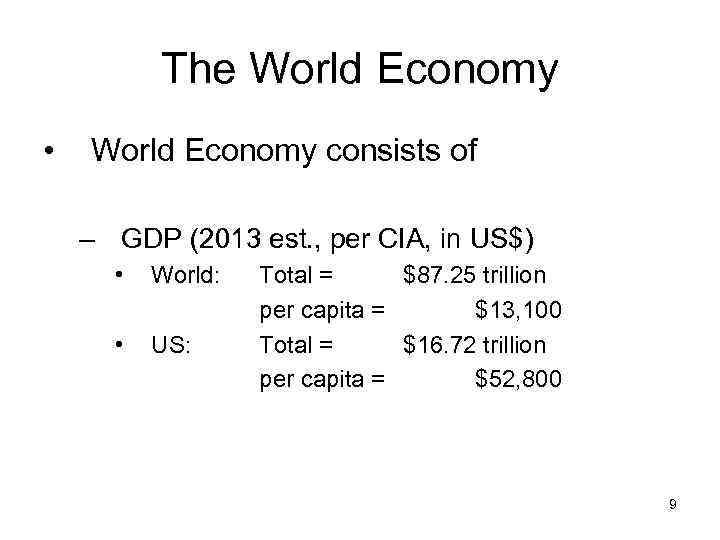 The World Economy • World Economy consists of – GDP (2013 est. , per CIA, in US$) • World: • US: Total = $87. 25 trillion per capita = $13, 100 Total = $16. 72 trillion per capita = $52, 800 9
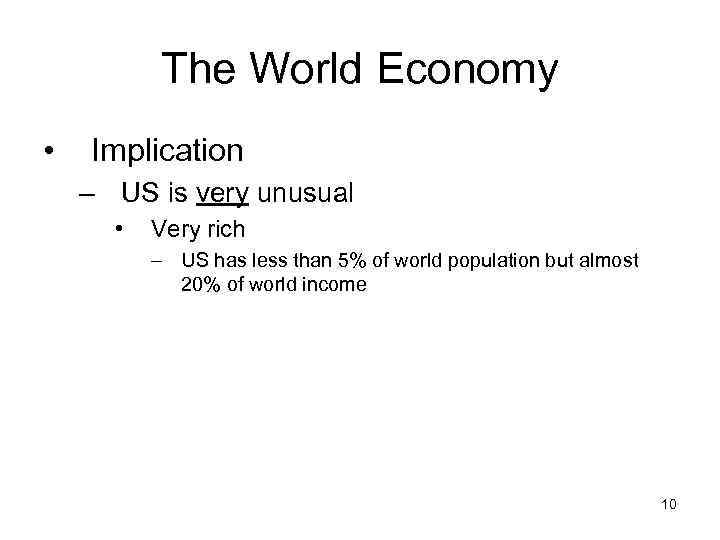 The World Economy • Implication – US is very unusual • Very rich – US has less than 5% of world population but almost 20% of world income 10
 Lecture 4 Overview of the World Economy • “Globalization” • Elements of the World Economy • Ways that Countries Interact – Trade – Capital Flows – Migration • Policies that Affect Others 11
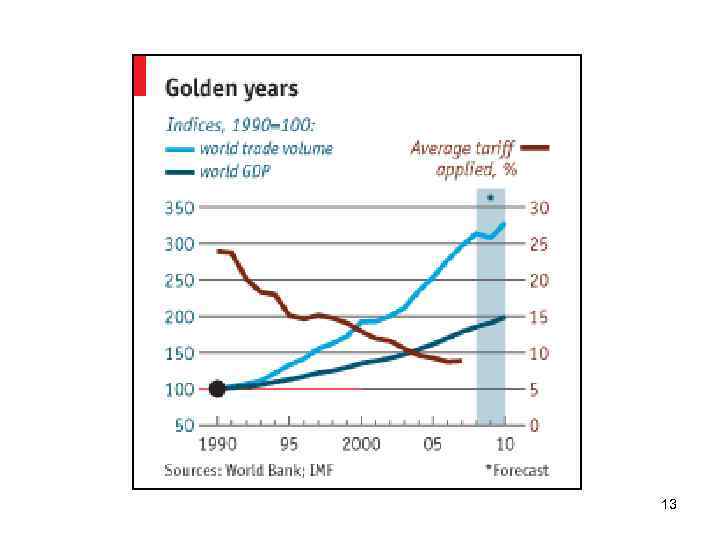
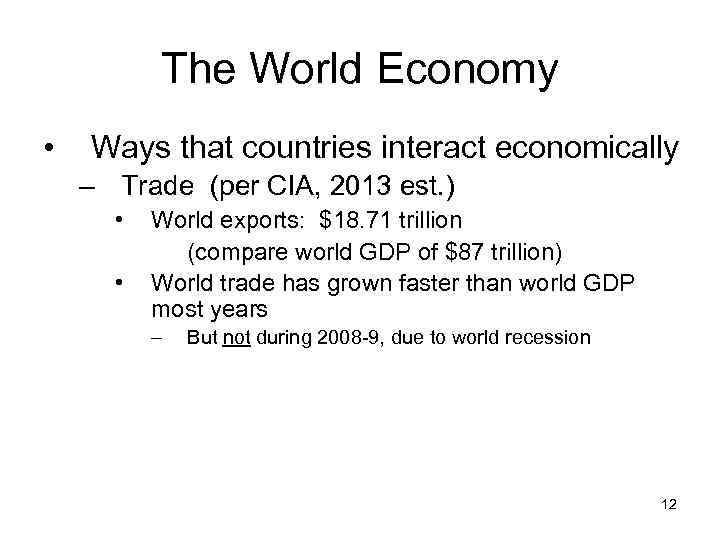 The World Economy • Ways that countries interact economically – Trade (per CIA, 2013 est. ) • • World exports: $18. 71 trillion (compare world GDP of $87 trillion) World trade has grown faster than world GDP most years – But not during 2008 -9, due to world recession 12
 13
13
 The World Economy • See tables below for – – Who trades most? Who trades with whom? Share of trade in GDP US: • What do we export/import? • To/from whom? 14
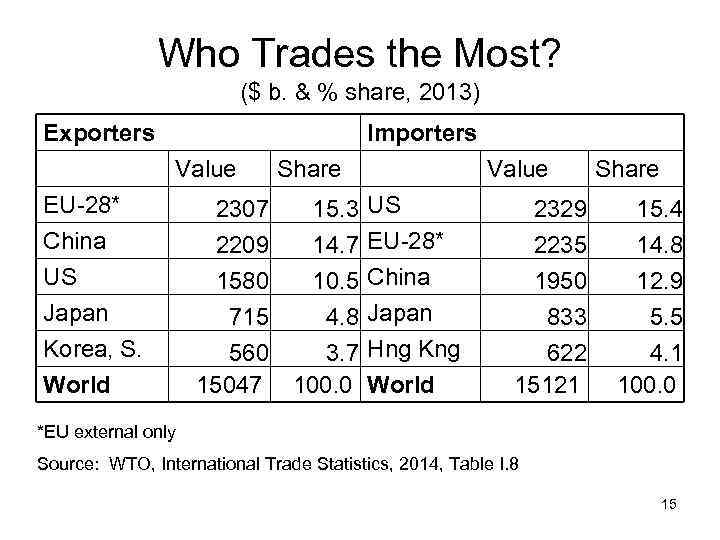 Who Trades the Most? ($ b. & % share, 2013) Exporters Importers Value EU-28* China US Japan Korea, S. World Share 2307 15. 3 2209 14. 7 1580 10. 5 715 4. 8 560 3. 7 15047 100. 0 Value US EU-28* China Japan Hng Kng World 2329 2235 1950 833 622 15121 Share 15. 4 14. 8 12. 9 5. 5 4. 1 100. 0 *EU external only Source: WTO, International Trade Statistics, 2014, Table I. 8 15
 Who Trades the Most? • Developed countries are the biggest traders • China is catching up, in trade volume – It was the #3 exporter six years ago when I taught the course; now it’s #2 and closing in on EU. – Others are gaining as well: Four years ago Canada was #5 exporter. Three years ago that was S Korea 16
 Who Trades the Most? • See Economist from about a year ago: “Trading Up: Picking the world champion of trade” – China claimed to have surpassed US. True only for goods, not goods + services • But with time China will pass US in both – China’s trade per GDP is much larger than the US, but below world average – Much of the value in China’s exports is imported inputs, thus low “value added. ” 17
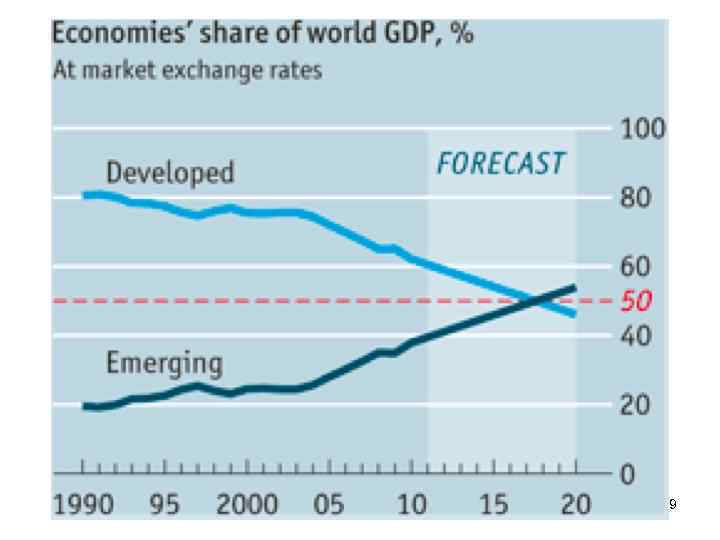
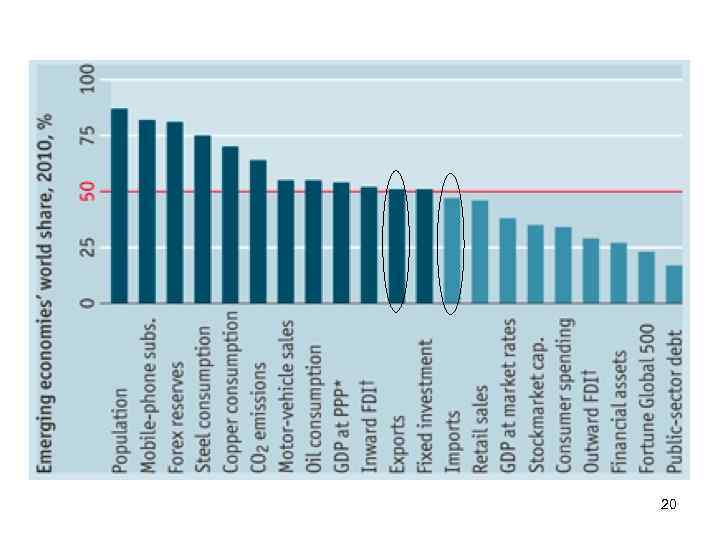
 Who Trades the Most? • “Emerging Markets” in general are catching up to, or surpassing, the developed countries – In GDP, trade, and more – See Economics Focus from The Economist, “Why the Tail Wags the Dog” 18
 Lecture 1: Overview 19
 20
20
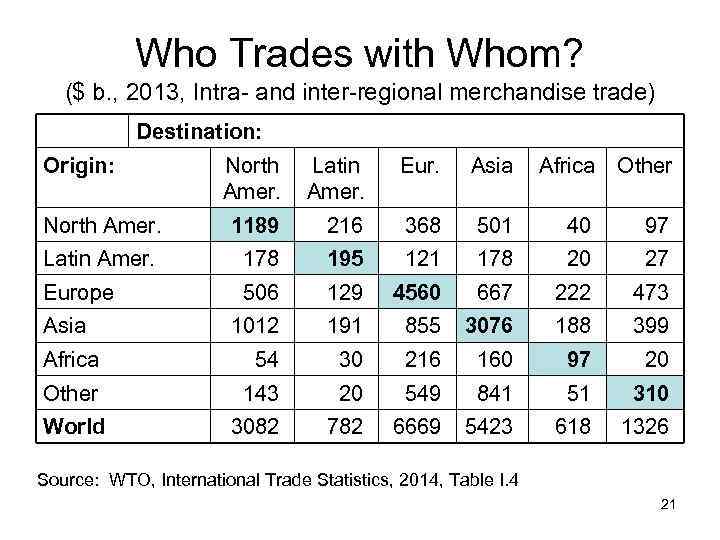 Who Trades with Whom? ($ b. , 2013, Intra- and inter-regional merchandise trade) Destination: Origin: North Amer. Latin Amer. Eur. Asia Africa Other North Amer. 1189 216 368 501 40 97 Latin Amer. 178 195 121 178 20 27 Europe 506 129 4560 667 222 473 1012 191 855 3076 188 399 Africa 54 30 216 160 97 20 Other 143 20 549 841 51 310 World 3082 782 6669 5423 618 1326 Asia Source: WTO, International Trade Statistics, 2014, Table I. 4 21
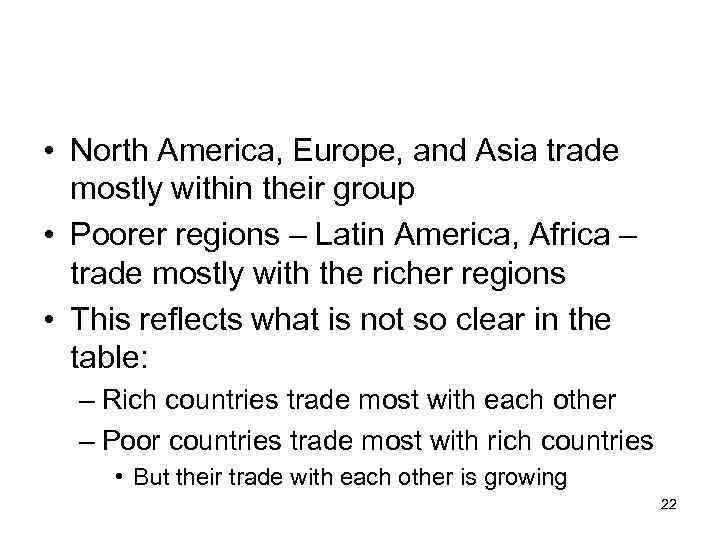 • North America, Europe, and Asia trade mostly within their group • Poorer regions – Latin America, Africa – trade mostly with the richer regions • This reflects what is not so clear in the table: – Rich countries trade most with each other – Poor countries trade most with rich countries • But their trade with each other is growing 22
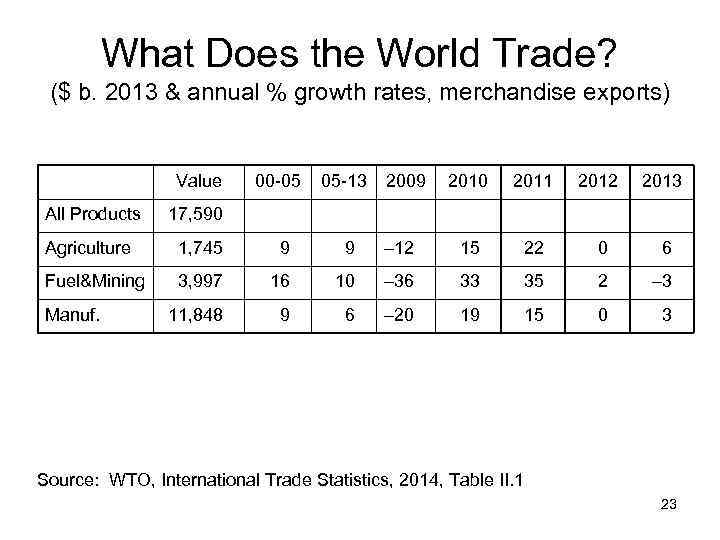 What Does the World Trade? ($ b. 2013 & annual % growth rates, merchandise exports) Value 00 -05 05 -13 2009 2010 2011 2012 2013 All Products 17, 590 Agriculture 1, 745 9 9 – 12 15 22 0 6 Fuel&Mining 3, 997 16 10 – 36 33 35 2 – 3 11, 848 9 6 – 20 19 15 0 3 Manuf. Source: WTO, International Trade Statistics, 2014, Table II. 1 23
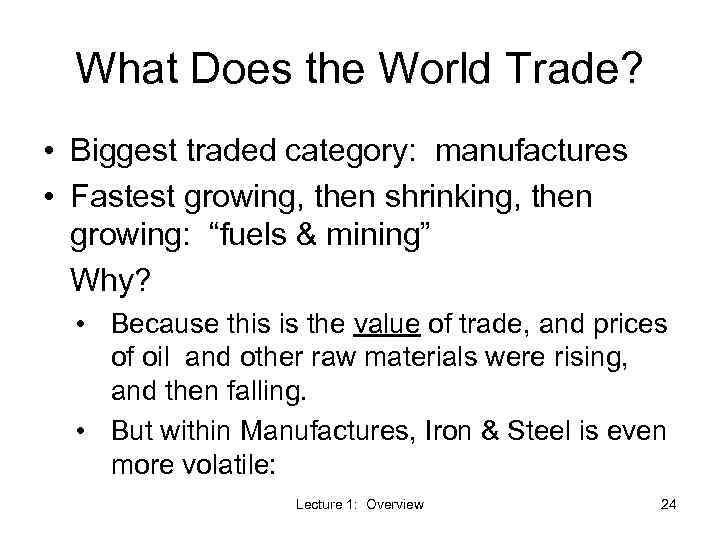 What Does the World Trade? • Biggest traded category: manufactures • Fastest growing, then shrinking, then growing: “fuels & mining” Why? • Because this is the value of trade, and prices of oil and other raw materials were rising, and then falling. • But within Manufactures, Iron & Steel is even more volatile: Lecture 1: Overview 24
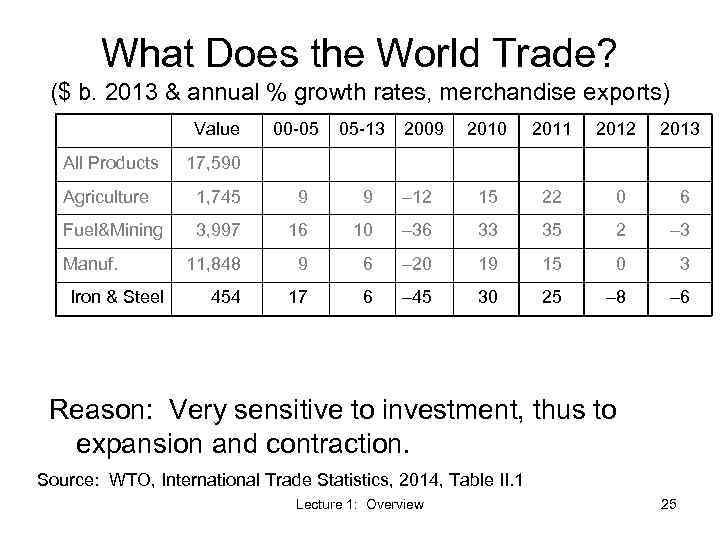 What Does the World Trade? ($ b. 2013 & annual % growth rates, merchandise exports) Value 00 -05 05 -13 2009 2010 2011 2012 2013 All Products 17, 590 Agriculture 1, 745 9 9 – 12 15 22 0 6 Fuel&Mining 3, 997 16 10 – 36 33 35 2 – 3 11, 848 9 6 – 20 19 15 0 3 454 17 6 – 45 30 25 – 8 – 6 Manuf. Iron & Steel Reason: Very sensitive to investment, thus to expansion and contraction. Source: WTO, International Trade Statistics, 2014, Table II. 1 Lecture 1: Overview 25
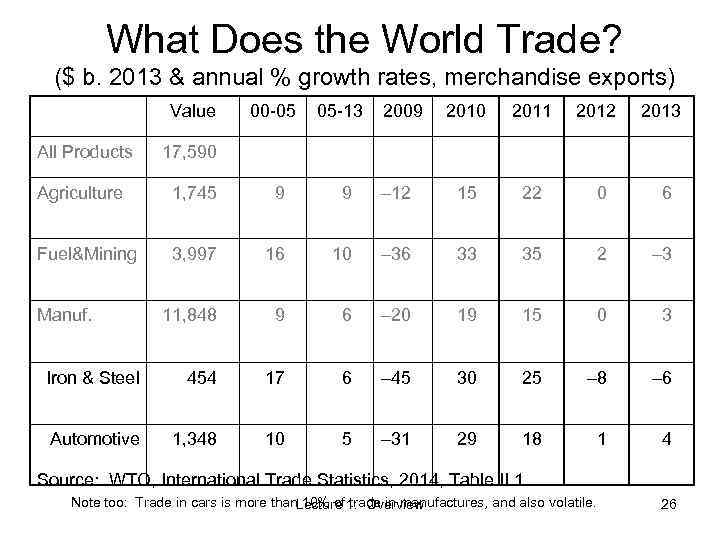 What Does the World Trade? ($ b. 2013 & annual % growth rates, merchandise exports) Value 00 -05 05 -13 2009 2010 2011 2012 2013 All Products 17, 590 Agriculture 1, 745 9 9 – 12 15 22 0 6 Fuel&Mining 3, 997 16 10 – 36 33 35 2 – 3 11, 848 9 6 – 20 19 15 0 3 Iron & Steel 454 17 6 – 45 30 25 – 8 – 6 Automotive 1, 348 10 5 – 31 29 18 1 4 Manuf. Source: WTO, International Trade Statistics, 2014, Table II. 1 Note too: Trade in cars is more than. Lecture 1: Overview 10% of trade in manufactures, and also volatile. 26
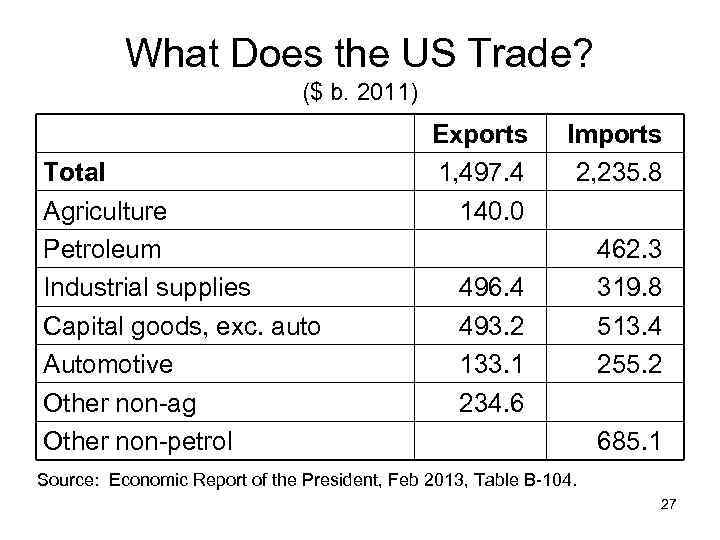 What Does the US Trade? ($ b. 2011) Total Agriculture Petroleum Industrial supplies Capital goods, exc. auto Automotive Other non-ag Other non-petrol Exports 1, 497. 4 140. 0 Imports 2, 235. 8 496. 4 493. 2 133. 1 234. 6 462. 3 319. 8 513. 4 255. 2 685. 1 Source: Economic Report of the President, Feb 2013, Table B-104. 27
 What Does the US Trade? • US imports are much larger than US exports – (We’ll see what that means later in the course. ) • US is a big… – Exporter of agricultural products – Importer of oil – Exporter and importer of capital goods (i. e. , machines for making things) Lecture 1: Overview 28
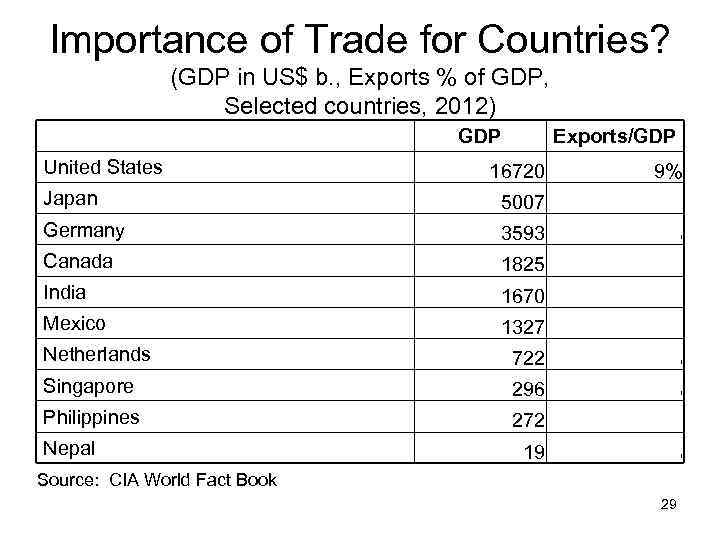 Importance of Trade for Countries? (GDP in US$ b. , Exports % of GDP, Selected countries, 2012) GDP United States Exports/GDP 16720 9% Japan 5007 14% Germany 3593 42% Canada 1825 25% India 1670 19% Mexico 1327 28% Netherlands 722 80% Singapore 296 139% Philippines 272 17% 19 5% Nepal Source: CIA World Fact Book 29
 Importance of Trade for Countries? • Even though we trade more than most, US trade is a smaller part of US GDP than for many other countries • Others that are low: Japan, Nepal (even lower than US) • Note Singapore: Exports can be more than GDP. – Reason: Exports are made using imported inputs, so value of exports includes imports. 30
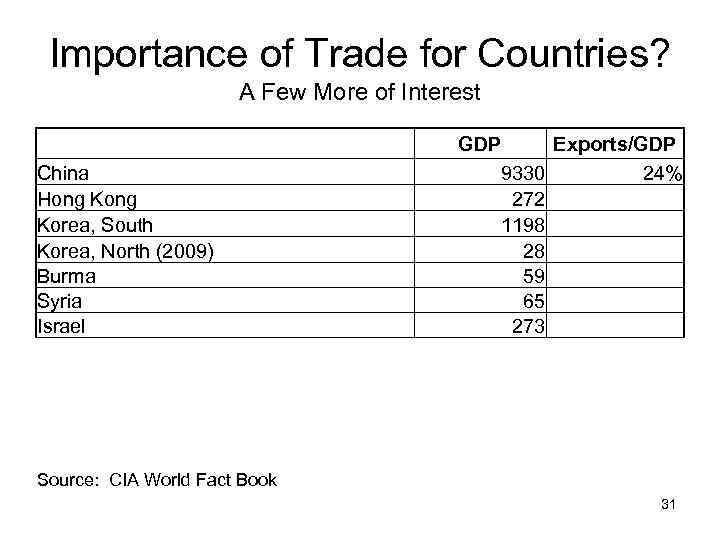 Importance of Trade for Countries? A Few More of Interest China Hong Korea, South Korea, North (2009) Burma Syria Israel GDP Exports/GDP 9330 24% 272 168% 1198 47% 28 7% 59 15% 65 6% 273 22% Source: CIA World Fact Book 31
 Lecture 4 Overview of the World Economy • “Globalization” • Elements of the World Economy • Ways that Countries Interact – Trade – Capital Flows – Migration • Policies that Affect Others 32
 The World Economy • Ways that countries interact economically – Capital Flows • • Financial (holdings of financial assets abroad) Real (international ownership of real assets) 33
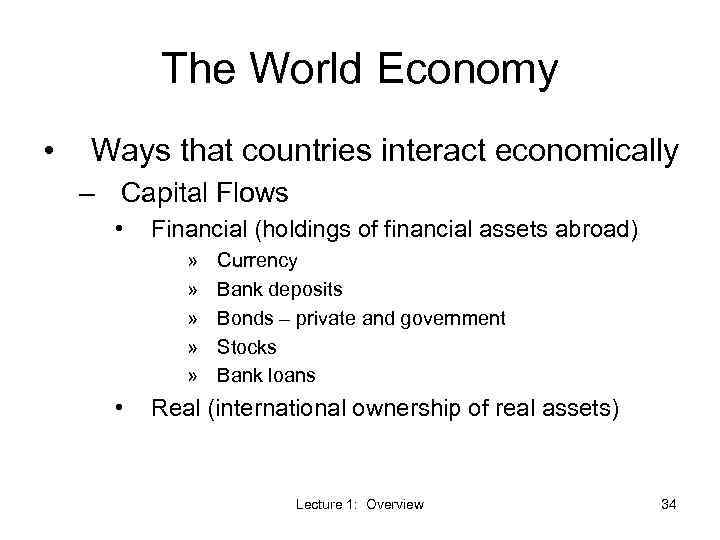 The World Economy • Ways that countries interact economically – Capital Flows • Financial (holdings of financial assets abroad) » » » • Currency Bank deposits Bonds – private and government Stocks Bank loans Real (international ownership of real assets) Lecture 1: Overview 34
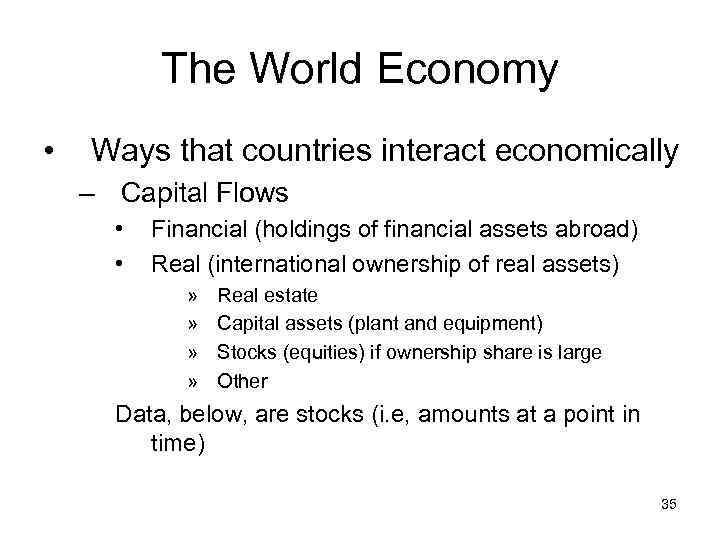 The World Economy • Ways that countries interact economically – Capital Flows • • Financial (holdings of financial assets abroad) Real (international ownership of real assets) » » Real estate Capital assets (plant and equipment) Stocks (equities) if ownership share is large Other Data, below, are stocks (i. e, amounts at a point in time) 35
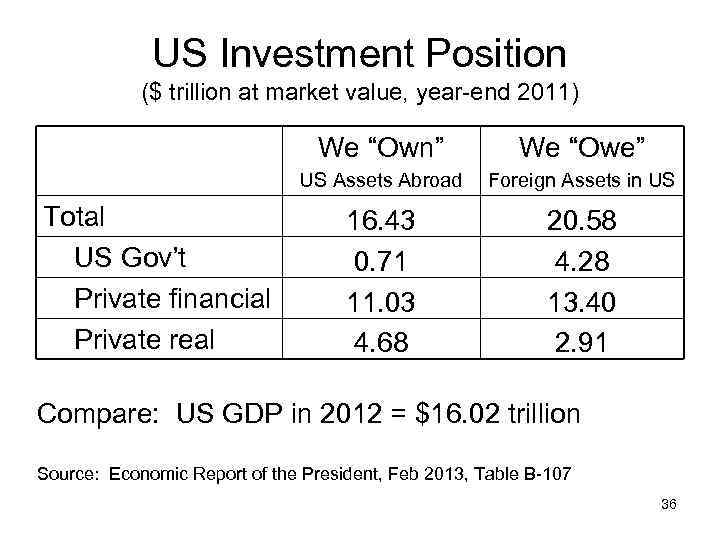 US Investment Position ($ trillion at market value, year-end 2011) We “Own” US Assets Abroad Total US Gov’t Private financial Private real We “Owe” Foreign Assets in US 16. 43 0. 71 11. 03 4. 68 20. 58 4. 28 13. 40 2. 91 Compare: US GDP in 2012 = $16. 02 trillion Source: Economic Report of the President, Feb 2013, Table B-107 36
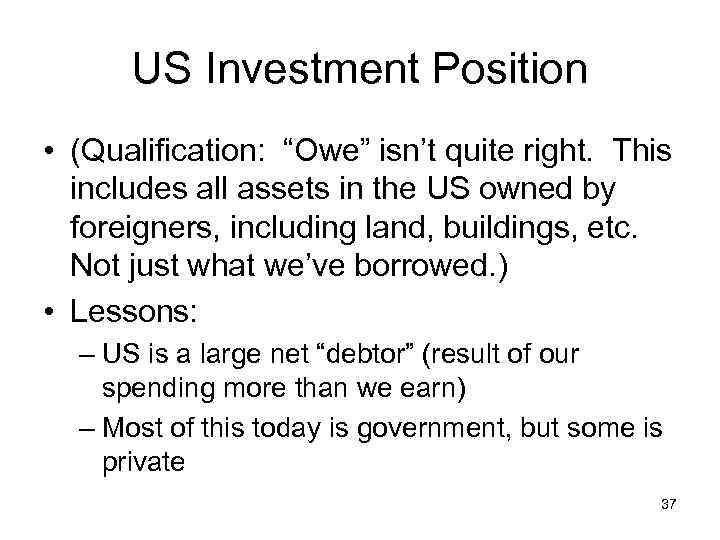 US Investment Position • (Qualification: “Owe” isn’t quite right. This includes all assets in the US owned by foreigners, including land, buildings, etc. Not just what we’ve borrowed. ) • Lessons: – US is a large net “debtor” (result of our spending more than we earn) – Most of this today is government, but some is private 37
 Lecture 4 Overview of the World Economy • “Globalization” • Elements of the World Economy • Ways that Countries Interact – Trade – Capital Flows – Migration • Policies that Affect Others 38
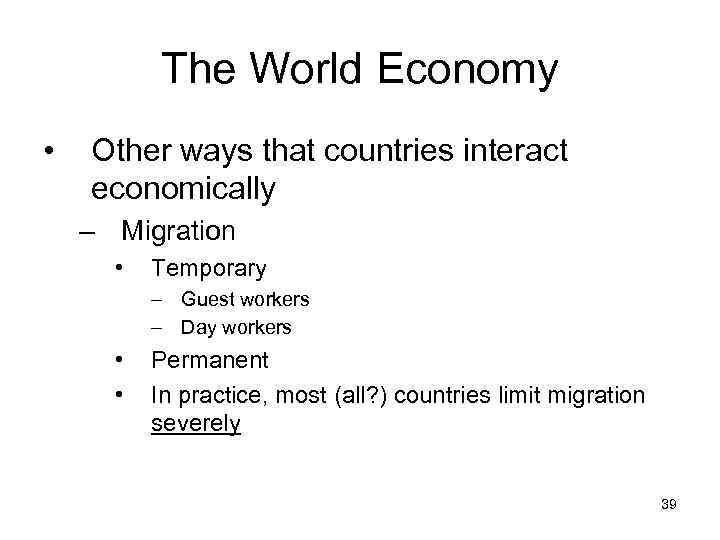 The World Economy • Other ways that countries interact economically – Migration • Temporary – Guest workers – Day workers • • Permanent In practice, most (all? ) countries limit migration severely 39
 Lecture 4 Overview of the World Economy • “Globalization” • Elements of the World Economy • Ways that Countries Interact – Trade – Capital Flows – Migration • Policies that Affect Others 40
 The World Economy • Other ways that countries interact economically – Policies that affect other countries • • Direct Indirect 41
 The World Economy • Other ways that countries interact economically – Policies that affect other countries • Direct – – – • Trade policies (tariffs, quotas) Foreign aid Capital controls Exchange rate management Immigration restrictions Indirect 42
 The World Economy • Aside on Tariffs – We will be dealing a lot with these – See reading by Hufbauer and Grieco: • • US tariffs are much lower than they used to be (average 4% now, vs. 40% in 1946) US has gained a great deal from lowering tariffs US still has much to gain from further lowering But there also severe costs for some people and firms who compete with imports 43
 The World Economy • Aside on Tariffs – Tariffs could go up: • • • WTO enforces only upper limits on tariffs Actual tariffs in many countries are below these limits, and could legally rise There was danger that the recent world recession would push countries to do that. – They didn’t – at least not much. 44
 The World Economy • Aside on Tariffs – 45% of US exports go to developing countries – US tariffs are much higher against developing countries than against developed countries 45
 The World Economy • Other ways that countries interact economically – Policies that affect other countries • Indirect – – Subsidies (esp. agriculture) » US farm subsidies > foreign aid (see CGD reading) Macro policies (monetary, fiscal) » Exchange-rate policies Environmental policies Standards » Labor » Health & safety » Norms 46
 Next Time • Institutions of the International Economy – What are they? • • The WTO The IMF The World Bank The OECD – What’s happening (or not happening) now? 47