


Lecture 4 The Syllable as a Phonetic and Phonological Unit
Plan 1. 2. 3. 4. 5. General Notes on the Syllable The Phonetic aspect of the Syllable The Structural Aspect of the Syllable Functions of the Syllable Graphic Characteristics of the Syllable
List of Terms syllable as a phonetic unit n syllable as a phonological unit n phonotactics n phonotactic peculiarities n
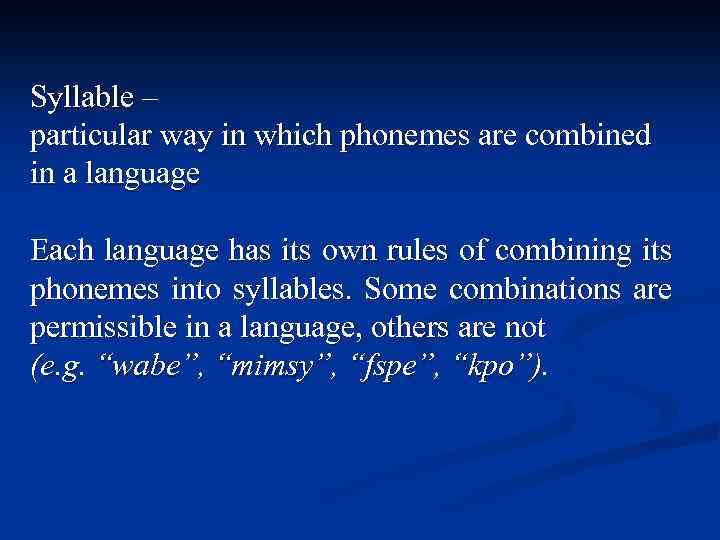
Syllable – particular way in which phonemes are combined in а language Each language has its own rules of combining its phonemes into syllables. Some combinations are permissible in a language, others are not (e. g. “wabe”, “mimsy”, “fspe”, “kpo”).
The Syllable as a Phonetic Unit is the smallest articulatory and perceptible unit. When we pronounce a syllable the speech organs, while producing a consonant (vowel), take all the positions necessary for the following vowel (consonant). The listener can recognize the preceding sound only after he has analysed the whole syllable. And it takes less time to identify a syllable than the isolated sounds it contains.
The Syllable as a phonological unit is a structural unit which consists of a vowel alone or of a vowel (or a syllabic sonorant) surrounded by consonants in the numbers and arrangements permitted by a given language.
Theories of Syllable Division (1) The expiratory (chest pulse) theory defines a syllable as a sound or a group of sounds that are pronounced in one chest pulse, accompanied by increases in air pressure: there as many syllables in a word as there are chest pulses (expirations) made during the utterance of a word (e. g. [`ko: ‑ fi] – 2 chest pulses – 2 syllables but [`si: ‑ iη] – 1 chest pulse but 2 syllables)
(2) Jespersen`s theory of relative sonority (the prominence theory) says that sounds are grouped around the most sonorous ones which form the peak of sonority in a syllable. One peak of sonority is separated from another peak by sounds of lower sonority. The distance between two points of lower sonority is a syllable. The number of syllables is determined by the number of peaks of prominence (e. g. melt ‑ 1 peak of sonority- 1 syllable). But it does not explain the mechanism of syllable formation, syllable division (e. g. [ǝnaismæn] – a nice man or an iceman)
(3) Shcherba`s theory of muscular tension says that a syllable is characterized by variations in muscular tension (the energy of articulation increases at the beginning of a syllable, reaches its maximum with a vowel (or a sonant) and decreases towards the end of a syllable. A syllable is an arc of muscular tension. (eg. [ta: ] – tar and [tauǝ] – tower, the second example is pronounced with two articulatory efforts, there are two arcs of muscular tension and two syllables)
Syllable formation in a language is based on the phonological opposition of vowels and consonants. Vowels are always syllabic, they occupy a central position in a syllable. Consonants are non-syllabic and incapable of forming syllables without vowels, serve as the margins of the sound combinations.
Depending on the position of consonants (C) in relation to a vowel (V), there are 4 types of syllables: qcovered open syllable (CV), when there is no consonant after the vowel (e. g. "no" ‑ [nəu]) quncovered closed syllable (VC), when the vowel is followed by a consonant (e. g. "odd" – [od]) qcovered closed syllable (CVC), when the vowel is preceded by a consonant (e. g. "note" – [nəut]) quncovered open syllable (V), then there is no consonant before the vowel (e. g. “oh” – [əu])
Phonotactics studies a syllable from the point of view of its structure, as a phonological unit and identifies the most typical syllable patterns in a language Phonotactic peculiarities of a language comprise the list of the most typical syllable patterns of a language and the laws that regulate the presence, the number and arrangements of vowels and consonants in a syllable in a given language
Some of the Phonotactic Peculiarities of English: 1. English historically short vowels under stress occur only in a closed syllable, are always followed by a consonant and the syllabic boundary never occurs after these vowels, it lies after the consonant (e. g. “twenty” – [twen-ti], “quickly” – [kwik-li]) or within it, if it is the only consonant between the checked vowel and the succeeding vowel (“letter” ‑ [letə]).
Some of the Phonotactic Peculiarities of English: 2. When there is a cluster of consonants between two vowels, the place of the syllabic boundary is conditioned by whether this cluster is permitted at the beginning of words or not. If it occurs in an initial position the syllabic boundary is before it. If it doesn't the boundary is between the consonants. (e. g. "agree" – [ǝ -`gri], “regret” – [ri – `gret])
Some of the Phonotactic Peculiarities of English: 3. A vowel may occur alone in a syllable or it may have up to 3 consonants before it and up to 4 consonants after it (e. g. "agree" – [ǝ -`gri], “texts” – [teksts]). 4. It is a feature of English that in initial position, i. e. before the vowel, there can be any consonant except [ η]; no consonant combinations are possible with [ð], [z], [tʃ], [dȝ], and such consonant clusters as [mh], [sr], [sʃ], [spw], [fs], [hr], [stl] can`t occur initially either.
Some of the Phonotactic Peculiarities of English: 5. Final clusters are much more complex in English than initial ones. This is due to the fact that final clusters are used to express grammatical meanings of plurality, tense, ordinal number (e. g. "texts" — […ksts], "mixed" – […kst])
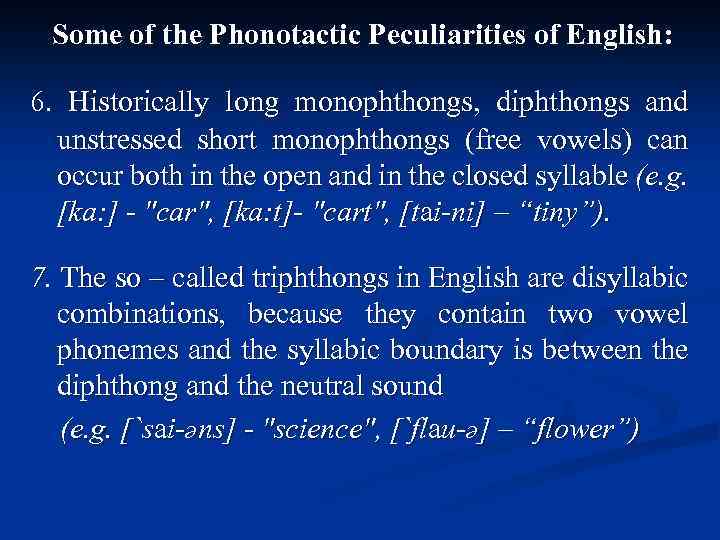
Some of the Phonotactic Peculiarities of English: 6. Historically long monophthongs, diphthongs and unstressed short monophthongs (free vowels) can occur both in the open and in the closed syllable (e. g. [ka: ] ‑ "car", [ka: t]‑ "cart", [tai-ni] – “tiny”). 7. The so – called triphthongs in English are disyllabic combinations, because they contain two vowel phonemes and the syllabic boundary is between the diphthong and the neutral sound (e. g. [`sai-ǝns] ‑ "science", [`flau-ǝ] – “flower”)
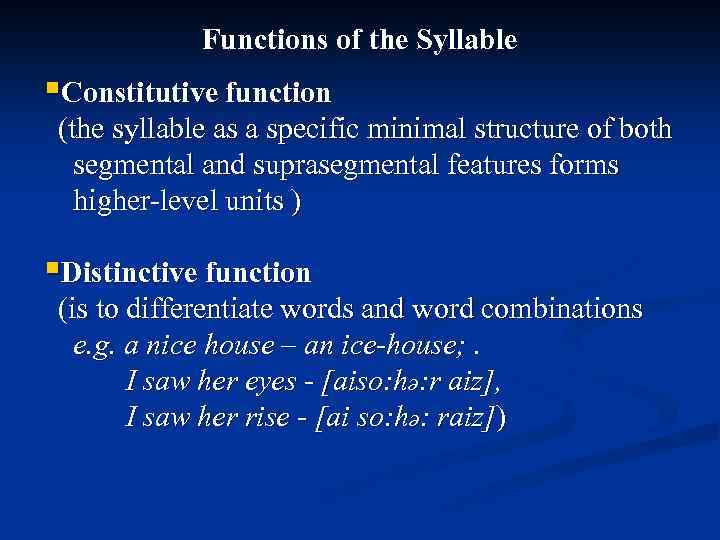
Functions of the Syllable §Constitutive function (the syllable as a specific minimal structure of both segmental and suprasegmental features forms higher-level units ) §Distinctive function (is to differentiate words and word combinations e. g. a nice house – an ice-house; . I saw her eyes ‑ [aiso: hǝ: r aiz], I saw her rise ‑ [ai so: hǝ: raiz])
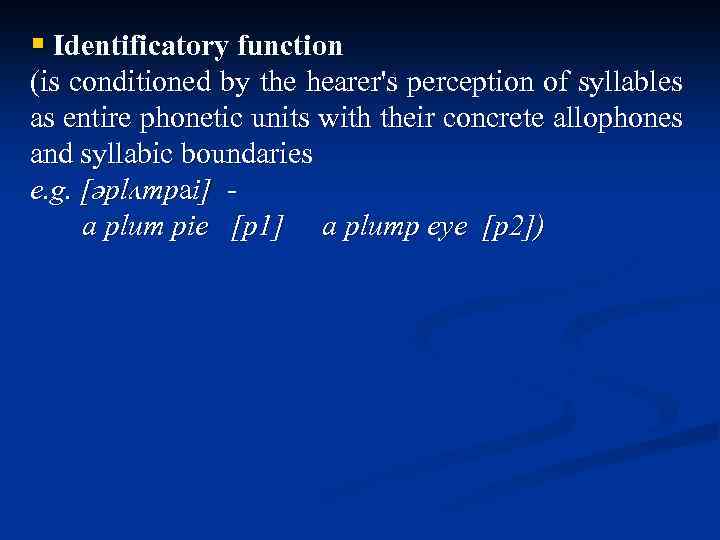
§ Identificatory function (is conditioned by the hearer's perception of syllables as entire phonetic units with their concrete allophones and syllabic boundaries e. g. [ǝplʌmpai] - a plum pie [p 1] a plump eye [p 2])
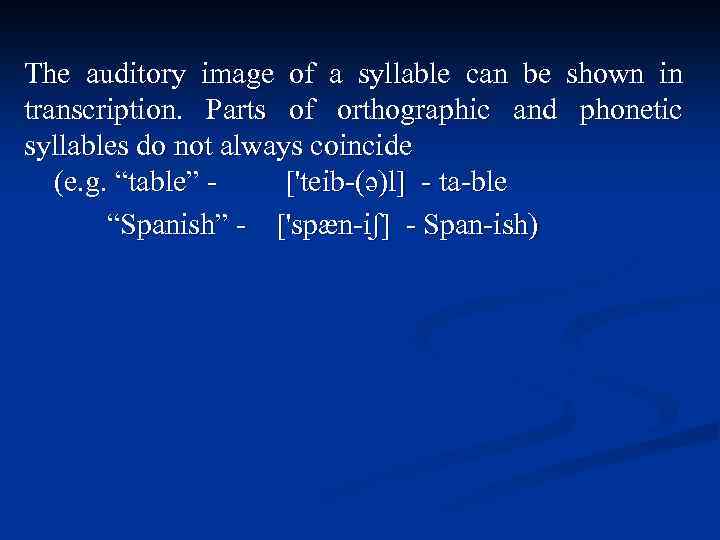
The auditory image of a syllable can be shown in transcription. Parts of orthographic and phonetic syllables do not always coincide (e. g. “table” ['teib-(ǝ)l] - ta-ble “Spanish” - ['spæn-iʃ] - Span-ish)
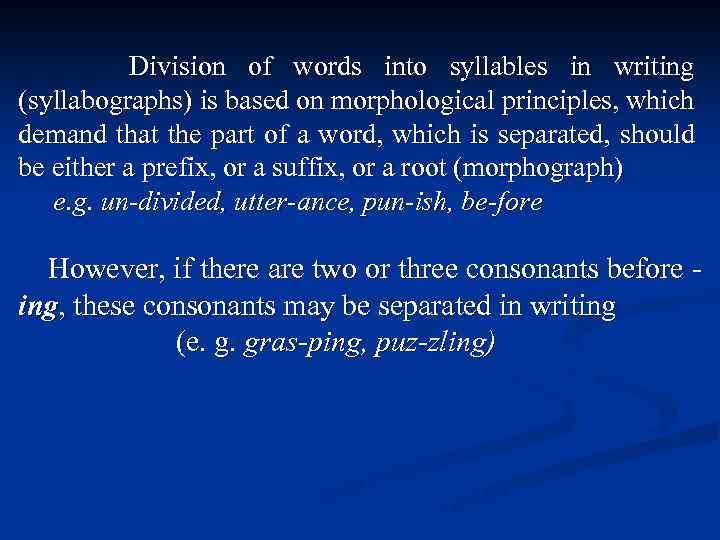
Division of words into syllables in writing (syllabographs) is based on morphological principles, which demand that the part of a word, which is separated, should be either a prefix, or a suffix, or a root (morphograph) e. g. un-divided, utter-ance, pun-ish, be-fore However, if there are two or three consonants before ing, these consonants may be separated in writing (e. g. gras-ping, puz-zling)
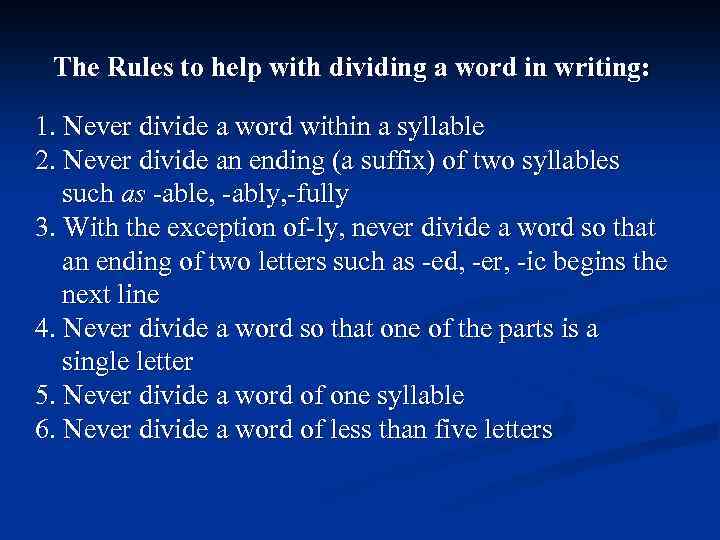
The Rules to help with dividing a word in writing: 1. Never divide a word within a syllable 2. Never divide an ending (a suffix) of two syllables such as -able, -ably, -fully 3. With the exception of-ly, never divide a word so that an ending of two letters such as -ed, -er, -ic begins the next line 4. Never divide a word so that one of the parts is a single letter 5. Never divide a word of one syllable 6. Never divide a word of less than five letters
List of Literature 1. 2. 3. Борисова, Л. В. Теоретическая фонетика английского языка: учеб. пособ. для ин-тов и фак. иностр. яз. / Л. В. Борисова, А. А. Метлюк; под ред. Л. В. Борисовой. – Минск: Выш. шк. , 1980. – 144 с. Леонтьева, С. Ф. Теоретическая фонетика современного английского языка: учеб. для студентов педагогических вузов и университетов / С. Ф. Леонтьева. – М. : Издательство «Менеджер» , 2004. – 336 с. Соколова, М. А. Теоретическая фонетика английского языка: учеб. для студ. высш. учеб. заведений / М. А. Соколова, К. Г. Гинтовт, И. С. Тихонова, Р. М. Тихонова. – М. : Гуманитар. Изд. Центр ВЛАДОС, 2004. – 289 с.
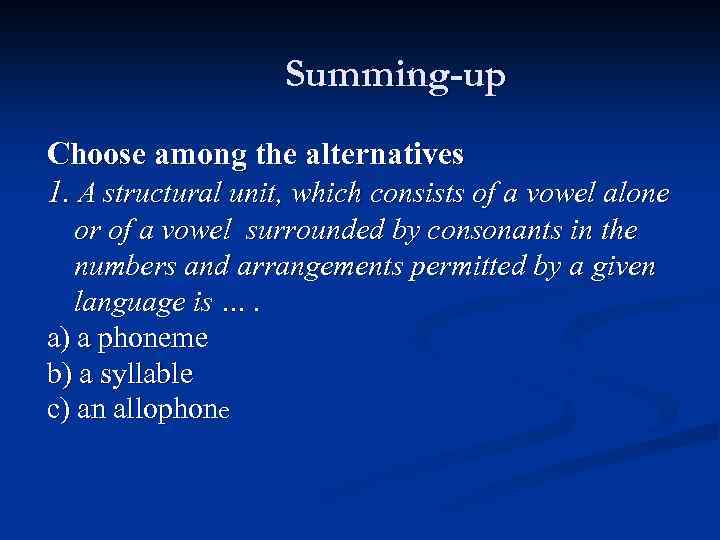
Summing-up Choose among the alternatives 1. A structural unit, which consists of a vowel alone or of a vowel surrounded by consonants in the numbers and arrangements permitted by a given language is …. a) a phoneme b) a syllable c) an allophone
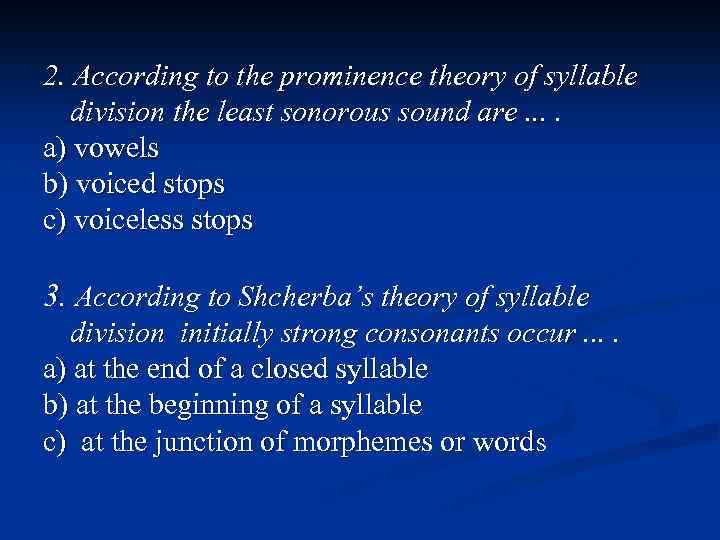
2. According to the prominence theory of syllable division the least sonorous sound are. . a) vowels b) voiced stops c) voiceless stops 3. According to Shcherba’s theory of syllable division initially strong consonants occur. . a) at the end of a closed syllable b) at the beginning of a syllable c) at the junction of morphemes or words
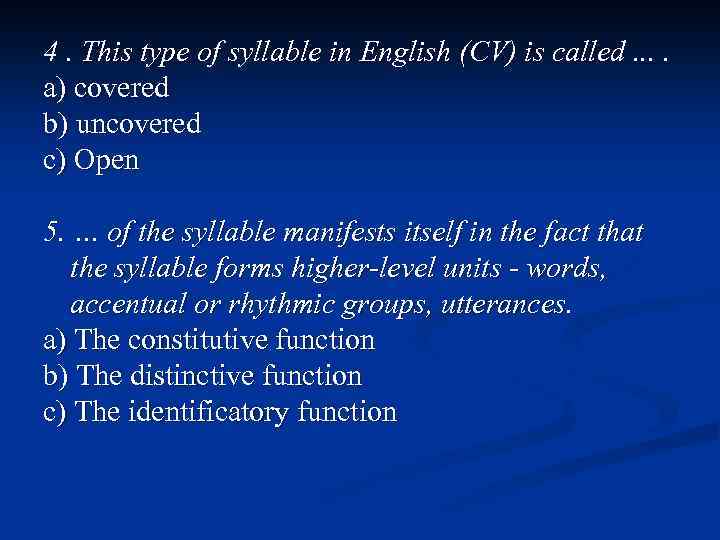
4. This type of syllable in English (CV) is called. . a) covered b) uncovered c) Open 5. … of the syllable manifests itself in the fact that the syllable forms higher-level units - words, accentual or rhythmic groups, utterances. a) The constitutive function b) The distinctive function c) The identificatory function
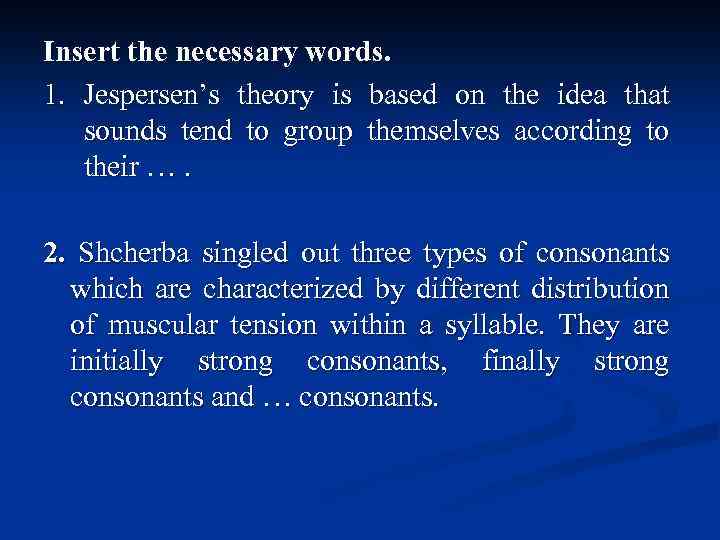
Insert the necessary words. 1. Jespersen’s theory is based on the idea that sounds tend to group themselves according to their …. 2. Shcherba singled out three types of consonants which are characterized by different distribution of muscular tension within a syllable. They are initially strong consonants, finally strong consonants and … consonants.
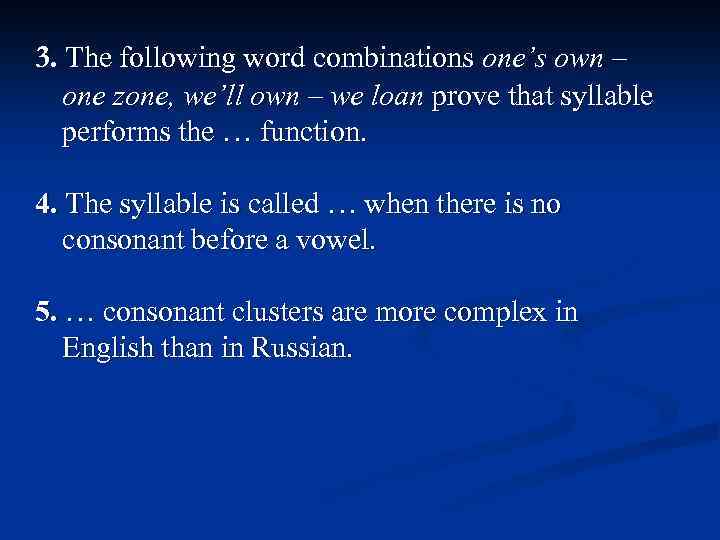
3. The following word combinations one’s own – one zone, we’ll own – we loan prove that syllable performs the … function. 4. The syllable is called … when there is no consonant before a vowel. 5. … consonant clusters are more complex in English than in Russian.
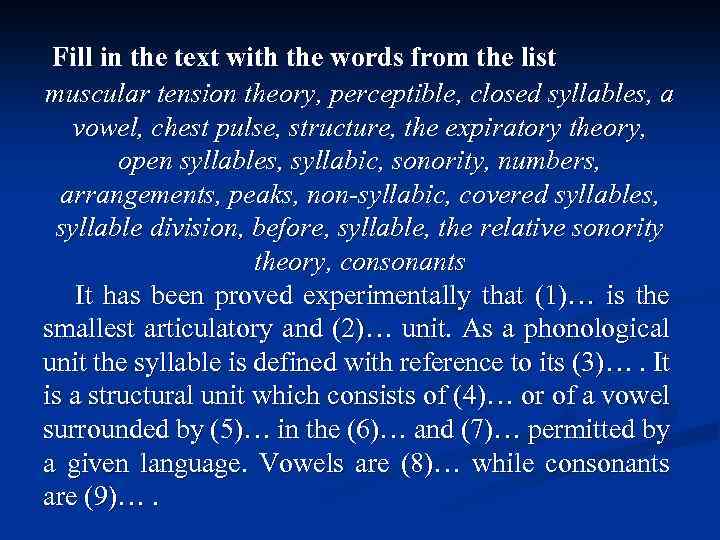
Fill in the text with the words from the list muscular tension theory, perceptible, closed syllables, a vowel, chest pulse, structure, the expiratory theory, open syllables, syllabic, sonority, numbers, arrangements, peaks, non-syllabic, covered syllables, syllable division, before, syllable, the relative sonority theory, consonants It has been proved experimentally that (1)… is the smallest articulatory and (2)… unit. As a phonological unit the syllable is defined with reference to its (3)…. It is a structural unit which consists of (4)… or of a vowel surrounded by (5)… in the (6)… and (7)… permitted by a given language. Vowels are (8)… while consonants are (9)….
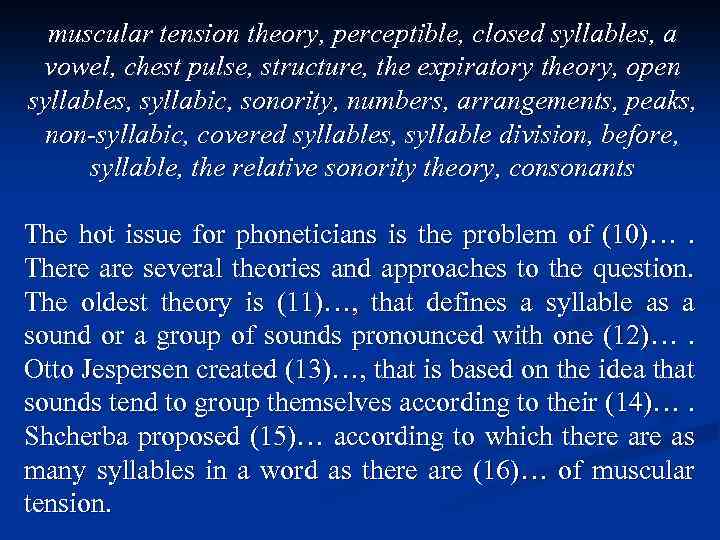
muscular tension theory, perceptible, closed syllables, a vowel, chest pulse, structure, the expiratory theory, open syllables, syllabic, sonority, numbers, arrangements, peaks, non-syllabic, covered syllables, syllable division, before, syllable, the relative sonority theory, consonants The hot issue for phoneticians is the problem of (10)…. There are several theories and approaches to the question. The oldest theory is (11)…, that defines a syllable as a sound or a group of sounds pronounced with one (12)…. Otto Jespersen created (13)…, that is based on the idea that sounds tend to group themselves according to their (14)…. Shcherba proposed (15)… according to which there as many syllables in a word as there are (16)… of muscular tension.
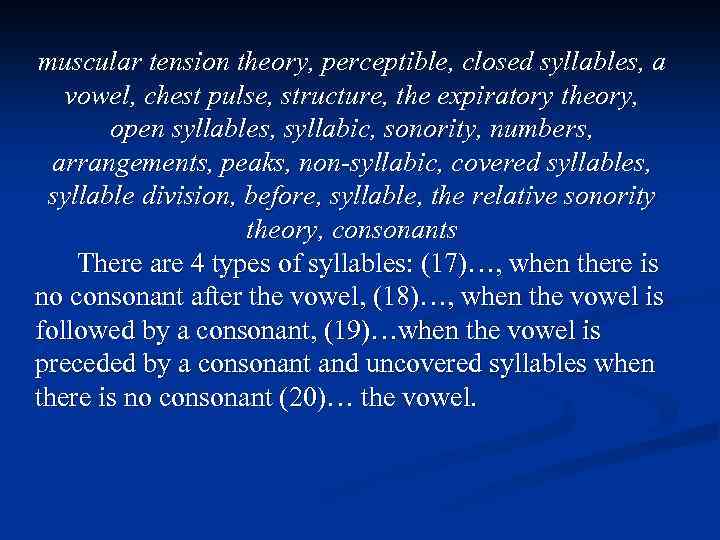
muscular tension theory, perceptible, closed syllables, a vowel, chest pulse, structure, the expiratory theory, open syllables, syllabic, sonority, numbers, arrangements, peaks, non-syllabic, covered syllables, syllable division, before, syllable, the relative sonority theory, consonants There are 4 types of syllables: (17)…, when there is no consonant after the vowel, (18)…, when the vowel is followed by a consonant, (19)…when the vowel is preceded by a consonant and uncovered syllables when there is no consonant (20)… the vowel.
