


 Скачать презентацию Lecture 4 Storage of grain mass 1 Regimes
Lec_4_manadjmant_engl_2011.ppt
- Количество слайдов: 36
 Lecture 4. Storage of grain mass 1. Regimes of storage grain mass. 2. Ways of storage grain mass. 3. The granary for storage of grain.
 Intensity of all physiology processes of grain masses depend on the same major factors: - humidity of grain mass and environment; - temperature of grain mass and environment; - access of air to grain mass. Regimes of storage of grain masses are based on the adjusting of parameters of these factors.
 There are three regimes of grain storage: 1) in the dry state (humidity near to critical); 2) in the cooled state; 3) without access of air.
 The chemical preserving of grain mass are also perspective. It is the treatment of grain mass by some organic acids which kill all living components of grain mass and protect it from biological spoilage.
 The choice of the regimes of storage depend on term of storage, peculiarity of climate, types of granaries and their capacities, purpose setting, qualities of consignment of grain and etc. The best results are possible at complex used the different regimes. For example, the storage of dry grain mass at the low temperatures.
 Storage of grain in the dry state A grain is dry, when no free moisture in it, and there is the only linked humidity, difficult for the active vital functions of grain and microorganisms.
 Grains of wheat, rye, barley, oat are dry, if it contains humidity up to 14%. The optimum norms of humidity for the long term storage of grain consignment is to be on 1 - 2 % below than critical humidity.
 Dry grain is usually storied in the bulk of height up to 10 - 12 m. Therefore in modern granary grain are loaded on maximal height, what possible to technical guide on a granary. Grain mass are well-prepared (cleared from admixtures, disinfected and cooling) possible to storage without moving in granary during 4 -5 years, and in the silos of elevators 2 -3 years.
 Storage of grain in the cooled state Cooling sharply brakes intensity of all biological processes in grain mass, reduce the vital functions of microorganisms, as the result of death of greater part of insects.
 Grain mass cooling to the first degree when temperature of all layers of bulk is less than 10 °С, second degree is less than 0 °С. The optimal for storage of grain the temperature is 0 till 5 °С.
 The basic meaning of the storage regime of grain in the cooled state is temporal preservation of moist and wet grain on a certain period (to beginning its drying). For cooling grain beside atmospheric air used also artificially cool air from refrigeration units (to apply for cooling of rice grain, seeds of sunflower and seeds of vegetable).
 Methods of cooling of grain mass by atmospheric air are divide into two groups: - passive; - active. At the passive cooling does not mix the grain mass and does not force air in it.
 Active methods of grain cooling - pass grain through cleaners, conveyers and norias; - treatment of grain on stationary or mobile installations for active aeration. Presently the basic method of cooling of grain is active aeration by atmospheric air.
 Storage of grain without access of air Absence of oxygen in intergrain spaces reduce of intensity of breathing of grain mass, as a result the grain of basic crop and other living components pass to the anaerobic breathing and gradually perish.
 As a result of the anaerobic breathing of grain release of warm reduced in 30 times and development of grain selfheating is eliminated. At such regimes vital capacity (схожість) of wet grain is lost and it used mainly as feed-stuff. The stable storage of grain at this regimes may be at full closure of granary. If content of oxygen exceeds 0. 5 % in grain, it will possible to development the mould and spoilage of grain.
 Anaerobic conditions at storage of grain create to one from three methods: 1) by the natural piling up a carbon dioxide and lost of oxygen during breathing of living components of grain mass; 2) by added to grain mass the gases (carbon dioxide, nitrogen and etc. ); 3) by creation in grain mass a vacuum.
 Chemical preservation of grain mass carry out with used different chemical matters which bring a grain to the state of anabiosis or abioze. All biological process in grain mass are stopped, the respiratory functions of grain and vital functions of microorganisms, bacteriums, yeasts are partly braked.
 There are two chemical protections of grain: 1) beforehand seed sterilization (завчасне протруювання зерна); 2) preservation of feed-stuff grain with the high humidity (for this purpose of chemical matters are used as preservatives - organic acids: vinegar, ant and propionic and also mixtures of these acids, Sodium Pyrosulphate, carbon ammonium salts).
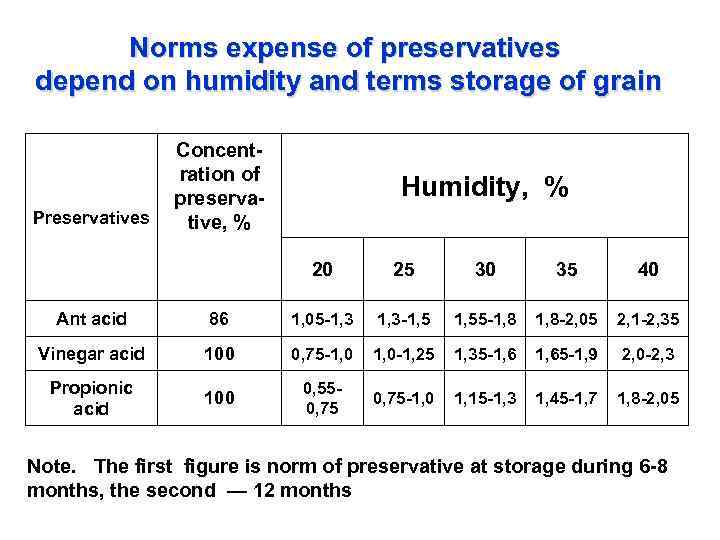 Norms expense of preservatives depend on humidity and terms storage of grain Preservatives Concentration of preservative, % Humidity, % 20 25 30 35 40 Ant acid 86 1, 05 -1, 3 -1, 55 -1, 8 -2, 05 2, 1 -2, 35 Vinegar acid 100 0, 75 -1, 0 -1, 25 1, 35 -1, 65 -1, 9 2, 0 -2, 3 Propionic acid 100 0, 550, 75 -1, 0 1, 15 -1, 3 1, 45 -1, 7 1, 8 -2, 05 Note. The first figure is norm of preservative at storage during 6 -8 months, the second — 12 months
 Ways of storage of grain mass The ways of storage of grain mass depend on their physical and physiological properties mainly.
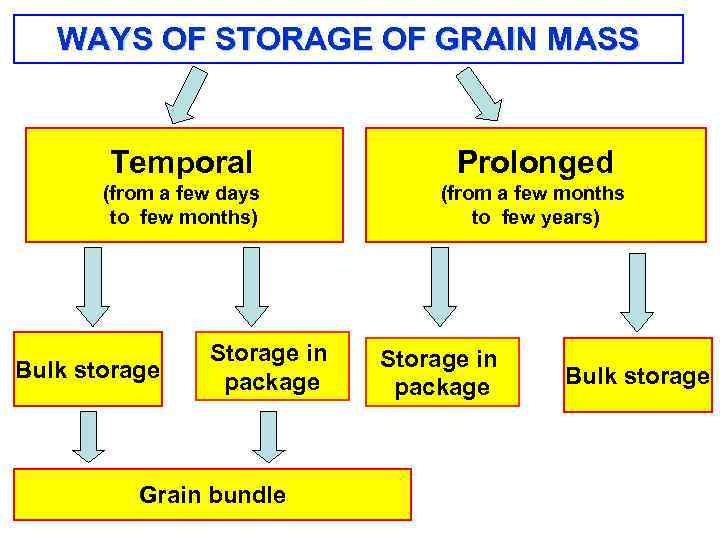 WAYS OF STORAGE OF GRAIN MASS Temporal Prolonged (from a few days to few months) (from a few months to few years) Bulk storage Storage in package Grain bundle Storage in package Bulk storage
 In a period harvesting of grain there is a necessity in organization of temporal storage of grain on barn floor - in grain bundle. Grain bundle is grain consignment, which are made of taking into account the set rules outside granary, that under the opened sky, in an bulk or package.
 Storage in grain bundle: The form of grain bundles are cone, pyramid, truncate pyramid or other configuration. It is help simple curve of bundle and guarantee the best flowing of atmospheric precipitation. Grain only food and feed-stuff purpose storage in the bundle. At the storage grain in a bundle taking account next peculiarity: - right choice of place for the bundle and its preparation; - preparation of grain mass after storage in grain bundle; - way of curve grain bundle.
 Place for bundle must be on flat place because atmospheric precipitation do not keep off on the it. Grain mass must be cooling to temperature is 8˚С and lower.
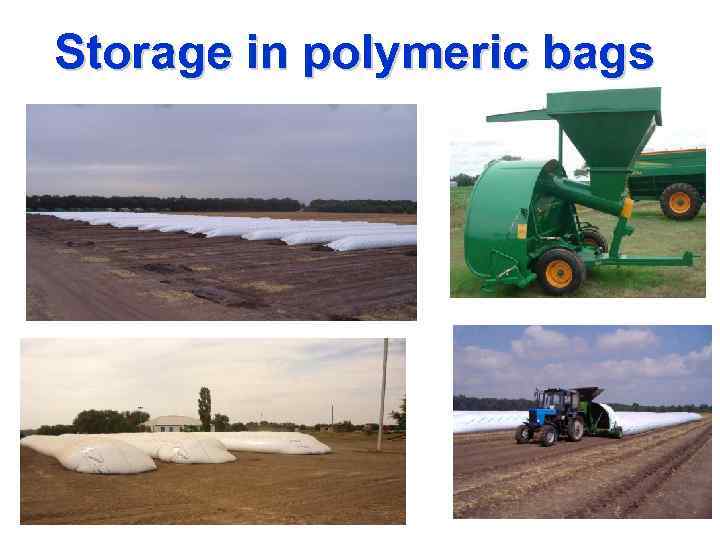 Storage in polymeric bags
 The types of granary for storage of grain. - single-storey of building with horizontal or sloping floors; - granary of bunker type; - elevators.
 The basic requirements to constructions of granaries Granary is to be good isolated from atmospheric and soil waters and sharply of temperature drop; protected from penetration of rodents and insects; to have mechanisms for the loading and unloading and rapid moving of grain mass; to provide storage of a few consignments of grain prevent their mixing; must have an ability for the control of process of storage of grain and conducting of prophylactic and health procedure in a granary.
 Classification of granary Granary is classified by the indexes: way of storage, degree of mechanization, location, building materials, duration of storage and etc.
 For degree of mechanization granary subdivide into: - mechanized (with stationary mechanisms for mechanization loading and unloading of grain); - partly mechanized (with stationary mechanisms for implementation of one operation, usual for the load of grain); - unmechanized (for facilitation of works applied only mobile mechanisms).
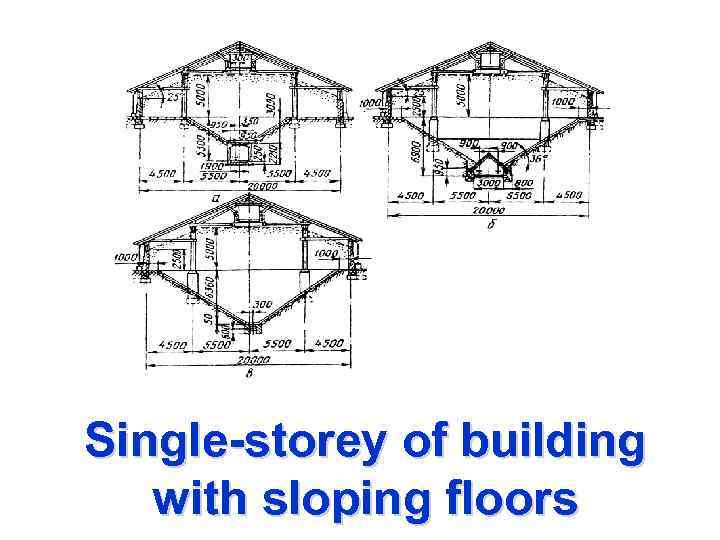 Single-storey of building with sloping floors
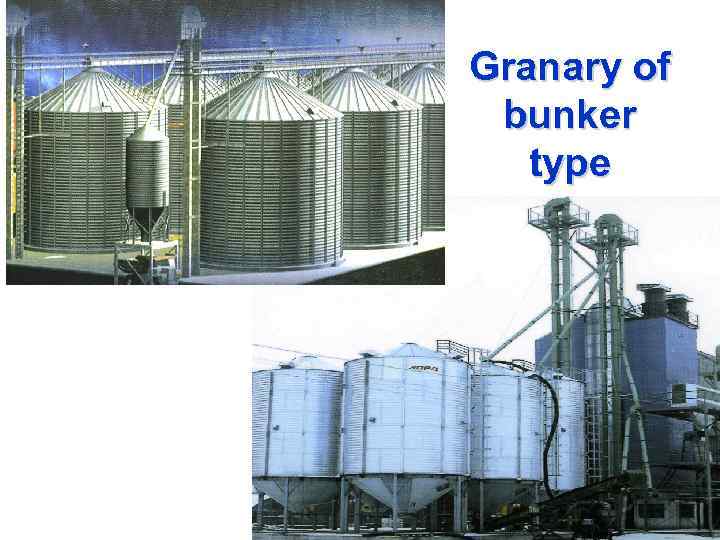 Granary of bunker type
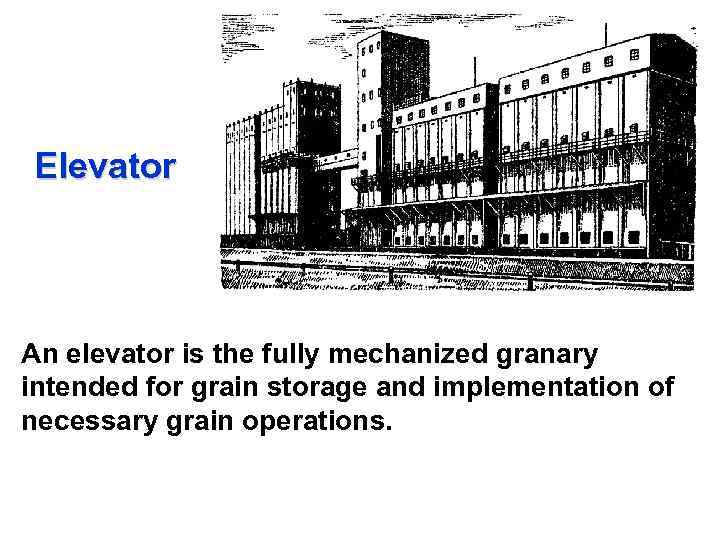 Elevator An elevator is the fully mechanized granary intended for grain storage and implementation of necessary grain operations.
 Elevator, as the fully mechanized granary, is intended for implementation of all load-unloading works, complete technological treatment and grain storage. It can be examined as complex combination of basic equipments and buildings: working tower with the technological and transport equipments; silos frame with the transport and other equipments; equipments for acceptance of grain from lorry, goods waggon, barge; equipments for unload of grain on different types of transport; systems of aspiration and removing of wastes.
 Elevators may be milling, trans-shipment, porting and purveying.
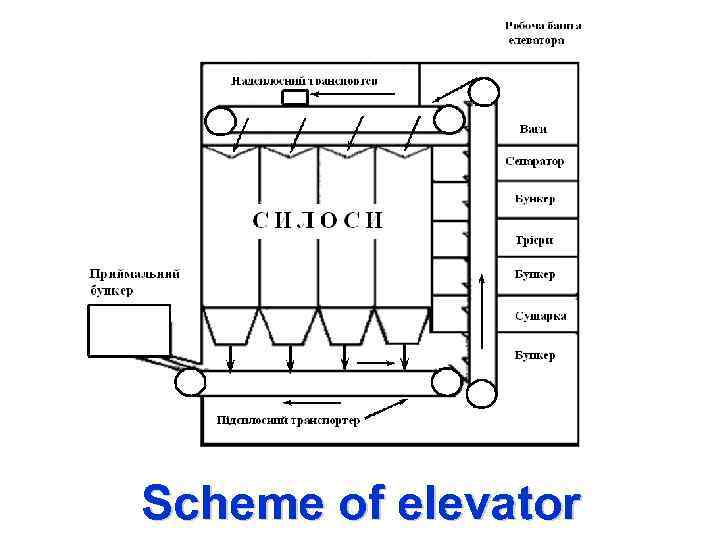 Scheme of elevator
 Thank you for attention.