


 Скачать презентацию LECTURE 4 OLD ENGLISH GRAMMAR THE NOMINAL SYSTEM
Lecture 4.ppt
- Количество слайдов: 17
 LECTURE 4 OLD ENGLISH GRAMMAR. THE NOMINAL SYSTEM
 Plan 1. 2. 3. 4. 5. 6. 7. General Characteristics of OE Grammar. The Noun. Its Grammatical Categories Noun Declensions. The Adjective. Morphological categories of the Adjective. Strong and Weak Declensions of Adjectives. Degrees of Comparison. The Pronoun. Classes of Pronouns. The Adverb.
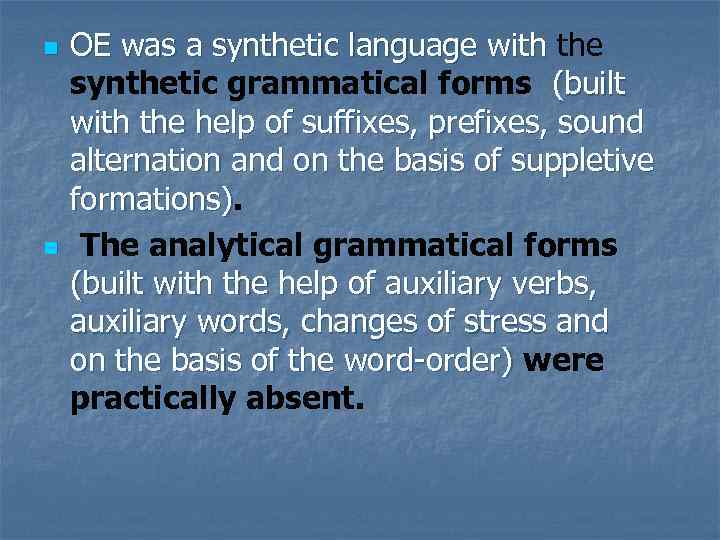 n n OE was a synthetic language with the synthetic grammatical forms (built with the help of suffixes, prefixes, sound alternation and on the basis of suppletive formations) The analytical grammatical forms (built with the help of auxiliary verbs, auxiliary words, changes of stress and on the basis of the word-order) were practically absent.
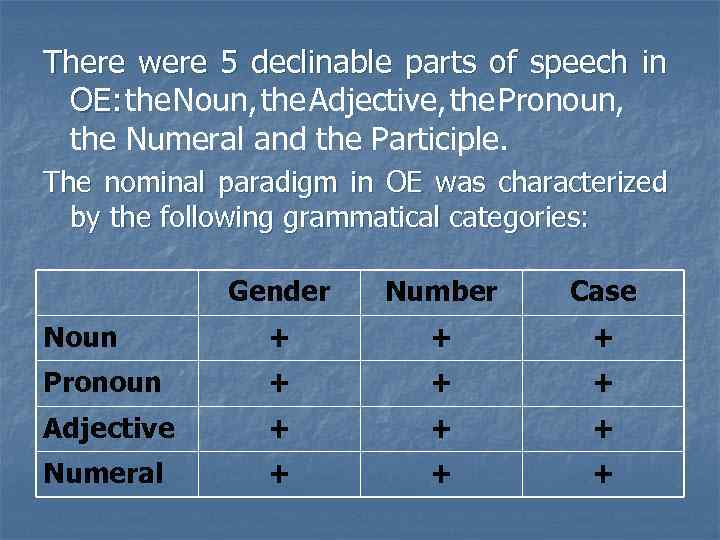 There were 5 declinable parts of speech in OE: the Noun, the Adjective, the Pronoun, the Numeral and the Participle. The nominal paradigm in OE was characterized by the following grammatical categories: Gender Number Case Noun + + + Pronoun + + + Adjective + + + Numeral + + +
 n The Noun in OE. The OE noun had grammatical categories of Gender, Number and Case. n The category of gender was based on the opposition of three genders – masculine, feminine and neuter. n Gender was not a purely grammatical category. It was a lexico-grammatical category, because gender was expressed not so much by the inflections but by the forms of agreement of adjectives, numerals and pronouns which modify the noun.
 n n Thus every noun with all its forms belonged to one of the genders. The grammatical gender didn’t always coincide with the natural gender of the person and sometimes even contradicted it (e. g. the noun wifman (woman) was declined as masculine) The grammatical category of Gender in OE is already in the process of decay: some nouns could be declined in accordance with different genders usually in different texts: e. g. ærist (resurrection) – m, f and n.
 n n The OE Noun had two numbers: singular and plural. The category of case was represented by four opposite members: N (the Nominative case); G (the Genitive case); D (the Dative case); Acc. (the Accusative case). The once existing instrumental case was no longer existing in OE. Its functions were taken by the Dative case.
 n n The Adjective in OE. The OE adjective was a fully declinable part of speech. It had the same categories as nouns (number, gender and case): 2 numbers, 3 genders and 5 cases. The categories of adjectives differ from the same categories of nouns: the categories of nouns are independent while the categories of adjectives are dependable upon the nouns. OE adjectives usually agree with the nouns they refer to in gender, number and case: this feature characterizes Modern Slavonic languages.
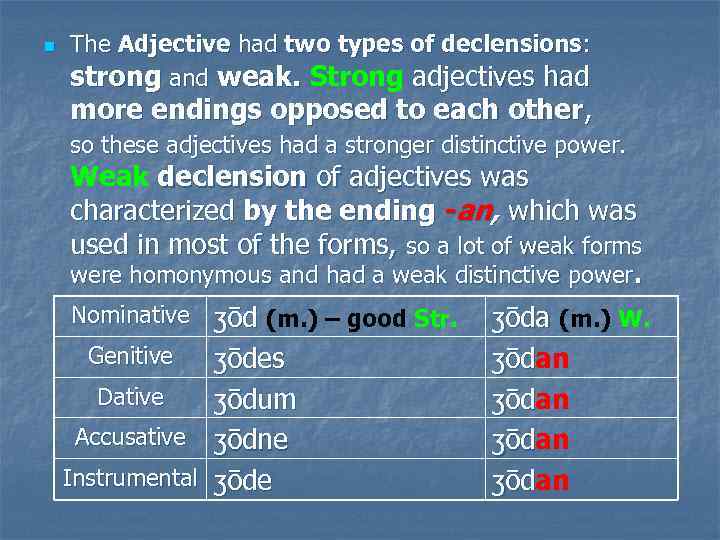 n The Adjective had two types of declensions: strong and weak. Strong adjectives had more endings opposed to each other, so these adjectives had a stronger distinctive power. Weak declension of adjectives was characterized by the ending -an, which was used in most of the forms, so a lot of weak forms were homonymous and had a weak distinctive power. Nominative ʒōd (m. ) – good Str. ʒōdes Dative ʒōdum Accusative ʒōdne Instrumental ʒōde Genitive ʒōda (m. ) W. ʒōdan ōd
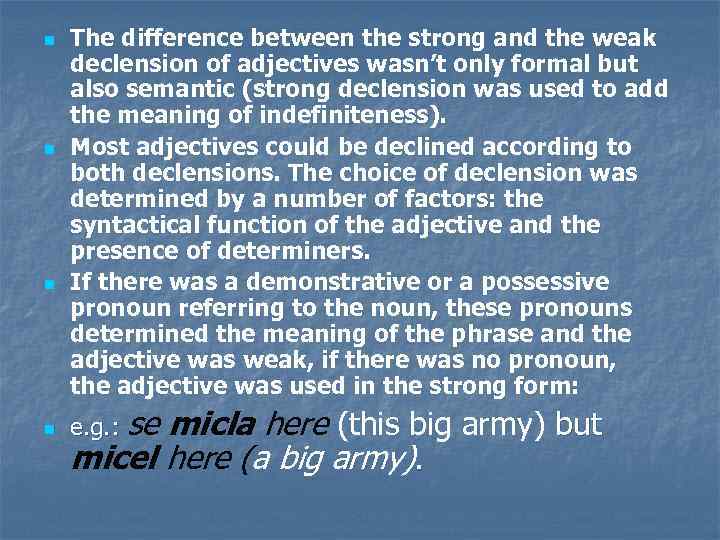 n n The difference between the strong and the weak declension of adjectives wasn’t only formal but also semantic (strong declension was used to add the meaning of indefiniteness). Most adjectives could be declined according to both declensions. The choice of declension was determined by a number of factors: the syntactical function of the adjective and the presence of determiners. If there was a demonstrative or a possessive pronoun referring to the noun, these pronouns determined the meaning of the phrase and the adjective was weak, if there was no pronoun, the adjective was used in the strong form: e. g. : se micla here (this big army) but micel here (a big army).
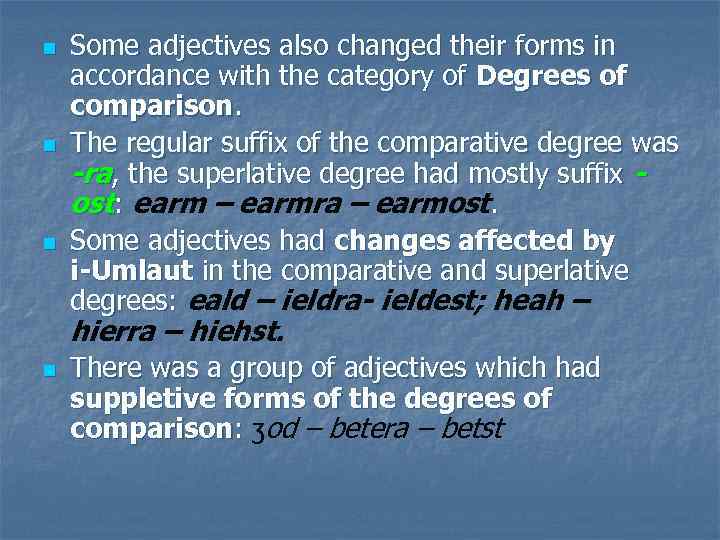 n n n Some adjectives also changed their forms in accordance with the category of Degrees of comparison. The regular suffix of the comparative degree was -ra, the superlative degree had mostly suffix ost: earm – earmra – earmost. Some adjectives had changes affected by i-Umlaut in the comparative and superlative degrees: eald – ieldra- ieldest; heah – hierra – hiehst. n There was a group of adjectives which had suppletive forms of the degrees of comparison: ʒod – betera – betst
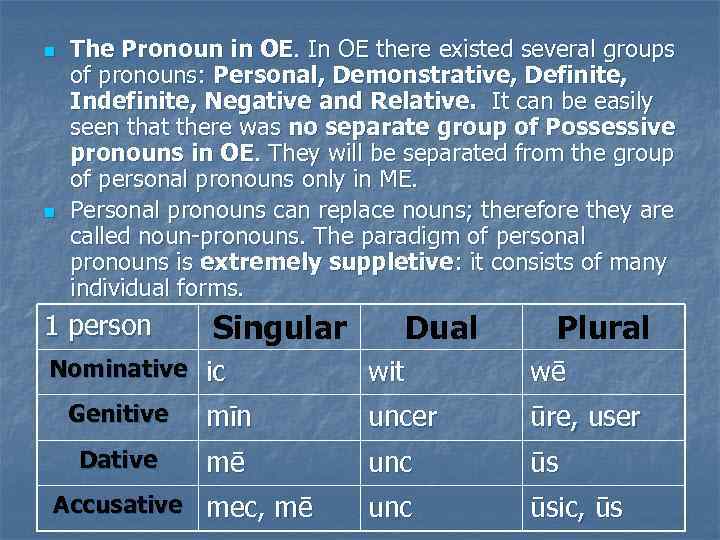 n n The Pronoun in OE. In OE there existed several groups of pronouns: Personal, Demonstrative, Definite, Indefinite, Negative and Relative. It can be easily seen that there was no separate group of Possessive pronouns in OE. They will be separated from the group of personal pronouns only in ME. Personal pronouns can replace nouns; therefore they are called noun-pronouns. The paradigm of personal pronouns is extremely suppletive: it consists of many individual forms. 1 person Singular Nominative ic Dual Plural wit wē Genitive mīn uncer ūre, user Dative mē unc ūsic, ūs Accusative mec, mē
 n Personal pronouns had the following grammatical categories: the category of Person (three persons: the first, the second and the third); the category of Number (three numbers: singular, dual and plural); the category of Case (four cases: Nominative, Genitive, Dative, Accusative). The third person singular had the category of gender with masculine, feminine, neuter forms. In plural there was no gender differences: one form could be referred to different genders.
 n Demonstrative pronouns. If personal pronouns are often called nounpronouns the demonstrative pronouns are called adjective-pronouns because they fulfill identical with adjectives functions and their grammatical categories are very much alike. Practically speaking there existed two demonstrative pronouns – sē (that) and ðes (this). These pronouns had many paradigmatic forms reflecting grammatical categories of gender, case, number and also the deictic (near-far) category. That is why these pronouns make up two groups based on the deictic opposition.
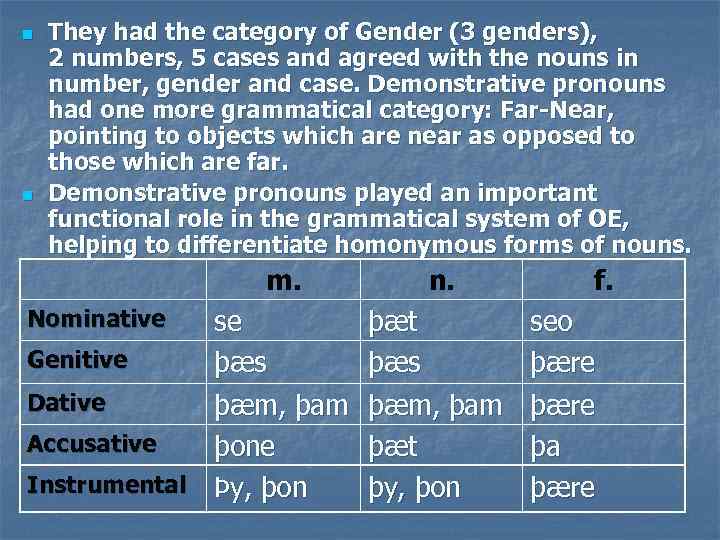 n n They had the category of Gender (3 genders), 2 numbers, 5 cases and agreed with the nouns in number, gender and case. Demonstrative pronouns had one more grammatical category: Far-Near, pointing to objects which are near as opposed to those which are far. Demonstrative pronouns played an important functional role in the grammatical system of OE, helping to differentiate homonymous forms of nouns. m. Nominative Genitive se þæs þæm, þam Accusative þone Instrumental Þy, þon Dative n. f. þæt þæs seo þære þæm, þam þæt þy, þon þære þa þære
 The Adverb in OE adverbs denoted specific kinds of actions expressed by the verb. Structurally, they could be primary and secondary (or derived). The latter could be derived from simple (primary) adjectives with the help of suffixes -e and –lice : heard – hearde, heardlic – heardlice. The suffix -lice of adverbs in ME will be reduced to -lic and thus will coincide in form with -lic of adjectives. That is why in Mod. E we have homophonic forms: adjectives and adverbs having suffix -ly.
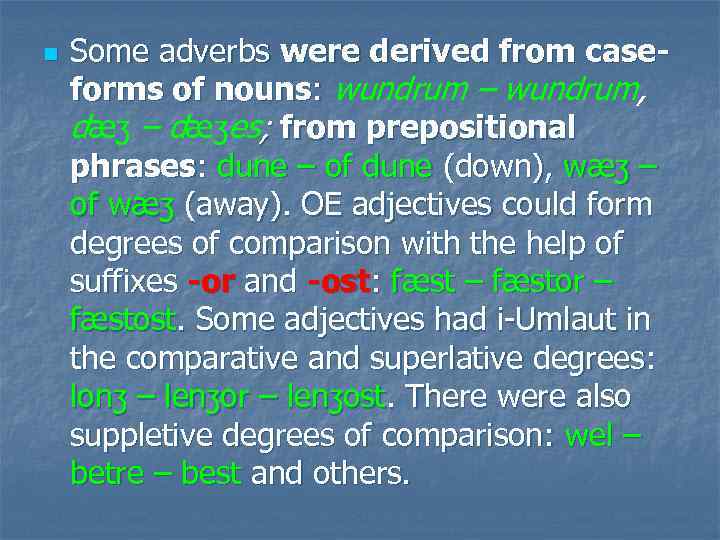 n Some adverbs were derived from caseforms of nouns: wundrum – wundrum, dæʒ – dæʒes; from prepositional phrases: dune – of dune (down), wæʒ – of wæʒ (away). OE adjectives could form degrees of comparison with the help of suffixes -or and -ost: fæst – fæstor – fæstost. Some adjectives had i-Umlaut in the comparative and superlative degrees: lonʒ – lenʒor – lenʒost. There were also suppletive degrees of comparison: wel – betre – best and others.