


 Скачать презентацию Lecture 4 OE Morphology Typological classification 19
L4.pptx
- Количество слайдов: 30
 Lecture 4 OE Morphology
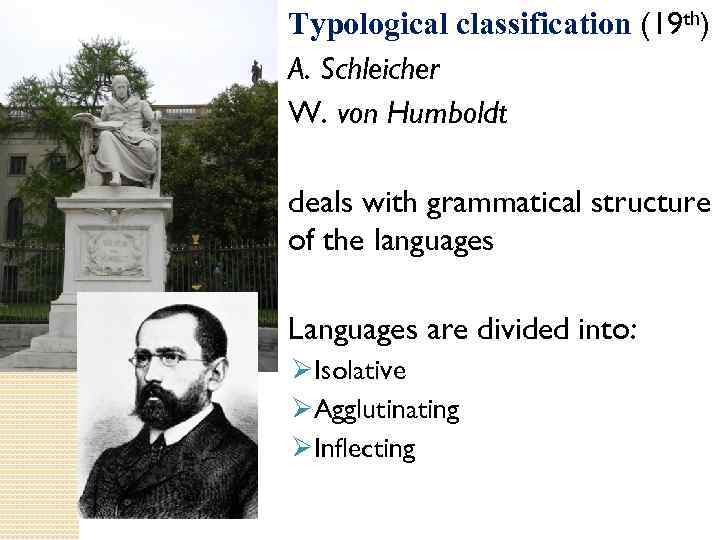 Typological classification (19 th) A. Schleicher W. von Humboldt deals with grammatical structure of the languages Languages are divided into: ØIsolative ØAgglutinating ØInflecting
 isolating Chinese and Vietnamese each lexical or grammatical unit of information is carried by an individual morph, without affixation or modification. Eg. : Georgian: Miq’varkhan. – I love you.
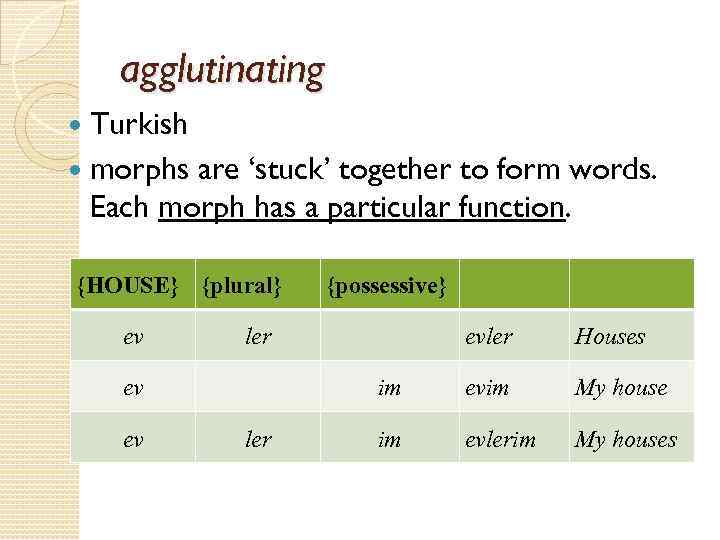 agglutinating Turkish morphs are ‘stuck’ together to form words. Each morph has a particular function. {HOUSE} {plural} ev ler evler Houses im ev ev {possessive} evim My house im evlerim My houses
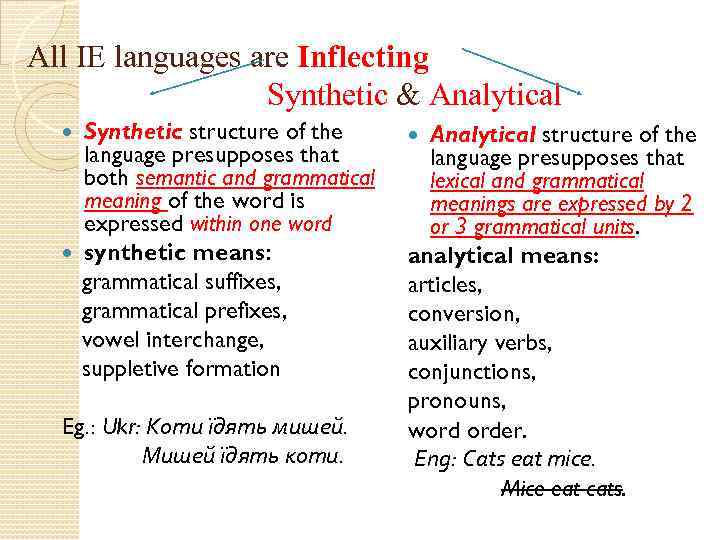 All IE languages are Inflecting Synthetic & Analytical Synthetic structure of the language presupposes that both semantic and grammatical meaning of the word is expressed within one word synthetic means: grammatical suffixes, grammatical prefixes, vowel interchange, suppletive formation Eg. : Ukr: Коти їдять мишей. Мишей їдять коти. Analytical structure of the language presupposes that lexical and grammatical meanings are expressed by 2 or 3 grammatical units. analytical means: articles, conversion, auxiliary verbs, conjunctions, pronouns, word order. Eng: Cats eat mice. Mice eat cats.
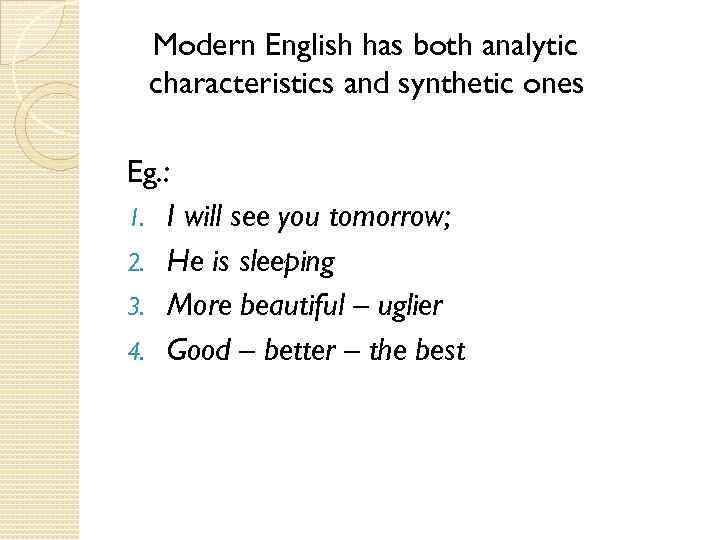 Modern English has both analytic characteristics and synthetic ones Eg. : 1. I will see you tomorrow; 2. He is sleeping 3. More beautiful – uglier 4. Good – better – the best
 OE morphology is different from that of Modern English, predominantly by being much more highly inflected Among living languages, OE morphology most closely resembles that of modern Icelandic and to a lesser extent that of modern High German
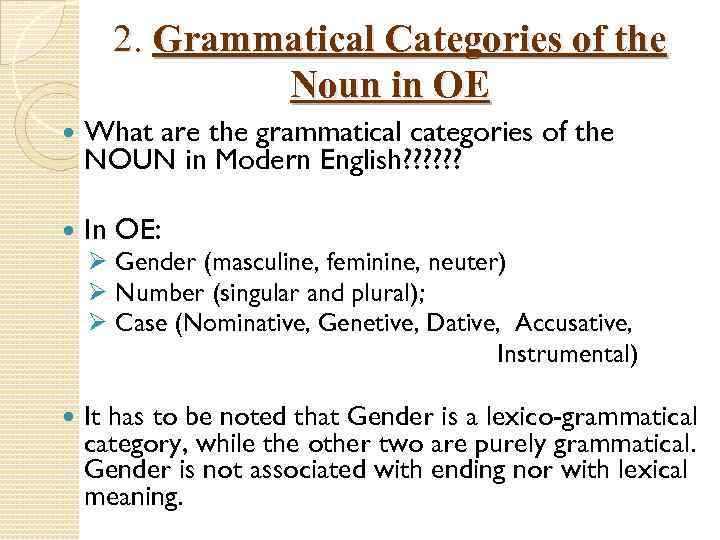 2. Grammatical Categories of the Noun in OE What are the grammatical categories of the NOUN in Modern English? ? ? In OE: Ø Gender (masculine, feminine, neuter) Ø Number (singular and plural); Ø Case (Nominative, Genetive, Dative, Accusative, Instrumental) It has to be noted that Gender is a lexico-grammatical category, while the other two are purely grammatical. Gender is not associated with ending nor with lexical meaning.
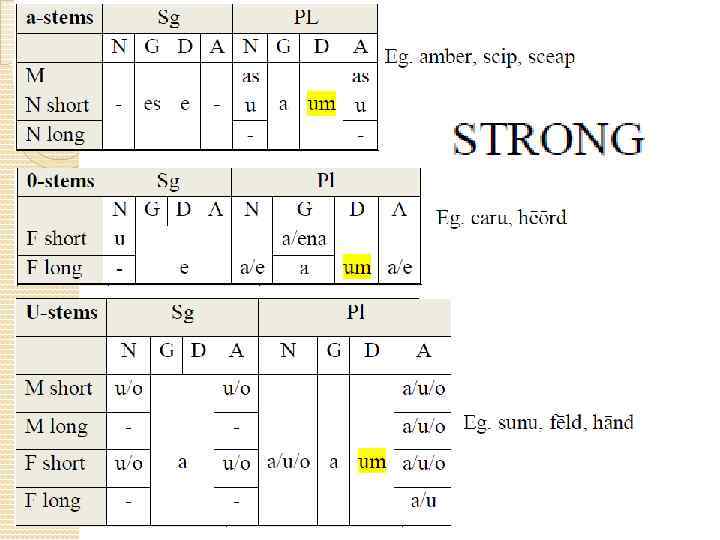
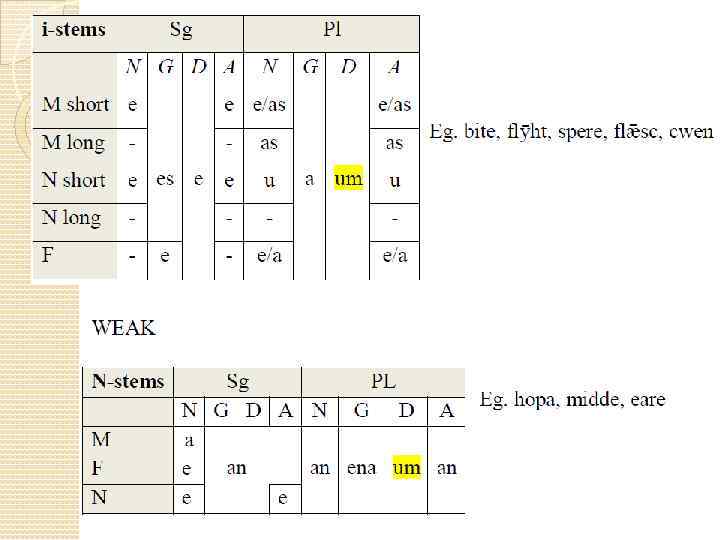
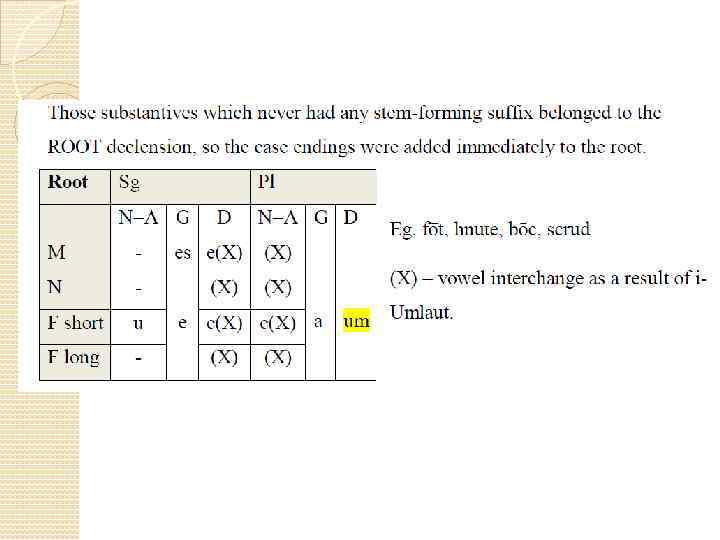
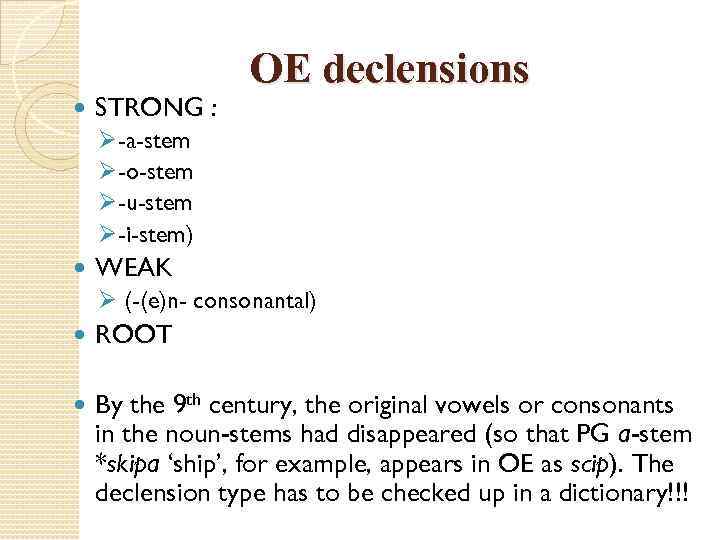 STRONG : OE declensions Ø-a-stem Ø-o-stem Ø-u-stem Ø-i-stem) WEAK Ø (-(e)n- consonantal) ROOT By the 9 th century, the original vowels or consonants in the noun-stems had disappeared (so that PG a-stem *skipa ‘ship’, for example, appears in OE as scip). The declension type has to be checked up in a dictionary!!!
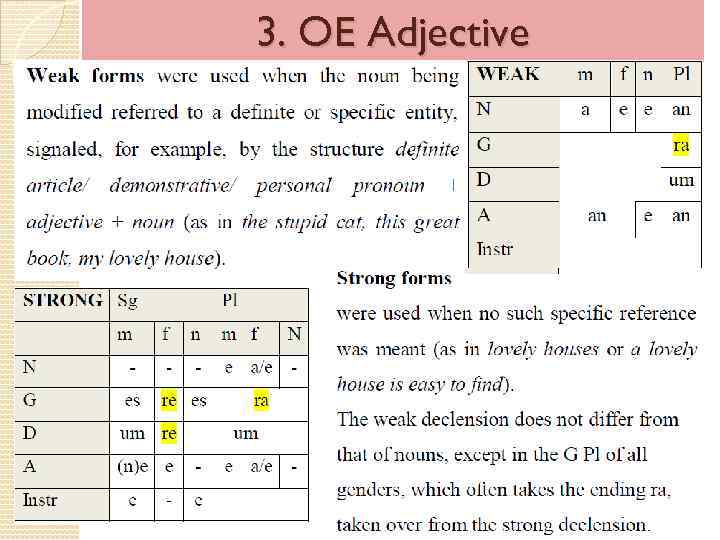 3. OE Adjective
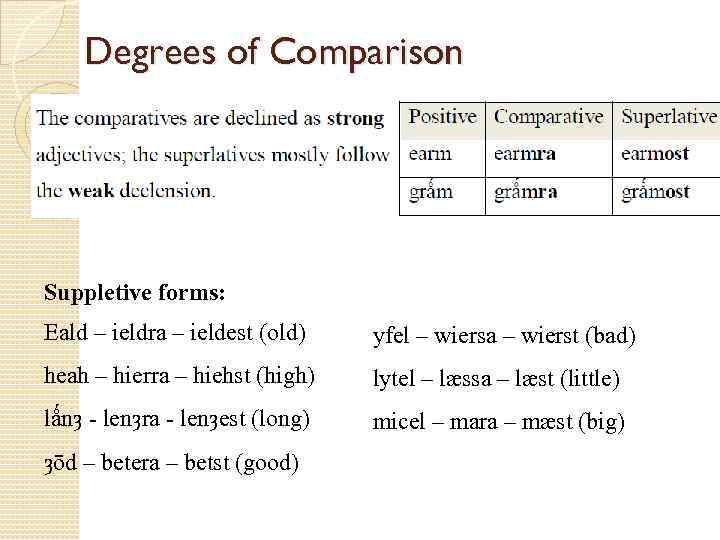 Degrees of Comparison Suppletive forms: Eald – ieldra – ieldest (old) yfel – wiersa – wierst (bad) heah – hierra – hiehst (high) lytel – læssa – læst (little) lǻnȝ - lenȝra - lenȝest (long) micel – mara – mæst (big) ȝōd – betera – betst (good)
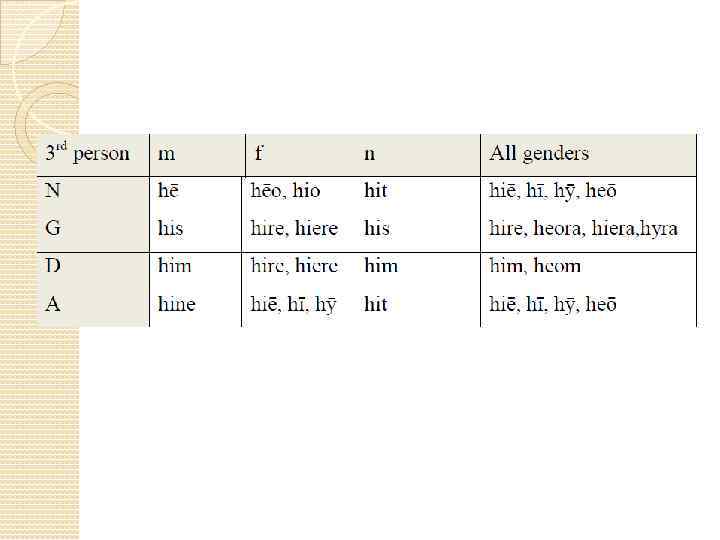
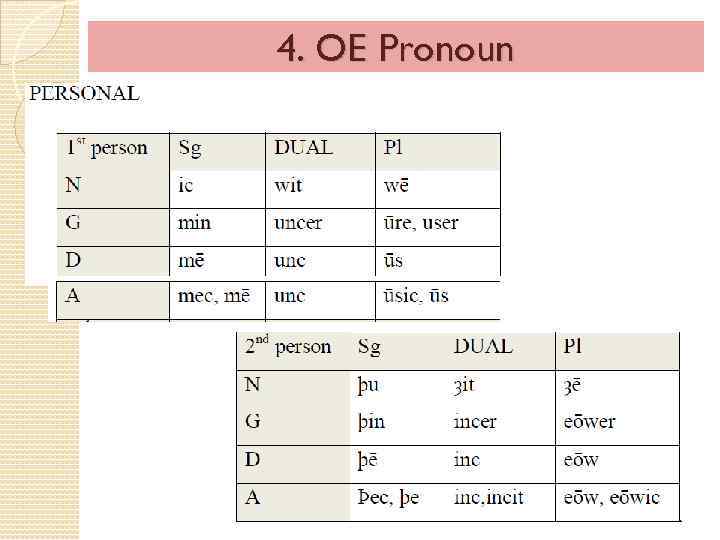 4. OE Pronoun
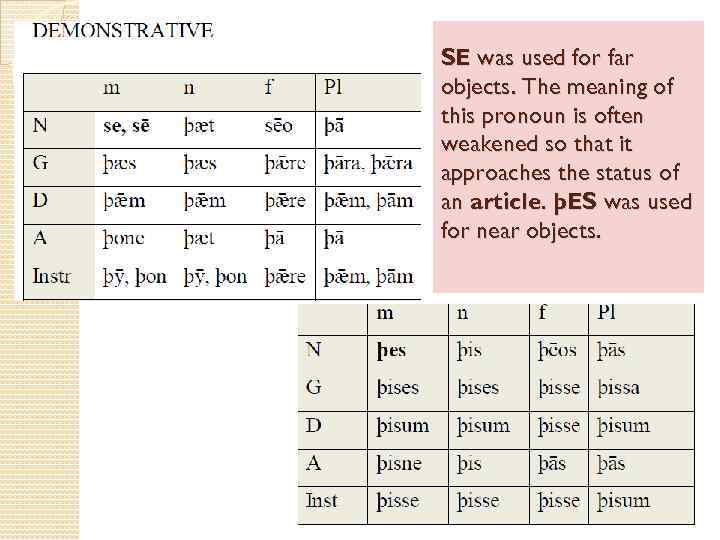 SE was used for far objects. The meaning of this pronoun is often weakened so that it approaches the status of an article. þES was used for near objects.
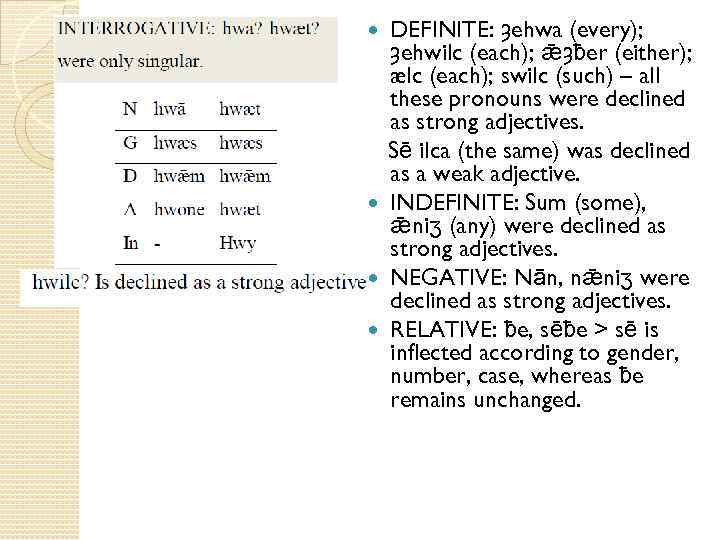 DEFINITE: ȝehwa (every); ȝehwilc (each); ǣȝƀer (either); ælc (each); swilc (such) – all these pronouns were declined as strong adjectives. Sē ilca (the same) was declined as a weak adjective. INDEFINITE: Sum (some), ǣniʒ (any) were declined as strong adjectives. NEGATIVE: Nān, nǣniʒ were declined as strong adjectives. RELATIVE: ƀe, sēƀe > sē is inflected according to gender, number, case, whereas ƀe remains unchanged.
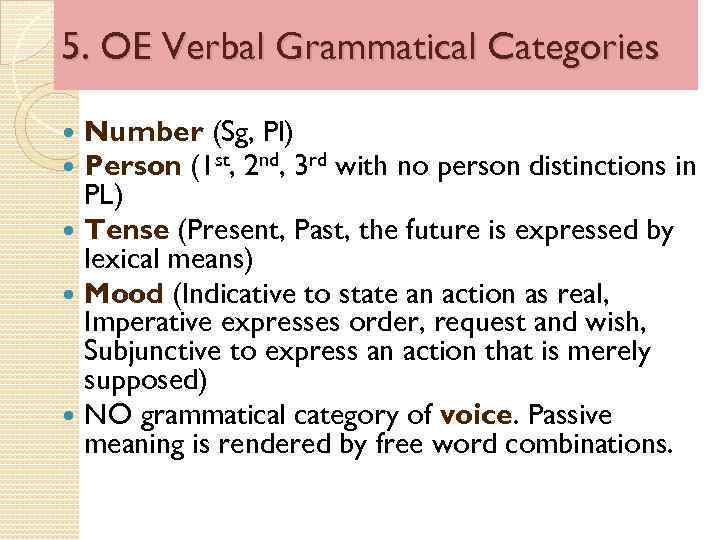 5. OE Verbal Grammatical Categories Number (Sg, Pl) Person (1 st, 2 nd, 3 rd with no person distinctions in PL) Tense (Present, Past, the future is expressed by lexical means) Mood (Indicative to state an action as real, Imperative expresses order, request and wish, Subjunctive to express an action that is merely supposed) NO grammatical category of voice. Passive meaning is rendered by free word combinations.
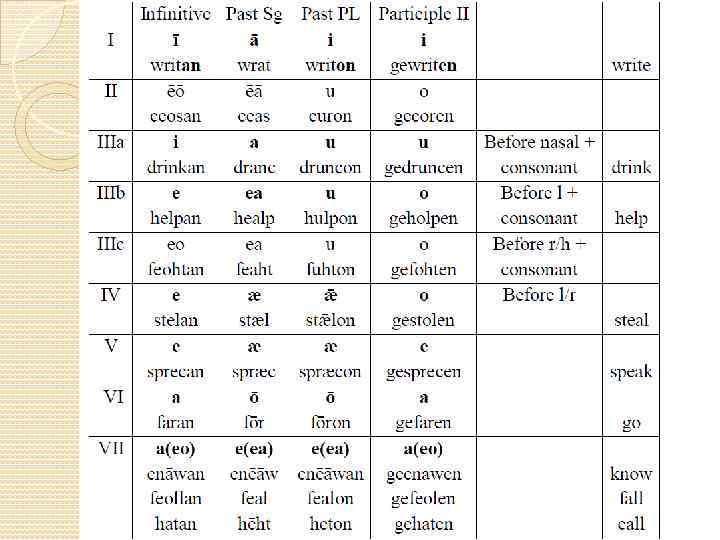
 (A) STRONG VERBS divided into 7 classes according to vowel gradation (ablaut) now are called irregular
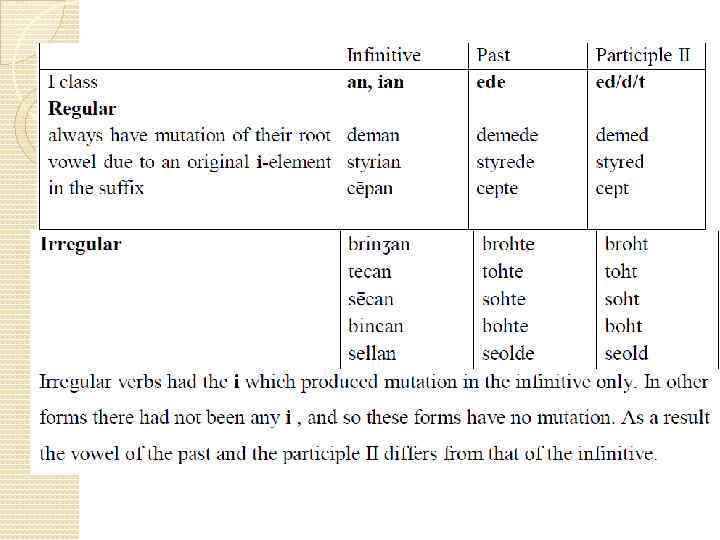
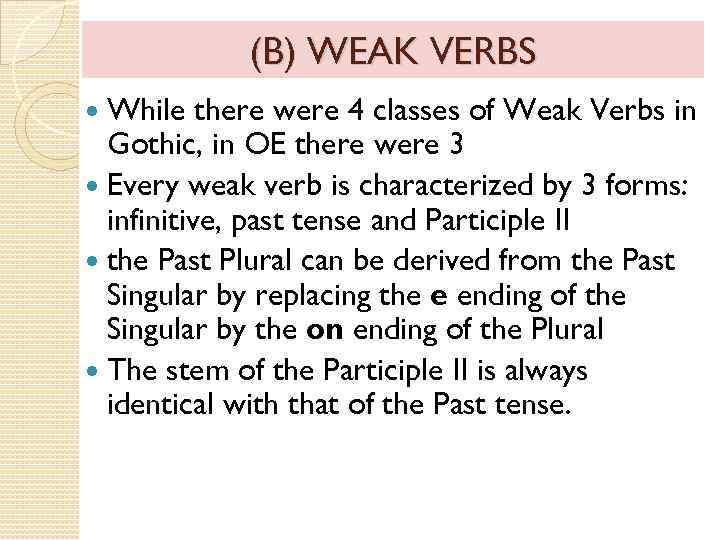 (B) WEAK VERBS While there were 4 classes of Weak Verbs in Gothic, in OE there were 3 Every weak verb is characterized by 3 forms: infinitive, past tense and Participle II the Past Plural can be derived from the Past Singular by replacing the e ending of the Singular by the on ending of the Plural The stem of the Participle II is always identical with that of the Past tense.
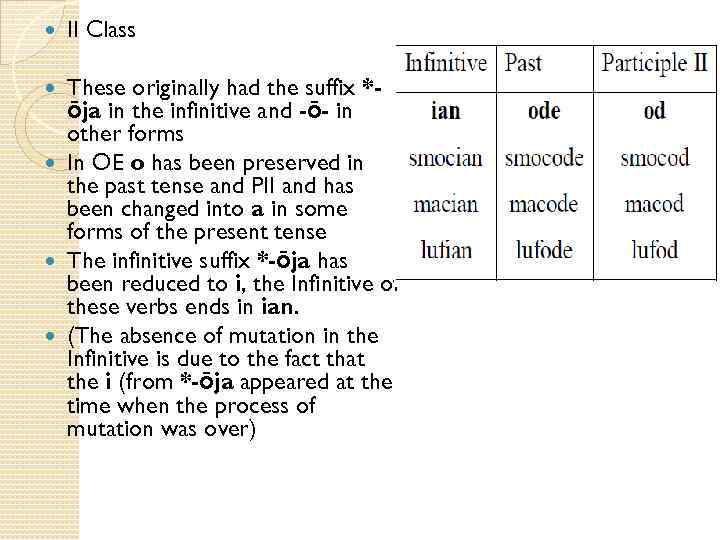 II Class These originally had the suffix *ōja in the infinitive and -ō- in other forms In OE o has been preserved in the past tense and PII and has been changed into a in some forms of the present tense The infinitive suffix *-ōja has been reduced to i, the Infinitive of these verbs ends in ian. (The absence of mutation in the Infinitive is due to the fact that the i (from *-ōja appeared at the time when the process of mutation was over)
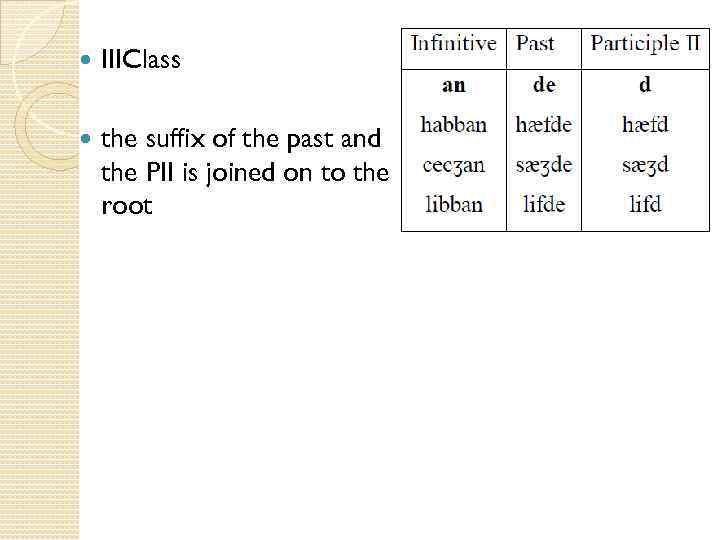 IIIClass the suffix of the past and the PII is joined on to the root
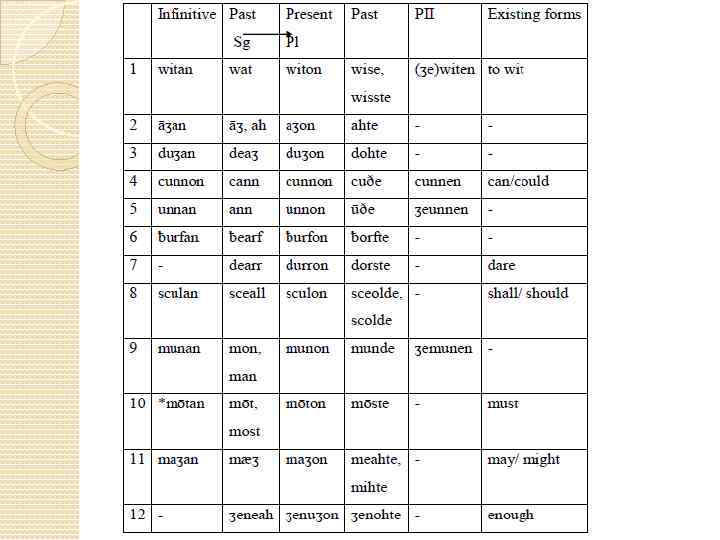
 (C) Preterite-Present Verbs Historically, Preterite-Present Verbs are strong PP Verbs are verbs in which Past Sg is reconsidered as Present and the new Past form is built with the help of the dental suffix
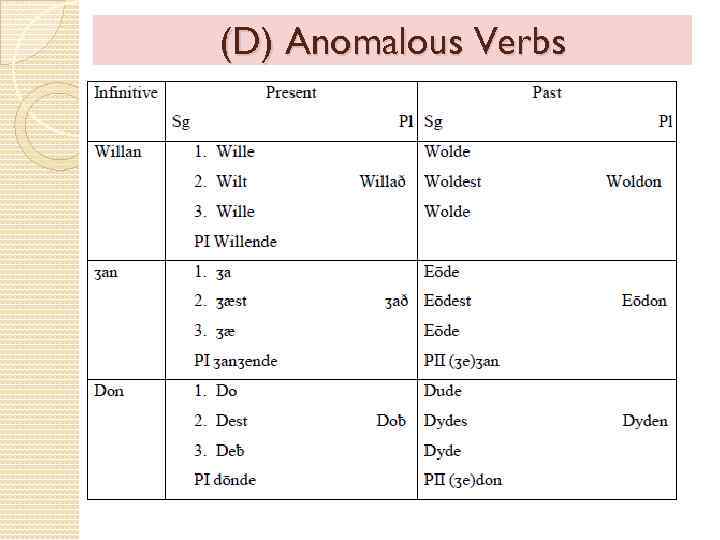 (D) Anomalous Verbs
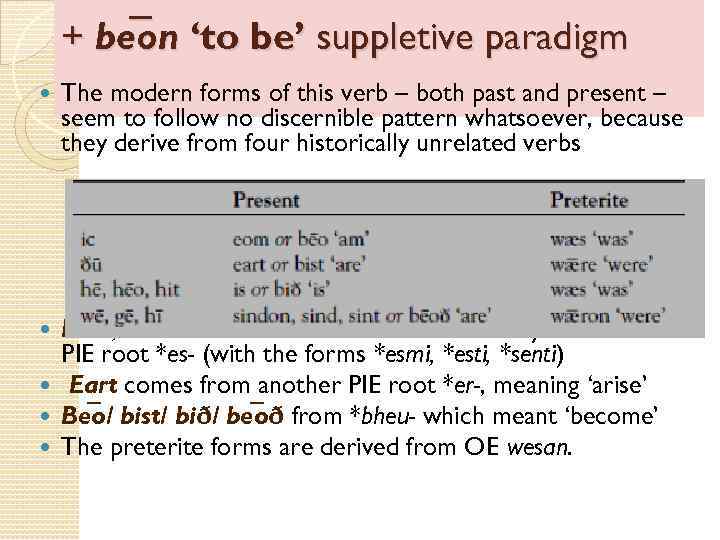 + be on ‘to be’ suppletive paradigm on The modern forms of this verb – both past and present – seem to follow no discernible pattern whatsoever, because they derive from four historically unrelated verbs Eom, is and sindon/sind/sint forms ultimately derive from a PIE root *es- (with the forms *esmi, *esti, *senti) Eart comes from another PIE root *er-, meaning ‘arise’ Be o/ bist/ bið/ be oð from *bheu- which meant ‘become’ The preterite forms are derived from OE wesan.
 6. Syncretism & Its Impact on Language Development syncretism is the identity of form of distinct morphological forms of a word. Can arise through either phonological or morphological change phonological change: forms that were originally distinct come to be pronounced identically, so that their distinctness is lost. morphological change: one form simply stops being used and is replaced by the other This fact eventually lead to gradual disappearance of those forms which were different due to the specificity of the stress, which was falling on the 1 st syllable of the root, thus making the endings often misheard and ‘swallowed’ By the end of the OE period the complex system of inflections started to get simplified With the arrival of Danes and Normans to Britain, OE started to get influenced by their languages These factors combined resulted in the end of the OE Period of ‘Full Endings’ and the beginning of the Middle English (ME) Period of socalled ‘Leveled Endings’