


 Скачать презентацию Lecture 4 Network Processors A Solution to the
ce1a1a67e60a1215cdde5cf91a76e143.ppt
- Количество слайдов: 53
 Lecture 4 Network Processors: A Solution to the Next Generation Networking Problems
 Outline Background and Motivation Network Processor Architecture Next Generation Network applications Our Research – Ne. PSim, DVFS/Clock Gating, Web Switch Design and Evaluation (IEEE Micro 2004, DAC 2005, Hot I 2005, ANCS 2005)
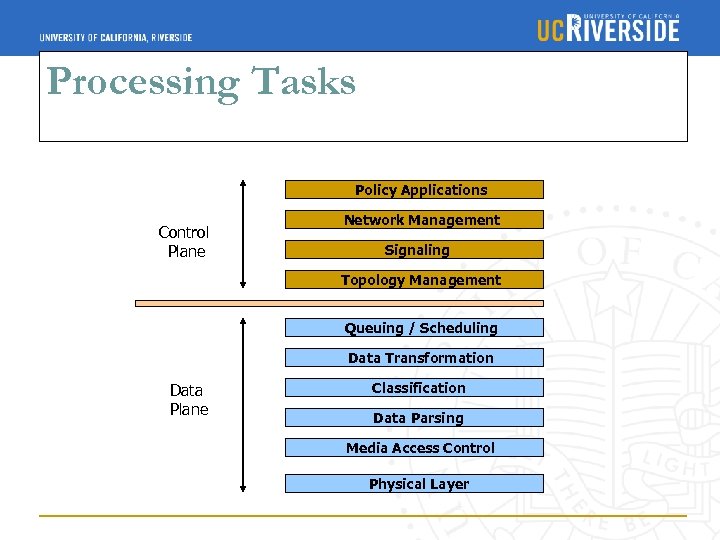 Processing Tasks Policy Applications Control Plane Network Management Signaling Topology Management Queuing / Scheduling Data Transformation Data Plane Classification Data Parsing Media Access Control Physical Layer
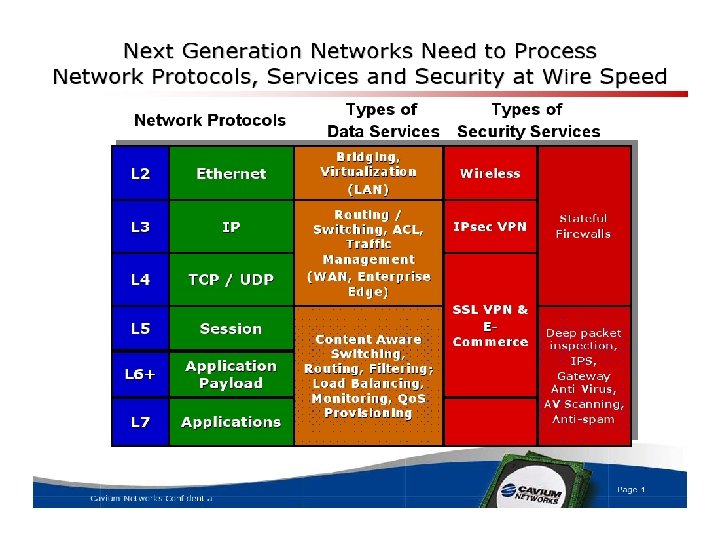
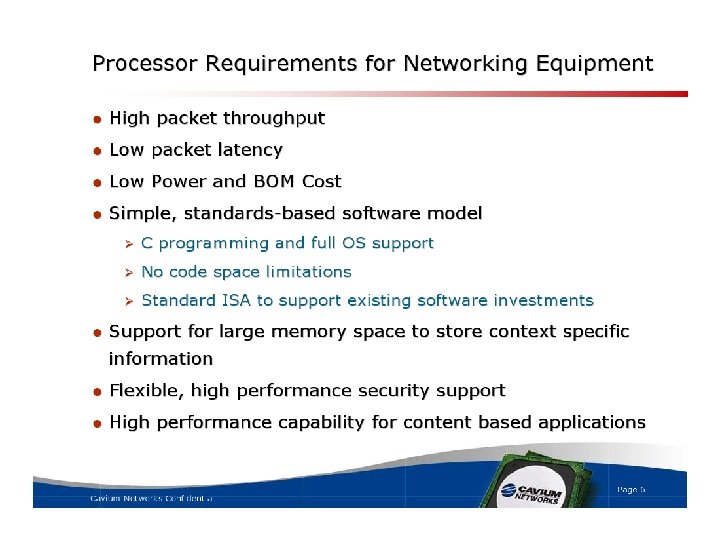
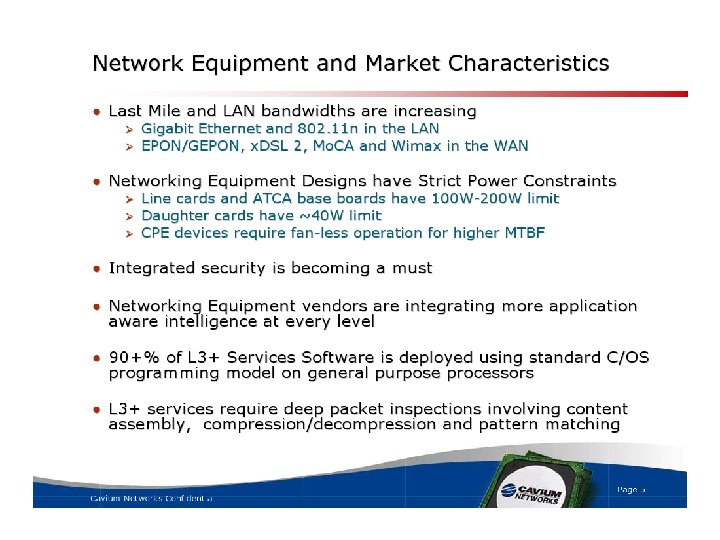
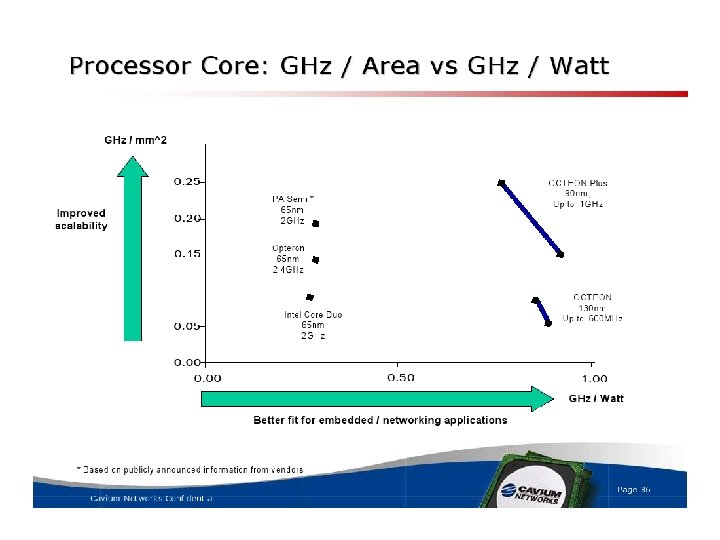
 Introduction to Network Processors n Traditional processors in networks q General-purpose CPU n q ASIC n n Not fast enough to handle new link speeds Good performance, but lack flexibility. New applications or protocols make the old processor obsolete Solution: Network Processors (NPs) q Processors ‘optimized’ for networking applications n Very powerful processors with additional special-purpose logic q q q Accelerators for a set of tasks Special memory controllers for moving packet data Software programmable
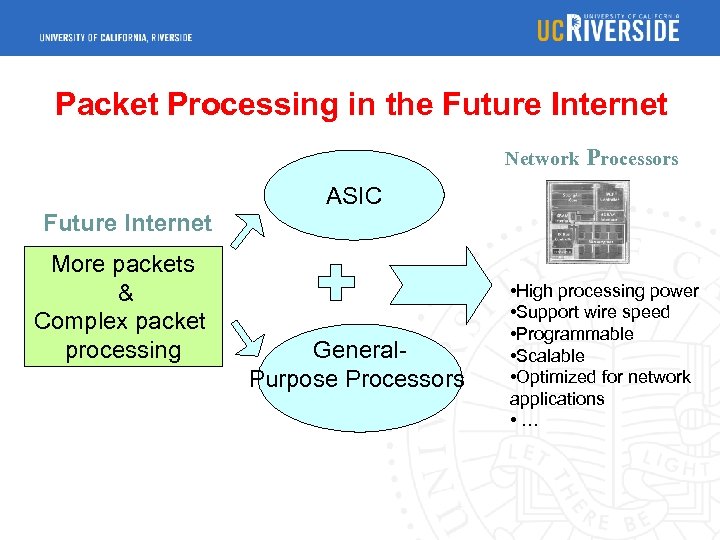 Packet Processing in the Future Internet Network Processors ASIC Future Internet More packets & Complex packet processing General. Purpose Processors • High processing power • Support wire speed • Programmable • Scalable • Optimized for network applications • …
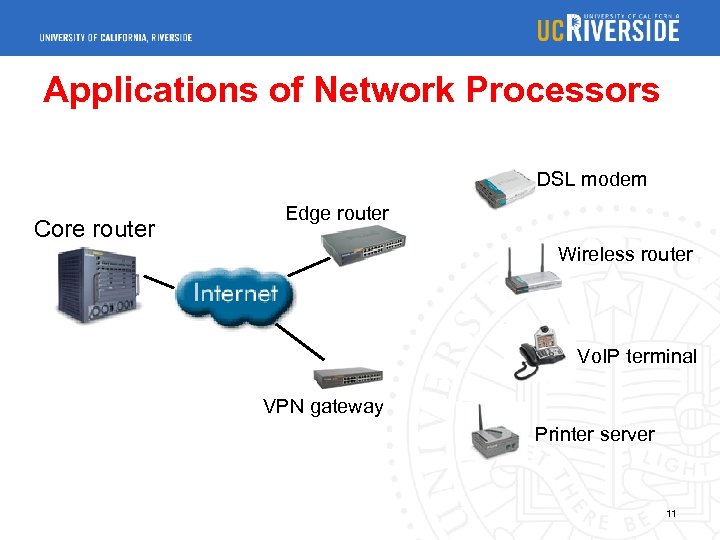 Applications of Network Processors DSL modem Core router Edge router Wireless router Vo. IP terminal VPN gateway Printer server 11
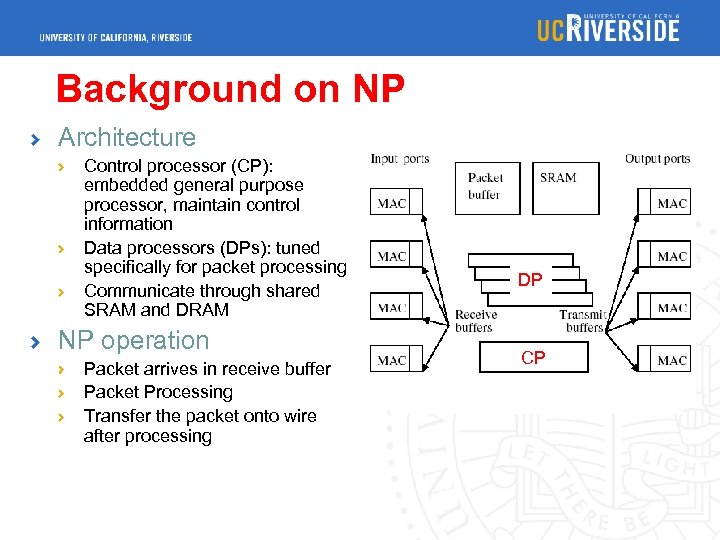 Background on NP Architecture Control processor (CP): embedded general purpose processor, maintain control information Data processors (DPs): tuned specifically for packet processing Communicate through shared SRAM and DRAM NP operation Packet arrives in receive buffer Packet Processing Transfer the packet onto wire after processing DP CP
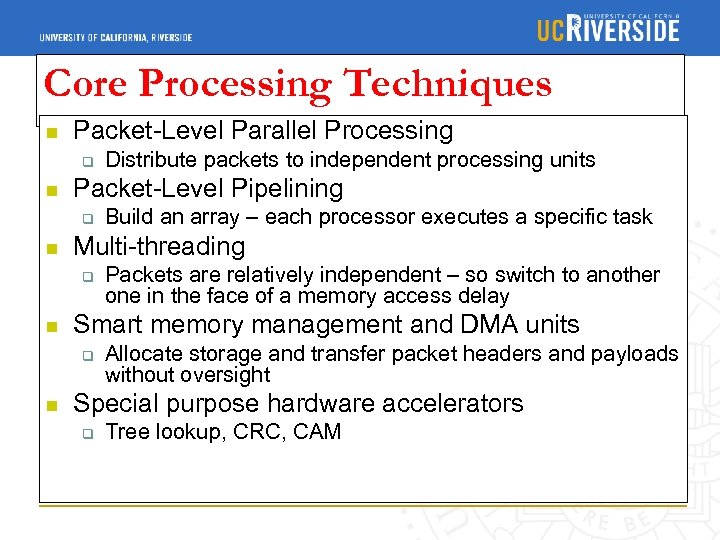 Core Processing Techniques n Packet-Level Parallel Processing q n Packet-Level Pipelining q n Packets are relatively independent – so switch to another one in the face of a memory access delay Smart memory management and DMA units q n Build an array – each processor executes a specific task Multi-threading q n Distribute packets to independent processing units Allocate storage and transfer packet headers and payloads without oversight Special purpose hardware accelerators q Tree lookup, CRC, CAM
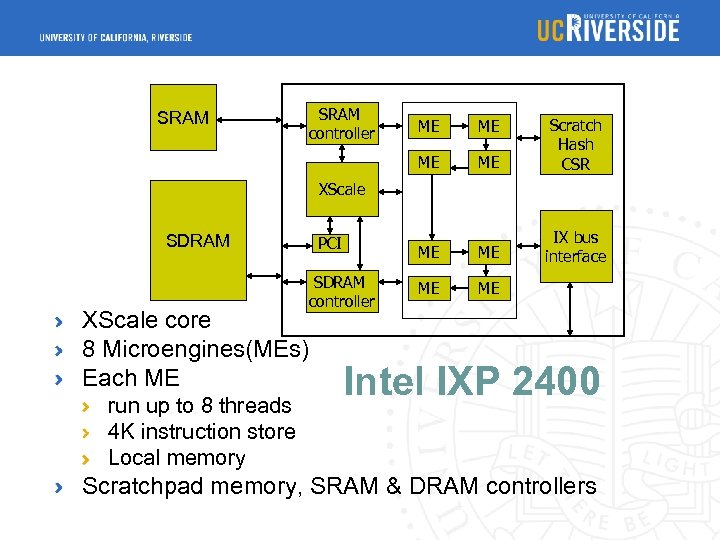 SRAM controller ME ME Scratch Hash CSR ME ME IX bus interface ME ME XScale SDRAM PCI SDRAM controller XScale core 8 Microengines(MEs) Each ME run up to 8 threads 4 K instruction store Local memory Intel IXP 2400 Scratchpad memory, SRAM & DRAM controllers
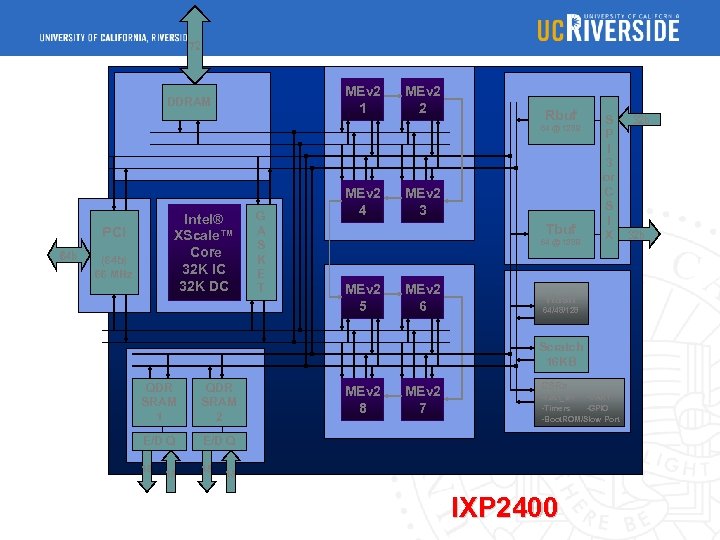 72 MEv 2 1 DDRAM MEv 2 2 Rbuf 64 @ 128 B Intel® XScale™ Core 32 K IC 32 K DC PCI 64 b (64 b) 66 MHz G A S K E T MEv 2 4 MEv 2 3 Tbuf 64 @ 128 B MEv 2 5 MEv 2 6 S P I 3 or C S I X Hash 64/48/128 Scratch 16 KB QDR SRAM 1 QDR SRAM 2 E/D Q 18 18 CSRs E/D Q 18 MEv 2 7 -Fast_wr -UART -Timers -GPIO -Boot. ROM/Slow Port 18 IXP 2400 32 b
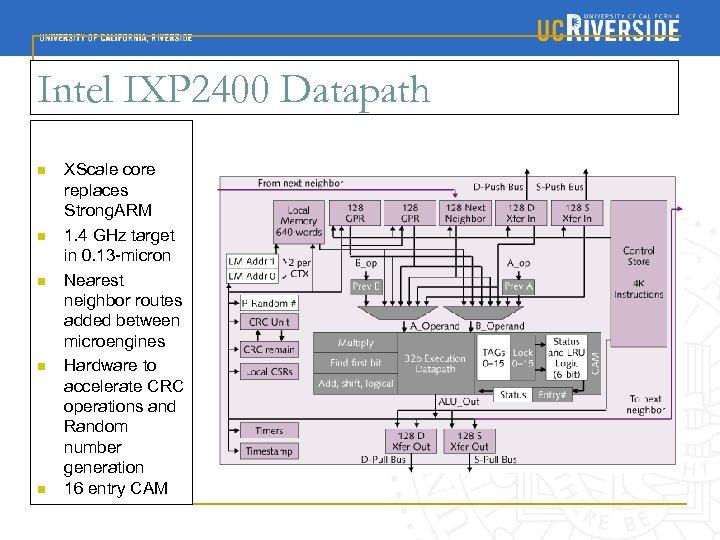 Intel IXP 2400 Datapath n n n XScale core replaces Strong. ARM 1. 4 GHz target in 0. 13 -micron Nearest neighbor routes added between microengines Hardware to accelerate CRC operations and Random number generation 16 entry CAM
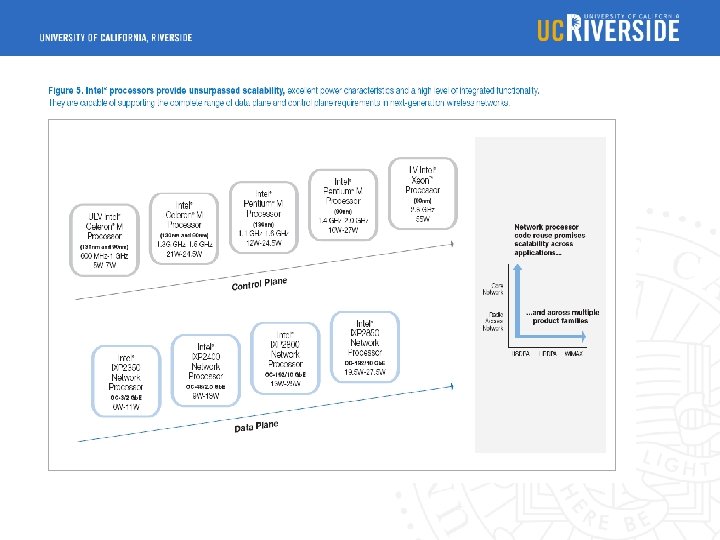
 Other Commercial Network Processors IBM Power NP, Cisco Twister, Motorola C-Port AMCC n. P 7510 EZchip NP 2 Agere Payload. Plus Hifn 5 NP 4 G
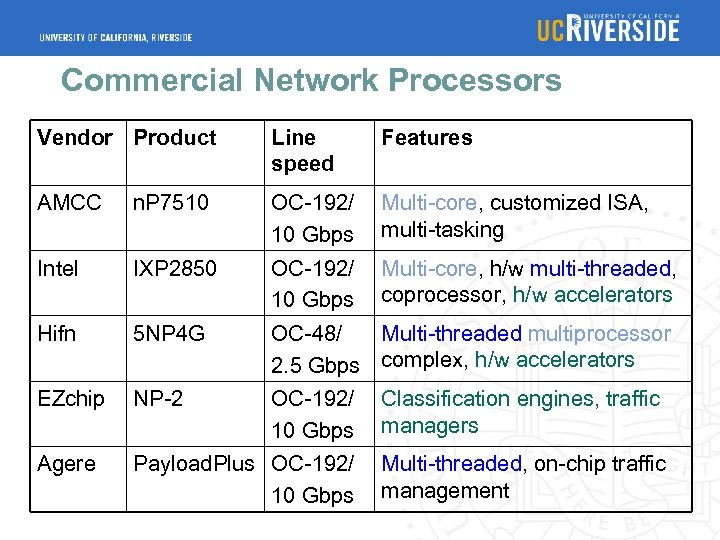 Commercial Network Processors Vendor Product Line speed Features AMCC n. P 7510 OC-192/ 10 Gbps Multi-core, customized ISA, multi-tasking Intel IXP 2850 OC-192/ 10 Gbps Multi-core, h/w multi-threaded, coprocessor, h/w accelerators Hifn 5 NP 4 G OC-48/ Multi-threaded multiprocessor 2. 5 Gbps complex, h/w accelerators EZchip NP-2 OC-192/ 10 Gbps Classification engines, traffic managers Agere Payload. Plus OC-192/ 10 Gbps Multi-threaded, on-chip traffic management
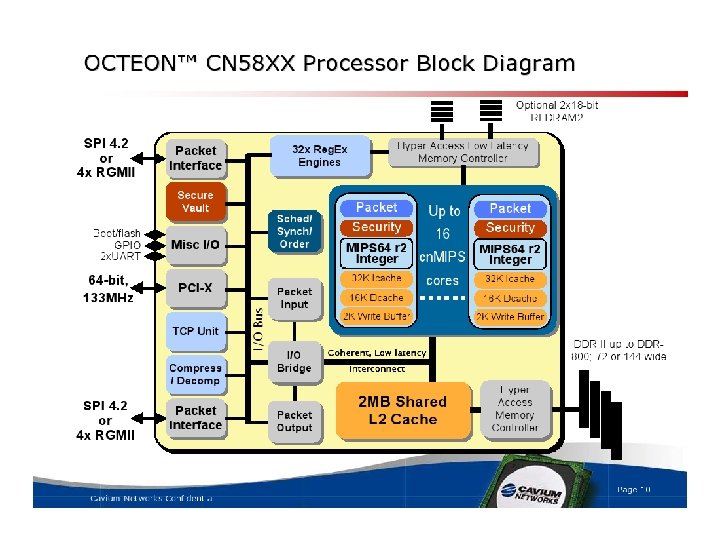
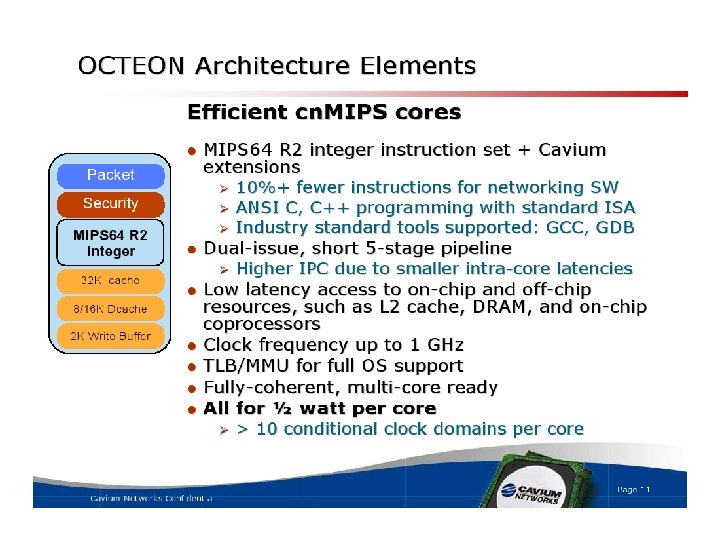
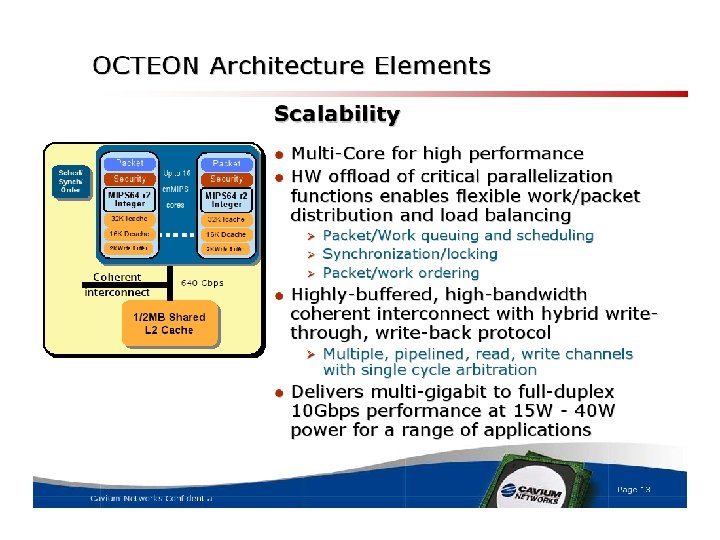
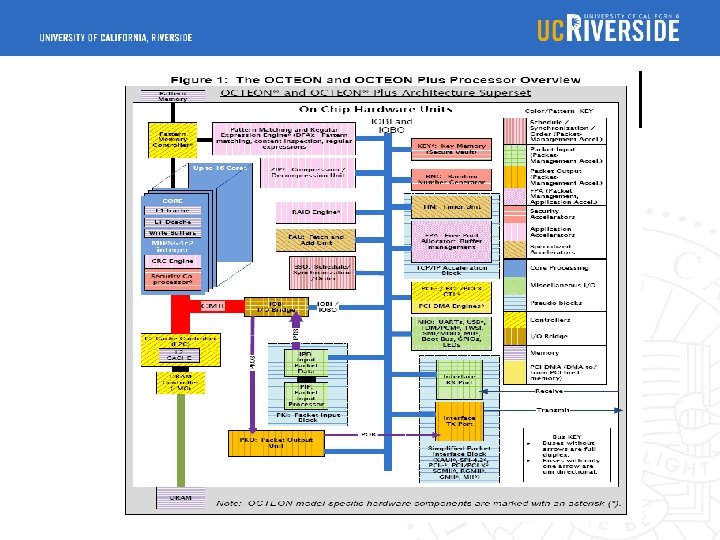
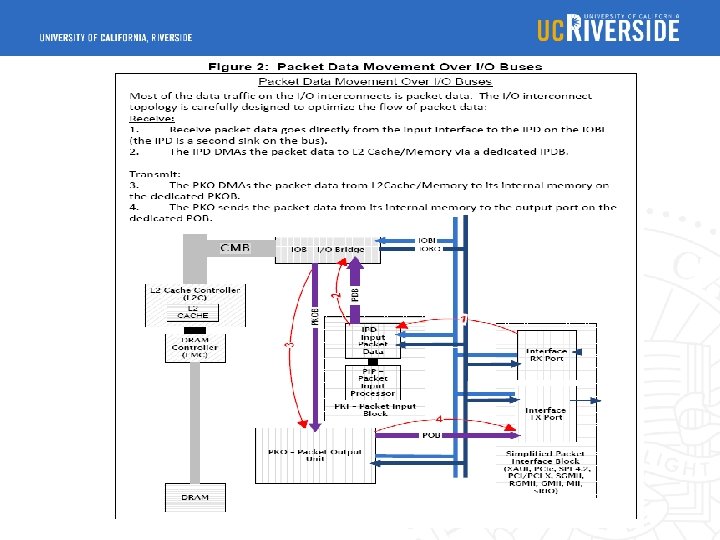
 Octeon Processor Acrchitecture
 Our Research Design and Evaluation and Low Power Design of Network Processors
 Outline Ne. PSim – A Network Processor Simulator Power Saving with Dynamic Voltage Scaling Adapting Processing Power Using Clock Gating 28
 Objectives and Challenges of Ne. PSim Objectives Open-source Cycle-level accuracy Flexibility Integrated power model Fast simulation speed Challenges Domain specific instruction set Porting network benchmarks Difficulty in debugging multithreaded programs Verification of the functionality and timing Yan Luo, Jun Yang, Laxmi Bhuyan, Li Zhao, Ne. PSim, IEEE Micro Special Issue on NP, Sept/Oct 2004, Intel IXP Summit Sept 2004, 250+ downloads, 1600+ page visits, users from Univ. of Arizona, Georgia Tech, Northwestern Univ. , Tsinghua Univ. 29
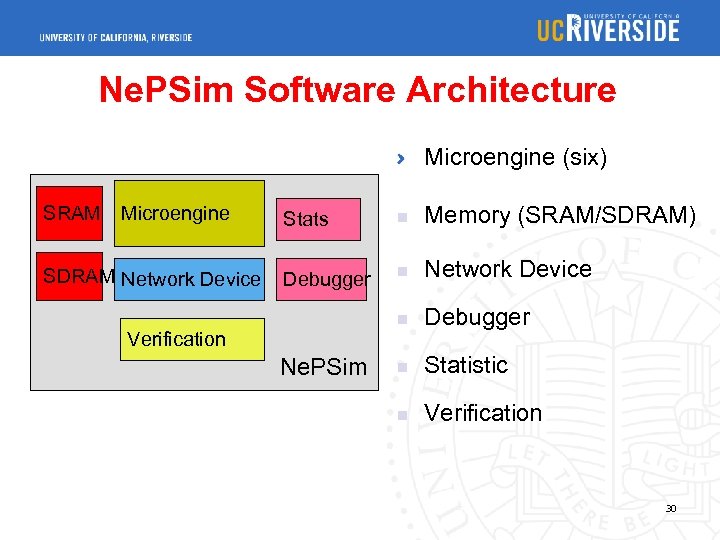 Ne. PSim Software Architecture Microengine (six) SRAM SDRAM Network Device Stats n Memory (SRAM/SDRAM) Debugger n Network Device n Microengine Debugger n Statistic n Verification Ne. PSim 30
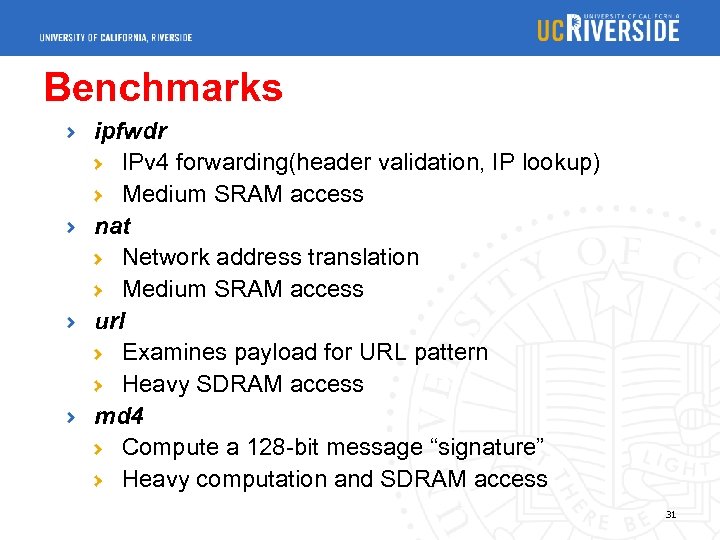 Benchmarks ipfwdr IPv 4 forwarding(header validation, IP lookup) Medium SRAM access nat Network address translation Medium SRAM access url Examines payload for URL pattern Heavy SDRAM access md 4 Compute a 128 -bit message “signature” Heavy computation and SDRAM access 31
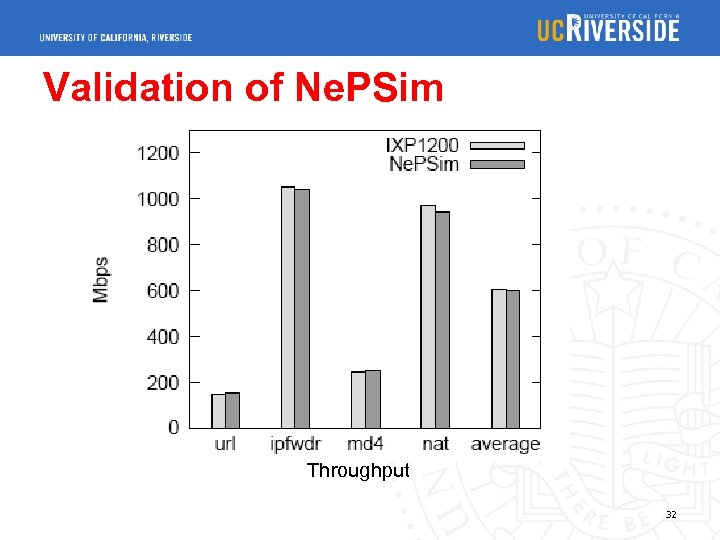 Validation of Ne. PSim Throughput 32
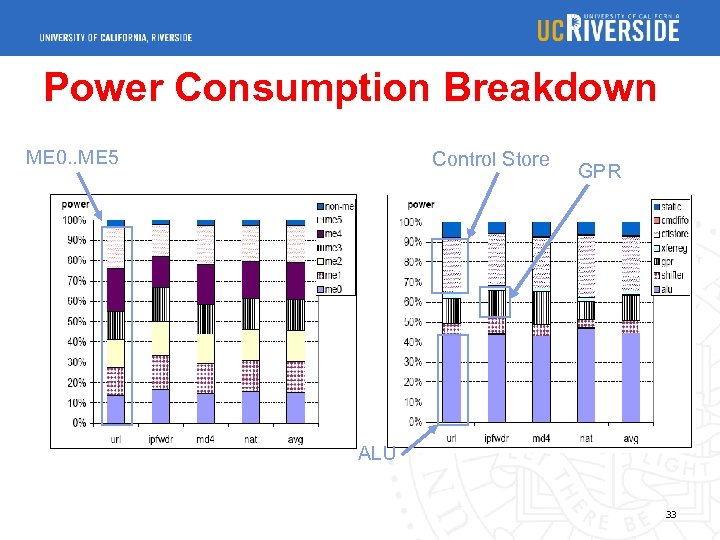 Power Consumption Breakdown ME 0. . ME 5 Control Store GPR ALU 33
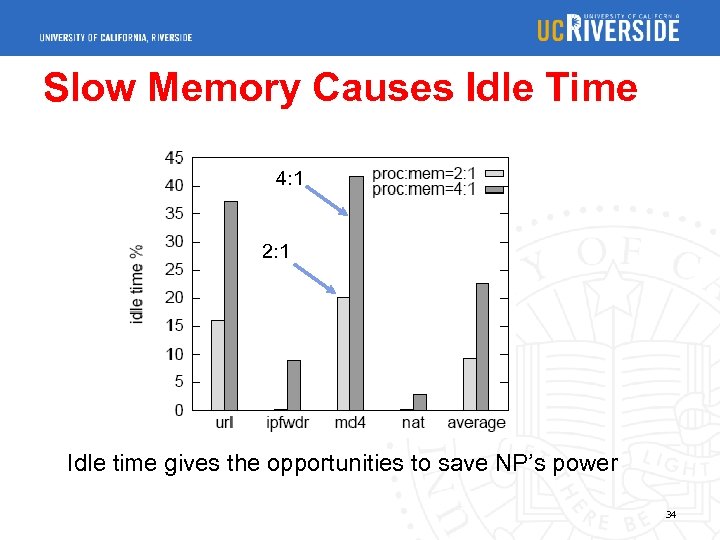 Slow Memory Causes Idle Time 4: 1 2: 1 Idle time gives the opportunities to save NP’s power 34
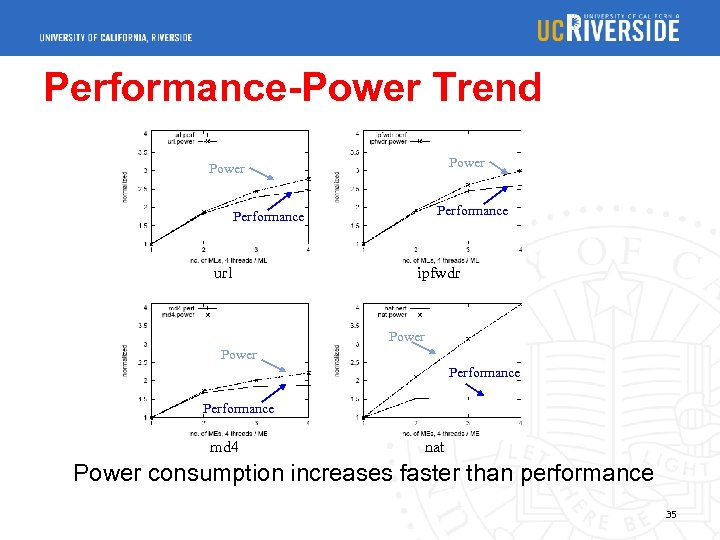 Performance-Power Trend Power Performance url ipfwdr Power Performance md 4 nat Power consumption increases faster than performance 35
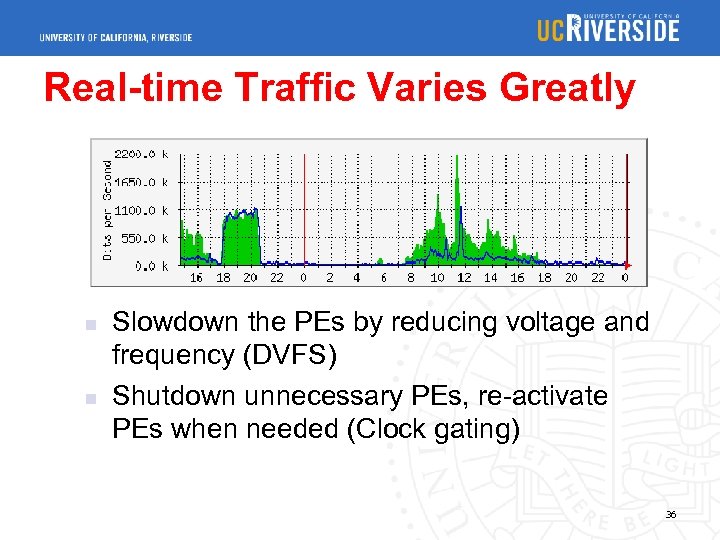 Real-time Traffic Varies Greatly n n Slowdown the PEs by reducing voltage and frequency (DVFS) Shutdown unnecessary PEs, re-activate PEs when needed (Clock gating) 36
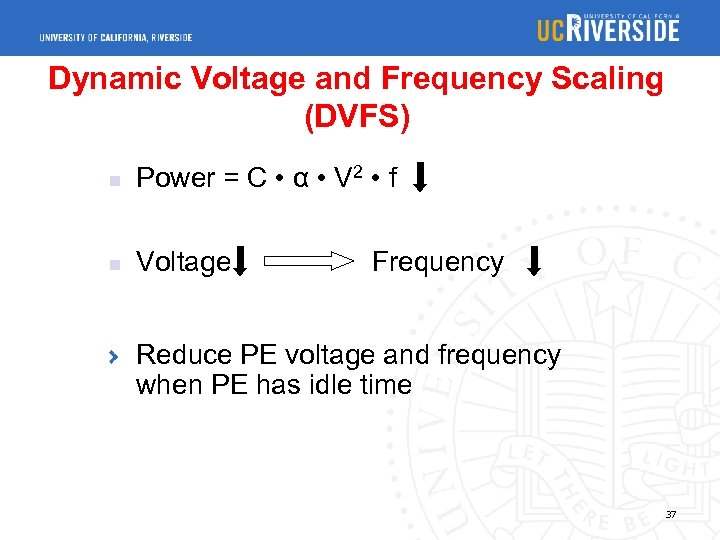 Dynamic Voltage and Frequency Scaling (DVFS) n Power = C • α • V 2 • f n Voltage Frequency Reduce PE voltage and frequency when PE has idle time 37
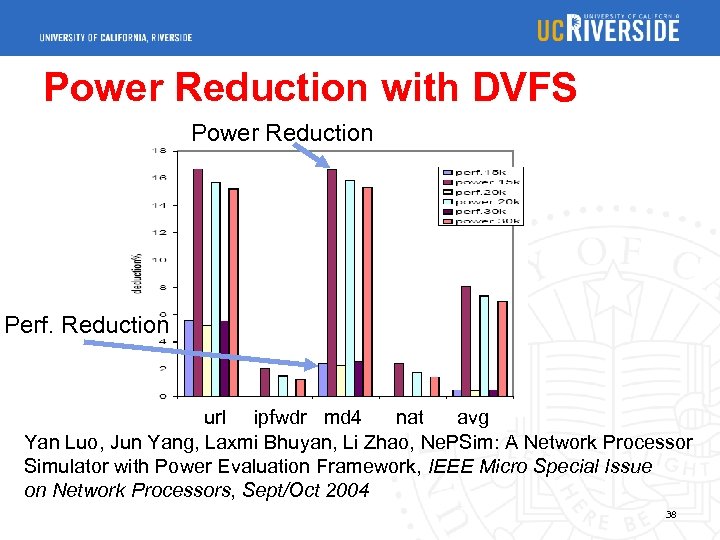 Power Reduction with DVFS Power Reduction Perf. Reduction url ipfwdr md 4 nat avg Yan Luo, Jun Yang, Laxmi Bhuyan, Li Zhao, Ne. PSim: A Network Processor Simulator with Power Evaluation Framework, IEEE Micro Special Issue on Network Processors, Sept/Oct 2004 38
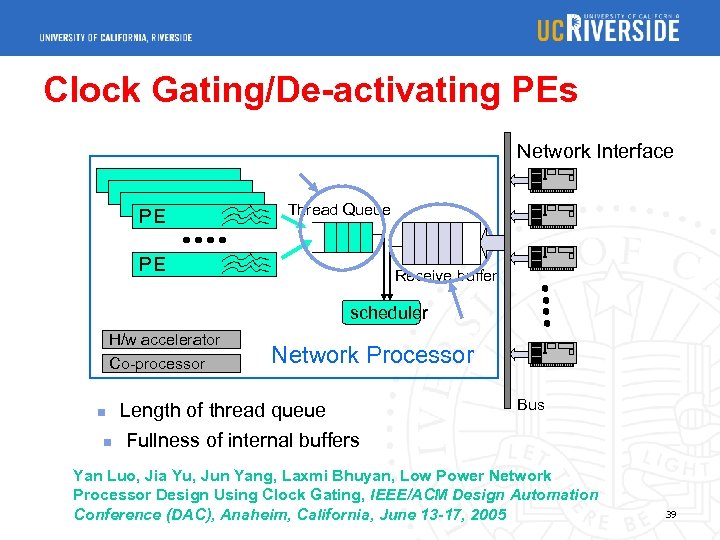 Clock Gating/De-activating PEs Network Interface PE Thread Queue PE Receive buffer scheduler H/w accelerator Co-processor n n Network Processor Length of thread queue Fullness of internal buffers Bus Yan Luo, Jia Yu, Jun Yang, Laxmi Bhuyan, Low Power Network Processor Design Using Clock Gating, IEEE/ACM Design Automation Conference (DAC), Anaheim, California, June 13 -17, 2005 39
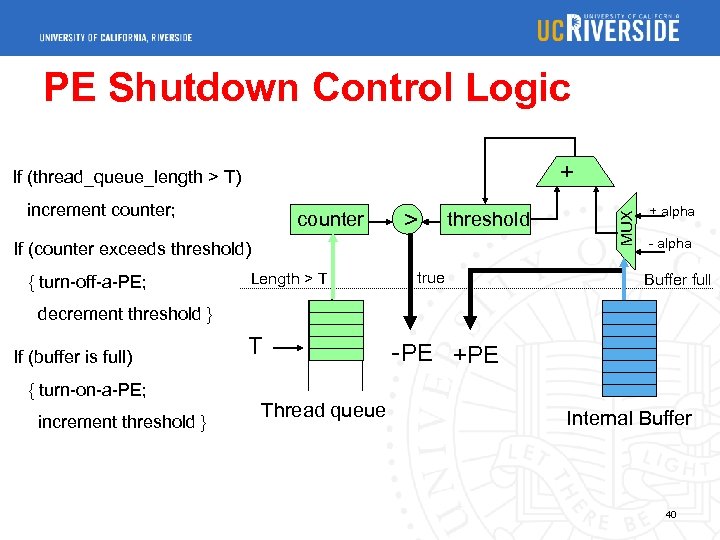 PE Shutdown Control Logic increment counter; counter > threshold If (counter exceeds threshold) { turn-off-a-PE; Length > T true MUX + If (thread_queue_length > T) + alpha - alpha Buffer full decrement threshold } If (buffer is full) { turn-on-a-PE; increment threshold } T Thread queue -PE +PE Internal Buffer 40
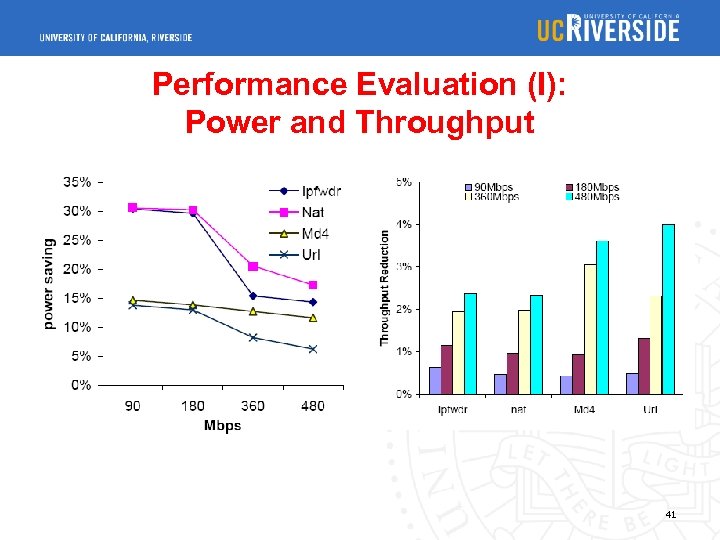 Performance Evaluation (I): Power and Throughput 41
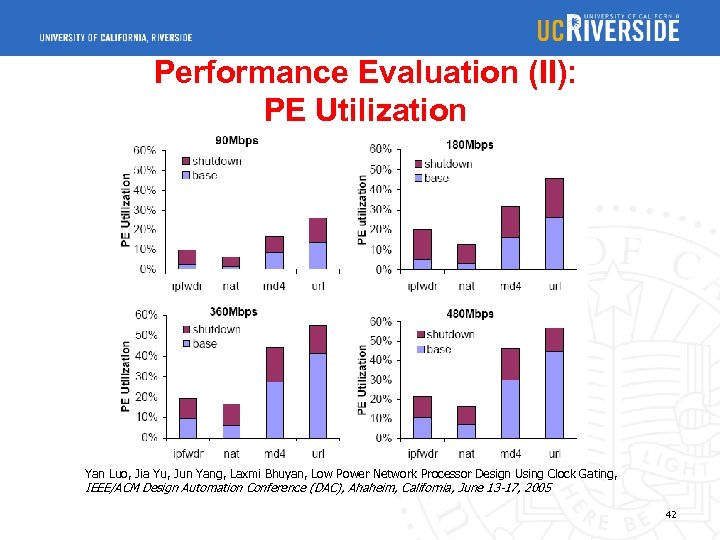 Performance Evaluation (II): PE Utilization Yan Luo, Jia Yu, Jun Yang, Laxmi Bhuyan, Low Power Network Processor Design Using Clock Gating, IEEE/ACM Design Automation Conference (DAC), Ahaheim, California, June 13 -17, 2005 42
 Main Contributions Constructed an execution driven multiprocessor router simulation framework, proposed a set of benchmark applications and evaluated performance Built Ne. PSim, the first open-source network processor simulator, ported network benchmarks and conducted performance and power evaluation Applied dynamic voltage scaling to reduce power consumption Used clock gating to adapt number of active PEs according to real-time traffic 43
![NP Related Work NP Performance An analytic framework [Franklin’ 02] Coarse-grain functional level approximation](https://present5.com/presentation/ce1a1a67e60a1215cdde5cf91a76e143/image-44.jpg "NP Related Work NP Performance An analytic framework [Franklin’ 02] Coarse-grain functional level approximation") NP Related Work NP Performance An analytic framework [Franklin’ 02] Coarse-grain functional level approximation [Xu’ 03] Improving performance of memories [Hasan’ 03] Power model Cacti [Jouppi’ 94] Wattch [Brooks’ 00] Orion [Wang’ 02] Simulation Tools SDK(closed-source, no power model, low speed) Simple. Scalar (disparity with real NP, inaccuracy) 44
NP Related Work NP Performance An analytic framework [Franklin’ 02] Coarse-grain functional level approximation [Xu’ 03] Improving performance of memories [Hasan’ 03] Power model Cacti [Jouppi’ 94] Wattch [Brooks’ 00] Orion [Wang’ 02] Simulation Tools SDK(closed-source, no power model, low speed) Simple. Scalar (disparity with real NP, inaccuracy) 44
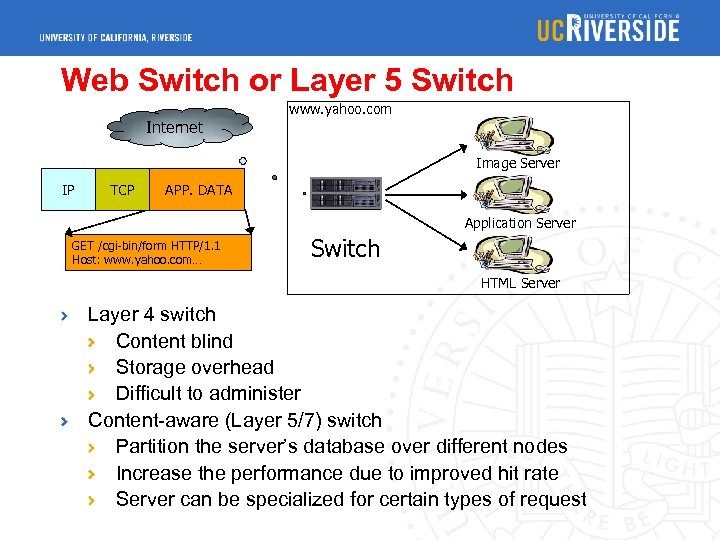 Web Switch or Layer 5 Switch www. yahoo. com Internet Image Server IP TCP APP. DATA Application Server GET /cgi-bin/form HTTP/1. 1 Host: www. yahoo. com… Switch HTML Server Layer 4 switch Content blind Storage overhead Difficult to administer Content-aware (Layer 5/7) switch Partition the server’s database over different nodes Increase the performance due to improved hit rate Server can be specialized for certain types of request
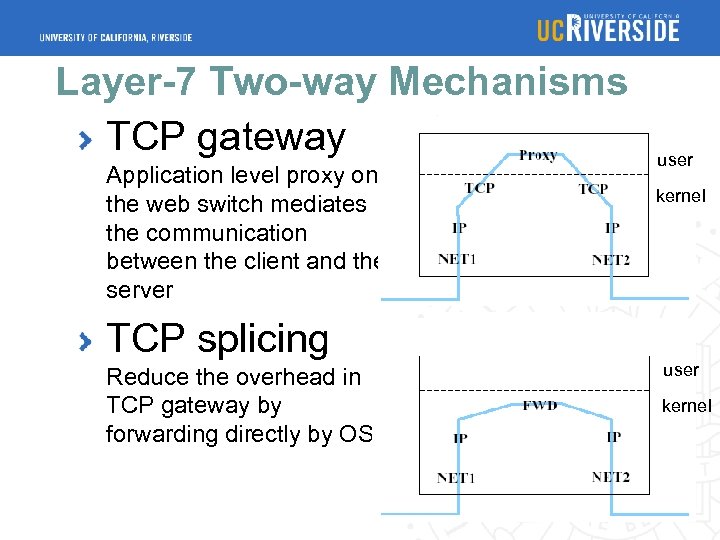 Layer-7 Two-way Mechanisms TCP gateway Application level proxy on the web switch mediates the communication between the client and the server TCP splicing Reduce the overhead in TCP gateway by forwarding directly by OS user kernel
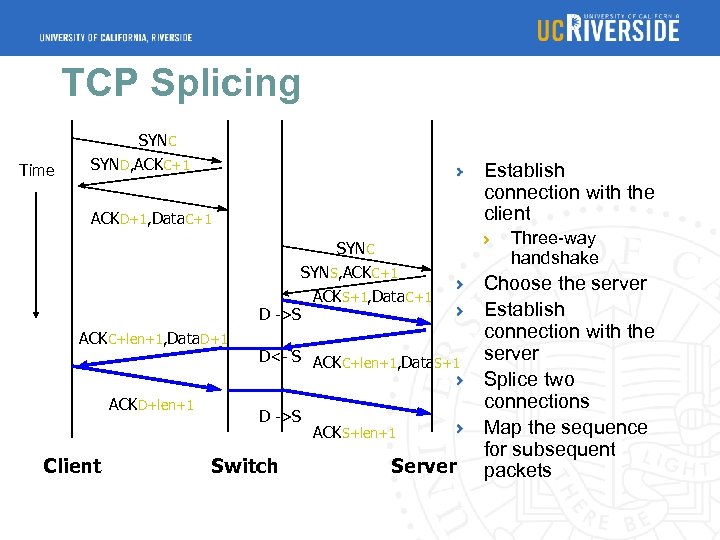 TCP Splicing Time SYNC SYND, ACKC+1 Establish connection with the client ACKD+1, Data. C+1 SYNC SYNS, ACKC+1 D ->S ACKC+len+1, Data. D+1 ACKD+len+1 Client ACKS+1, Data. C+1 D<- S ACKC+len+1, Data. S+1 D ->S Switch ACKS+len+1 Server Three-way handshake Choose the server Establish connection with the server Splice two connections Map the sequence for subsequent packets
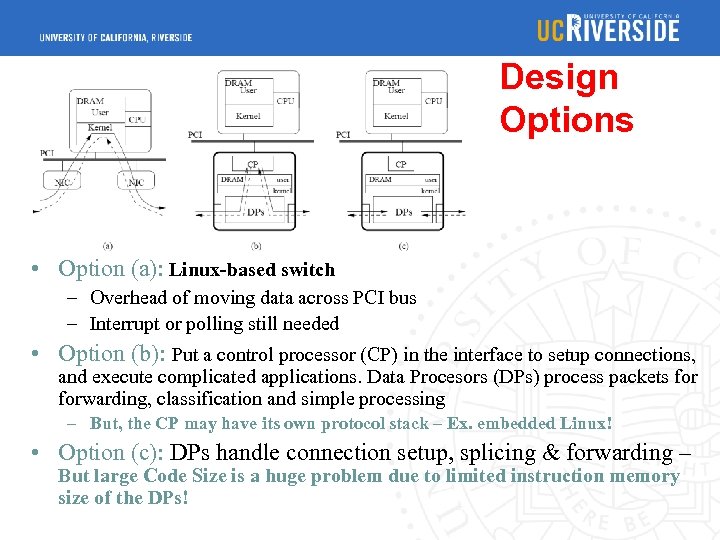 Design Options • Option (a): Linux-based switch – Overhead of moving data across PCI bus – Interrupt or polling still needed • Option (b): Put a control processor (CP) in the interface to setup connections, and execute complicated applications. Data Procesors (DPs) process packets forwarding, classification and simple processing – But, the CP may have its own protocol stack – Ex. embedded Linux! • Option (c): DPs handle connection setup, splicing & forwarding – But large Code Size is a huge problem due to limited instruction memory size of the DPs!
 Experimental Setup Radisys ENP 2611 containing an IXP 2400 XScale & ME: 600 MHz 8 MB SRAM and 128 MB DRAM Three 1 Gbps Ethernet ports: 1 for Client port and 2 for Server ports Server: Apache web server on an Intel 3. 0 GHz Xeon processor Client: Httperf on a 2. 5 GHz Intel P 4 processor Linux-based switch Loadable kernel module 2. 5 GHz P 4, two 1 Gbps Ethernet NICs
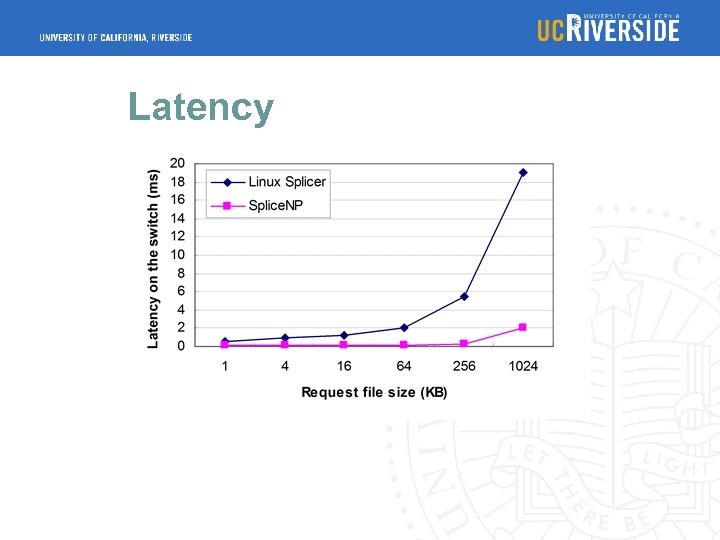
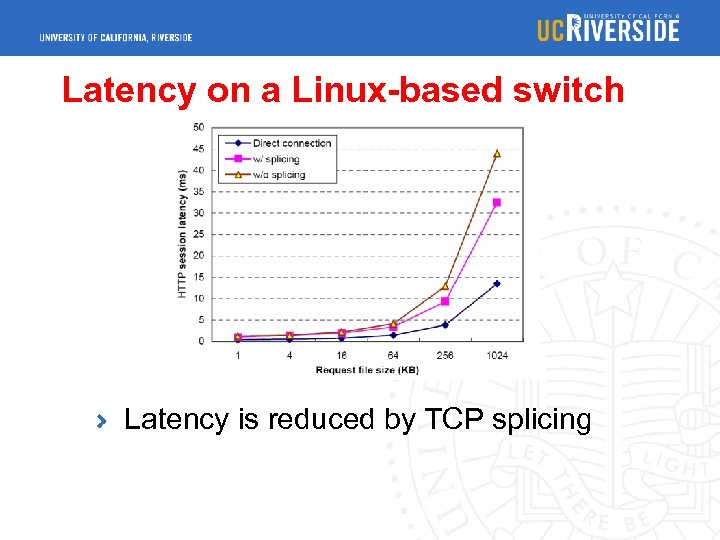 Latency on a Linux-based switch Latency is reduced by TCP splicing
 Latency
 Throughput
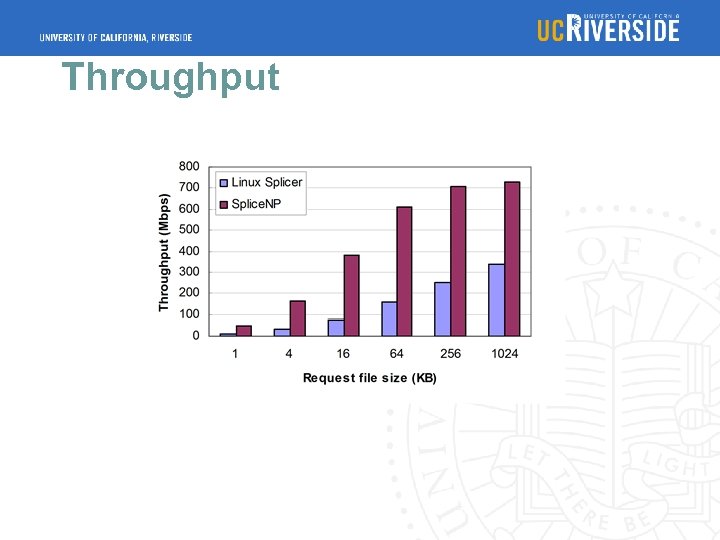
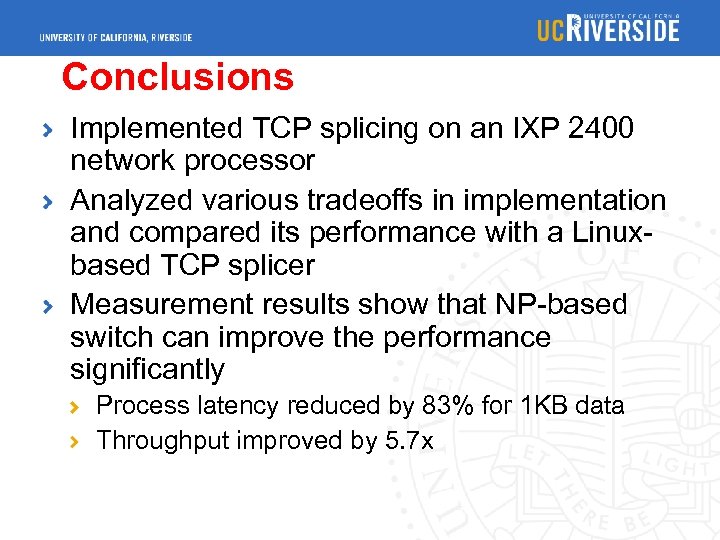 Conclusions Implemented TCP splicing on an IXP 2400 network processor Analyzed various tradeoffs in implementation and compared its performance with a Linuxbased TCP splicer Measurement results show that NP-based switch can improve the performance significantly Process latency reduced by 83% for 1 KB data Throughput improved by 5. 7 x