 Скачать презентацию Lecture 4 LEXICAL PROBLEMS OF TRANSLATION HANDLING CONTEXT-FREE
Lecture_4.pptx
- Количество слайдов: 14



Lecture 4 LEXICAL PROBLEMS OF TRANSLATION HANDLING CONTEXT-FREE WORDS
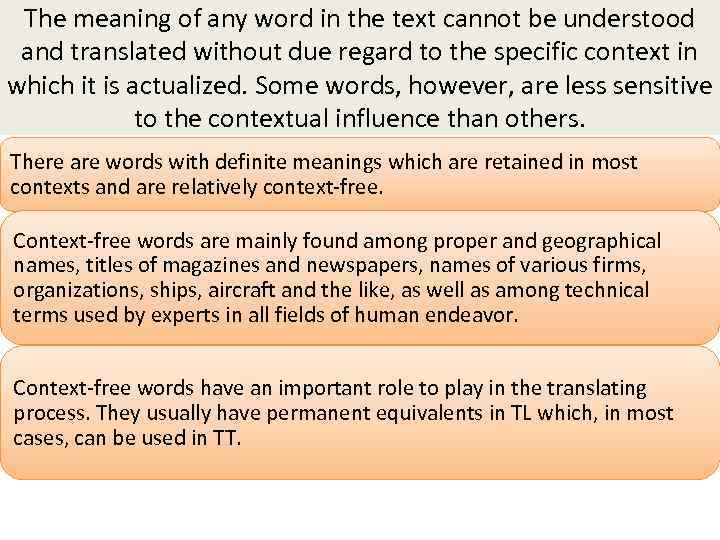
The meaning of any word in the text cannot be understood and translated without due regard to the specific context in which it is actualized. Some words, however, are less sensitive to the contextual influence than others. There are words with definite meanings which are retained in most contexts and are relatively context-free. Context-free words are mainly found among proper and geographical names, titles of magazines and newspapers, names of various firms, organizations, ships, aircraft and the like, as well as among technical terms used by experts in all fields of human endeavor. Context-free words have an important role to play in the translating process. They usually have permanent equivalents in TL which, in most cases, can be used in TT.
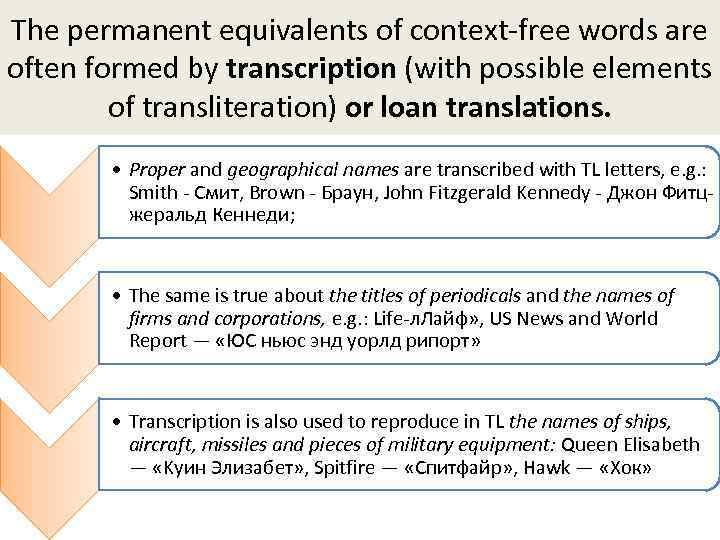
The permanent equivalents of context-free words are often formed by transcription (with possible elements of transliteration) or loan translations. • Proper and geographical names are transcribed with TL letters, e. g. : Smith - Смит, Brown - Браун, John Fitzgerald Kennedy - Джон Фитцжеральд Кеннеди; • The same is true about the titles of periodicals and the names of firms and corporations, e. g. : Life-л. Лайф» , US News and World Report — «ЮС ньюс энд уорлд рипорт» • Transcription is also used to reproduce in TL the names of ships, aircraft, missiles and pieces of military equipment: Queen Elisabeth — «Kyин Элизабет» , Spitfire — «Спитфайр» , Hawk — «Хок»
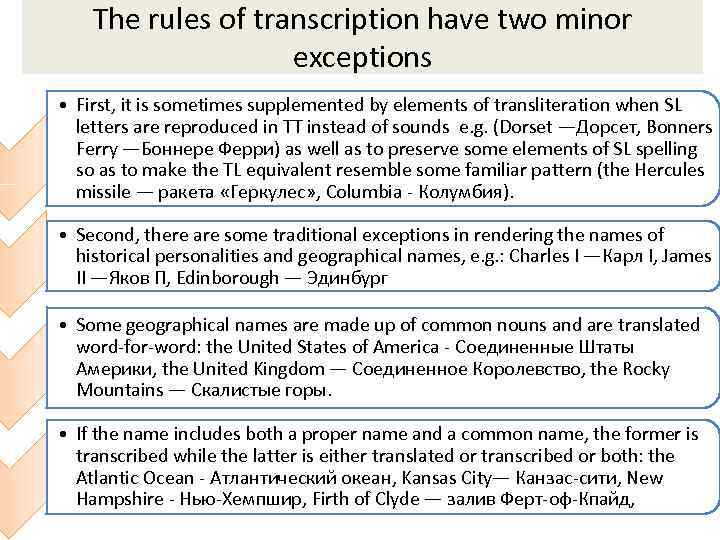
The rules of transcription have two minor exceptions • First, it is sometimes supplemented by elements of transliteration when SL letters are reproduced in TT instead of sounds e. g. (Dorset —Дорсет, Bonners Ferry —Боннере Ферри) as well as to preserve some elements of SL spelling so as to make the TL equivalent resemble some familiar pattern (the Hercules missile — ракета «Геркулес» , Columbia - Колумбия). • Second, there are some traditional exceptions in rendering the names of historical personalities and geographical names, e. g. : Charles I —Карл I, James II —Яков П, Edinborough — Эдинбург • Some geographical names are made up of common nouns and are translated word-for-word: the United States of America - Соединенные Штаты Америки, the United Kingdom — Соединенное Королевство, the Rocky Mountains — Скалистые горы. • If the name includes both a proper name and a common name, the former is transcribed while the latter is either translated or transcribed or both: the Atlantic Ocean - Атлантический океан, Kansas City— Канзас-сити, New Hampshire - Нью-Хемпшир, Firth of Clyde — залив Ферт-оф-Кпайд,
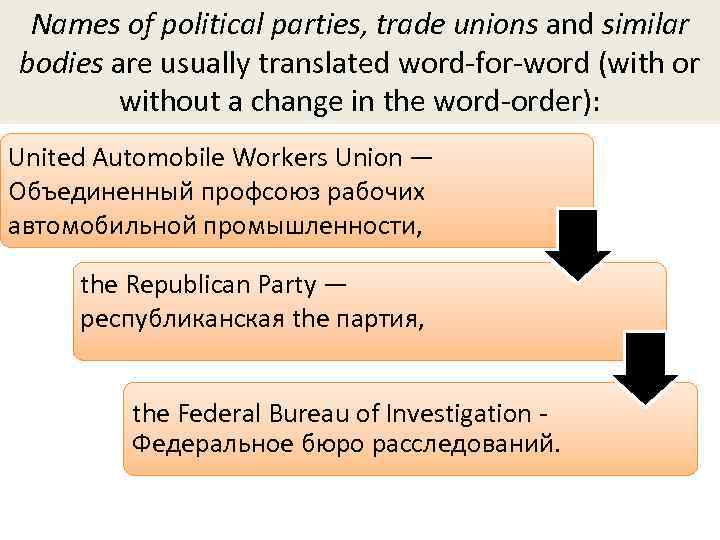
Names of political parties, trade unions and similar bodies are usually translated word-for-word (with or without a change in the word-order): United Automobile Workers Union — Объединенный профсоюз рабочих автомобильной промышленности, the Republican Party — республиканская the партия, the Federal Bureau of Investigation Федеральное бюро расследований.
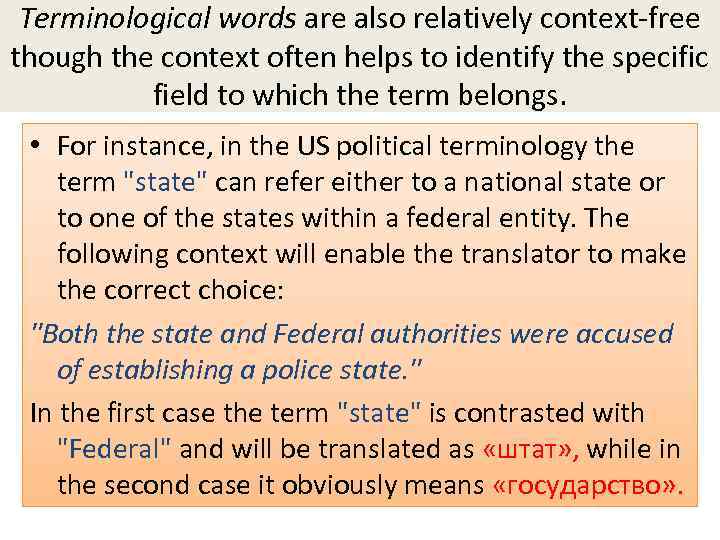
Terminological words are also relatively context-free though the context often helps to identify the specific field to which the term belongs. • For instance, in the US political terminology the term "state" can refer either to a national state or to one of the states within a federal entity. The following context will enable the translator to make the correct choice: "Both the state and Federal authorities were accused of establishing a police state. " In the first case the term "state" is contrasted with "Federal" and will be translated as «штат» , while in the second case it obviously means «государство» .
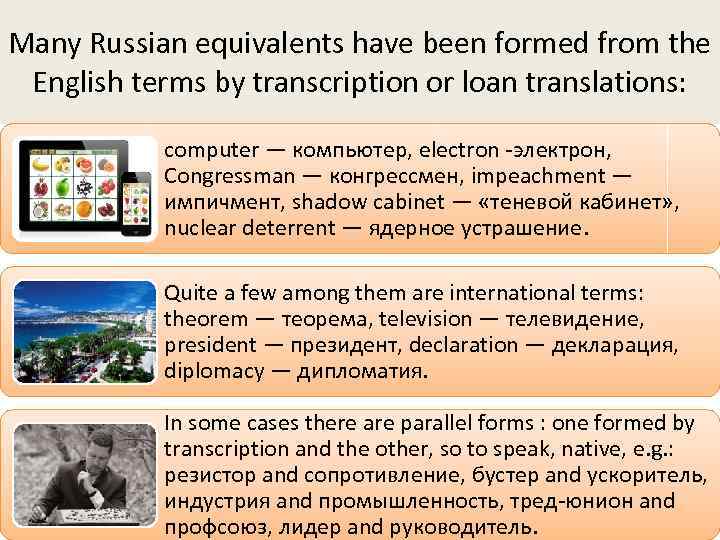
Many Russian equivalents have been formed from the English terms by transcription or loan translations: computer — компьютер, electron -электрон, Congressman — конгрессмен, impeachment — импичмент, shadow cabinet — «теневой кабинет» , nuclear deterrent — ядерное устрашение. Quite a few among them are international terms: theorem — теорема, television — телевидение, president — президент, declaration — декларация, diplomacy — дипломатия. In some cases there are parallel forms : one formed by transcription and the other, so to speak, native, e. g. : резистор and сопротивление, бустер and ускоритель, индустрия and промышленность, тред-юнион and профсоюз, лидер and руководитель.
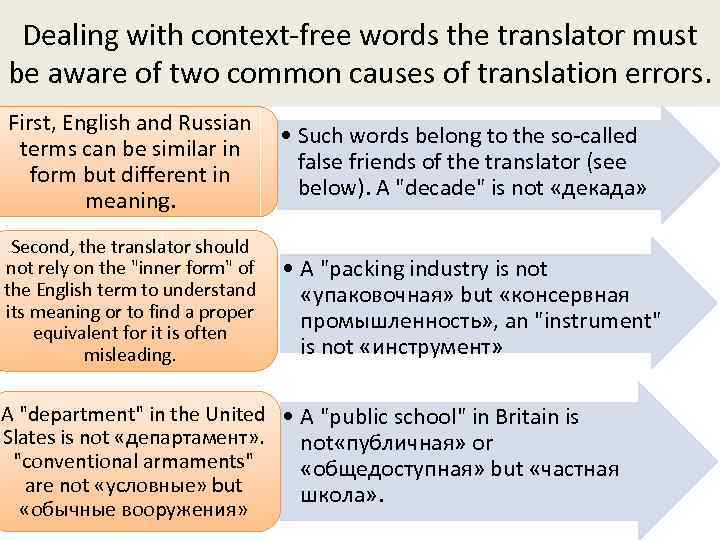
Dealing with context-free words the translator must be aware of two common causes of translation errors. First, English and Russian terms can be similar in form but different in meaning. • Such words belong to the so-called false friends of the translator (see below). A "decade" is not «декада» Second, the translator should not rely on the "inner form" of the English term to understand its meaning or to find a proper equivalent for it is often misleading. • A "packing industry is not «упаковочная» but «консервная промышленность» , an "instrument" is not «инструмент» A "department" in the United • A "public school" in Britain is Slates is not «департамент» . not «публичная» or "conventional armaments" «общедоступная» but «частная are not «условные» but школа» . «обычные вооружения»
In conclusions, • Translation of technical terms puts a premium on the translator's knowledge of the subject-matter of ST. • He must take great pains to get familiar with the system of terms in the appropriate field and make good use of technical dictionaries and other books of reference.
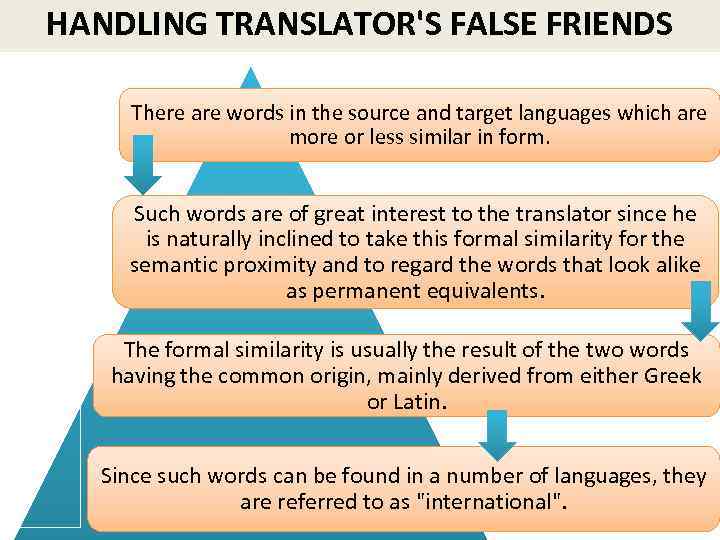
HANDLING TRANSLATOR'S FALSE FRIENDS There are words in the source and target languages which are more or less similar in form. Such words are of great interest to the translator since he is naturally inclined to take this formal similarity for the semantic proximity and to regard the words that look alike as permanent equivalents. The formal similarity is usually the result of the two words having the common origin, mainly derived from either Greek or Latin. Since such words can be found in a number of languages, they are referred to as "international".
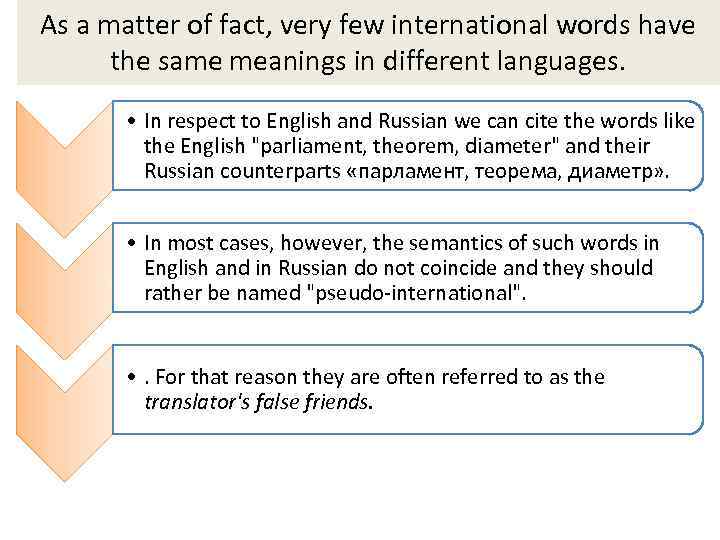
As a matter of fact, very few international words have the same meanings in different languages. • In respect to English and Russian we can cite the words like the English "parliament, theorem, diameter" and their Russian counterparts «парламент, теорема, диаметр» . • In most cases, however, the semantics of such words in English and in Russian do not coincide and they should rather be named "pseudo-international". • . For that reason they are often referred to as the translator's false friends.
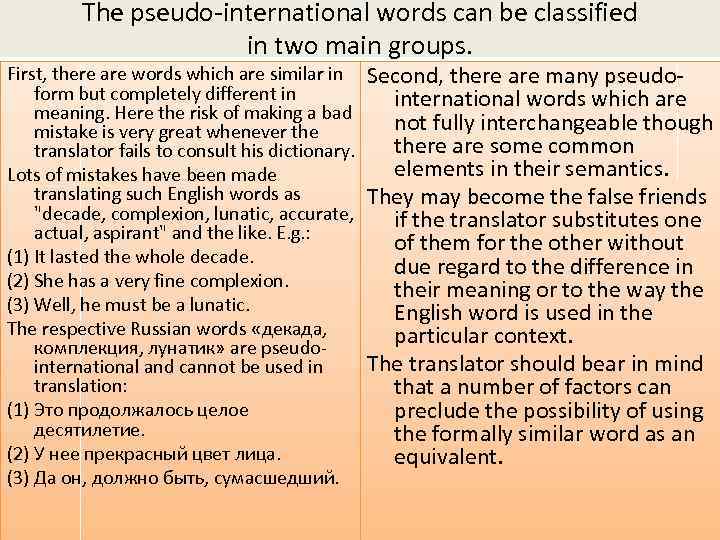
The pseudo-international words can be classified in two main groups. First, there are words which are similar in form but completely different in meaning. Here the risk of making a bad mistake is very great whenever the translator fails to consult his dictionary. Lots of mistakes have been made translating such English words as "decade, complexion, lunatic, accurate, actual, aspirant" and the like. E. g. : (1) It lasted the whole decade. (2) She has a very fine complexion. (3) Well, he must be a lunatic. The respective Russian words «декада, комплекция, лунатик» are pseudointernational and cannot be used in translation: (1) Это продолжалось целое десятилетие. (2) У нее прекрасный цвет лица. (3) Да он, должно быть, сумасшедший. Second, there are many pseudointernational words which are not fully interchangeable though there are some common elements in their semantics. They may become the false friends if the translator substitutes one of them for the other without due regard to the difference in their meaning or to the way the English word is used in the particular context. The translator should bear in mind that a number of factors can preclude the possibility of using the formally similar word as an equivalent.
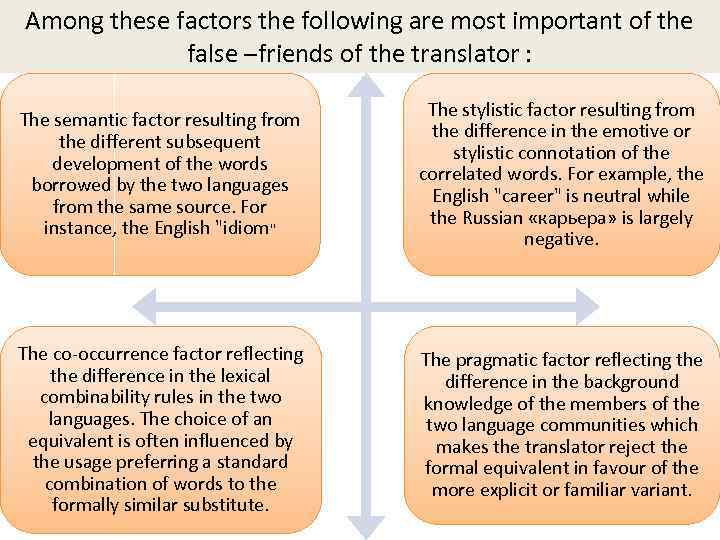
Among these factors the following are most important of the false –friends of the translator : The semantic factor resulting from the different subsequent development of the words borrowed by the two languages from the same source. For instance, the English "idiom" The stylistic factor resulting from the difference in the emotive or stylistic connotation of the correlated words. For example, the English "career" is neutral while the Russian «карьера» is largely negative. The co-occurrence factor reflecting the difference in the lexical combinability rules in the two languages. The choice of an equivalent is often influenced by the usage preferring a standard combination of words to the formally similar substitute. The pragmatic factor reflecting the difference in the background knowledge of the members of the two language communities which makes the translator reject the formal equivalent in favour of the more explicit or familiar variant.
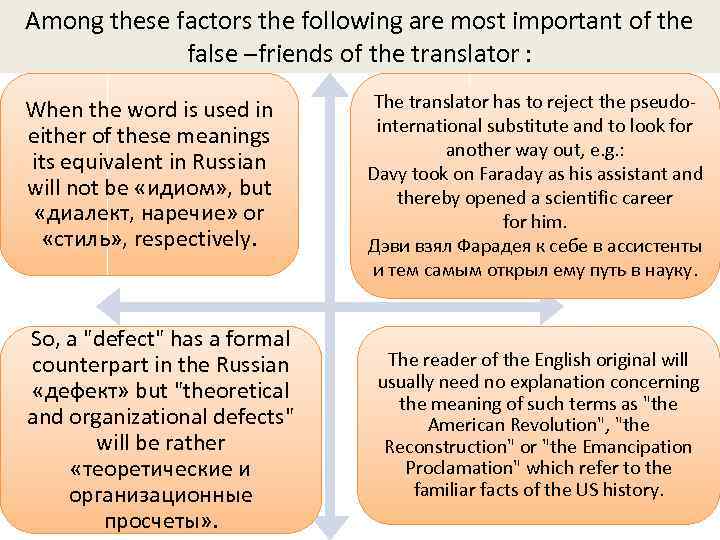
Among these factors the following are most important of the false –friends of the translator : When the word is used in either of these meanings its equivalent in Russian will not be «идиом» , but «диалект, наречие» or «стиль» , respectively. So, a "defect" has a formal counterpart in the Russian «дефект» but "theoretical and organizational defects" will be rather «теоретические и организационные просчеты» . The translator has to reject the pseudointernational substitute and to look for another way out, e. g. : Davy took on Faraday as his assistant and thereby opened a scientific career for him. Дэви взял Фарадея к себе в ассистенты и тем самым открыл ему путь в науку. The reader of the English original will usually need no explanation concerning the meaning of such terms as "the American Revolution", "the Reconstruction" or "the Emancipation Proclamation" which refer to the familiar facts of the US history.
Скачать презентацию Lecture 4 LEXICAL PROBLEMS OF TRANSLATION HANDLING CONTEXT-FREE
Lecture_4.pptx