


 Скачать презентацию Lecture 4 Genome Rearrangements End Sequence Profiling
bd5c7649cd845a9d14f39e824a7c54b7.ppt
- Количество слайдов: 93
 Lecture 4: Genome Rearrangements
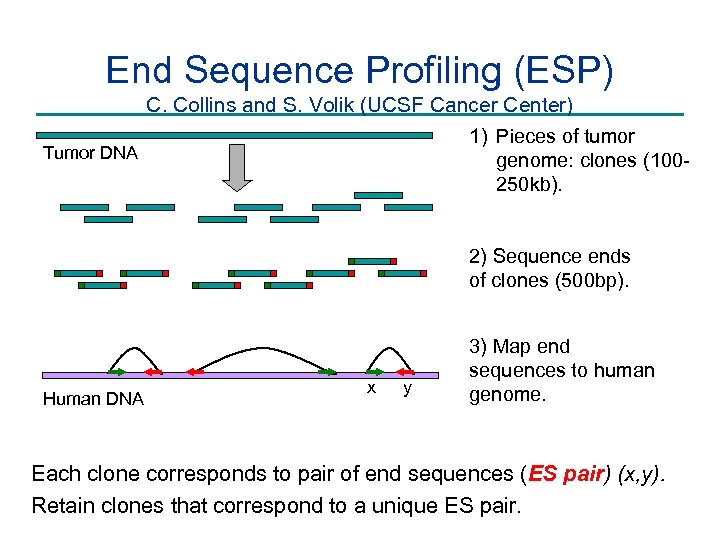 End Sequence Profiling (ESP) C. Collins and S. Volik (UCSF Cancer Center) 1) Pieces of tumor Tumor DNA genome: clones (100250 kb). 2) Sequence ends of clones (500 bp). Human DNA x y 3) Map end sequences to human genome. Each clone corresponds to pair of end sequences (ES pair) (x, y). Retain clones that correspond to a unique ES pair.
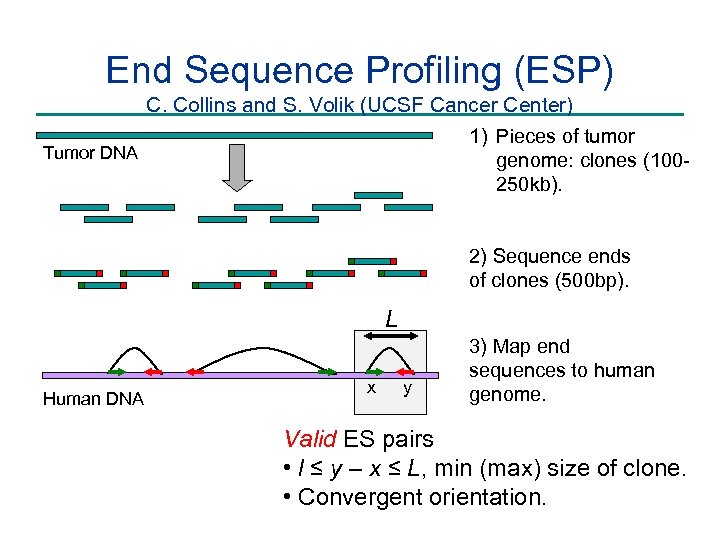 End Sequence Profiling (ESP) C. Collins and S. Volik (UCSF Cancer Center) 1) Pieces of tumor Tumor DNA genome: clones (100250 kb). 2) Sequence ends of clones (500 bp). L Human DNA x y 3) Map end sequences to human genome. Valid ES pairs • l ≤ y – x ≤ L, min (max) size of clone. • Convergent orientation.
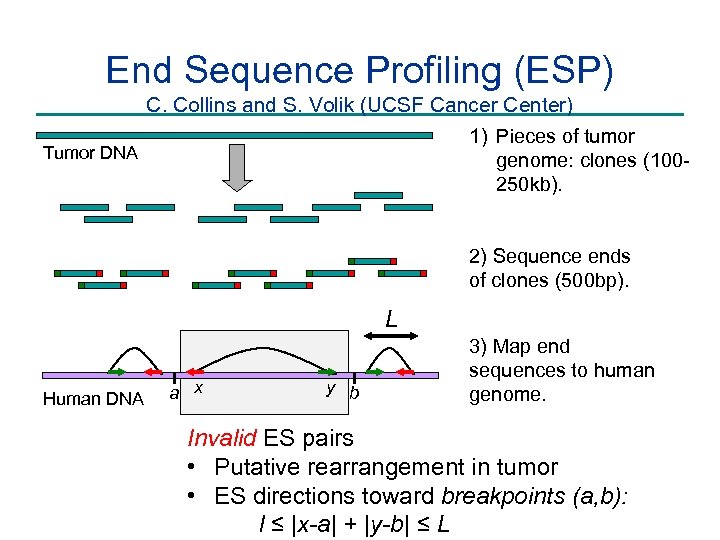 End Sequence Profiling (ESP) C. Collins and S. Volik (UCSF Cancer Center) 1) Pieces of tumor Tumor DNA genome: clones (100250 kb). 2) Sequence ends of clones (500 bp). L Human DNA a x y b 3) Map end sequences to human genome. Invalid ES pairs • Putative rearrangement in tumor • ES directions toward breakpoints (a, b): l ≤ |x-a| + |y-b| ≤ L
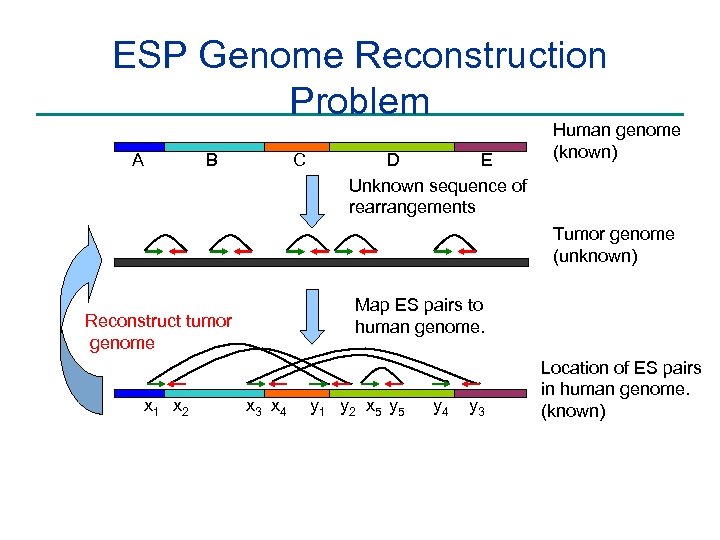 ESP Genome Reconstruction Problem A C B E D Unknown sequence of rearrangements Human genome (known) Tumor genome (unknown) Map ES pairs to human genome. Reconstruct tumor genome x 1 x 2 x 3 x 4 y 1 y 2 x 5 y 4 y 3 Location of ES pairs in human genome. (known)
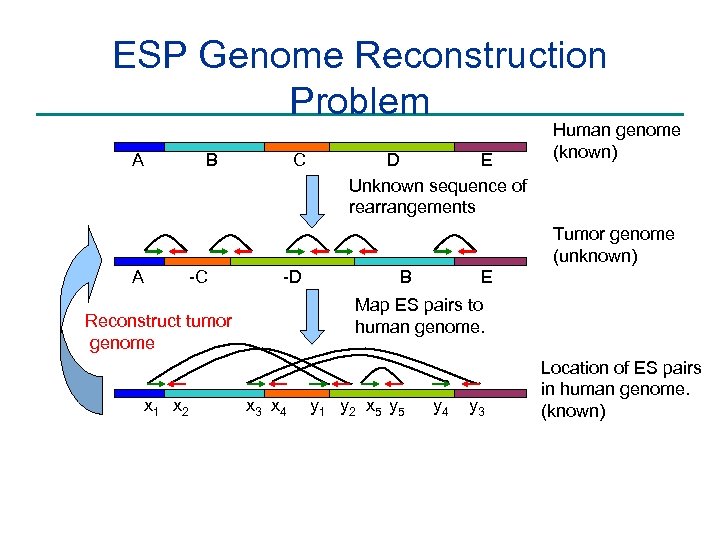 ESP Genome Reconstruction Problem A C B E D Unknown sequence of rearrangements Human genome (known) Tumor genome (unknown) A -C -D Map ES pairs to human genome. Reconstruct tumor genome x 1 x 2 E B x 3 x 4 y 1 y 2 x 5 y 4 y 3 Location of ES pairs in human genome. (known)
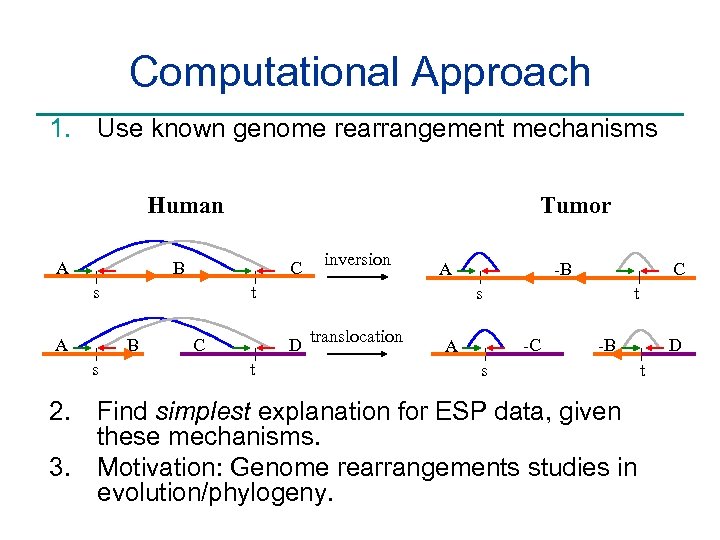 Computational Approach 1. Use known genome rearrangement mechanisms Human A Tumor B C B s A t s A inversion t C t s D translocation C -B -C A -B s 2. Find simplest explanation for ESP data, given these mechanisms. 3. Motivation: Genome rearrangements studies in evolution/phylogeny. D t
 Outline • Sorting By Reversals • Naïve Greedy Algorithm • Breakpoints and Greedy algorithm • • Breakpoint Graphs Hurdles, Fortresses, Superfortresses, etc. Signed Permutations Multichromosomal Rearrangements
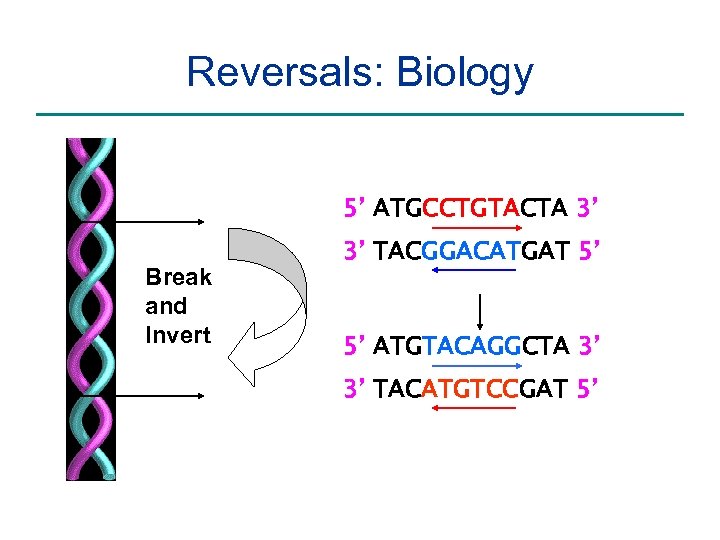 Reversals: Biology 5’ ATGCCTGTACTA 3’ Break and Invert 3’ TACGGACATGAT 5’ 5’ ATGTACAGGCTA 3’ 3’ TACATGTCCGAT 5’
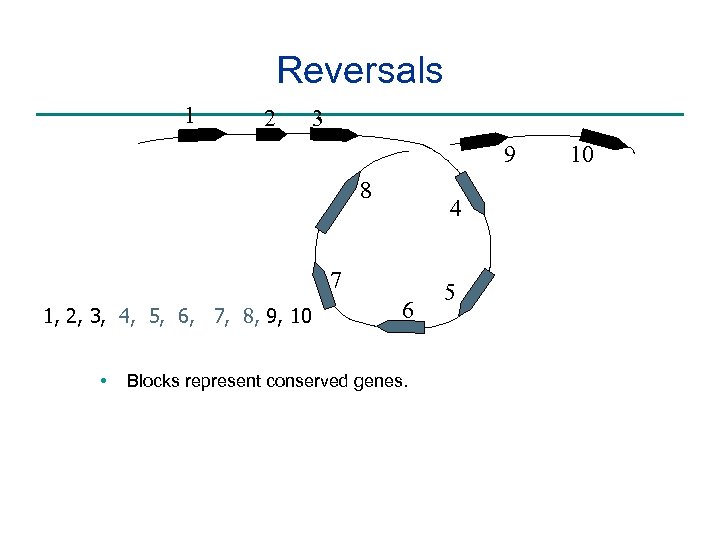 Reversals 1 2 3 9 8 4 7 1, 2, 3, 4, 5, 6, 7, 8, 9, 10 • 6 Blocks represent conserved genes. 5 10
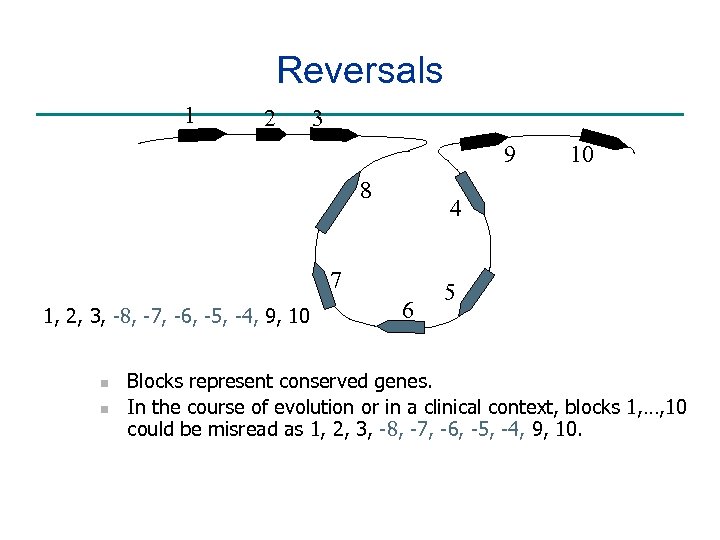 Reversals 1 2 3 9 8 4 7 1, 2, 3, -8, -7, -6, -5, -4, 9, 10 n n 10 6 5 Blocks represent conserved genes. In the course of evolution or in a clinical context, blocks 1, …, 10 could be misread as 1, 2, 3, -8, -7, -6, -5, -4, 9, 10.
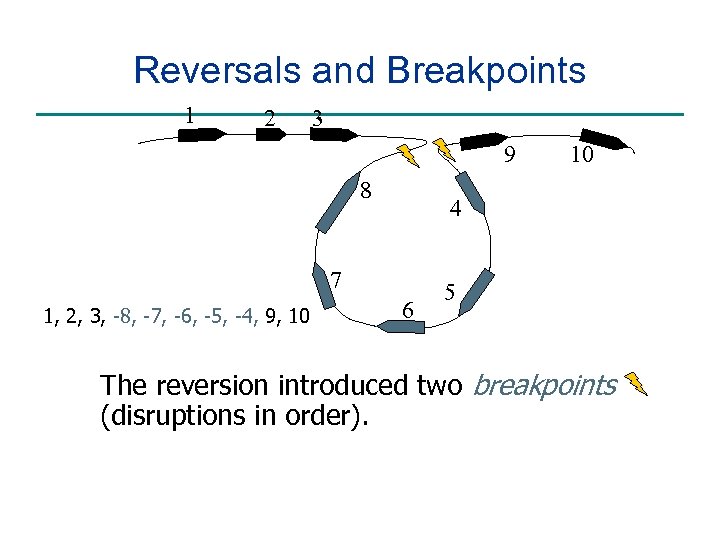 Reversals and Breakpoints 1 2 3 9 8 4 7 1, 2, 3, -8, -7, -6, -5, -4, 9, 10 10 6 5 The reversion introduced two breakpoints (disruptions in order).
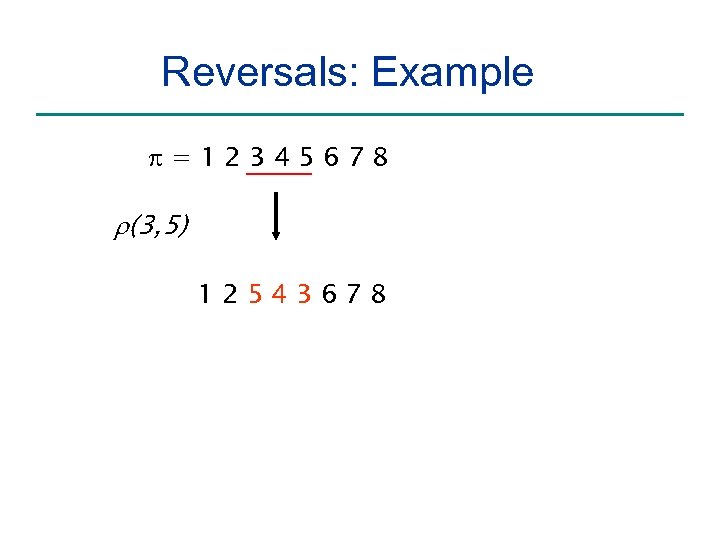 Reversals: Example =12345678 r(3, 5) 12543678
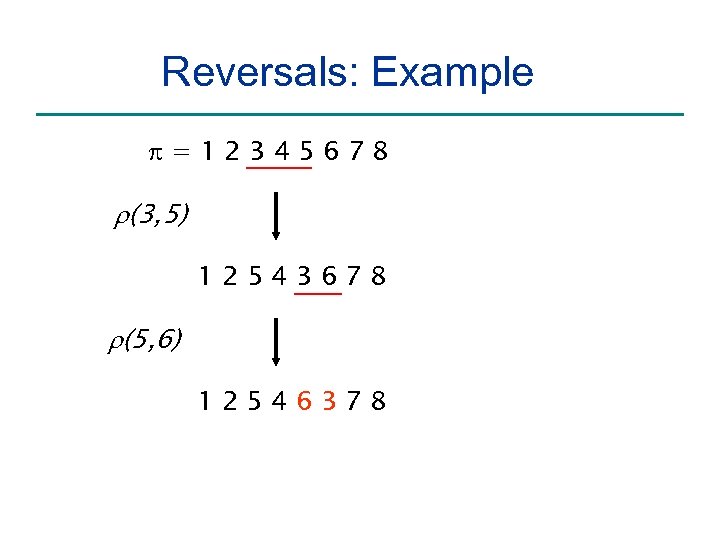 Reversals: Example =12345678 r(3, 5) 12543678 r(5, 6) 12546378
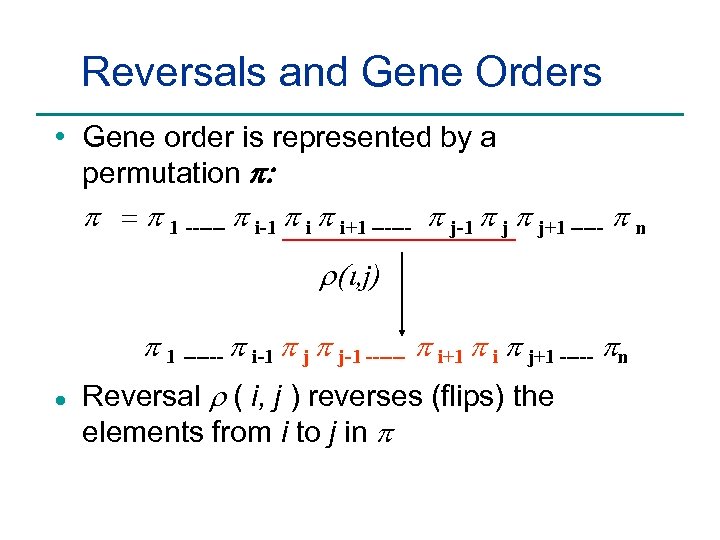 Reversals and Gene Orders • Gene order is represented by a permutation p: p = p 1 ------ p i-1 p i+1 ------ p j-1 p j+1 ----- p n r(i, j) p 1 ------ p i-1 p j-1 ------ p i+1 p i p j+1 ----- pn l Reversal r ( i, j ) reverses (flips) the elements from i to j in p
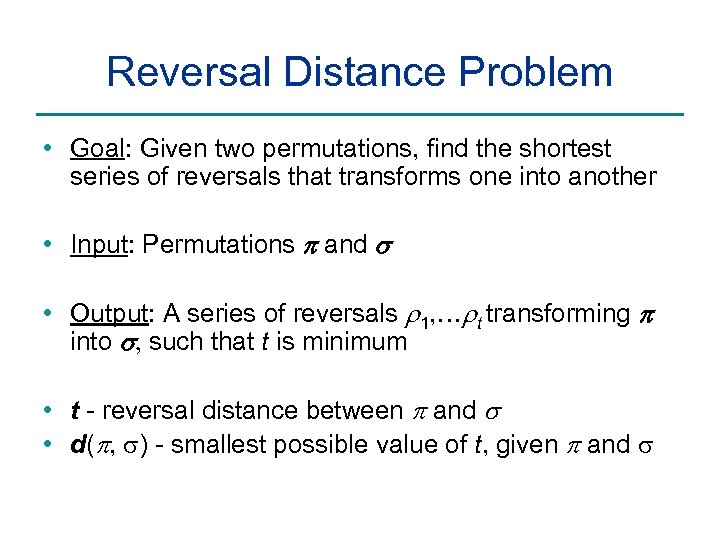 Reversal Distance Problem • Goal: Given two permutations, find the shortest series of reversals that transforms one into another • Input: Permutations p and s • Output: A series of reversals r 1, …rt transforming p into s, such that t is minimum • t - reversal distance between p and s • d(p, ) - smallest possible value of t, given p and
 Sorting By Reversals Problem • Goal: Given a permutation, find a shortest series of reversals that transforms it into the identity permutation (1 2 … n ) • Input: Permutation p • Output: A series of reversals r 1, … rt transforming p into the identity permutation such that t is minimum
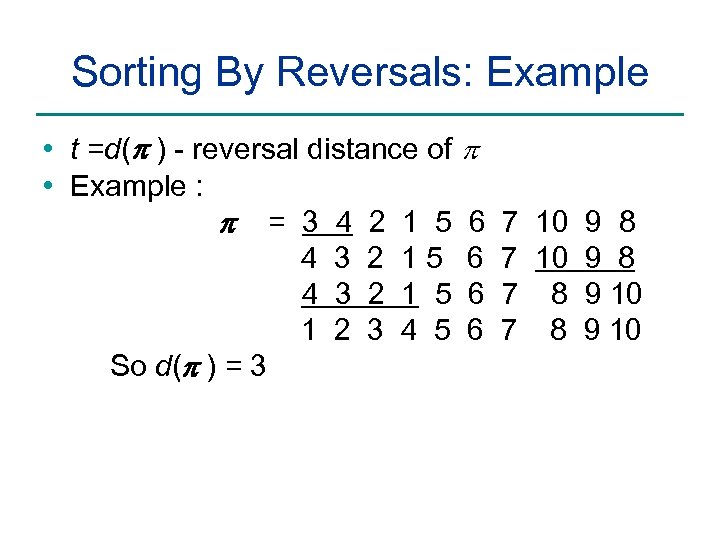 Sorting By Reversals: Example • t =d(p ) - reversal distance of p • Example : p = 3 4 2 1 5 6 4 3 2 1 5 6 1 2 3 4 5 6 So d(p ) = 3 7 10 9 8 7 8 9 10
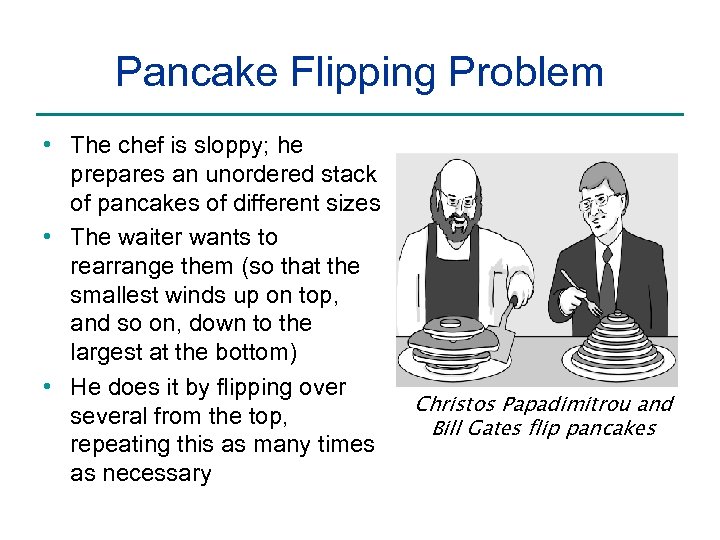 Pancake Flipping Problem • The chef is sloppy; he prepares an unordered stack of pancakes of different sizes • The waiter wants to rearrange them (so that the smallest winds up on top, and so on, down to the largest at the bottom) • He does it by flipping over several from the top, repeating this as many times as necessary Christos Papadimitrou and Bill Gates flip pancakes
 Pancake Flipping Problem: Formulation • Goal: Given a stack of n pancakes, what is the minimum number of flips to rearrange them into perfect stack? • Input: Permutation p • Output: A series of prefix reversals r 1, … rt transforming p into the identity permutation such that t is minimum
 Pancake Flipping Problem: Greedy Algorithm • Greedy approach: 2 prefix reversals at most to place a pancake in its right position, 2 n – 2 steps total • William Gates and Christos Papadimitriou showed in the mid-1970 s that this problem can be solved by at most 5/3 (n + 1) prefix reversals
 Sorting By Reversals: A Greedy Algorithm • If sorting permutation p = 1 2 3 6 4 5, the first three elements are already in order so it does not make any sense to break them. • The length of the already sorted prefix of p is denoted prefix(p) • prefix(p) = 3 • This results in an idea for a greedy algorithm: increase prefix(p) at every step
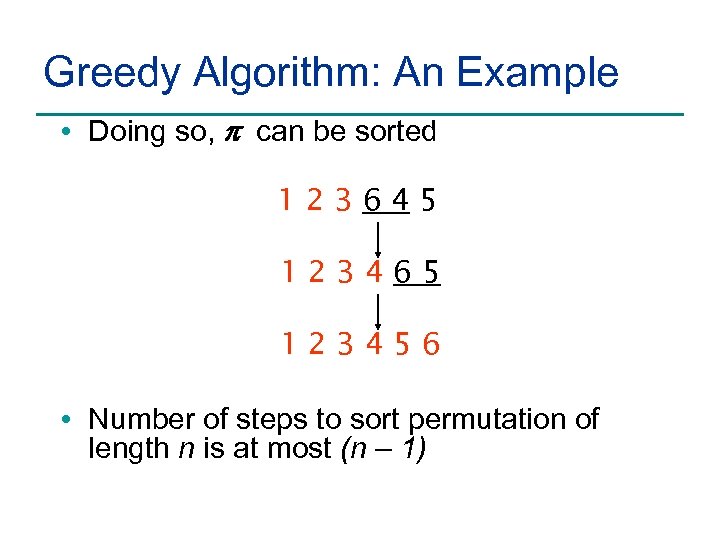 Greedy Algorithm: An Example • Doing so, p can be sorted 123645 123465 123456 • Number of steps to sort permutation of length n is at most (n – 1)
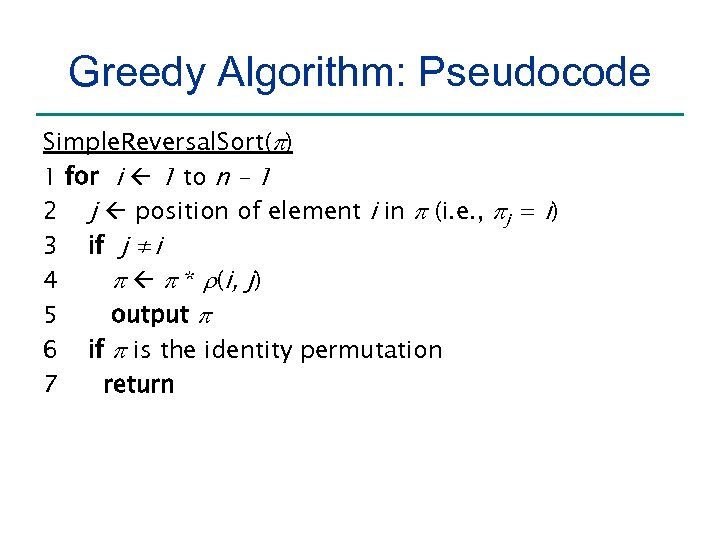 Greedy Algorithm: Pseudocode Simple. Reversal. Sort(p) 1 for i 1 to n – 1 2 j position of element i in p (i. e. , pj = i) 3 if j ≠i 4 p p * r(i, j) 5 output p 6 if p is the identity permutation 7 return
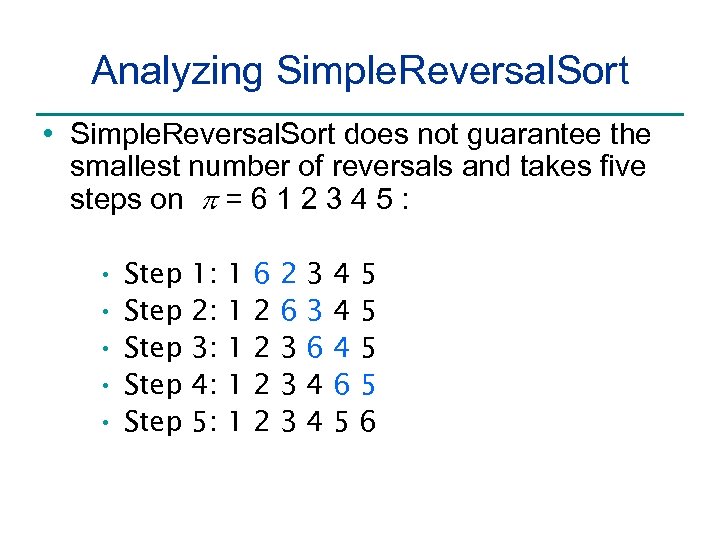 Analyzing Simple. Reversal. Sort • Simple. Reversal. Sort does not guarantee the smallest number of reversals and takes five steps on p = 6 1 2 3 4 5 : • • • Step Step 1: 2: 3: 4: 5: 1 1 1 6 2 2 2 6 3 3 3 6 4 4 4 6 5 5 5 6
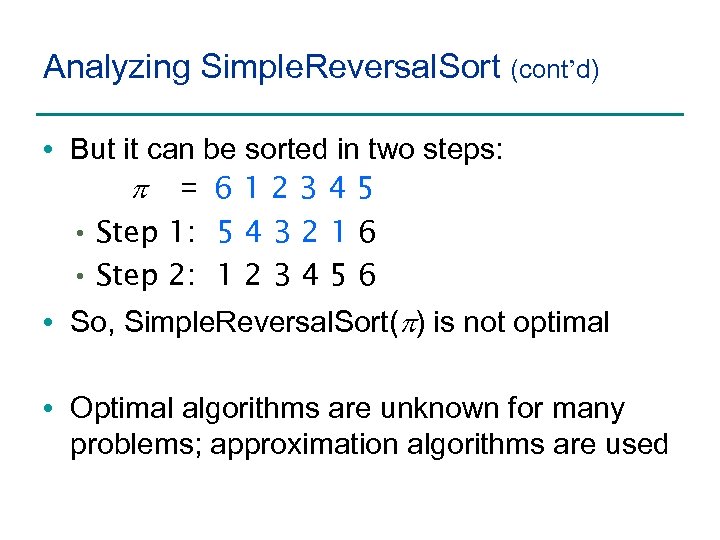 Analyzing Simple. Reversal. Sort (cont’d) • But it can be sorted in two steps: p = 612345 • Step 1: 5 4 3 2 1 6 • Step 2: 1 2 3 4 5 6 • So, Simple. Reversal. Sort(p) is not optimal • Optimal algorithms are unknown for many problems; approximation algorithms are used
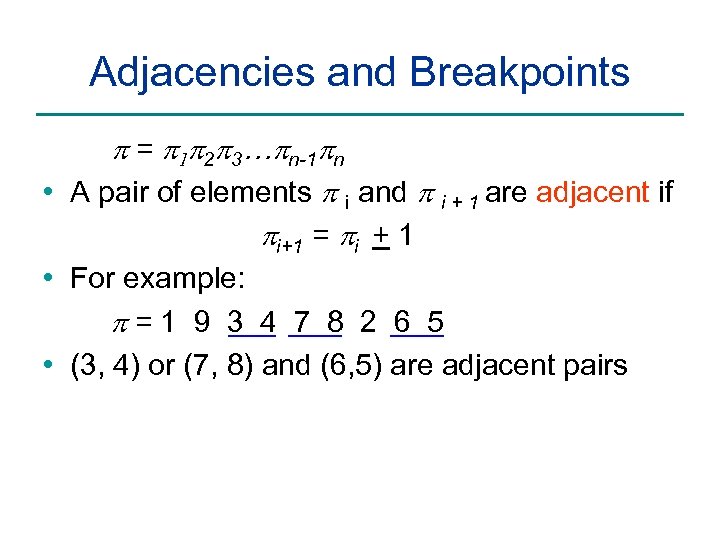 Adjacencies and Breakpoints p = p 1 p 2 p 3…pn-1 pn • A pair of elements p i and p i + 1 are adjacent if pi+1 = pi + 1 • For example: p=1 9 3 4 7 8 2 6 5 • (3, 4) or (7, 8) and (6, 5) are adjacent pairs
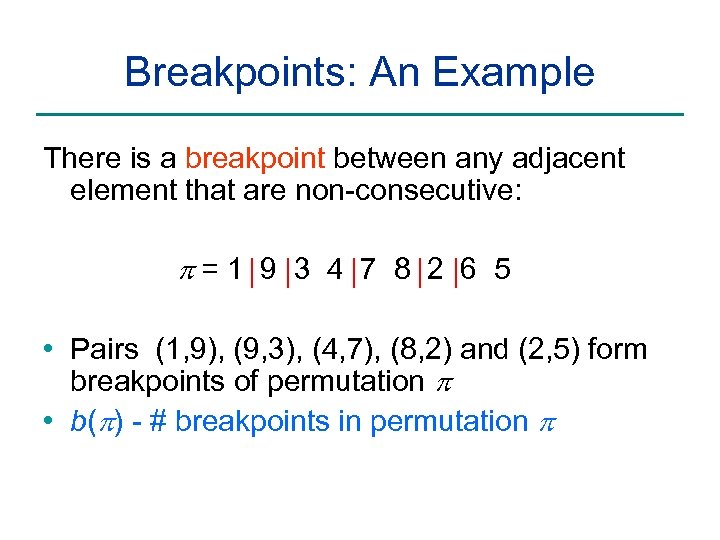 Breakpoints: An Example There is a breakpoint between any adjacent element that are non-consecutive: p=1 9 3 4 7 8 2 6 5 • Pairs (1, 9), (9, 3), (4, 7), (8, 2) and (2, 5) form breakpoints of permutation p • b(p) - # breakpoints in permutation p
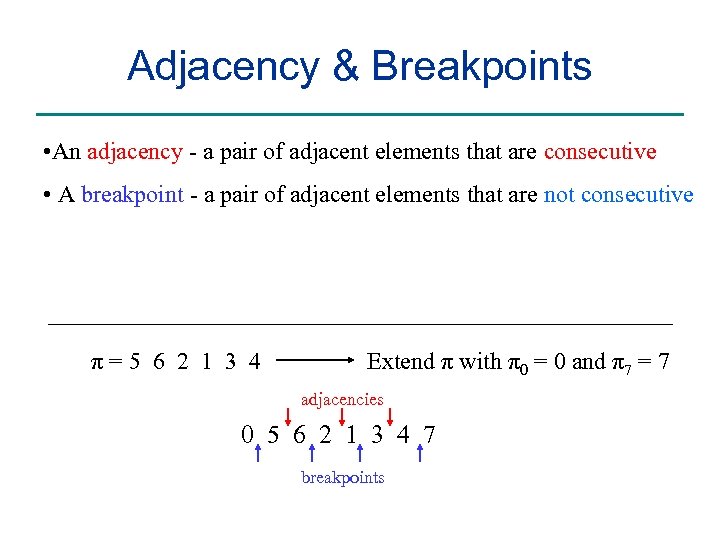 Adjacency & Breakpoints • An adjacency - a pair of adjacent elements that are consecutive • A breakpoint - a pair of adjacent elements that are not consecutive π=5 6 2 1 3 4 Extend π with π0 = 0 and π7 = 7 adjacencies 0 5 6 2 1 3 4 7 breakpoints
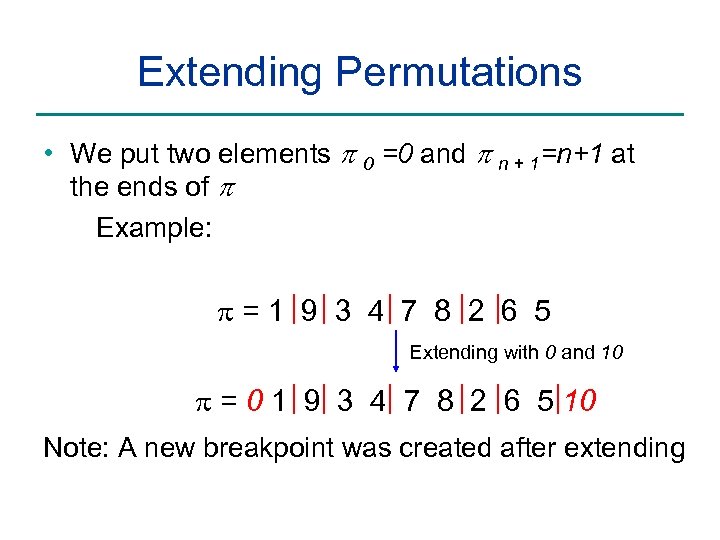 Extending Permutations • We put two elements p 0 =0 and p n + 1=n+1 at the ends of p Example: =1 9 3 4 7 8 2 6 5 Extending with 0 and 10 = 0 1 9 3 4 7 8 2 6 5 10 Note: A new breakpoint was created after extending
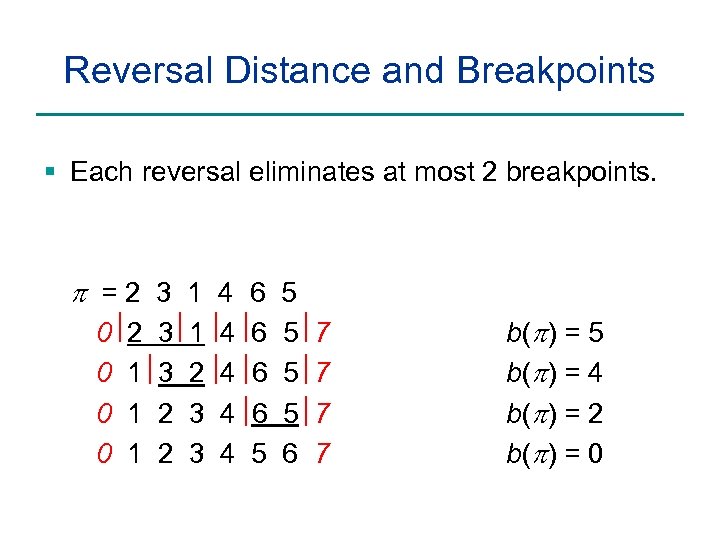 Reversal Distance and Breakpoints § Each reversal eliminates at most 2 breakpoints. p =2 3 1 4 6 5 0 0 2 1 1 1 3 3 2 2 1 2 3 3 4 4 6 6 6 5 5 6 7 7 b(p) = 5 b(p) = 4 b(p) = 2 b(p) = 0
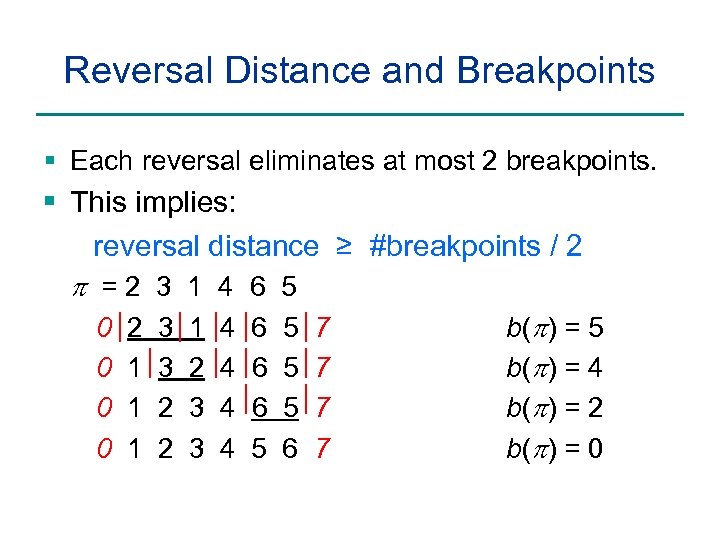 Reversal Distance and Breakpoints § Each reversal eliminates at most 2 breakpoints. § This implies: reversal distance ≥ #breakpoints / 2 p =2 3 1 4 6 5 0 2 3 1 4 6 5 7 b(p) = 5 0 1 3 2 4 6 5 7 b(p) = 4 0 1 2 3 4 6 5 7 b(p) = 2 0 1 2 3 4 5 6 7 b(p) = 0
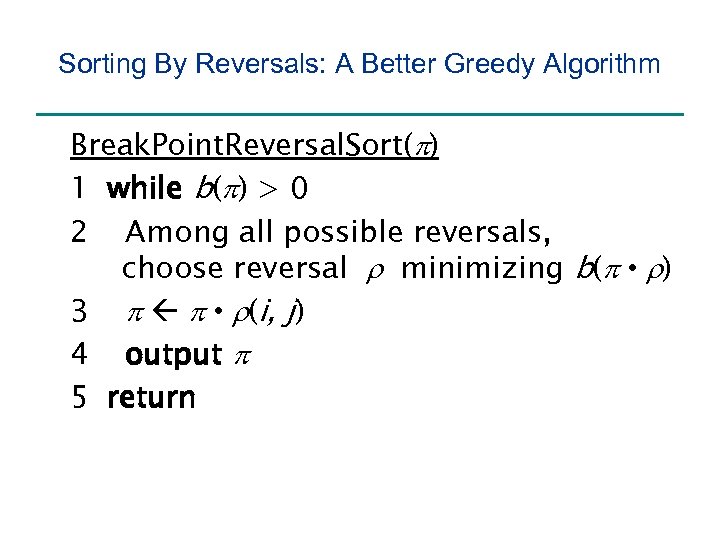 Sorting By Reversals: A Better Greedy Algorithm Break. Point. Reversal. Sort(p) 1 while b(p) > 0 2 Among all possible reversals, choose reversal r minimizing b(p • r) 3 p p • r(i, j) 4 output p 5 return
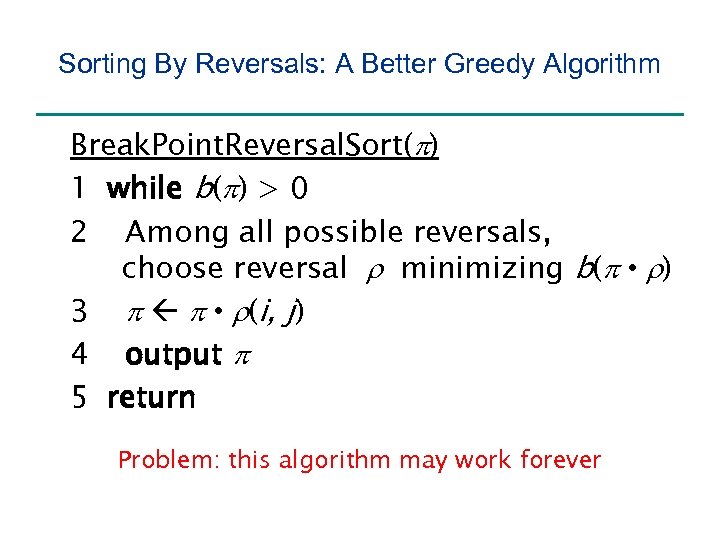 Sorting By Reversals: A Better Greedy Algorithm Break. Point. Reversal. Sort(p) 1 while b(p) > 0 2 Among all possible reversals, choose reversal r minimizing b(p • r) 3 p p • r(i, j) 4 output p 5 return Problem: this algorithm may work forever
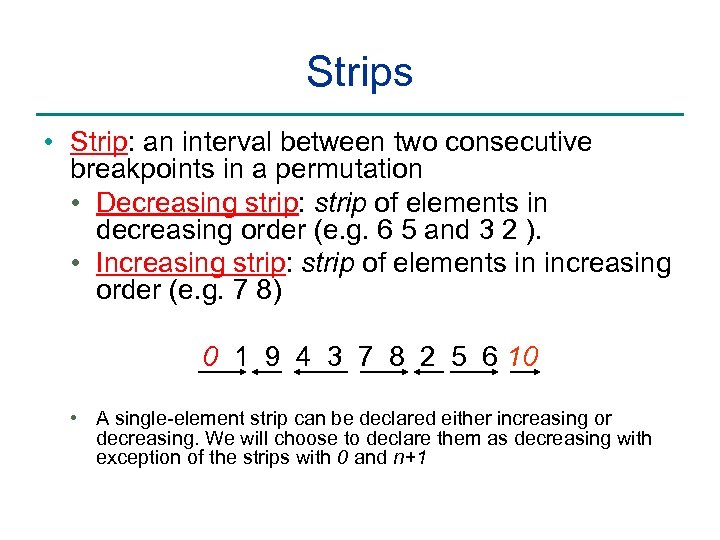 Strips • Strip: an interval between two consecutive breakpoints in a permutation • Decreasing strip: strip of elements in decreasing order (e. g. 6 5 and 3 2 ). • Increasing strip: strip of elements in increasing order (e. g. 7 8) 0 1 9 4 3 7 8 2 5 6 10 • A single-element strip can be declared either increasing or decreasing. We will choose to declare them as decreasing with exception of the strips with 0 and n+1
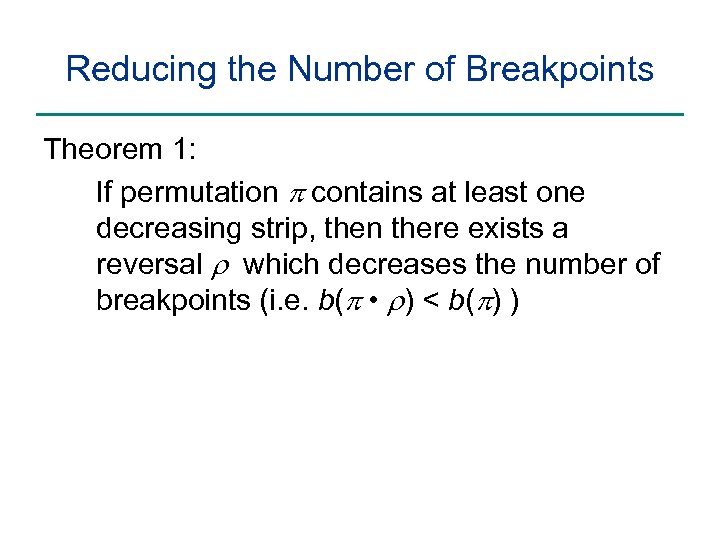 Reducing the Number of Breakpoints Theorem 1: If permutation p contains at least one decreasing strip, then there exists a reversal r which decreases the number of breakpoints (i. e. b(p • r) < b(p) )
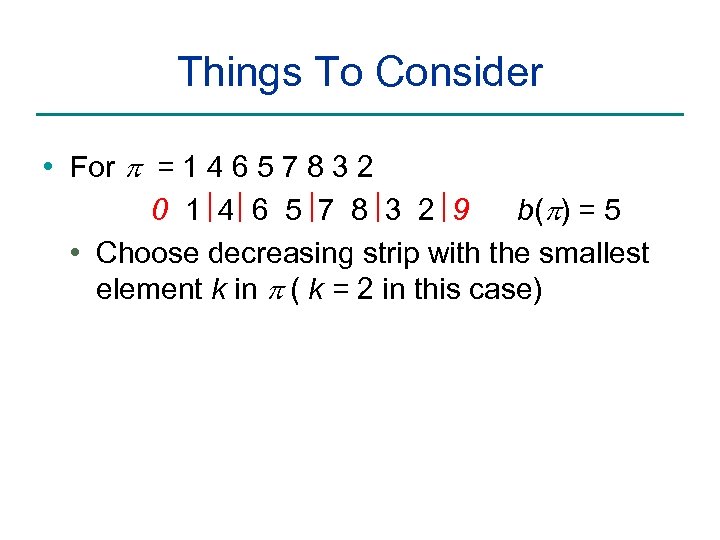 Things To Consider • For p = 1 4 6 5 7 8 3 2 0 1 4 6 5 7 8 3 2 9 b(p) = 5 • Choose decreasing strip with the smallest element k in p ( k = 2 in this case)
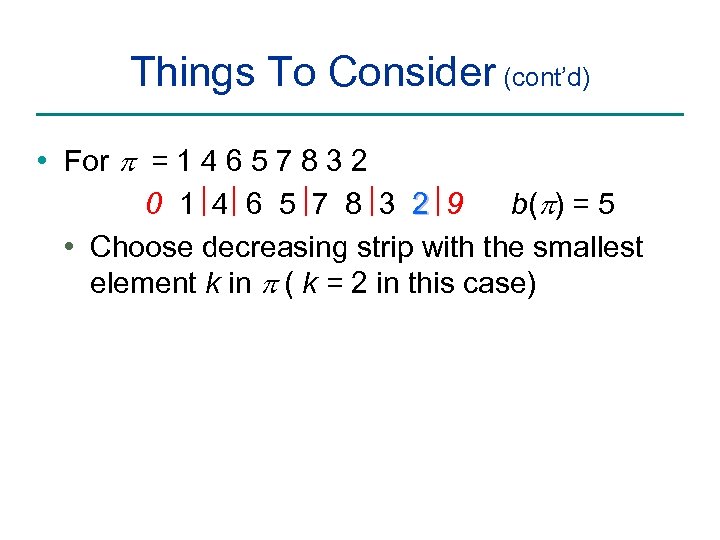 Things To Consider (cont’d) • For p = 1 4 6 5 7 8 3 2 0 1 4 6 5 7 8 3 2 9 b(p) = 5 • Choose decreasing strip with the smallest element k in p ( k = 2 in this case)
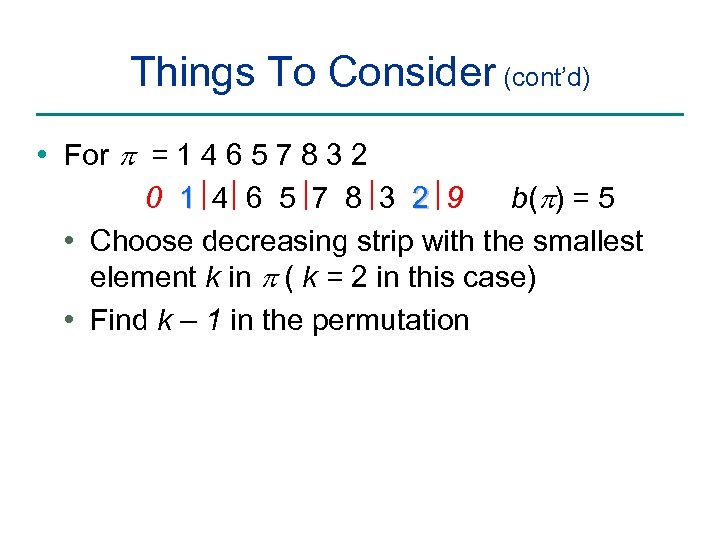 Things To Consider (cont’d) • For p = 1 4 6 5 7 8 3 2 0 1 4 6 5 7 8 3 2 9 b(p) = 5 • Choose decreasing strip with the smallest element k in p ( k = 2 in this case) • Find k – 1 in the permutation
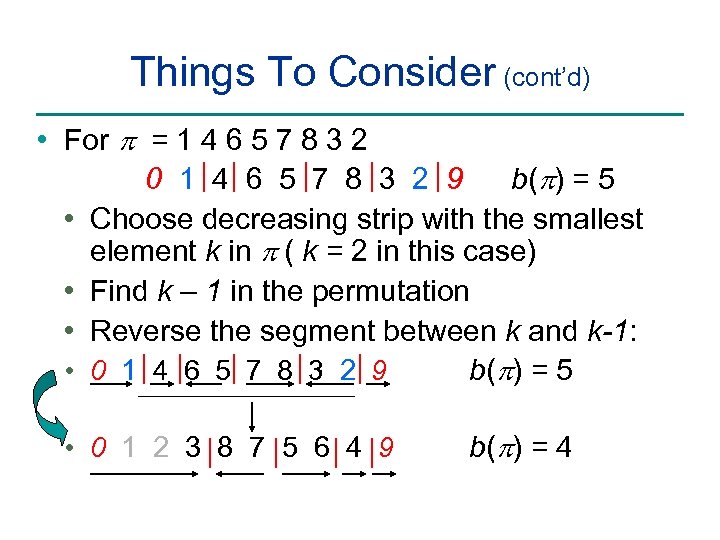 Things To Consider (cont’d) • For p = 1 4 6 5 7 8 3 2 0 1 4 6 5 7 8 3 2 9 b(p) = 5 • Choose decreasing strip with the smallest element k in p ( k = 2 in this case) • Find k – 1 in the permutation • Reverse the segment between k and k-1: • 0 1 4 6 5 7 8 3 2 9 b(p) = 5 • 0 1 2 3 8 7 5 6 4 9 b(p) = 4
 Reducing the Number of Breakpoints Again • If there is no decreasing strip, there may be no reversal r that reduces the number of breakpoints (i. e. b(p • r) ≥ b(p) for any reversal r). • By reversing an increasing strip ( # of breakpoints stay unchanged ), we will create a decreasing strip at the next step. Then the number of breakpoints will be reduced in the next step (theorem 1).
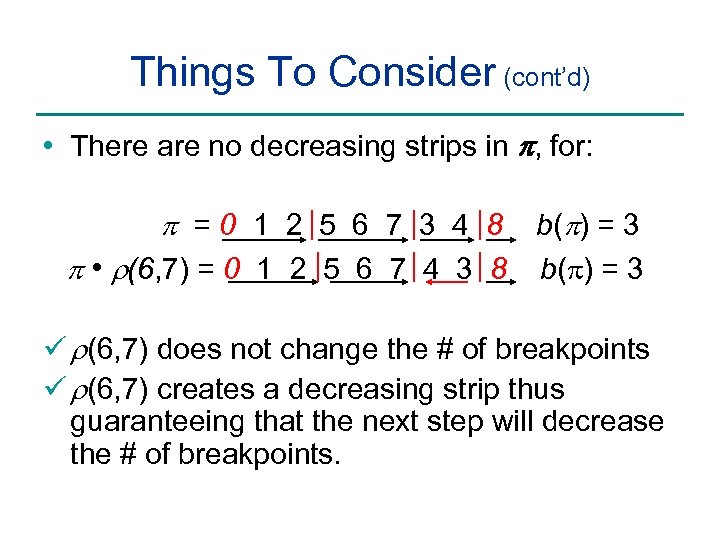 Things To Consider (cont’d) • There are no decreasing strips in p, for: p =0 1 2 5 6 7 3 4 8 b(p) = 3 p • r(6, 7) = 0 1 2 5 6 7 4 3 8 b( ) = 3 ü r(6, 7) does not change the # of breakpoints ü r(6, 7) creates a decreasing strip thus guaranteeing that the next step will decrease the # of breakpoints.
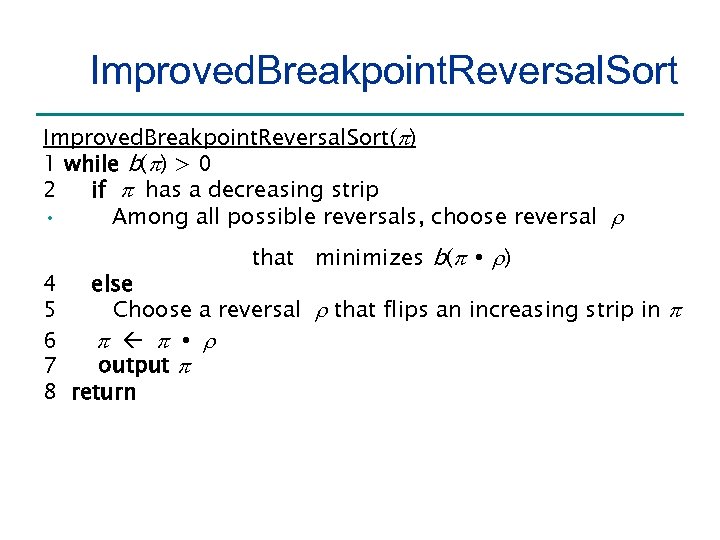 Improved. Breakpoint. Reversal. Sort(p) 1 while b(p) > 0 2 if p has a decreasing strip • Among all possible reversals, choose reversal r that minimizes b(p • r) 4 else 5 Choose a reversal r that flips an increasing strip in p 6 p p • r 7 output p 8 return
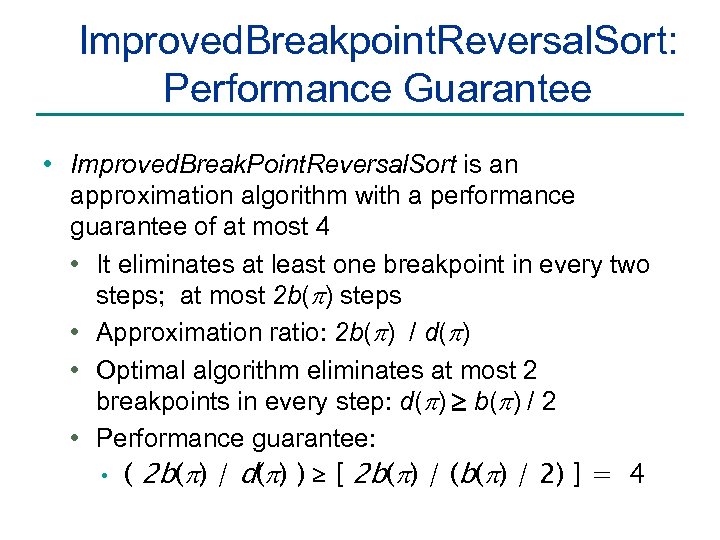 Improved. Breakpoint. Reversal. Sort: Performance Guarantee • Improved. Break. Point. Reversal. Sort is an approximation algorithm with a performance guarantee of at most 4 • It eliminates at least one breakpoint in every two steps; at most 2 b(p) steps • Approximation ratio: 2 b(p) / d(p) • Optimal algorithm eliminates at most 2 breakpoints in every step: d(p) b(p) / 2 • Performance guarantee: • ( 2 b(p) / d(p) ) [ 2 b(p) / (b(p) / 2) ] = 4
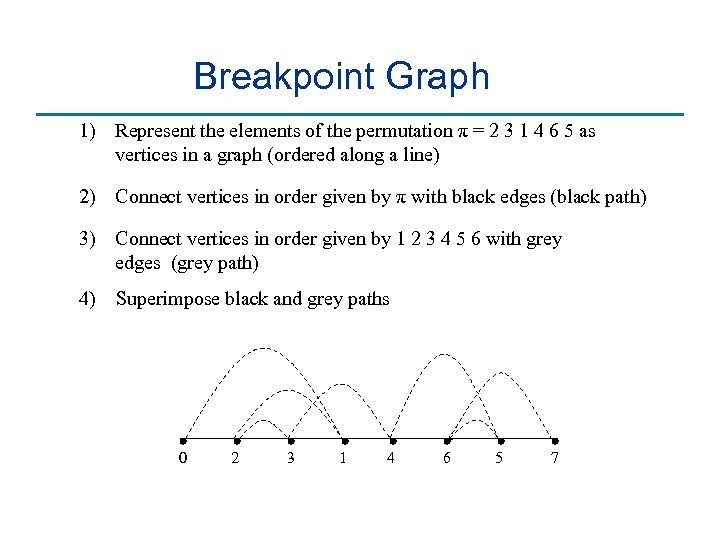 Breakpoint Graph 1) Represent the elements of the permutation π = 2 3 1 4 6 5 as vertices in a graph (ordered along a line) 2) Connect vertices in order given by π with black edges (black path) 3) Connect vertices in order given by 1 2 3 4 5 6 with grey edges (grey path) 4) Superimpose black and grey paths 0 2 3 1 4 6 5 7
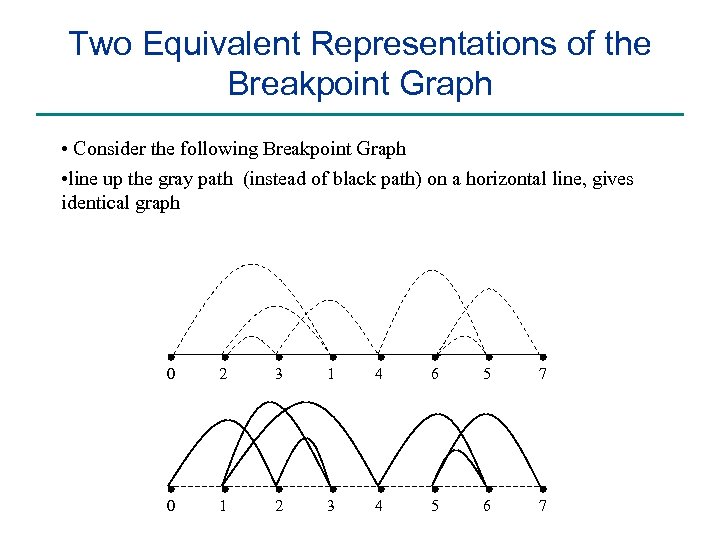 Two Equivalent Representations of the Breakpoint Graph • Consider the following Breakpoint Graph • line up the gray path (instead of black path) on a horizontal line, gives identical graph 0 2 3 1 4 6 5 7 0 1 2 3 4 5 6 7
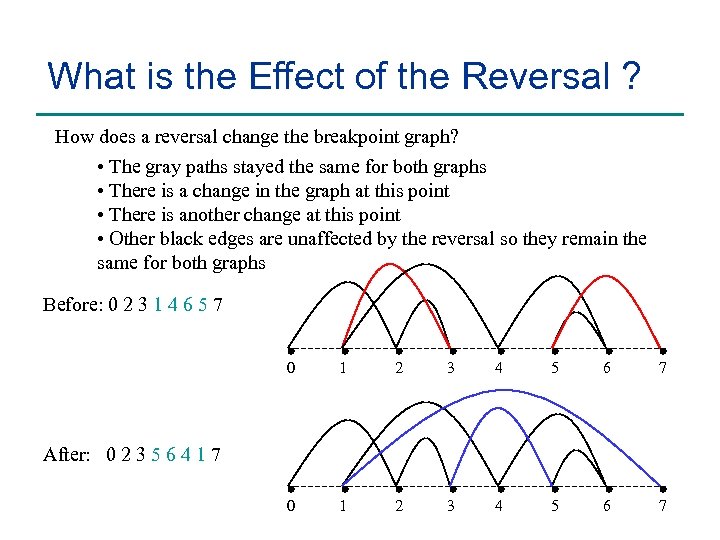 What is the Effect of the Reversal ? How does a reversal change the breakpoint graph? • The gray paths stayed the same for both graphs • There is a change in the graph at this point • There is another change at this point • Other black edges are unaffected by the reversal so they remain the same for both graphs Before: 0 2 3 1 4 6 5 7 0 1 2 3 4 5 6 7 After: 0 2 3 5 6 4 1 7
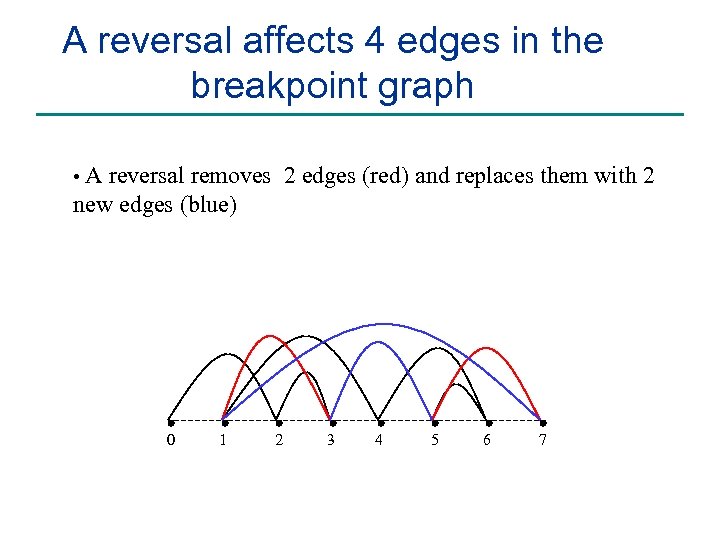 A reversal affects 4 edges in the breakpoint graph • A reversal removes 2 edges (red) and replaces them with 2 new edges (blue) 0 1 2 3 4 5 6 7
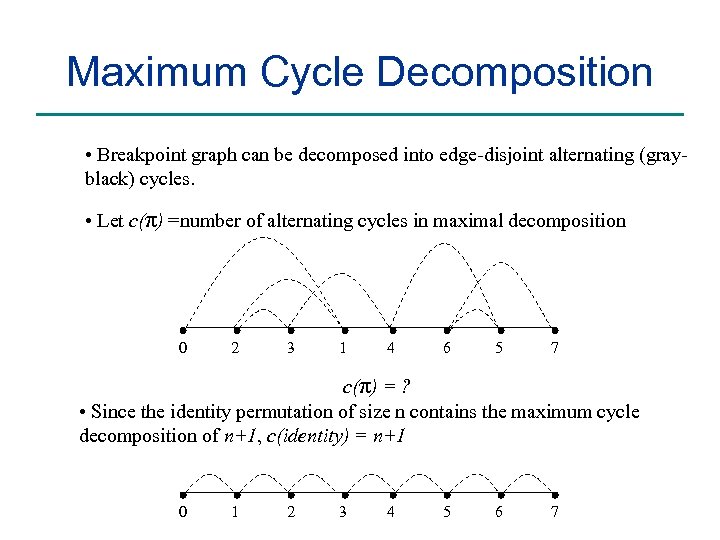 Maximum Cycle Decomposition • Breakpoint graph can be decomposed into edge-disjoint alternating (grayblack) cycles. • Let c(π) =number of alternating cycles in maximal decomposition 0 2 3 1 4 6 5 7 c(π) = ? • Since the identity permutation of size n contains the maximum cycle decomposition of n+1, c(identity) = n+1 0 1 2 3 4 5 6 7
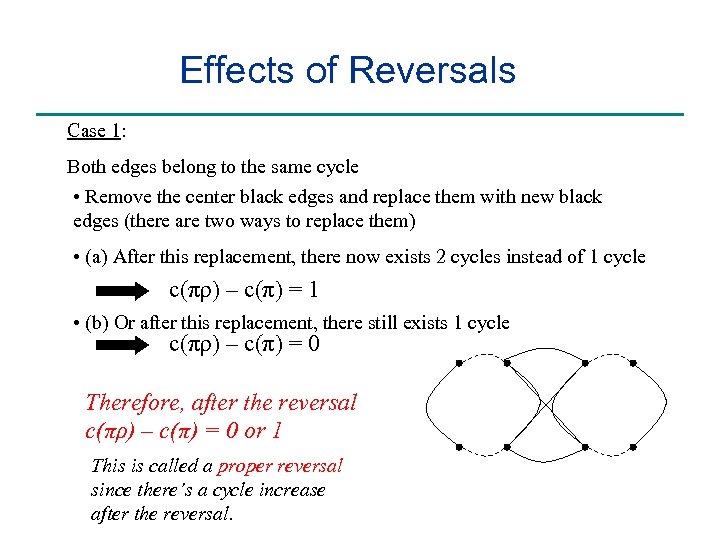 Effects of Reversals Case 1: Both edges belong to the same cycle • Remove the center black edges and replace them with new black edges (there are two ways to replace them) • (a) After this replacement, there now exists 2 cycles instead of 1 cycle c(πρ) – c(π) = 1 • (b) Or after this replacement, there still exists 1 cycle c(πρ) – c(π) = 0 Therefore, after the reversal c(πρ) – c(π) = 0 or 1 This is called a proper reversal since there’s a cycle increase after the reversal.
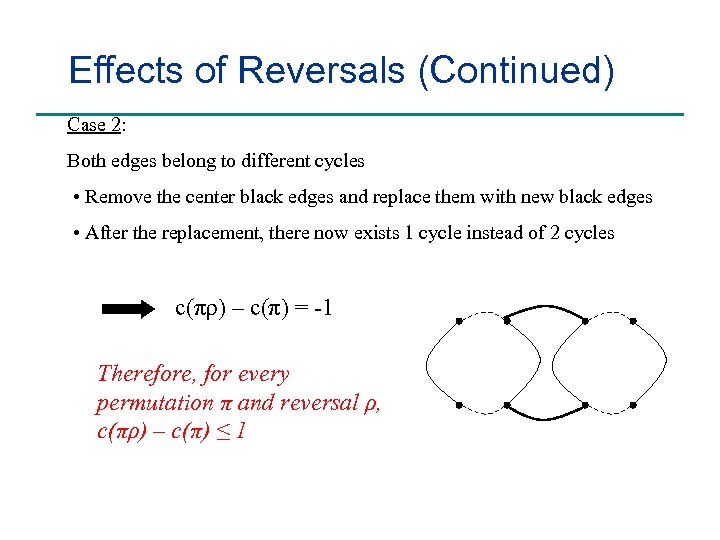 Effects of Reversals (Continued) Case 2: Both edges belong to different cycles • Remove the center black edges and replace them with new black edges • After the replacement, there now exists 1 cycle instead of 2 cycles c(πρ) – c(π) = -1 Therefore, for every permutation π and reversal ρ, c(πρ) – c(π) ≤ 1
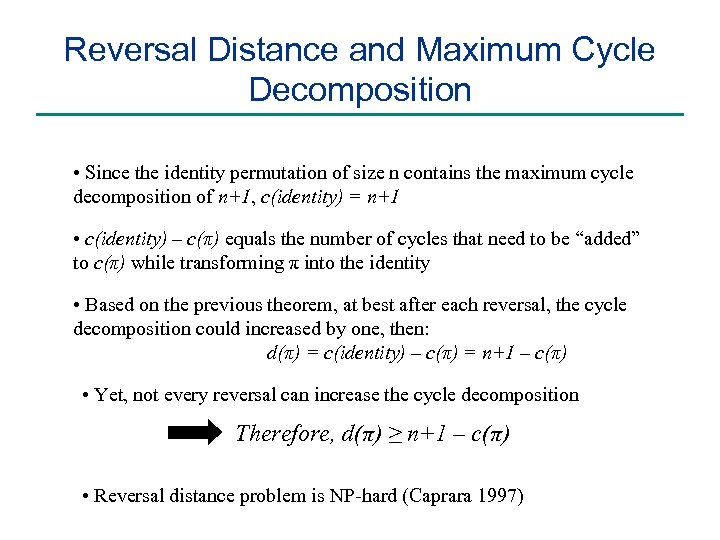 Reversal Distance and Maximum Cycle Decomposition • Since the identity permutation of size n contains the maximum cycle decomposition of n+1, c(identity) = n+1 • c(identity) – c(π) equals the number of cycles that need to be “added” to c(π) while transforming π into the identity • Based on the previous theorem, at best after each reversal, the cycle decomposition could increased by one, then: d(π) = c(identity) – c(π) = n+1 – c(π) • Yet, not every reversal can increase the cycle decomposition Therefore, d(π) ≥ n+1 – c(π) • Reversal distance problem is NP-hard (Caprara 1997)
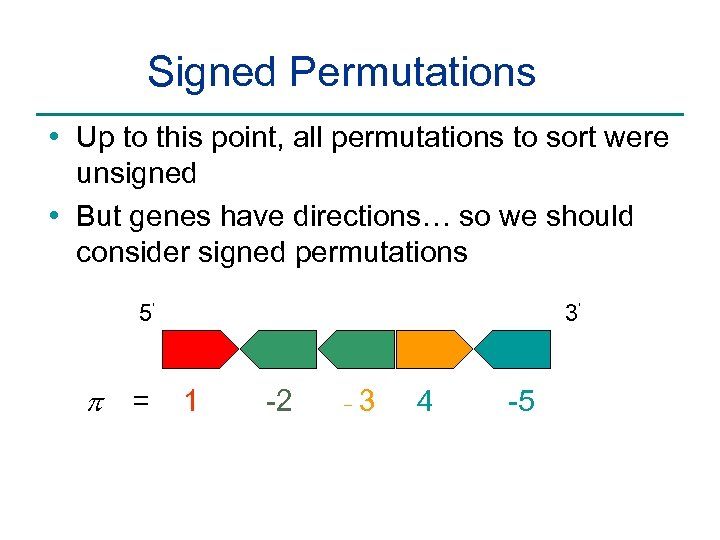 Signed Permutations • Up to this point, all permutations to sort were unsigned • But genes have directions… so we should consider signed permutations 5’ p = 3’ 1 -2 - 3 4 -5
 Sorting by reversals: 5 steps
 Sorting by reversals: 4 steps
 Sorting by reversals: 4 steps What is the reversal distance for this permutation? Can it be sorted in 3 steps?
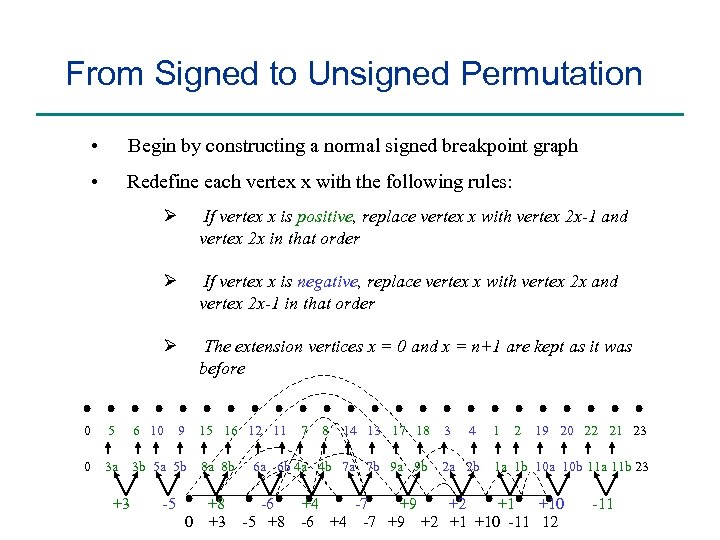 From Signed to Unsigned Permutation • Begin by constructing a normal signed breakpoint graph • Redefine each vertex x with the following rules: Ø Ø 5 0 3 a +3 If vertex x is negative, replace vertex x with vertex 2 x and vertex 2 x-1 in that order Ø 0 If vertex x is positive, replace vertex x with vertex 2 x-1 and vertex 2 x in that order The extension vertices x = 0 and x = n+1 are kept as it was before 6 10 9 15 16 12 11 3 b 5 a 5 b -5 8 a 8 b +8 0 +3 7 8 14 13 17 18 6 a 6 b 4 a 4 b 7 a 7 b 9 a 9 b -6 -5 +8 3 4 2 a 2 b 1 2 19 20 22 21 23 1 a 1 b 10 a 10 b 11 a 11 b 23 +4 -7 +9 +2 +1 +10 -6 +4 -7 +9 +2 +1 +10 -11 12 -11
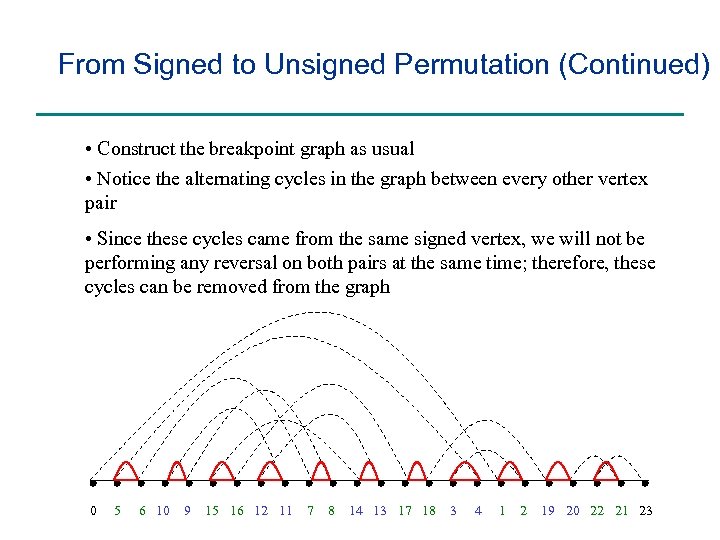 From Signed to Unsigned Permutation (Continued) • Construct the breakpoint graph as usual • Notice the alternating cycles in the graph between every other vertex pair • Since these cycles came from the same signed vertex, we will not be performing any reversal on both pairs at the same time; therefore, these cycles can be removed from the graph 0 5 6 10 9 15 16 12 11 7 8 14 13 17 18 3 4 1 2 19 20 22 21 23
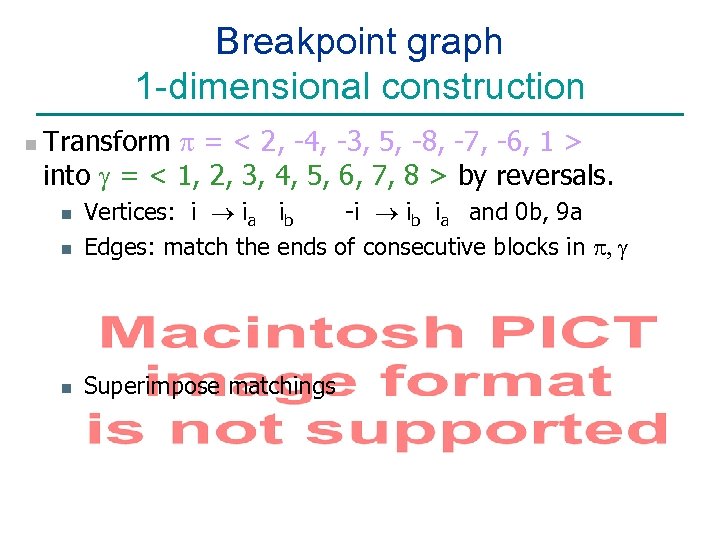 Breakpoint graph 1 -dimensional construction n Transform = < 2, -4, -3, 5, -8, -7, -6, 1 > into g = < 1, 2, 3, 4, 5, 6, 7, 8 > by reversals. n Vertices: i ® ia ib -i ® ib ia and 0 b, 9 a Edges: match the ends of consecutive blocks in , g n Superimpose matchings n
 Breakpoint graph Breakpoints Each reversal goes between 2 breakpoints, so d ³ # breakpoints / 2 = 6/2 = 3. n Theorem (Hannenhalli-Pevzner 1995): d=n+1–c+h+f where c = # cycles; h, f are rather complicated, but can be computed from graph in polynomial time. n Here, d = 8 + 1 – 5 + 0 = 4 n
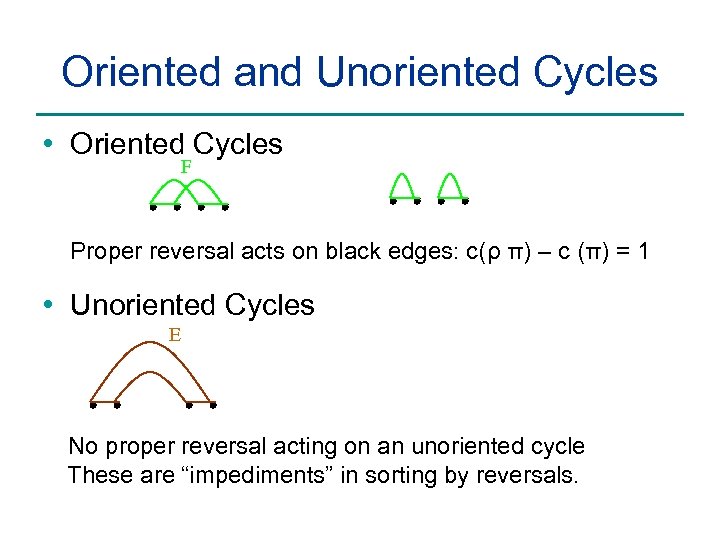 Oriented and Unoriented Cycles • Oriented Cycles F Proper reversal acts on black edges: c(ρ π) – c (π) = 1 • Unoriented Cycles E No proper reversal acting on an unoriented cycle These are “impediments” in sorting by reversals.
 Breakpoint graph Þ rearrangement scenario
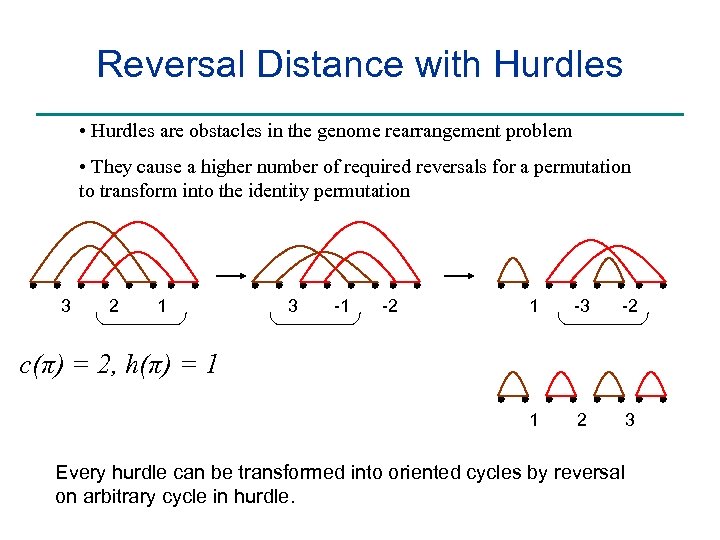 Reversal Distance with Hurdles • Hurdles are obstacles in the genome rearrangement problem • They cause a higher number of required reversals for a permutation to transform into the identity permutation 3 2 1 3 -1 -2 1 -3 -2 1 2 3 c(π) = 2, h(π) = 1 Every hurdle can be transformed into oriented cycles by reversal on arbitrary cycle in hurdle.
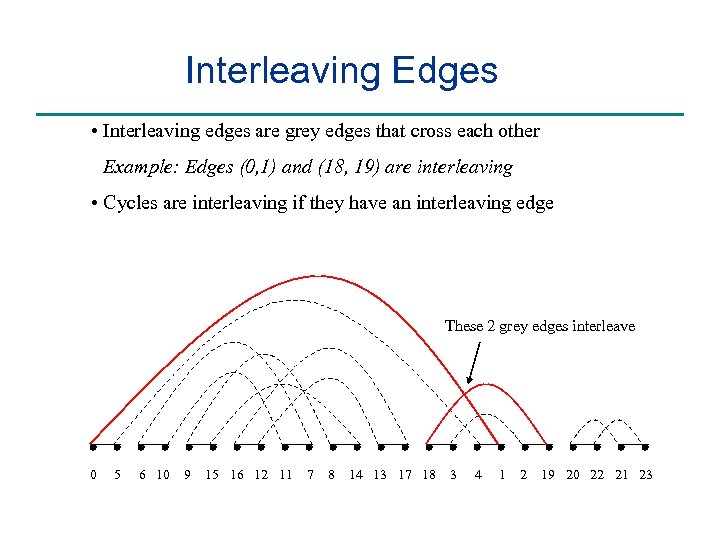 Interleaving Edges • Interleaving edges are grey edges that cross each other Example: Edges (0, 1) and (18, 19) are interleaving • Cycles are interleaving if they have an interleaving edge These 2 grey edges interleave 0 5 6 10 9 15 16 12 11 7 8 14 13 17 18 3 4 1 2 19 20 22 21 23
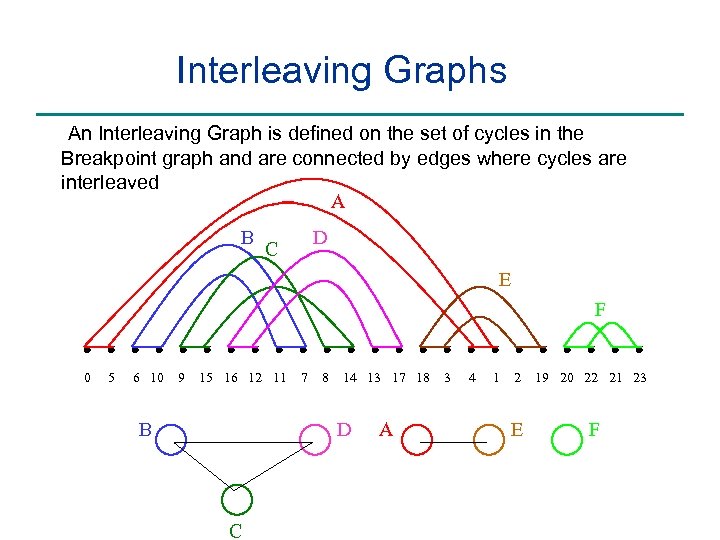 Interleaving Graphs An Interleaving Graph is defined on the set of cycles in the Breakpoint graph and are connected by edges where cycles are interleaved A B D C E F 0 5 6 10 9 15 16 12 11 B 7 8 14 13 17 18 D C A 3 4 1 2 E 19 20 22 21 23 F
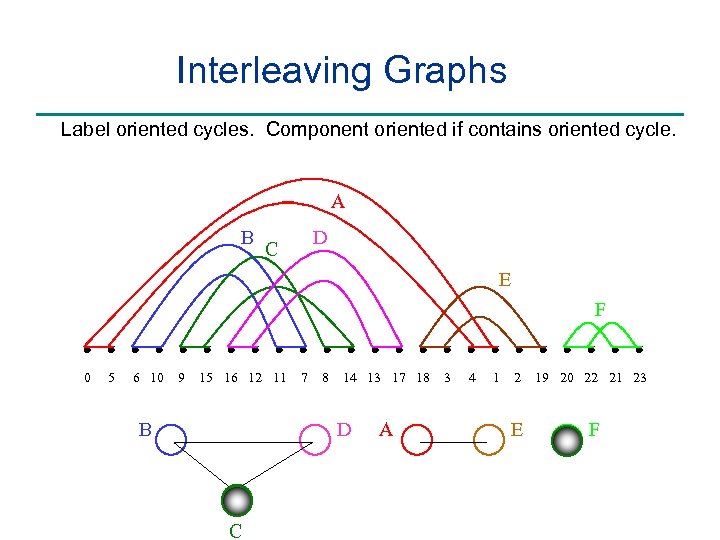 Interleaving Graphs Label oriented cycles. Component oriented if contains oriented cycle. A B D C E F 0 5 6 10 9 15 16 12 11 B 7 8 14 13 17 18 D C A 3 4 1 2 E 19 20 22 21 23 F
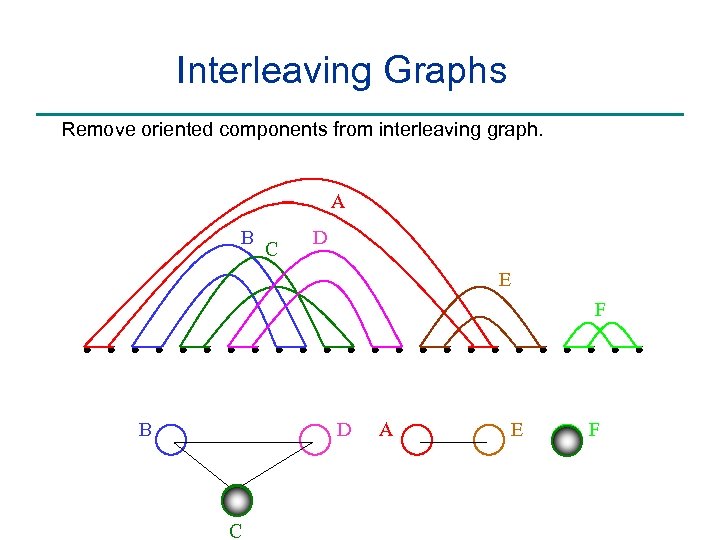 Interleaving Graphs Remove oriented components from interleaving graph. A B C D E F B D C A E F
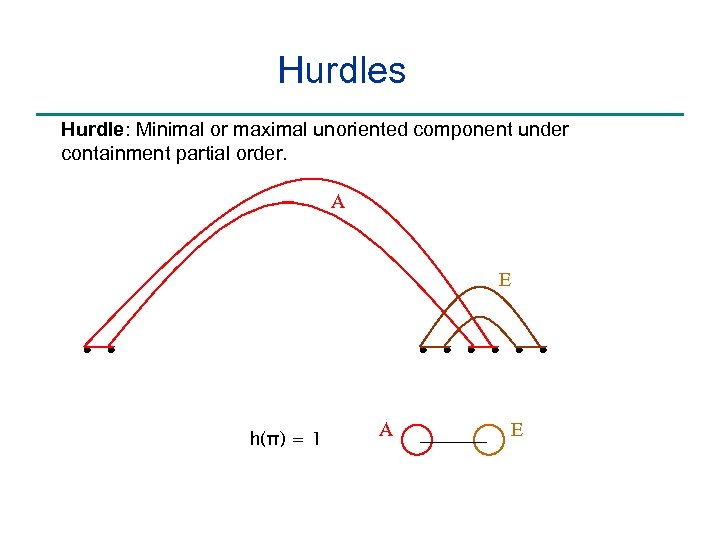 Hurdles Hurdle: Minimal or maximal unoriented component under containment partial order. A E h(π) = 1 A E
 Reversal Distance with Hurdles • Hurdles are obstacles in the genome rearrangement problem • They cause a higher number of required reversals for a permutation to transform into the identity permutation • Let h(π) be the number of hurdles in permutation π • Taking into account of hurdles, the following formula gives a tighter bound on reversal distance: d(π) ≥ n+1 – c(π) + h(π) Every hurdle can be transformed into oriented cycles by reversal on arbitrary cycle in hurdle. ** Doing so, might cause problems with overlapping hurdles
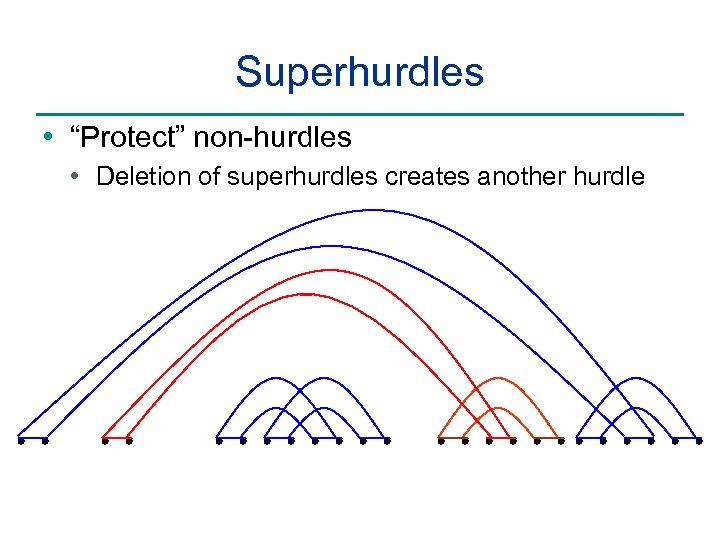 Superhurdles • “Protect” non-hurdles • Deletion of superhurdles creates another hurdle
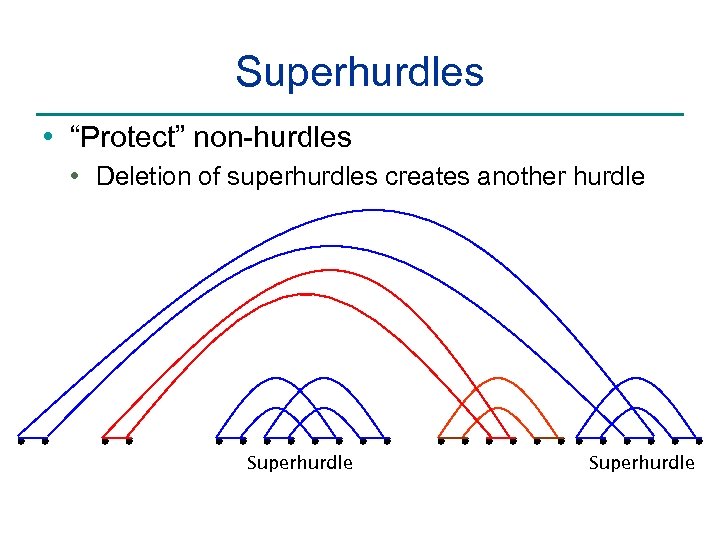 Superhurdles • “Protect” non-hurdles • Deletion of superhurdles creates another hurdle Superhurdle
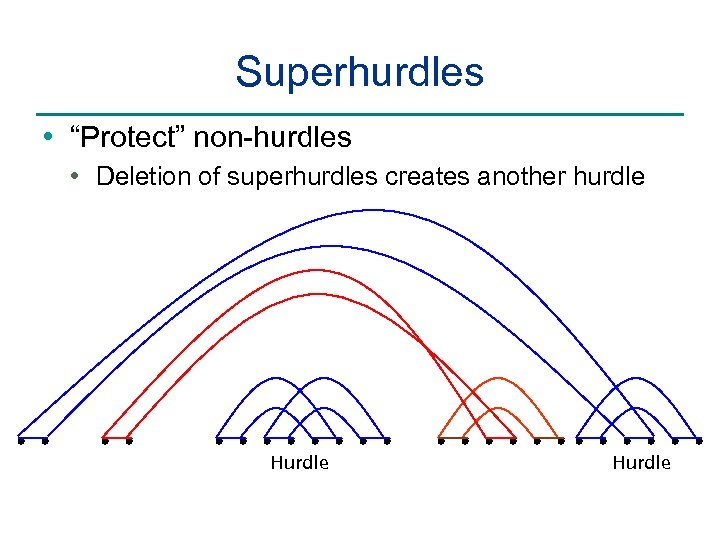 Superhurdles • “Protect” non-hurdles • Deletion of superhurdles creates another hurdle Hurdle
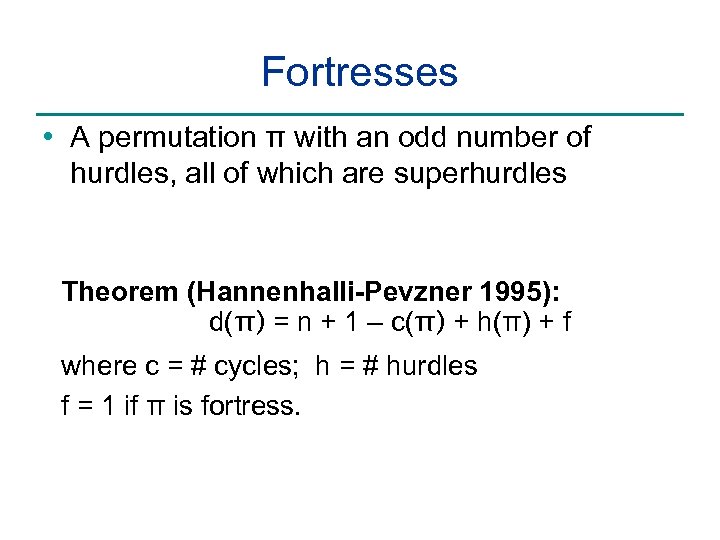 Fortresses • A permutation π with an odd number of hurdles, all of which are superhurdles Theorem (Hannenhalli-Pevzner 1995): d(π) = n + 1 – c(π) + h(π) + f where c = # cycles; h = # hurdles f = 1 if π is fortress.
 Complexity of reversal distance
 Genome rearrangements Mouse (X chrom. ) Unknown ancestor ~ 75 million years ago Human (X chrom. ) • What are the similarity blocks and how to find them? • What is the architecture of the ancestral genome? • What is the evolutionary scenario for transforming one genome into the other?
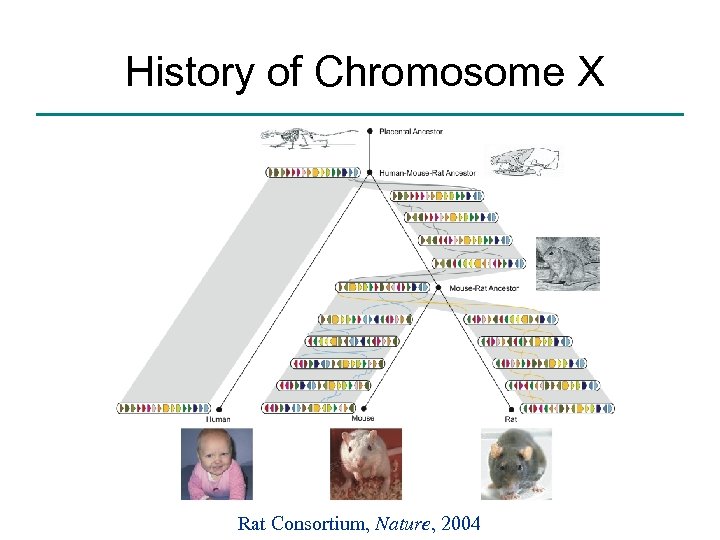 History of Chromosome X Rat Consortium, Nature, 2004
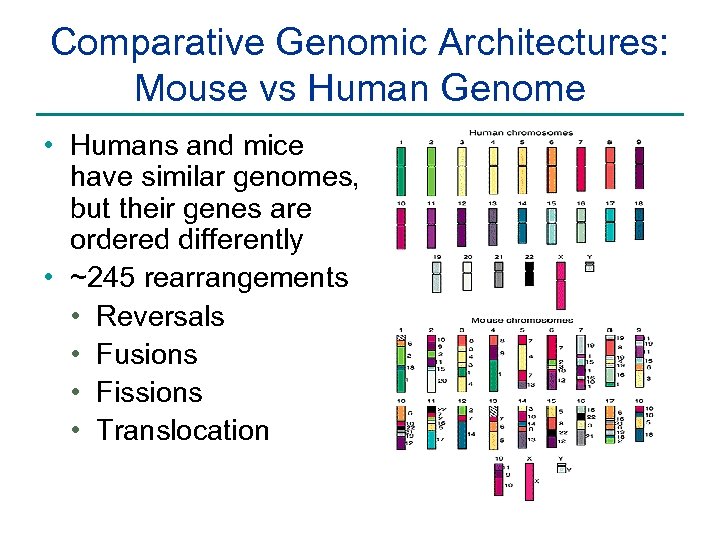 Comparative Genomic Architectures: Mouse vs Human Genome • Humans and mice have similar genomes, but their genes are ordered differently • ~245 rearrangements • Reversals • Fusions • Fissions • Translocation
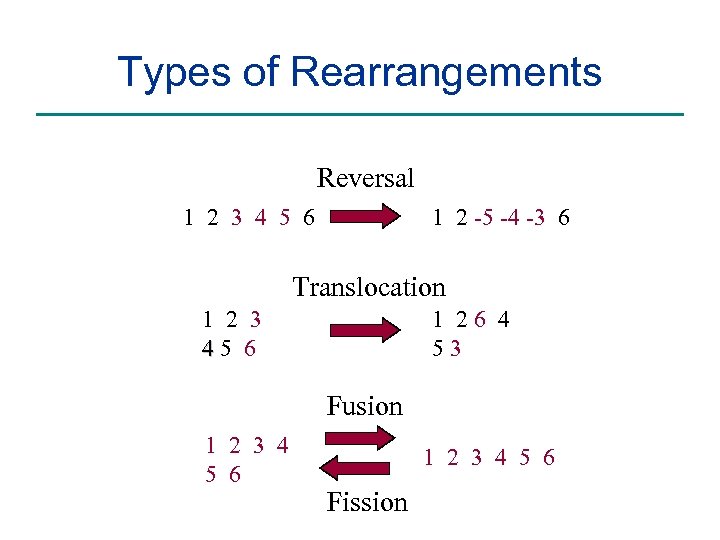 Types of Rearrangements Reversal 1 2 3 4 5 6 1 2 -5 -4 -3 6 Translocation 1 2 3 45 6 1 26 4 53 Fusion 1 2 3 4 5 6 Fission
 Comparative Genomic Architecture of Human and Mouse Genomes Finding the corresponding “synteny blocks” in human and mouse genomes requires some work
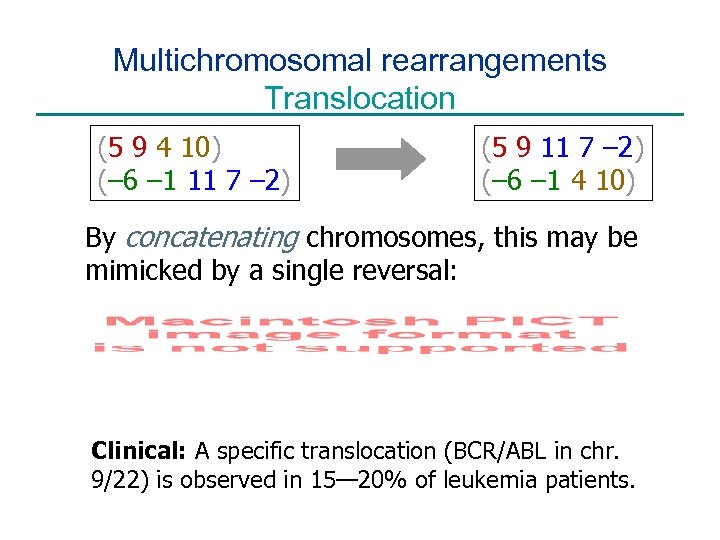 Multichromosomal rearrangements Translocation (5 9 4 10) (– 6 – 1 11 7 – 2) (5 9 11 7 – 2) (– 6 – 1 4 10) By concatenating chromosomes, this may be mimicked by a single reversal: Clinical: A specific translocation (BCR/ABL in chr. 9/22) is observed in 15— 20% of leukemia patients.
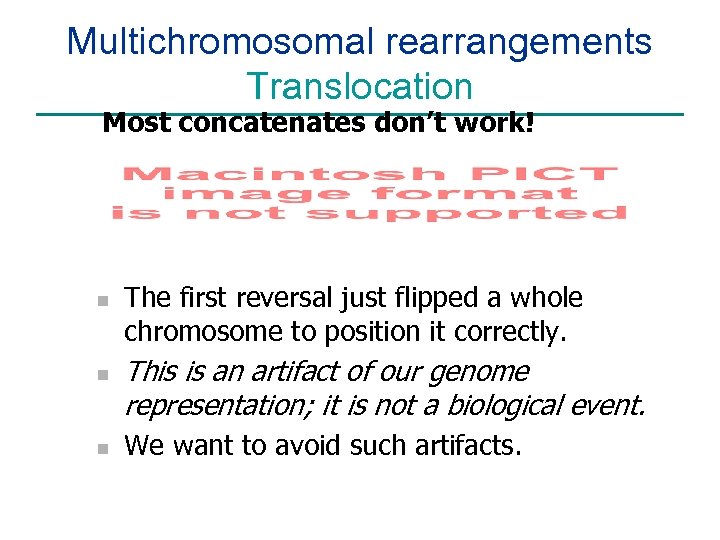 Multichromosomal rearrangements Translocation Most concatenates don’t work! n n n The first reversal just flipped a whole chromosome to position it correctly. This is an artifact of our genome representation; it is not a biological event. We want to avoid such artifacts.
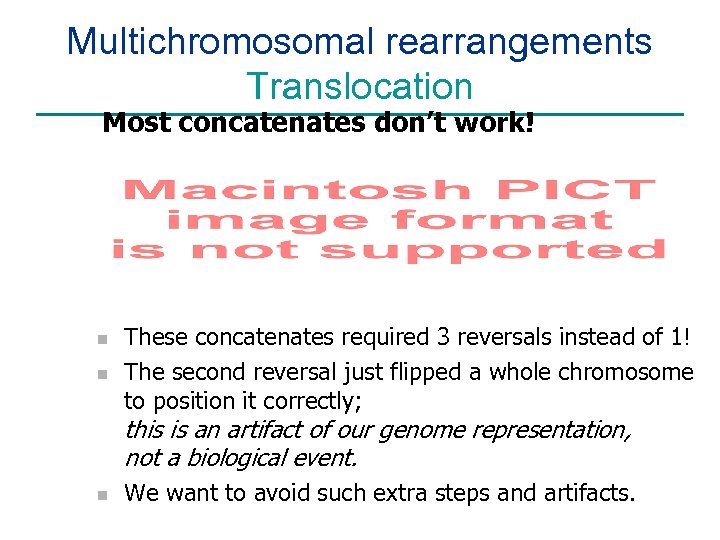 Multichromosomal rearrangements Translocation Most concatenates don’t work! n n These concatenates required 3 reversals instead of 1! The second reversal just flipped a whole chromosome to position it correctly; this is an artifact of our genome representation, not a biological event. n We want to avoid such extra steps and artifacts.
 Multichromosomal rearrangements Fission and fusion (1 2 3 4 5) () (1 2) (3 4 5) By concatenating chromosomes, this may be mimicked by a single reversal: Evolution: Human chromosome 2 is the fusion of two chromosomes from other hominoids (chimpanzees, orangutans, gorillas).
 Multichromosomal rearrangements Fission and fusion (1 2 3 4 5) () (1 2) (3 4 5) • By concatenating chromosomes, this may be mimicked by a single reversal: • Flipping the whole chromosome (3 4 5) gives a different representation (– 5 – 4 – 3) of the same chromosome. • Chromosome ends ( ) must be tracked too.
 Multichromosomal rearrangements Concatenates • Concatenate together all the chromosomes of a genome into a single sequence. • These concatenates represent the same genome: (5 9 4 10) (8 3) (– 6 – 1 11 7 – 2) (8 3) (2 – 7 – 11 1 6) (5 9 4 10) • Permuting the order of chromosomes and flipping chromosomes do not count as biological events. • Chromosome ends ( ) ( ) are included and are distinguishable.
 Multichromosomal rearrangements Results Theorem (Tesler 2002): Let d = minimum total number of reversals, translocations, fissions, and fusions among all rearrangement scenarios between two genomes. By carefully choosing concatenates of the genomes, we can usually mimic a most parsimonious scenario by a d-step reversal scenario on the concatenates with no chromosome flips or chromosome permutations. There are pathological cases requiring a (d + 1)-step reversal scenario with one chromosome flip. Total time O(( n + N )2).
 Multichromosomal rearrangements Results n n n = # of blocks, N = # of chromosomes Distance is the minimum number of reversals, fissions, fusions, translocations. Solution method: use suitable concatenates to obtain an equivalent “sorting by reversals” problem. The H-P algorithm has a nonconstructive step that required a lot of work to fix. It pertains to choosing concatenates to avoid flips and chromosome permutations. (Tesler 2002) does this constructively.
 GRIMM Web Server • Real genome architectures are represented by signed permutations • Efficient algorithms to sort signed permutations have been developed • GRIMM web server computes the reversal distances between signed permutations:
 GRIMM Web Server 22 dense pages to fix gaps http: //www-cse. ucsd. edu/groups/bioinformatics/GRIMM
 GRIMM-Synteny on X chromosome 2 -dimensional breakpoint graph
 GRIMM-Synteny on X chromosome 2 -dimensional breakpoint graph
 Additional Problems 1. Other rearrangement operations Duplications 2. Rearrangements and Phylogeny Multiple Genomic Distance Problem: Given permutations 1, …, k find a permutation such that k=1, k d( 1, ) is minimal.
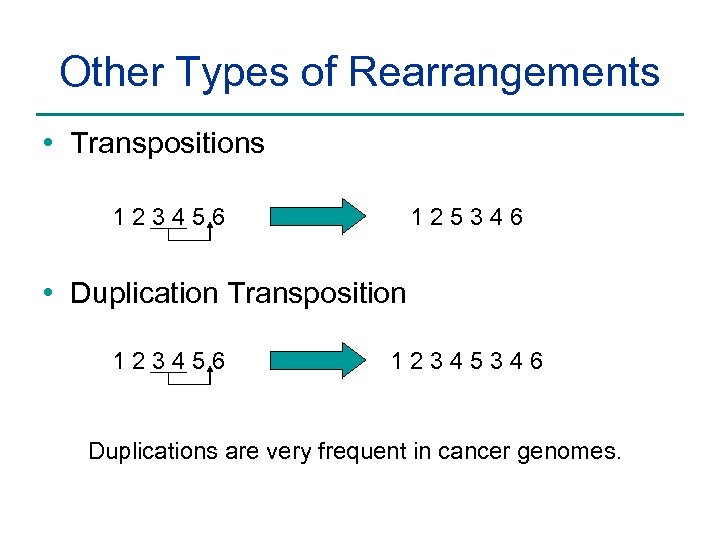 Other Types of Rearrangements • Transpositions 123456 125346 • Duplication Transposition 123456 12345346 Duplications are very frequent in cancer genomes.