


 Скачать презентацию Lecture 4 FORMS OF SOCIAL LIFE ORGANIZATIONS AND
5th_lecture Organizations .ppt
- Количество слайдов: 36
 Lecture #4 FORMS OF SOCIAL LIFE: ORGANIZATIONS AND BUREAUCRACY. INSTITUTIONS 02/28/2012
 Formal organizations large secondary groups organized to achieve their goals efficiently. operate in a deliberate way, not to meet personal needs but to accomplish complex jobs.

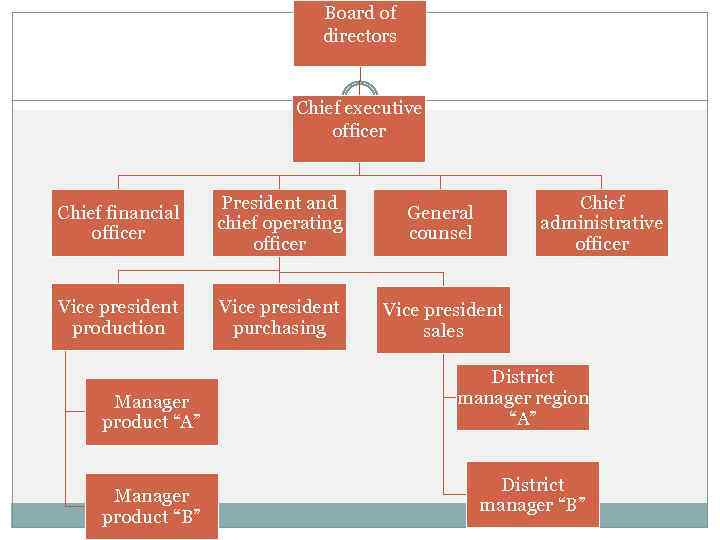 Board of directors Chief executive officer Chief financial officer President and chief operating officer General counsel Vice president production Vice president purchasing Vice president sales Manager product “A” Manager product “B” Chief administrative officer District manager region “A” District manager “B”
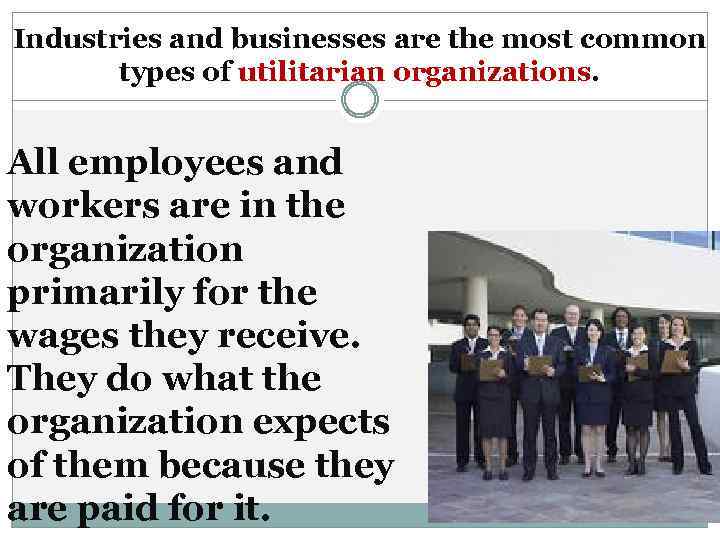 Industries and businesses are the most common types of utilitarian organizations. All employees and workers are in the organization primarily for the wages they receive. They do what the organization expects of them because they are paid for it.
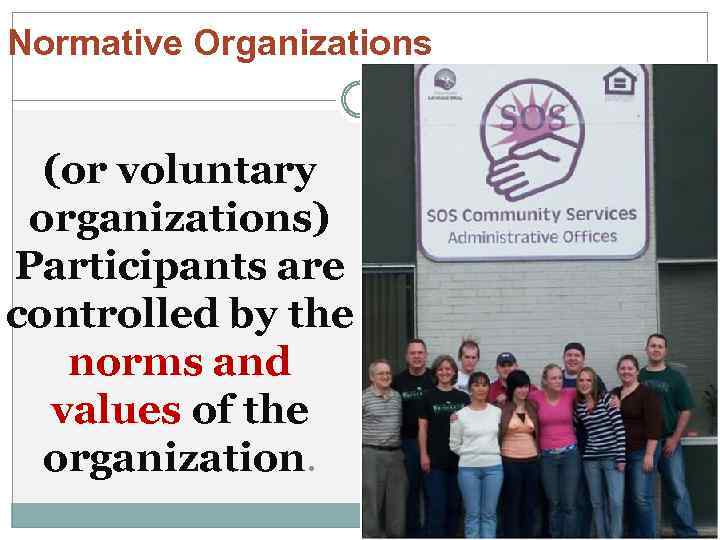 Normative Organizations (or voluntary organizations) Participants are controlled by the norms and values of the organization.
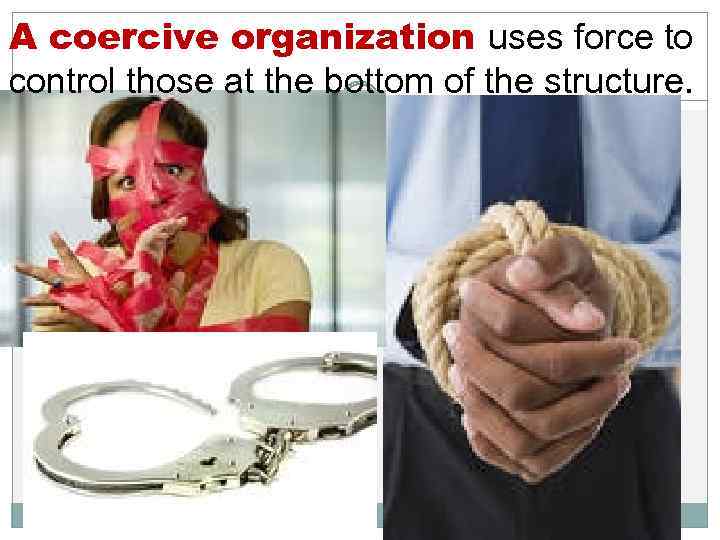 A coercive organization uses force to control those at the bottom of the structure.
 A total institution is an organization that is cut off from the rest of society, forming an all-encompassing social environment to meet all the needs of its members.
 What is a Bureaucracy? All of these types of organizations, especially as they grow in population size, tend to become bureaucracies.






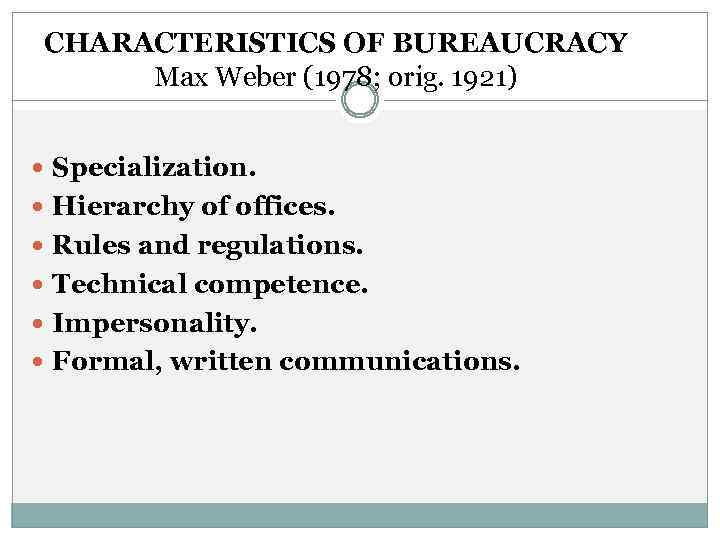 CHARACTERISTICS OF BUREAUCRACY Max Weber (1978; orig. 1921) Specialization. Hierarchy of offices. Rules and regulations. Technical competence. Impersonality. Formal, written communications.
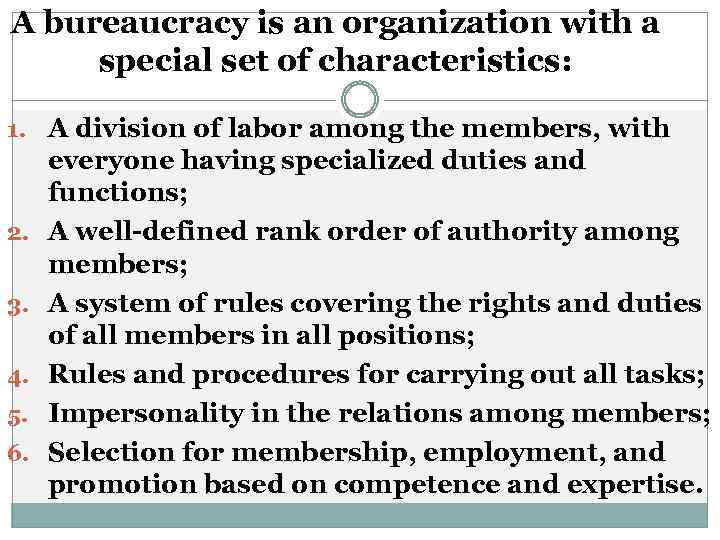 A bureaucracy is an organization with a special set of characteristics: 1. A division of labor among the members, with 2. 3. 4. 5. 6. everyone having specialized duties and functions; A well-defined rank order of authority among members; A system of rules covering the rights and duties of all members in all positions; Rules and procedures for carrying out all tasks; Impersonality in the relations among members; Selection for membership, employment, and promotion based on competence and expertise.
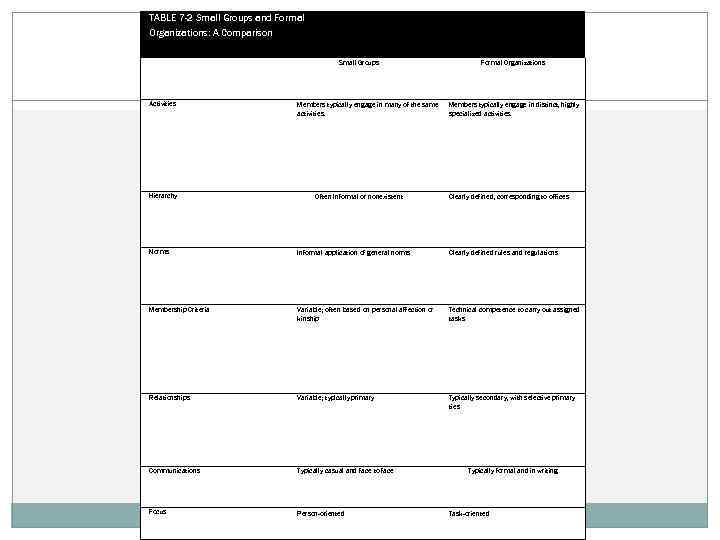 TABLE 7 -2 Small Groups and Formal Organizations: A Comparison Small Groups Activities Hierarchy Members typically engage in many of the same activities. Often Informal or nonexistent Formal Organizations Members typically engage in distinct, highly specialized activities. Clearly defined, corresponding to offices Norms Informal application of general norms Clearly defined rules and regulations Membership Criteria Variable; often based on personal affection or kinship Technical competence to carry out assigned tasks Relationships Variable; typically primary Typically secondary, with selective primary ties Communications Typically casual and face to face Focus Person-oriented Typically formal and in writing Task-oriented
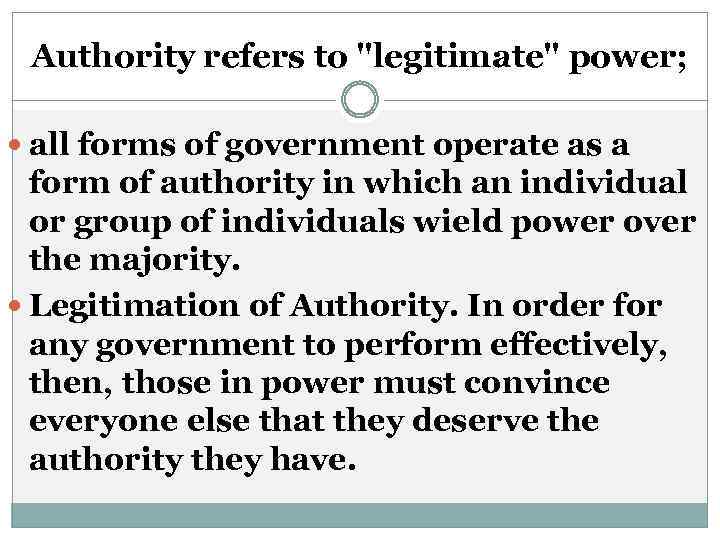 Authority refers to "legitimate" power; all forms of government operate as a form of authority in which an individual or group of individuals wield power over the majority. Legitimation of Authority. In order for any government to perform effectively, then, those in power must convince everyone else that they deserve the authority they have.
 Charisma is the extraordinary, sometimes supernatural, qualities of a person. Charisma is derived more from the beliefs of the followers than from the actual qualities of leaders. As long as a person believes he or she has special qualities, or it is believed by followers, authority will be derived from charisma. Examples of charismatic political leaders are Hitler, Mao Zedong, Castro, and Gandhi. Charismatic religious leaders include Jesus, Mohammed, Reverend Sun Myung Moon of the Unification Church, and Ayatollah Khomeini.
 In a system of rational-legal authority, leaders are legitimized by the rule of law. They derive their authority from the rules and regulations of the system rather than from their personal qualities or from tradition. For example, the office of President of the RK is legitimized by the Constitution, which defines the President's rights and responsibilities.
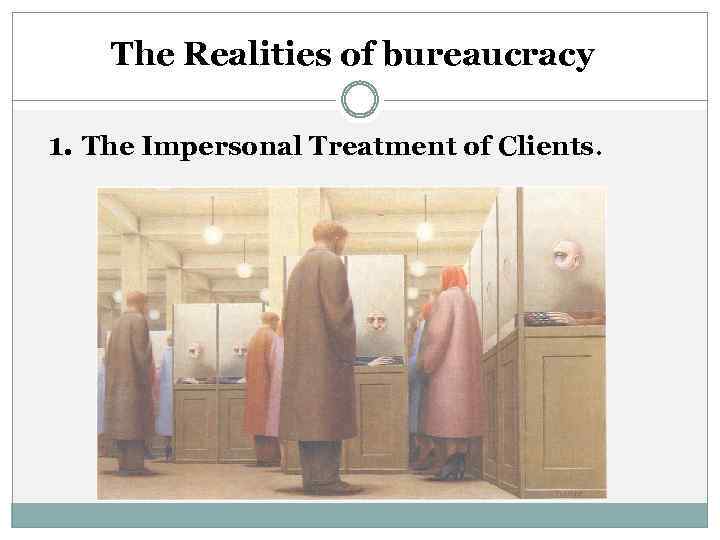 The Realities of bureaucracy 1. The Impersonal Treatment of Clients.
 The Realities of bureaucracy 2. Paperwork and Red Tape. 3. Rules and Regulations. The following account of an incident in a post office. A clerk telling a customer that he couldn't rent a post-office box unless he had a permanent address. "But the reason I need a box is because I don't have a permanent address, " the man explained. "When you get a permanent address, " the clerk politely explained, "you can get the box. " "But, then I won't need it. . . ".
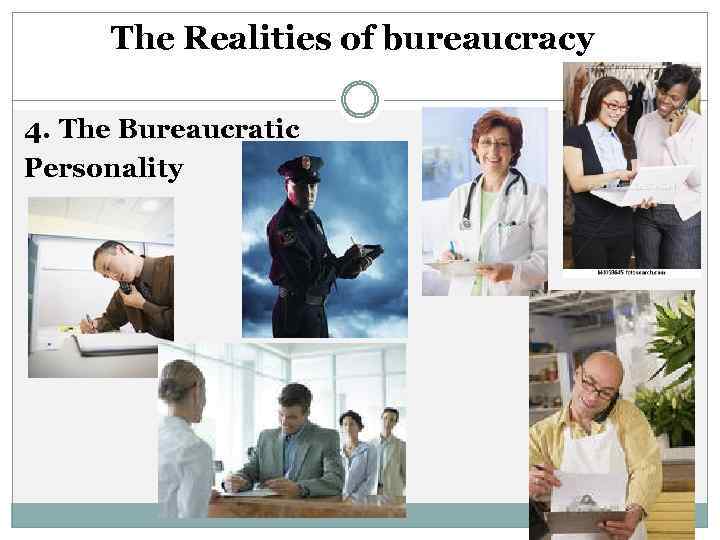 The Realities of bureaucracy 4. The Bureaucratic Personality
 The Realities of bureaucracy 5. The Informal System.
 The tendency toward Oligarchy An oligarchy is characterized by a small group of people at the top of the organization having almost all the control and power - “Iron law of oligarchy”. (Michels, 1915/1962).
 Conflict in Organizations Conflict between individuals or groups within organizations is pervasive because individuals have incompatible personalities or because they are in competition for some scarce goal or resource. A major form of conflict within bureaucracies occurs when professionals are employed in bureaucratic organizations. Professionals generally assume that their actions and performances should be judged and controlled only by other professionals. However, professionals employed in bureaucratic organizations are often subject to the supervision of nonprofessional superiors.
 Can Bureaucracy Be Eliminated? Most contemporary observers think that the clock cannot be turned back. "As much as we may wish otherwise, . . . large organizations operating on bureaucratic principles will remain part of the social landscape for some time to come“. (Blau and Meyer, 1987, p. 195).
 Institutions are a set of groups and organizations with norms and values that center around the most basic needs of a society. The major institutions are the family, education, the economy, health and medicine, and the polity. All of these institutions are found in one form or another in all societies because they carry out necessary societal tasks.
 Society A society is a population living in a given territory, with a social structure, and sharing a culture.
 Societies are most commonly described in terms of their economic systems. The long history of human existence has had only a few basic types of economic arrangements. Hunting and Gathering Societies (until about 7000 B. C. ) Horticultural Societal (7000 B. C. ) Agrarian societies (3000 B. C. ) Industrial societies Postindustrial society
 Industrial societies are those in which the predominant economic activity is the production of manufactured goods. Agricultural production must, of course, continue in industrial societies, but in the most highly industrialized societies only a small proportion of the population is engaged in agriculture. In the U S today, the figure is less than 5 percent
 The postindustrial society describes a society that was formerly industrial but is now primarily engaged in producing services and information rather than manufactured goods. In the US today most people in the labor force are providing services (70%) of some kind instead of producing things.
 A Sociological Classification of Societies The relationships between people are different in modern societies than in societies of the past. Ferdinand Toennies (XIX, German) labeled historical societies gemeinschaft and modern societies gesellschaft.
 Gemeinschaft societies are characterized by very personal face- to-face relationships such as those that exist in families, in rural villages, and perhaps in small towns. These highly personal relations between people are valued for their intrinsic qualities, not for the use they might be to us.
 Gesellschaft societies are characterized by relationships that are impersonal and distant. People interact with each other only in limited ways. The relationships are entered into only for what they might provide. Social relationships in a gesellschaft society are seen as means to ends.