


 Скачать презентацию Lecture 4 Earth s structure 1 2
lesson 4 Political map of the world.pptx
- Количество слайдов: 20
 Lecture 4
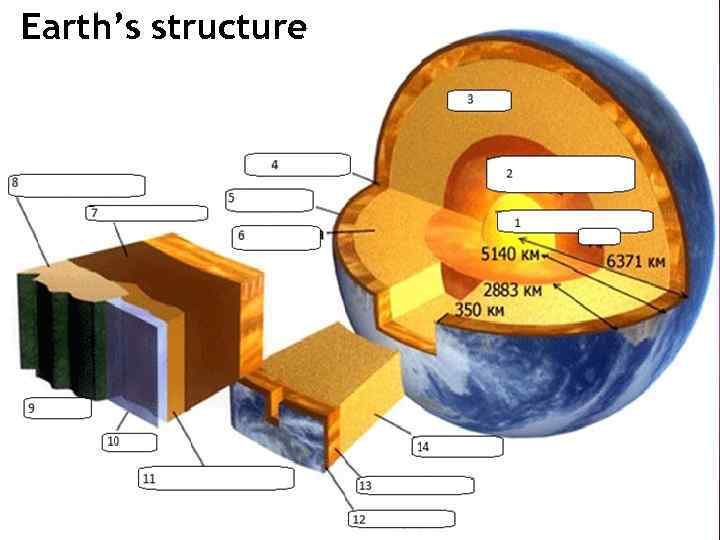 Earth’s structure
 1. 2. 3. 1 variant Give the names to the parts of the earth and give definitions to them. (uneven numbers) Translate the following elements: железо, титан, кислород, азот, углерод, кремний, калий, World Ocean consists of …. Complete. Give examples to 5 largest lakes. 1. 2. 3. 2 variant Give the names to the parts of the earth and give definitions to them. (even numbers) Translate the following elements: никель, алюминий, водород, гелий, магний, кальций, натрий Land waters consist of …. Complete. Give examples to 5 longest rivers.
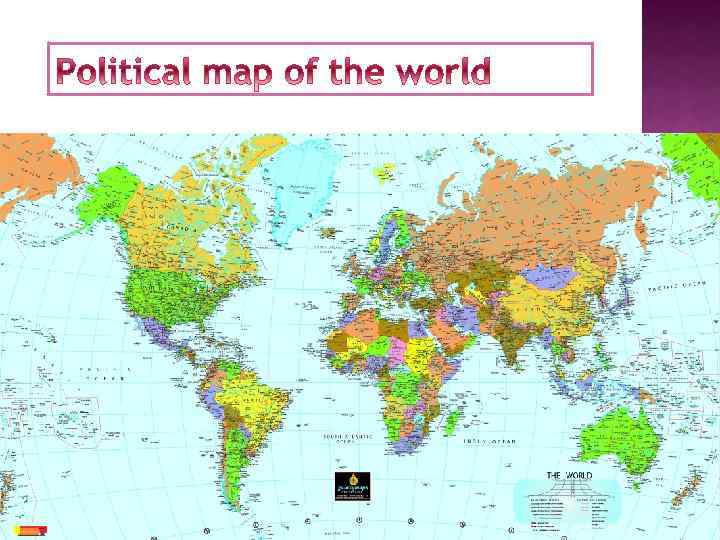
 1. Stages and periods of the world map forming. 2. Typology of the world countries. 3. Political system: administrative and territorial division.
 During XXcentury After disintegration of USSR, SFRY and Czechoslovakia – 20 times as much 195 independent sovereign states in the world (including disputed but defacto independent Taiwan), plus about 60 dependent areas and five disputed territories, like Kosovo.
 was increasing in 1950– 1989 thanks to joining the U. N. O. by countries that avoided from the colonial dependence. Nowadays, all CIS countries, six republics of the former Yugoslavia, Czech Republic and Slovakia enter the U. N. O. In 2002, after a special referendum, Switzerland entered the U. N. O. Now only Vatican, which is observer, doesn’t enter the U. N. O. Total amount is more than 190 countries.
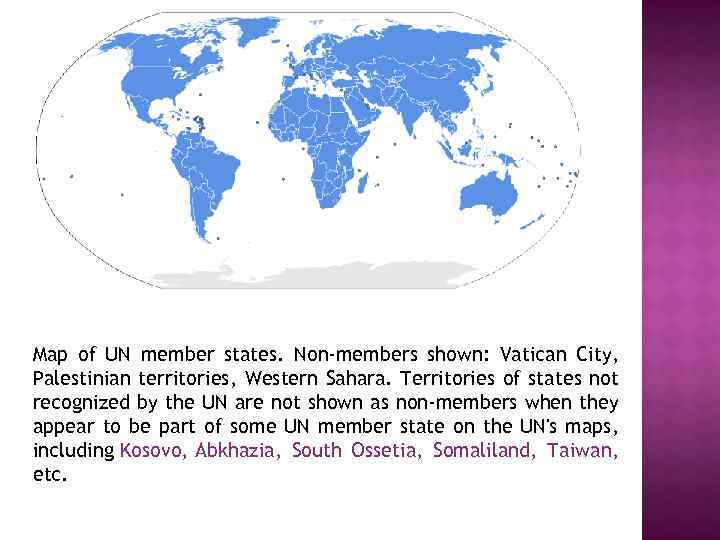 Map of UN member states. Non-members shown: Vatican City, Palestinian territories, Western Sahara. Territories of states not recognized by the UN are not shown as non-members when they appear to be part of some UN member state on the UN's maps, including Kosovo, Abkhazia, South Ossetia, Somaliland, Taiwan, etc.
 Typology of the world countries is one of the most difficult methodological tasks. Economists, geographers, sociologists and other scientists are dealing with those tasks. The country typology is an historical category. Really, before the beginning of 1990 of XX century, all countries of the world were divided in the three main types: Ø socialist, Ø capitalist and Ø developed.
 In 1990 of XX century, after the world socialist system disintegration, countries were divided into: 1) economically highly developed (Norway, Australia, the Netherlands, the United States, New Zealand, Canada, Ireland, Liechtenstein, Germany, Sweden); 2) Developing (Latin America, Africa, some countries of Asia); 3) countries with transitional economy (CIS, China, Eastern Europe) But the binomial countries’ typology is widespread; it is divided into: 1) economically developed and 2) developing.
 Political system of any country is characterized by administrative and territorial division (ATD). Usually such division is carried out with economical, historical, national, natural and other factors.
 1. Unitary state is a form of the government system, when there are: common constitution, legislative and executive organs in the country. Such countries in the world are majority. For example: Byelorussia, Poland, France, Sweden, Japan, Turkey, Egypt, Chile and Cuba. 2. Federative state is a form of the government system, when with the common (federal) laws and authorities, there are selfgoverning administrative areas – republics, states, provinces, lands, cantons that have own organs of the legislative and executive powers, though «second-order» . For example: the USA, Argentina, Australia, Austria, Belgium, Brazil etc.
 At the republican system legislative power belongs to the parliament, which is elected by all urban population, and executive power belongs to the government. In the presidential republic, president has a big power. There are 100 countries in the world. These countries are widespread in Africa (for example, Egypt, Algeria, Nigeria, South Africa) and in Latin America (for example, Mexico, Brazil, Venezuela, Argentina). There are few presidential republics in the foreign Asia (for example, Iran, Pakistan, Indonesia, the Philippines), and in the foreign Europe – less (for example, France). The USA is a striking example of the presidential republic. Also all 12 CIS countries are the presidential republics. Some of them (including Russia) are called superpresidential republics, so long as their constitutions give special rights to the presidents. Parliamentary republics are typical for the foreign Europe, but there are many such countries in the foreign Asia (for example, China, India).
 Monarchies also appeared in ancient times (Ancient Rome in empire period), but monarchies were widespread in the Middle Ages and in the modern time. In 2008, there were 29 monarchies on the political world map: 13 – in Asia, 12 – in Europe, 3 – in Africa and 1 – in Oceania. There are: one empire, kingdoms, princedoms, dukedoms, sultanates, emirates, Papal States – Vatican among them. Usual authorities are lifelong and descend, but in Malaysia and UAE monarch is elected in five years term.
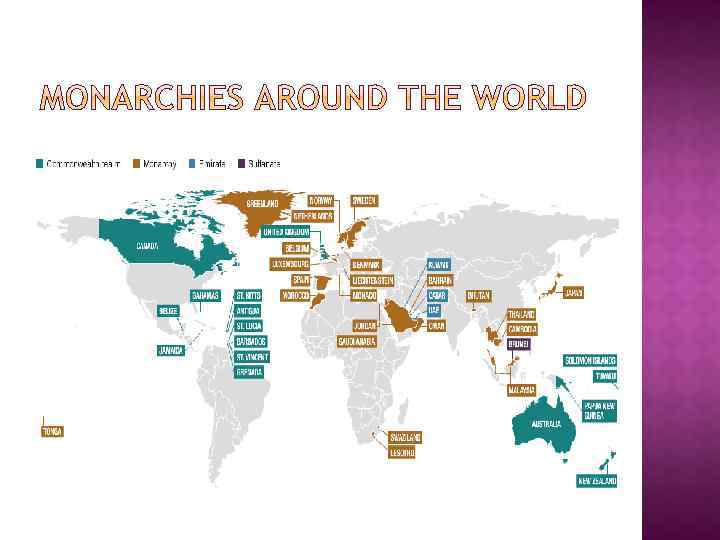
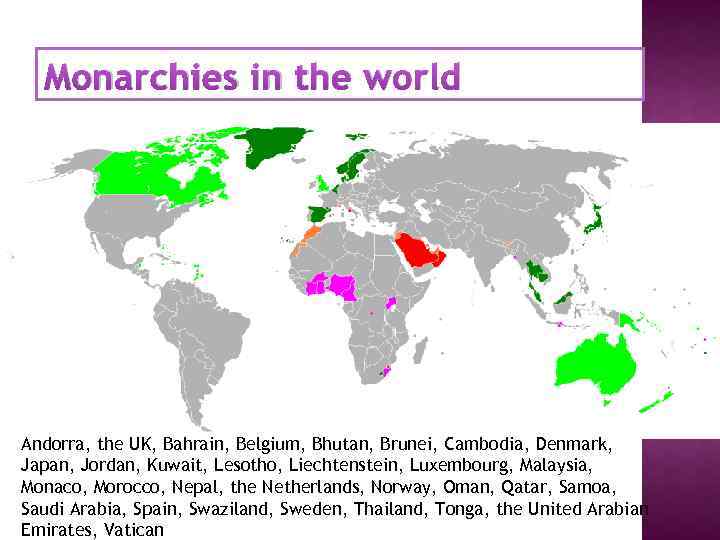 Monarchies in the world Andorra, the UK, Bahrain, Belgium, Bhutan, Brunei, Cambodia, Denmark, Japan, Jordan, Kuwait, Lesotho, Liechtenstein, Luxembourg, Malaysia, Monaco, Morocco, Nepal, the Netherlands, Norway, Oman, Qatar, Samoa, Saudi Arabia, Spain, Swaziland, Sweden, Thailand, Tonga, the United Arabian Emirates, Vatican
 Paint and write down the names of the countries which are monarchies
 Монархия – это форма правления, когда власть над государством переходит из одного поколения в другое поколение. В наше время во всем мире насчитывается около 30 монархических стран. В Азии на данный момент находятся 14 монархий. Это Саудовская Аравия, Оман, ОАЭ, Кувейт, Катар, Бруней, Бахрейн, Япония, Таиланд, Непал, Малайзия, Камбоджа, Иордания и Бутан. Следует заметить, что в первых семи странах, перечисленных выше, наблюдается абсолютная монархия. Это означает, что в руках правителя сосредоточена вся власть: и судебная, и исполнительная, и законодательная. 12 монархий существует в Европе. Сюда относятся такие страны, как Швеция, Норвегия, Нидерланды, Монако, Люксембург, Лихтенштейн, Испания, Дания, Великобритания, Ватикан, Бельгия и Андорра. Абсолютная монархия на этой территории существует только в Ватикане, где правителем страны является Папа Римский. При таком виде правления, как в Ватикане, Саудовской Аравии и Брунее, конституция практически не играет важной роли и правит страной духовное лицо. 3 монархических государства находятся в Африке: Свазиленд, Марокко и Лесото. И последняя монархия расположена в Океании – это государство Тонго. Самой древней монархией считается Японская, которая была признана еще в 660 году до нашей эры.
 1. 2. 3. 1) 2) 3) 4) Learn the lecture notes Learn by heart new words Answer the questions: Draw the countries on the blank map the populations of which exceed 100 million people. Plot monarchies on the blank map. Point the countries with the federative form of government. Give reasons to increase of amount of countries.