 Скачать презентацию Lecture 4 BGP Presentations Lab information
1bb2059c21a399da48421eda983589aa.ppt
- Количество слайдов: 19



Lecture 4: BGP • Presentations • Lab information • H/W update
Inter-Domain routing – At the beginning: the Internet was a single network • Funded by the US Government, ARPAnet • Started in 1969 and lasted until 1985 – As its size grew things became unworkable (see RFC-827) – Time to introduce hierarchy: • All the routers of the same organization belong to the same Administrative System (AS) • Routing is between ASes now
Administrative Systems (AS) • Single organization – Same routing policy • Has a unique id – AS Number (ASN) – 16 bits right now – Valid ids between 1 -64511 – 64 bits are coming – Right now 22, 500 are visible in the Internet
Exterior Routing or Inter-domain routing • Certain routers in an AS talk to routers in other ASes and exchange routing information • Then they introduce this information inside their AS • EXAMPLE
So every Inter-domain protocol has to do the following • • Establish the adjacency with the neighbor Monitor the status of this connection Exchange routing information Some similarities with intra-domain routing protocols but: – Can not do flooding now, network is too big – Routing information is different now • Reachability information – I can reach network a. b/16 through next-hop nh • EXAMPLE
What is the cost now? • It is the cost of transiting an AS network • What does it mean? • Can not compare costs from two different AS • Cost may have to do more with business than network engineering – Sending traffic to a given route may cost me more
Policy Routing • By controlling what I export I control what traffic I carry – I can have backdoor links for example • By controlling what I import I control where my traffic goes • All these are based on business reasons and do not have to do much with routing itself – I have a contract to provide or buy service with a customer or by a provider – Configured manually on each border router as a list of import and export policies – Can be long, tedious and error-prone
A Naïve Approach: EGP • For NSFnet: – Assume 2 level hierarchy with a backbone/stub networks – No problem with loops • Periodic exchange of reachability information – Works fine as long as the routes are not too many • Advertise a single integer cost with each reachable destination – But what do I do with it?
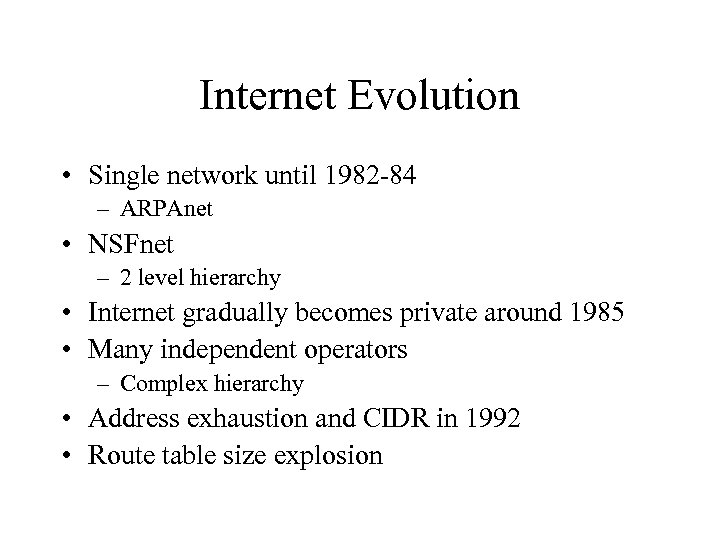
Internet Evolution • Single network until 1982 -84 – ARPAnet • NSFnet – 2 level hierarchy • Internet gradually becomes private around 1985 • Many independent operators – Complex hierarchy • Address exhaustion and CIDR in 1992 • Route table size explosion
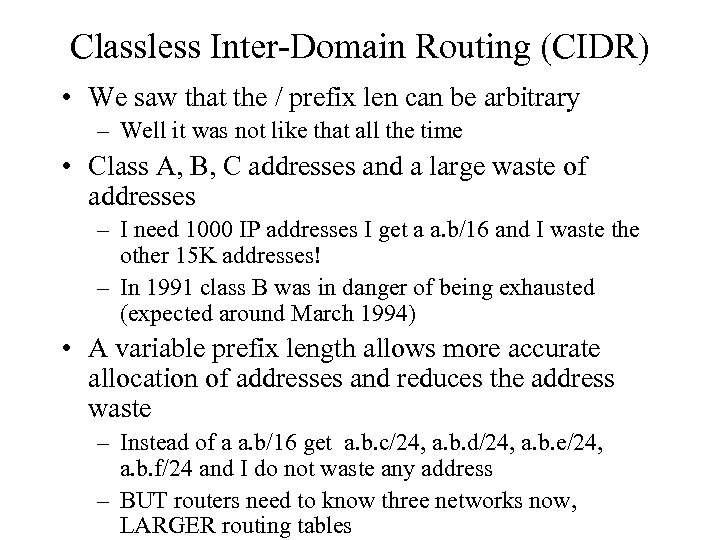
Classless Inter-Domain Routing (CIDR) • We saw that the / prefix len can be arbitrary – Well it was not like that all the time • Class A, B, C addresses and a large waste of addresses – I need 1000 IP addresses I get a a. b/16 and I waste the other 15 K addresses! – In 1991 class B was in danger of being exhausted (expected around March 1994) • A variable prefix length allows more accurate allocation of addresses and reduces the address waste – Instead of a a. b/16 get a. b. c/24, a. b. d/24, a. b. e/24, a. b. f/24 and I do not waste any address – BUT routers need to know three networks now, LARGER routing tables
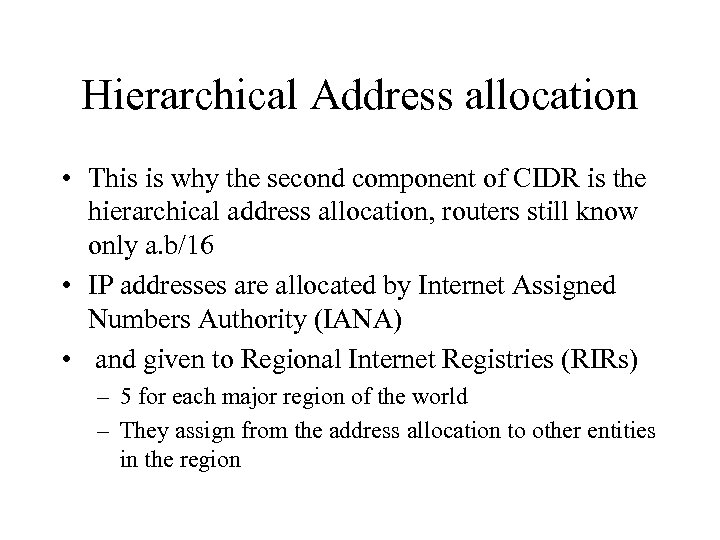
Hierarchical Address allocation • This is why the second component of CIDR is the hierarchical address allocation, routers still know only a. b/16 • IP addresses are allocated by Internet Assigned Numbers Authority (IANA) • and given to Regional Internet Registries (RIRs) – 5 for each major region of the world – They assign from the address allocation to other entities in the region
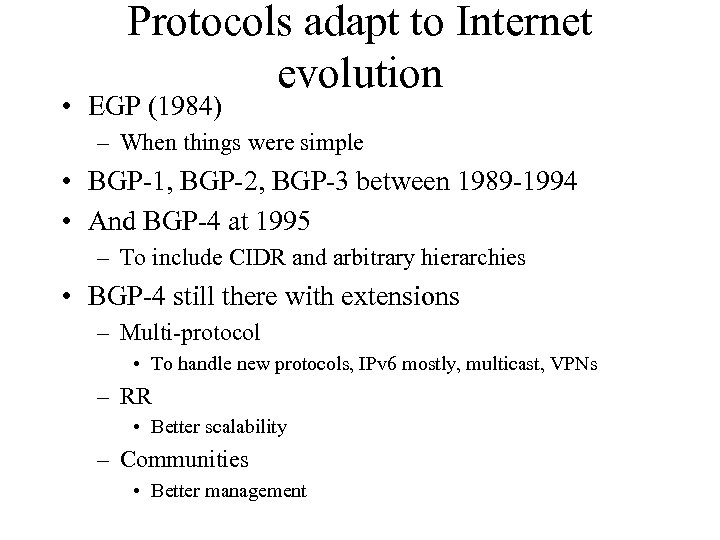
Protocols adapt to Internet evolution • EGP (1984) – When things were simple • BGP-1, BGP-2, BGP-3 between 1989 -1994 • And BGP-4 at 1995 – To include CIDR and arbitrary hierarchies • BGP-4 still there with extensions – Multi-protocol • To handle new protocols, IPv 6 mostly, multicast, VPNs – RR • Better scalability – Communities • Better management
Internet evolved to… • Something very large and complex • Structure is definitely not an acyclic graph – Dual homing, peering etc… – I can have routing loops • Reachable destinations are MANY – Around 90 K unique prefixes these days • Many more if we count multiple routes to a prefix – Hard to exchange them periodically • Each AS has its own internal policies and notion of cost – It is not possible to compare between different ASes

How to deal with arbitrary AS topologies? • BGP-4 – Path vector, CIDR, policies • Path vector – I list all the ASes in the path – Loop avoidance is trivial: • make sure that I am not listed in the path • Add myself in the path when I advertise a prefix • Of course there is no free lunch: – Route advertisements are getting large… – It really depends on the topology of the internet – Some attempt to measure is at RFC 1774
Paths • BGP manages paths • Path consists of – Network Layer Reachability Information (NLRI) e. g 12. 50. 45/24 – A sequence of PATH attributes that give info related to this destination • PATH attributes – Each have a Flags field • Optional or well known (well known must be supported by all routers) • Transitive or local (Transitive gets propagated, local not) • Partial or not (partial applies only to part of the path)
Important path attributes • ORIGIN (well known) – Is this path learned from IGP, BGP or other • AS_PATH – The list of ASes (well known) • NEXT_HOP – Next hop to reach the prefix (well known) • MULTI_EXIT_DISC (MED) – Helps selection of paths (local, optional) • LOCAL_PREF – Helps selection of paths (well known)
BGP next hop • EXAMPLE • Can be third party • IGP knows how to reach the next hop – Recursive route lookup – Can use the best route to reach the next hop • Next hop usually is the loopback address – Never goes down
Internal BGP • An AS will have multiple border routers talking to different peers – May learn multiple routes for the same prefix – How do I choose which one to use? – Border routers must make a consistent decision • Else I may have routing loops • All border routers in my AS talk to each other – Internal BGP or i. BGP – Over multiple IGP hops, not directly connected – Must be a full-mesh
MED and Local Pref • EXAMPLE • Local pref has effect on outgoing traffic • MED on incoming traffic
Скачать презентацию Lecture 4 BGP Presentations Lab information
1bb2059c21a399da48421eda983589aa.ppt