

Lecture 4 Basics of the Product Policy of

Lecture 4 Basics of the Product Policy of an Enterprise
Enterprise’s economic activity is efficient when its products (goods or services) are demanded and bring profit. Product policy – strategy aimed to form competitive advantages of products. In order to actively explore the nature of a product further, lets consider it as three different products - the CORE product, the ACTUAL product, and finally the AUGMENTED product.
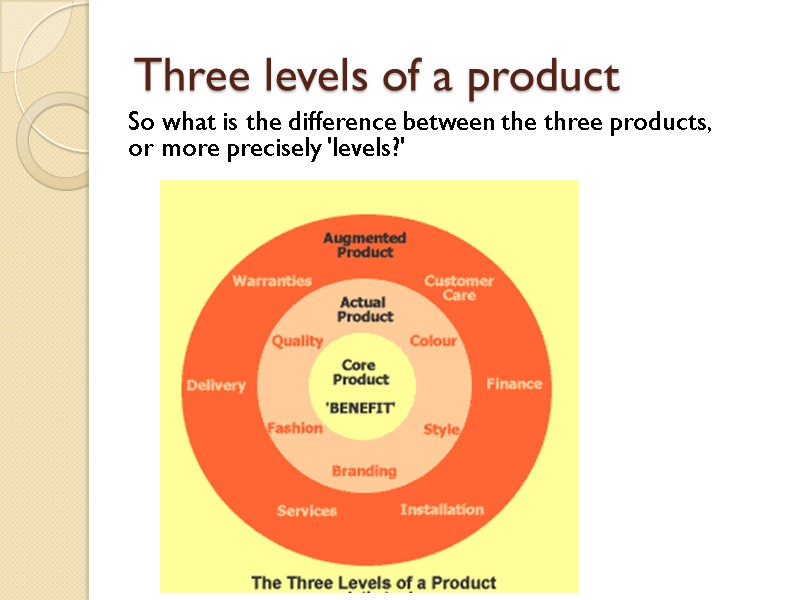
Three levels of a product So what is the difference between the three products, or more precisely 'levels?'
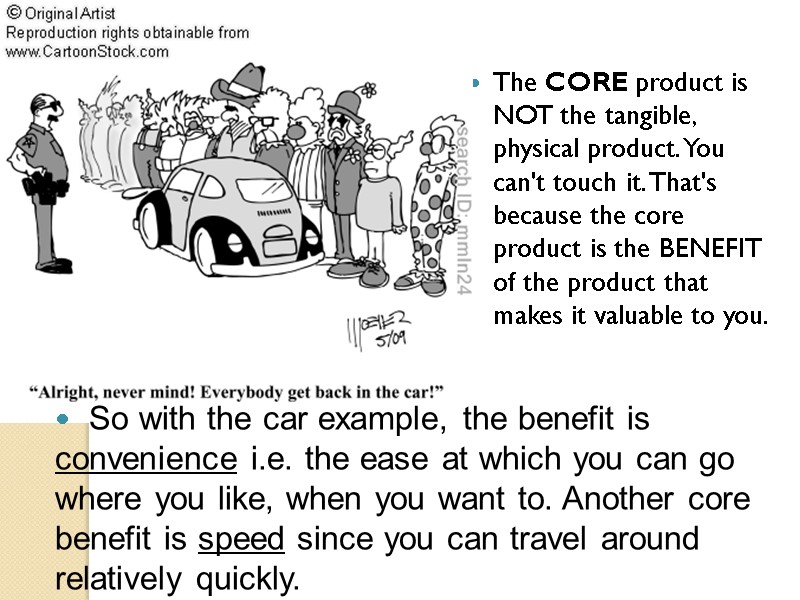
The CORE product is NOT the tangible, physical product. You can't touch it. That's because the core product is the BENEFIT of the product that makes it valuable to you. So with the car example, the benefit is convenience i.e. the ease at which you can go where you like, when you want to. Another core benefit is speed since you can travel around relatively quickly.
The ACTUAL product is the tangible, physical product. You can get some use out of it. Again with the car example, it is the vehicle that you test drive, buy and then collect. The AUGMENTED product is the non-physical part of the product. It usually consists of lots of added value, for which you may or may not pay a premium. So when you buy a car, part of the augmented product would be the warranty, the customer service support offered by the car's manufacture, and any after-sales service.
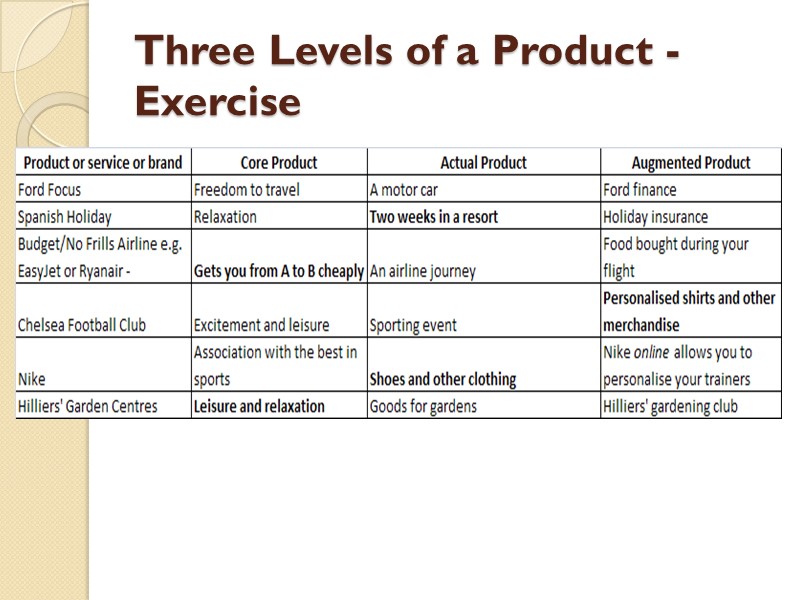
Three Levels of a Product - Exercise
From the point of end use, goods are divided into 2 groups: Consumer goods (for individual, family consumption); Goods for production purposes - bought by individuals, companies for further processing or resale. Ex.: equipment, raw materials, semi-processed goods.
The most important market feature of a product is its competitiveness – the ability of a product to be demanded on the market. Competitiveness of a product is determined by its quality, economic and marketing characteristics.
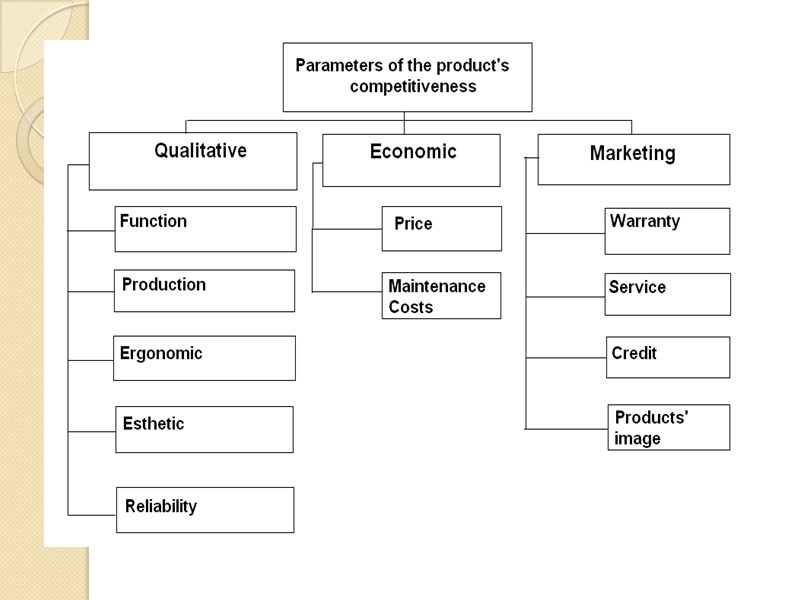
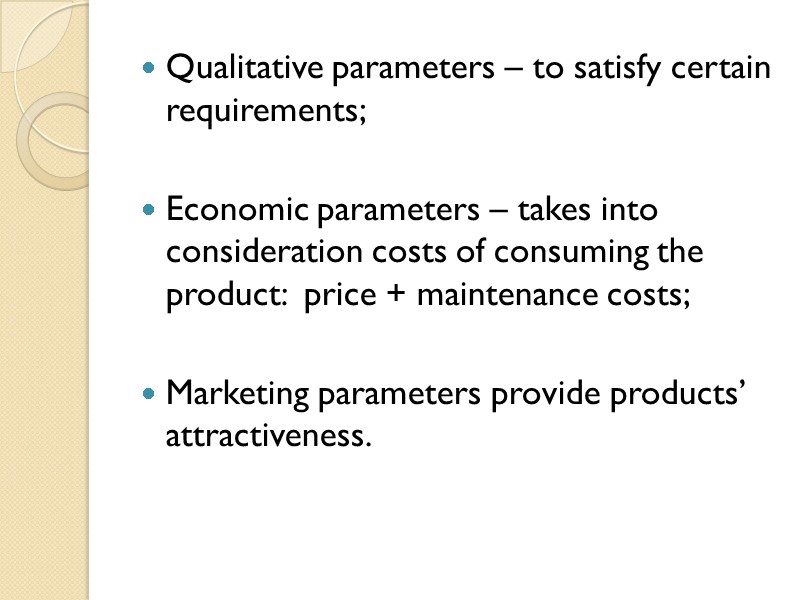
Qualitative parameters – to satisfy certain requirements; Economic parameters – takes into consideration costs of consuming the product: price + maintenance costs; Marketing parameters provide products’ attractiveness.
Certification refers to the confirmation of certain characteristics of an object, person, or organization. The most common type of certification in modern society is product certification. This refers to processes intended to determine if a product meets minimum standards, similar to quality assurance.
According to the Law of RK “About certification:” Основными целями сертификации являются: - обеспечение безопасности продукции, процессов, работ, услуг для жизни и здоровья людей, охраны имущества граждан и окружающей среды; - защита интересов потребителей в вопросах качества продукции и услуг; - устранение технических барьеров в торговле, обеспечение конкурентоспособности продукции на внутреннем и внешнем рынках; - создание необходимых условий для деятельности физических и юридических лиц на едином товарном рынке Казахстана, а также для участия в международном экономическом, научно-техническом сотрудничестве и международной торговле.
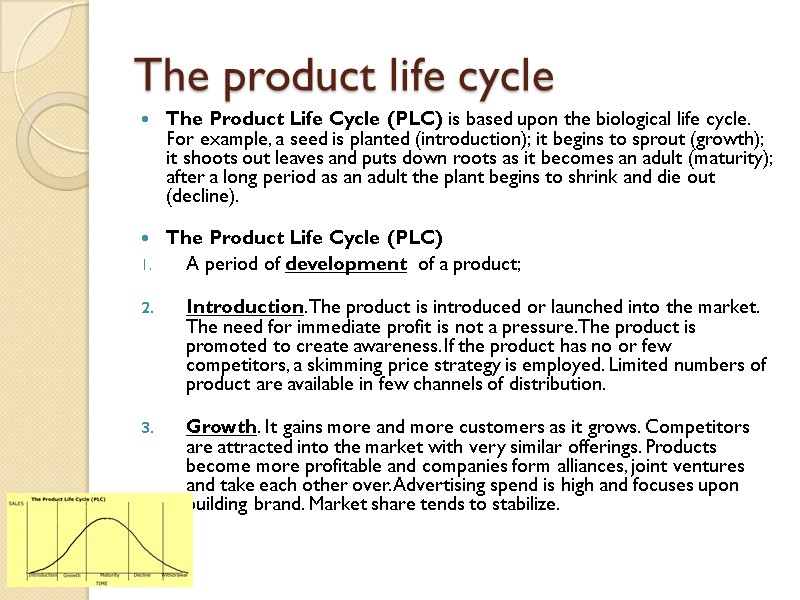
The Product Life Cycle (PLC) is based upon the biological life cycle. For example, a seed is planted (introduction); it begins to sprout (growth); it shoots out leaves and puts down roots as it becomes an adult (maturity); after a long period as an adult the plant begins to shrink and die out (decline). The Product Life Cycle (PLC) A period of development of a product; Introduction. The product is introduced or launched into the market. The need for immediate profit is not a pressure. The product is promoted to create awareness. If the product has no or few competitors, a skimming price strategy is employed. Limited numbers of product are available in few channels of distribution. Growth. It gains more and more customers as it grows. Competitors are attracted into the market with very similar offerings. Products become more profitable and companies form alliances, joint ventures and take each other over. Advertising spend is high and focuses upon building brand. Market share tends to stabilize. The product life cycle
Maturity. Eventually the market stabilizes and the product becomes mature. Those products that survive the earlier stages tend to spend longest in this phase. Sales grow at a decreasing rate and then stabilize. Producers attempt to differentiate products and brands are key to this. Price wars and intense competition occur. At this point the market reaches saturation. Producers begin to leave the market due to poor margins. Promotion becomes more widespread and use a greater variety of media. Most products are in the maturity stage of the product life cycle. It is important to be proactive and come up with ways to extend the product life cycle. This can be accomplished by: (a) modifying the market -- find new users for the product. (b) modifying the product -- change a product feature to attract new users (c) modify the marketing mix -- change one of the marketing mix elements, e.g., price or the way the product is promoted.
5. Decline. After a period of time the product is overtaken by development and the introduction of superior competitors, it goes into decline and is eventually withdrawn. At this point there is a downturn in the market. For example more innovative products are introduced or consumer tastes have changed. There is intense price-cutting and many more products are withdrawn from the market. Profits can be improved by reducing marketing spend and cost cutting. In fact, some failures are due to poor product positioning. The way a product is positioned can affect its sales. Sick Products—Sometimes existing brands get old and sick. Companies have to consider pruning the product line. Marketers also have to look at all their brands and decide which need to be pruned. This means eliminating the sick brands, i.e., brands that do not have a future and waste a great deal of management time. How to spot a sick product: Sales trend is down, price trend is down, profit trend is down, and/or it uses up too much managerial time.
What to do? Some possibilities: 1. Delete the product as soon as possible. Considerations in dropping the product: (a) Effects on customers who expect service and replacement parts. (b) Effects on employees if you fire the workers making the product. (c) Effect on other products in the product line. For example, if GE were to discontinue selling dryers, this might have an adverse effect on washing machines. 2. Sell the product to another company. 3. Revise your marketing strategy. You might turn the brand into a discount brand which means sell it for a very low price and minimize your promotional expenses. This was done to Pepsodent toothpaste and Lux soap. You might try to find a new target market and/or modernize the brand by giving it a new package. 4. You might eliminate the product gradually and milk it for remaining profits. The way to do this is to eliminate all marketing support (no advertising or sales promotions such as couponing) and continue to sell it.
Strategy of Pepsi According to Business Week (June 14, 2004, pp. 54-56), Pepsi adds more than 200 product variations every year. Pepsi is not obsessed with protecting the market share of its flagship brands (Pepsi and Lay's potato chips) but is concerned with "understanding and catering to changing tastes." The company believes that consumers are looking for innovation. Here are some examples of how Pepsi has dealt with changes in consumer taste: (a) There is a growing market for New Age beverages-- Pepsi acquired SoBe Beverages and has used brand extensions to add such products as SoBe No Fear (energy drink), SoBe Synergy (50% juice targeted to school-aged children), and SoBe Fuerte (Hispanic Market). Also introduced Propel Fitness Water (flavored, vitamin-enhanced water). (b) For those concerned with obesity-- Frito-Lay offers low-fat chips and is developing low-carb Doritos, Cheetos, and Tostitos. (c) For those concerns with health -- natural and organic chips. (d) For the huge Hispanic market-- Company brought four popular brands from a Mexican subsidiary (e.g., Sabritones Chile and Lime puffed wheat snacks). There was a Fear that these brands might CANNIBALIZE existing US brands. The company, therefore, limited distribution of the products to mom-and-pop bodegas in Mexican-dominated neighborhoods. Since these new brands were positioned as ethnic specialty not a line extension of Frito-Lay and were therefore able to get more shelf space. Please note that this is a good example of ETHNIC MARKETING.
Strategy of Pepsi The Pepsi Cola Company has defined its COMPANY MISSION as serving customers, not as protecting flagship brands. Is this a good idea? Yes! This is one way of ensuring that a company's products have appeal to young people and not only appeal to older consumers. Many young people would rather drink water, sports drinks, or tea than cola beverages. In fact, Coca Cola is promoting POWERADE (I happen to like POWERADE ZERO) and even has soda machines for it. The days where cola beverages dominate the soft drink market may be over. A word about Ethnic Marketing-- I am sure that you have all noticed that Brooklyn (and Brooklyn College) is not a proverbial melting pot, but is a "salad bowl" consisting of many different ethnic groups with distinct identities (Russian, Caribbean, Italian, Jewish, Chinese, Polish, Puerto Rican, Ukrainian, African-American, etc.). We all share core American values but we still are proud of our backgrounds. A savvy marketer knows that there are different subcultures within the United States and Americans are not monolithic. Ethnic marketing is about understanding the culture of various ethnic groups and marketing in a special way to them.
Brand - A brand is the identity of a specific product, service, or business. A brand can take many forms, including a name, sign, symbol, color combination or slogan. A legally protected brand name is called a Trademark. The Brand and Trademark
The product policy – activities on planning and carrying out strategies to form competitive advantages. There are 3 variables of the product policy-making: Goals of an enterprise; Market opportunities Resources. Strategic decisions in product policy
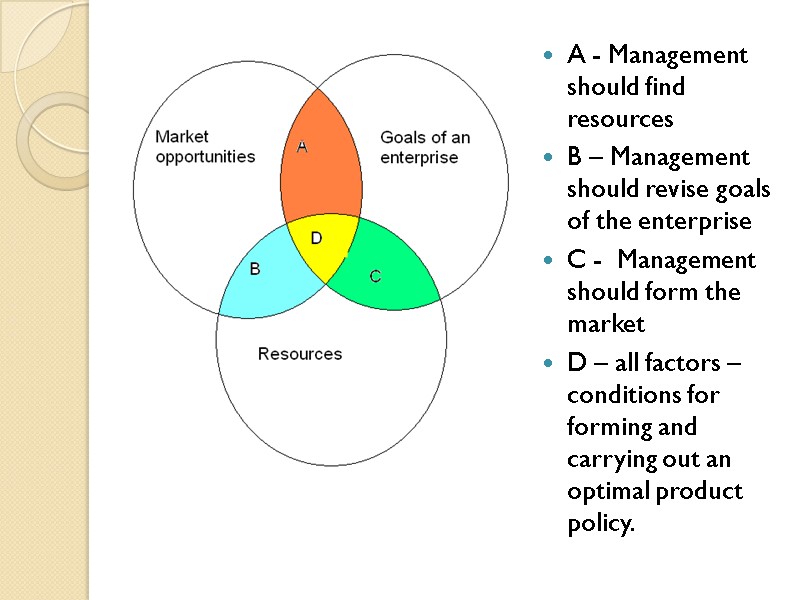
A - Management should find resources B – Management should revise goals of the enterprise C - Management should form the market D – all factors –conditions for forming and carrying out an optimal product policy.
Demand forecasting is the activity of estimating the quantity of a product or service that consumers will purchase. No demand forecasting method is 100% accurate. Combined forecasts improve accuracy and reduce the likelihood of large errors. Demand forecasting
Methods that rely on qualitative assessment. - Forecasting demand based on expert opinion. Some of the types in this method are: Unaided judgment (opinion of consumers, experts); Prediction market Delphi technique; Game theory; Simulated interaction; Intentions and expectations surveys; Conjoint analysis. Demand forecasting methods
Delphi technique is a systematic forecasting method which relies on a panel of experts. The experts answer questionnaires in two or more rounds. After each round, a facilitator provides an anonymous summary of the experts’ forecasts from the previous round as well as the reasons they provided for their judgments. Thus, experts are encouraged to revise their earlier answers in light of the replies of other members of their panel. It is believed that during this process the range of the answers will decrease and the group will converge towards the “correct” answers. Finally, the process is stopped after a pre-defined stop criterion (e.g. number of rounds, achievement of consensus, stability of results) and the mean and median scores of the final rounds determine the results.
Game theory attempts to mathematically capture behavior in strategic situations, or games, in which an individual’s success in making choices depends on the choices of others.
Conjoint analysis is a statistical technique used in market research how people value different features that make up an individual product or service. The objective of conjoint analysis is to determine what combination of a limited number of attributes is most influential on respondent choice or decision making. A controlled set of potential products or services is shown to respondents and by analyzing how they make preferences between these products, the implicit valuation of the individual elements making up the product or service can be determined. These implicit valuations can be used to create market models that estimate market share, revenue and even profitability of new designs.
Three Directions of the Product strategy Innovation Modification Elimination
Innovation is the multi-stage process whereby organizations transform ideas into new/improved products, service or processes, in order to advance, compete and differentiate themselves successfully in their marketplace. Innovation - the development of new products, changes in design of established products, or use of new materials or components in the manufacture of established products Product Innovation
Two categories of product innovation: Development of new products; - New product development describes the complete process of bringing a new product or service to market. There are two parallel paths involved in the process: one involves the idea generation, product design and detail engineering; the other involves market research and marketing analysis. Improvement of existing products. - This includes, but is not limited to, improvements in functional characteristics, technical abilities, or ease of use.
Product Modification Product modification means changing one or more of the product's features and may involve reformulation and repackaging to enhance its customer appeal. Modifications can give a competitive advantage, e.g., a company may be able to charge a higher price and enhance customer loyalty. Product modification is often used as a way of extending the product life cycle of a product.
Two categories of product modification: Product variation - Changing its parameters and properties, “old” product is removed from production. Motives for variation are new requirements of consumers toward properties of a product and need to reply to competitors’ actions. Product differentiation - Changing the product without removing the product from production.
Product Elimination Product Elimination - the decision to drop a product (for example, in the decline stage of its life cycle) in order to use the costs associated with it to enhance profits or to release resources that could be more effectively used in other ways.
Two categories of product elimination: Specialization Remove from production - Selling to other enterprises, sales of products.
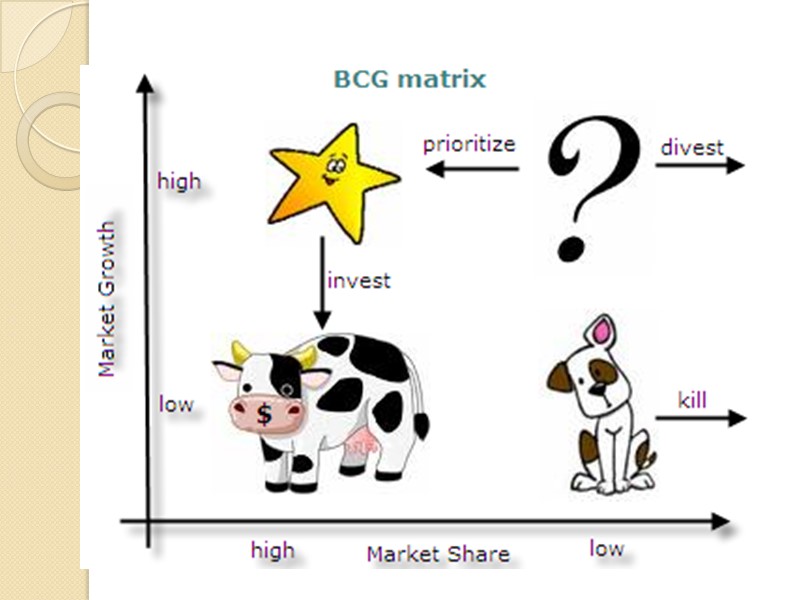
The BCG matrix product portfolio method Key issues in creating the product policy could be determined using the portfolio method - the Boston Consulting Group matrix The BCG matrix method is based on the product life cycle theory that can be used to determine what priorities should be given in the product portfolio of a business unit. To ensure long-term value creation, a company should have a portfolio of products that contains both high-growth products in need of cash inputs and low-growth products that generate a lot of cash.
It has 2 dimensions: market share and market growth. The basic idea behind it is that the bigger the market share a product has or the faster the product's market grows the better it is for the company.
Placing products in the BCG matrix results in 4 categories in a portfolio of a company: 1. Stars (=high growth, high market share, Growth PLC) use large amounts of cash and are leaders in the business so they should also generate large amounts of cash. frequently roughly in balance on net cash flow – much investments in providing high growth. However if needed any attempt should be made to hold share, because the rewards will be a cash cow if market share is kept. 2. Cash Cows (=low growth, high market share, Maturity PLC) - profits and cash generation should be high, and because of the low growth, investments needed should be low. Keep profits high Strategy: discounts, variation, differentiation.
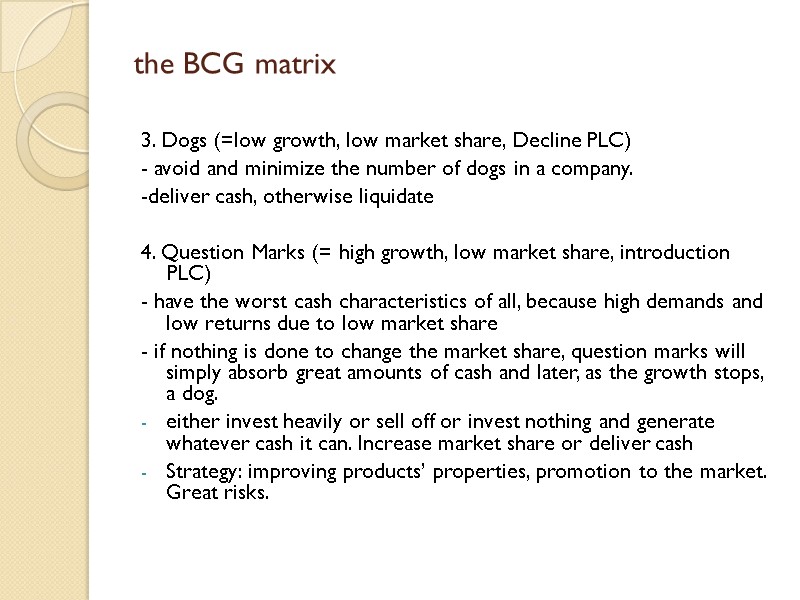
the BCG matrix 3. Dogs (=low growth, low market share, Decline PLC) - avoid and minimize the number of dogs in a company. -deliver cash, otherwise liquidate 4. Question Marks (= high growth, low market share, introduction PLC) - have the worst cash characteristics of all, because high demands and low returns due to low market share - if nothing is done to change the market share, question marks will simply absorb great amounts of cash and later, as the growth stops, a dog. either invest heavily or sell off or invest nothing and generate whatever cash it can. Increase market share or deliver cash Strategy: improving products’ properties, promotion to the market. Great risks.
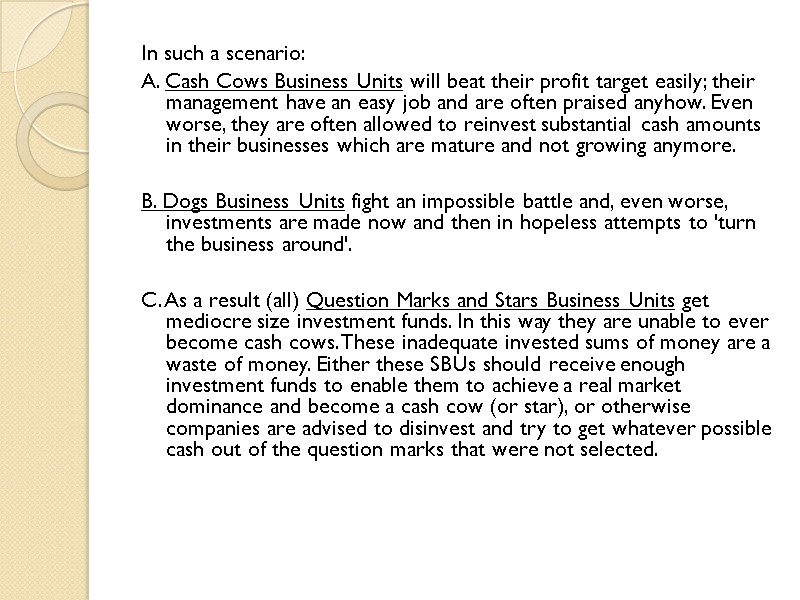
In such a scenario: A. Cash Cows Business Units will beat their profit target easily; their management have an easy job and are often praised anyhow. Even worse, they are often allowed to reinvest substantial cash amounts in their businesses which are mature and not growing anymore. B. Dogs Business Units fight an impossible battle and, even worse, investments are made now and then in hopeless attempts to 'turn the business around'. C. As a result (all) Question Marks and Stars Business Units get mediocre size investment funds. In this way they are unable to ever become cash cows. These inadequate invested sums of money are a waste of money. Either these SBUs should receive enough investment funds to enable them to achieve a real market dominance and become a cash cow (or star), or otherwise companies are advised to disinvest and try to get whatever possible cash out of the question marks that were not selected.
The main purpose of the product policy is determination of the optimal balance between new and existing products. The balanced product portfolio should include products at different stages of the product life cycle. This provides constant improvement of financial positions.
Customer Service A part of a product policy Customer service is a series of activities designed to enhance the level of customer satisfaction – that is, the feeling that a product or service has met the customer expectation.
Main functions of service: Attracting customers, Supporting and developing products, Informing customers. Two types of services: Technical assistance (Product delivery, installation, repair works); Trade service (consulting).
Manufacturing program Manufacturing program – plan for production and sales of products Goals of Manufacturing program : Achieve goals of the enterprise; Satisfy consumers’ needs; Efficient production; Forming competitive advantages.
Basis for determining the manufacturing program Strategic and current goals of the enterprise; The product policy; Market research results; Resources of the enterprise (material, labor and financial resources).
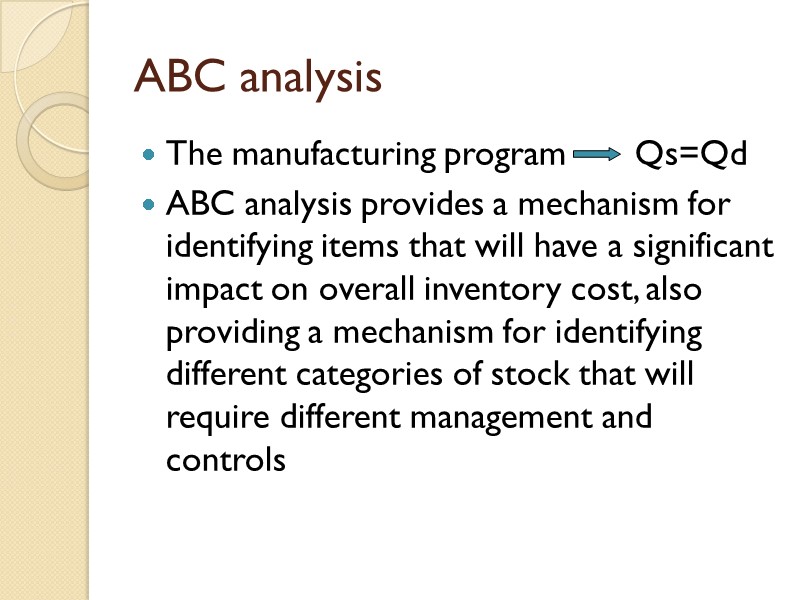
ABC analysis The manufacturing program Qs=Qd ABC analysis provides a mechanism for identifying items that will have a significant impact on overall inventory cost, also providing a mechanism for identifying different categories of stock that will require different management and controls
ABC analysis When carrying out an ABC analysis, inventory items are valued (item cost multiplied by quantity issued/consumed in period) with the results then ranked. The results are then grouped typically into three bands. These bands are called ABC codes.
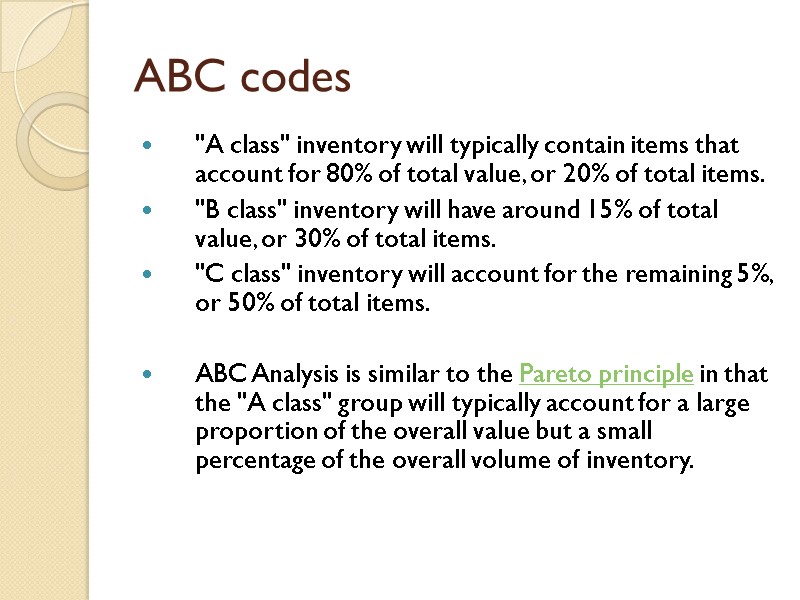
ABC codes "A class" inventory will typically contain items that account for 80% of total value, or 20% of total items. "B class" inventory will have around 15% of total value, or 30% of total items. "C class" inventory will account for the remaining 5%, or 50% of total items. ABC Analysis is similar to the Pareto principle in that the "A class" group will typically account for a large proportion of the overall value but a small percentage of the overall volume of inventory.
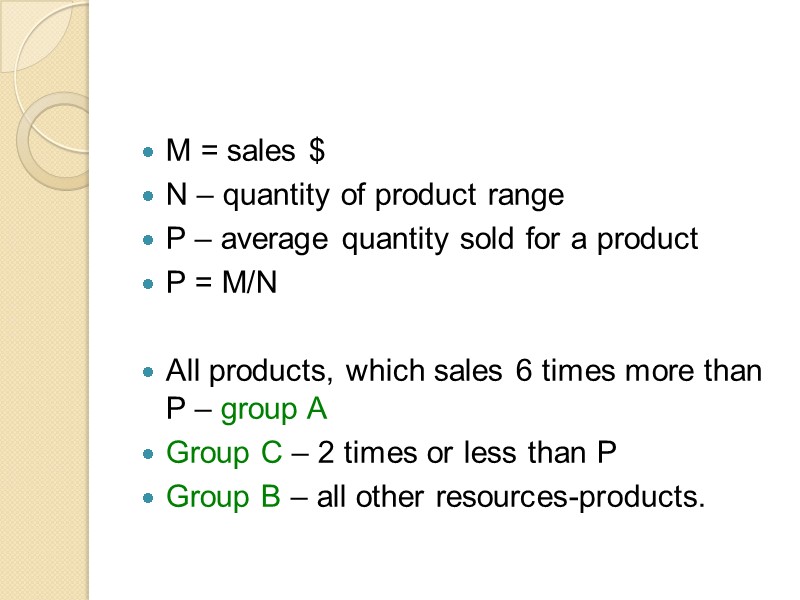
M = sales $ N – quantity of product range P – average quantity sold for a product Р = M/N All products, which sales 6 times more than P – group A Group C – 2 times or less than P Group B – all other resources-products.
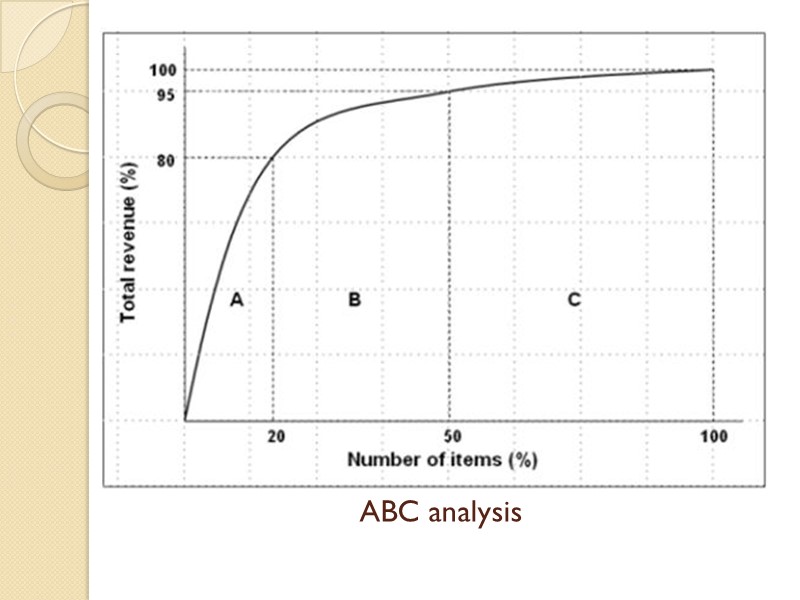
ABC analysis
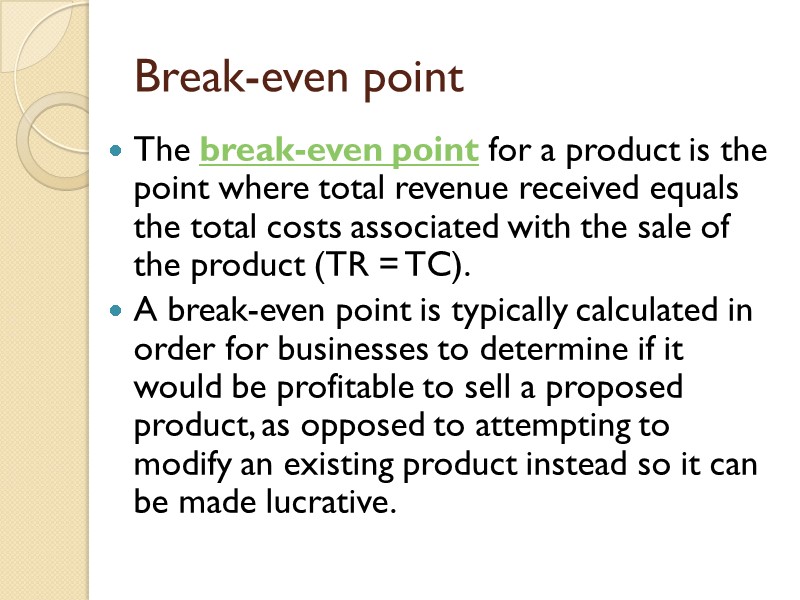
Break-even point The break-even point for a product is the point where total revenue received equals the total costs associated with the sale of the product (TR = TC). A break-even point is typically calculated in order for businesses to determine if it would be profitable to sell a proposed product, as opposed to attempting to modify an existing product instead so it can be made lucrative.
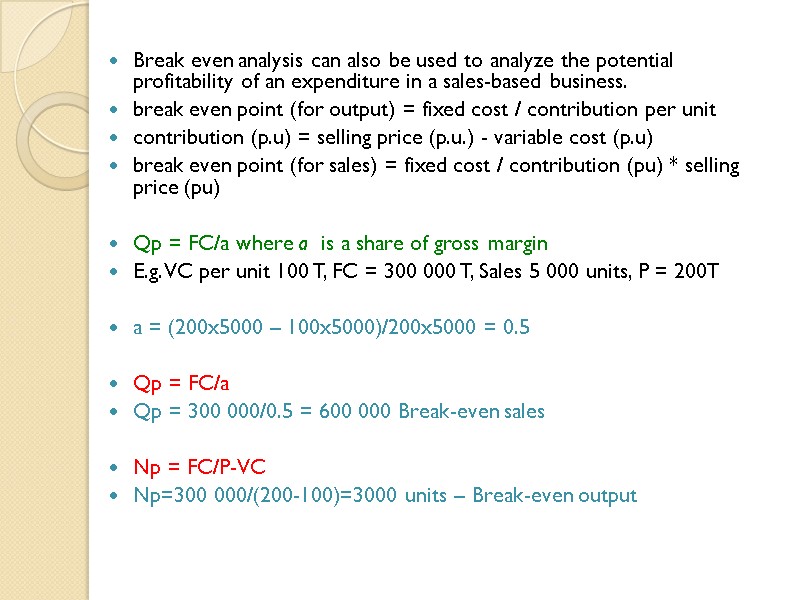
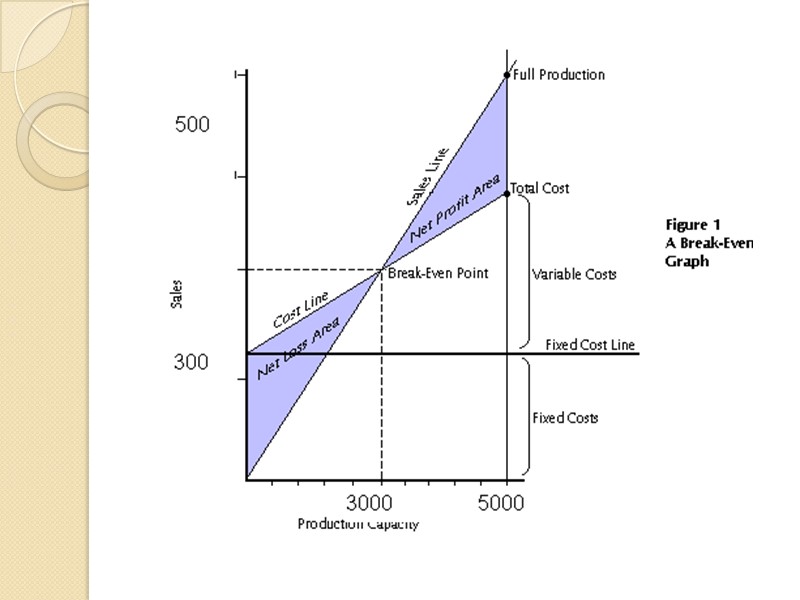
Break even analysis can also be used to analyze the potential profitability of an expenditure in a sales-based business. break even point (for output) = fixed cost / contribution per unit contribution (p.u) = selling price (p.u.) - variable cost (p.u) break even point (for sales) = fixed cost / contribution (pu) * selling price (pu) Qp = FC/a where a is a share of gross margin E.g. VC per unit 100 T, FC = 300 000 T, Sales 5 000 units, P = 200T a = (200x5000 – 100x5000)/200x5000 = 0.5 Qp = FC/a Qp = 300 000/0.5 = 600 000 Break-even sales Np = FC/P-VC Np=300 000/(200-100)=3000 units – Break-even output
 Скачать презентацию Lecture 4 Basics of the Product Policy of
22890-lecture_week_4_ee.ppt
- Количество слайдов: 52