Скачать презентацию LECTURE 4 1 General notion of non-equivalents ways
LECTURE 4.pptx
- Количество слайдов: 37
 LECTURE 4. 1. General notion of non-equivalents, ways of translation. 2. Neologisms: groups & ways of translation. 3. International words. 4. Misleading words: groups & ways of translation
 • Non-equivalents are SL words which have no corresponding lexical units in the TL vocabulary.
 Groups of non-equivalents: • 1) words denoting referents unknown in the TL – things, objects, notions, features of national life, customs, habits, etc. the words of this group bear a distinctly national character (public school, backbencher). • 2)words which for some linguistic reason have no equivalents in the TL, the so-called linguistic lacunae, e. g. conservationist, oralist, readership.
 There are three ways of rendering nonequivalents in translation: 1)by borrowings: • the borrowed words may be either transliterated or transcribed, e. g. ale – ель, roastbeef – ростбіф, sweater – светр (transliterated borrowings); • know-how – ноу-хау, establishment – істеблішмент (transcribed borrowings); 2) by translation loans: • House of Commons – Палата Общин
 3) by descriptive or interpreting translation: • landslide – перемога на виборах з переважною кількістю голосів; • a stringer (амер. ) – частково зайнятий кореспондент, праця якого оплачується з розрахунку кількості написаних слів; • a conservationist (environmentalist) – людина, яка переймається забрудненням чи знищенням навколишнього середовища.
 • Her home is filled from top to toe with Victoria, classically elegant, very together stuff. • This college professor is what campaign sides describe as an “oralist” – someone who isn’t asked to hammer out position papers, but can drop by or call up with some words of advice.
 Neologisms – words, terms, or phrases that have been recently created (“coined”) – often to apply to new concepts, to synthesize pre-existing concepts, or to make older terminology sound more contemporary. Neologisms are newly coined words or words that have acquired additional meaning due to social, cultural, economic, political changes in human society.
 Neologisms can be categorized as: 1) formal - completely new words (duvet day). 2) eponyms - recently based on proper names, including inventors and names of firms, brands and towns; 3) derived (miswant – v, miswanting (n)); 4) new collocations, e. g. ', `anti-/unsocial hours'; 5) phrasal (nouns or verbs) - `trade-off; 6) semantic (old words with new meanings), e. g. `sophisticated', ‘to screen (to clasify)'; 7) abbreviations & acronyms (or shortened form of words)
 • • Sunlighting Third place Undertime Ubermom / soccer mom / cutting-edge mom • Glass ceiling / silicon ceiling / grey ceiling • Diversity fatigue
 Neologisms are coined according to: • Affixation • Conversion • Compounding • Shortening • Blending • Extension of meaning
 Affixation 1) -eteria/ateria is a noun-forming suffix indicating a place of business offering goods or services, applied to most inexpensive places serving quick lunches, mostly used in advertisements: • Candyteria — магазин солодощів. 2) - er indicates the doer of the action: • Chopper (a ticket collector) —контролер • State-righter — людина, яка підтримує зміцнення, розвиток прав в певній країні • Hard-liner— прихильник жорсткого курсу в політиці або в будь-якій іншій сфері життя.
 • most + n • the most interesting project • a most interesting project
 3) - ee is a noun-forming suffix added to nouns and verbs denoting the object of an action: • Investigee — дослідник; • Divorcee — людина, яка розлучається; • Pollee — людина, яка бере участь в опитуванні громадської думки. 4) - dоm s is a noun-forming suffix denoting the realm, era, or time: • Screendom — працівники кіно; • Fandom — шанувальники; • Puzzledom — любителі кросвордів. 5) - fest is used with nouns to denote uninterrupted, immoderate activity: • Smokerfest —людина, яка палить довгий час; • Walkfest — довга прогулянка; • Talk-fest — теревеньки.
 6) - happy gives the noun the connotation of something excited, or being obsessed with something: • Coop-happy (a person insane from confinement) – людина, що тужить наодинці. • Headline-happy (a person who reads only headlines) – людина, яка читає лише заголовки. • Car-happy (a person who is crazy about cars) – автомобіліст-фанатик.
 • In-carrier education – підвищення кваліфікації • In-party dispute – внутрішньопартійні розбіжності, сварки • In-house regulations – внутрішній розпорядок • Deschooling – індивідуальне навчання • Superfly – чудовий, привабливий
 • Workless • Uninstalled • Spin row • Grief tourism • Weather tourism • Sun-and-sea tourism • Novelty degree • Red Teaming • Grey nomad • Gray zone • Tart noir • Joy-to-stuff ratio
 Functional shift or Conversion • Pretty pretties – нарядна жіноча сукня • a read-in – збірка дискусійних статей • a be-in (a large usually peaceable gathering of young people in which they are free and spontaneous) – натовп, зібрання молодих людей • Swim-in – змагання з плавання • Lobby-in — конференція з політичних питань • to mall • to demall • to mall-walk
 Compounding • Opener-upper — перший номер програми • Youth quake – демографічний вибух • Trouble-shooter — спеціальний уповноважений для улагодження конфліктів • Bling-bling – статус зірки, слава • Open-collar (worker) – той, що працює вдома • To kitchen-sink – довести до банкрутства
 Blends • • • Gambaholic Infonomics Infobesity Bizample Netizen Arrignance Aurisma Sheeple Funtamination Daycation Fratire
 • • • CAM FSP SMUM BOGOF Con Libs Nukes WHO WAY yuppie
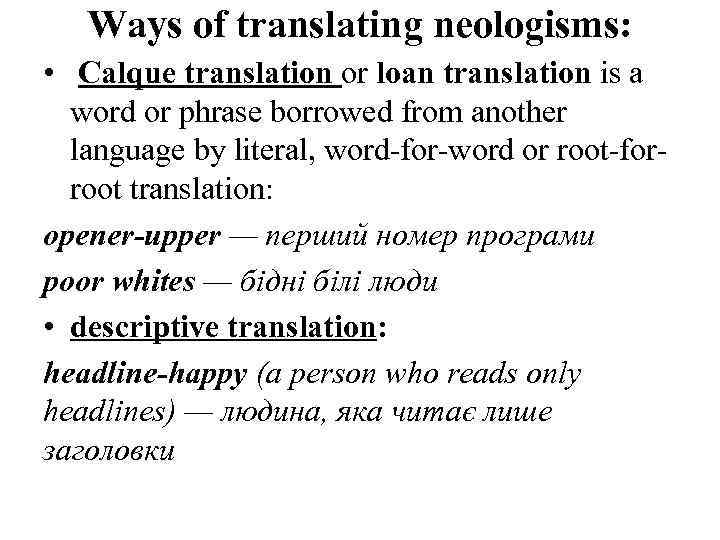 Ways of translating neologisms: • Calque translation or loan translation is a word or phrase borrowed from another language by literal, word-for-word or root-forroot translation: opener-upper — перший номер програми poor whites — бідні білі люди • descriptive translation: headline-happy (a person who reads only headlines) — людина, яка читає лише заголовки
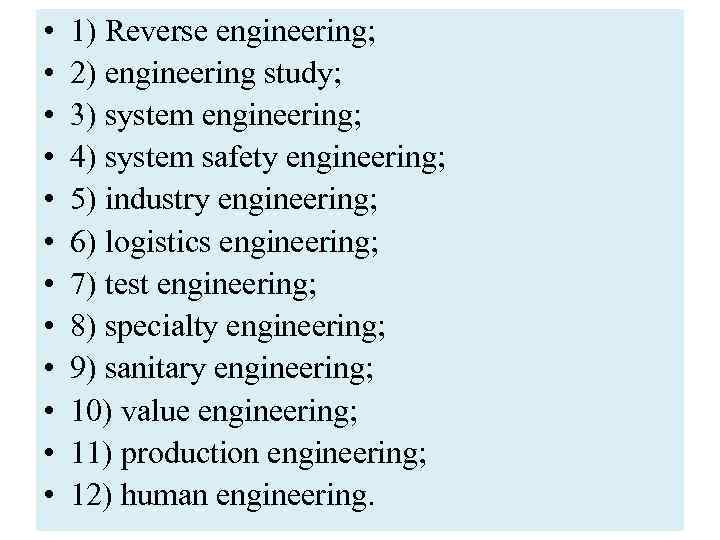 • • • 1) Reverse engineering; 2) engineering study; 3) system engineering; 4) system safety engineering; 5) industry engineering; 6) logistics engineering; 7) test engineering; 8) specialty engineering; 9) sanitary engineering; 10) value engineering; 11) production engineering; 12) human engineering.
 International words • borrowed from one and the same SL by at least three genealogically different languages in the similar lingual form and identical meaning (have a more or less similar phonetic form in many languages). They express not only scientific, social and political notions but everyday things and notions as well: electronics – электроніка; dynamic – динамічний; calorie – калорія; elegant – eлегантний.
 According to their etymology they fall into 2 groups: 1) words borrowed from Latin and Greek (ovation, triumph); 2) words borrowed from modern languages (passport).
 Groups of international words: • Genuine internationalisms – characterised by their semantic singularity – lexically & orthographically similar in the SL and the TL (symposium - симпозіум, zebra - зебра). • Pseudo-international words occur when semantics of the SL and the TL do not coincide. Such words are normally polysemantic, which is typical оf the presеntday English but less common in Ukrainian.
 • Conductor: 1) Кондуктор – genuine internationalism 2) Провідник – international loan word 3) Провід – international loan word 4) Громовідвід – international loan word 5) Диригент – pseudointernationalism 6) Керівник – pseudointernationalism
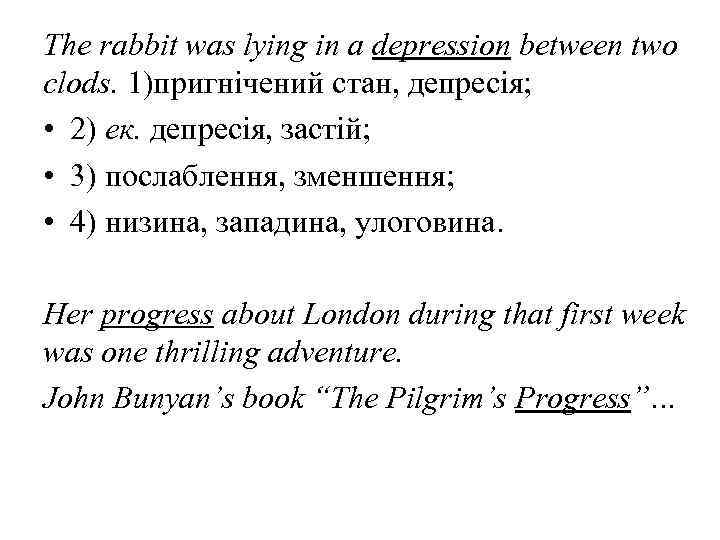 The rabbit was lying in a depression between two clods. 1)пригнічений стан, депресія; • 2) ек. депресія, застій; • 3) послаблення, зменшення; • 4) низина, западина, улоговина. Her progress about London during that first week was one thrilling adventure. John Bunyan’s book “The Pilgrim’s Progress”…
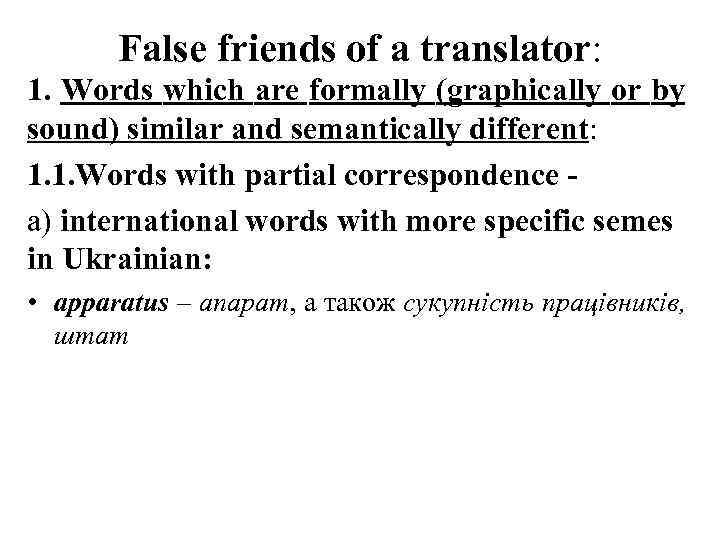 False friends of a translator: 1. Words which are formally (graphically or by sound) similar and semantically different: 1. 1. Words with partial correspondence a) international words with more specific semes in Ukrainian: • apparatus – апарат, а також сукупність працівників, штат
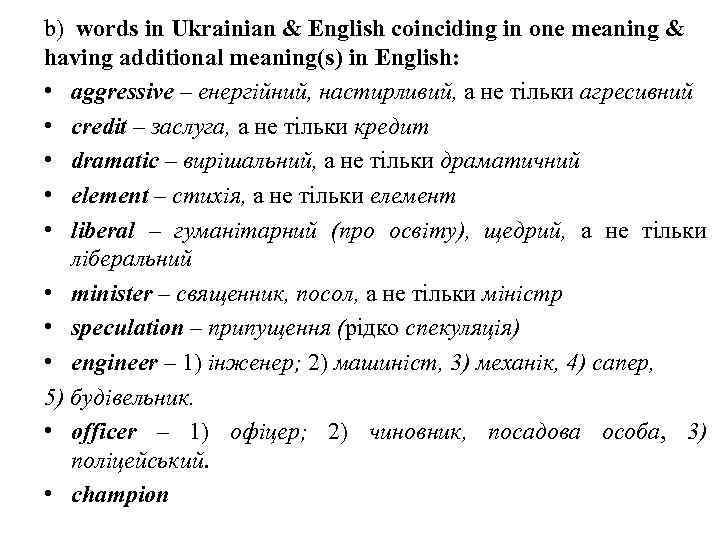 b) words in Ukrainian & English coinciding in one meaning & having additional meaning(s) in English: • aggressive – енергійний, настирливий, а не тільки агресивний • credit – заслуга, а не тільки кредит • dramatic – вирішальний, а не тільки драматичний • element – стихія, а не тільки елемент • liberal – гуманітарний (про освіту), щедрий, а не тільки ліберальний • minister – священник, посол, а не тільки міністр • speculation – припущення (рідко спекуляція) • engineer – 1) інженер; 2) машиніст, 3) механік, 4) сапер, 5) будівельник. • officer – 1) офіцер; 2) чиновник, посадова особа, 3) поліцейський. • champion
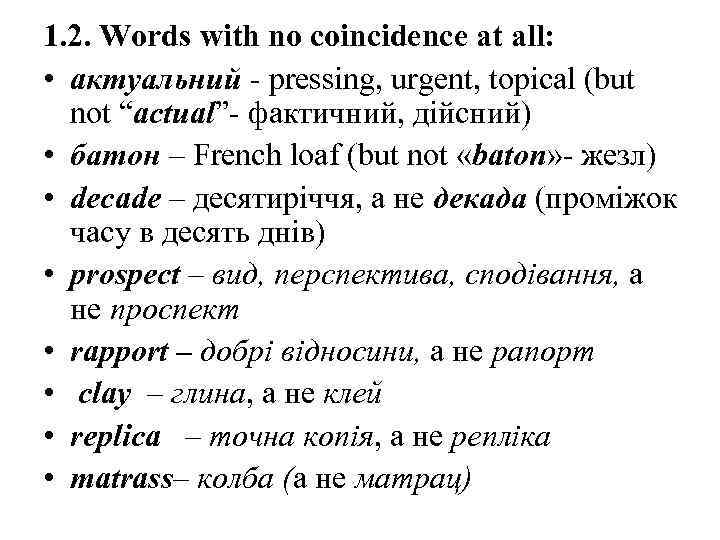 1. 2. Words with no coincidence at all: • aктуальний - pressing, urgent, topical (but not “actual”- фактичний, дійсний) • батон – French loaf (but not «baton» - жезл) • decade – десятиріччя, а не декада (проміжок часу в десять днів) • prospect – вид, перспектива, сподівання, а не проспект • rapport – добрі відносини, а не рапорт • clay – глина, а не клей • replica – точна копія, а не репліка • matrass– колба (а не матрац)
 2. Words which in the plural have another meaning: • work ‟робота” – works ‟праці” і ‟завод”, • fund ‟фонд” – funds ‟фонди” і ‟гроші”, • development – ‟розвиток, забудова (місцевості)” – developments ‟події”, • damage ‟ушкодження”– damages ‟збитки”, • Scale – scales, • Compass – compasses
 3. Words – names of the units of measurement in tune with the source languages and translation, but different in number marked: • ton(ne) – брит. тонна (1016 кг); ам. тонна (907 кг); укр. метрична тонна (1000 кг). • Pint – 0, 57 л (Br. ); 0, 48 л (US)
 4. Paronyms – words with the similar (but not identical) sounds but different meanings: vcomplement (v/n) – complementary medicine vcompliment (v/n) – complimentary tickets / bottle of wine
 vaid – verb – to help, to assist vaide – noun – an assistant • My aide will aid you with the delivery schedule. vail – verb – to cause to suffer, to hurt, to be ill, to suffer vale – noun – an intoxicating liquor, beer • Drinking too much ale in the evening ails him in the morning.
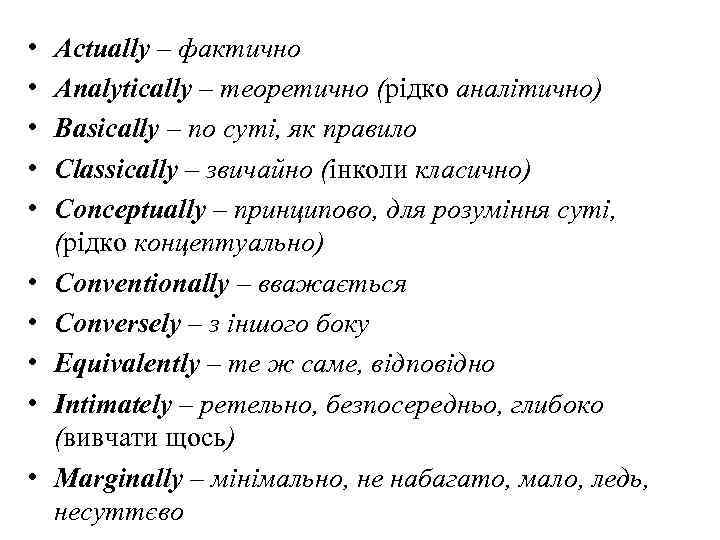 • • • Actually – фактично Analytically – теоретично (рідко аналітично) Basically – по суті, як правило Classically – звичайно (інколи класично) Conceptually – принципово, для розуміння суті, (рідко концептуально) Conventionally – вважається Conversely – з іншого боку Equivalently – те ж саме, відповідно Intimately – ретельно, безпосередньо, глибоко (вивчати щось) Marginally – мінімально, не набагато, мало, ледь, несуттєво
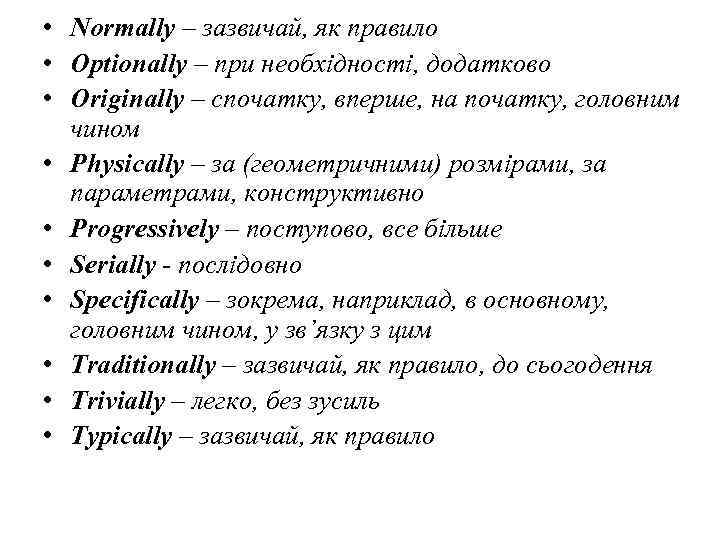 • Normally – зазвичай, як правило • Optionally – при необхідності, додатково • Originally – спочатку, вперше, на початку, головним чином • Physically – за (геометричними) розмірами, за параметрами, конструктивно • Progressively – поступово, все більше • Serially - послідовно • Specifically – зокрема, наприклад, в основному, головним чином, у зв’язку з цим • Traditionally – зазвичай, як правило, до сьогодення • Trivially – легко, без зусиль • Typically – зазвичай, як правило