



 LECTURE 3. TYPOLOGY OF THE PARTS OF SPEECH IN THE CONRASTED LANGUAGES
 CLASSIFICATION NOTIONALS: THE THE THE NOUN ADJECTIVE NUMERAL PRONOUN VERB ADVERB OF THE PARTS OF SPEECH
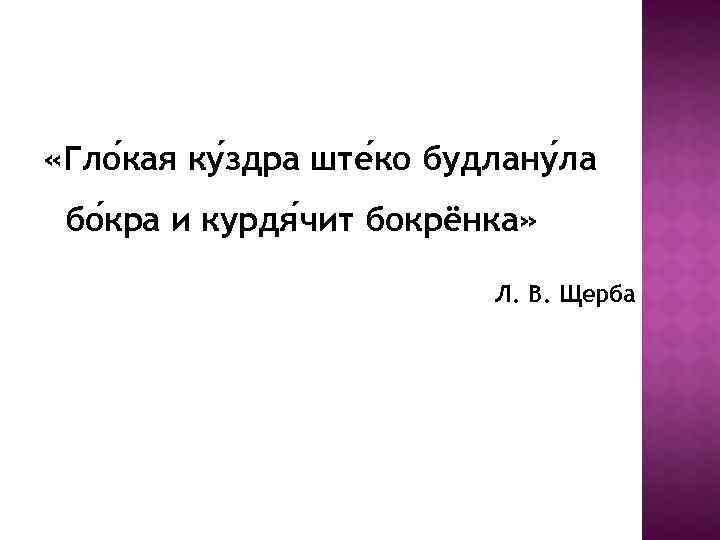 «Гло кая ку здра ште ко будлану ла бо кра и курдя чит бокрёнка» Л. В. Щерба
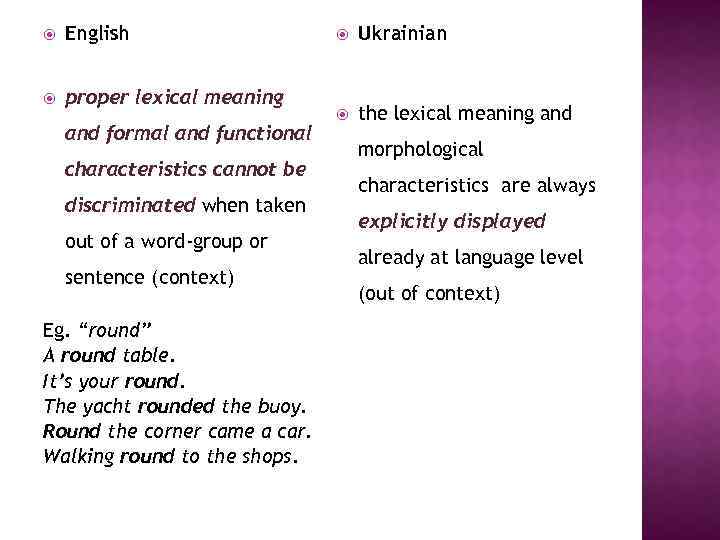 English proper lexical meaning and formal and functional characteristics cannot be discriminated when taken out of a word-group or sentence (context) Eg. “round” A round table. It’s your round. The yacht rounded the buoy. Round the corner came a car. Walking round to the shops. Ukrainian the lexical meaning and morphological characteristics are always explicitly displayed already at language level (out of context)
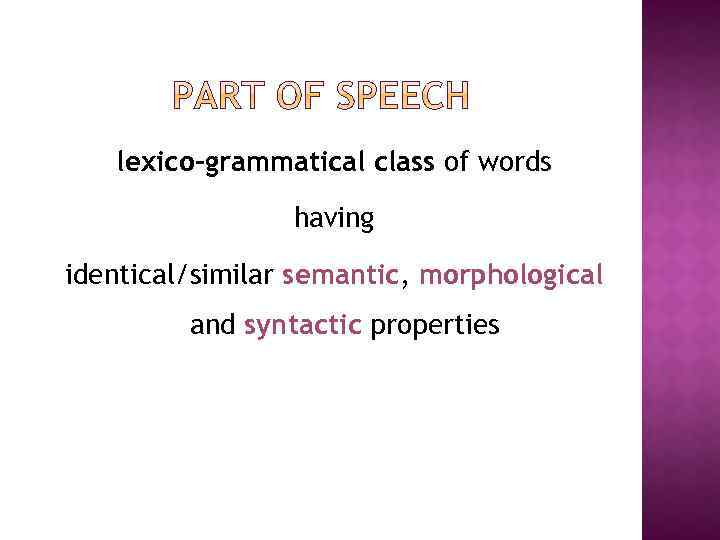 lexico-grammatical class of words having identical/similar semantic, morphological and syntactic properties
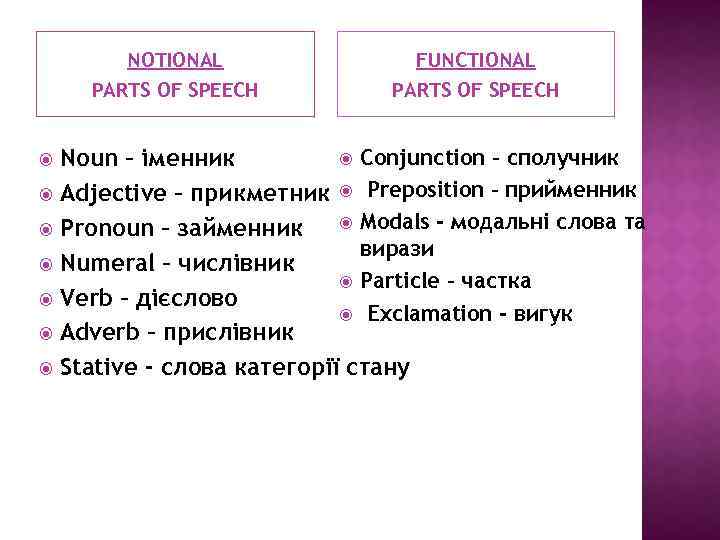 NOTIONAL FUNCTIONAL PARTS OF SPEECH Conjunction – сполучник Noun – іменник Adjective – прикметник Preposition – прийменник Modals - модальні слова та Pronoun – займенник вирази Numeral – числівник Particle – часткa Verb – дієслово Exclamation - вигук Adverb – прислівник Stative - слова категорії стану
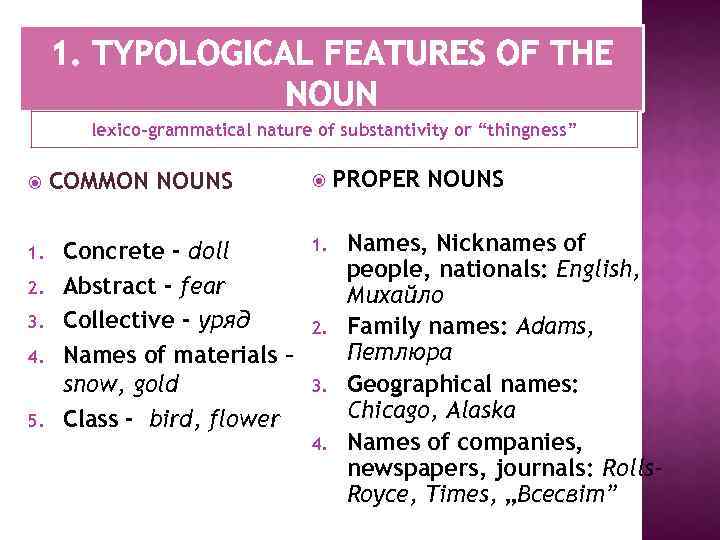 lexico-grammatical nature of substantivity or “thingness” 1. 2. 3. 4. 5. COMMON NOUNS Concrete - doll Abstract - fear Collective - уряд Names of materials – snow, gold Class - bird, flower 1. 2. 3. 4. PROPER NOUNS Names, Nicknames of people, nationals: English, Михайло Family names: Adams, Петлюра Geographical names: Chicago, Alaska Names of companies, newspapers, journals: Rolls. Royce, Times, „Всесвіт”
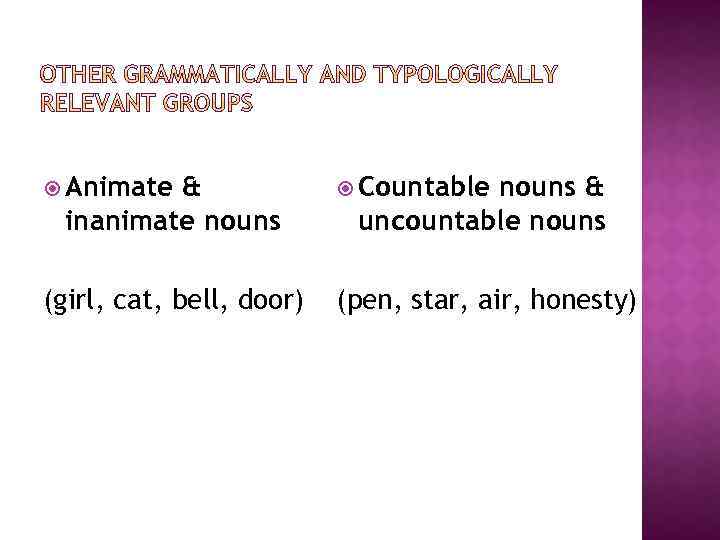 Animate & inanimate nouns Countable nouns & uncountable nouns (girl, cat, bell, door) (pen, star, air, honesty)
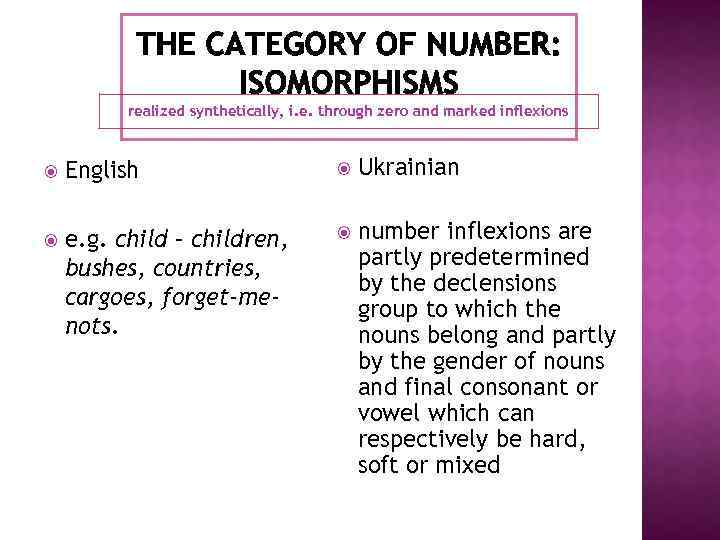 realized synthetically, i. e. through zero and marked inflexions English Ukrainian e. g. child – children, bushes, countries, cargoes, forget-menots. number inflexions are partly predetermined by the declensions group to which the nouns belong and partly by the gender of nouns and final consonant or vowel which can respectively be hard, soft or mixed
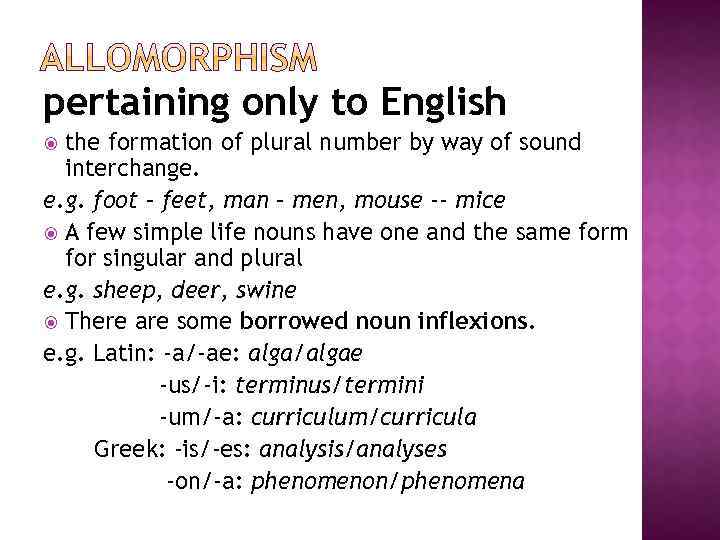 pertaining only to English the formation of plural number by way of sound interchange. e. g. foot – feet, man – men, mouse -- mice A few simple life nouns have one and the same form for singular and plural e. g. sheep, deer, swine There are some borrowed noun inflexions. e. g. Latin: -a/-ae: alga/algae -us/-i: terminus/termini -um/-a: curriculum/curricula Greek: -is/-es: analysis/analyses -on/-a: phenomenon/phenomena
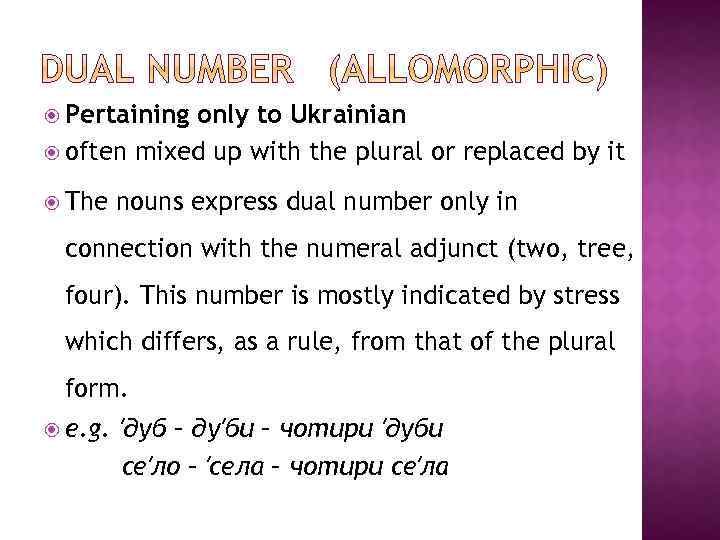 Pertaining only to Ukrainian often mixed up with the plural or replaced by it The nouns express dual number only in connection with the numeral adjunct (two, tree, four). This number is mostly indicated by stress which differs, as a rule, from that of the plural form. e. g. ′дуб – ду′би – чотири ′дуби се′ло – ′села – чотири се′лa
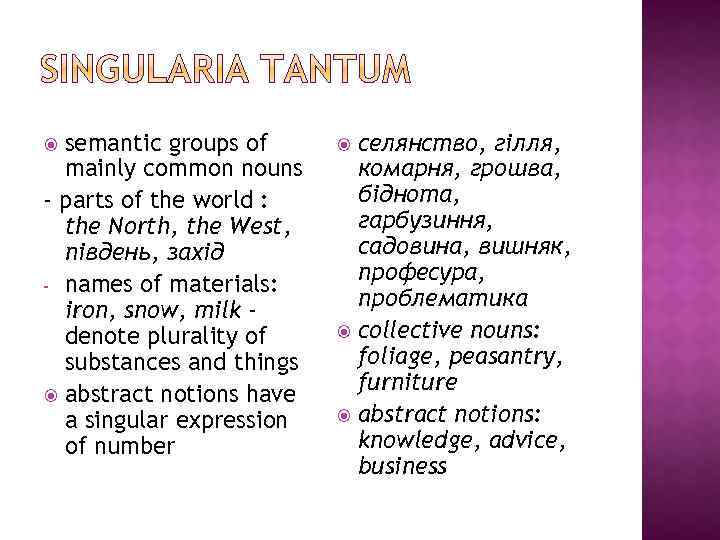 semantic groups of mainly common nouns - parts of the world : the North, the West, південь, захід - names of materials: iron, snow, milk denote plurality of substances and things abstract notions have a singular expression of number селянство, гілля, комарня, грошва, біднота, гарбузиння, садовина, вишняк, професура, проблематика collective nouns: foliage, peasantry, furniture abstract notions: knowledge, advice, business
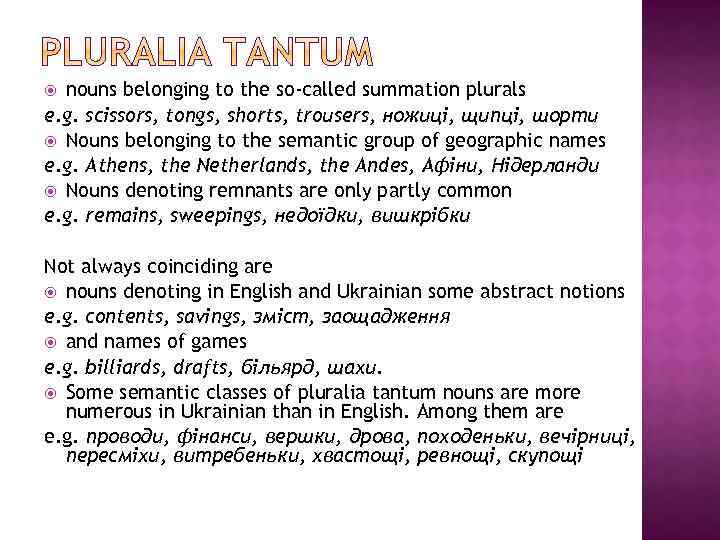 nouns belonging to the so-called summation plurals e. g. scissors, tongs, shorts, trousers, ножиці, щипці, шорти Nouns belonging to the semantic group of geographic names e. g. Athens, the Netherlands, the Andes, Афіни, Нідерланди Nouns denoting remnants are only partly common e. g. remains, sweepings, недоїдки, вишкрібки Not always coinciding are nouns denoting in English and Ukrainian some abstract notions e. g. contents, savings, зміст, заощадження and names of games e. g. billiards, drafts, більярд, шахи. Some semantic classes of pluralia tantum nouns are more numerous in Ukrainian than in English. Among them are e. g. проводи, фінанси, вершки, дрова, походеньки, вечірниці, пересміхи, витребеньки, хвастощі, ревнощі, скупощі
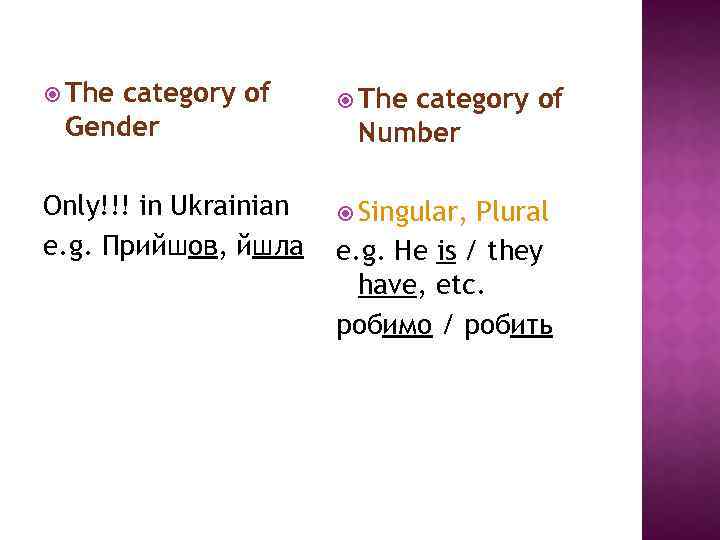
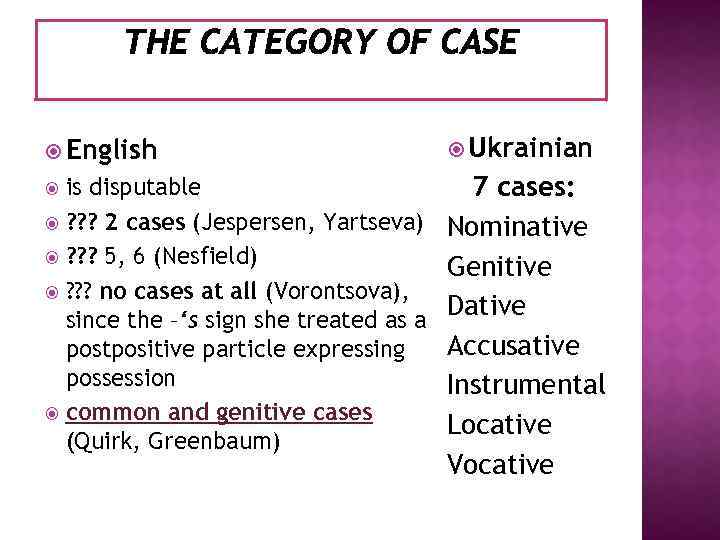 English Ukrainian is disputable ? ? ? 2 cases (Jespersen, Yartseva) ? ? ? 5, 6 (Nesfield) ? ? ? no cases at all (Vorontsova), since the –‘s sign she treated as a postpositive particle expressing possession common and genitive cases (Quirk, Greenbaum) 7 cases: Nominative Genitive Dative Accusative Instrumental Locative Vocative
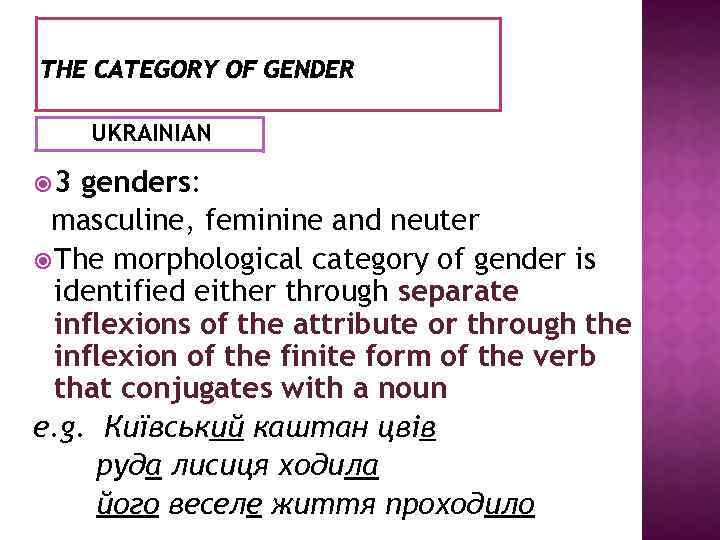 UKRAINIAN 3 genders: masculine, feminine and neuter The morphological category of gender is identified either through separate inflexions of the attribute or through the inflexion of the finite form of the verb that conjugates with a noun e. g. Київський каштан цвів руда лисиця ходила його веселе життя проходило
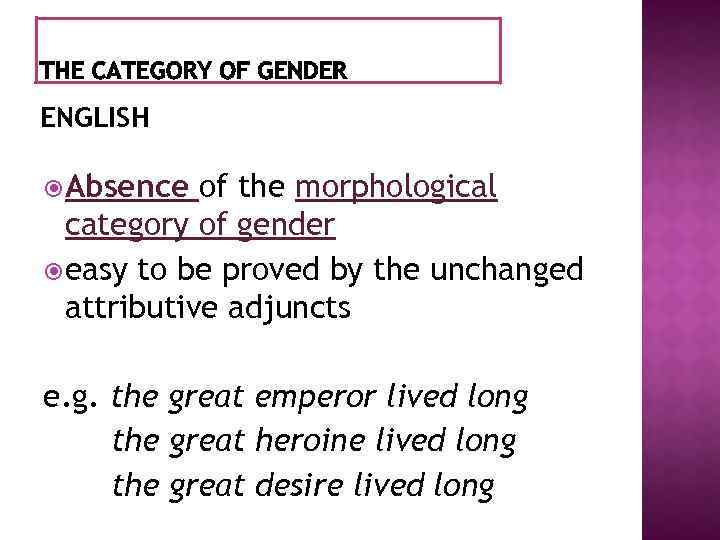 ENGLISH Absence of the morphological category of gender easy to be proved by the unchanged attributive adjuncts e. g. the great emperor lived long the great heroine lived long the great desire lived long
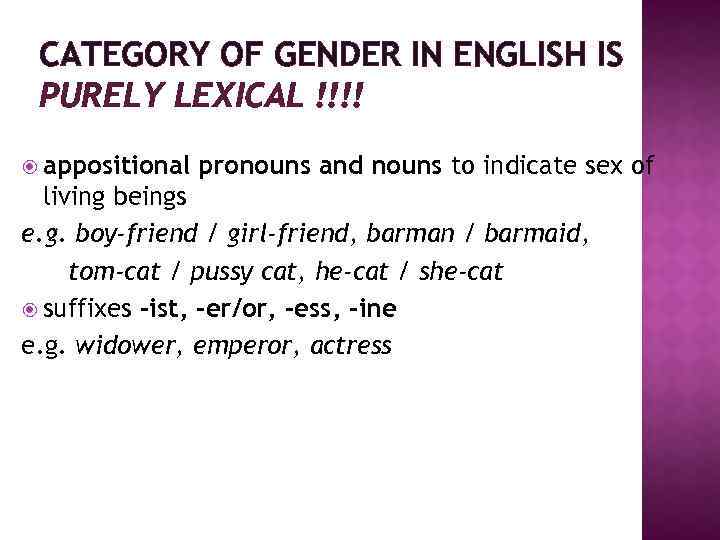 CATEGORY OF GENDER IN ENGLISH IS PURELY LEXICAL !!!! appositional pronouns and nouns to indicate sex of living beings e. g. boy-friend / girl-friend, barman / barmaid, tom-cat / pussy cat, he-cat / she-cat suffixes –ist, -er/or, -ess, -ine e. g. widower, emperor, actress
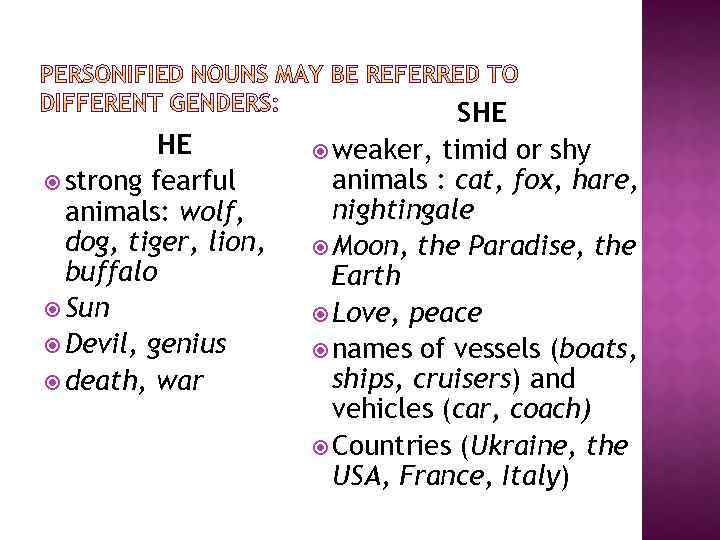 HE strong fearful animals: wolf, dog, tiger, lion, buffalo Sun Devil, genius death, war SHE weaker, timid or shy animals : cat, fox, hare, nightingale Moon, the Paradise, the Earth Love, peace names of vessels (boats, ships, cruisers) and vehicles (car, coach) Countries (Ukraine, the USA, France, Italy)
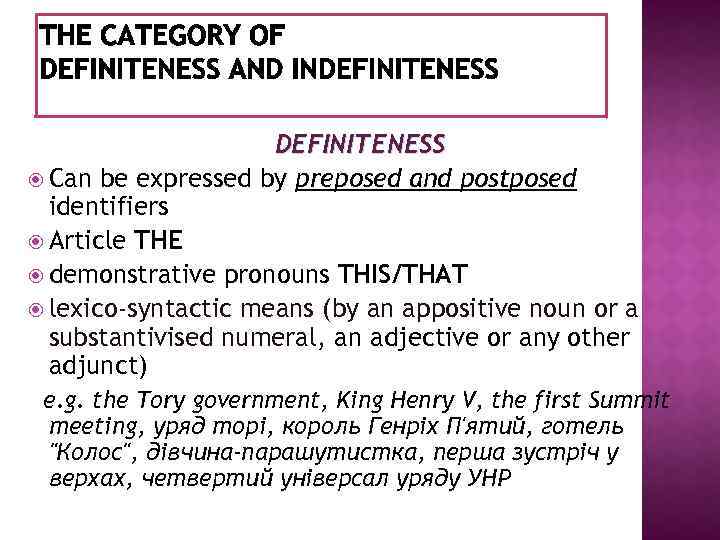 DEFINITENESS Can be expressed by preposed and postposed identifiers Article THE demonstrative pronouns THIS/THAT lexico-syntactic means (by an appositive noun or a substantivised numeral, an adjective or any other adjunct) e. g. the Tory government, King Henry V, the first Summit meeting, уряд торі, король Генріх П'ятий, готель "Колос", дівчина-парашутистка, перша зустріч у верхах, четвертий універсал уряду УНР
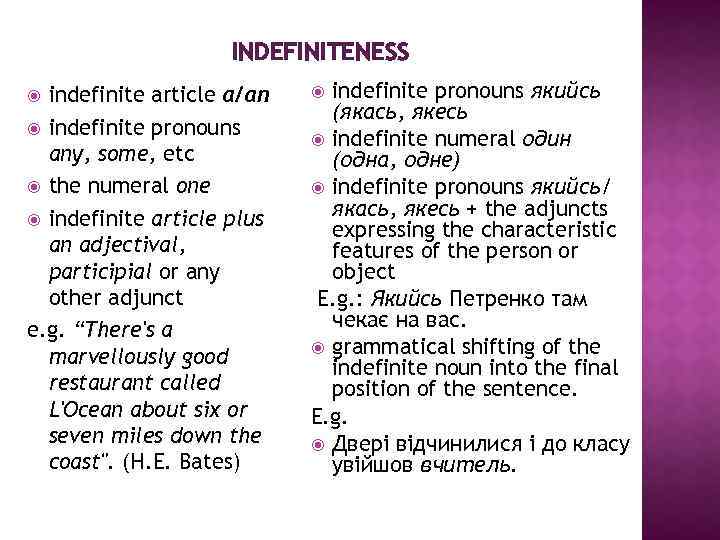 INDEFINITENESS indefinite article a/an indefinite pronouns any, some, etc the numeral one indefinite article plus an adjectival, participial or any other adjunct e. g. “There's a marvellously good restaurant called L'Ocean about six or seven miles down the coast". (H. E. Bates) indefinite pronouns якийсь (якась, якесь indefinite numeral один (одна, одне) indefinite pronouns якийсь/ якась, якесь + the adjuncts expressing the characteristic features of the person or object E. g. : Якийсь Петренко там чекає на вас. grammatical shifting of the indefinite noun into the final position of the sentence. E. g. Двері відчинилися і до класу увійшов вчитель.
 2. TYPOLOGICAL FEATURES OF THE ADJECTIVE AS A PART OF SPEECH The adjective as a part of speech is characterized in English and Ukrainian by its common implicit lexico-grammatical nature and common functions in the sentence It expresses the quality of things or substaces.
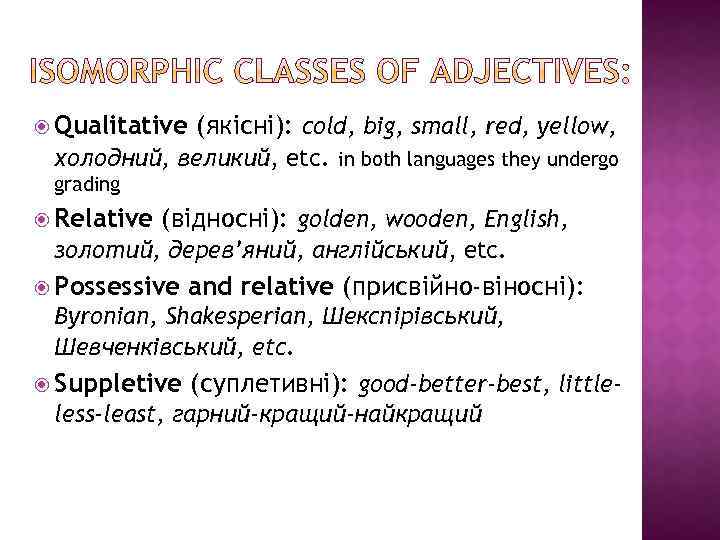 Qualitative (якісні): cold, big, small, red, yellow, холодний, великий, etc. in both languages they undergo grading Relative (відносні): golden, wooden, English, золотий, дерев’яний, англійський, etc. Possessive and relative (присвійно-віносні): Byronian, Shakesperian, Шекспірівський, Шевченківський, etc. Suppletive (суплетивні): good-better-best, little- less-least, гарний-кращий-найкращий
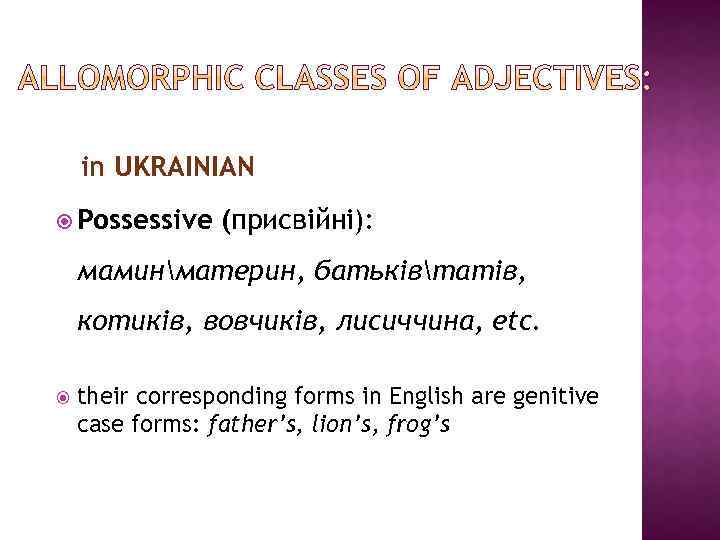 in UKRAINIAN Possessive (присвійні): маминматерин, батьківтатів, котиків, вовчиків, лисиччина, etc. their corresponding forms in English are genitive case forms: father’s, lion’s, frog’s
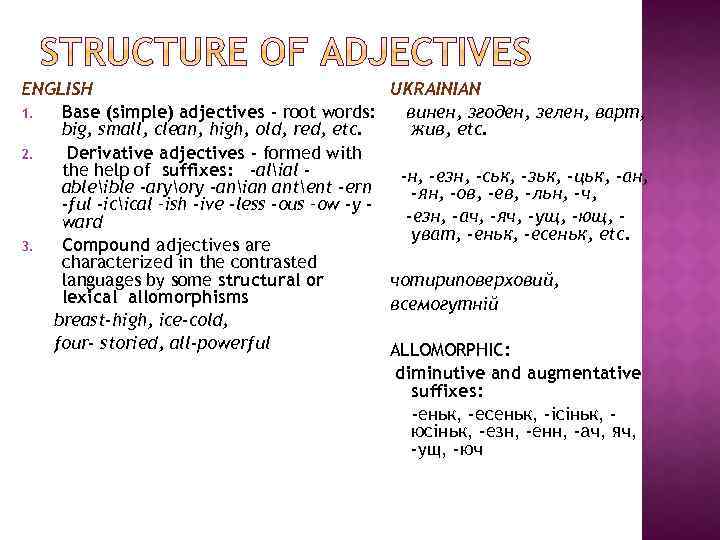 ENGLISH 1. Base (simple) adjectives - root words: big, small, clean, high, old, red, etc. 2. Derivative adjectives - formed with the help of suffixes: -alial ableible -aryory -anian antent -ern -ful -icical –ish -ive -less -ous –ow -y ward 3. Compound adjectives are characterized in the contrasted languages by some structural or lexical allomorphisms breast-high, ice-cold, four- storied, all-powerful UKRAINIAN винен, згоден, зелен, варт, жив, etc. -н, -езн, -ськ, -зьк, -цьк, -ан, -ян, -ов, -ев, -льн, -ч, -езн, -ач, -яч, -ущ, -ющ, уват, -еньк, -есеньк, etc. чотириповерховий, всемогутній ALLOMORPHIC: diminutive and augmentative suffixes: -еньк, -есеньк, -ісіньк, юсіньк, -езн, -енн, -ач, яч, -ущ, -юч
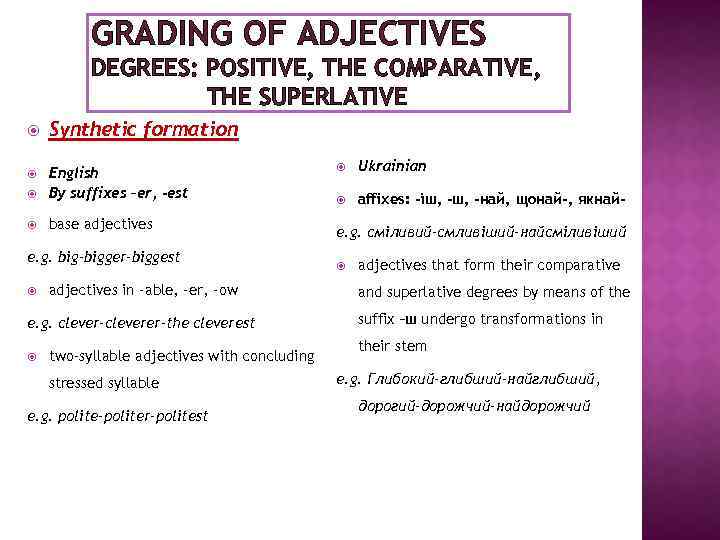 GRADING OF ADJECTIVES DEGREES: POSITIVE, THE COMPARATIVE, THE SUPERLATIVE Synthetic formation English By suffixes –er, -est base adjectives e. g. big-bigger-biggest adjectives in –able, -er, -ow e. g. clever-cleverer-the cleverest two-syllable adjectives with concluding stressed syllable e. g. polite-politer-politest Ukrainian аffixes: -іш, -най, щонай-, якнай- e. g. сміливий-смливіший-найсміливіший adjectives that form their comparative and superlative degrees by means of the suffix –ш undergo transformations in their stem e. g. Глибокий-глибший-найглибший, дорогий-дорожчий-найдорожчий
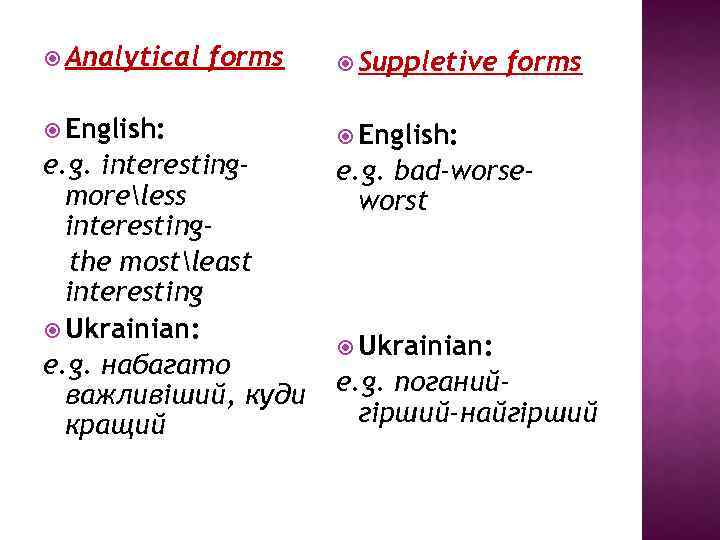 Analytical forms English: e. g. interestingmoreless interestingthe mostleast interesting Ukrainian: e. g. набагато важливіший, куди кращий Suppletive forms English: e. g. bad-worseworst Ukrainian: e. g. поганийгірший-найгірший
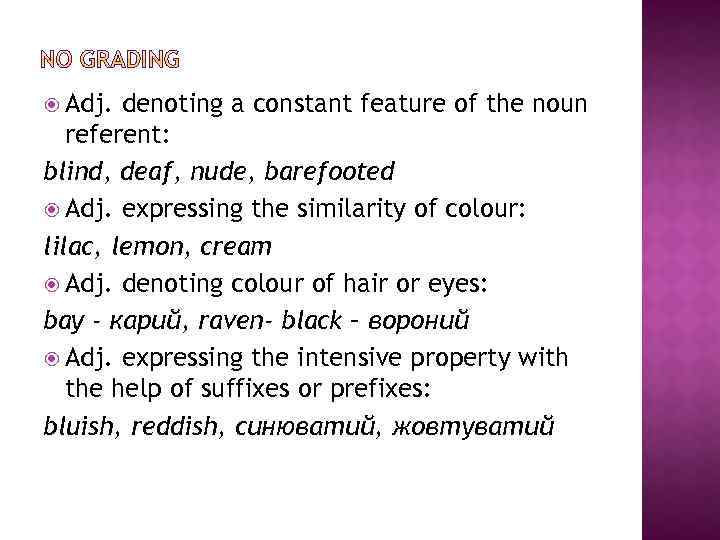 Adj. denoting a constant feature of the noun referent: blind, deaf, nude, barefooted Adj. expressing the similarity of colour: lilac, lemon, cream Adj. denoting colour of hair or eyes: bay - карий, raven- black – вороний Adj. expressing the intensive property with the help of suffixes or prefixes: bluish, reddish, синюватий, жовтуватий
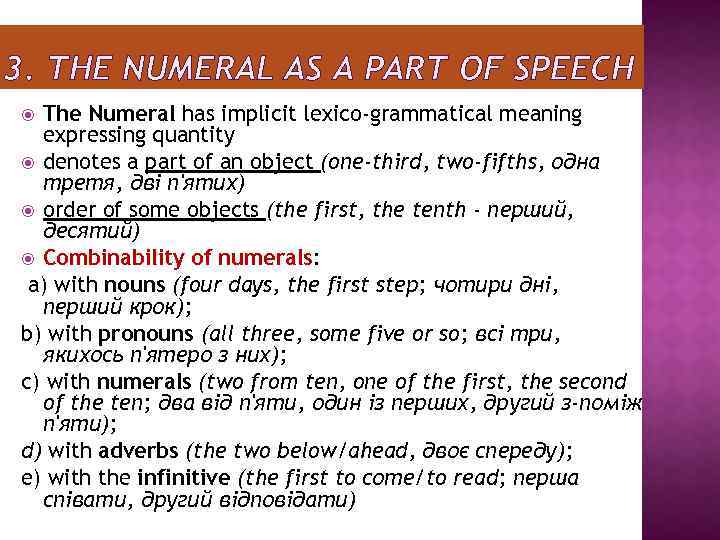 3. THE NUMERAL AS A PART OF SPEECH The Numeral has implicit lexico-grammatical meaning expressing quantity denotes a part of an object (one-third, two-fifths, одна третя, дві п'ятих) order of some objects (the first, the tenth - перший, десятий) Combinability of numerals: a) with nouns (four days, the first step; чотири дні, перший крок); b) with pronouns (all three, some five or so; всі три, якихось п'ятеро з них); с) with numerals (two from ten, one of the first, the second of the ten; два від п'яти, один із перших, другий з-поміж п'яти); d) with adverbs (the two below/ahead, двоє спереду); е) with the infinitive (the first to соте/to read; перша співати, другий відповідати)
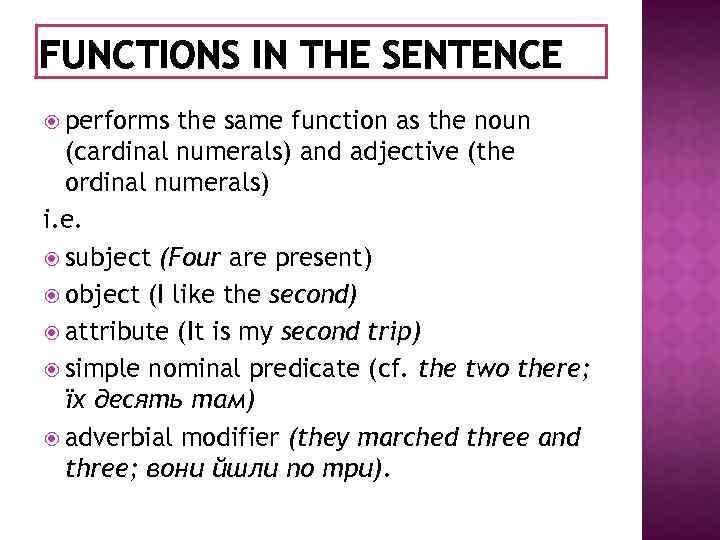 FUNCTIONS IN THE SENTENCE performs the same function as the noun (cardinal numerals) and adjective (the ordinal numerals) i. e. subject (Four are present) object (I like the second) attribute (It is my second trip) simple nominal predicate (cf. the two there; їх десять там) adverbial modifier (they marched three and three; вони йшли по три).
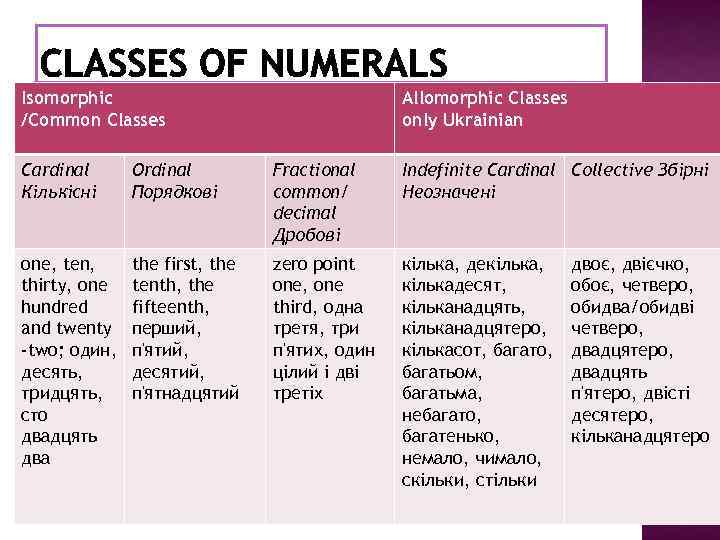 Isomorphic /Common Classes Allomorphic Classes only Ukrainian Cardinal Кількісні Ordinal Порядкові Fractional common/ decimal Дробові Indefinite Cardinal Collective Збірні Неозначені one, ten, thirty, one hundred and twenty -two; один, десять, тридцять, сто двадцять два the first, the tenth, the fifteenth, перший, п'ятий, десятий, п'ятнадцятий zero point one, one third, одна третя, три п'ятих, один цілий і дві третіх кілька, декілька, кількадесят, кільканадцять, кільканадцятеро, кількасот, багато, багатьом, багатьма, небагато, багатенько, немало, чимало, скільки, стільки двоє, двієчко, обоє, четверо, обидва/обидві четверо, двадцять п'ятеро, двісті десятеро, кільканадцятеро
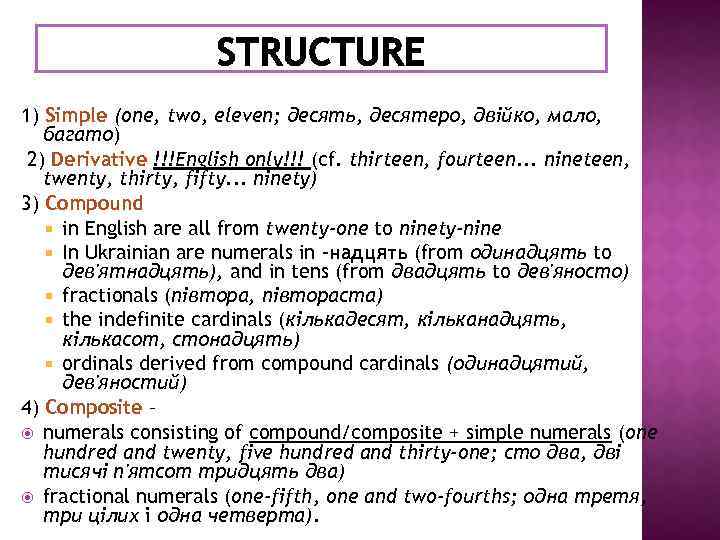 1) Simple (one, two, eleven; десять, десятеро, двійко, мало, багато) 2) Derivative !!!English only!!! (cf. thirteen, fourteen. . . nineteen, twenty, thirty, fifty. . . ninety) 3) Compound in English are all from twenty-one to ninety-nine In Ukrainian are numerals in -надцять (from одинадцять to дев'ятнадцять), and in tens (from двадцять to дев'яносто) fractionals (півтора, півтораста) the indefinite cardinals (кількадесят, кільканадцять, кількасот, стонадцять) ordinals derived from compound cardinals (одинадцятий, дев'яностий) 4) Composite – numerals consisting of compound/composite + simple numerals (one hundred and twenty, five hundred and thirty-one; сто два, дві тисячі п'ятсот тридцять два) fractional numerals (one-fifth, one and two-fourths; одна третя, три цілих і одна четверта).
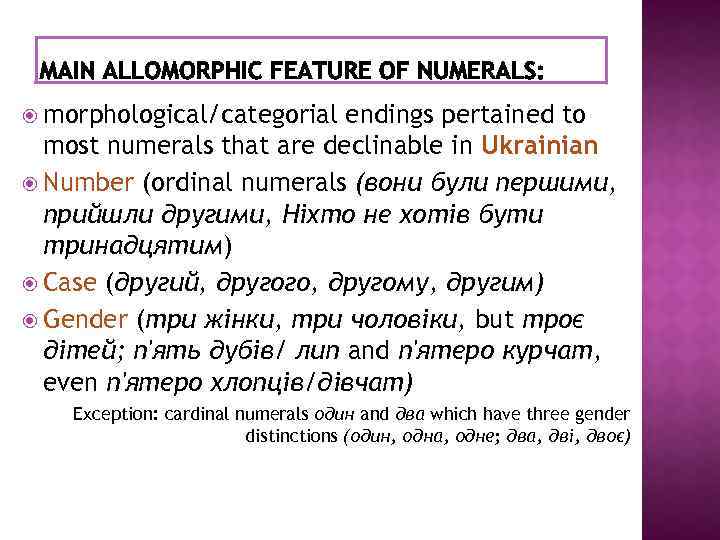 morphological/categorial endings pertained to most numerals that are declinable in Ukrainian Number (ordinal numerals (вони були першими, прийшли другими, Ніхто не хотів бути тринадцятим) Case (другий, другого, другому, другим) Gender (три жінки, три чоловіки, but троє дітей; п'ять дубів/ лип and п'ятеро курчат, even п'ятеро хлопців/дівчат) Exception: cardinal numerals один and два which have three gender distinctions (один, одна, одне; два, дві, двоє)
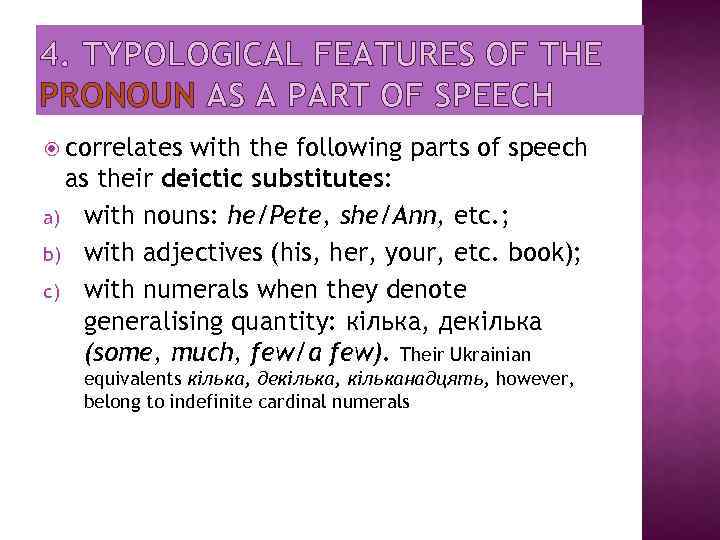 4. TYPOLOGICAL FEATURES OF THE PRONOUN AS A PART OF SPEECH correlates with the following parts of speech as their deictic substitutes: a) with nouns: he/Pete, she/Ann, etc. ; b) with adjectives (his, her, your, etc. book); c) with numerals when they denote generalising quantity: кілька, декілька (some, much, few/a few). Their Ukrainian equivalents кілька, декілька, кільканадцять, however, belong to indefinite cardinal numerals
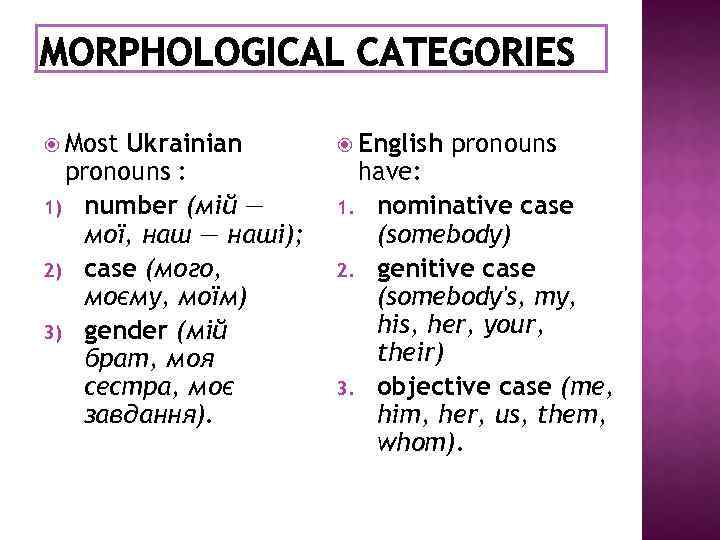 Most Ukrainian pronouns : 1) number (мій — мої, наш — наші); 2) case (мого, моєму, моїм) 3) gender (мій брат, моя сестра, моє завдання). English pronouns have: 1. nominative case (somebody) 2. genitive case (somebody's, my, his, her, your, their) 3. objective case (me, him, her, us, them, whom).
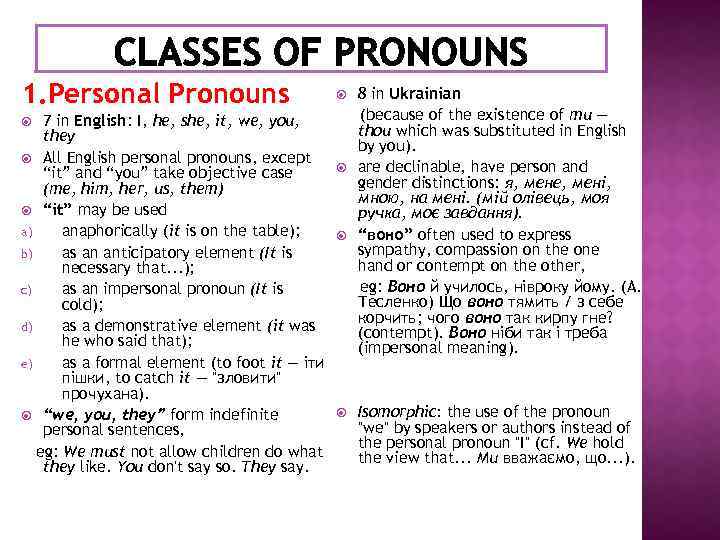 1. Personal Pronouns 7 in English: I, he, she, it, we, you, they All English personal pronouns, except “it” and “you” take objective case (me, him, her, us, them) “it” may be used a) anaphorically (it is on the table); b) as an anticipatory element (It is necessary that. . . ); c) as an impersonal pronoun (It is cold); d) as a demonstrative element (it was he who said that); e) as a formal element (to foot it — іти пішки, to catch it — "зловити" прочухана). “we, you, they” form indefinite personal sentences, eg: We must not allow children do what they like. You don't say so. They say. 8 in Ukrainian (because of the existence of mu — thou which was substituted in English by you). are declinable, have person and gender distinctions: я, мене, мені, мною, на мені. (мій олівець, моя ручка, моє завдання). “воно” often used to express sympathy, compassion on the one hand or contempt on the other, eg: Воно й училось, нівроку йому. (А. Тесленко) Що воно тямить / з себе корчить; чого воно так кирпу гне? (contempt). Воно ніби так і треба (impersonal meaning). Isomorphic: the use of the pronoun "we" by speakers or authors instead of the personal pronoun "I" (cf. We hold the view that. . . Ми вважаємо, що. . . ).
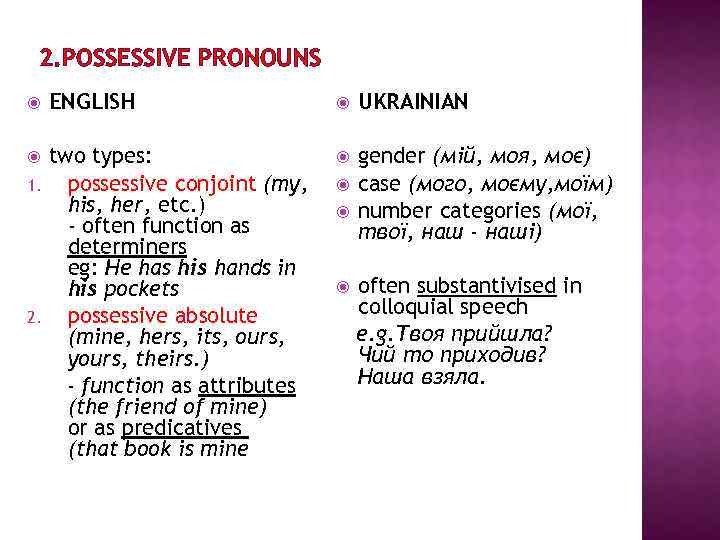 2. POSSESSIVE PRONOUNS ENGLISH UKRAINIAN two types: possessive conjoint (my, his, her, etc. ) - often function as determiners eg: He has his hands in his pockets possessive absolute (mine, hers, its, ours, yours, theirs. ) - function as attributes (the friend of mine) or as predicatives (that book is mine gender (мій, моя, моє) case (мого, моєму, моїм) number categories (мої, твої, наш - наші) 1. 2. often substantivised in colloquial speech e. g. Твоя прийшла? Чий то приходив? Наша взяла.
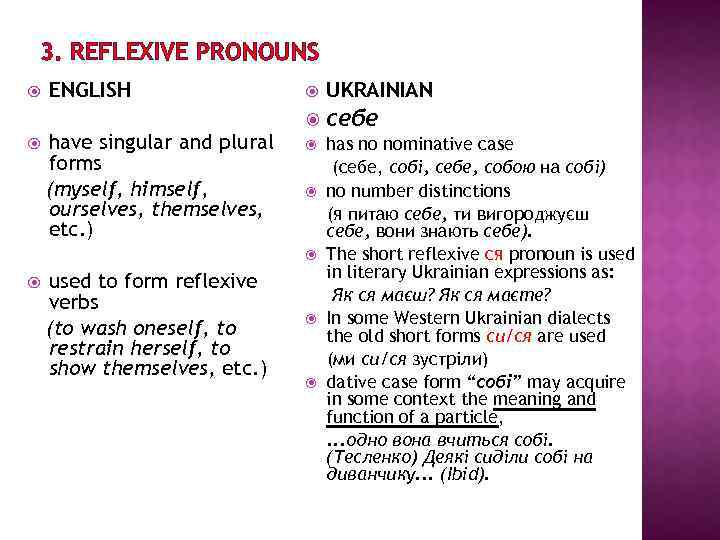 3. REFLEXIVE PRONOUNS ENGLISH have singular and plural forms (myself, himself, ourselves, themselves, etc. ) UKRAINIAN себе used to form reflexive verbs (to wash oneself, to restrain herself, to show themselves, etc. ) has no nominative case (ceбe, собі, себе, собою на собі) no number distinctions (я питаю себе, ти вигороджуєш себе, вони знають себе). The short reflexive ся pronoun is used in literary Ukrainian expressions as: Як ся маєш? Як ся маєте? In some Western Ukrainian dialects the old short forms си/ся are used (ми си/ся зустріли) dative case form “собі” may acquire in some context the meaning and function of a particle, . . . одно вона вчиться собі. (Тесленко) Деякі сиділи собі на диванчику. . . (Ibid).
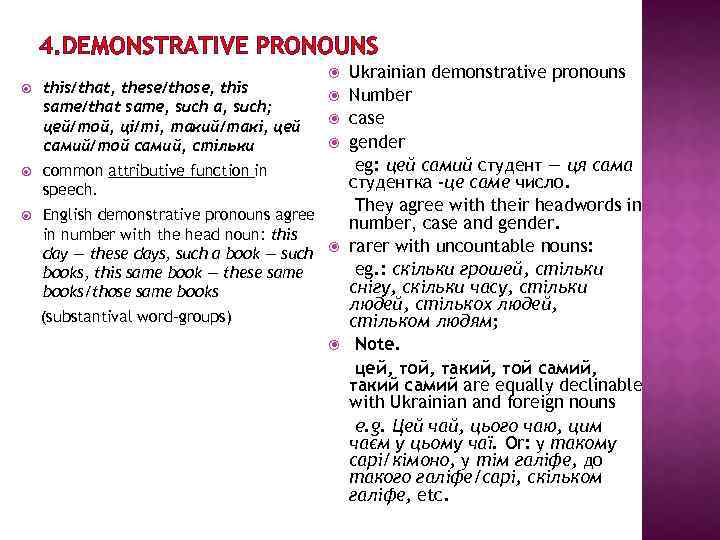 4. DEMONSTRATIVE PRONOUNS this/that, these/those, this same/that same, such a, such; цей/той, ці/ті, такий/такі, цей самий/той самий, стільки common attributive function in speech. English demonstrative pronouns agree in number with the head noun: this day — these days, such a book — such books, this same book — these same books/those same books (substantival word-groups) Ukrainian demonstrative pronouns Number case gender eg: цей самий студент — ця сама студентка -це саме число. They agree with their headwords in number, case and gender. rarer with uncountable nouns: eg. : скільки грошей, стільки снігу, скільки часу, стільки людей, стількох людей, стільком людям; Note. цей, той, такий, той самий, такий самий are equally declinable with Ukrainian and foreign nouns e. g. Цей чай, цього чаю, цим чаєм у цьому чаї. Or: у такому сарі/кімоно, у тім галіфе, до такого галіфе/сарі, скільком галіфе, etc.
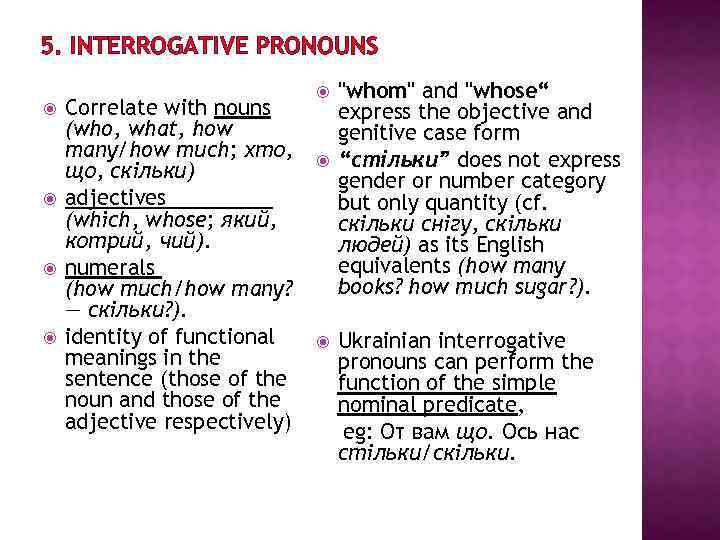 5. INTERROGATIVE PRONOUNS Correlate with nouns (who, what, how many/how much; хто, що, скільки) adjectives (which, whose; який, котрий, чий). numerals (how much/how many? — скільки? ). identity of functional meanings in the sentence (those of the noun and those of the adjective respectively) "whom" and "whose“ express the objective and genitive case form “cтільки” does not express gender or number category but only quantity (cf. скільки снігу, скільки людей) as its English equivalents (how many books? how much sugar? ). Ukrainian interrogative pronouns can perform the function of the simple nominal predicate, eg: От вам що. Ось нас стільки/скільки.
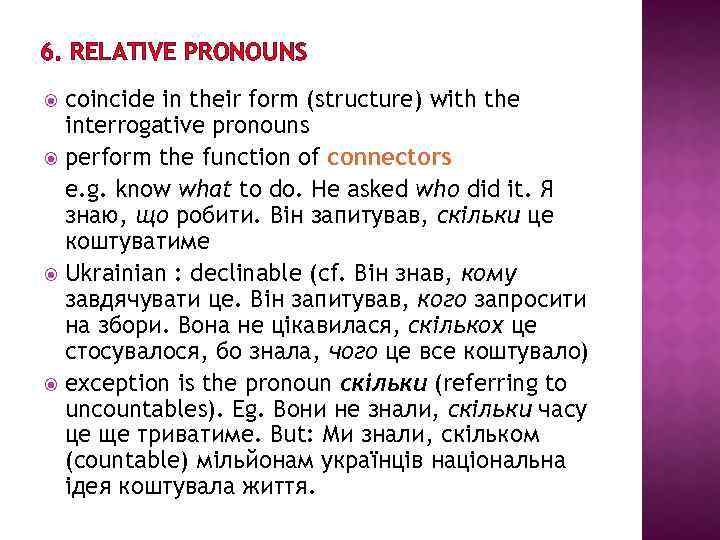 6. RELATIVE PRONOUNS coincide in their form (structure) with the interrogative pronouns perform the function of connectors e. g. know what to do. He asked who did it. Я знаю, що робити. Він запитував, скільки це коштуватиме Ukrainian : declinable (cf. Він знав, кому завдячувати це. Він запитував, кого запросити на збори. Вона не цікавилася, скількох це стосувалося, бо знала, чого це все коштувало) exception is the pronoun скільки (referring to uncountables). Eg. Вони не знали, скільки часу це ще триватиме. But: Ми знали, скільком (countable) мільйонам українців національна ідея коштувала життя.
 7. RECIPROCAL PRONOUNS 2 in English (each other and one another) 1 in Ukrainian (in 3 gender forms, Sg. and Pl. ): один одного, одна одну, одне одного, одні одних. . neuter gender form may be used in Ukrainian for any gender and number (singular or plural) nouns. E. g. Обоє молодят поглядали одне на одного. Вони якусь мить мовчки дивились у вічі одне одному. Хлопці й дівчата були варті одних.
 8. INDEFINITE PRONOUNS some, any, somebody, anybody/ anybody's, someone/someone's, something, anything, дехто, дещо, хтось, щось, хто-небудь, що-небудь, який-небудь, будь-хто, будь-що, казна-хто, казна-що I). R. Quirk, S. Greenbaum, G. Leech, J. Svartvik: 1. universal (each, all, every, the very) 2. partitive (some thing, anything, nothing, either, neither, any, none, etc. ). English pronouns (cf. much, little, few) correpond to Ukrainian indefinite numerals (небагато/кілька) II). В. S. Khaimovich, B. I. Rohovska subdivided the English indefinite pronouns into: 1) "genuine indefinite pronouns" (some, any and their compounds); 2) "generalising pronouns" (all, both, each, and their com pounds); 3) "quantitative pronouns" (many, much, few, little) 4) "contrasting pronouns" (another, one). III). Ukrainian grammarians single out one more subclass "identifying” (означальні) pronouns: весь, всякий, жодний, кожний, інший, сам (the last one is a reflexive pronoun in English). The functions of indefinite pronouns in the sentence coincide with those of the noun or adjective E. g. Some are wise and some are otherwise. That is all. I saw nobody there. We shall go another way. Хто розумний, а хто навпаки. Це. було все. Я нікого не бачив. Ми знаємо інший вихід.
 9. NEGATIVE PRONOUNS A) B) C) 1. 2. 3. no, nobody, none, nothing, neither — ніхто, ніщо, ніякий/нікотрий, нічий, ніскільки Ukrainian negative pronouns are declinable and are used as noun pronouns. Isomorphic in the contrasted languages are the structural forms of negative pronouns, which may be: simple (no) Compound none (no one), nobody, nothing, ніхто, ніщо, ніякий Composite більш нічого, жоден інший, nothing else, nothing more Allomorphism: wide use of English negative pronouns to form negative word-groups and sentences, eg: no pains, no gains (під лежачий камінь вода не тече); nobody home-клепки не вистачає. Both smiled but neither spoke. (Heyer) Nobody ever knows anything. (Hemingway) Ukrainian equivalent sentences have the negative pronouns + the negative particle не: Обоє посміхались, але «ніхтo/жоден з них не озвався. Ніхто взагалі нічого не знає. Ukrainian negative pronouns have diminutive forms which are completely unknown in English pronouns (cf. нічогісінько, аніскілечки, ніякісінький).
 5. TYPOLOGICAL FEATURES OF THE VERB AS A PART OF SPEECH general implicit meaning (lexico-grammatical nature) of the verb which serves to convey verbiability: Different kinds of activity (go, read, skate) Various processes (boil, grow) Inner state of a person (feel, worry) Possession (have, possess)
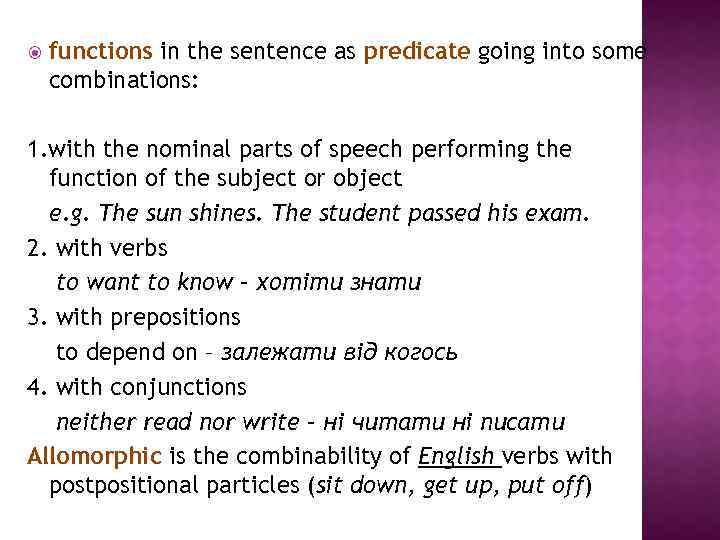 functions in the sentence as predicate going into some combinations: 1. with the nominal parts of speech performing the function of the subject or object e. g. The sun shines. The student passed his exam. 2. with verbs to want to know – хотіти знати 3. with prepositions to depend on – залежати від когось 4. with conjunctions neither read nor write – ні читати ні писати Allomorphic is the combinability of English verbs with postpositional particles (sit down, get up, put off)
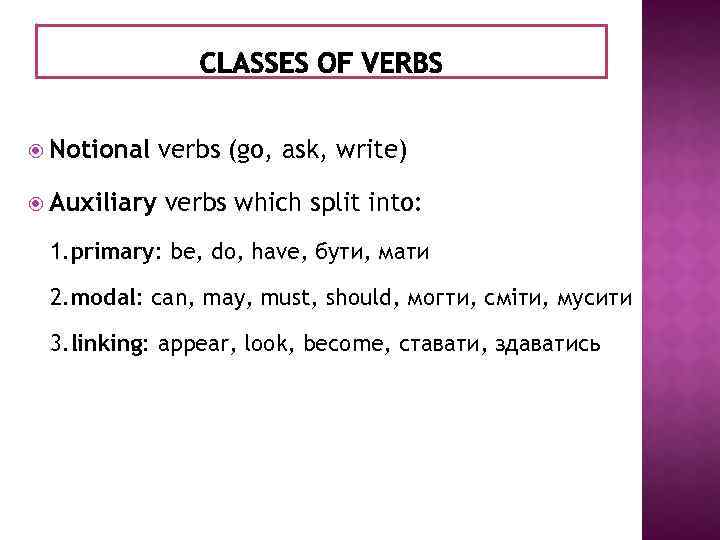 Notional Auxiliary verbs (go, ask, write) verbs which split into: 1. primary: be, do, have, бути, мати 2. modal: can, may, must, should, могти, сміти, мусити 3. linking: appear, look, become, ставати, здаватись
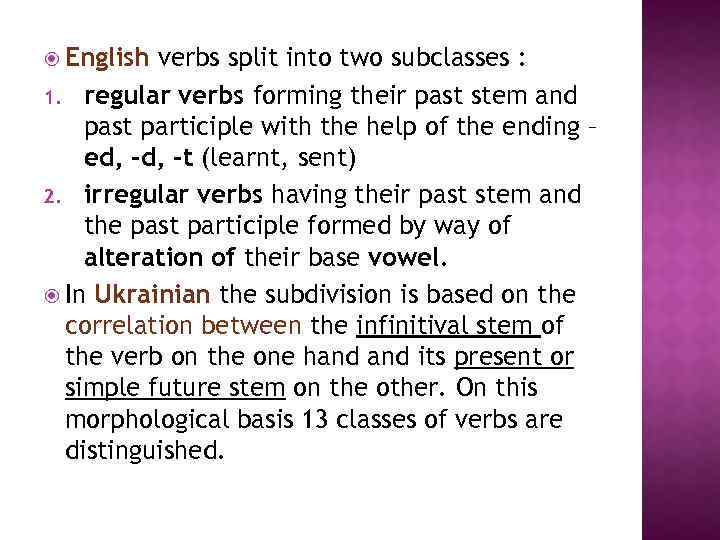 English verbs split into two subclasses : 1. regular verbs forming their past stem and past participle with the help of the ending – ed, -t (learnt, sent) 2. irregular verbs having their past stem and the past participle formed by way of alteration of their base vowel. In Ukrainian the subdivision is based on the correlation between the infinitival stem of the verb on the one hand its present or simple future stem on the other. On this morphological basis 13 classes of verbs are distinguished.
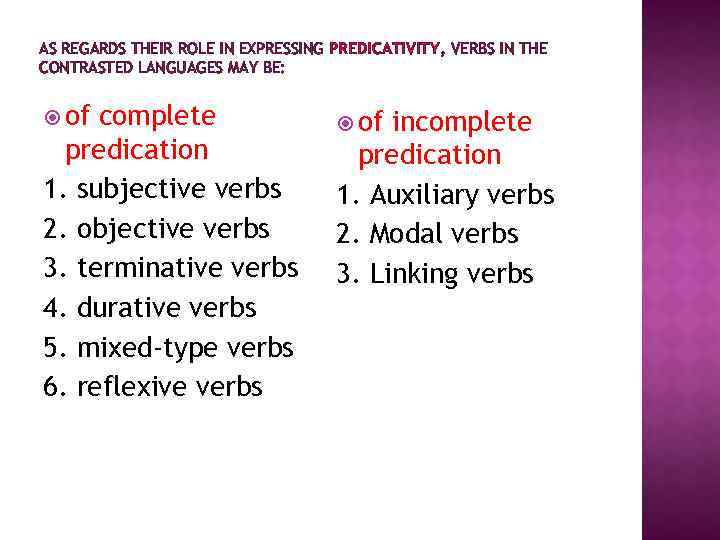 AS REGARDS THEIR ROLE IN EXPRESSING PREDICATIVITY, VERBS IN THE CONTRASTED LANGUAGES MAY BE: of complete predication 1. subjective verbs 2. objective verbs 3. terminative verbs 4. durative verbs 5. mixed-type verbs 6. reflexive verbs of incomplete predication 1. Auxiliary verbs 2. Modal verbs 3. Linking verbs
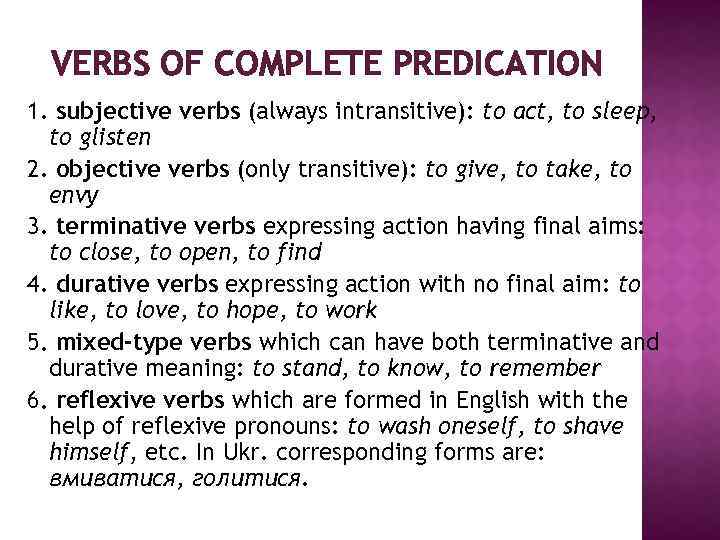 VERBS OF COMPLETE PREDICATION 1. subjective verbs (always intransitive): to act, to sleep, to glisten 2. objective verbs (only transitive): to give, to take, to envy 3. terminative verbs expressing action having final aims: to close, to open, to find 4. durative verbs expressing action with no final aim: to like, to love, to hope, to work 5. mixed-type verbs which can have both terminative and durative meaning: to stand, to know, to remember 6. reflexive verbs which are formed in English with the help of reflexive pronouns: to wash oneself, to shave himself, etc. In Ukr. corresponding forms are: вмиватися, голитися.
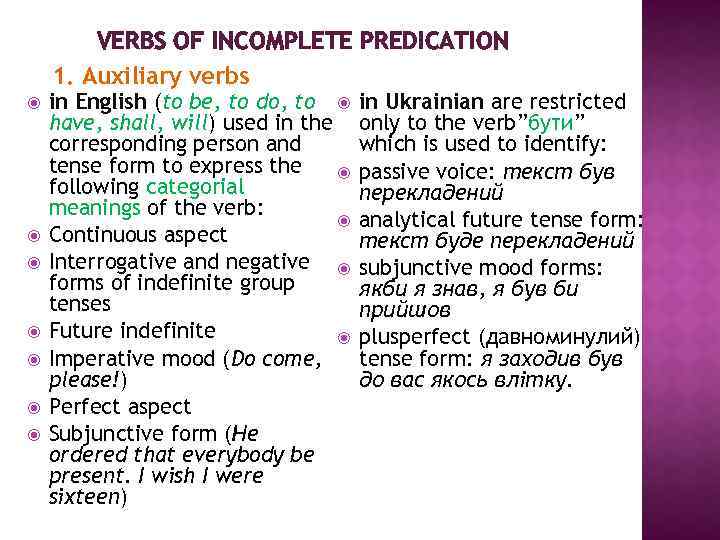 VERBS OF INCOMPLETE PREDICATION 1. Auxiliary verbs in English (to be, to do, to have, shall, will) used in the corresponding person and tense form to express the following categorial meanings of the verb: Continuous aspect Interrogative and negative forms of indefinite group tenses Future indefinite Imperative mood (Do come, please!) Perfect aspect Subjunctive form (He ordered that everybody be present. I wish I were sixteen) in Ukrainian are restricted only to the verb”бути” which is used to identify: passive voice: текст був перекладений analytical future tense form: текст буде перекладений subjunctive mood forms: якби я знав, я був би прийшов plusperfect (давноминулий) tense form: я заходив був до вас якось влітку.
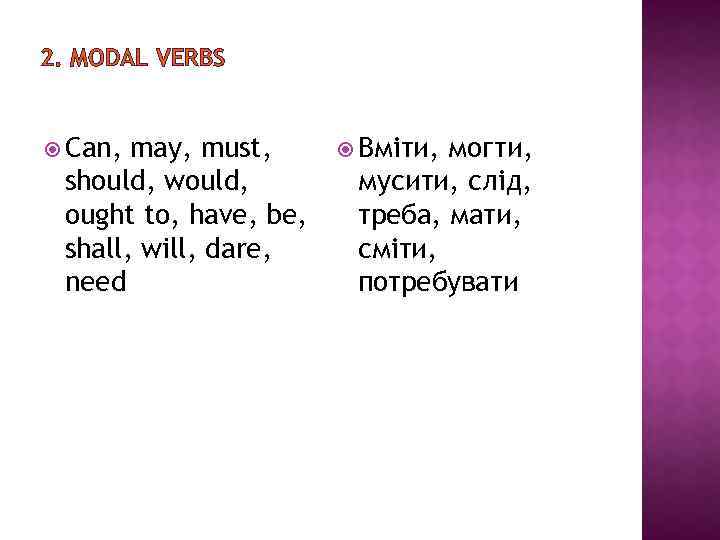 2. MODAL VERBS Can, may, must, should, would, ought to, have, be, shall, will, dare, need Вміти, могти, мусити, слід, треба, мати, сміти, потребувати
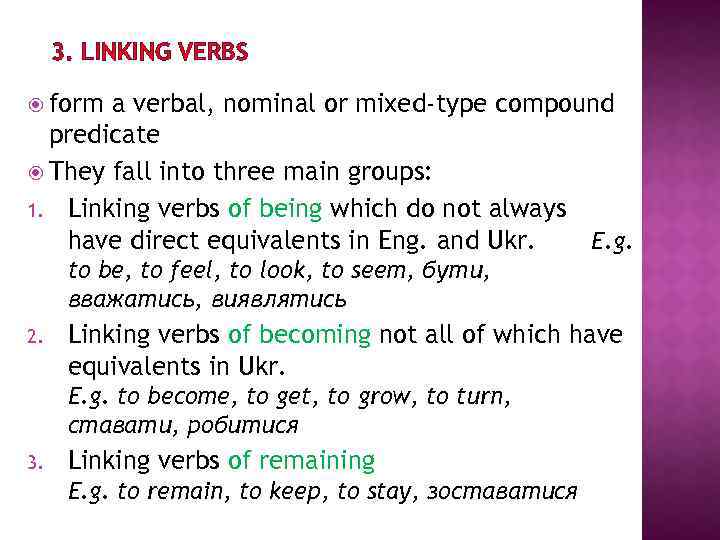 3. LINKING VERBS form a verbal, nominal or mixed-type compound predicate They fall into three main groups: 1. Linking verbs of being which do not always have direct equivalents in Eng. and Ukr. E. g. to be, to feel, to look, to seem, бути, вважатись, виявлятись 2. Linking verbs of becoming not all of which have equivalents in Ukr. E. g. to become, to get, to grow, to turn, ставати, робитися 3. Linking verbs of remaining E. g. to remain, to keep, to stay, зоставатися
 NON-FINITE FORMS OF THE VERBS Common: infinitive and two participles; Divergent: the gerund in English and the diyepryslivnyk in Ukrainian.
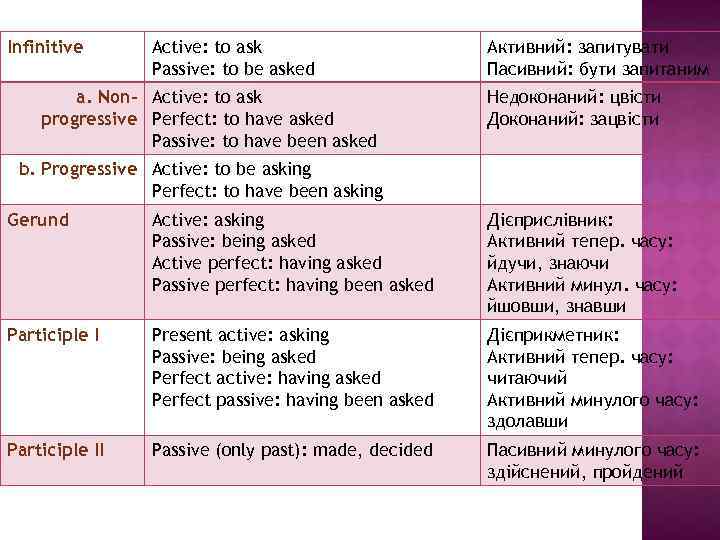 Infinitive Active: to ask Passive: to be asked a. Non- Active: to ask progressive Perfect: to have asked Passive: to have been asked Активний: запитувати Пасивний: бути запитаним Недоконаний: цвісти Доконаний: зацвісти b. Progressive Active: to be asking Perfect: to have been asking Gerund Active: asking Passive: being asked Active perfect: having asked Passive perfect: having been asked Дієприслівник: Активний тепер. часу: йдучи, знаючи Активний минул. часу: йшовши, знавши Participle I Present active: asking Passive: being asked Perfect active: having asked Perfect passive: having been asked Дієприкметник: Активний тепер. часу: читаючий Активний минулого часу: здолавши Participle II Passive (only past): made, decided Пасивний минулого часу: здійснений, пройдений
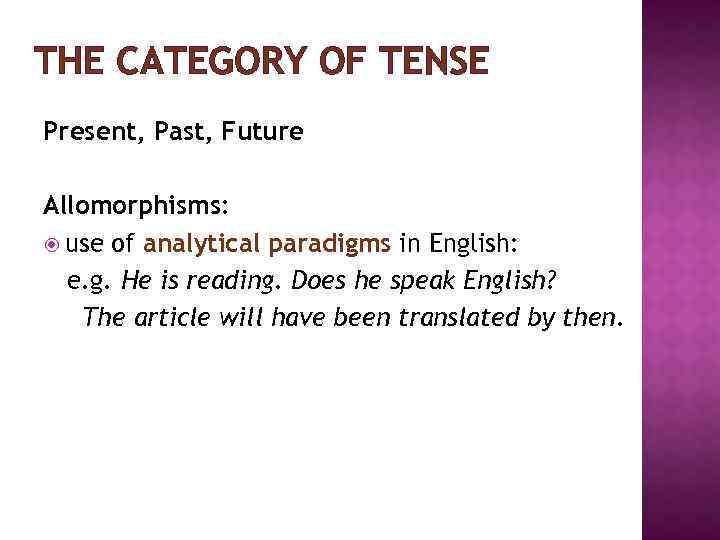
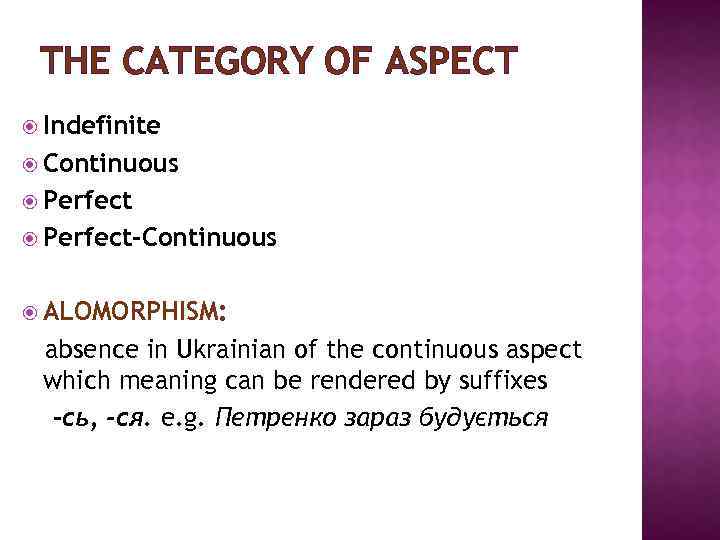
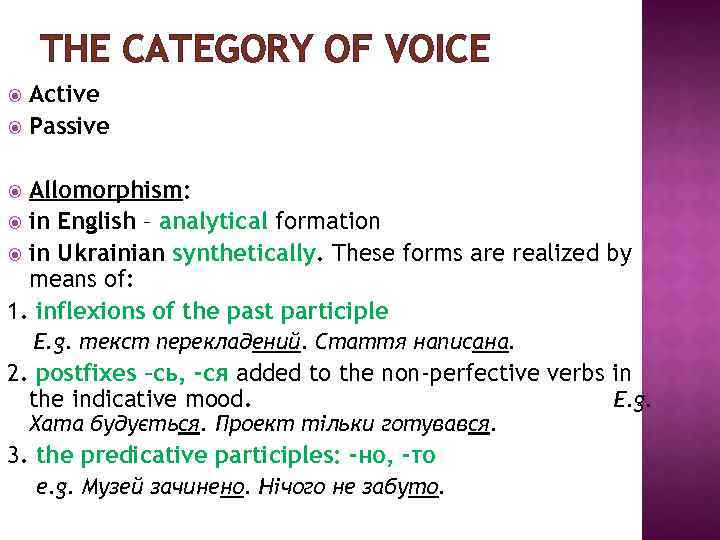
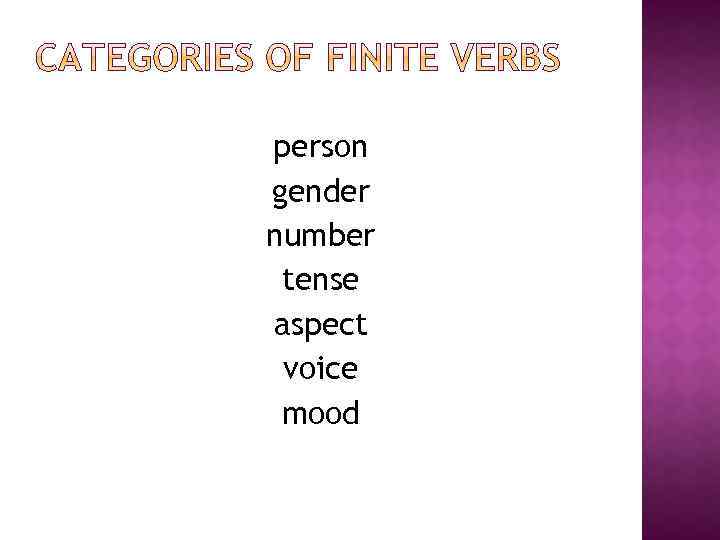 person gender number tense aspect voice mood
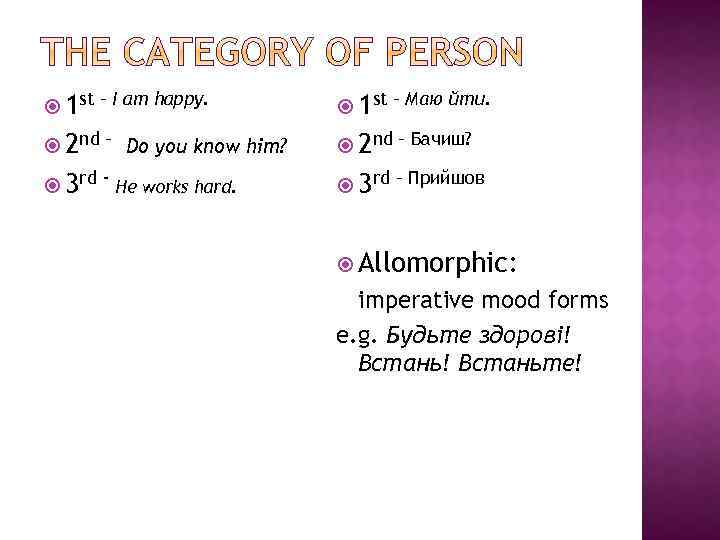 1 st – I am happy. 1 st – Маю йти. 2 nd – Do you know him? 2 nd – Бачиш? 3 rd - He works hard. 3 rd – Прийшов Allomorphic: imperative mood forms e. g. Будьте здорові! Встаньте!
 The category of Gender The Only!!! in Ukrainian e. g. Прийшов, йшла Singular, category of Number Plural e. g. He is / they have, etc. робимо / робить
 THE CATEGORY OF TENSE Present, Past, Future Allomorphisms: use of analytical paradigms in English: e. g. He is reading. Does he speak English? The article will have been translated by then.
 THE CATEGORY OF ASPECT Indefinite Continuous Perfect-Continuous ALOMORPHISM: absence in Ukrainian of the continuous aspect which meaning can be rendered by suffixes –сь, -ся. e. g. Петренко зараз будується
 THE CATEGORY OF VOICE Active Passive Allomorphism: in English – analytical formation in Ukrainian synthetically. These forms are realized by means of: 1. inflexions of the past participle E. g. текст перекладений. Стаття написана. 2. postfixes –сь, -ся added to the non-perfective verbs in the indicative mood. E. g. Хата будується. Проект тільки готувався. 3. the predicative participles: -но, -то e. g. Музей зачинено. Нічого не забуто.
 THE CATEGORY OF MOOD Indicative Imperative Subjunctive is realized in both languages synthetically and analytically
 ADVERB indeclinable notional word expressing: the quality or state of an action the circumstances in which the action proceeds a degree of some other quality
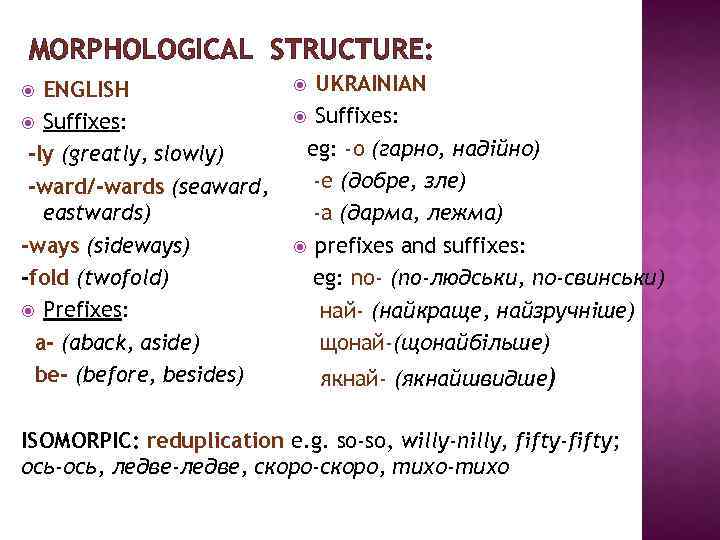 MORPHOLOGICAL STRUCTURE: ENGLISH Suffixes: -ly (greatly, slowly) -ward/-wards (seaward, eastwards) -ways (sideways) -fold (twofold) Prefixes: a- (aback, aside) be- (before, besides) UKRAINIAN Suffixes: eg: -o (гарно, надійно) -е (добре, зле) -а (дарма, лежма) prefixes and suffixes: eg: no- (no-людськи, по-свинськи) най- (найкраще, найзручніше) щонай-(щонайбільше) якнай- (якнайшвидше) ISOMORPIC: reduplication e. g. so-so, willy-nilly, fifty-fifty; ось-ось, ледве-ледве, скоро-скоро, тихо-тихо
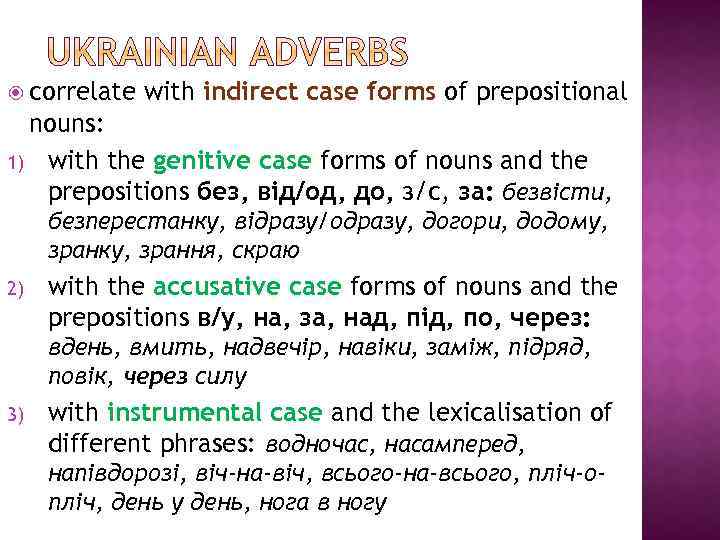 correlate with indirect case forms of prepositional nouns: 1) with the genitive case forms of nouns and the prepositions без, від/од, до, з/с, за: безвісти, безперестанку, відразу/одразу, догори, додому, зранку, зрання, скраю 2) with the accusative case forms of nouns and the prepositions в/у, на, за, над, під, по, через: вдень, вмить, надвечір, навіки, заміж, підряд, повік, через силу 3) with instrumental case and the lexicalisation of different phrases: водночас, насамперед, напівдорозі, віч-на-віч, всього-на-всього, пліч-опліч, день у день, нога в ногу
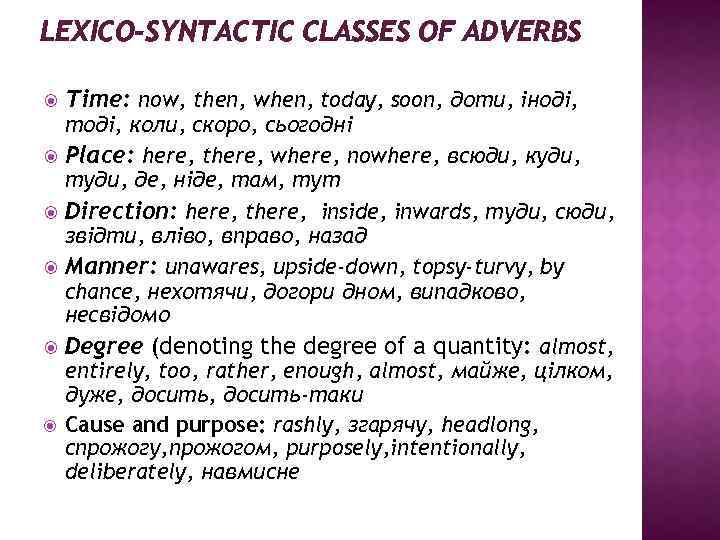 LEXICO-SYNTACTIC CLASSES OF ADVERBS Time: now, then, when, today, soon, доти, іноді, тоді, коли, скоро, сьогодні Place: here, there, where, nowhere, всюди, куди, туди, де, ніде, там, тут Direction: here, there, inside, inwards, туди, сюди, звідти, вліво, вправо, назад Manner: unawares, upside-down, topsy-turvy, by chance, нехотячи, догори дном, випадково, несвідомо Degree (denoting the degree of a quantity: almost, entirely, too, rather, enough, almost, майже, цілком, дуже, досить-таки Cause and purpose: rashly, згарячу, headlong, спрожогу, прожогом, purposely, intentionally, deliberately, навмисне
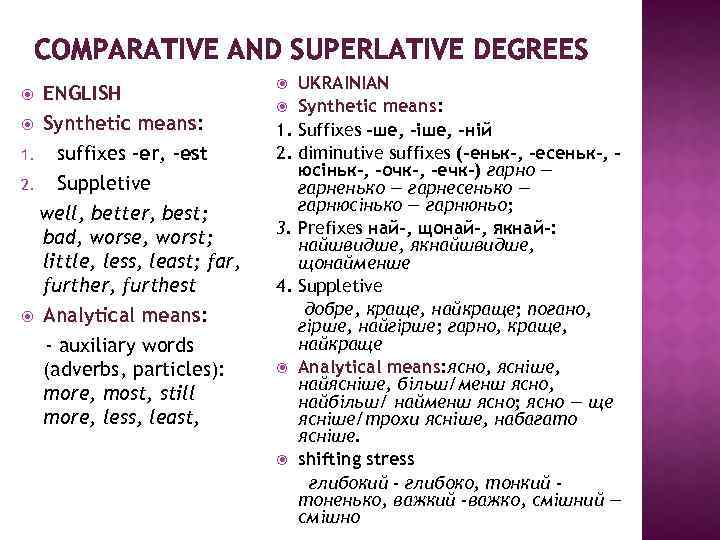 COMPARATIVE AND SUPERLATIVE DEGREES ENGLISH Synthetic means: suffixes -er, -est 2. Suppletive well, better, best; bad, worse, worst; little, less, least; far, furthest Analytical means: - auxiliary words (adverbs, particles): more, most, still more, less, least, 1. 2. 3. 4. UKRAINIAN Synthetic means: Suffixes -ше, -іше, -ній diminutive suffixes (-еньк-, -есеньк-, юсіньк-, -очк-, -ечк-) гарно — гарненько — гарнесенько — гарнюсінько — гарнюньо; Prefixes най-, щонай-, якнай-: найшвидше, якнайшвидше, щонайменше Suppletive добре, краще, найкраще; погано, гірше, найгірше; гарно, краще, найкраще Analytical means: ясно, ясніше, найясніше, більш/менш ясно, найбільш/ найменш ясно; ясно — ще ясніше/трохи ясніше, набагато ясніше. shifting stress глибокий - глибоко, тонкий тоненько, важкий -важко, смішний — смішно
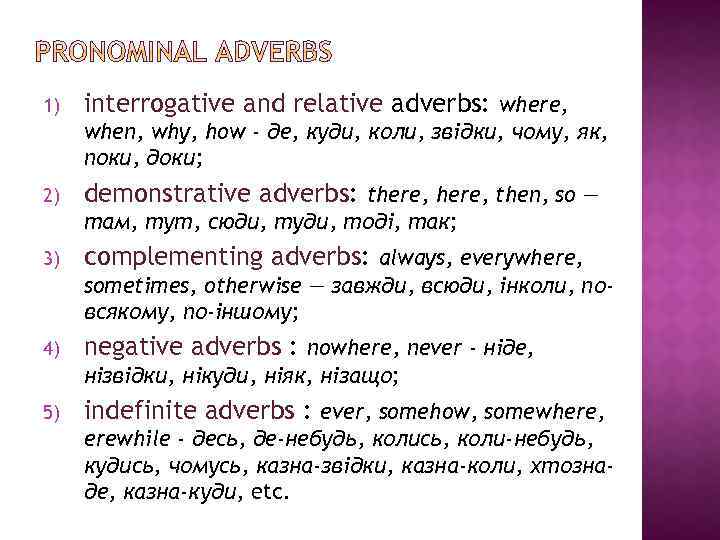 1) interrogative and relative adverbs: where, when, why, how - де, куди, коли, звідки, чому, як, поки, доки; 2) demonstrative adverbs: there, then, so — там, тут, сюди, туди, тоді, так; 3) complementing adverbs: always, everywhere, sometimes, otherwise — завжди, всюди, інколи, повсякому, по-іншому; 4) negative adverbs : nowhere, never - ніде, нізвідки, нікуди, ніяк, нізащо; 5) indefinite adverbs : ever, somehow, somewhere, erewhile - десь, де-небудь, колись, коли-небудь, кудись, чомусь, казна-звідки, казна-коли, хтознаде, казна-куди, etc.
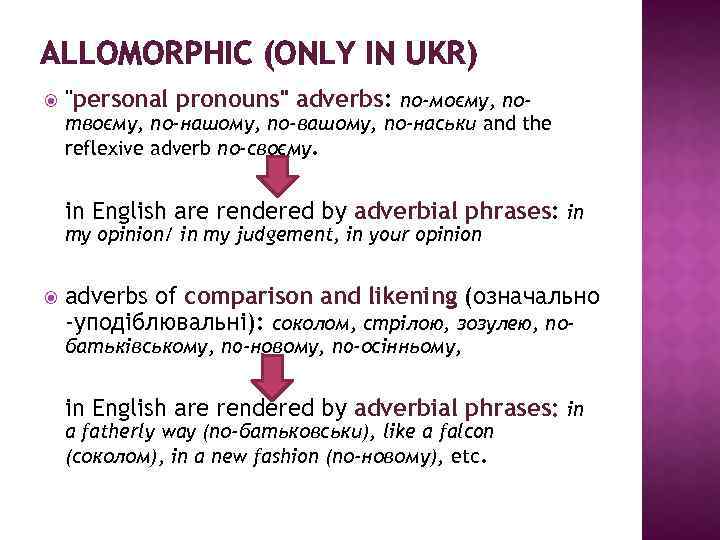 ALLOMORPHIC (ONLY IN UKR) "personal pronouns" adverbs: по-моєму, по- твоєму, по-нашому, по-вашому, по-наськи and the reflexive adverb по-своєму. in English are rendered by adverbial phrases: in my opinion/ in my judgement, in your opinion adverbs of comparison and likening (означально -уподіблювальні): соколом, стрілою, зозулею, побатьківському, no-новому, no-осінньому, in English are rendered by adverbial phrases: in a fatherly way (по-батьковськи), like a falcon (соколом), in a new fashion (по-новому), etc.
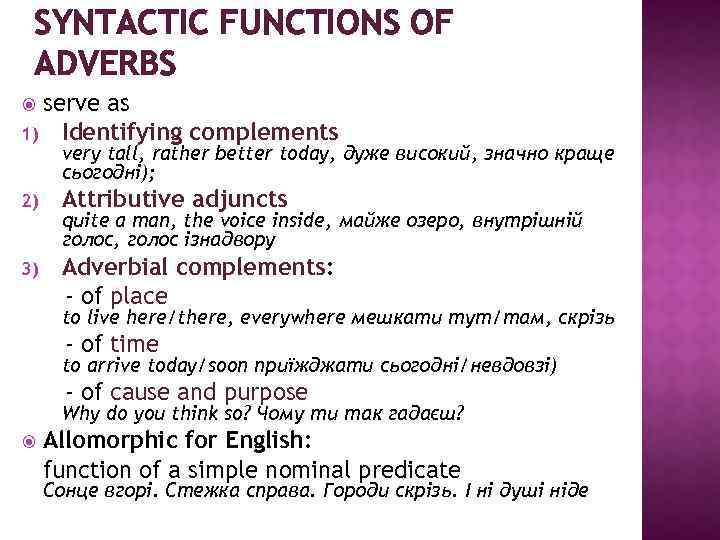 SYNTACTIC FUNCTIONS OF ADVERBS serve as 1) Identifying complements very tall, rather better today, дуже високий, значно краще сьогодні); 2) Attributive adjuncts 3) Adverbial complements: - of place quite a man, the voice inside, майже озеро, внутрішній голос, голос ізнадвору to live here/there, everywhere мешкати тут/там, скрізь - of time to arrive today/soon приїжджати сьогодні/невдовзі) - of cause and purpose Why do you think so? Чому ти так гадаєш? Allomorphic for English: function of a simple nominal predicate Сонце вгорі. Стежка справа. Городи скрізь. І ні душі ніде
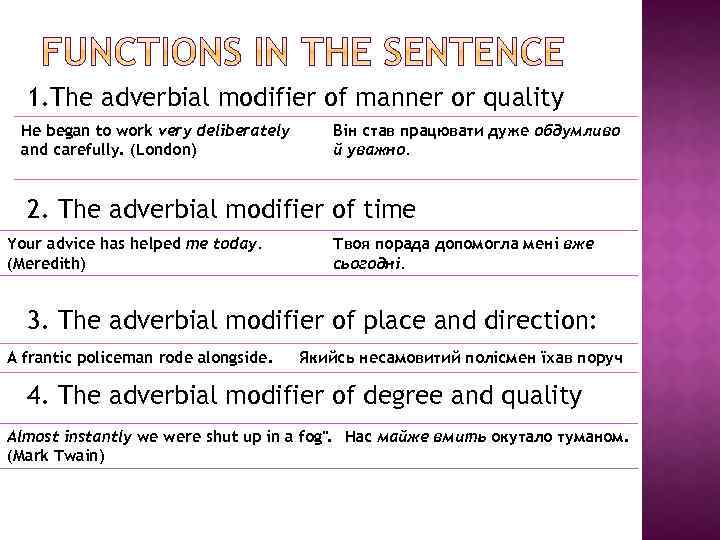 1. The adverbial modifier of manner or quality He began to work very deliberately and carefully. (London) Він став працювати дуже обдумливо й уважно. 2. The adverbial modifier of time Your advice has helped me today. (Meredith) Твоя порада допомогла мені вже сьогодні. 3. The adverbial modifier of place and direction: A frantic policeman rode alongside. Якийсь несамовитий полісмен їхав поруч 4. The adverbial modifier of degree and quality Almost instantly we were shut up in a fog". Нас майже вмить окутало туманом. (Mark Twain)
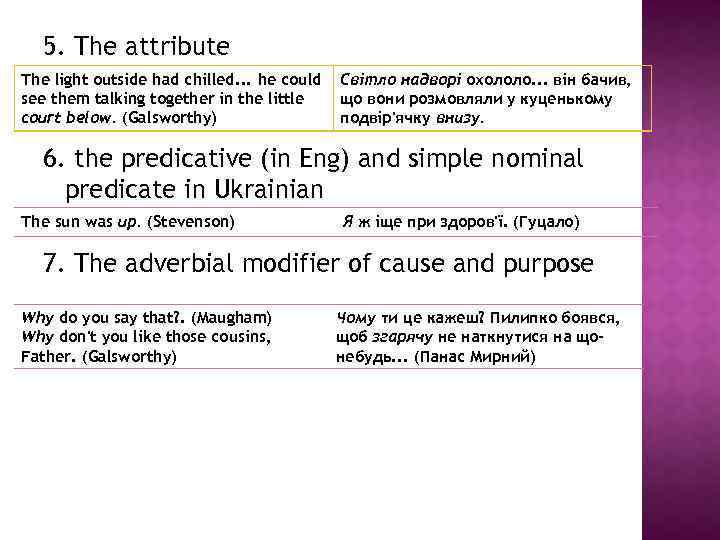 5. The attribute The light outside had chilled. . . he could see them talking together in the little court below. (Galsworthy) Світло надворі охололо. . . він бачив, що вони розмовляли у куценькому подвір'ячку внизу. 6. the predicative (in Eng) and simple nominal predicate in Ukrainian The sun was up. (Stevenson) Я ж іще при здоров'ї. (Гуцало) 7. The adverbial modifier of cause and purpose Why do you say that? . (Maugham) Why don't you like those cousins, Father. (Galsworthy) Чому ти це кажеш? Пилипко боявся, щоб згарячу не наткнутися на щонебудь. . . (Панас Мирний)
 Read pp. 179 – 257 Statives and their Typological Characteristics p. 254 Pp. 275 -276, Questions: 1 -15 Pp. 276 -280, Ex. 1 -7, 9 -10