Скачать презентацию Lecture 3 The system of English phonemes
Lecture 3_new.ppt
- Количество слайдов: 19
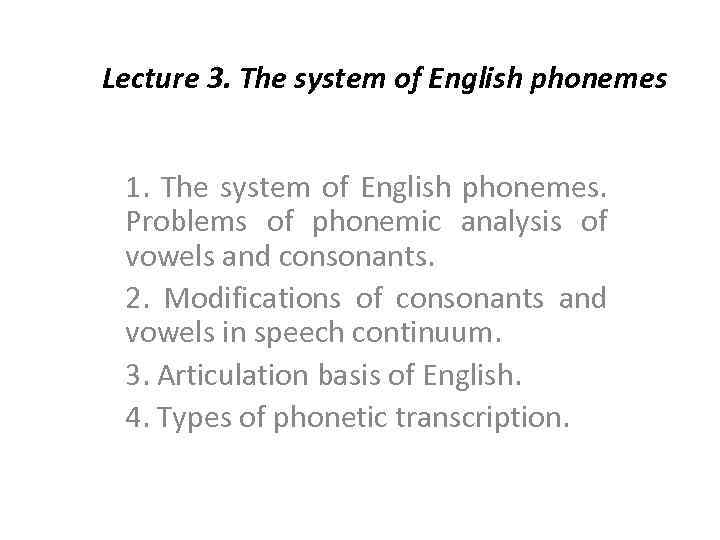 Lecture 3. The system of English phonemes 1. The system of English phonemes. Problems of phonemic analysis of vowels and consonants. 2. Modifications of consonants and vowels in speech continuum. 3. Articulation basis of English. 4. Types of phonetic transcription.
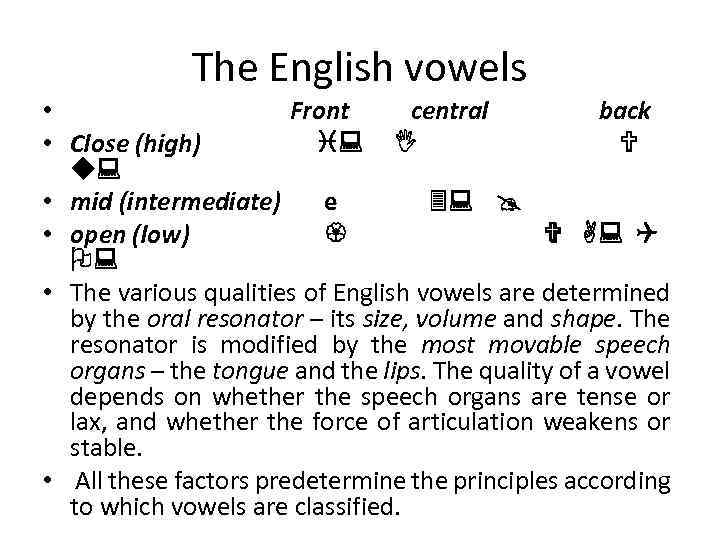 The English vowels • Front central back • Close (high) • mid (intermediate) e • open (low) • The various qualities of English vowels are determined by the oral resonator – its size, volume and shape. The resonator is modified by the most movable speech organs – the tongue and the lips. The quality of a vowel depends on whether the speech organs are tense or lax, and whether the force of articulation weakens or stable. • All these factors predetermine the principles according to which vowels are classified.
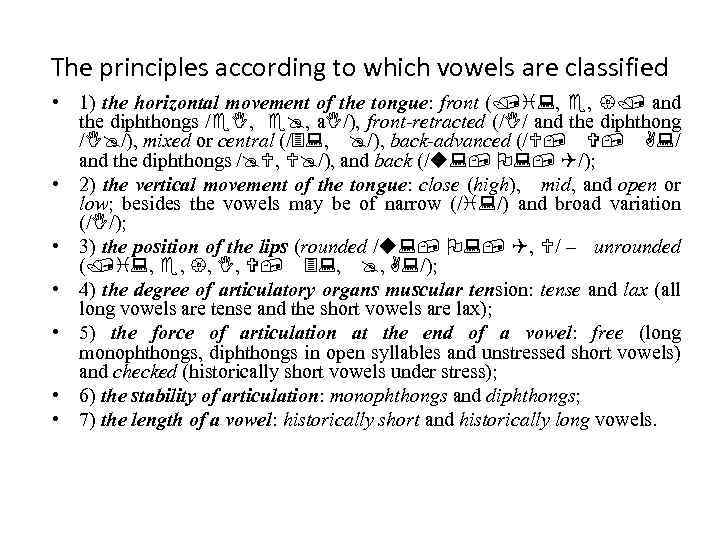 The principles according to which vowels are classified • 1) the horizontal movement of the tongue: front ( , , and the diphthongs / , , a /), front-retracted (/ / and the diphthong / /), mixed or central (/ , /), back-advanced (/ / and the diphthongs / , /), and back (/ /); • 2) the vertical movement of the tongue: close (high), mid, and open or low; besides the vowels may be of narrow (/ /) and broad variation (/ /); • 3) the position of the lips (rounded / , / – unrounded ( , , , /); • 4) the degree of articulatory organs muscular tension: tense and lax (all long vowels are tense and the short vowels are lax); • 5) the force of articulation at the end of a vowel: free (long monophthongs, diphthongs in open syllables and unstressed short vowels) and checked (historically short vowels under stress); • 6) the stability of articulation: monophthongs and diphthongs; • 7) the length of a vowel: historically short and historically long vowels.
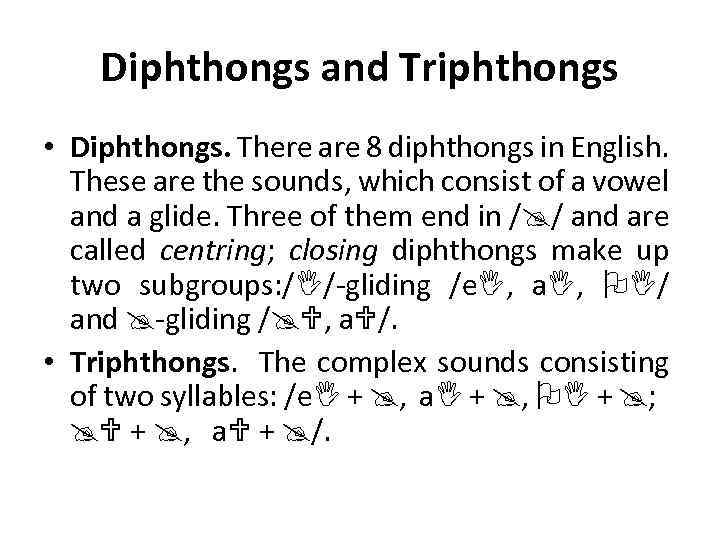 Diphthongs and Triphthongs • Diphthongs. There are 8 diphthongs in English. These are the sounds, which consist of a vowel and a glide. Three of them end in / / and are called centring; closing diphthongs make up two subgroups: / /-gliding /e , a , / and -gliding / , a /. • Triphthongs. The complex sounds consisting of two syllables: /e + , a + , + ; + , a + /.
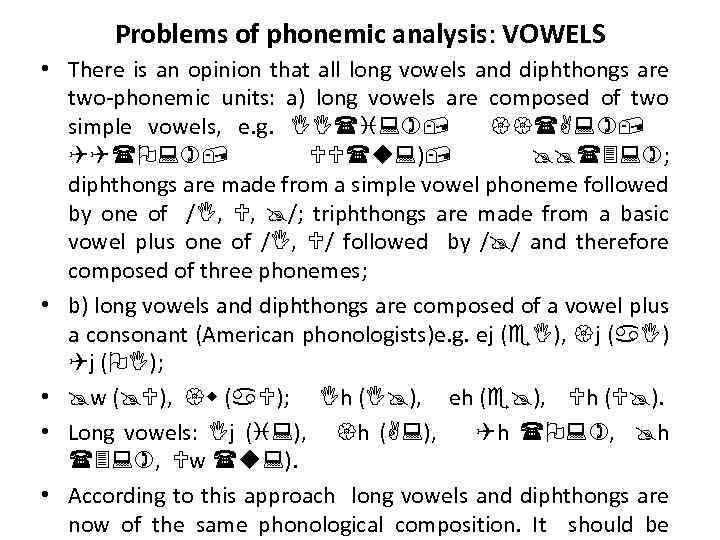 Problems of phonemic analysis: VOWELS • There is an opinion that all long vowels and diphthongs are two-phonemic units: a) long vowels are composed of two simple vowels, e. g. ) ; diphthongs are made from a simple vowel phoneme followed by one of / , , /; triphthongs are made from a basic vowel plus one of / , / followed by / / and therefore composed of three phonemes; • b) long vowels and diphthongs are composed of a vowel plus a consonant (American phonologists)e. g. ej ( ), j ( ); • w ( ), ( ); h ( ), eh ( ), h ( ). • Long vowels: j ( ), h ( ), h , w ). • According to this approach long vowels and diphthongs are now of the same phonological composition. It should be
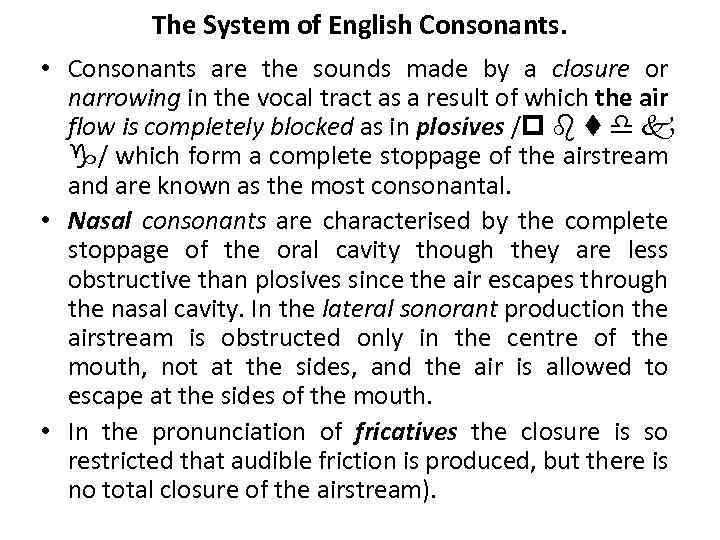 The System of English Consonants. • Consonants are the sounds made by a closure or narrowing in the vocal tract as a result of which the air flow is completely blocked as in plosives / / which form a complete stoppage of the airstream and are known as the most consonantal. • Nasal consonants are characterised by the complete stoppage of the oral cavity though they are less obstructive than plosives since the air escapes through the nasal cavity. In the lateral sonorant production the airstream is obstructed only in the centre of the mouth, not at the sides, and the air is allowed to escape at the sides of the mouth. • In the pronunciation of fricatives the closure is so restricted that audible friction is produced, but there is no total closure of the airstream).
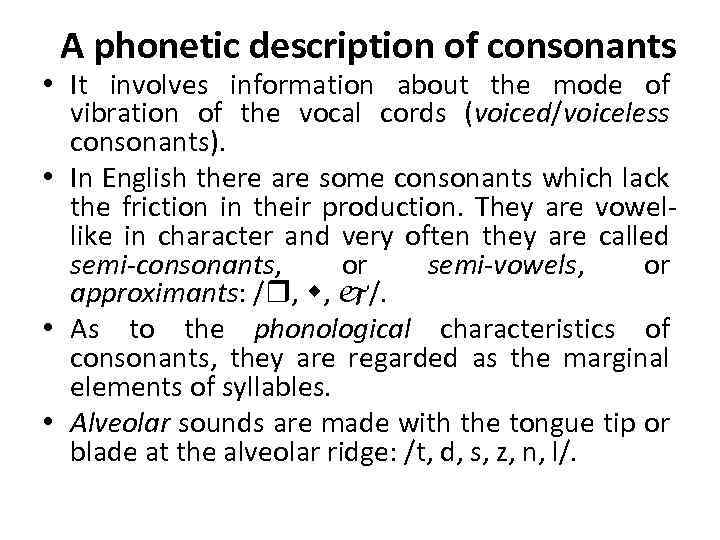 A phonetic description of consonants • It involves information about the mode of vibration of the vocal cords (voiced/voiceless consonants). • In English there are some consonants which lack the friction in their production. They are vowellike in character and very often they are called semi-consonants, or semi-vowels, or approximants: / , , /. • As to the phonological characteristics of consonants, they are regarded as the marginal elements of syllables. • Alveolar sounds are made with the tongue tip or blade at the alveolar ridge: /t, d, s, z, n, l/.
 Principles of consonants classification 1 • • • • • The type of obstruction and the manner of producing noise: a) occlusive b) constrictives Plosives nasal sonorans Fricatives oral sonorants central lateral /p, b, t, d, k, / / m, n, / f, v, , , s, z, , , h/ / j, w, r / / l/ c) occlusive-constrictive (affricates) /t , d / the active organ of speech: a) labial b) labio-dental c) lingual p, b, m, w f, v forelingual medio-ling. back-ling. apical cacuminal j k, , t, d, s, z, n, l r d) pharyngeal • h •
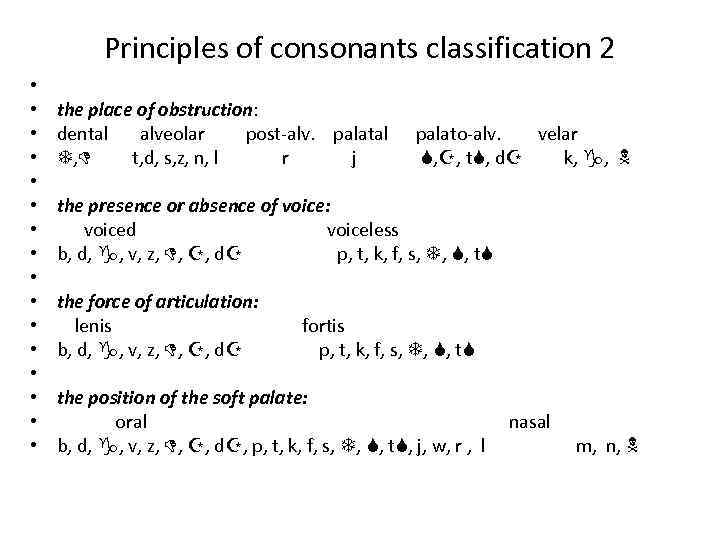 Principles of consonants classification 2 • • • • the place of obstruction: dental alveolar post-alv. palatal palato-alv. velar , t, d, s, z, n, l r j , , t , d k, , the presence or absence of voice: voiced voiceless b, d, , v, z, , , d p, t, k, f, s, , , t the force of articulation: lenis fortis b, d, , v, z, , , d p, t, k, f, s, , , t the position of the soft palate: oral nasal b, d, , v, z, , , d , p, t, k, f, s, , , t , j, w, r , l m, n,
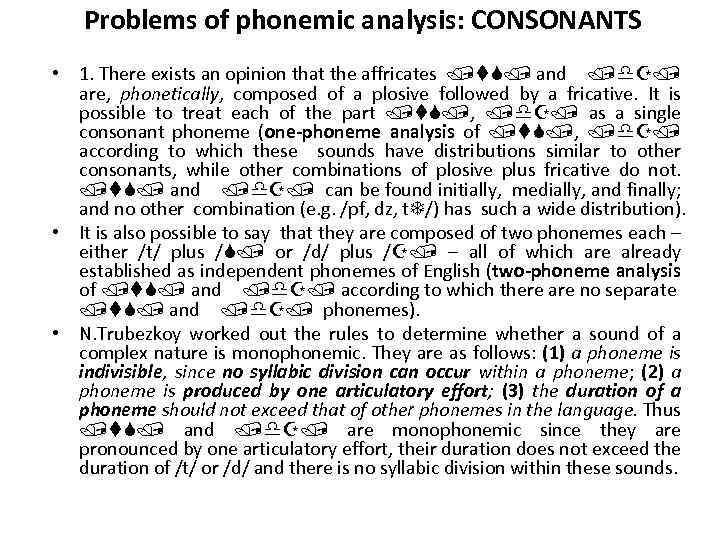 Problems of phonemic analysis: CONSONANTS • 1. There exists an opinion that the affricates and are, phonetically, composed of a plosive followed by a fricative. It is possible to treat each of the part , as a single consonant phoneme (one-phoneme analysis of , according to which these sounds have distributions similar to other consonants, while other combinations of plosive plus fricative do not. and can be found initially, medially, and finally; and no other combination (e. g. /pf, dz, t /) has such a wide distribution). • It is also possible to say that they are composed of two phonemes each – either /t/ plus / or /d/ plus / – all of which are already established as independent phonemes of English (two-phoneme analysis of and according to which there are no separate and phonemes). • N. Trubezkoy worked out the rules to determine whether a sound of a complex nature is monophonemic. They are as follows: (1) a phoneme is indivisible, since no syllabic division can occur within a phoneme; (2) a phoneme is produced by one articulatory effort; (3) the duration of a phoneme should not exceed that of other phonemes in the language. Thus and are monophonemic since they are pronounced by one articulatory effort, their duration does not exceed the duration of /t/ or /d/ and there is no syllabic division within these sounds.
 Types of variation • Idiolectal variation embraces the individual peculiarities of articulating sounds, caused by the shape and form of the speaker’s speech organs and by his articulatory habits. Idiolectal variation may cause a lot of difficulties in communication. At the same time it enables people to identify the speech of definite individuals. • Diaphonic variation affects the quality and quantity of particular phonemes. It is caused by definite historical tendencies active in certain localities. Diaphonic variants do not affect intelligibility of speech, yet they inform the listener about the speaker’s origin and his social standing. • Allophonic variation is conditioned by phonetic position and phonetic environment.
 Assimilation • Assimilation is modification in the articulation of a consonant under the influence of a neighbouring consonant. • Assimilation may affect all the features of the articulation of a consonant or only some of them. • 1) assimilation affecting the place of articulation; 2) assimilation affecting the place of articulation and the active organ of speech; 3) assimilation affecting the manner of poise production; 4) assimilation affecting the work of the vocal cords; 5) assimilation affecting the lip position; 6) assimilation affecting the position of the soft palate.
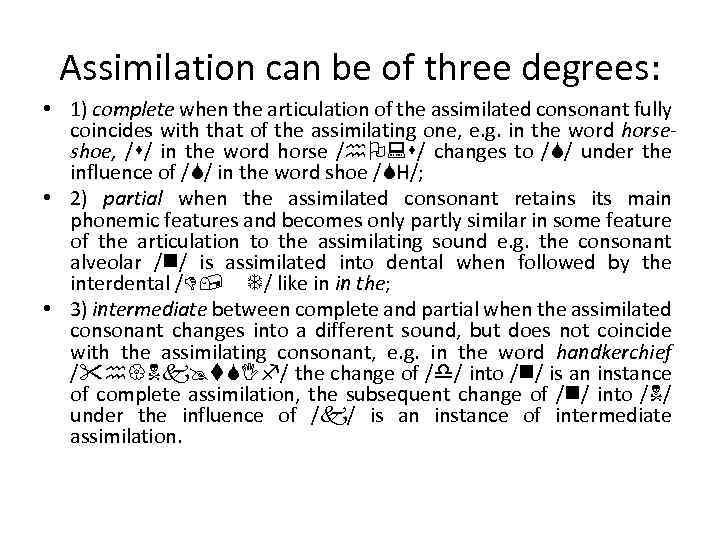 Assimilation can be of three degrees: • 1) complete when the articulation of the assimilated consonant fully coincides with that of the assimilating one, e. g. in the word horseshoe, / / in the word horse / / changes to / / under the influence of / / in the word shoe / H/; • 2) partial when the assimilated consonant retains its main phonemic features and becomes only partly similar in some feature of the articulation to the assimilating sound e. g. the consonant alveolar / / is assimilated into dental when followed by the interdental / / like in in the; • 3) intermediate between complete and partial when the assimilated consonant changes into a different sound, but does not coincide with the assimilating consonant, e. g. in the word handkerchief / / the change of / / into / / is an instance of complete assimilation, the subsequent change of / / into / / under the influence of / / is an instance of intermediate assimilation.
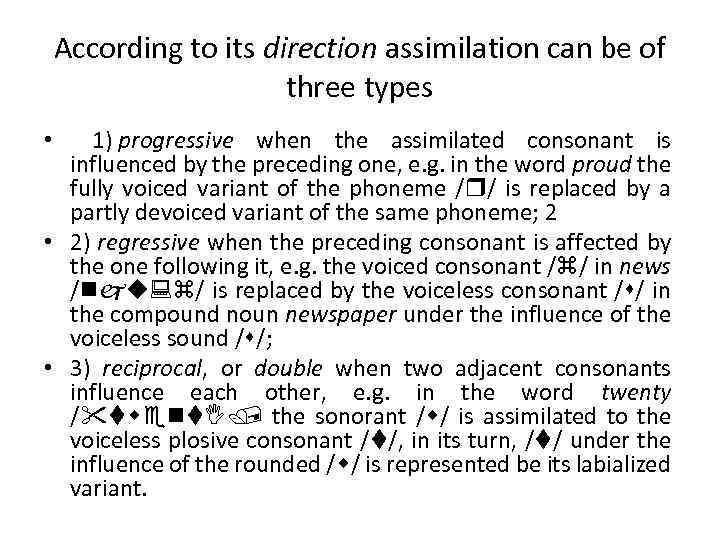 According to its direction assimilation can be of three types • 1) progressive when the assimilated consonant is influenced by the preceding one, e. g. in the word proud the fully voiced variant of the phoneme / / is replaced by a partly devoiced variant of the same phoneme; 2 • 2) regressive when the preceding consonant is affected by the one following it, e. g. the voiced consonant / / in news / / is replaced by the voiceless consonant / / in the compound noun newspaper under the influence of the voiceless sound / /; • 3) reciprocal, or double when two adjacent consonants influence each other, e. g. in the word twenty / the sonorant / / is assimilated to the voiceless plosive consonant / /, in its turn, / / under the influence of the rounded / / is represented be its labialized variant.
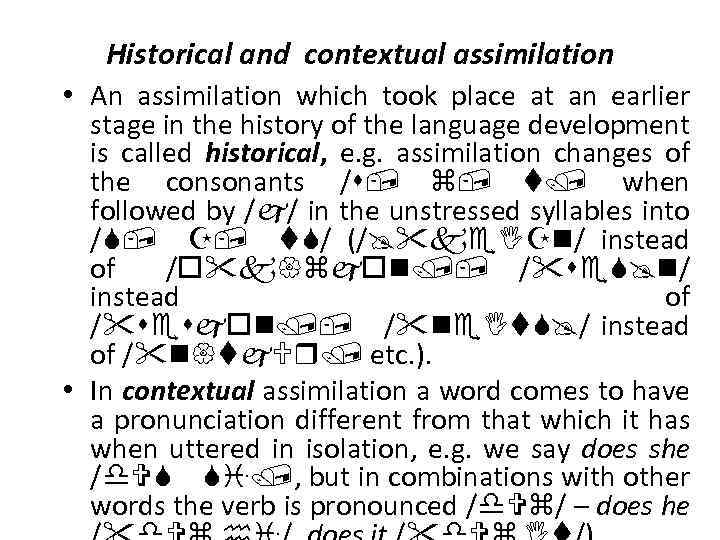 Historical and contextual assimilation • An assimilation which took place at an earlier stage in the history of the language development is called historical, e. g. assimilation changes of the consonants / when followed by / / in the unstressed syllables into / / (/ / instead of / / instead of / etc. ). • In contextual assimilation a word comes to have a pronunciation different from that which it has when uttered in isolation, e. g. we say does she / . , but in combinations with other words the verb is pronounced / / – does he .
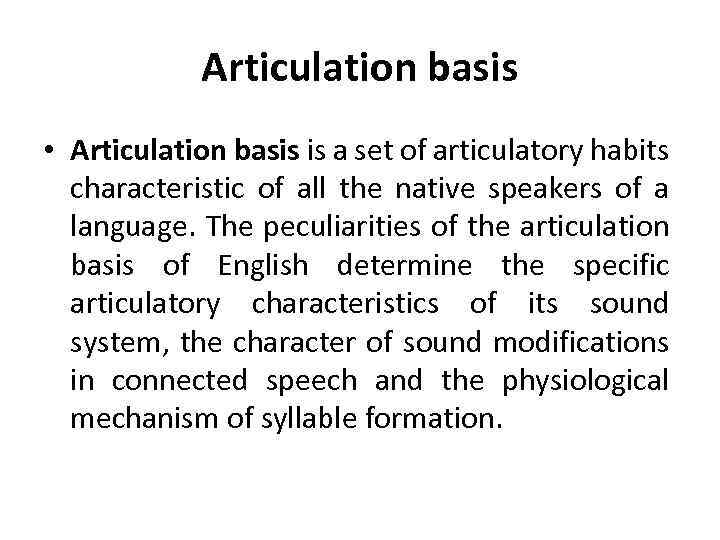 Articulation basis • Articulation basis is a set of articulatory habits characteristic of all the native speakers of a language. The peculiarities of the articulation basis of English determine the specific articulatory characteristics of its sound system, the character of sound modifications in connected speech and the physiological mechanism of syllable formation.
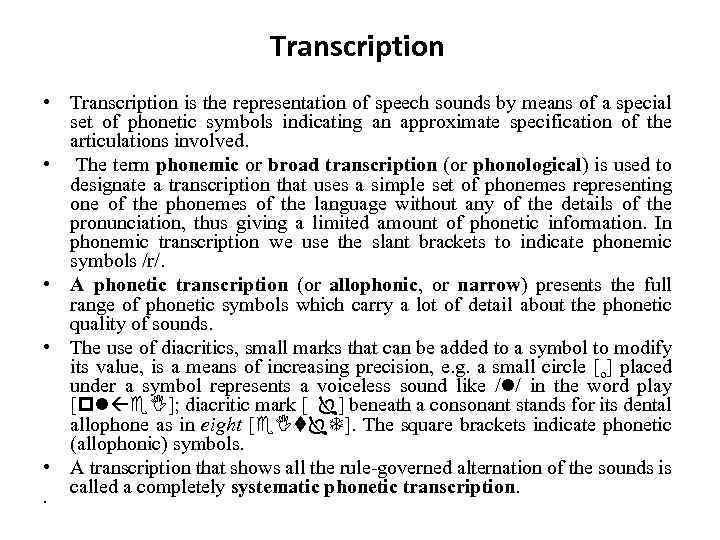 Transcription • Transcription is the representation of speech sounds by means of a special set of phonetic symbols indicating an approximate specification of the articulations involved. • The term phonemic or broad transcription (or phonological) is used to designate a transcription that uses a simple set of phonemes representing one of the phonemes of the language without any of the details of the pronunciation, thus giving a limited amount of phonetic information. In phonemic transcription we use the slant brackets to indicate phonemic symbols /r/. • A phonetic transcription (or allophonic, or narrow) presents the full range of phonetic symbols which carry a lot of detail about the phonetic quality of sounds. • The use of diacritics, small marks that can be added to a symbol to modify its value, is a means of increasing precision, e. g. a small circle [o] placed under a symbol represents a voiceless sound like / / in the word play [ ]; diacritic mark [ ] beneath a consonant stands for its dental allophone as in eight [ ]. The square brackets indicate phonetic (allophonic) symbols. • A transcription that shows all the rule-governed alternation of the sounds is called a completely systematic phonetic transcription. •