


 Скачать презентацию Lecture 3 The Law of Demand Our
0020273357fd14a698957cc4bf68197d.ppt
- Количество слайдов: 28
 Lecture 3 The Law of Demand ■ Our objectives: ► Explain individual choices among unlimited wants in a world of limited resources ► Develop a theory that helps us better understand predict human actions ►What do people (our customers) want?
 A Simple(? ) Application of Law of Demand Saved Pepsi 1931 Pepsi was bankrupt. It and Coke both produced 6 oz (1/6 th liter) drink bottles. Years of advertising had not worked for Pepsi. It then made and sold 12 oz (1/3 liter) bottles of soda for twice the usual price—no results. It then sold 12 oz (1/3 liter) bottles for same price as Coke’s 6 oz bottles. Sales sky rocketed; the company was saved.
 Demand Is Very Difficult n n What we measure in demand is a reflection of individual desires not the actual desires. Daniel Bernoulli, a mathematical genius who lived in Switzerland, noted, in 1738, that people seek goodness or pleasure (utility). That is, we do not seek smartphones because they are smartphones but because they are useful and give us pleasure. Use and pleasure cannot be measured, only approximated. This is behind the law of demand.
 A Note on Value, Scarcity, and Price as Related to Demand Why do people want what they want? n The diamond-water paradox. n Scarcity need not ≠ highly valued (snake meat) n Low cost need not ≠ low value (lock box key) n Markets reflect what people value in relationship to current availability. n Demand is our best understanding of what people value—given current conditions. n Demand reflects information from many different people that market participants process.
 The Law of Demand ■ Holding all other relevant factors constant, the lower (higher) the price of a good, the greater (lower) will be the quantity demanded. ► Like all scientific propositions, it is a ceteris paribus (“other things equal” or “other things constant”) statement ► Note on terminology: - Price means opportunity cost; - Good means anything people value
 Why focus on the Law of Demand? It is the most powerful proposition in economics that helps us explain many things. ► Irrigation design in arid and wet climates ► Building heights in cities compared to small towns ► The seasonal pattern of vegetable prices ► The shape of waterfront properties ► Electricity prices and automatic switches ► Etc. , etc.
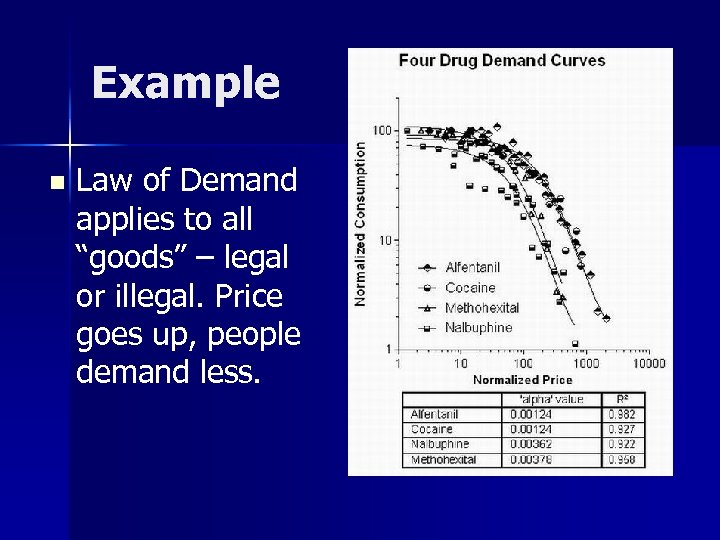 Example n Law of Demand applies to all “goods” – legal or illegal. Price goes up, people demand less.
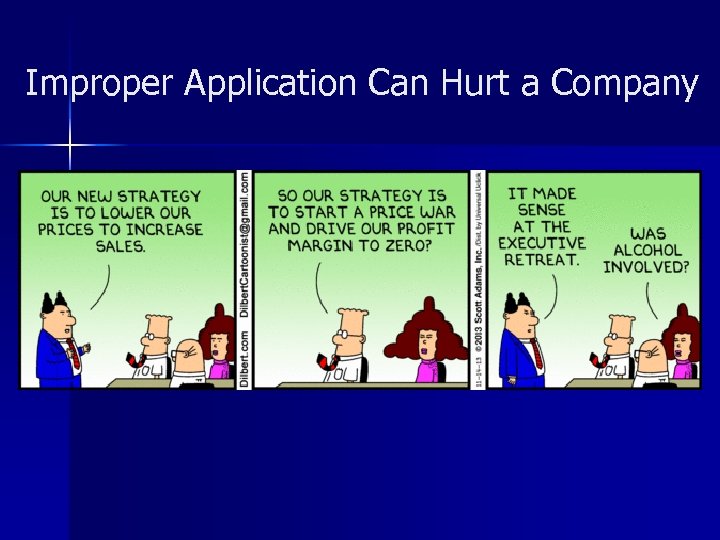 Improper Application Can Hurt a Company
 The Demand Function: Some Definitions The relationship between quantity consumed and the factors determining that: D = f (P, PS, PC, I, E, T, etc. ) ■ Price of the good in question—determines the location along a demand curve ■ Other variables (relevant factors) determine the placement of a demand curve: ► Prices of related goods (substitutes and complements) ► Income of buyers ► Tastes (preferences) of buyers ► Expectations held by buyers, regarding the future ► Other matters particular to a certain good
 The Role of Tastes They are very hard to measure, so we generally ignore them, but we know they exist. Look to marketing and psychology for guidance here, not economists! For economists, tastes are often the unexplained portion of consumption
 Expectations Difficult to measure or operationalize — but real. When measurable, include in the analysis. But experience shows—measures are very poor predictors of actions. The Consumer Confidence Index (Conference Board) was at 115 in June 2007; down to 26 in March 2009. Ex post. (59 in July 2011) Like tastes, these can “explain” anything so become useless.
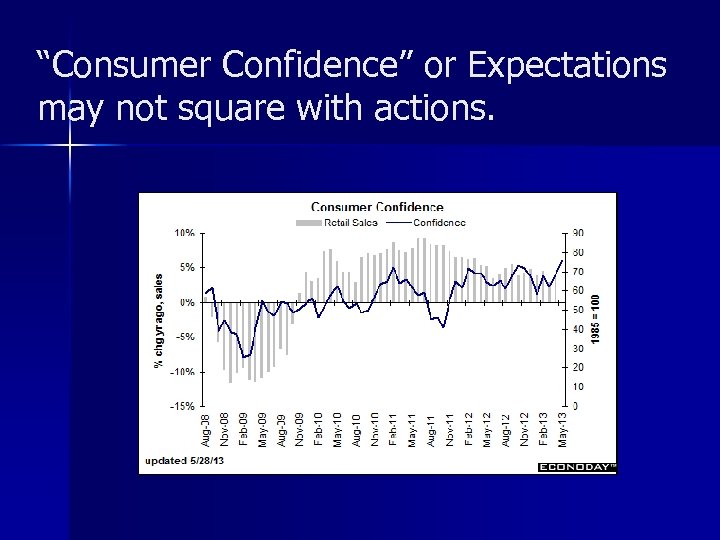 “Consumer Confidence” or Expectations may not square with actions.
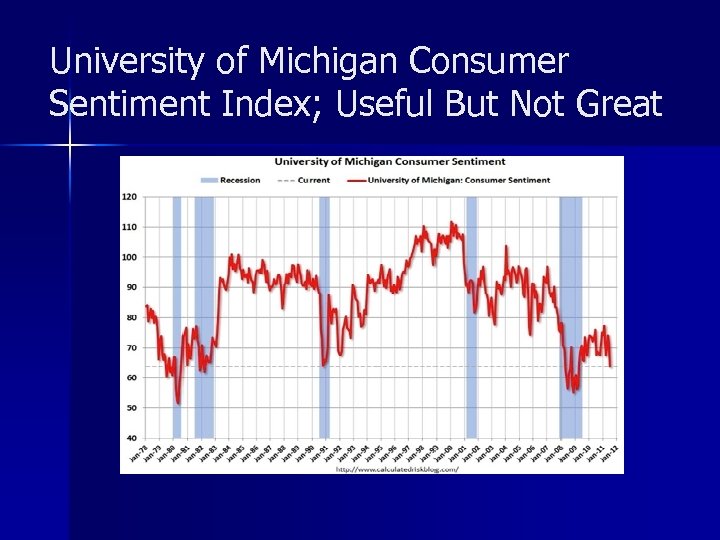 University of Michigan Consumer Sentiment Index; Useful But Not Great
 This or that? Substitutes Essentially, goods used in place of each other— similar performance characteristics. But a substitute in one market may not be in another market—orange juice and orange soda. ► Different brands of gasoline; robots in Renault factory in France v. workers in Renault factory in Russia; (1/100 industrial workers in China; 11/100 in U. S. ; 14/100 in Japan); movie theater v. download movie at home; shipping hard drives by Fed. Ex rather than send data by Internet (Google does it).
 Related Goods: Complements Essentially, goods used together ► Computer hardware and software; tennis balls and rackets; airplane travel and hotel rooms; Google maps and discount coupons; growing corn for ethanol and Deere tractors
 Changes in the Price of Related Goods ■ Goods X and Y are substitutes if: ► A change in price of X changes demand for Y in same direction - Px up implies Dy up (Dy shifts to the right) - Px down implies Dy down (Dy shifts to the left) ► Effect of change in Py on Dx is also in same direction
 More on the Prices of Related Goods ■ Goods V and W are complements if: ► A change in price of V changes demand for W in opposite direction: - Pv up implies Dw down (Dw shifts to left) - Pv down implies Dw (Dw shifts to right) ► Effect of a change in Pw on Dv is also in opposite direction
 Changes in Income ■ Normal Goods: Change in income changes demand in same direction - Higher income causes increase in demand - Lower income causes decrease in demand ► ”Superior” good is a variant: change in demand due to income change is quite large ► ■ Inferior goods: ► Change in income changes demand in opposite direction - Higher income causes decrease in demand - Lower income causes increase in demand
 Terminology: Used to avoid confusion ■ Changes in quantity demanded: Caused by changes in price of a good means movement along a given demand curve ■ Changes in demand: Caused by changes in other factors: - Prices of other goods - Income - Expectations, etc. ► Means a shift of the entire demand curve
 Summarizing the Demand Curve The demand curve is a simple way of expressing a complex market. Strip it to the essentials to think about it. The curve represents the individual values of many different existing and potential demanders. All that information is imagined to be captured in that little curve to help us focus our thinking about the basics.
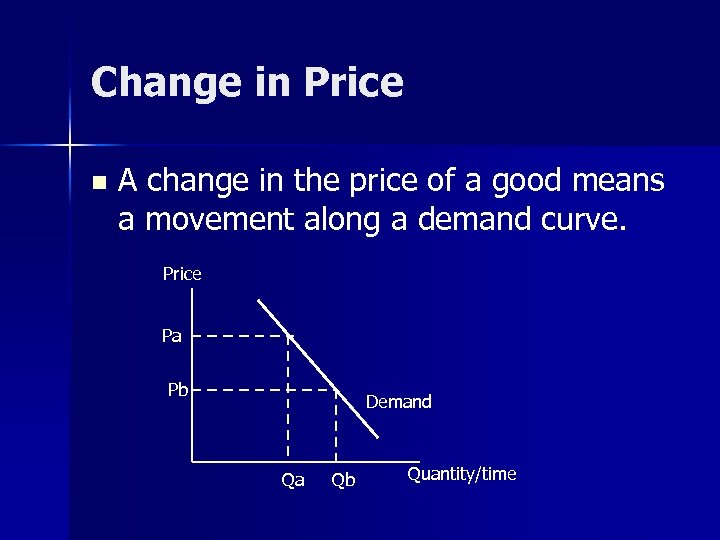 Change in Price n A change in the price of a good means a movement along a demand curve. Price Pa Pb Demand Qa Qb Quantity/time
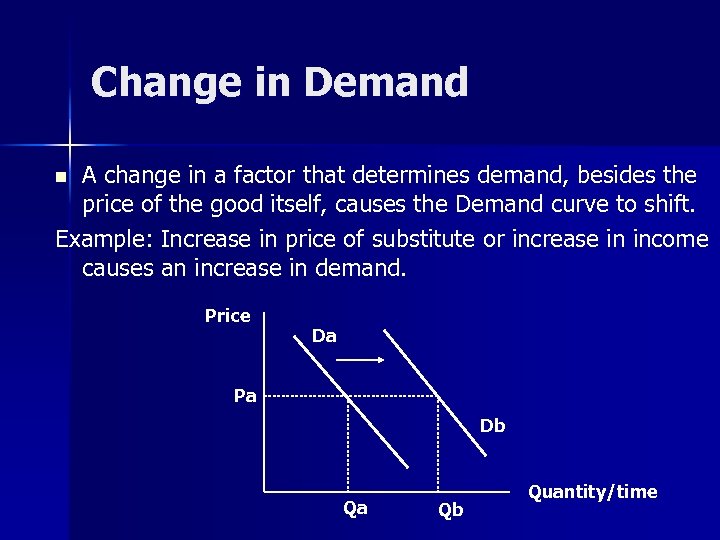 Change in Demand A change in a factor that determines demand, besides the price of the good itself, causes the Demand curve to shift. Example: Increase in price of substitute or increase in income causes an increase in demand. n Price Da Pa Db Qa Qb Quantity/time
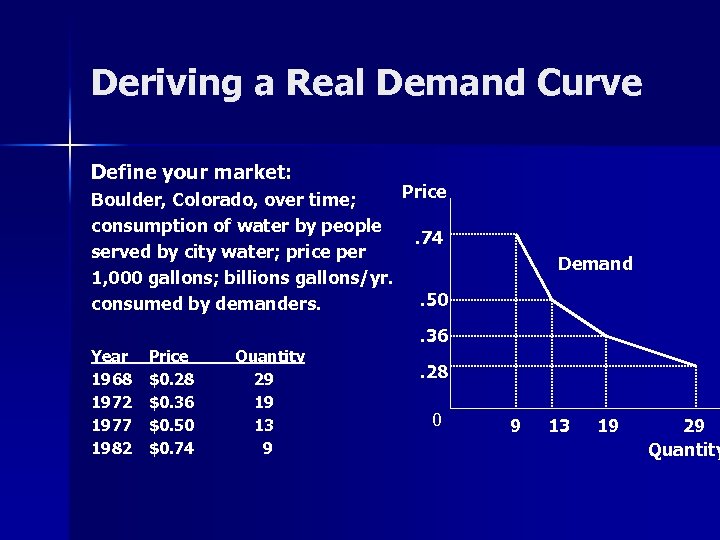 Deriving a Real Demand Curve Define your market: Price Boulder, Colorado, over time; consumption of water by people. 74 served by city water; price per 1, 000 gallons; billions gallons/yr. . 50 consumed by demanders. Demand . 36 Year 1968 1972 1977 1982 Price $0. 28 $0. 36 $0. 50 $0. 74 Quantity 29 19 13 9 . 28 0 9 13 19 29 Quantity
 What else would you want to know? The Demand curve plots the relationship between price and quantity demanded – nothing else – everything else is held constant But in the real world, other things are not constant, so what else would you want to know if you wanted to understand that market better? Name likely relevant factors:
 Demand analysis n 1. 2. 3. How would demand for hair replacement treatment be likely to change if the following occurs? A fall in the price of treatment. A rise in income. A rise in the divorce rate.
 Clever sales pitch n A British cellphone company promised new subscribers in November and December that all calls on Christmas Day, December 25, would be free. What would you expect happened to the volume of calls that day?
 Question on changing demand n Trying to predict future demand, GE research showed that the average size of the American family was declining and so was the average square footage of houses. How would you think this impacted the demand for the design of, say, refrigerators?
 Key Point from Peter Drucker Most important question sellers must ask: “What is value to the customer? ” Sellers often think they know, but do not. The customers do not buy a product; they buy value. Demanders are buying a product to satisfy a want. Do not guess what customers want—carefully evaluate what they want. Evaluate products from customers’ viewpoint, not how the producer knows it works.