


 Скачать презентацию Lecture 3 QM MM Applications Quantum Simulation in
53f8604303611ec61c2444530b061986.ppt
- Количество слайдов: 26
 Lecture 3 QM/MM Applications
 Quantum Simulation in Industry Overview ¤ Objectives • Extend QM/MM Codes and port to HPC architectures • Incorporate QM/MM molecular dynamics for chemical reactions • Demonstrate the value of HPC simulations in industrial chemistry ¤ Consortium • Daresbury (Coordinator) • Academic (Zurich/Muelheim, Royal Institution) • Industrial (Norsk Hydro, BASF, ICI) ¤ Resources • Funded by the European Union (EU contribution of 1. 2 MECU) • 1998 -2001 http: //www. cse. clrc. ac. uk/Activity/QUASI
 QUASI - Partners ¤ Drs Paul Sherwood, Martyn Guest (Daresbury Laboratory) • Coordinator • Ab-initio and HPC implementations • Chem. Shell software ¤ Prof Walter Thiel (MPI Muelheim) • Semi-emprical (MNDO 94), QM/MM coupling ¤ Prof Richard Catlow (Royal Insitution) • Classical simulation, shell model, force field derivation ¤ Dr Steve Rogers (ICI) • Methanol synthesis by metal oxide catalysts (with Royal Institution) ¤ Dr Ansgar Schaeffer (BASF) • Enzyme inhibitor simulation (with Zurich) ¤ Dr Klaus Schoeffel (Norsk Hydro) • Zeolite catalysis for N 2 O abatement (with Daresbury)
 QUASI - Workplan • Design ¤ QM and MM validation ¤ QM/MM coupling approaches (Daresbury, Zurich) • Enhancements to QM/MM Methodology ¤ ¤ ¤ Geometry Optimisation for QM/MM Systems (Zurich/Daresbury) Classical Shell Model QM/MM (Royal Institution/Daresbury) Molecular Dynamics (DL/Royal Institution) GUI Development (BASF/Daresbury) Forcefield Development (Royal Institition) • Joint Academic/Industrial Applications ¤ Demonstration and Commercial Calculations ¤ Workshop 25 -27 September 2000, Muelheim, Germany
 Solvation studies using QM/MM
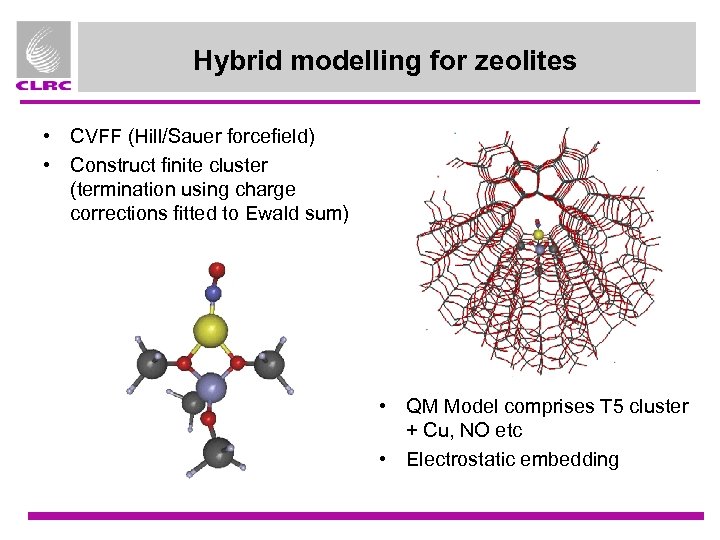 Hybrid modelling for zeolites • CVFF (Hill/Sauer forcefield) • Construct finite cluster (termination using charge corrections fitted to Ewald sum) • QM Model comprises T 5 cluster + Cu, NO etc • Electrostatic embedding
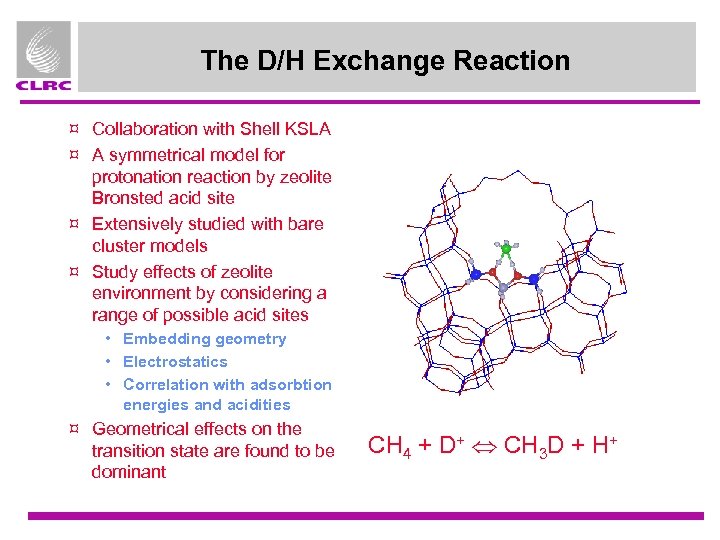 The D/H Exchange Reaction ¤ Collaboration with Shell KSLA ¤ A symmetrical model for protonation reaction by zeolite Bronsted acid site ¤ Extensively studied with bare cluster models ¤ Study effects of zeolite environment by considering a range of possible acid sites • Embedding geometry • Electrostatics • Correlation with adsorbtion energies and acidities ¤ Geometrical effects on the transition state are found to be dominant CH 4 + D+ CH 3 D + H+
 QUASI - Applications Focus ¤ Norsk Hydro / Daresbury • Zeolites systems with adsorbed Cu species, decomposition of N 2 O and NOx • Based on CFF forcefield, GAMESS-UK+DL_POLY ¤ BASF / Muelheim • Enzyme inhibitor binding (thrombin and anticoagulant drug candidates) • Enzyme reactivity modelling (Triose Phosphate Isomerase) • Using MNDO/TURBOMOLE with CHARMM forcefield (DL_POLY) ¤ ICI/ Royal Institution • Modelling surface catalysis, methanol synthesis reaction • Using GULP shell model potentials and GAMESS-UK DFT
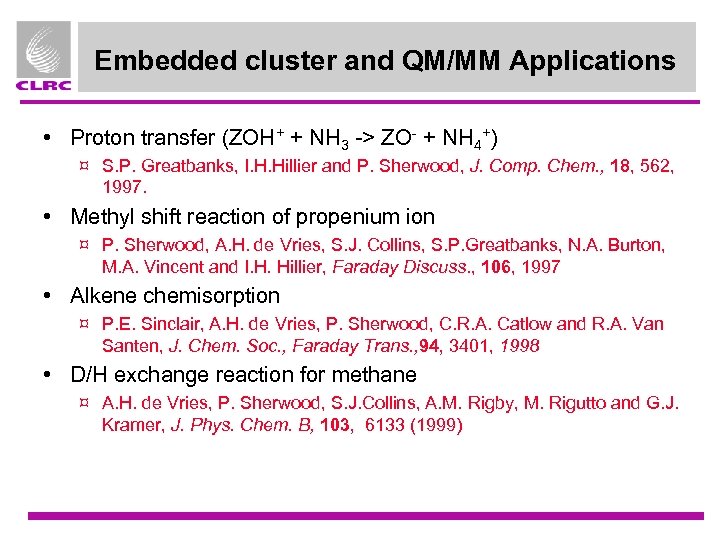 Embedded cluster and QM/MM Applications • Proton transfer (ZOH+ + NH 3 -> ZO- + NH 4+) ¤ S. P. Greatbanks, I. H. Hillier and P. Sherwood, J. Comp. Chem. , 18, 562, 1997. • Methyl shift reaction of propenium ion ¤ P. Sherwood, A. H. de Vries, S. J. Collins, S. P. Greatbanks, N. A. Burton, M. A. Vincent and I. H. Hillier, Faraday Discuss. , 106, 1997 • Alkene chemisorption ¤ P. E. Sinclair, A. H. de Vries, P. Sherwood, C. R. A. Catlow and R. A. Van Santen, J. Chem. Soc. , Faraday Trans. , 94, 3401, 1998 • D/H exchange reaction for methane ¤ A. H. de Vries, P. Sherwood, S. J. Collins, A. M. Rigby, M. Rigutto and G. J. Kramer, J. Phys. Chem. B, 103, 6133 (1999)
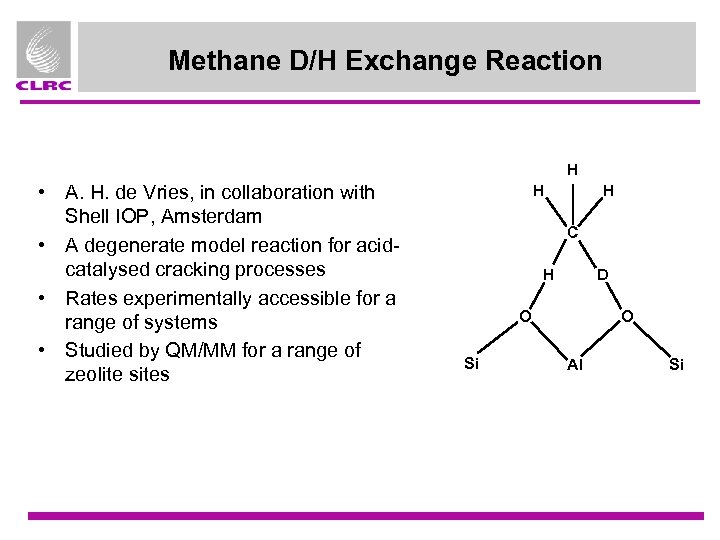 Methane D/H Exchange Reaction H • A. H. de Vries, in collaboration with Shell IOP, Amsterdam • A degenerate model reaction for acidcatalysed cracking processes • Rates experimentally accessible for a range of systems • Studied by QM/MM for a range of zeolite sites H H C H D O Si O Al Si
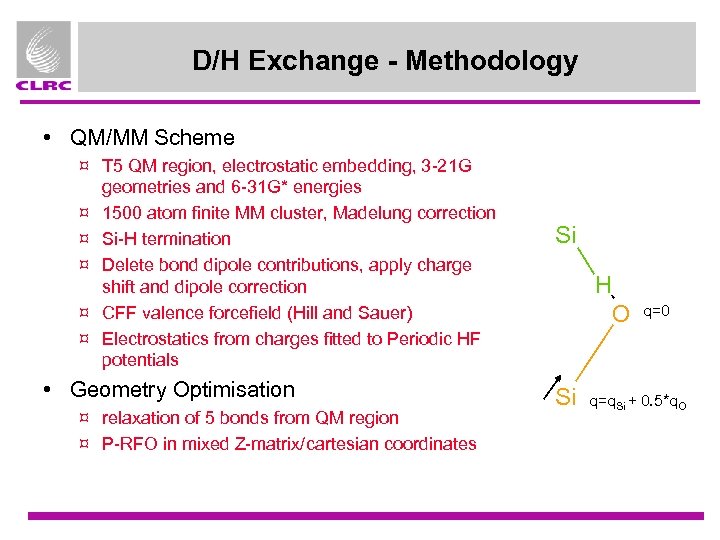 D/H Exchange - Methodology • QM/MM Scheme ¤ T 5 QM region, electrostatic embedding, 3 -21 G geometries and 6 -31 G* energies ¤ 1500 atom finite MM cluster, Madelung correction ¤ Si-H termination ¤ Delete bond dipole contributions, apply charge shift and dipole correction ¤ CFF valence forcefield (Hill and Sauer) ¤ Electrostatics from charges fitted to Periodic HF potentials • Geometry Optimisation ¤ relaxation of 5 bonds from QM region ¤ P-RFO in mixed Z-matrix/cartesian coordinates Si H O Si q=0 q=q. Si + 0. 5*q. O
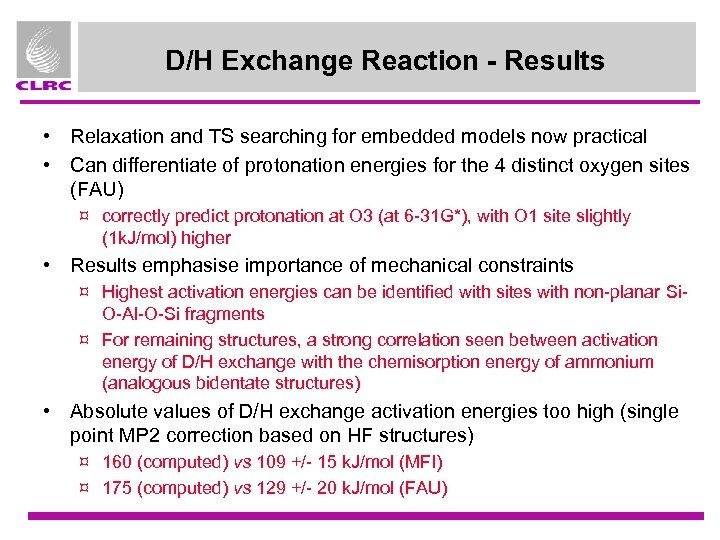 D/H Exchange Reaction - Results • Relaxation and TS searching for embedded models now practical • Can differentiate of protonation energies for the 4 distinct oxygen sites (FAU) ¤ correctly predict protonation at O 3 (at 6 -31 G*), with O 1 site slightly (1 k. J/mol) higher • Results emphasise importance of mechanical constraints ¤ Highest activation energies can be identified with sites with non-planar Si. O-Al-O-Si fragments ¤ For remaining structures, a strong correlation seen between activation energy of D/H exchange with the chemisorption energy of ammonium (analogous bidentate structures) • Absolute values of D/H exchange activation energies too high (single point MP 2 correction based on HF structures) ¤ 160 (computed) vs 109 +/- 15 k. J/mol (MFI) ¤ 175 (computed) vs 129 +/- 20 k. J/mol (FAU)
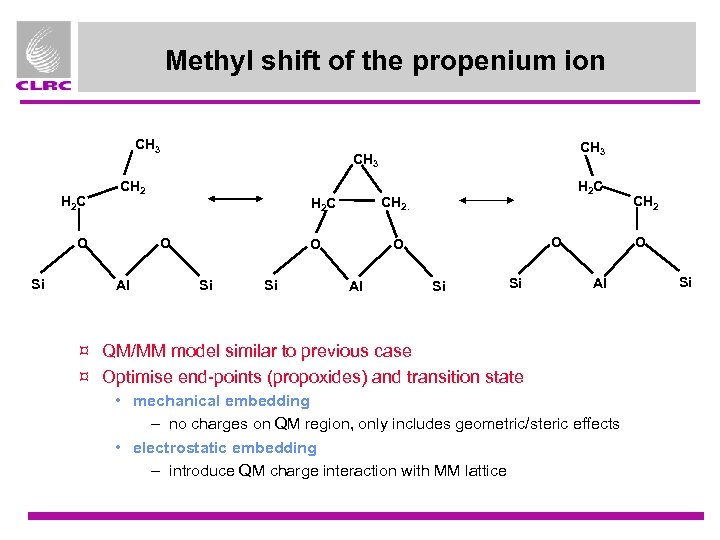 Methyl shift of the propenium ion CH 3 H 2 C CH 2 O Si Si H 2 C CH 2. H 2 C O Al CH 3 O O Al Si Si CH 2 O Al ¤ QM/MM model similar to previous case ¤ Optimise end-points (propoxides) and transition state • mechanical embedding – no charges on QM region, only includes geometric/steric effects • electrostatic embedding – introduce QM charge interaction with MM lattice Si
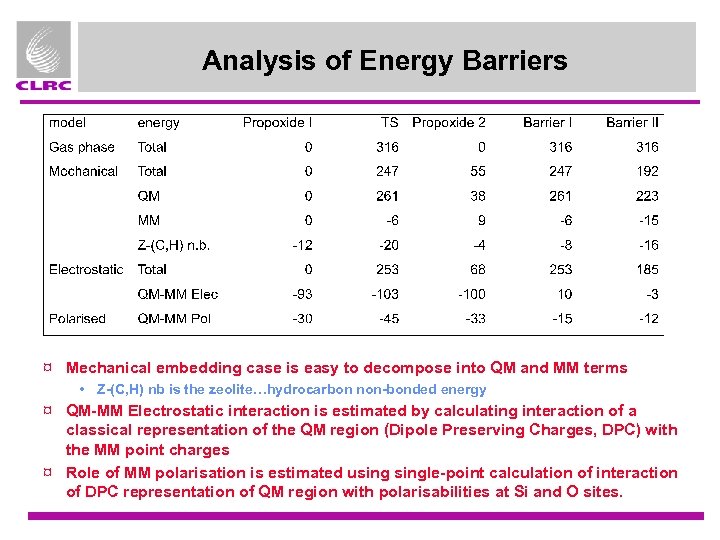 Analysis of Energy Barriers ¤ Mechanical embedding case is easy to decompose into QM and MM terms • Z-(C, H) nb is the zeolite…hydrocarbon non-bonded energy ¤ QM-MM Electrostatic interaction is estimated by calculating interaction of a classical representation of the QM region (Dipole Preserving Charges, DPC) with the MM point charges ¤ Role of MM polarisation is estimated usingle-point calculation of interaction of DPC representation of QM region with polarisabilities at Si and O sites.
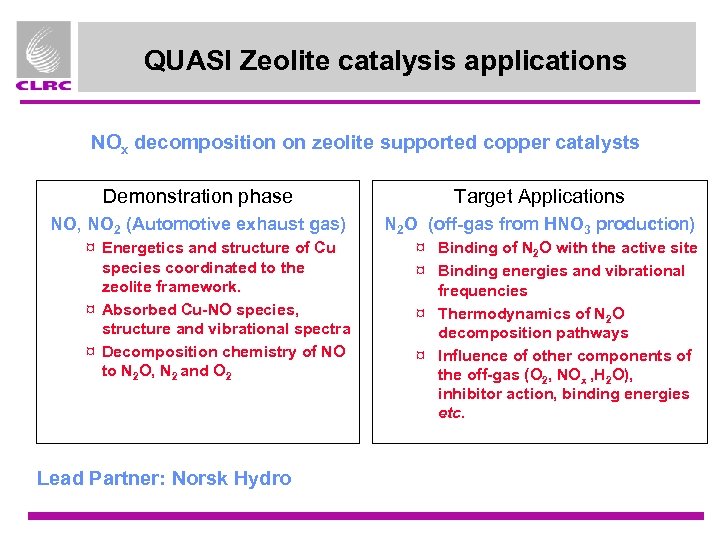 QUASI Zeolite catalysis applications NOx decomposition on zeolite supported copper catalysts Demonstration phase Target Applications NO, NO 2 (Automotive exhaust gas) N 2 O (off-gas from HNO 3 production) ¤ Energetics and structure of Cu species coordinated to the zeolite framework. ¤ Absorbed Cu-NO species, structure and vibrational spectra ¤ Decomposition chemistry of NO to N 2 O, N 2 and O 2 Lead Partner: Norsk Hydro ¤ Binding of N 2 O with the active site ¤ Binding energies and vibrational frequencies ¤ Thermodynamics of N 2 O decomposition pathways ¤ Influence of other components of the off-gas (O 2, NOx , H 2 O), inhibitor action, binding energies etc.
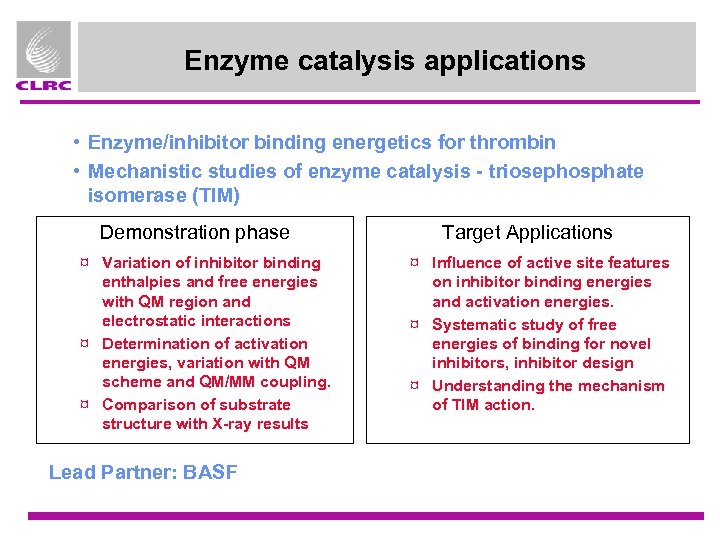 Enzyme catalysis applications • Enzyme/inhibitor binding energetics for thrombin • Mechanistic studies of enzyme catalysis - triosephosphate isomerase (TIM) Demonstration phase ¤ Variation of inhibitor binding enthalpies and free energies with QM region and electrostatic interactions ¤ Determination of activation energies, variation with QM scheme and QM/MM coupling. ¤ Comparison of substrate structure with X-ray results Lead Partner: BASF Target Applications ¤ Influence of active site features on inhibitor binding energies and activation energies. ¤ Systematic study of free energies of binding for novel inhibitors, inhibitor design ¤ Understanding the mechanism of TIM action.
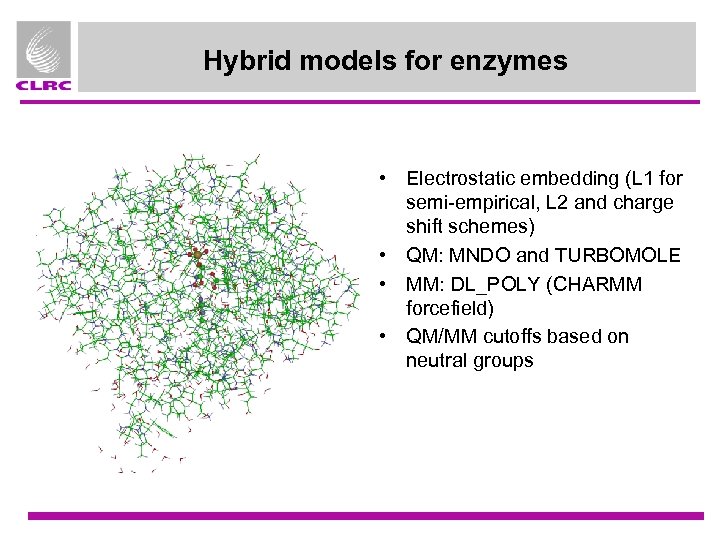 Hybrid models for enzymes • Electrostatic embedding (L 1 for semi-empirical, L 2 and charge shift schemes) • QM: MNDO and TURBOMOLE • MM: DL_POLY (CHARMM forcefield) • QM/MM cutoffs based on neutral groups
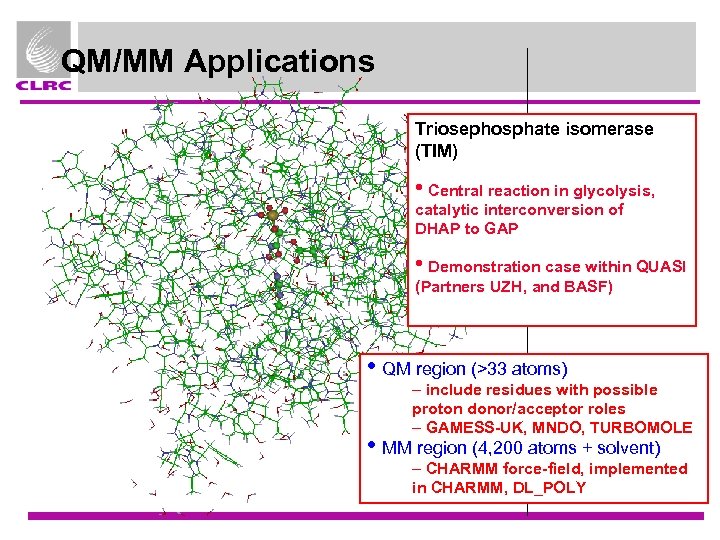 QM/MM Applications Triosephosphate isomerase (TIM) • Central reaction in glycolysis, catalytic interconversion of DHAP to GAP • Demonstration case within QUASI (Partners UZH, and BASF) • QM region (>33 atoms) – include residues with possible proton donor/acceptor roles – GAMESS-UK, MNDO, TURBOMOLE • MM region (4, 200 atoms + solvent) – CHARMM force-field, implemented in CHARMM, DL_POLY
 Enzyme QM/MM Applications - TIM
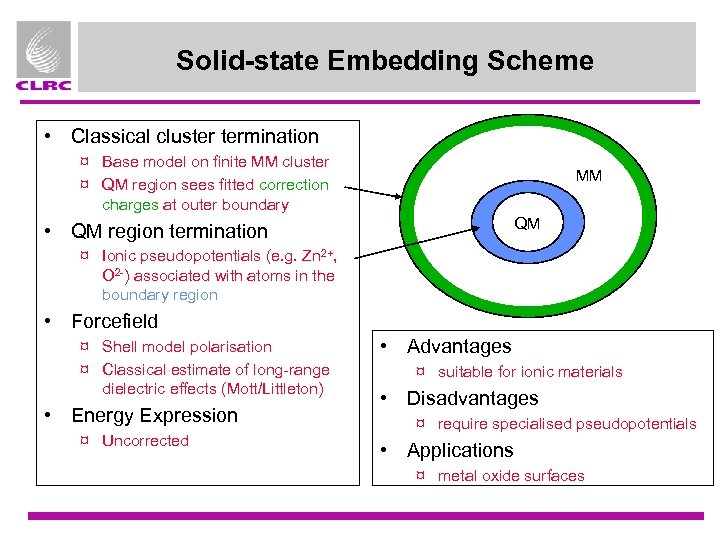 Solid-state Embedding Scheme • Classical cluster termination ¤ Base model on finite MM cluster ¤ QM region sees fitted correction charges at outer boundary MM QM • QM region termination ¤ Ionic pseudopotentials (e. g. Zn 2+, O 2 -) associated with atoms in the boundary region • Forcefield ¤ Shell model polarisation ¤ Classical estimate of long-range dielectric effects (Mott/Littleton) • Energy Expression ¤ Uncorrected • Advantages ¤ suitable for ionic materials • Disadvantages ¤ require specialised pseudopotentials • Applications ¤ metal oxide surfaces
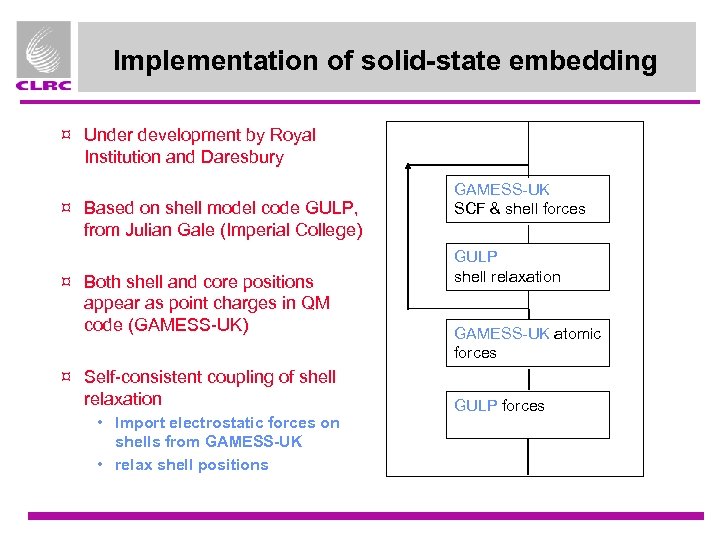 Implementation of solid-state embedding ¤ Under development by Royal Institution and Daresbury ¤ Based on shell model code GULP, from Julian Gale (Imperial College) ¤ Both shell and core positions appear as point charges in QM code (GAMESS-UK) ¤ Self-consistent coupling of shell relaxation • Import electrostatic forces on shells from GAMESS-UK • relax shell positions GAMESS-UK SCF & shell forces GULP shell relaxation GAMESS-UK atomic forces GULP forces
 QUASI - Surface catalysis applications Methanol synthesis from synthesis gas (CO, CO 2 and H 2) using the ternary catalyst system Cu/Zn. O/Al 2 O 3 e. g. CO + 2 H 2 -> CH 3(OH) Demonstration phase ¤ Geometry and electronic structure of bulk and surface QM clusters as a function of cluster size. ¤ Adsorption of Cu(I) on the Zn. O surface ¤ Absorption energies, IR spectra and PES for CO on Cu and Zn sites Lead Partner: ICI Target Applications ¤ Stability of Cu clusters of different sizes and ox. states ¤ Structure and energetics of absorption formate, methoxy and carbonate on the surface, 13 C chemical shifts ¤ Transition states for proton and hydride transfer steps ¤ Understanding promoter action
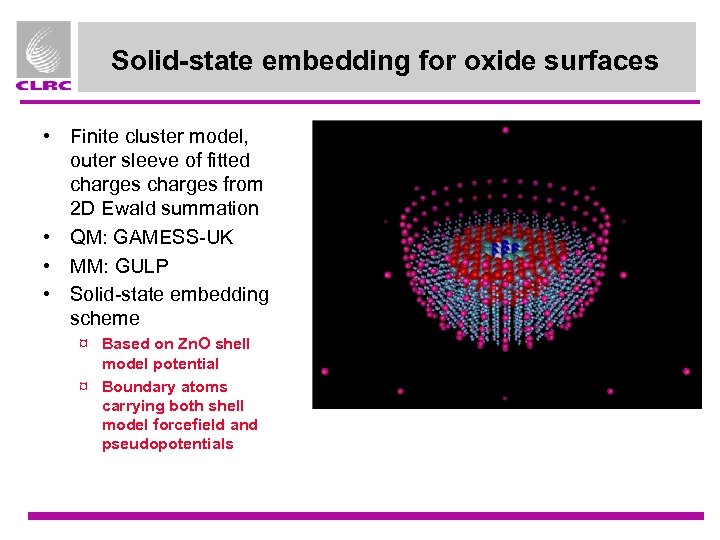 Solid-state embedding for oxide surfaces • Finite cluster model, outer sleeve of fitted charges from 2 D Ewald summation • QM: GAMESS-UK • MM: GULP • Solid-state embedding scheme ¤ Based on Zn. O shell model potential ¤ Boundary atoms carrying both shell model forcefield and pseudopotentials
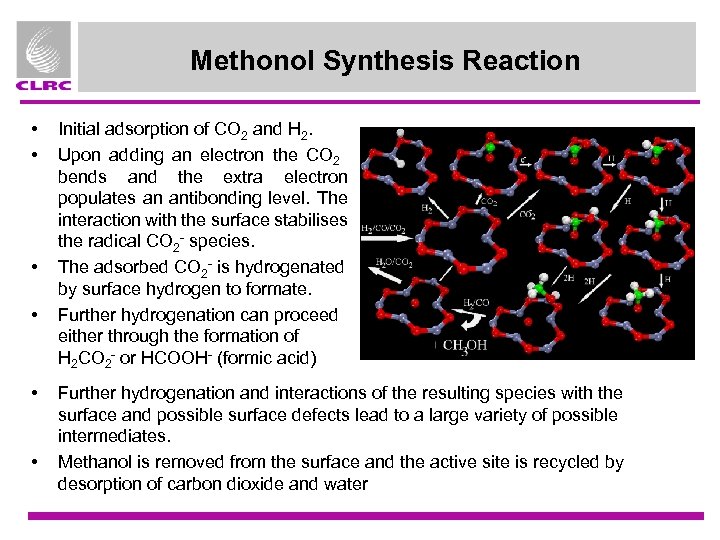 Methonol Synthesis Reaction • • • Initial adsorption of CO 2 and H 2. Upon adding an electron the CO 2 bends and the extra electron populates an antibonding level. The interaction with the surface stabilises the radical CO 2 - species. The adsorbed CO 2 - is hydrogenated by surface hydrogen to formate. Further hydrogenation can proceed either through the formation of H 2 CO 2 - or HCOOH- (formic acid) Further hydrogenation and interactions of the resulting species with the surface and possible surface defects lead to a large variety of possible intermediates. Methanol is removed from the surface and the active site is recycled by desorption of carbon dioxide and water
 Adsorption of copper clusters
 Acknowledgements • QUASI software developments ¤ Geometry optimisation, CHARMM interfacing, G 98 interface • Walter Thiel, Frank Terstegen, Salomon Billeter, Alex Turner ¤ TURBOMOLE interface • Ansgar Schäfer, Christian Lennartz ¤ Solid-state embedding • Alexei Sokol, Sam French, Richard Catlow • Other Collaborators ¤ CHARMM/GAMESS-UK • Bernie Brooks, Eric Billings ¤ Chem. Shell developments, models for zeolites • Alex de Vries, Simon Collins, Ian Hillier, Steve Greatbanks • CEC, Shell SIOP Amsterdam