Скачать презентацию Lecture 3 Post-harvesting treatment of green grain
Lec_3_manadjmant_engl_2011.ppt
- Количество слайдов: 39
 Lecture 3. Post-harvesting treatment of green grain.
 Plan of lecture 1. Post-harvesting treatment of green grain. 2. Clearing of grain. 3. Aeration of grain. 4. Drying of grain.
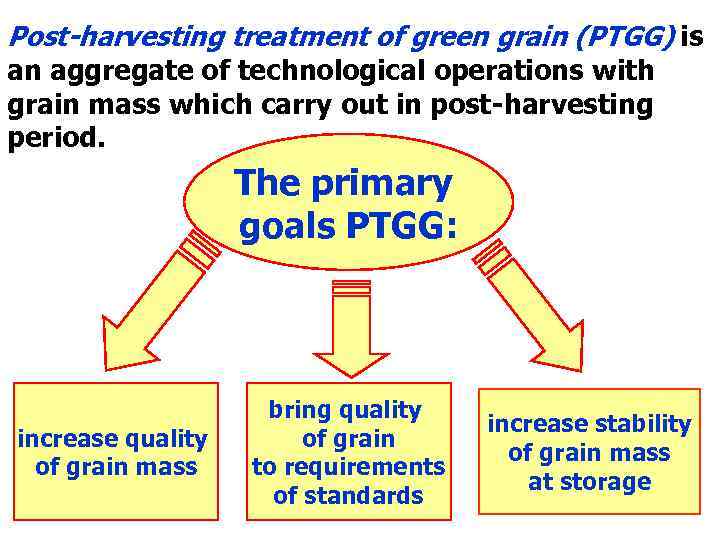 Post-harvesting treatment of green grain (PTGG) is an aggregate of technological operations with grain mass which carry out in post-harvesting period. The primary goals PTGG: increase quality of grain mass bring quality of grain to requirements of standards increase stability of grain mass at storage
 PTGG begins with an estimation of grain mass of its quality for parameters of humidity, contents of admixture and their element content. The full cycle PTGG includes: - Reception of grain and formation of grain consignment; - Clarification from admixtures; - Drying or active aeration.
 Kinds of technologies PTGG: 1. Separate - carry out quality of grain to requirements of standards for some passing through machines. Defects: - grain is upset some times among machines; - necessary a lot of the staff; - grain is damaged; - a long period grain remains without treatment and becomes unstable at storage. 2. Streaming – carry out quality of grain to requirements of standards for one passing through machines.
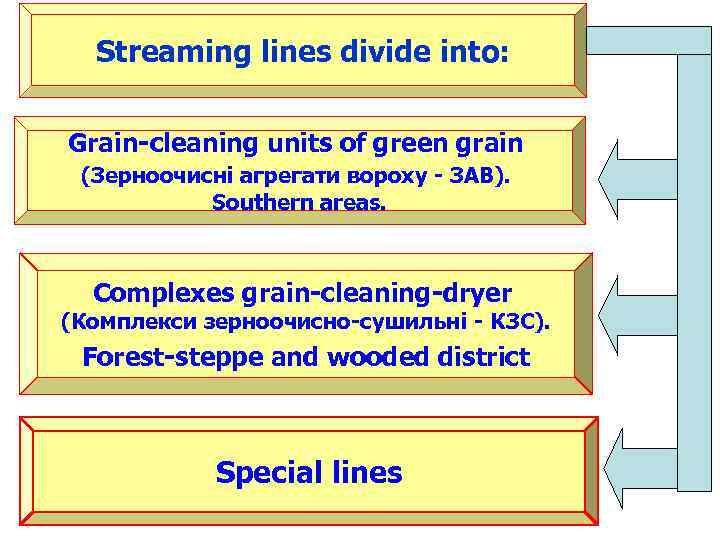 Streaming lines divide into: Grain-cleaning units of green grain (Зерноочисні агрегати вороху - ЗАВ). Southern areas. Complexes grain-cleaning-dryer (Комплекси зерноочисно-сушильні - КЗС). Forest-steppe and wooded district Special lines
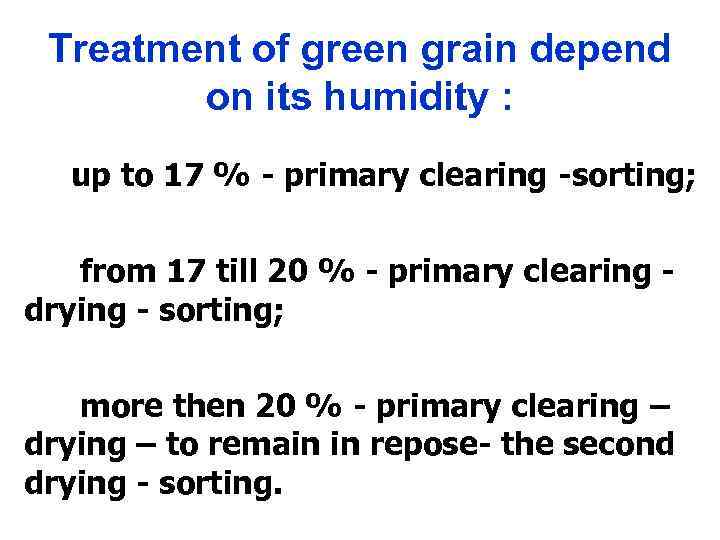 Treatment of green grain depend on its humidity : up to 17 % - primary clearing -sorting; from 17 till 20 % - primary clearing drying - sorting; more then 20 % - primary clearing – drying – to remain in repose- the second drying - sorting.
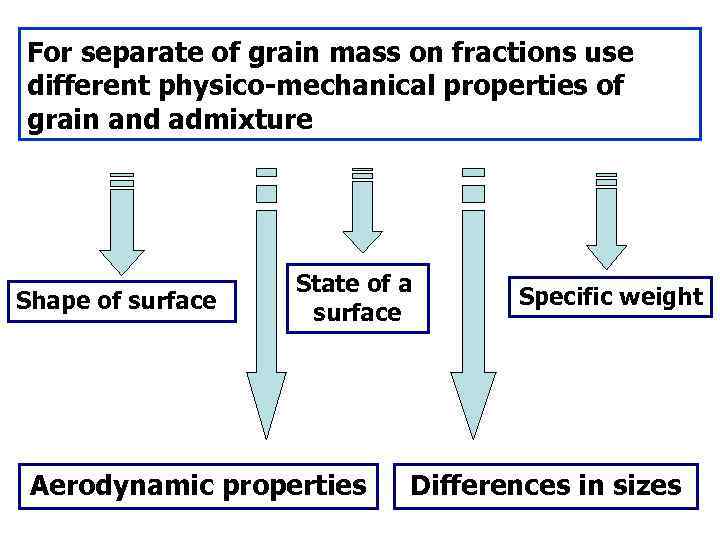 For separate of grain mass on fractions use different physico-mechanical properties of grain and admixture Shape of surface State of a surface Aerodynamic properties Specific weight Differences in sizes
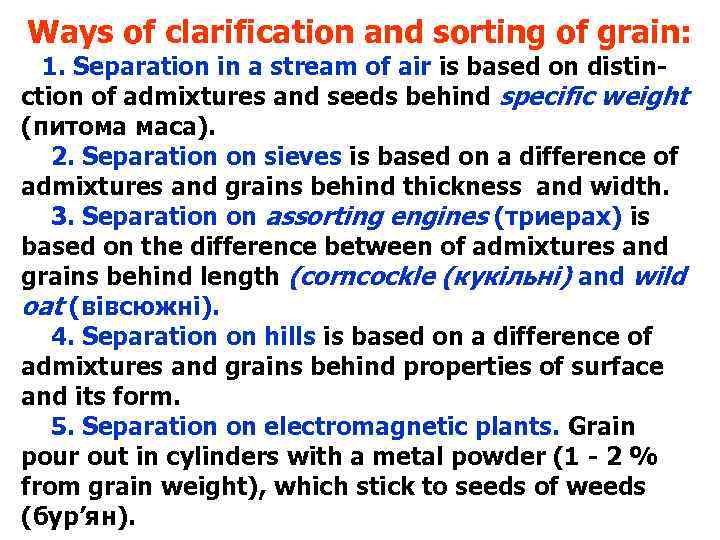 Ways of clarification and sorting of grain: 1. Separation in a stream of air is based on distinction of admixtures and seeds behind specific weight (питома маса). 2. Separation on sieves is based on a difference of admixtures and grains behind thickness and width. 3. Separation on assorting engines (триерах) is based on the difference between of admixtures and grains behind length (corncockle (кукільні) and wild oat (вівсюжні). 4. Separation on hills is based on a difference of admixtures and grains behind properties of surface and its form. 5. Separation on electromagnetic plants. Grain pour out in cylinders with a metal powder (1 - 2 % from grain weight), which stick to seeds of weeds (бур’ян).
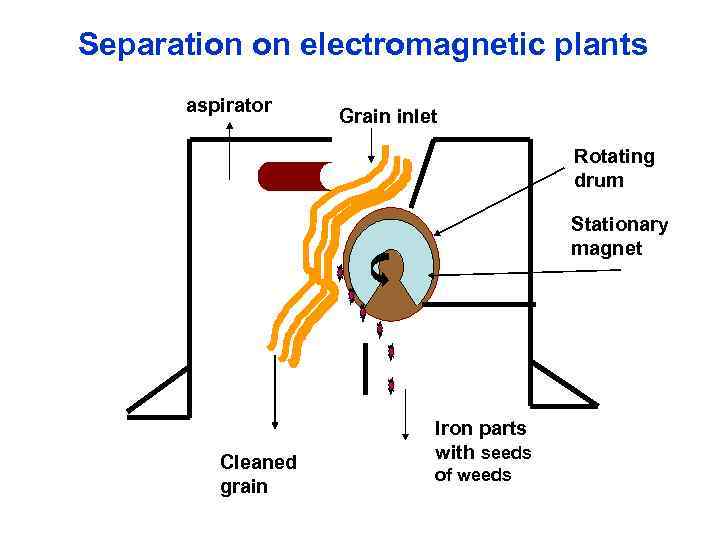 Separation on electromagnetic plants aspirator Grain inlet Rotating drum Stationary magnet Cleaned grain Iron parts with seeds of weeds
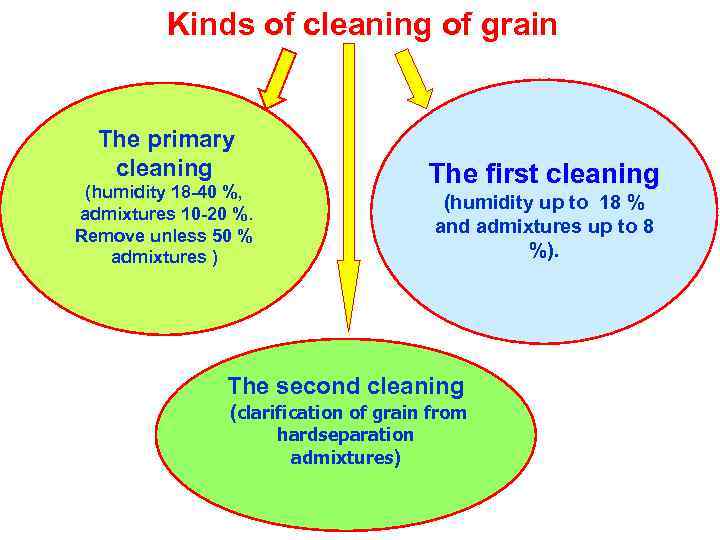 Kinds of cleaning of grain The primary cleaning The first cleaning (humidity 18 -40 %, admixtures 10 -20 %. Remove unless 50 % admixtures ) (humidity up to 18 % and admixtures up to 8 %). The second cleaning (clarification of grain from hardseparation admixtures)
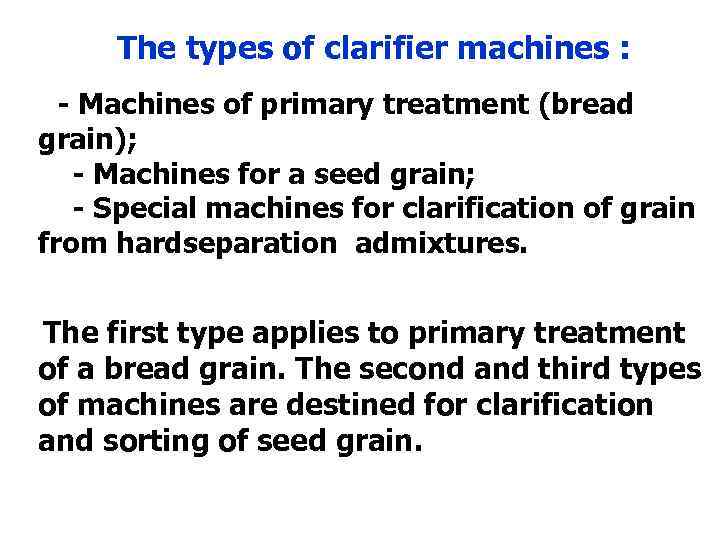 The types of clarifier machines : - Machines of primary treatment (bread grain); - Machines for a seed grain; - Special machines for clarification of grain from hardseparation admixtures. The first type applies to primary treatment of a bread grain. The second and third types of machines are destined for clarification and sorting of seed grain.
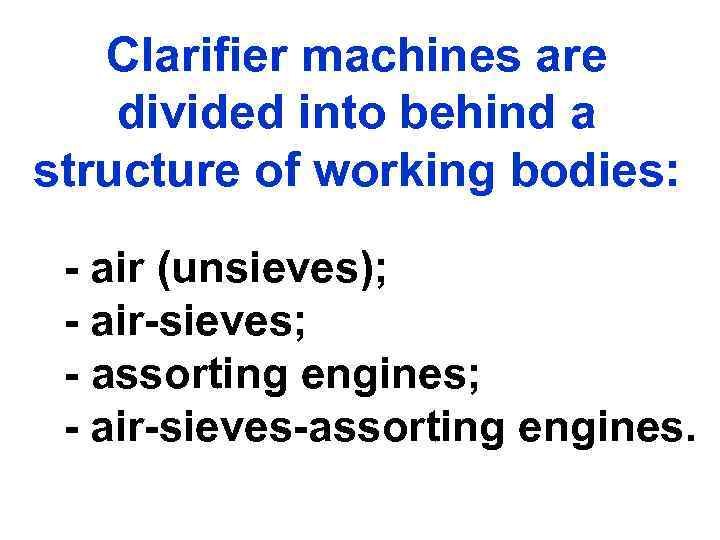 Clarifier machines are divided into behind a structure of working bodies: - air (unsieves); - air-sieves; - assorting engines; - air-sieves-assorting engines.
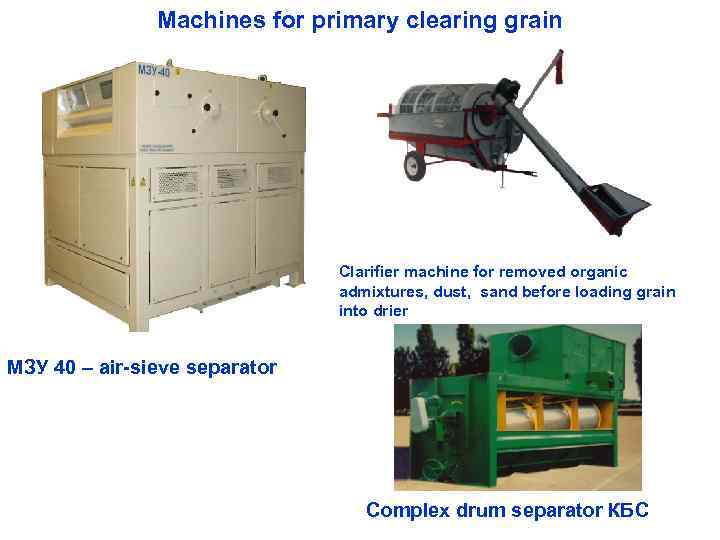 Machines for primary clearing grain Clarifier machine for removed organic admixtures, dust, sand before loading grain into drier МЗУ 40 – air-sieve separator Complex drum separator КБС
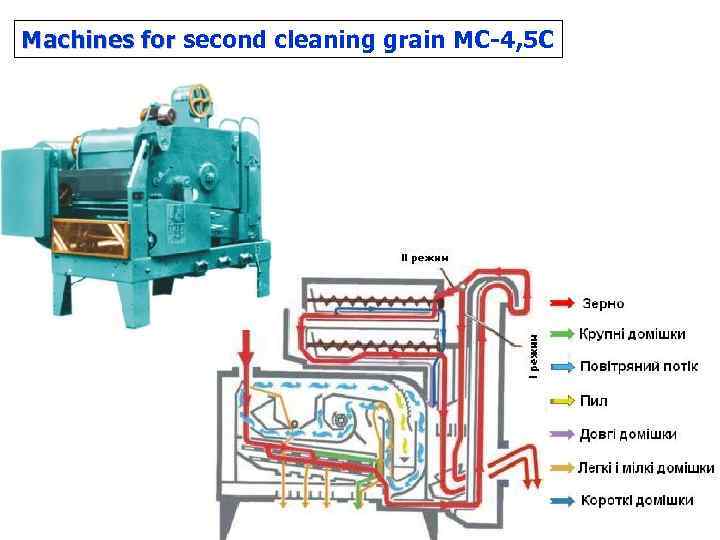 Machines for second cleaning grain МС-4, 5 С
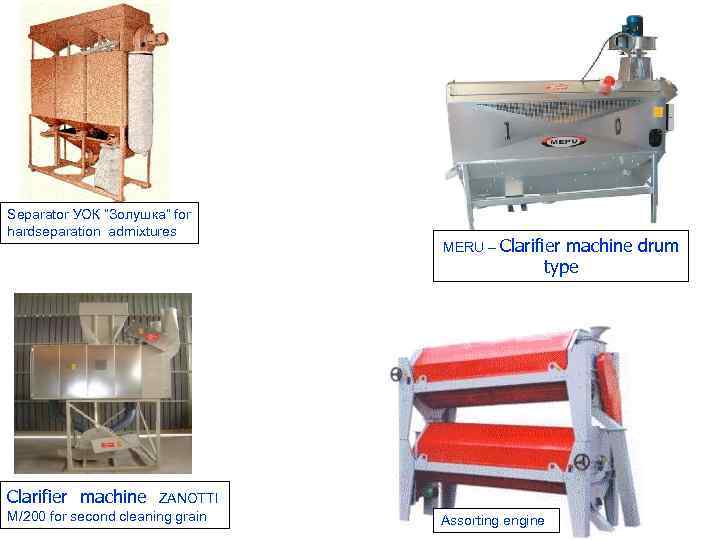 Separator УОК “Золушка” for hardseparation admixtures MERU – Clarifier machine drum type Clarifier machine ZANOTTI M/200 for second cleaning grain Assorting engine
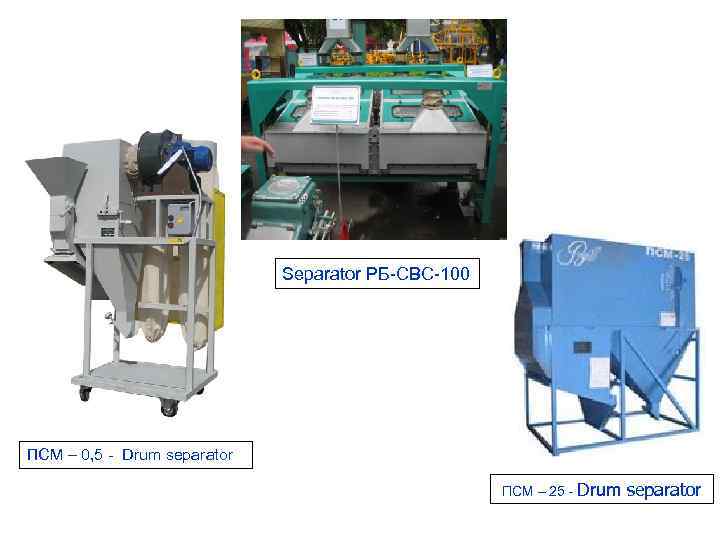 Separator РБ-СВС-100 ПСМ – 0, 5 - Drum separator ПСМ – 25 - Drum separator
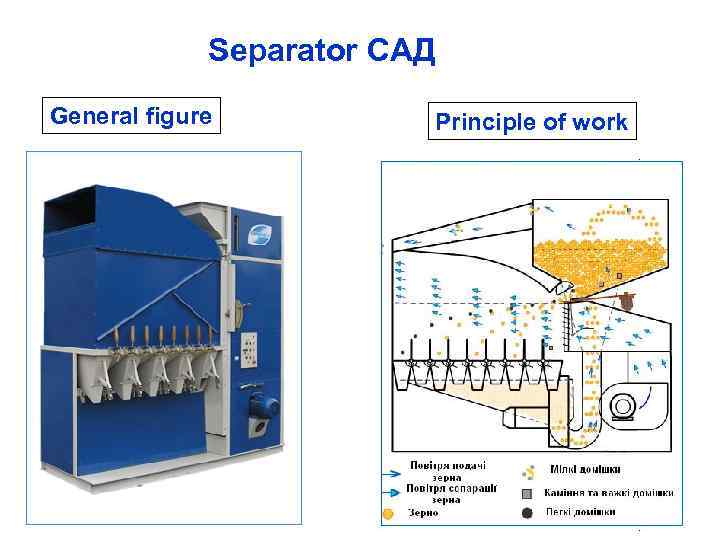 Separator САД General figure Principle of work
 Aeration of grain mass Behind intensity of movement of air in a bulk of grain aeration may be: • Passive; • Active aeration of grain is carried out on installation equipped by fan. Active aeration may be: - continuous; - interrupt.
 Active aeration is compulsory blow of grain mass by atmospheric air. Functions of active aeration of grain: - preventive aim; - cooling; - frozen; - drying; - decontamination; - liquidations of self-heating; - warming up of seeds before sowing.
 INSTALLATIONS FOR ACTIVE AERATION OF GRAIN STATIONARY VENTILATION INSTALLATIONS: - stationary installations type of SVU-1 or SVU-2 have a stationary channels in a floor of granary or a barn floor; - BINS (BV-6; BV-12. 5; BV-25; BV-50). PORTABLE: FLOOR PORTABLE have system of portable airdistributing gridiron which put in the certain place on floor of granary or a barn floor ( «Promzemproekt» ); TUBE MOBILE: - Mobile one-tube installations (PVU-1); - Telescopic ventilating installations (ТVU-2).
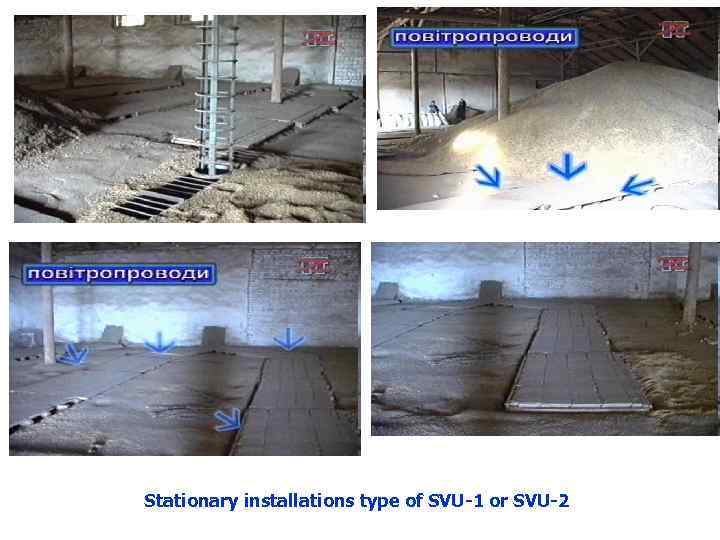 Stationary installations type of SVU-1 or SVU-2
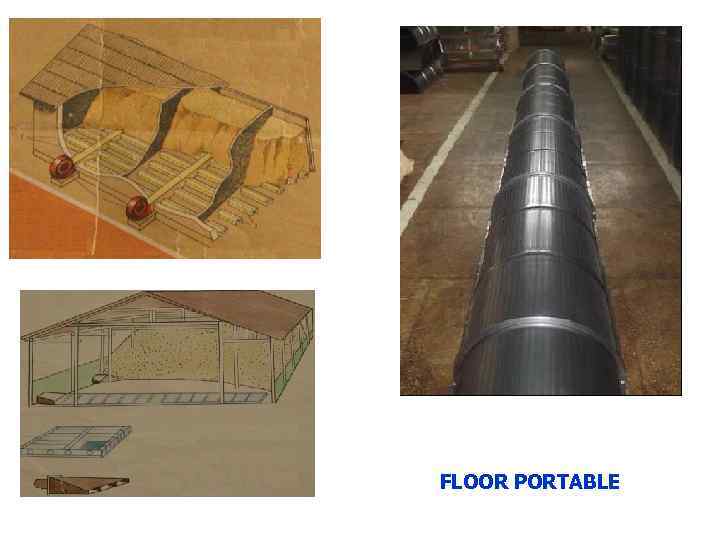 FLOOR PORTABLE
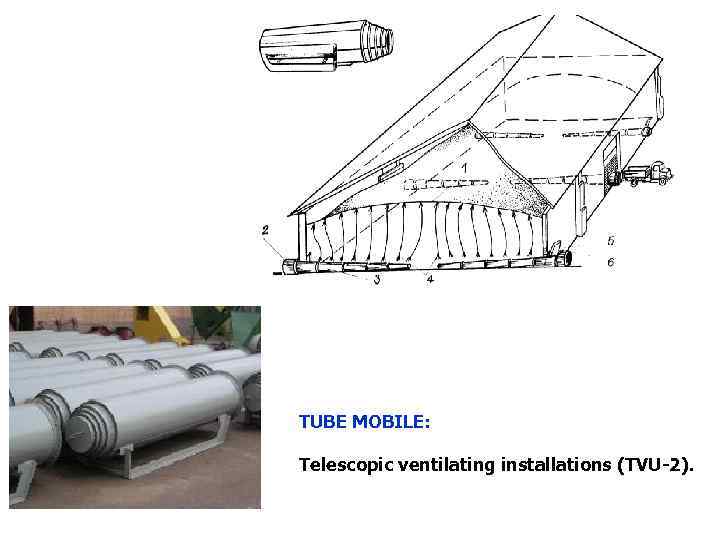 TUBE MOBILE: Telescopic ventilating installations (ТVU-2).
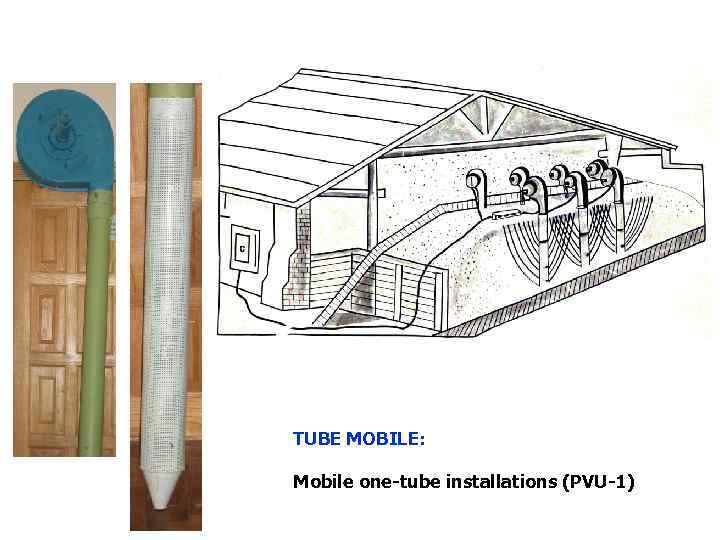 TUBE MOBILE: Mobile one-tube installations (PVU-1)
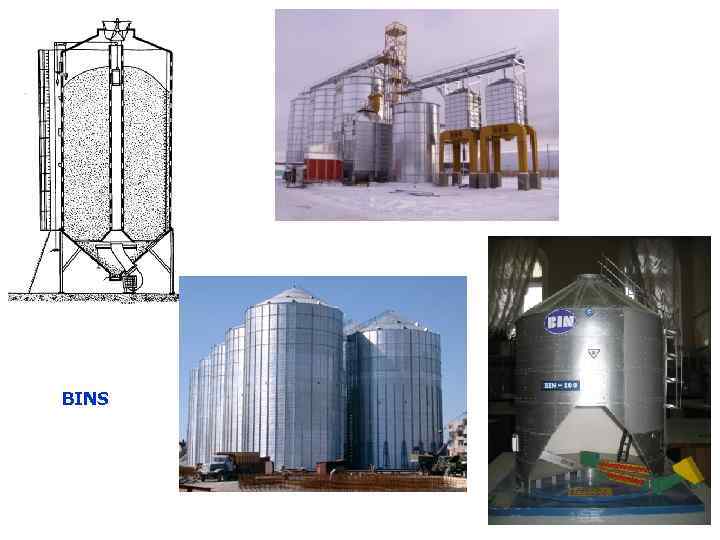 BINS
BINS
 Active aeration is carried out by atmospheric air only when actual humidity of grain exceeds equilibrium on 1 % and more. Only when grain mass is self-heating active aeration should be carry out for any relative humidity of air. Active aeration carries out according to its regimes established for every crop. Regimes of active aeration is optimum association of parameters of treatment of grain by an air stream which provides the best economic result.
 Drying of grain Drying is a basis technological operation for carrying out grain and seeds to constant state.
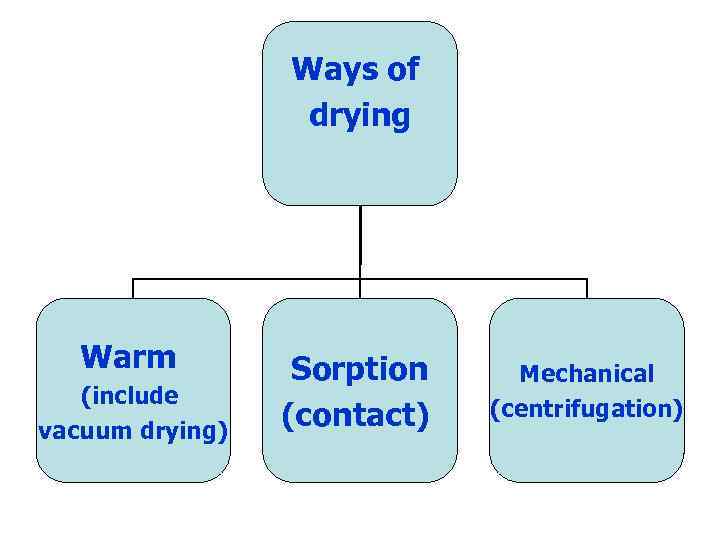 Ways of drying Warm (include vacuum drying) Sorption (contact) Mechanical (centrifugation)
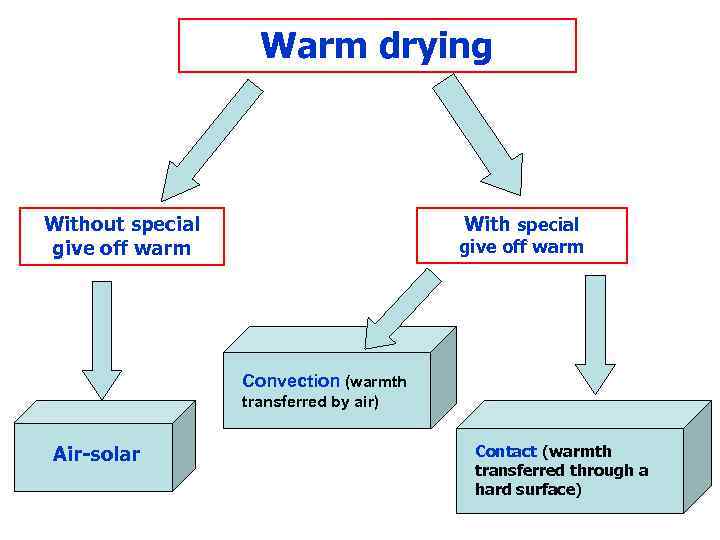 Warm drying Without special give off warm With special give off warm Convection (warmth transferred by air) Air-solar Contact (warmth transferred through a hard surface)
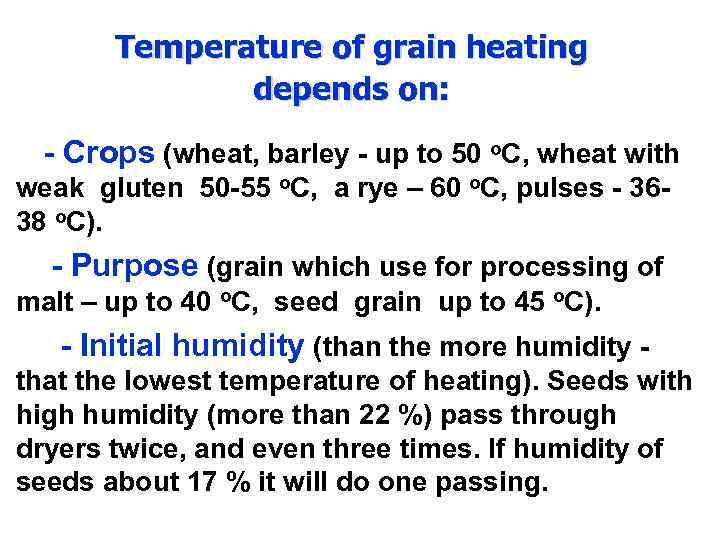 Temperature of grain heating depends on: - Crops (wheat, barley - up to 50 o. C, wheat with weak gluten 50 -55 o. C, a rye – 60 o. C, pulses - 3638 o. C). - Purpose (grain which use for processing of malt – up to 40 o. C, seed grain up to 45 o. C). - Initial humidity (than the more humidity - that the lowest temperature of heating). Seeds with high humidity (more than 22 %) pass through dryers twice, and even three times. If humidity of seeds about 17 % it will do one passing.
 The types of drier - Chamber drier; - Mine drier; - Drum-type drier; - Recycling drier;
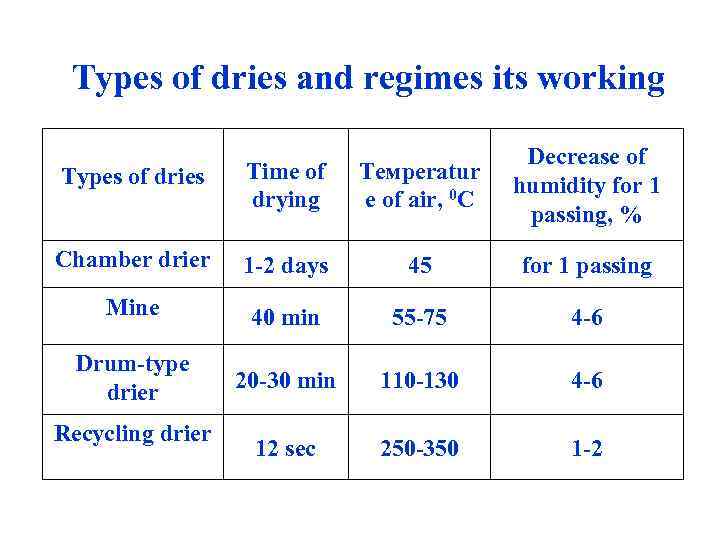 Types of dries and regimes its working Types of dries Time of drying Темperatur e of air, 0 С Decrease of humidity for 1 passing, % Chamber drier 1 -2 days 45 for 1 passing Mine 40 min 55 -75 4 -6 Drum-type drier 20 -30 min 110 -130 4 -6 12 sec 250 -350 1 -2 Recycling drier
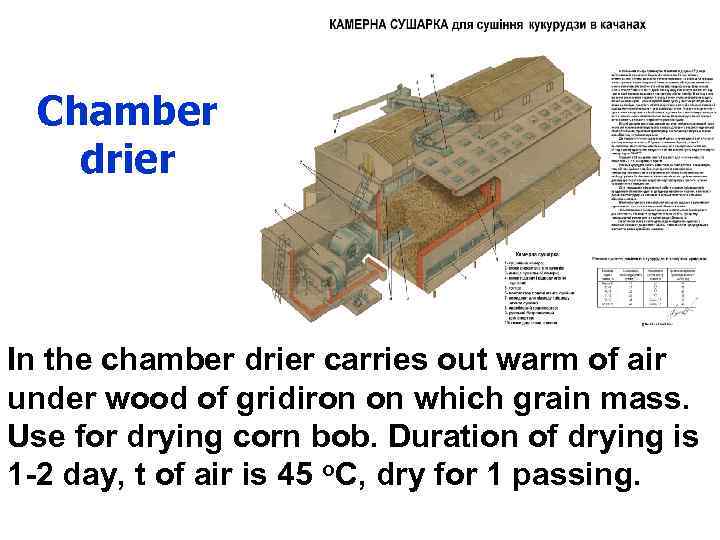 Chamber drier In the chamber drier carries out warm of air under wood of gridiron on which grain mass. Use for drying corn bob. Duration of drying is 1 -2 day, t of air is 45 о. С, dry for 1 passing.
 Mine drier
 Mine drier Duration of drying is 40 -60 min. , temperature of air 55 -75 о. С. Apply to grain any destination. Cleanliness of seeds before drying is 98 -99 %, the contents straw admixtures – up to 0. 5 %. For one passing humidity to reduce on 46 %.
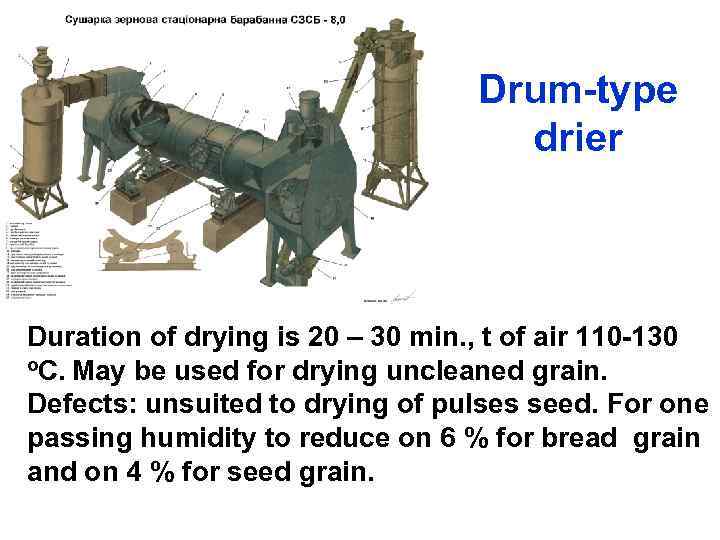 Drum-type drier Duration of drying is 20 – 30 min. , t of air 110 -130 о. С. May be used for drying uncleaned grain. Defects: unsuited to drying of pulses seed. For one passing humidity to reduce on 6 % for bread grain and on 4 % for seed grain.
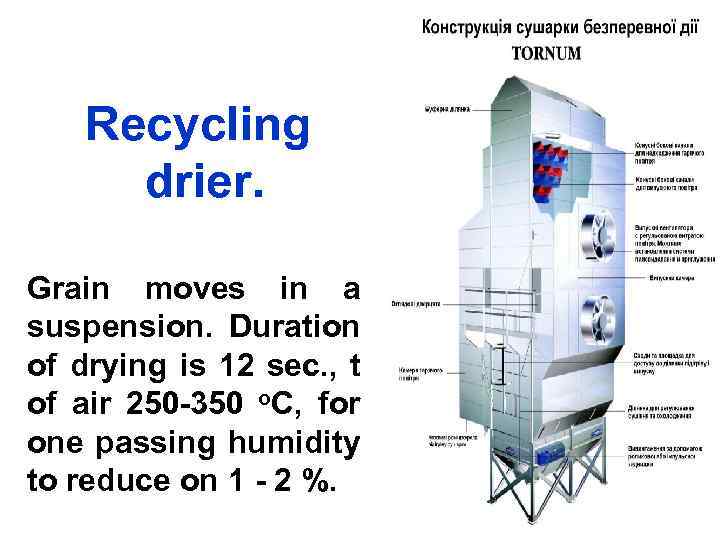 Recycling drier. Grain moves in a suspension. Duration of drying is 12 sec. , t of air 250 -350 о. С, for one passing humidity to reduce on 1 - 2 %.