 Скачать презентацию Lecture 3 Method Parameters Building Java Programs A
1c55b0298d7f9208306c22635749b8ad.ppt
- Количество слайдов: 20



Lecture 3: Method Parameters Building Java Programs: A Back to Basics Approach by Stuart Reges and Marty Stepp Copyright (c) Pearson 2013. All rights reserved.

Strings String is a type used in Java to store literal expressions. It is NOT a primitive type. public static void main(String[] args) { String x=“This is a string. ”; System. out. println(“x”); // x System. out. println(x); //This is a string. System. out. println(“This is another string. ”); } Output: x This is a string. This is another string. 2
Method Parameters Methods in Java can have parameters or input arguments. Syntax: public static void method. Name(type var 1) { <statements>} // declare The parameters in the method header are formal parameters. method. Name(expression); // call The parameters in the method header are actual parameters. 3
Method Parameters Example: public static void print. Double(int x) { System. out. println(“Your number ” + x + “doubled is” + 2*x +”. ”); } To call: print. Double(5); //Your number 5 doubled is 10. print. Double(3. 4); //Error! Incompatible types! 4
![Method Parameters Methods cannot change the values of primitive types. public static void main(String[]](https://present5.com/presentation/1c55b0298d7f9208306c22635749b8ad/image-5.jpg "Method Parameters Methods cannot change the values of primitive types. public static void main(String[]")
Method Parameters Methods cannot change the values of primitive types. public static void main(String[] args) { int x=3; print. Double(4); print. Double(x); System. out. println(“x is now “ + x); } Output: Your number 4 doubled is 8. Your number 3 doubled is 6. x is now 3 Note: The value of x did not change. 5
Method Parameters Methods in Java can have return types. public static type method. Name(type var 1, …, type var 2) { <statements>} // declare Example: public static int double. This(int n) { int m=2*n; return m; // or simply return 2*n; } int a=double. This(9); //a is now 18 6
![Return public static void main(String[] args){ int x=6; int y; double. This(x); //returned value](https://present5.com/presentation/1c55b0298d7f9208306c22635749b8ad/image-7.jpg "Return public static void main(String[] args){ int x=6; int y; double. This(x); //returned value")
Return public static void main(String[] args){ int x=6; int y; double. This(x); //returned value NOT SAVED! y=double. This(x); // y is now 12. System. out. println(“x doubled is “ + double. This(x)); System. out. println(“x is now “ + x); } Output: x doubled is 12 x is now 6 7
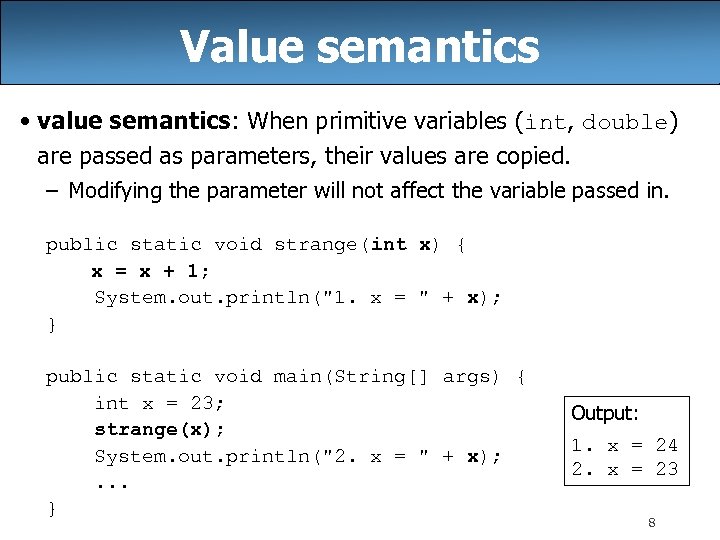
Value semantics • value semantics: When primitive variables (int, double) are passed as parameters, their values are copied. – Modifying the parameter will not affect the variable passed in. public static void strange(int x) { x = x + 1; System. out. println("1. x = " + x); } public static void main(String[] args) { int x = 23; strange(x); System. out. println("2. x = " + x); . . . } Output: 1. x = 24 2. x = 23 8
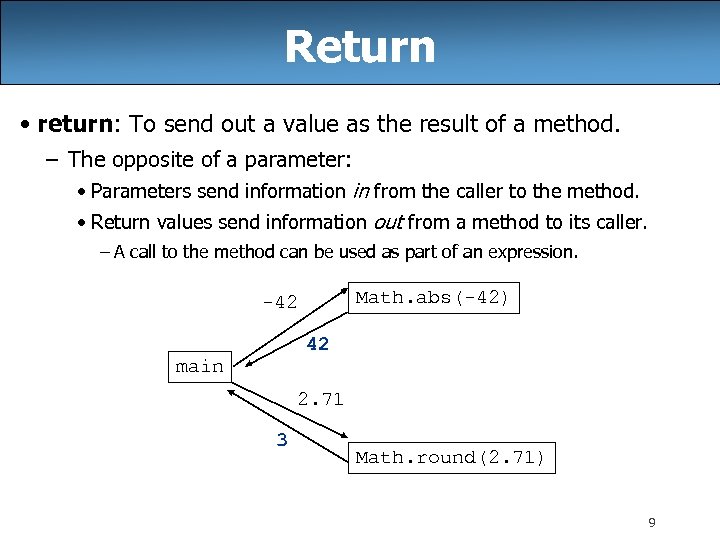
Return • return: To send out a value as the result of a method. – The opposite of a parameter: • Parameters send information in from the caller to the method. • Return values send information out from a method to its caller. – A call to the method can be used as part of an expression. Math. abs(-42) -42 42 main 2. 71 3 Math. round(2. 71) 9
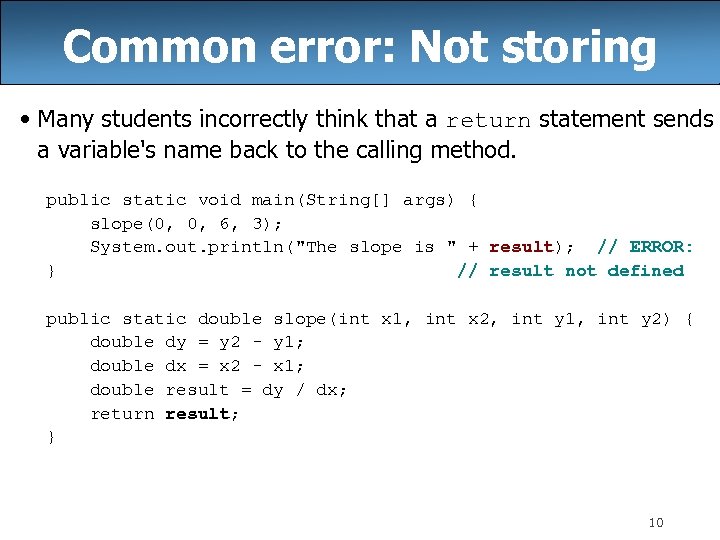
Common error: Not storing • Many students incorrectly think that a return statement sends a variable's name back to the calling method. public static void main(String[] args) { slope(0, 0, 6, 3); System. out. println("The slope is " + result); // ERROR: } // result not defined public static double slope(int x 1, int x 2, int y 1, int y 2) { double dy = y 2 - y 1; double dx = x 2 - x 1; double result = dy / dx; return result; } 10
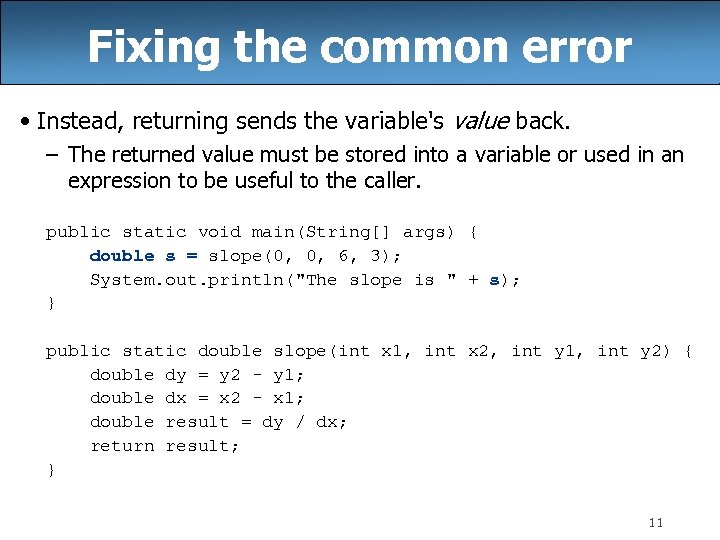
Fixing the common error • Instead, returning sends the variable's value back. – The returned value must be stored into a variable or used in an expression to be useful to the caller. public static void main(String[] args) { double s = slope(0, 0, 6, 3); System. out. println("The slope is " + s); } public static double slope(int x 1, int x 2, int y 1, int y 2) { double dy = y 2 - y 1; double dx = x 2 - x 1; double result = dy / dx; return result; } 11
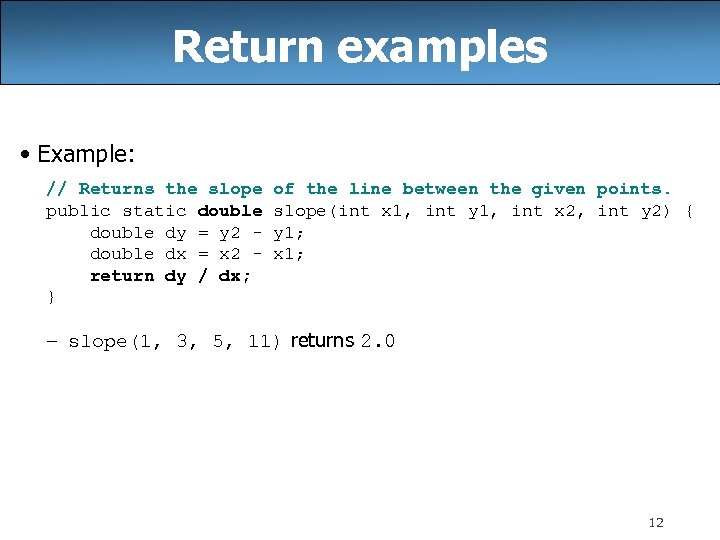
Return examples • Example: // Returns the slope public static double dy = y 2 double dx = x 2 return dy / dx; } of the line between the given points. slope(int x 1, int y 1, int x 2, int y 2) { y 1; x 1; – slope(1, 3, 5, 11) returns 2. 0 12
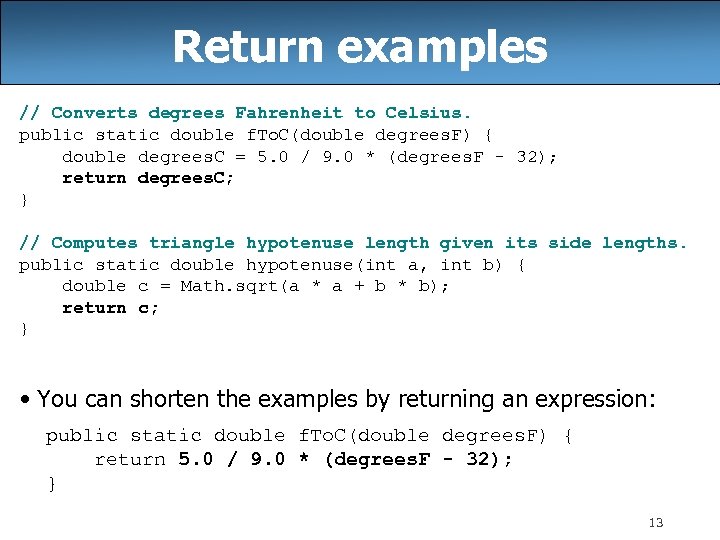
Return examples // Converts degrees Fahrenheit to Celsius. public static double f. To. C(double degrees. F) { double degrees. C = 5. 0 / 9. 0 * (degrees. F - 32); return degrees. C; } // Computes triangle hypotenuse length given its side lengths. public static double hypotenuse(int a, int b) { double c = Math. sqrt(a * a + b * b); return c; } • You can shorten the examples by returning an expression: public static double f. To. C(double degrees. F) { return 5. 0 / 9. 0 * (degrees. F - 32); } 13
![Find the errors Public class Parameters{ public static void main(String[] args){ double bubble=867. 53,](https://present5.com/presentation/1c55b0298d7f9208306c22635749b8ad/image-14.jpg "Find the errors Public class Parameters{ public static void main(String[] args){ double bubble=867. 53,")
Find the errors Public class Parameters{ public static void main(String[] args){ double bubble=867. 53, x=10. 01, y=5. 3; printer(double x, double y); printer(x); printer(“barack”, “obama”); System. out. println(“z = “ + z); } public static void printer(x, y){ int z = 5; System. out. println(“x = “ + double x+ “ and y= “+y); System. out. println(“The value from main is “+bubble); . }} 14
![Find the errors Public class Parameters{ public static void main(String[] args){ double bubble=867. 53,](https://present5.com/presentation/1c55b0298d7f9208306c22635749b8ad/image-15.jpg "Find the errors Public class Parameters{ public static void main(String[] args){ double bubble=867. 53,")
Find the errors Public class Parameters{ public static void main(String[] args){ double bubble=867. 53, x=10. 01, y=5. 3; printer(double x, double y); printer(x); // need two arguments. printer(“barack”, “obama”); // not right types System. out. println(“z = “ + z); // z is local to //printer } public static void printer(x, y){ int z = 5; System. out. println(“x = “ + double x+ “ and y= “+y); System. out. println(“The value from main is “+bubble); }} 15
![Corrected Version public class Parameters{ public static void main(String[] args){ double bubble=867. 53, x=10.](https://present5.com/presentation/1c55b0298d7f9208306c22635749b8ad/image-16.jpg "Corrected Version public class Parameters{ public static void main(String[] args){ double bubble=867. 53, x=10.")
Corrected Version public class Parameters{ public static void main(String[] args){ double bubble=867. 53, x=10. 01, y=5. 3; printer(double x, double y); printer(x, y); // need two arguments. printer(“barack”, “obama”); // not right types int z=8; System. out. println(“z = “ + z); // z is local to printer } public static void printer(double x, double y){ int z = 5; System. out. println(“x = “ + double x+ “ and y= “+y); System. out. println(“The value from main is “+bubble); 16 }}
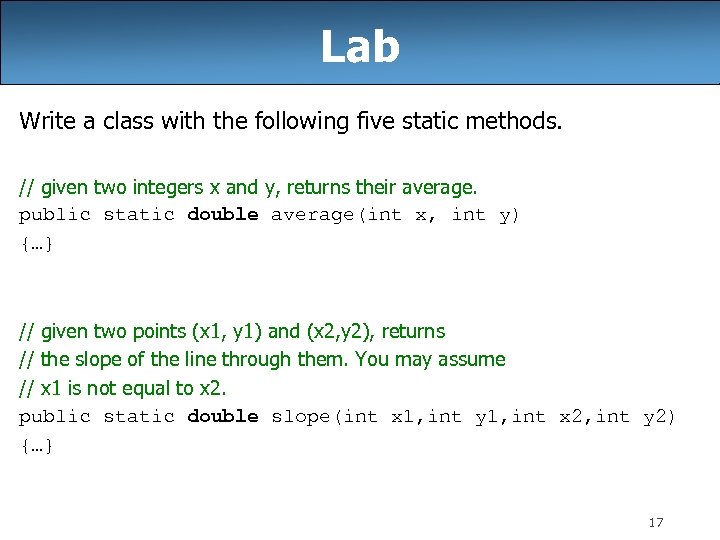
Lab Write a class with the following five static methods. // given two integers x and y, returns their average. public static double average(int x, int y) {…} // given two points (x 1, y 1) and (x 2, y 2), returns // the slope of the line through them. You may assume // x 1 is not equal to x 2. public static double slope(int x 1, int y 1, int x 2, int y 2) {…} 17
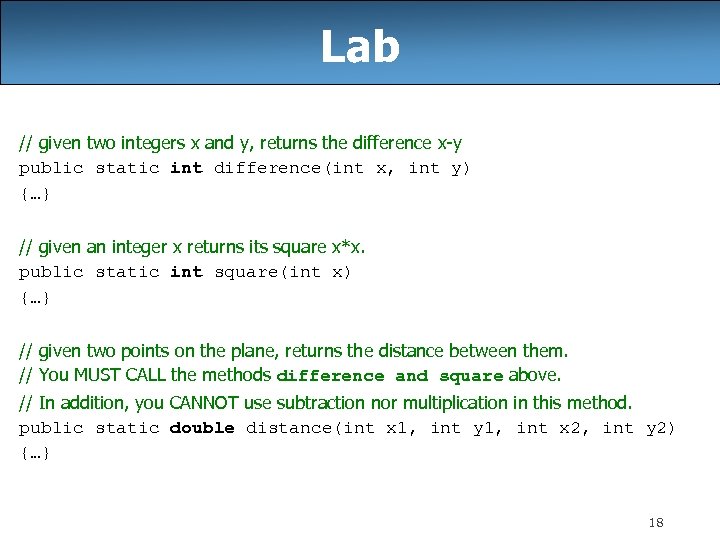
Lab // given two integers x and y, returns the difference x-y public static int difference(int x, int y) {…} // given an integer x returns its square x*x. public static int square(int x) {…} // given two points on the plane, returns the distance between them. // You MUST CALL the methods difference and square above. // In addition, you CANNOT use subtraction nor multiplication in this method. public static double distance(int x 1, int y 1, int x 2, int y 2) {…} 18
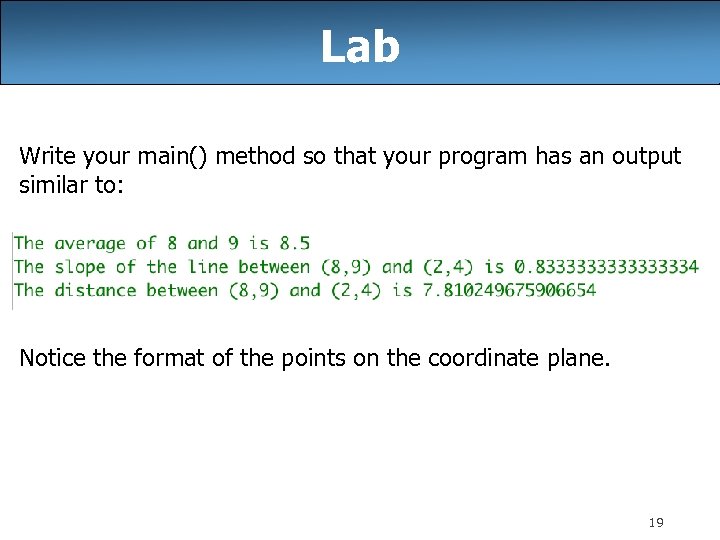
Lab Write your main() method so that your program has an output similar to: Notice the format of the points on the coordinate plane. 19
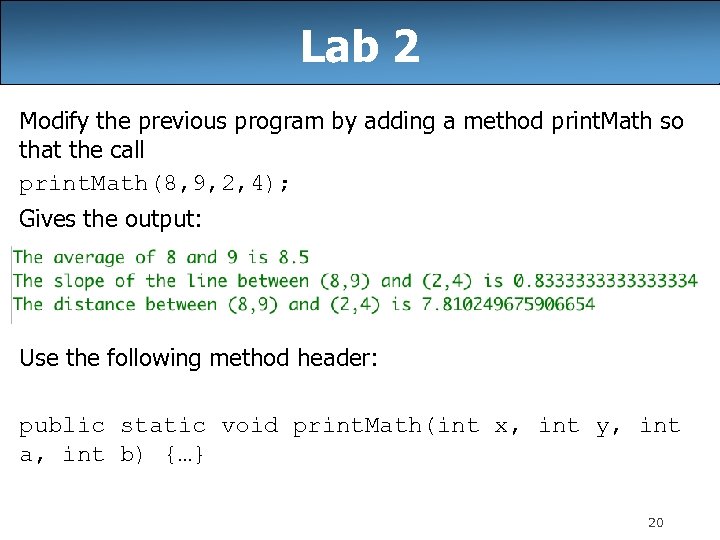
Lab 2 Modify the previous program by adding a method print. Math so that the call print. Math(8, 9, 2, 4); Gives the output: Use the following method header: public static void print. Math(int x, int y, int a, int b) {…} 20
Скачать презентацию Lecture 3 Method Parameters Building Java Programs A
1c55b0298d7f9208306c22635749b8ad.ppt