 Скачать презентацию LECTURE 3 GOALS AND OBJECTIVES ANNA N KONDAKOVA
Lecture 2 - Goals and Objectives + models.pptx
- Количество слайдов: 28




LECTURE 3: GOALS AND OBJECTIVES ANNA N. KONDAKOVA, HIGHER SCHOOL OF THE HUMANITIES, SOCIAL STUDIES AND INTERNATIONAL COMMUNICATION, NARFU
LECTURE OUTLINE Definitions and characteristics of goals Characteristics of objectives Goals vs objectives Variety of CEFR objectives Frameworks for writing goals and objectives
GOAL DEFINITION Broad statements that provide signposts for course development (Nunan and Lamb, 2001) General statements concerning desirable and attainable course purposes and aims based on perceived language and situation needs (Brown, 1995)
Do we write goals and objectives prior to a course?
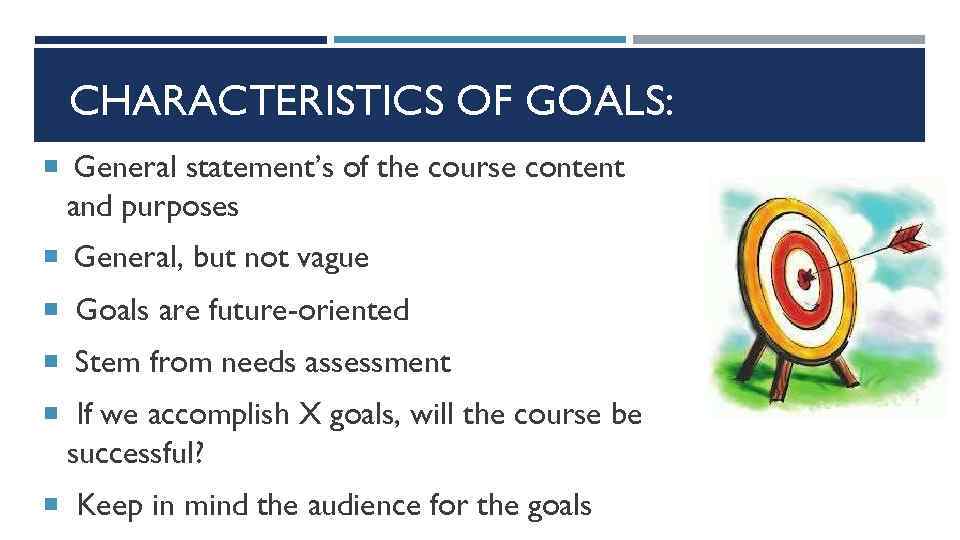
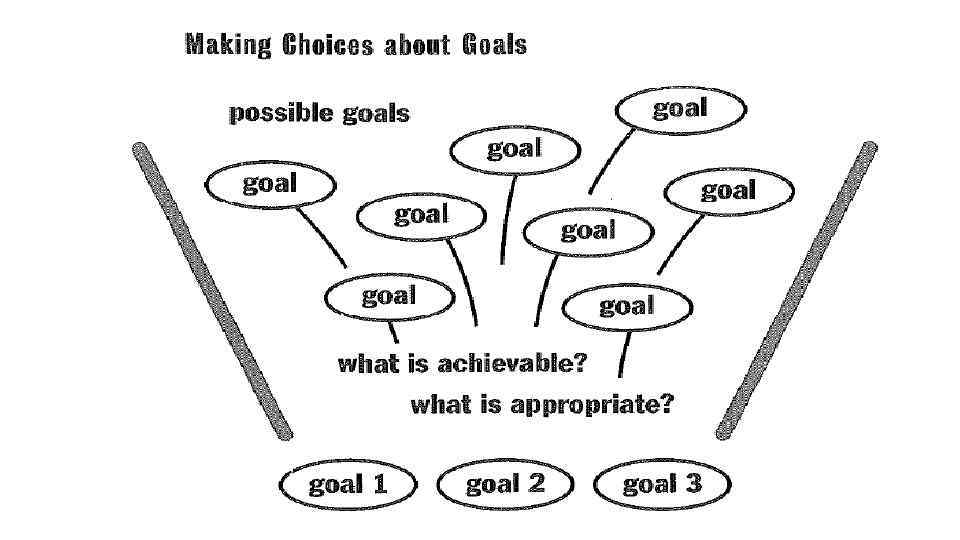
CHARACTERISTICS OF GOALS: General statement’s of the course content and purposes General, but not vague Goals are future-oriented Stem from needs assessment If we accomplish X goals, will the course be successful? Keep in mind the audience for the goals
JAPAN, EFL COURSE Goal: “To develop students’ basic ability to understand a foreign language and express themselves in it, to deepen their interest in it…” Sometimes looks like a dream…

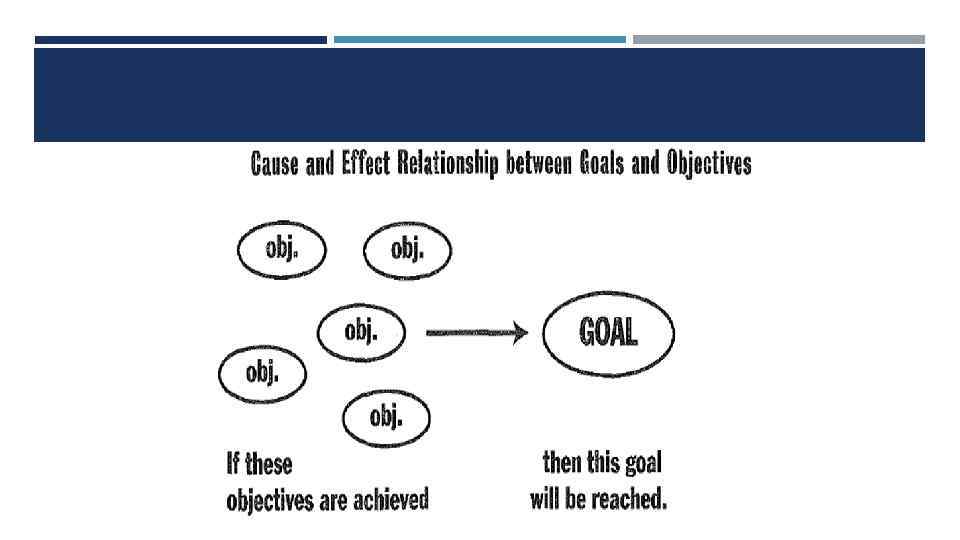
OBJECTIVES VS GOALS Objectives are statements about how the goals will be achieved A cause and effect relationship between goals and objectives Goals are more general and objectives more specific Goals are long-term, and objectives are short-term
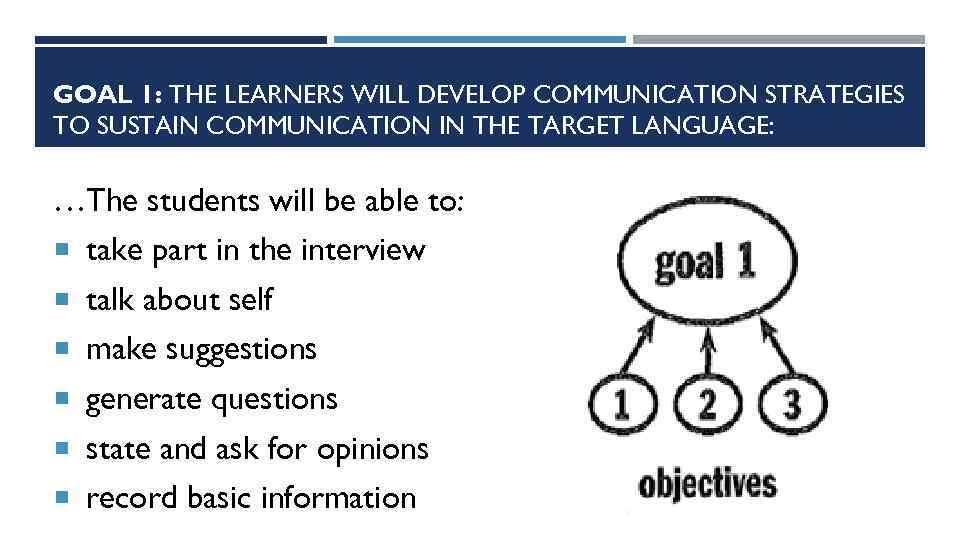
GOAL 1: THE LEARNERS WILL DEVELOP COMMUNICATION STRATEGIES TO SUSTAIN COMMUNICATION IN THE TARGET LANGUAGE: …The students will be able to: take part in the interview talk about self make suggestions generate questions state and ask for opinions record basic information
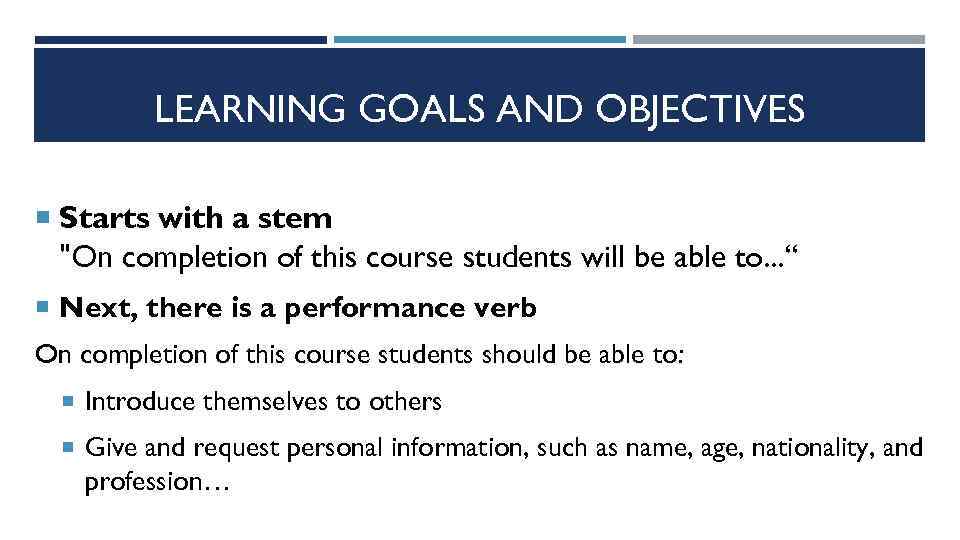
LEARNING GOALS AND OBJECTIVES Starts with a stem "On completion of this course students will be able to. . . “ Next, there is a performance verb On completion of this course students should be able to: Introduce themselves to others Give and request personal information, such as name, age, nationality, and profession…
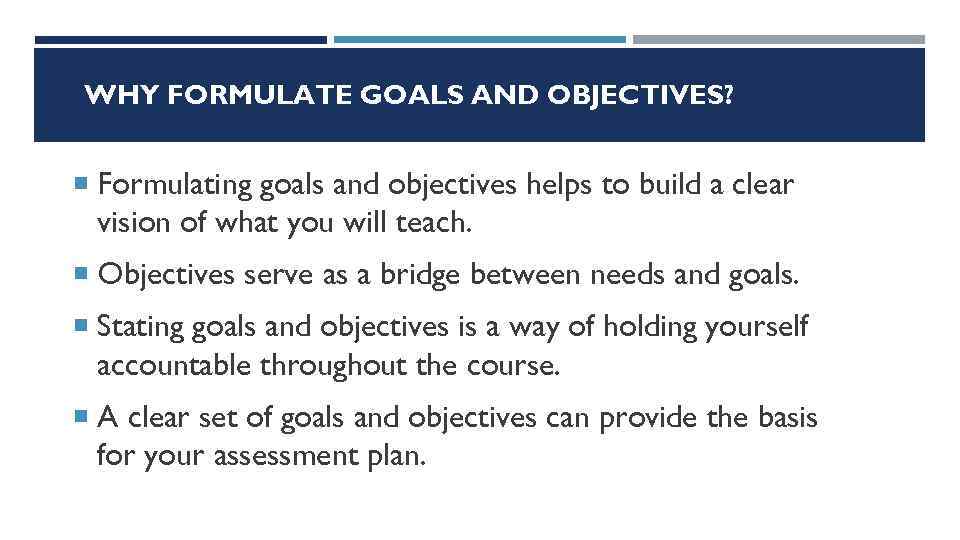
WHY FORMULATE GOALS AND OBJECTIVES? Formulating goals and objectives helps to build a clear vision of what you will teach. Objectives serve as a bridge between needs and goals. Stating goals and objectives is a way of holding yourself accountable throughout the course. A clear set of goals and objectives can provide the basis for your assessment plan.
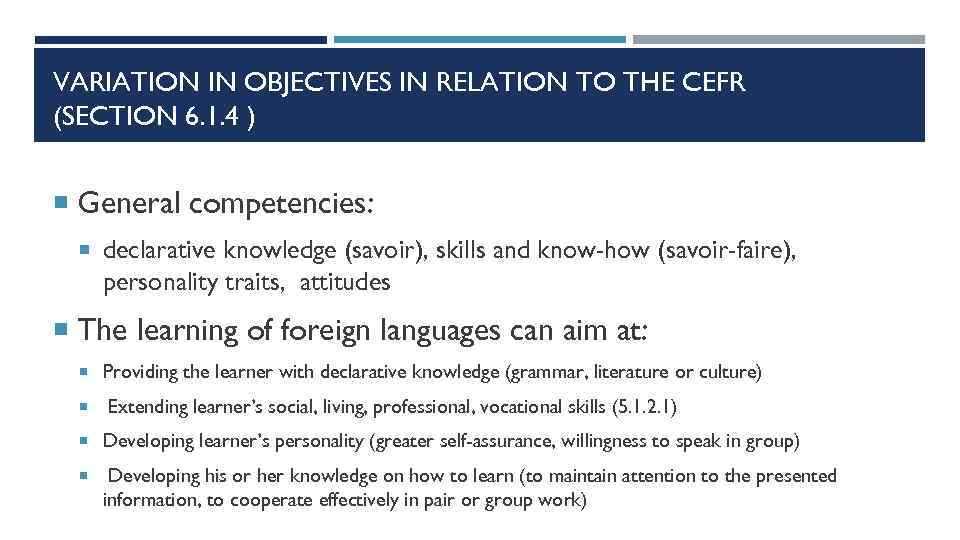
VARIATION IN OBJECTIVES IN RELATION TO THE CEFR (SECTION 6. 1. 4 ) General competencies: declarative knowledge (savoir), skills and know-how (savoir-faire), personality traits, attitudes The learning of foreign languages can aim at: Providing the learner with declarative knowledge (grammar, literature or culture) Extending learner’s social, living, professional, vocational skills (5. 1. 2. 1) Developing learner’s personality (greater self-assurance, willingness to speak in group) Developing his or her knowledge on how to learn (to maintain attention to the presented information, to cooperate effectively in pair or group work)
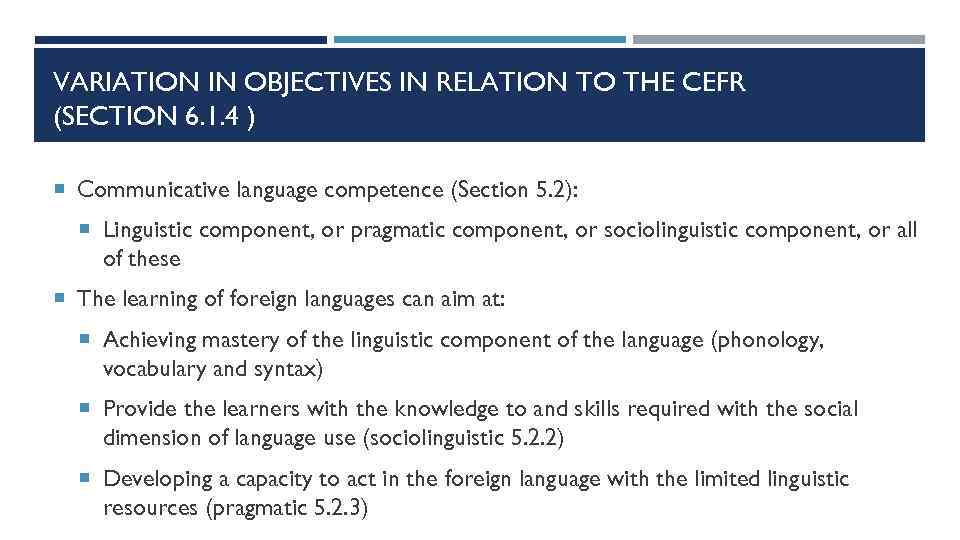
VARIATION IN OBJECTIVES IN RELATION TO THE CEFR (SECTION 6. 1. 4 ) Communicative language competence (Section 5. 2): Linguistic component, or pragmatic component, or sociolinguistic component, or all of these The learning of foreign languages can aim at: Achieving mastery of the linguistic component of the language (phonology, vocabulary and syntax) Provide the learners with the knowledge to and skills required with the social dimension of language use (sociolinguistic 5. 2. 2) Developing a capacity to act in the foreign language with the limited linguistic resources (pragmatic 5. 2. 3)
VARIATION IN OBJECTIVES IN RELATION TO THE CEFR (SECTION 6. 1. 4 ) In terms of better performance in one or more specific language activities (4. 4): reception, production, interaction or mediation The learning of foreign languages can aim at: Having effective results in in receptive activities (reading or listening) or mediation (translating or interpreting) or face-to-face-interaction (speaking and listening) It is possible to attach significantly greater importance to one of the aspects, and it will affect the entire process of course design: choice of content and learning tasks, selection of materials, deciding on the progression and remedial actions needed
VARIATION IN OBJECTIVES IN RELATION TO THE CEFR (SECTION 6. 1. 4 ) In terms of optimal functional operation in a given domain: (4. 1. 1. ) : public, occupational, personal, educational The learning of foreign languages can aim at: Performing a job better Helping with studies Facilitating life in a foreign country
The goal of this course is students’ acquisition and control of the sound structures and sentence patterns of basic introductory English. 1. GRAMMAR – To introduce students to the verb “be” in the simple present tense and how to add articles, adjectives, and nouns to it and to introduce students to other simple present tense statements, negatives, questions, and short answers, as well as imperatives, adverbs of frequency, and simple modals at the introductory level.
2. VOCABULARY – To introduce students to basic English vocabulary including greetings, family members, numbers, places in a home, names of cities, countries, continents, as well as daily activities, transportation, clothes, colors, foods, parts of the body, illnesses, and holidays.
3. LISTENING – To develop students’ understanding of basic spoken English words through focused listening and understanding of general and specific details in simple conversations. 4. SPEAKING/PRONUNCIATION – To get students to focus on specific sounds such as /r/, /sh/, /ch/ and final /-s/ as well as intonation of basic vocabulary or word stress and to ask yes/no questions politely and provide logical responses.
5. READING/WRITING – To have students understand basic sentence structure and content in introductory level reading passages and write simple sentences to describe people, places, jobs, abilities, and clothes, among other basic themes.
KASA MODEL FOR GOALS Knowledge: what students will know and understand Attitude: address the affective and values-based dimension of learning Skills: what students can do with the language Awareness: what students need to be aware of when learning a language
STERN MODEL (1992) FOR GOALS Proficiency: what students will be able to do with the language Cognitive: includes explicit knowledge, information and conceptual learning about language Affective: these include achieving positive attitudes toward the target language and culture Transfer: how what one does or learns in the classroom can be transferred outside of the classroom
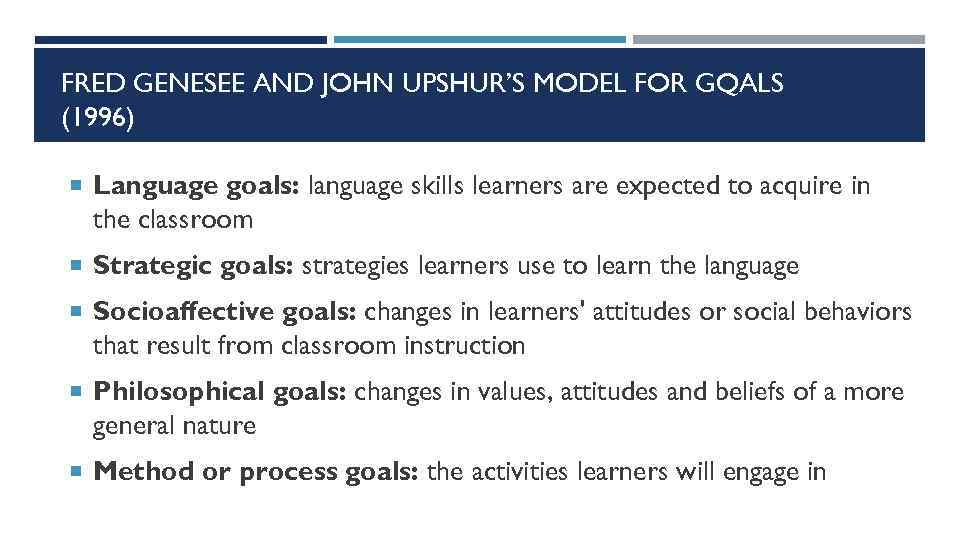
FRED GENESEE AND JOHN UPSHUR’S MODEL FOR GQALS (1996) Language goals: language skills learners are expected to acquire in the classroom Strategic goals: strategies learners use to learn the language Socioaffective goals: changes in learners' attitudes or social behaviors that result from classroom instruction Philosophical goals: changes in values, attitudes and beliefs of a more general nature Method or process goals: the activities learners will engage in
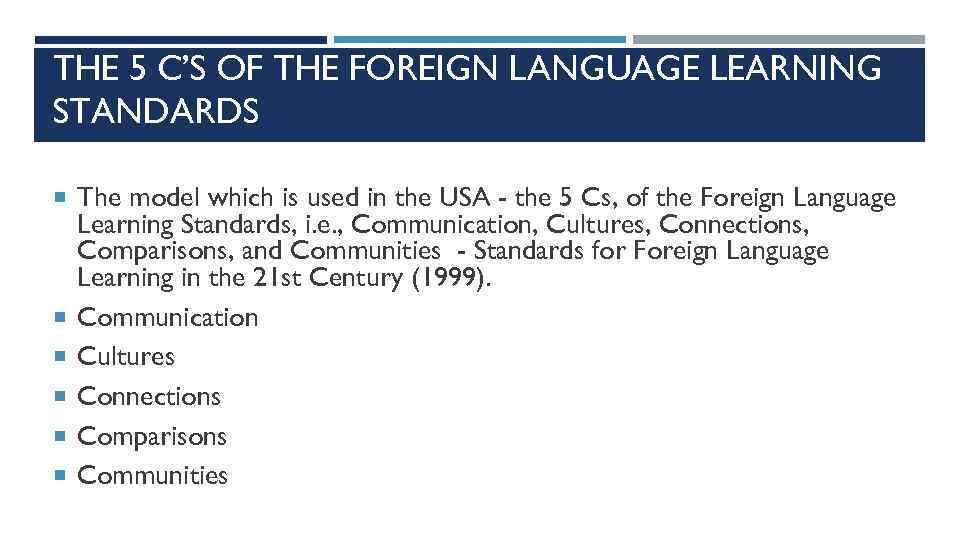
THE 5 C’S OF THE FOREIGN LANGUAGE LEARNING STANDARDS The model which is used in the USA - the 5 Cs, of the Foreign Language Learning Standards, i. e. , Communication, Cultures, Connections, Comparisons, and Communities - Standards for Foreign Language Learning in the 21 st Century (1999). Communication Cultures Connections Comparisons Communities
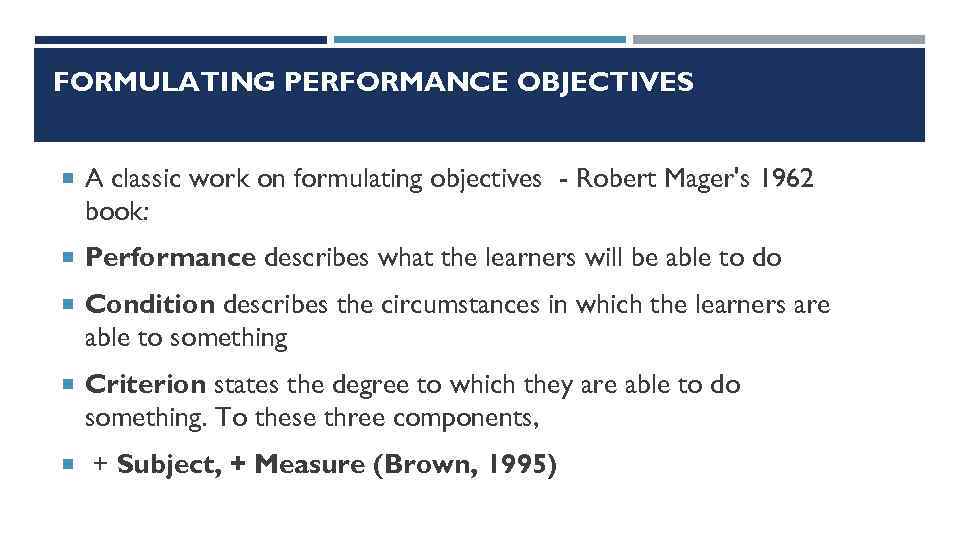
FORMULATING PERFORMANCE OBJECTIVES A classic work on formulating objectives - Robert Mager's 1962 book: Performance describes what the learners will be able to do Condition describes the circumstances in which the learners are able to something Criterion states the degree to which they are able to do something. To these three components, + Subject, + Measure (Brown, 1995)
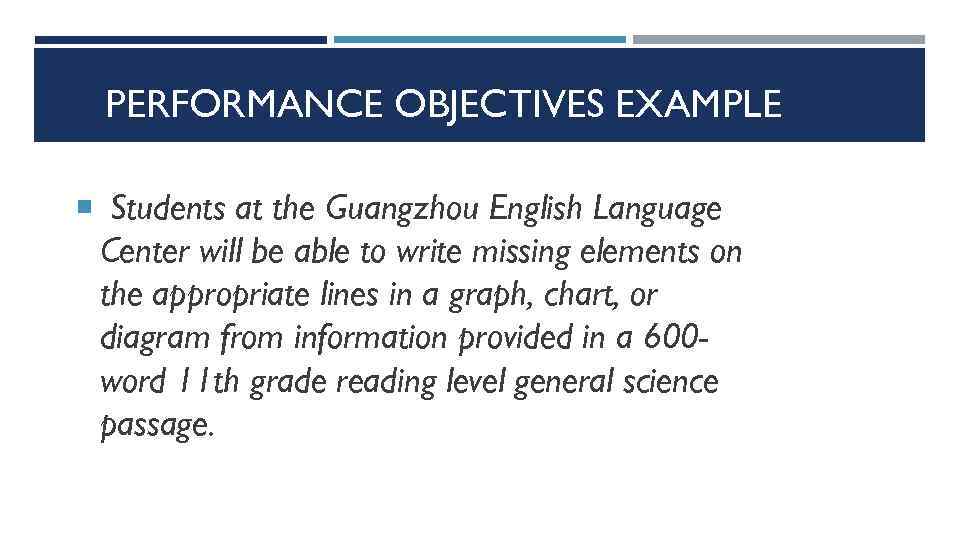
PERFORMANCE OBJECTIVES EXAMPLE Students at the Guangzhou English Language Center will be able to write missing elements on the appropriate lines in a graph, chart, or diagram from information provided in a 600 word 11 th grade reading level general science passage.
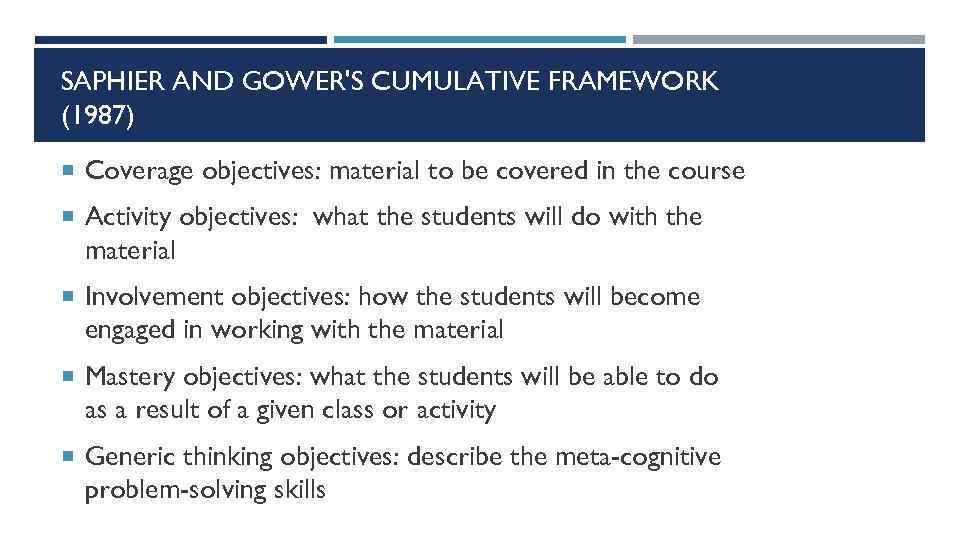
SAPHIER AND GOWER'S CUMULATIVE FRAMEWORK (1987) Coverage objectives: material to be covered in the course Activity objectives: what the students will do with the material Involvement objectives: how the students will become engaged in working with the material Mastery objectives: what the students will be able to do as a result of a given class or activity Generic thinking objectives: describe the meta-cognitive problem-solving skills
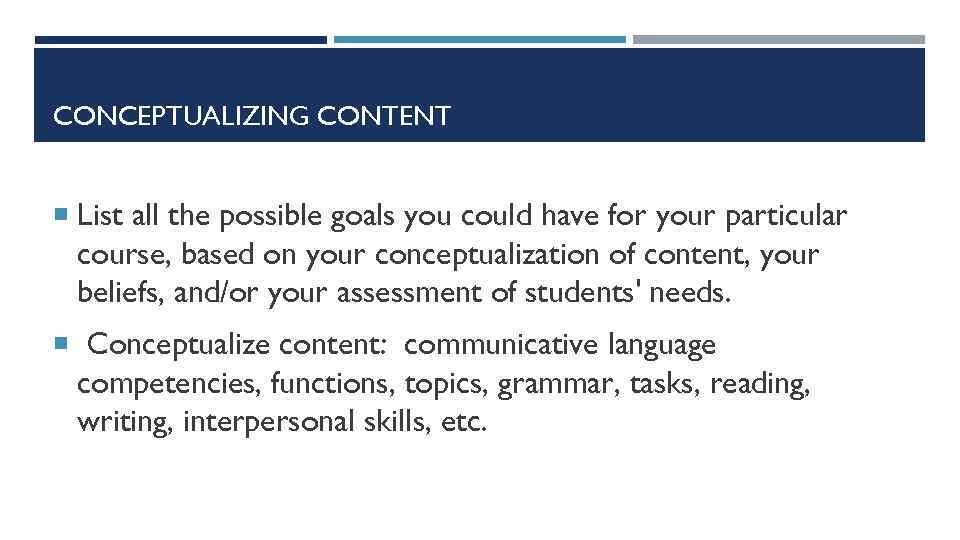
CONCEPTUALIZING CONTENT List all the possible goals you could have for your particular course, based on your conceptualization of content, your beliefs, and/or your assessment of students' needs. Conceptualize content: communicative language competencies, functions, topics, grammar, tasks, reading, writing, interpersonal skills, etc.
Скачать презентацию LECTURE 3 GOALS AND OBJECTIVES ANNA N KONDAKOVA
Lecture 2 - Goals and Objectives + models.pptx