 Скачать презентацию LECTURE 3 ENGLISH VOCABULARY AS A SYSTEM OUTLINE
Lectures 3-4.ppt
- Количество слайдов: 11



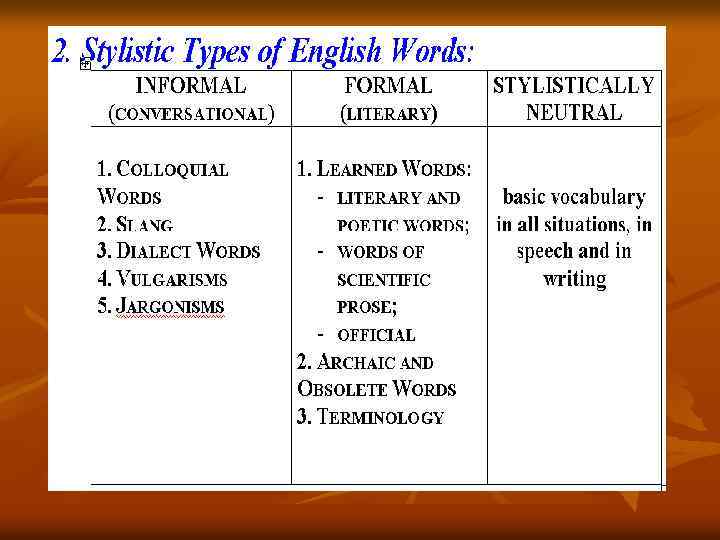
LECTURE 3 ENGLISH VOCABULARY AS A SYSTEM OUTLINE: 1. BASIC FEATURES OF THE MAIN VARIANTS OF ENGLISH LANGUAGE 2. ENGLISH VOCABULARY AS A SYSTEM 3. STYLISTIC TYPES OF
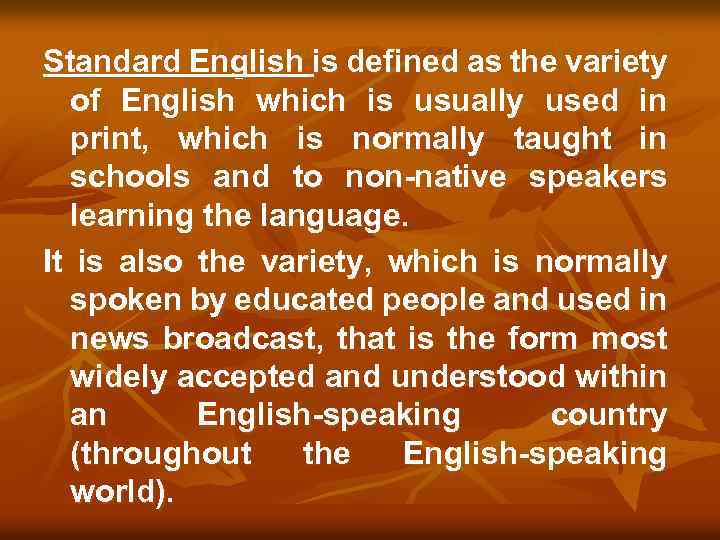
Standard English is defined as the variety of English which is usually used in print, which is normally taught in schools and to non-native speakers learning the language. It is also the variety, which is normally spoken by educated people and used in news broadcast, that is the form most widely accepted and understood within an English-speaking country (throughout the English-speaking world).

Variants of English: British English, Scottish English, Irish English American English, Canadian English, Australian English, New Zealand English, South African English and Indian English
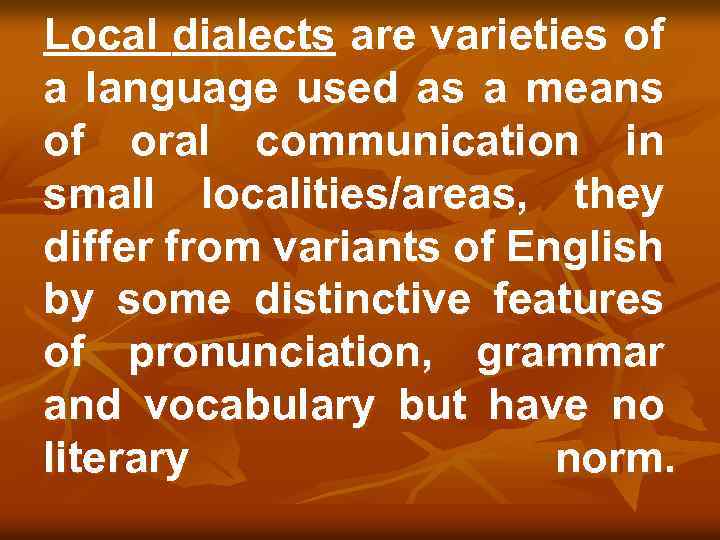
Local dialects are varieties of a language used as a means of oral communication in small localities/areas, they differ from variants of English by some distinctive features of pronunciation, grammar and vocabulary but have no literary norm.

Dialect is a language variety peculiar to one region of the country in which the language is spoken. A dialect is traditionally opposed to Standard English.
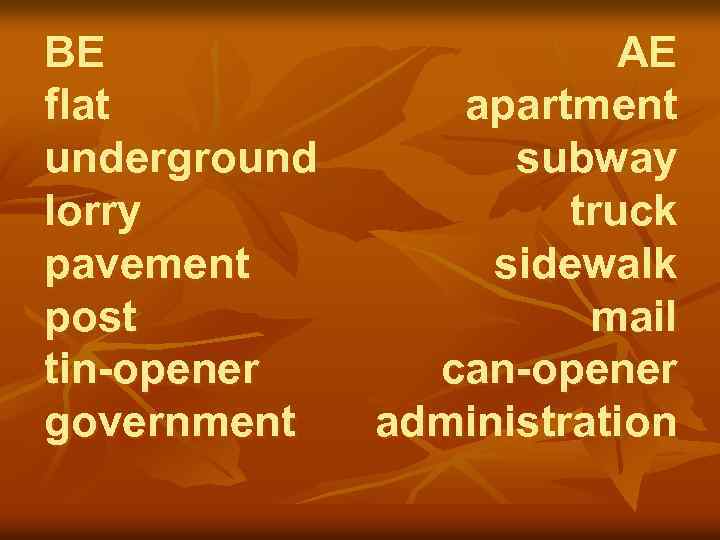
BE AE flat apartment underground subway lorry truck pavement sidewalk post mail tin-opener can-opener government administration
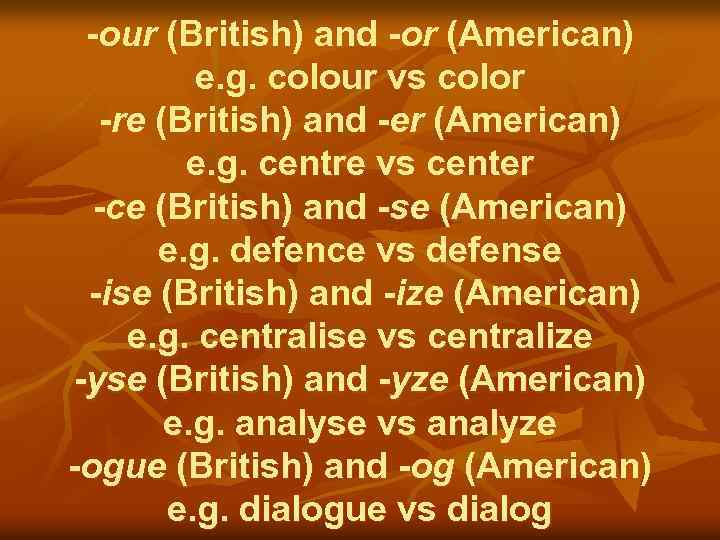
-our (British) and -or (American) e. g. colour vs color -re (British) and -er (American) e. g. centre vs center -ce (British) and -se (American) e. g. defence vs defense -ise (British) and -ize (American) e. g. centralise vs centralize -yse (British) and -yze (American) e. g. analyse vs analyze -ogue (British) and -og (American) e. g. dialogue vs dialog
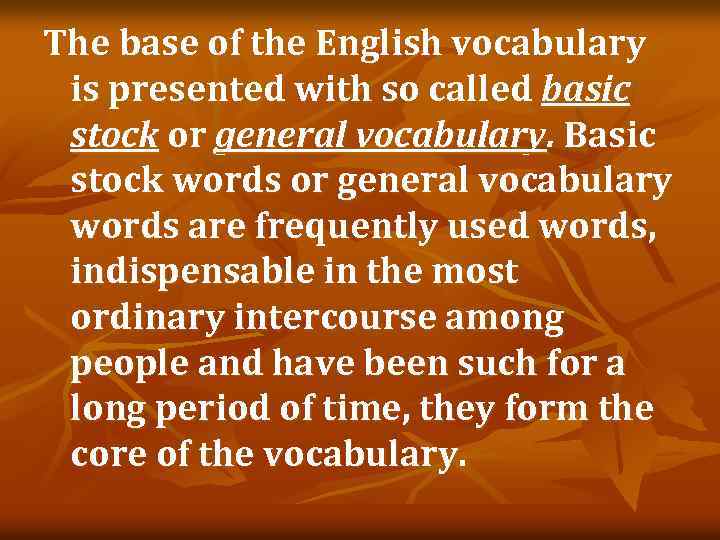
The base of the English vocabulary is presented with so called basic stock or general vocabulary. Basic stock words or general vocabulary words are frequently used words, indispensable in the most ordinary intercourse among people and have been such for a long period of time, they form the core of the vocabulary.
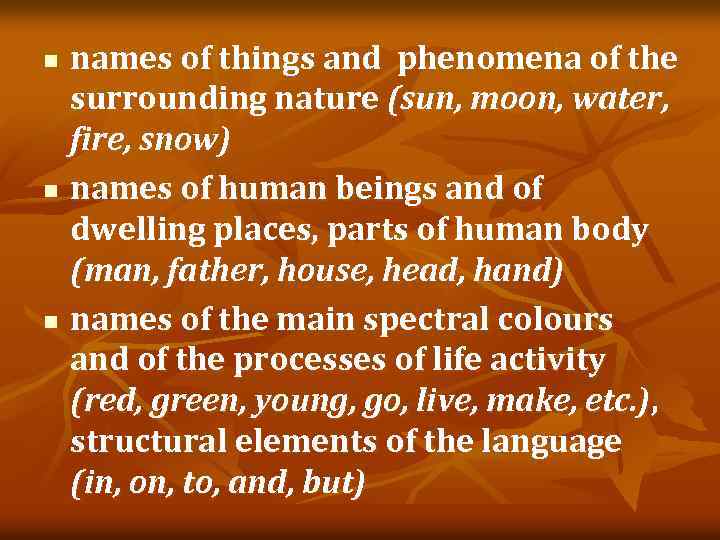
n n n names of things and phenomena of the surrounding nature (sun, moon, water, fire, snow) names of human beings and of dwelling places, parts of human body (man, father, house, head, hand) names of the main spectral colours and of the processes of life activity (red, green, young, go, live, make, etc. ), structural elements of the language (in, on, to, and, but)
PRACTICE № 2: 1. WITH THE HELP OF A DICTIONARY DEFINE THE STYLISTIC VALUE OF EACH OF THE FOLLOWING WORDS: TO DIE, TO KICK THE BUCKET, TO PASS AWAY, TO DECEASE, TO EXPIRE. 2. GROUP THE FOLLOWING WORDS ACCORDING TO THEIR ORIGIN: MACHINE, MULE, CHOCOLATE, TELEPHONE, WIGWAM, KANGAROO, BEAUTY, UMBRELLA, GROTTO, LOTTERY, SONATA, SONNET, KARATE, ORANGE, PUNCH, MANIFEST, UMBRELLA, VIOLIN, BANANA, COFFEE, CANOE, HAMMOCK, HURRICANE, TOBACCO, TANK, GUITAR, SPUTNIK, JUNGLE, PYJAMAS, INFLUENZA, FIASCO, KINDERGARTEN, BORSCH, RUCKSACK, POODLE, MOSQUITO, POTATO, HAMBURGER, LAGER, REEF, DECK, LANDSCAPE, ROSTER, COACH, MAZURKA, POLKA, SUGAR, CANDY, SHAMPOO, GEISHA, KIMONO, HAREM, SOFA, ASSASSIN, ZERO, CRUISE, EASEL, KIOSK, YOGHURT, BAZAAR, CARAVAN, BAMBOO, KETCHUP, TEA, KUNG FU, PERESTROIKA, SAMOVAR, SOLO, COCOA, KHAKI. 3. EXPLAIN THE ETYMOLOGY OF THE FOLLOWING LEXICAL UNITS: GUARD, MACARONI, RURAL, SCHOOL, MOUSTACHE, MILLENNIUM, POULTRY, LANDSCAPE.
Скачать презентацию LECTURE 3 ENGLISH VOCABULARY AS A SYSTEM OUTLINE
Lectures 3-4.ppt