


 Скачать презентацию Lecture 29 — Polymorphisms in Human DNA Sequences
6597519cc74ac193573c50eb3c02257b.ppt
- Количество слайдов: 26
 Lecture 29 - Polymorphisms in Human DNA Sequences • SNPs • SSRs
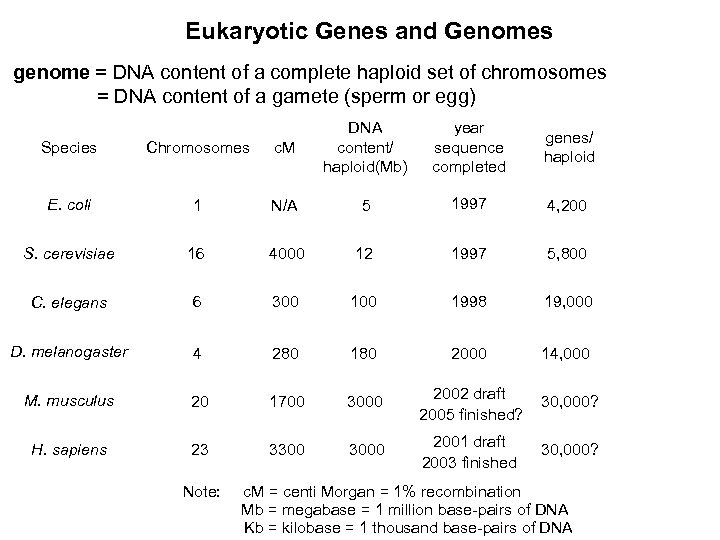 Eukaryotic Genes and Genomes genome = DNA content of a complete haploid set of chromosomes = DNA content of a gamete (sperm or egg) Species Chromosomes c. M DNA content/ haploid(Mb) E. coli 1 N/A 5 1997 4, 200 S. cerevisiae 16 4000 12 1997 5, 800 C. elegans 6 300 1998 19, 000 D. melanogaster 4 280 180 2000 14, 000 M. musculus 20 1700 3000 2002 draft 2005 finished? 30, 000? H. sapiens 23 3300 3000 2001 draft 2003 finished 30, 000? Note: year sequence completed genes/ haploid c. M = centi Morgan = 1% recombination Mb = megabase = 1 million base-pairs of DNA Kb = kilobase = 1 thousand base-pairs of DNA
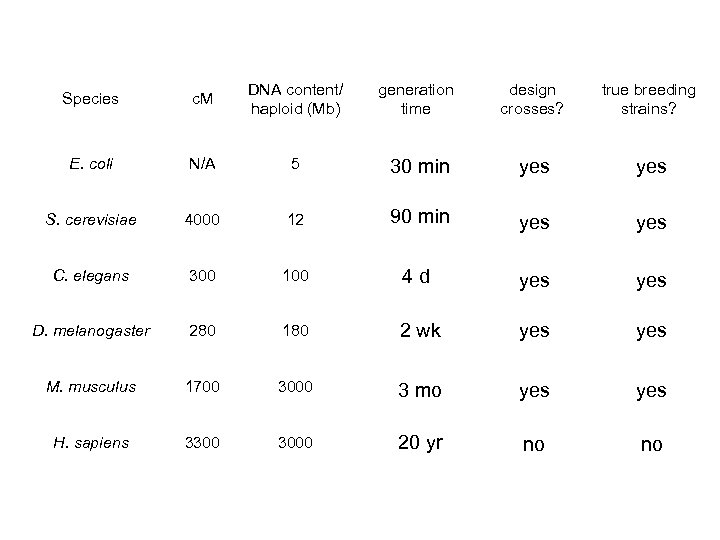 Species c. M DNA content/ haploid (Mb) generation time design crosses? true breeding strains? E. coli N/A 5 30 min yes S. cerevisiae 4000 12 90 min yes C. elegans 300 100 4 d yes D. melanogaster 280 180 2 wk yes M. musculus 1700 3000 3 mo yes H. sapiens 3300 3000 20 yr no no
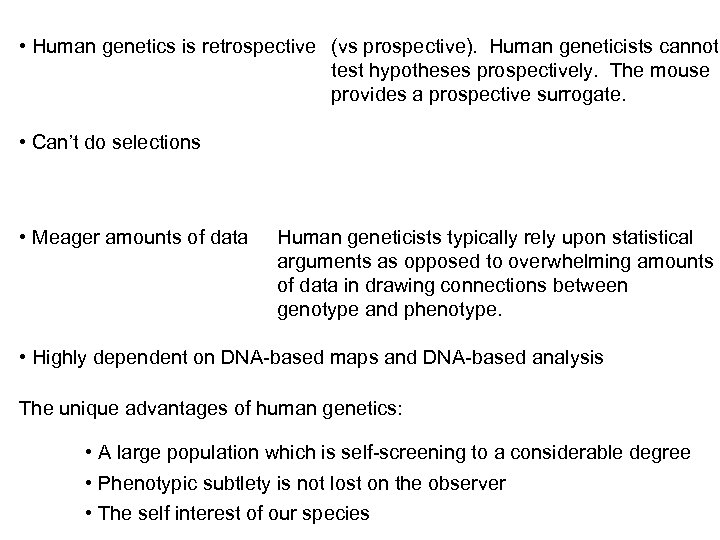 • Human genetics is retrospective (vs prospective). Human geneticists cannot test hypotheses prospectively. The mouse provides a prospective surrogate. • Can’t do selections • Meager amounts of data Human geneticists typically rely upon statistical arguments as opposed to overwhelming amounts of data in drawing connections between genotype and phenotype. • Highly dependent on DNA-based maps and DNA-based analysis The unique advantages of human genetics: • A large population which is self-screening to a considerable degree • Phenotypic subtlety is not lost on the observer • The self interest of our species
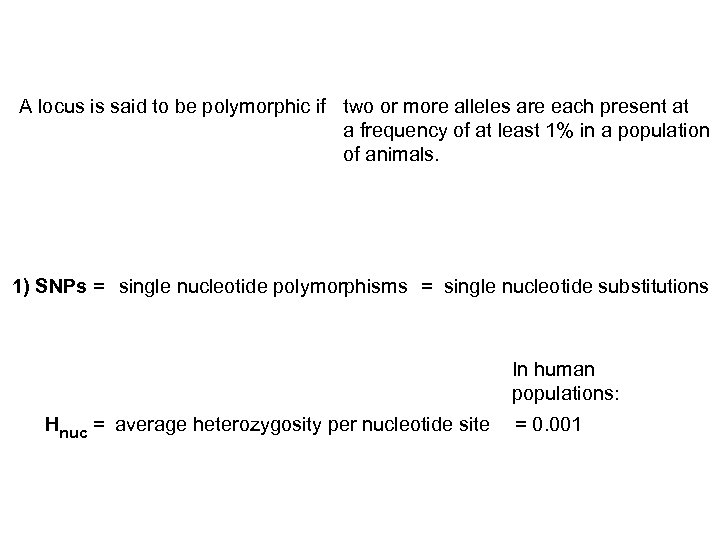 A locus is said to be polymorphic if two or more alleles are each present at a frequency of at least 1% in a population of animals. 1) SNPs = single nucleotide polymorphisms = single nucleotide substitutions In human populations: Hnuc = average heterozygosity per nucleotide site = 0. 001

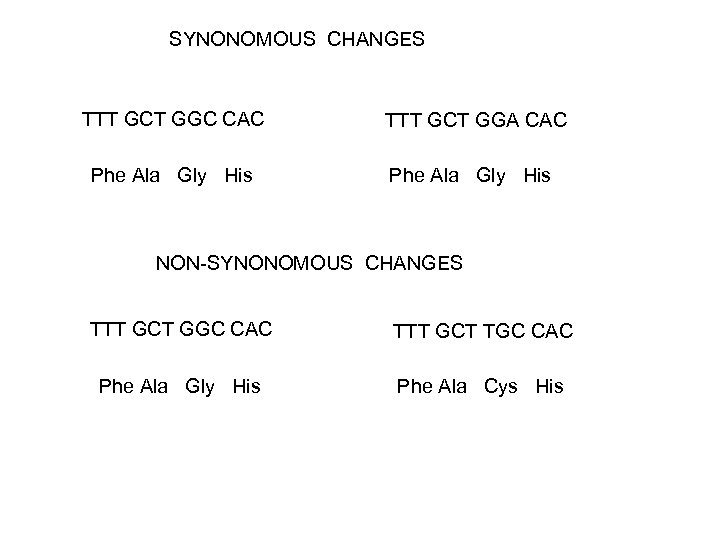 SYNONOMOUS CHANGES TTT GCT GGC CAC TTT GCT GGA CAC Phe Ala Gly His NON-SYNONOMOUS CHANGES TTT GCT GGC CAC TTT GCT TGC CAC Phe Ala Gly His Phe Ala Cys His
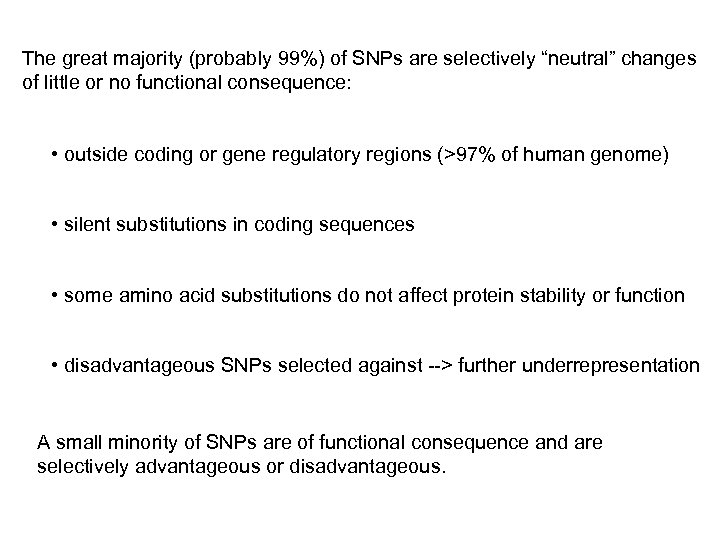 The great majority (probably 99%) of SNPs are selectively “neutral” changes of little or no functional consequence: • outside coding or gene regulatory regions (>97% of human genome) • silent substitutions in coding sequences • some amino acid substitutions do not affect protein stability or function • disadvantageous SNPs selected against --> further underrepresentation A small minority of SNPs are of functional consequence and are selectively advantageous or disadvantageous.
 Affymetrix chip
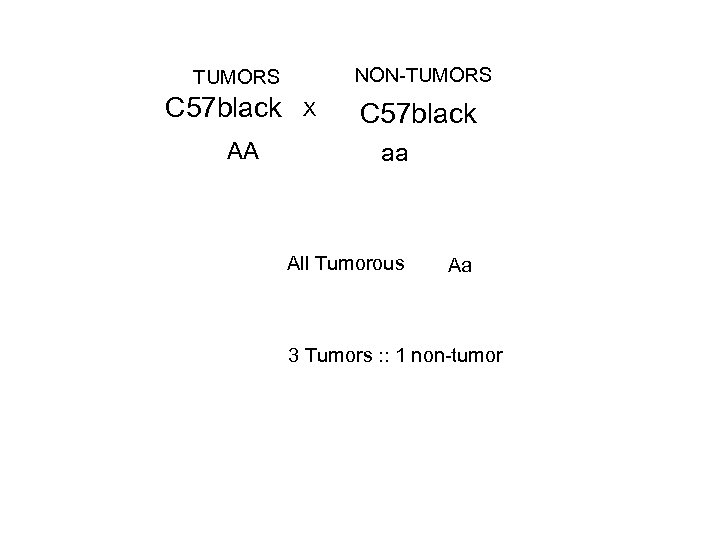 NON-TUMORS C 57 black AA X C 57 black aa All Tumorous Aa 3 Tumors : : 1 non-tumor
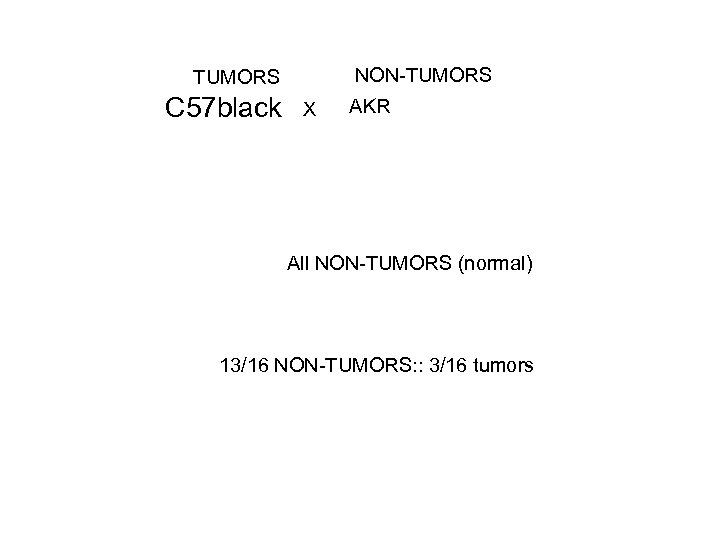 NON-TUMORS C 57 black X AKR All NON-TUMORS (normal) 13/16 NON-TUMORS: : 3/16 tumors
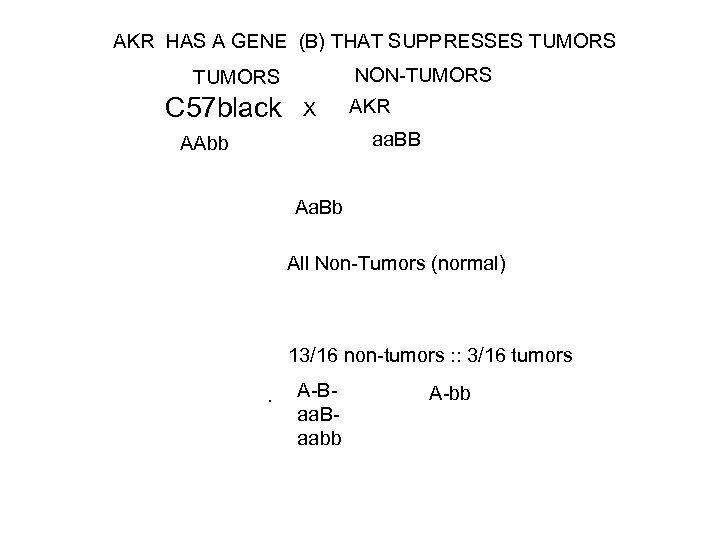 AKR HAS A GENE (B) THAT SUPPRESSES TUMORS NON-TUMORS C 57 black X AKR aa. BB AAbb Aa. Bb All Non-Tumors (normal) 13/16 non-tumors : : 3/16 tumors. A-Baa. Baabb A-bb
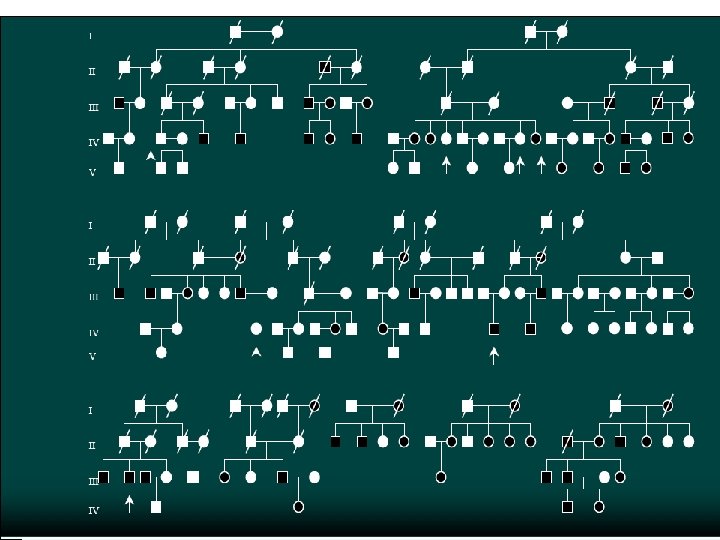
 LACTOSE glucose residue CANDIDATE GENE
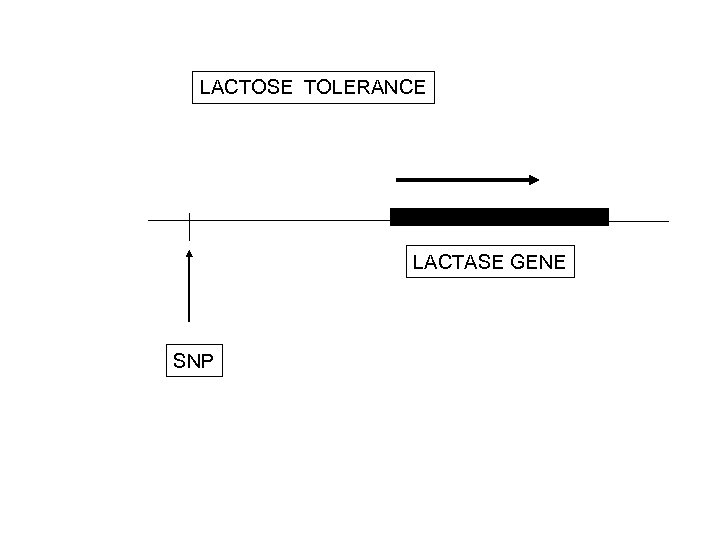
 The enzyme lactase that is located in the villus enterocytes of the small intestine is responsible for digestion of lactose in milk. Lactase activity is high and vital during infancy, but in most mammals, including most humans, lactase activity declines after the weaning phase. In other healthy humans, lactase activity persists at a high level throughout adult life, enabling them to digest lactose as adults. This dominantly inherited genetic trait is known as lactase persistence. The distribution of these different lactase phenotypes in human populations is highly variable and is controlled by a polymorphic element cis-acting to the lactase gene. A putative causal nucleotide change has been identified and occurs on the background of a very extended haplotype that is frequent in Northern Europeans, where lactase persistence is frequent. This single nucleotide polymorphism is located 14 kb upstream from the start of transcription of lactase in an intron of the adjacent gene MCM 6. This change does not, however, explain all the variation in lactase expression.
 LACTOSE TOLERANCE LACTASE GENE SNP
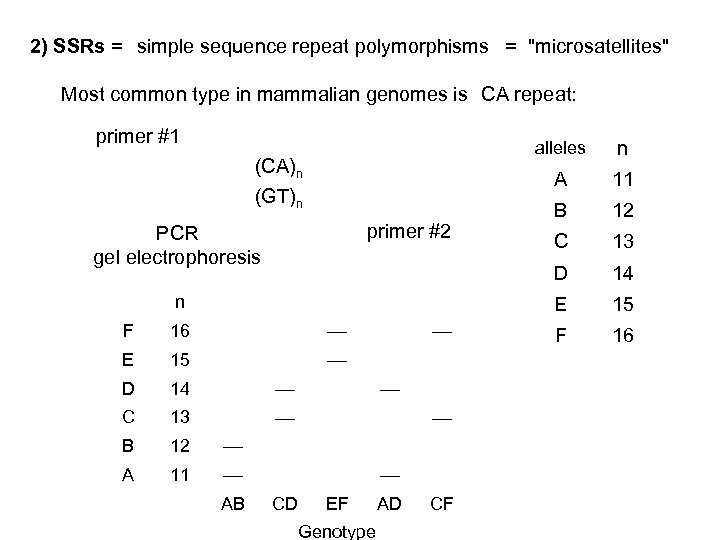 2) SSRs = simple sequence repeat polymorphisms = "microsatellites" Most common type in mammalian genomes is CA repeat: primer #1 alleles A n F 16 E 15 D 14 C 13 B 12 A 11 AB CD EF Genotype AD CF B 12 C 13 14 E primer #2 PCR gel electrophoresis 11 D (CA)n (GT)n n 15 F 16
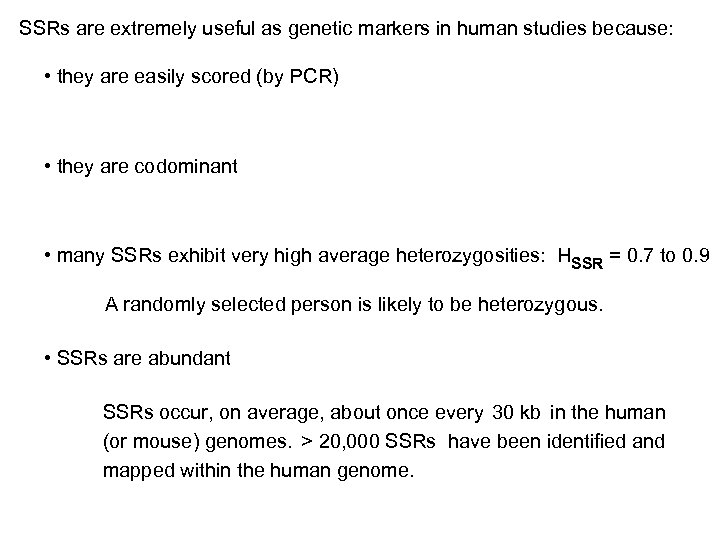 SSRs are extremely useful as genetic markers in human studies because: • they are easily scored (by PCR) • they are codominant • many SSRs exhibit very high average heterozygosities: HSSR = 0. 7 to 0. 9 A randomly selected person is likely to be heterozygous. • SSRs are abundant SSRs occur, on average, about once every 30 kb in the human (or mouse) genomes. > 20, 000 SSRs have been identified and mapped within the human genome.
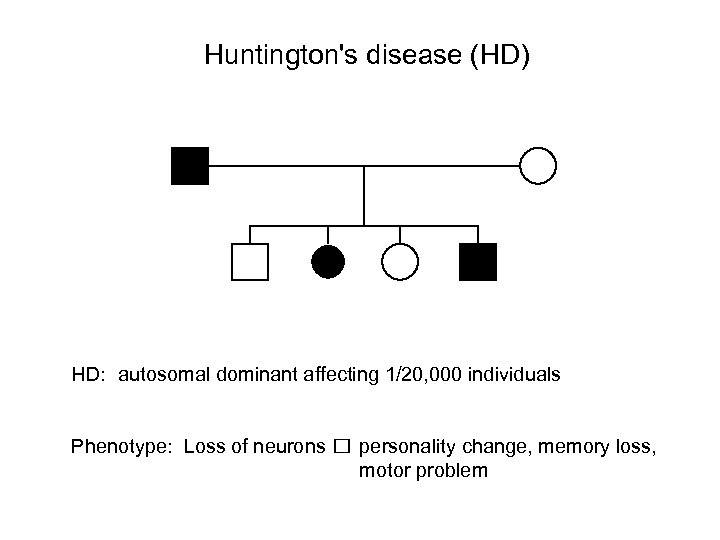 Huntington's disease (HD) HD: autosomal dominant affecting 1/20, 000 individuals Phenotype: Loss of neurons personality change, memory loss, motor problem
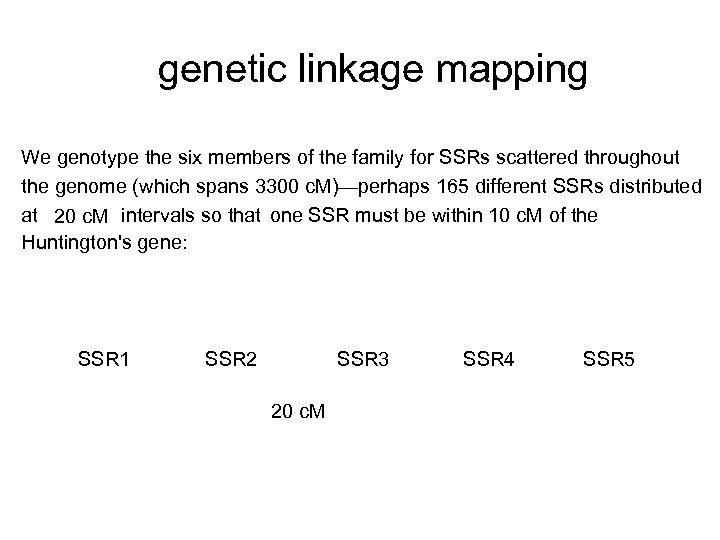 genetic linkage mapping We genotype the six members of the family for SSRs scattered throughout the genome (which spans 3300 c. M)—perhaps 165 different SSRs distributed at 20 c. M intervals so that one SSR must be within 10 c. M of the Huntington's gene: SSR 1 SSR 2 SSR 3 20 c. M SSR 4 SSR 5
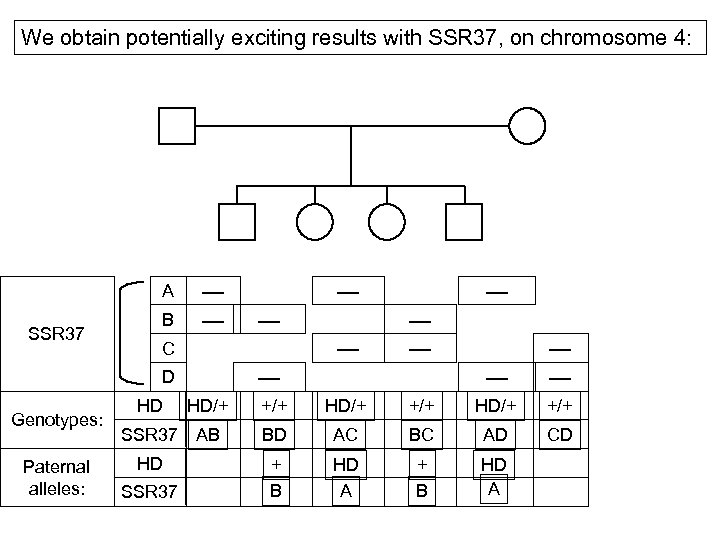 We obtain potentially exciting results with SSR 37, on chromosome 4: A SSR 37 B Paternal alleles: HD SSR 37 HD/+ SSR 37 AB HD C D Genotypes: +/+ HD/+ +/+ BD AC BC AD CD + B HD A