 Скачать презентацию Lecture 29 Conclusions and Final Review Thursday December
6545162ed087a07ea2c0b670bd56d889.ppt
- Количество слайдов: 24



Lecture 29 Conclusions and Final Review Thursday, December 06, 2001 William H. Hsu Department of Computing and Information Sciences, KSU http: //www. cis. ksu. edu/~bhsu Readings: Chapters 1 -10, 13, Mitchell Chapters 14 -21, Russell and Norvig CIS 732: Machine Learning and Pattern Recognition Kansas State University Department of Computing and Information Sciences
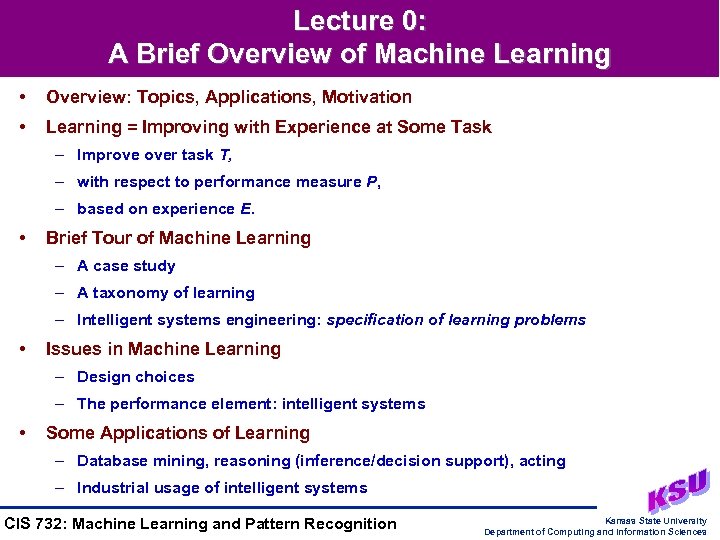
Lecture 0: A Brief Overview of Machine Learning • Overview: Topics, Applications, Motivation • Learning = Improving with Experience at Some Task – Improve over task T, – with respect to performance measure P, – based on experience E. • Brief Tour of Machine Learning – A case study – A taxonomy of learning – Intelligent systems engineering: specification of learning problems • Issues in Machine Learning – Design choices – The performance element: intelligent systems • Some Applications of Learning – Database mining, reasoning (inference/decision support), acting – Industrial usage of intelligent systems CIS 732: Machine Learning and Pattern Recognition Kansas State University Department of Computing and Information Sciences
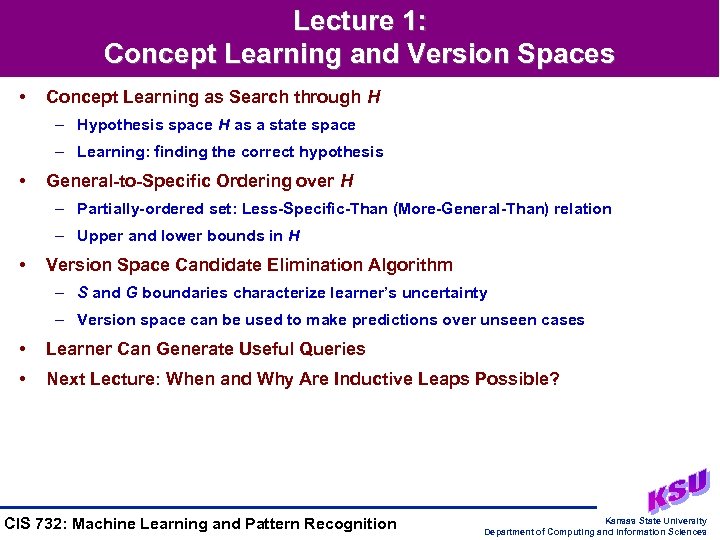
Lecture 1: Concept Learning and Version Spaces • Concept Learning as Search through H – Hypothesis space H as a state space – Learning: finding the correct hypothesis • General-to-Specific Ordering over H – Partially-ordered set: Less-Specific-Than (More-General-Than) relation – Upper and lower bounds in H • Version Space Candidate Elimination Algorithm – S and G boundaries characterize learner’s uncertainty – Version space can be used to make predictions over unseen cases • Learner Can Generate Useful Queries • Next Lecture: When and Why Are Inductive Leaps Possible? CIS 732: Machine Learning and Pattern Recognition Kansas State University Department of Computing and Information Sciences
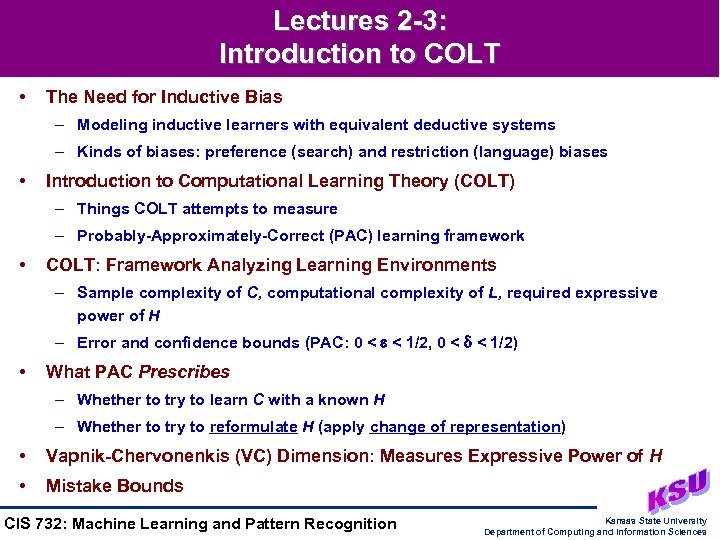
Lectures 2 -3: Introduction to COLT • The Need for Inductive Bias – Modeling inductive learners with equivalent deductive systems – Kinds of biases: preference (search) and restriction (language) biases • Introduction to Computational Learning Theory (COLT) – Things COLT attempts to measure – Probably-Approximately-Correct (PAC) learning framework • COLT: Framework Analyzing Learning Environments – Sample complexity of C, computational complexity of L, required expressive power of H – Error and confidence bounds (PAC: 0 < < 1/2, 0 < < 1/2) • What PAC Prescribes – Whether to try to learn C with a known H – Whether to try to reformulate H (apply change of representation) • Vapnik-Chervonenkis (VC) Dimension: Measures Expressive Power of H • Mistake Bounds CIS 732: Machine Learning and Pattern Recognition Kansas State University Department of Computing and Information Sciences
Lectures 4 -5: Decision Tree Induction • Model (“Architecture”): Decision Trees (DTs) • Algorithm Build-DT: Top Down Induction • Entropy and Information Gain: ID 3 – Goal: to measure uncertainty removed by splitting on a candidate attribute A – ID 3 Build-DT using Gain( • ) • ID 3 as Hypothesis Space Search (in State Space of Decision Trees) • Data Mining using MLC++ (Machine Learning Library in C++) • Occam’s Razor and Decision Trees – Preference biases versus language biases – Minimum Description Length (MDL) – justification for Occam’s Razor biases • Overfitting – Problem: fitting training data too closely – Overfitting prevention, avoidance, and recovery techniques • Other Ways to Make Decision Tree Induction More Robust CIS 732: Machine Learning and Pattern Recognition Kansas State University Department of Computing and Information Sciences
Lectures 6 -7: ANNs (Perceptrons, MLPs, Backprop) • Neural Networks: Parallel, Distributed Processing Systems – Biological and artificial (ANN) types – Perceptron (linear threshold unit/gate, aka LTU/LTG): model neuron • Update Rules for Single-Layer Networks – Multiplicative (Hebbian, Winnow), additive (gradient: Perceptron, Delta Rule) – Batch versus incremental mode • Advantages and Disadvantages of LTG – “Disadvantage” (tradeoff): simple and restrictive – “Advantage”: perform well on many realistic problems (e. g. , some text learning) • Multi-Layer ANNs and Backprop – Backpropagation of error: distributes penalty (loss) function throughout network – Gradient learning: takes derivative of error surface with respect to weights – Error is based on difference between desired output (t) and actual output (o) • Overfitting in ANNs • Recurrent ANNs: Can Express Temporal Depth (Non-Markovity) CIS 732: Machine Learning and Pattern Recognition Kansas State University Department of Computing and Information Sciences
Lecture 8: Statistical Evaluation of Hypotheses • Statistical Evaluation Methods for Learning: Three Questions – Generalization quality • How well does observed accuracy estimate generalization accuracy? • Estimation bias and variance • Confidence intervals – Comparing generalization quality • How certain are we that h 1 is better than h 2? • Confidence intervals for paired tests – Learning and statistical evaluation • What is the best way to make the most of limited data? • k-fold CV • Tradeoffs: Bias versus Variance • Next: Sections 6. 1 -6. 5, Mitchell (Bayes’s Theorem; ML; MAP) CIS 732: Machine Learning and Pattern Recognition Kansas State University Department of Computing and Information Sciences
Lectures 9 -11: Bayesian Learning • Introduction to Bayesian Learning: Bayes’s Theorem – Definition of conditional (posterior) probability P(x | y) – Bayes’s Theorem: P(x | y) = P(y | x) · P(x) / P(y) • Maximum A Posteriori (MAP) and Maximum Likelihood (ML) Hypotheses – Bayes’s Rule and MAP – Uniform priors: allow use of MLE to generate MAP hypotheses – Relation to version spaces, candidate elimination • Minimum Description Length (MDL) Revisited – Bayesian Information Criterion (BIC): justification for Occam’s Razor • Bayes Optimal Classifier (BOC) – Using BOC as a “gold standard” • Gibbs Classifier – Ratio bound • Simple (Naïve) Bayes – Rationale for assumption; pitfalls CIS 732: Machine Learning and Pattern Recognition Kansas State University Department of Computing and Information Sciences
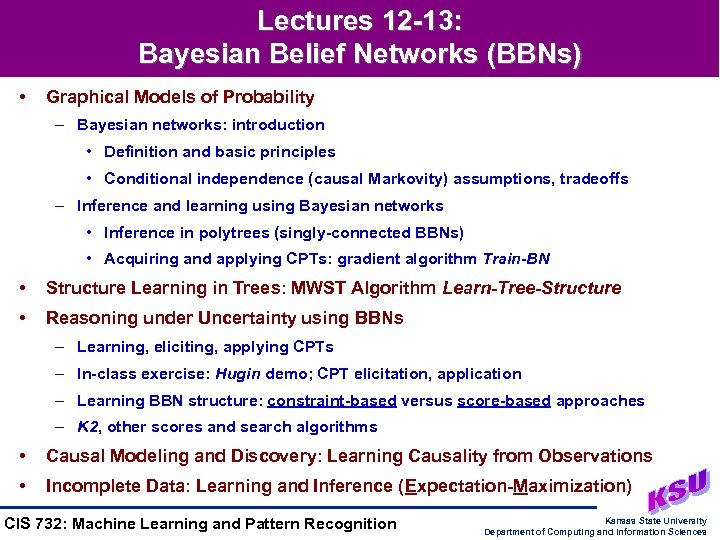
Lectures 12 -13: Bayesian Belief Networks (BBNs) • Graphical Models of Probability – Bayesian networks: introduction • Definition and basic principles • Conditional independence (causal Markovity) assumptions, tradeoffs – Inference and learning using Bayesian networks • Inference in polytrees (singly-connected BBNs) • Acquiring and applying CPTs: gradient algorithm Train-BN • Structure Learning in Trees: MWST Algorithm Learn-Tree-Structure • Reasoning under Uncertainty using BBNs – Learning, eliciting, applying CPTs – In-class exercise: Hugin demo; CPT elicitation, application – Learning BBN structure: constraint-based versus score-based approaches – K 2, other scores and search algorithms • Causal Modeling and Discovery: Learning Causality from Observations • Incomplete Data: Learning and Inference (Expectation-Maximization) CIS 732: Machine Learning and Pattern Recognition Kansas State University Department of Computing and Information Sciences
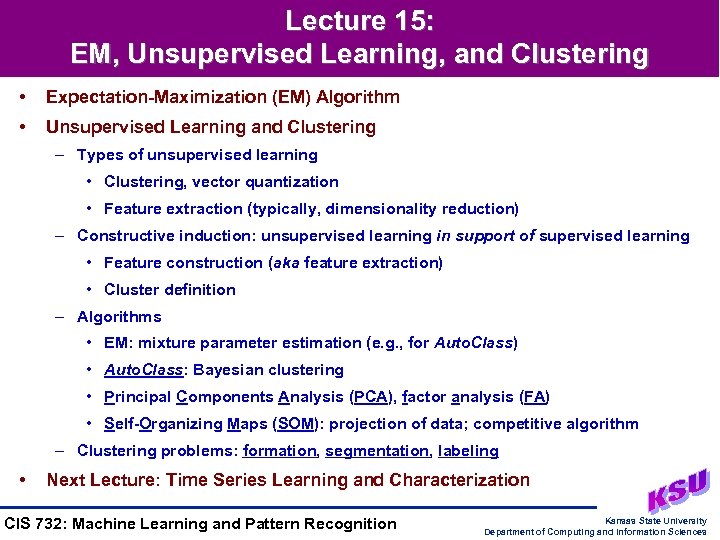
Lecture 15: EM, Unsupervised Learning, and Clustering • Expectation-Maximization (EM) Algorithm • Unsupervised Learning and Clustering – Types of unsupervised learning • Clustering, vector quantization • Feature extraction (typically, dimensionality reduction) – Constructive induction: unsupervised learning in support of supervised learning • Feature construction (aka feature extraction) • Cluster definition – Algorithms • EM: mixture parameter estimation (e. g. , for Auto. Class) • Auto. Class: Bayesian clustering • Principal Components Analysis (PCA), factor analysis (FA) • Self-Organizing Maps (SOM): projection of data; competitive algorithm – Clustering problems: formation, segmentation, labeling • Next Lecture: Time Series Learning and Characterization CIS 732: Machine Learning and Pattern Recognition Kansas State University Department of Computing and Information Sciences
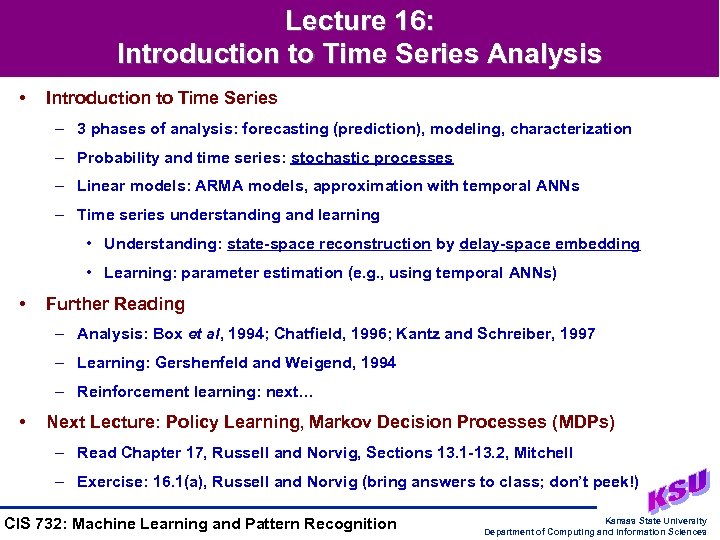
Lecture 16: Introduction to Time Series Analysis • Introduction to Time Series – 3 phases of analysis: forecasting (prediction), modeling, characterization – Probability and time series: stochastic processes – Linear models: ARMA models, approximation with temporal ANNs – Time series understanding and learning • Understanding: state-space reconstruction by delay-space embedding • Learning: parameter estimation (e. g. , using temporal ANNs) • Further Reading – Analysis: Box et al, 1994; Chatfield, 1996; Kantz and Schreiber, 1997 – Learning: Gershenfeld and Weigend, 1994 – Reinforcement learning: next… • Next Lecture: Policy Learning, Markov Decision Processes (MDPs) – Read Chapter 17, Russell and Norvig, Sections 13. 1 -13. 2, Mitchell – Exercise: 16. 1(a), Russell and Norvig (bring answers to class; don’t peek!) CIS 732: Machine Learning and Pattern Recognition Kansas State University Department of Computing and Information Sciences
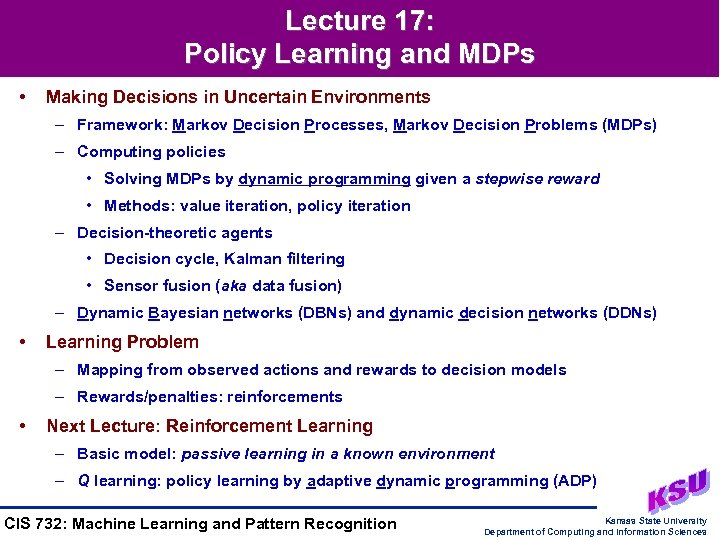
Lecture 17: Policy Learning and MDPs • Making Decisions in Uncertain Environments – Framework: Markov Decision Processes, Markov Decision Problems (MDPs) – Computing policies • Solving MDPs by dynamic programming given a stepwise reward • Methods: value iteration, policy iteration – Decision-theoretic agents • Decision cycle, Kalman filtering • Sensor fusion (aka data fusion) – Dynamic Bayesian networks (DBNs) and dynamic decision networks (DDNs) • Learning Problem – Mapping from observed actions and rewards to decision models – Rewards/penalties: reinforcements • Next Lecture: Reinforcement Learning – Basic model: passive learning in a known environment – Q learning: policy learning by adaptive dynamic programming (ADP) CIS 732: Machine Learning and Pattern Recognition Kansas State University Department of Computing and Information Sciences
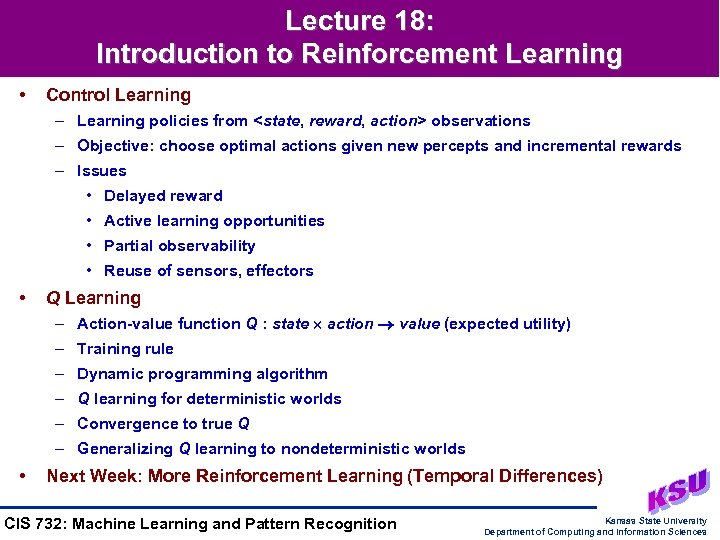
Lecture 18: Introduction to Reinforcement Learning • Control Learning – Learning policies from <state, reward, action> observations – Objective: choose optimal actions given new percepts and incremental rewards – Issues • Delayed reward • Active learning opportunities • Partial observability • Reuse of sensors, effectors • Q Learning – Action-value function Q : state action value (expected utility) – Training rule – Dynamic programming algorithm – Q learning for deterministic worlds – Convergence to true Q – Generalizing Q learning to nondeterministic worlds • Next Week: More Reinforcement Learning (Temporal Differences) CIS 732: Machine Learning and Pattern Recognition Kansas State University Department of Computing and Information Sciences
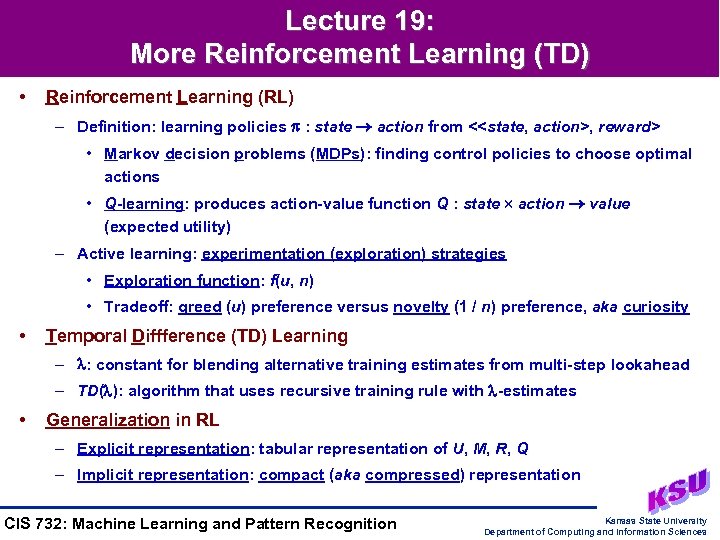
Lecture 19: More Reinforcement Learning (TD) • Reinforcement Learning (RL) – Definition: learning policies : state action from <<state, action>, reward> • Markov decision problems (MDPs): finding control policies to choose optimal actions • Q-learning: produces action-value function Q : state action value (expected utility) – Active learning: experimentation (exploration) strategies • Exploration function: f(u, n) • Tradeoff: greed (u) preference versus novelty (1 / n) preference, aka curiosity • Temporal Diffference (TD) Learning – : constant for blending alternative training estimates from multi-step lookahead – TD( ): algorithm that uses recursive training rule with -estimates • Generalization in RL – Explicit representation: tabular representation of U, M, R, Q – Implicit representation: compact (aka compressed) representation CIS 732: Machine Learning and Pattern Recognition Kansas State University Department of Computing and Information Sciences
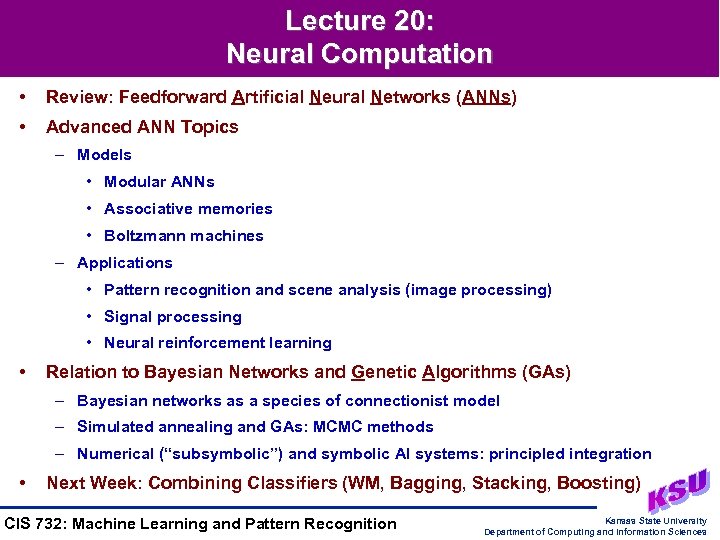
Lecture 20: Neural Computation • Review: Feedforward Artificial Neural Networks (ANNs) • Advanced ANN Topics – Models • Modular ANNs • Associative memories • Boltzmann machines – Applications • Pattern recognition and scene analysis (image processing) • Signal processing • Neural reinforcement learning • Relation to Bayesian Networks and Genetic Algorithms (GAs) – Bayesian networks as a species of connectionist model – Simulated annealing and GAs: MCMC methods – Numerical (“subsymbolic”) and symbolic AI systems: principled integration • Next Week: Combining Classifiers (WM, Bagging, Stacking, Boosting) CIS 732: Machine Learning and Pattern Recognition Kansas State University Department of Computing and Information Sciences
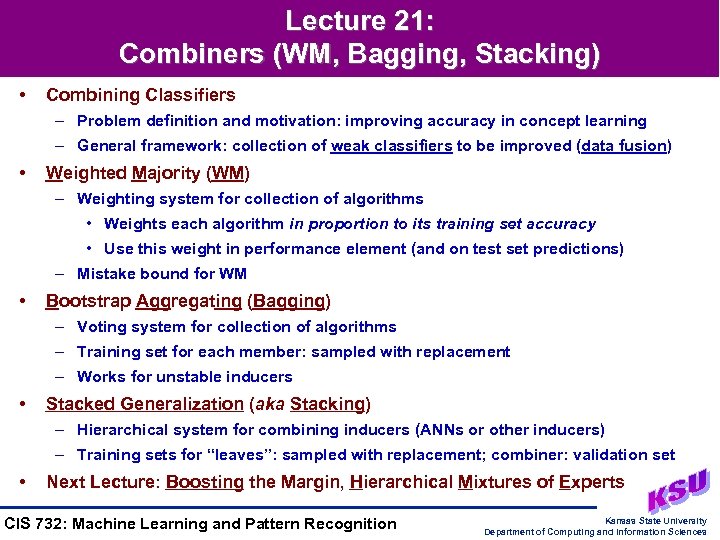
Lecture 21: Combiners (WM, Bagging, Stacking) • Combining Classifiers – Problem definition and motivation: improving accuracy in concept learning – General framework: collection of weak classifiers to be improved (data fusion) • Weighted Majority (WM) – Weighting system for collection of algorithms • Weights each algorithm in proportion to its training set accuracy • Use this weight in performance element (and on test set predictions) – Mistake bound for WM • Bootstrap Aggregating (Bagging) – Voting system for collection of algorithms – Training set for each member: sampled with replacement – Works for unstable inducers • Stacked Generalization (aka Stacking) – Hierarchical system for combining inducers (ANNs or other inducers) – Training sets for “leaves”: sampled with replacement; combiner: validation set • Next Lecture: Boosting the Margin, Hierarchical Mixtures of Experts CIS 732: Machine Learning and Pattern Recognition Kansas State University Department of Computing and Information Sciences
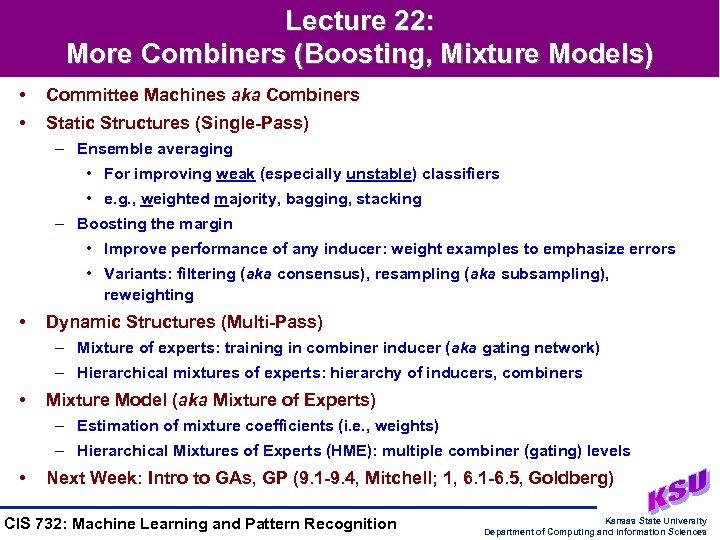
Lecture 22: More Combiners (Boosting, Mixture Models) • Committee Machines aka Combiners • Static Structures (Single-Pass) – Ensemble averaging • For improving weak (especially unstable) classifiers • e. g. , weighted majority, bagging, stacking – Boosting the margin • Improve performance of any inducer: weight examples to emphasize errors • Variants: filtering (aka consensus), resampling (aka subsampling), reweighting • Dynamic Structures (Multi-Pass) – Mixture of experts: training in combiner inducer (aka gating network) – Hierarchical mixtures of experts: hierarchy of inducers, combiners • Mixture Model (aka Mixture of Experts) – Estimation of mixture coefficients (i. e. , weights) – Hierarchical Mixtures of Experts (HME): multiple combiner (gating) levels • Next Week: Intro to GAs, GP (9. 1 -9. 4, Mitchell; 1, 6. 1 -6. 5, Goldberg) CIS 732: Machine Learning and Pattern Recognition Kansas State University Department of Computing and Information Sciences
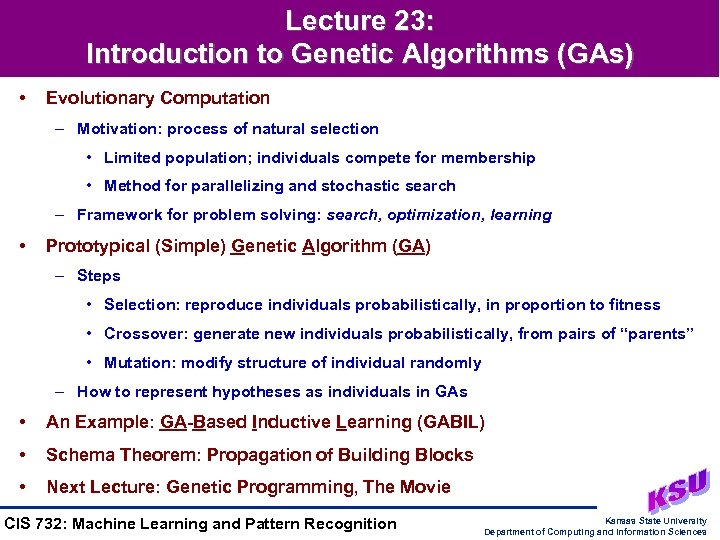
Lecture 23: Introduction to Genetic Algorithms (GAs) • Evolutionary Computation – Motivation: process of natural selection • Limited population; individuals compete for membership • Method for parallelizing and stochastic search – Framework for problem solving: search, optimization, learning • Prototypical (Simple) Genetic Algorithm (GA) – Steps • Selection: reproduce individuals probabilistically, in proportion to fitness • Crossover: generate new individuals probabilistically, from pairs of “parents” • Mutation: modify structure of individual randomly – How to represent hypotheses as individuals in GAs • An Example: GA-Based Inductive Learning (GABIL) • Schema Theorem: Propagation of Building Blocks • Next Lecture: Genetic Programming, The Movie CIS 732: Machine Learning and Pattern Recognition Kansas State University Department of Computing and Information Sciences
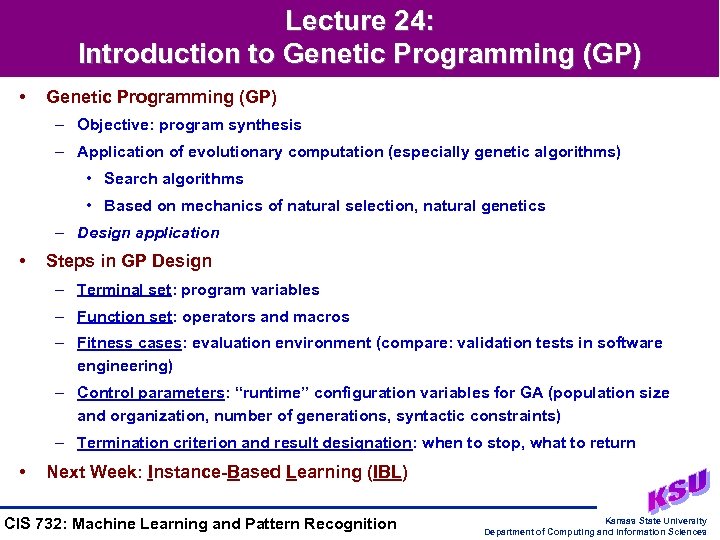
Lecture 24: Introduction to Genetic Programming (GP) • Genetic Programming (GP) – Objective: program synthesis – Application of evolutionary computation (especially genetic algorithms) • Search algorithms • Based on mechanics of natural selection, natural genetics – Design application • Steps in GP Design – Terminal set: program variables – Function set: operators and macros – Fitness cases: evaluation environment (compare: validation tests in software engineering) – Control parameters: “runtime” configuration variables for GA (population size and organization, number of generations, syntactic constraints) – Termination criterion and result designation: when to stop, what to return • Next Week: Instance-Based Learning (IBL) CIS 732: Machine Learning and Pattern Recognition Kansas State University Department of Computing and Information Sciences
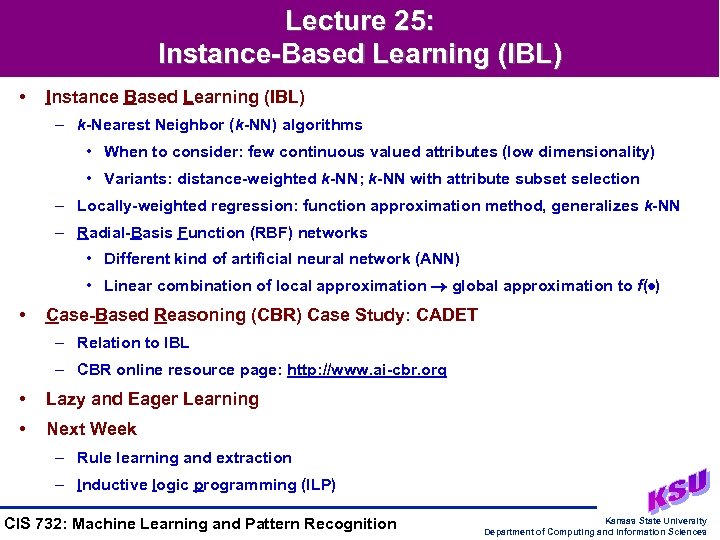
Lecture 25: Instance-Based Learning (IBL) • Instance Based Learning (IBL) – k-Nearest Neighbor (k-NN) algorithms • When to consider: few continuous valued attributes (low dimensionality) • Variants: distance-weighted k-NN; k-NN with attribute subset selection – Locally-weighted regression: function approximation method, generalizes k-NN – Radial-Basis Function (RBF) networks • Different kind of artificial neural network (ANN) • Linear combination of local approximation global approximation to f( ) • Case-Based Reasoning (CBR) Case Study: CADET – Relation to IBL – CBR online resource page: http: //www. ai-cbr. org • Lazy and Eager Learning • Next Week – Rule learning and extraction – Inductive logic programming (ILP) CIS 732: Machine Learning and Pattern Recognition Kansas State University Department of Computing and Information Sciences
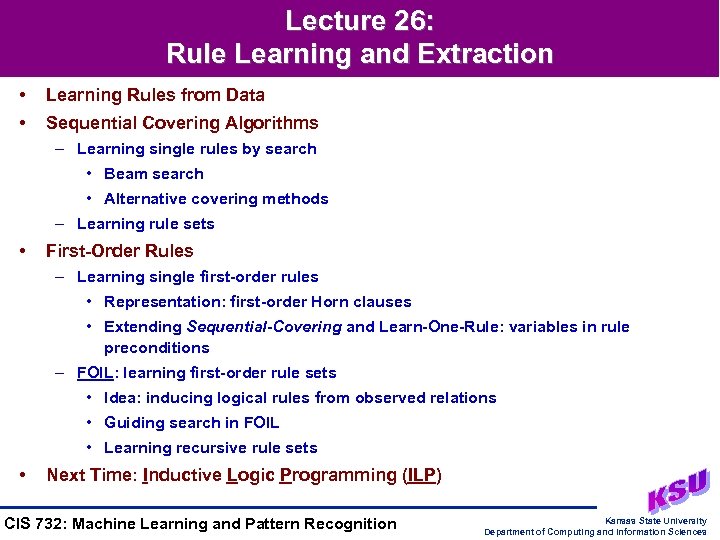
Lecture 26: Rule Learning and Extraction • Learning Rules from Data • Sequential Covering Algorithms – Learning single rules by search • Beam search • Alternative covering methods – Learning rule sets • First-Order Rules – Learning single first-order rules • Representation: first-order Horn clauses • Extending Sequential-Covering and Learn-One-Rule: variables in rule preconditions – FOIL: learning first-order rule sets • Idea: inducing logical rules from observed relations • Guiding search in FOIL • Learning recursive rule sets • Next Time: Inductive Logic Programming (ILP) CIS 732: Machine Learning and Pattern Recognition Kansas State University Department of Computing and Information Sciences
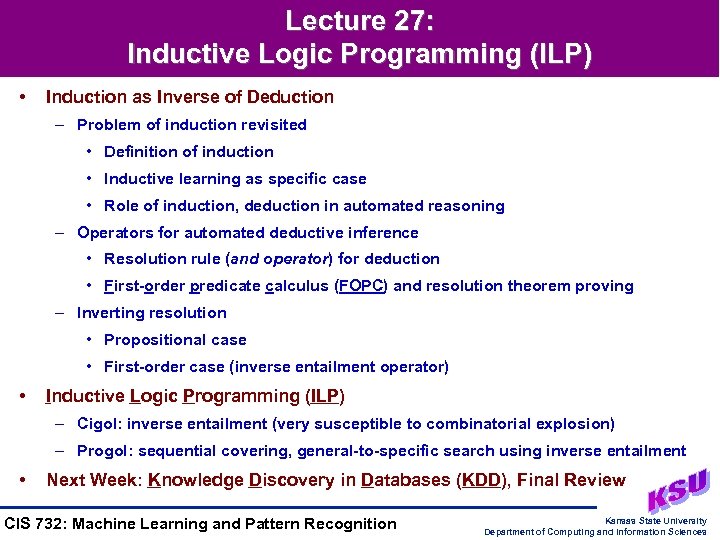
Lecture 27: Inductive Logic Programming (ILP) • Induction as Inverse of Deduction – Problem of induction revisited • Definition of induction • Inductive learning as specific case • Role of induction, deduction in automated reasoning – Operators for automated deductive inference • Resolution rule (and operator) for deduction • First-order predicate calculus (FOPC) and resolution theorem proving – Inverting resolution • Propositional case • First-order case (inverse entailment operator) • Inductive Logic Programming (ILP) – Cigol: inverse entailment (very susceptible to combinatorial explosion) – Progol: sequential covering, general-to-specific search using inverse entailment • Next Week: Knowledge Discovery in Databases (KDD), Final Review CIS 732: Machine Learning and Pattern Recognition Kansas State University Department of Computing and Information Sciences
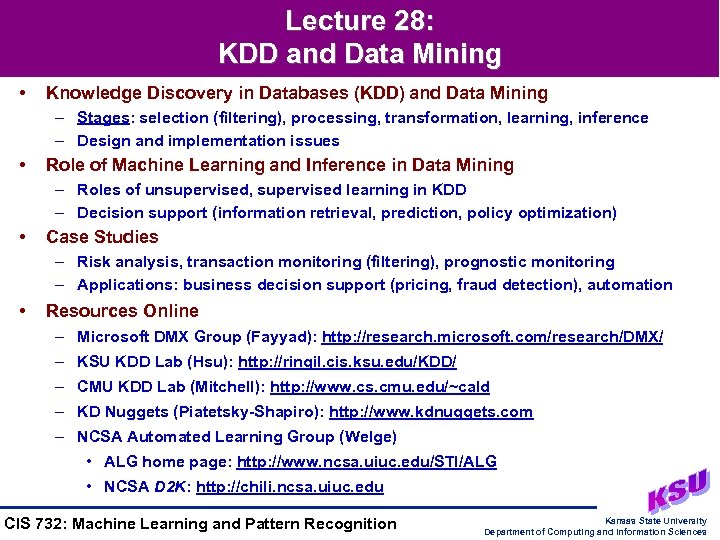
Lecture 28: KDD and Data Mining • Knowledge Discovery in Databases (KDD) and Data Mining – Stages: selection (filtering), processing, transformation, learning, inference – Design and implementation issues • Role of Machine Learning and Inference in Data Mining – Roles of unsupervised, supervised learning in KDD – Decision support (information retrieval, prediction, policy optimization) • Case Studies – Risk analysis, transaction monitoring (filtering), prognostic monitoring – Applications: business decision support (pricing, fraud detection), automation • Resources Online – Microsoft DMX Group (Fayyad): http: //research. microsoft. com/research/DMX/ – KSU KDD Lab (Hsu): http: //ringil. cis. ksu. edu/KDD/ – CMU KDD Lab (Mitchell): http: //www. cs. cmu. edu/~cald – KD Nuggets (Piatetsky-Shapiro): http: //www. kdnuggets. com – NCSA Automated Learning Group (Welge) • ALG home page: http: //www. ncsa. uiuc. edu/STI/ALG • NCSA D 2 K: http: //chili. ncsa. uiuc. edu CIS 732: Machine Learning and Pattern Recognition Kansas State University Department of Computing and Information Sciences
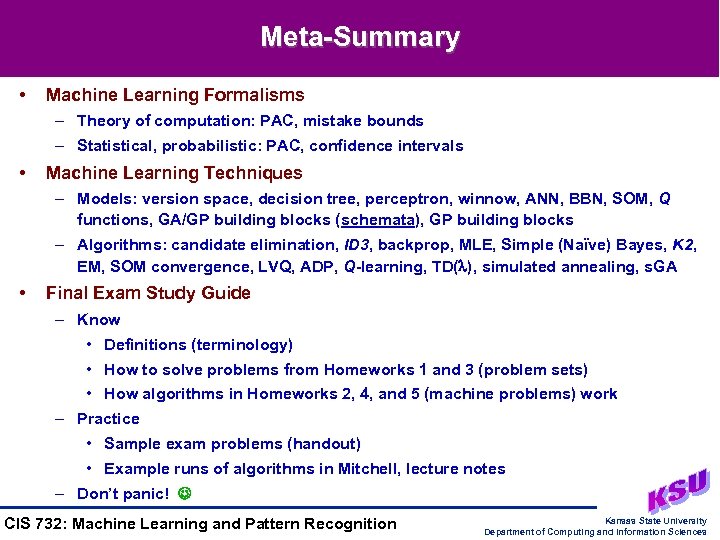
Meta-Summary • Machine Learning Formalisms – Theory of computation: PAC, mistake bounds – Statistical, probabilistic: PAC, confidence intervals • Machine Learning Techniques – Models: version space, decision tree, perceptron, winnow, ANN, BBN, SOM, Q functions, GA/GP building blocks (schemata), GP building blocks – Algorithms: candidate elimination, ID 3, backprop, MLE, Simple (Naïve) Bayes, K 2, EM, SOM convergence, LVQ, ADP, Q-learning, TD( ), simulated annealing, s. GA • Final Exam Study Guide – Know • Definitions (terminology) • How to solve problems from Homeworks 1 and 3 (problem sets) • How algorithms in Homeworks 2, 4, and 5 (machine problems) work – Practice • Sample exam problems (handout) • Example runs of algorithms in Mitchell, lecture notes – Don’t panic! CIS 732: Machine Learning and Pattern Recognition Kansas State University Department of Computing and Information Sciences
Скачать презентацию Lecture 29 Conclusions and Final Review Thursday December
6545162ed087a07ea2c0b670bd56d889.ppt