


 Скачать презентацию Lecture 23 OUTLINE Maximum clock frequency
c4ec6d704fa7af2ba1b56049c592733f.ppt
- Количество слайдов: 31
 Lecture #23 OUTLINE • • Maximum clock frequency - three figures of merit Continuously-switched inverters Ring oscillators IC Fabrication Technology – Doping – Oxidation – Thin-film deposition – Lithography – Etch Reading (Rabaey et al. ) • Chapters 5. 4 and 2. 1 -2. 2 EECS 40, Fall 2004 Lecture 23, Slide 1 Prof. White
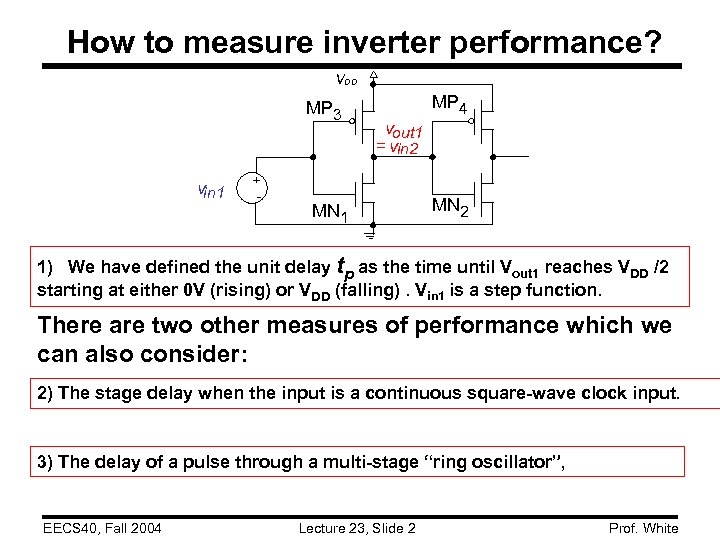 How to measure inverter performance? VDD MP 3 vin 1 + - MP 4 vout 1 = vin 2 MN 1 MN 2 1) We have defined the unit delay tp as the time until Vout 1 reaches VDD /2 starting at either 0 V (rising) or VDD (falling). Vin 1 is a step function. There are two other measures of performance which we can also consider: 2) The stage delay when the input is a continuous square-wave clock input. 3) The delay of a pulse through a multi-stage “ring oscillator”, EECS 40, Fall 2004 Lecture 23, Slide 2 Prof. White
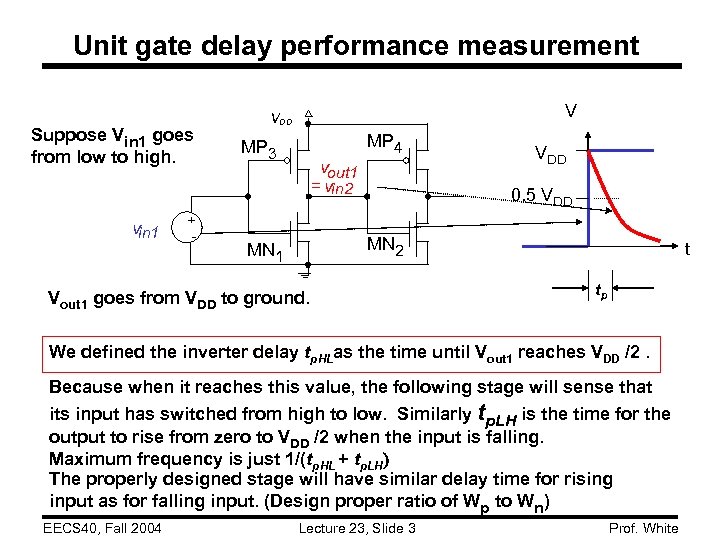 Unit gate delay performance measurement Suppose Vin 1 goes from low to high. vin 1 + - V VDD MP 3 MP 4 vout 1 = vin 2 VDD 0. 5 VDD MN 2 MN 1 Vout 1 goes from VDD to ground. t tp We defined the inverter delay tp. HLas the time until Vout 1 reaches VDD /2. Because when it reaches this value, the following stage will sense that its input has switched from high to low. Similarly tp. LH is the time for the output to rise from zero to VDD /2 when the input is falling. Maximum frequency is just 1/(tp. HL + tp. LH) The properly designed stage will have similar delay time for rising input as for falling input. (Design proper ratio of W p to Wn) EECS 40, Fall 2004 Lecture 23, Slide 3 Prof. White
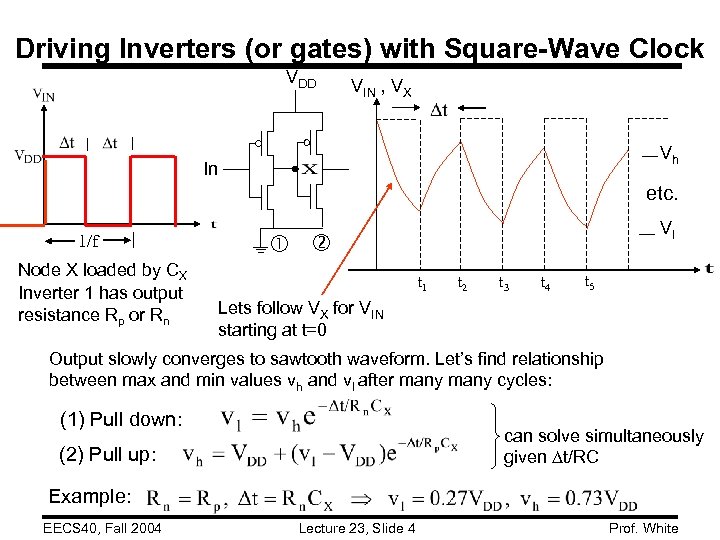 Driving Inverters (or gates) with Square-Wave Clock VDD VIN , VX Vh In etc. 1/f Node X loaded by CX Inverter 1 has output resistance Rp or Rn Vl t 1 t 2 t 3 t 4 t 5 Lets follow VX for VIN starting at t=0 Output slowly converges to sawtooth waveform. Let’s find relationship between max and min values vh and vl after many cycles: (1) Pull down: can solve simultaneously given t/RC (2) Pull up: Example: EECS 40, Fall 2004 Lecture 23, Slide 4 Prof. White
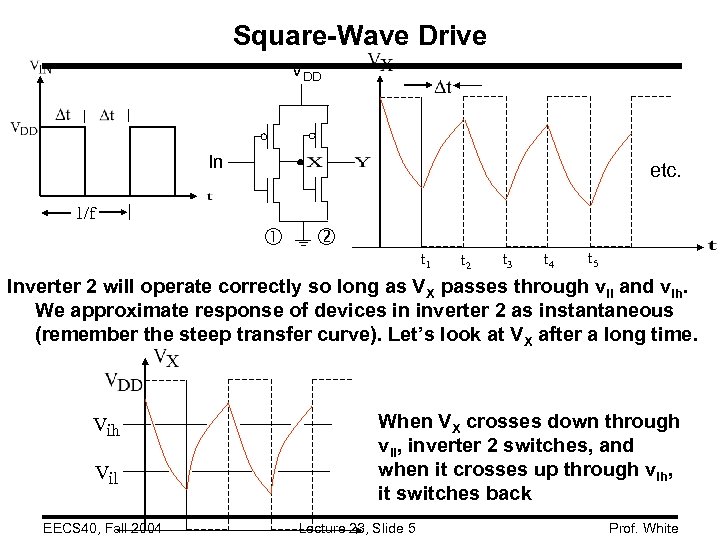 Square-Wave Drive VDD In etc. 1/f t 1 t 2 t 3 t 4 t 5 Inverter 2 will operate correctly so long as VX passes through vil and vih. We approximate response of devices in inverter 2 as instantaneous (remember the steep transfer curve). Let’s look at VX after a long time. Vih Vil EECS 40, Fall 2004 When VX crosses down through vil, inverter 2 switches, and when it crosses up through vih, it switches back Lecture 23, Slide 5 Prof. White
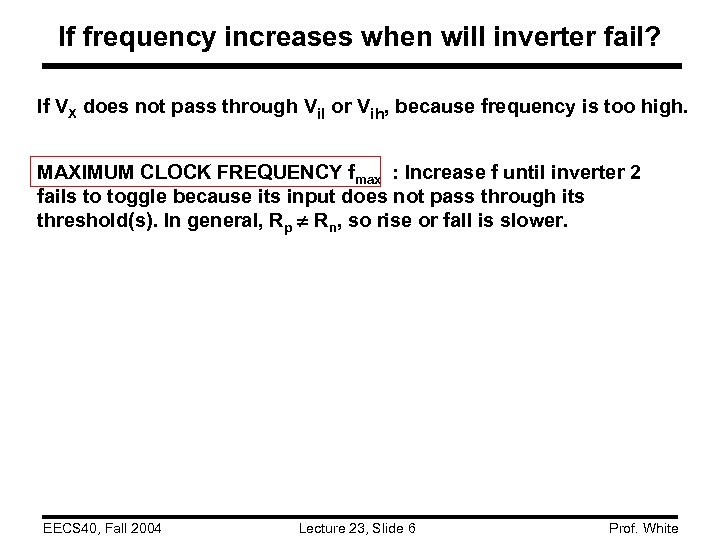 If frequency increases when will inverter fail? If VX does not pass through Vil or Vih, because frequency is too high. MAXIMUM CLOCK FREQUENCY fmax : Increase f until inverter 2 fails to toggle because its input does not pass through its threshold(s). In general, Rp Rn, so rise or fall is slower. EECS 40, Fall 2004 Lecture 23, Slide 6 Prof. White
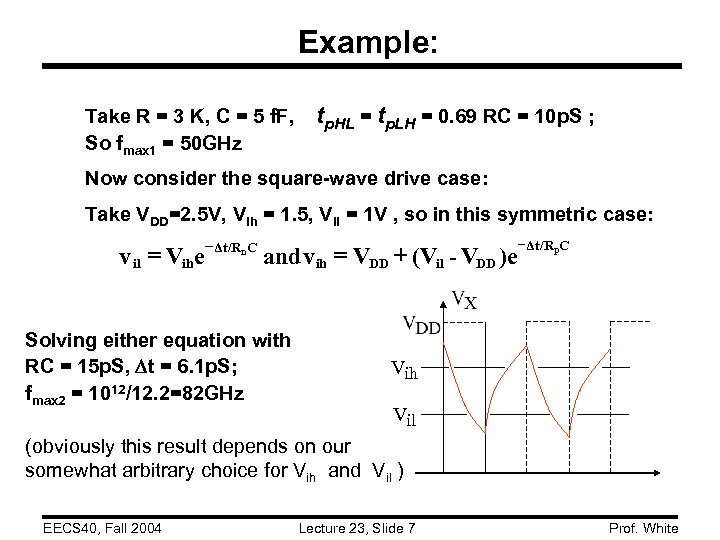 Example: Take R = 3 K, C = 5 f. F, So fmax 1 = 50 GHz tp. HL = tp. LH = 0. 69 RC = 10 p. S ; Now consider the square-wave drive case: Take VDD=2. 5 V, Vih = 1. 5, Vil = 1 V , so in this symmetric case: v il = Vihe Δt/Rn. C andv ih = VDD + (Vil - VDD )e Solving either equation with RC = 15 p. S, Dt = 6. 1 p. S; fmax 2 = 1012/12. 2=82 GHz - Δt/Rp. C Vih Vil (obviously this result depends on our somewhat arbitrary choice for Vih and Vil ) EECS 40, Fall 2004 Lecture 23, Slide 7 Prof. White
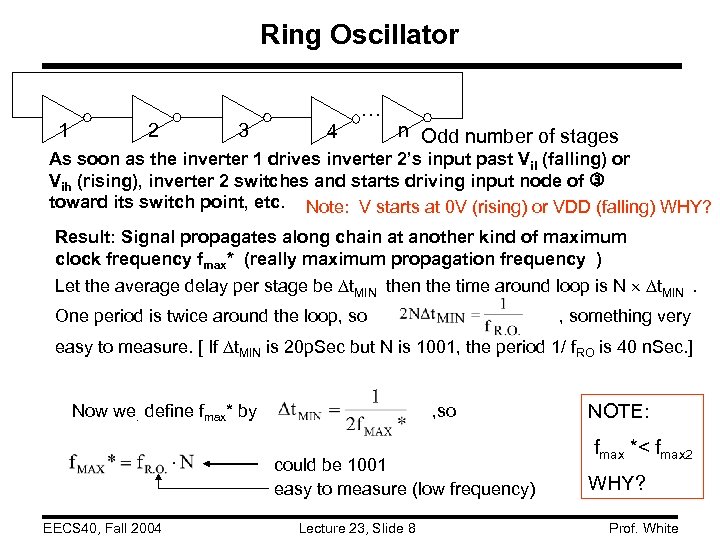 Ring Oscillator 1 2 3 4 … n Odd number of stages As soon as the inverter 1 drives inverter 2’s input past Vil (falling) or Vih (rising), inverter 2 switches and starts driving input node of toward its switch point, etc. Note: V starts at 0 V (rising) or VDD (falling) WHY? Result: Signal propagates along chain at another kind of maximum clock frequency fmax* (really maximum propagation frequency ) Let the average delay per stage be t. MIN then the time around loop is N t. MIN. One period is twice around the loop, something very easy to measure. [ If t. MIN is 20 p. Sec but N is 1001, the period 1/ f. RO is 40 n. Sec. ] Now we. define fmax* by , so could be 1001 easy to measure (low frequency) EECS 40, Fall 2004 Lecture 23, Slide 8 NOTE: fmax *< fmax 2 WHY? Prof. White
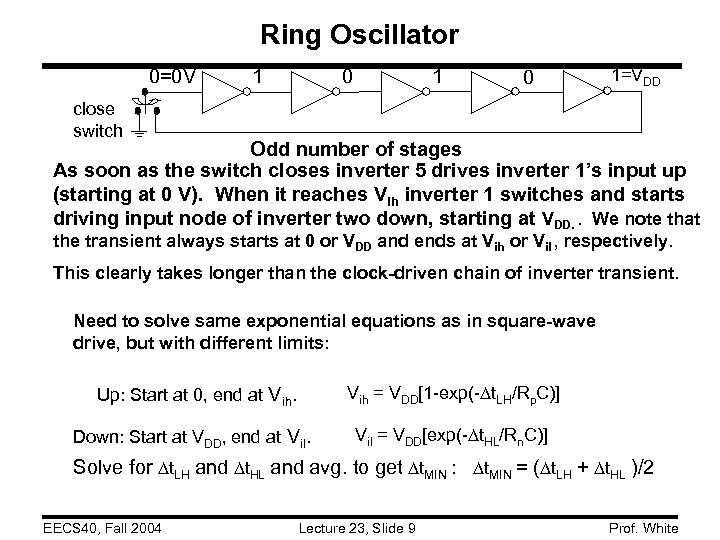 Ring Oscillator 0=0 V 1 0 1=VDD close switch Odd number of stages As soon as the switch closes inverter 5 drives inverter 1’s input up (starting at 0 V). When it reaches Vih inverter 1 switches and starts driving input node of inverter two down, starting at VDD. . We note that the transient always starts at 0 or VDD and ends at Vih or Vil , respectively. This clearly takes longer than the clock-driven chain of inverter transient. Need to solve same exponential equations as in square-wave drive, but with different limits: Up: Start at 0, end at Vih = VDD[1 -exp(- t. LH/Rp. C)] Down: Start at VDD, end at Vil = VDD[exp(- t. HL/Rn. C)] Solve for t. LH and t. HL and avg. to get t. MIN : t. MIN = ( t. LH + t. HL )/2 EECS 40, Fall 2004 Lecture 23, Slide 9 Prof. White
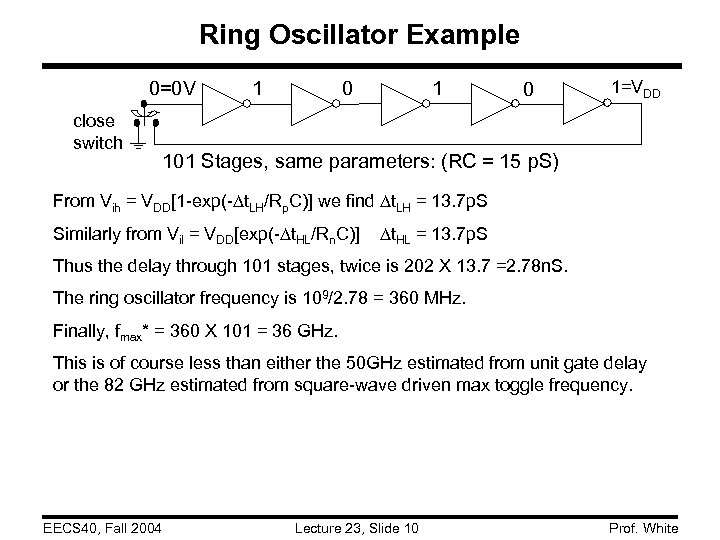 Ring Oscillator Example 0=0 V close switch 1 0 1=VDD 101 Stages, same parameters: (RC = 15 p. S) From Vih = VDD[1 -exp(- t. LH/Rp. C)] we find t. LH = 13. 7 p. S Similarly from Vil = VDD[exp(- t. HL/Rn. C)] t. HL = 13. 7 p. S Thus the delay through 101 stages, twice is 202 X 13. 7 =2. 78 n. S. The ring oscillator frequency is 109/2. 78 = 360 MHz. Finally, fmax* = 360 X 101 = 36 GHz. This is of course less than either the 50 GHz estimated from unit gate delay or the 82 GHz estimated from square-wave driven max toggle frequency. EECS 40, Fall 2004 Lecture 23, Slide 10 Prof. White
 Integrated Circuit Fabrication Goal: Mass fabrication (i. e. simultaneous fabrication) of many “chips”, each a circuit (e. g. a microprocessor or memory chip) containing millions or billions of transistors Method: Lay down thin films of semiconductors, metals and insulators and pattern each layer with a process much like printing (lithography). Materials used in a basic CMOS integrated circuit: • Si substrate – selectively doped in various regions • Si. O 2 insulator • Polycrystalline silicon – used for the gate electrodes EECS 40, Fall 2004 Lecture 23, Slide 11 Prof. White
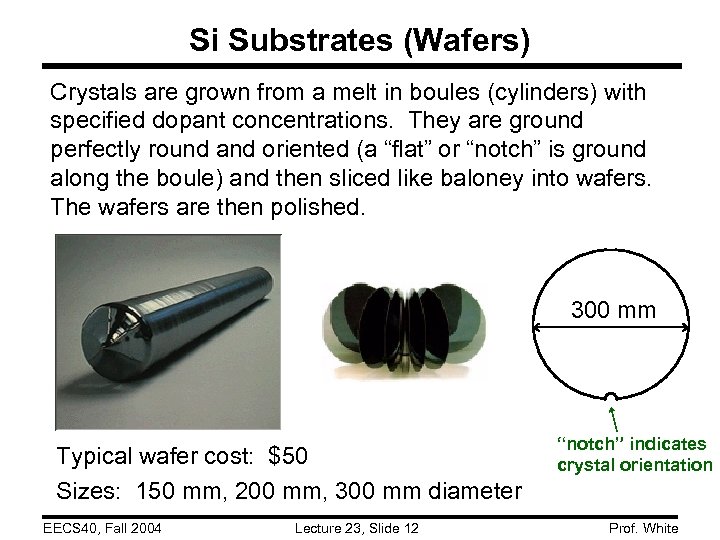 Si Substrates (Wafers) Crystals are grown from a melt in boules (cylinders) with specified dopant concentrations. They are ground perfectly round and oriented (a “flat” or “notch” is ground along the boule) and then sliced like baloney into wafers. The wafers are then polished. 300 mm Typical wafer cost: $50 Sizes: 150 mm, 200 mm, 300 mm diameter EECS 40, Fall 2004 Lecture 23, Slide 12 “notch” indicates crystal orientation Prof. White
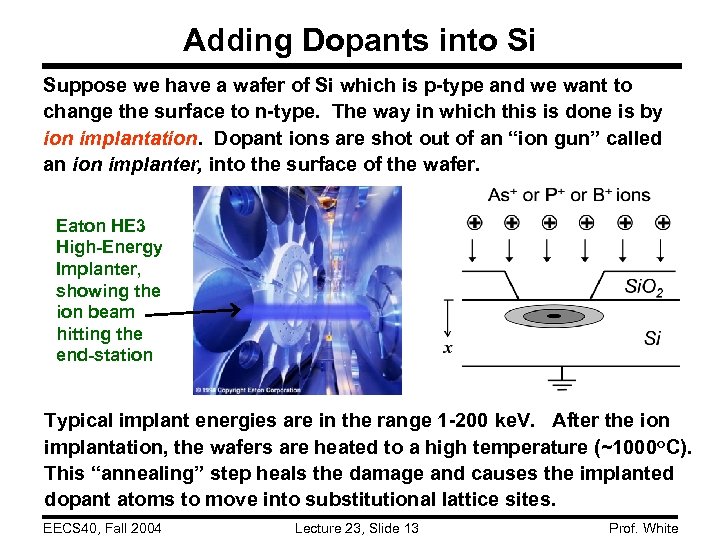 Adding Dopants into Si Suppose we have a wafer of Si which is p-type and we want to change the surface to n-type. The way in which this is done is by ion implantation. Dopant ions are shot out of an “ion gun” called an ion implanter, into the surface of the wafer. Eaton HE 3 High-Energy Implanter, showing the ion beam hitting the end-station Typical implant energies are in the range 1 -200 ke. V. After the ion implantation, the wafers are heated to a high temperature (~1000 o. C). This “annealing” step heals the damage and causes the implanted dopant atoms to move into substitutional lattice sites. EECS 40, Fall 2004 Lecture 23, Slide 13 Prof. White
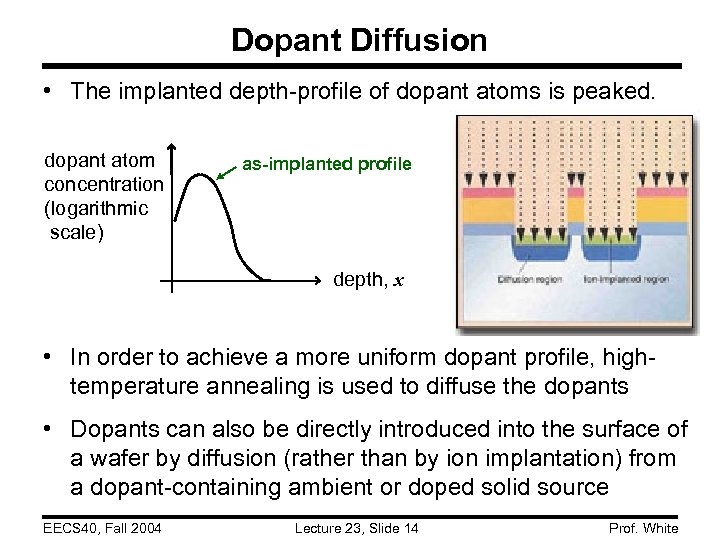 Dopant Diffusion • The implanted depth-profile of dopant atoms is peaked. dopant atom concentration (logarithmic scale) as-implanted profile depth, x • In order to achieve a more uniform dopant profile, hightemperature annealing is used to diffuse the dopants • Dopants can also be directly introduced into the surface of a wafer by diffusion (rather than by ion implantation) from a dopant-containing ambient or doped solid source EECS 40, Fall 2004 Lecture 23, Slide 14 Prof. White
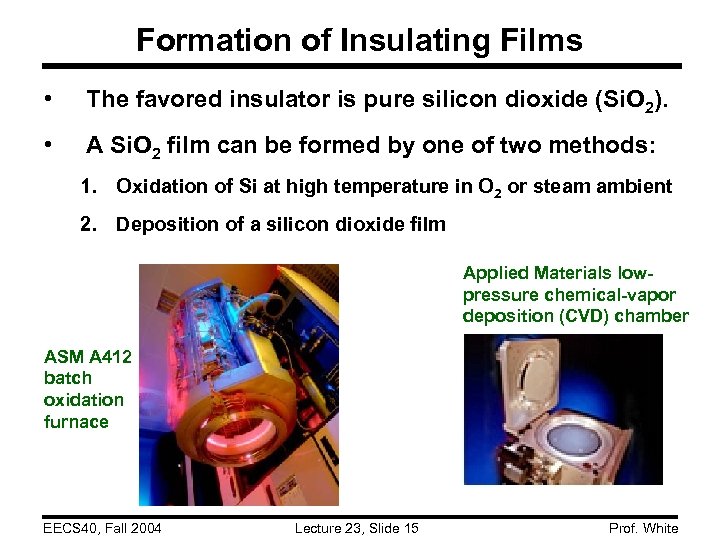 Formation of Insulating Films • The favored insulator is pure silicon dioxide (Si. O 2). • A Si. O 2 film can be formed by one of two methods: 1. Oxidation of Si at high temperature in O 2 or steam ambient 2. Deposition of a silicon dioxide film Applied Materials lowpressure chemical-vapor deposition (CVD) chamber ASM A 412 batch oxidation furnace EECS 40, Fall 2004 Lecture 23, Slide 15 Prof. White
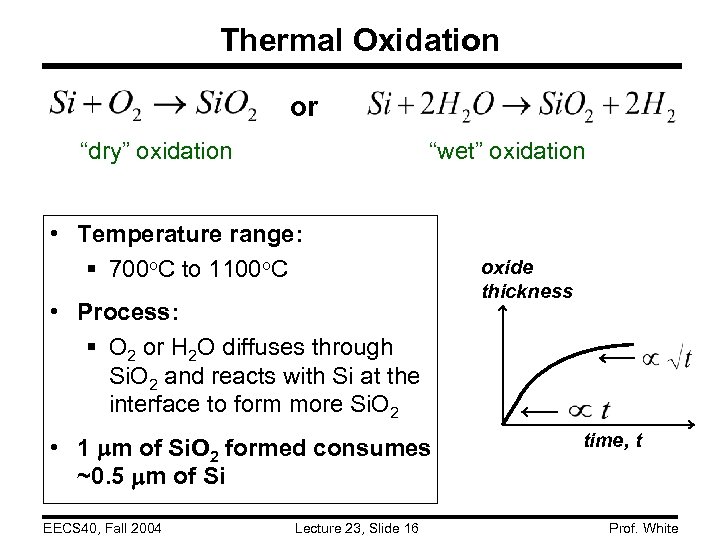 Thermal Oxidation or “wet” oxidation “dry” oxidation • Temperature range: § 700 o. C to 1100 o. C • Process: § O 2 or H 2 O diffuses through Si. O 2 and reacts with Si at the interface to form more Si. O 2 • 1 m of Si. O 2 formed consumes ~0. 5 m of Si EECS 40, Fall 2004 Lecture 23, Slide 16 oxide thickness time, t Prof. White
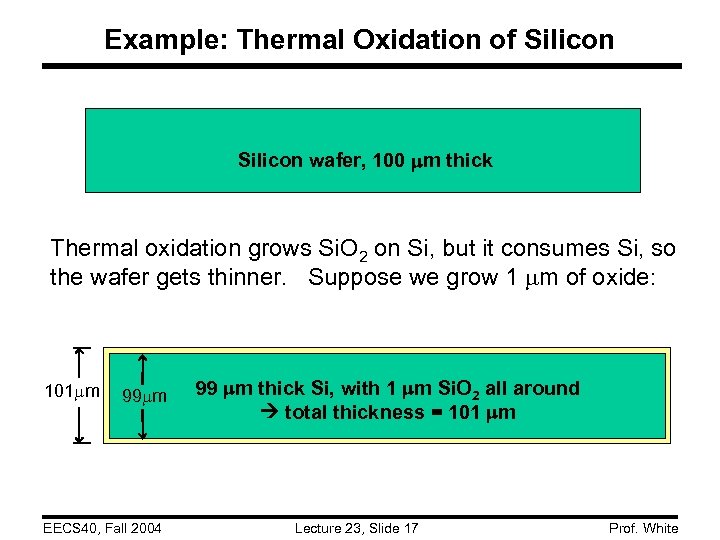 Example: Thermal Oxidation of Silicon wafer, 100 m thick Thermal oxidation grows Si. O 2 on Si, but it consumes Si, so the wafer gets thinner. Suppose we grow 1 m of oxide: 101 m 99 m EECS 40, Fall 2004 99 m thick Si, with 1 m Si. O 2 all around total thickness = 101 m Lecture 23, Slide 17 Prof. White
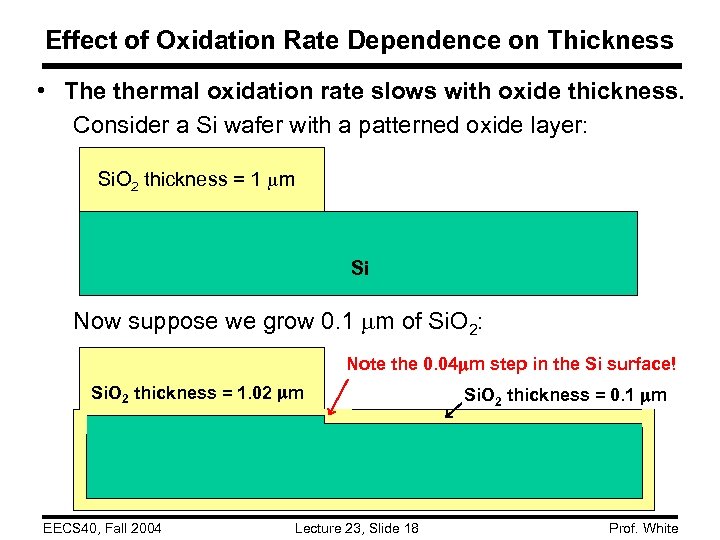 Effect of Oxidation Rate Dependence on Thickness • The thermal oxidation rate slows with oxide thickness. Consider a Si wafer with a patterned oxide layer: Si. O 2 thickness = 1 m Si Now suppose we grow 0. 1 m of Si. O 2: Note the 0. 04 m step in the Si surface! Si. O 2 thickness = 1. 02 m EECS 40, Fall 2004 Lecture 23, Slide 18 Si. O 2 thickness = 0. 1 m Prof. White
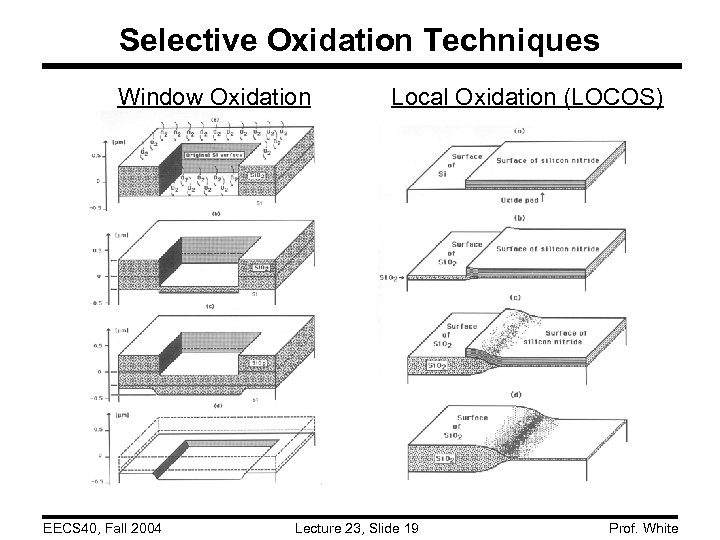 Selective Oxidation Techniques Window Oxidation EECS 40, Fall 2004 Local Oxidation (LOCOS) Lecture 23, Slide 19 Prof. White
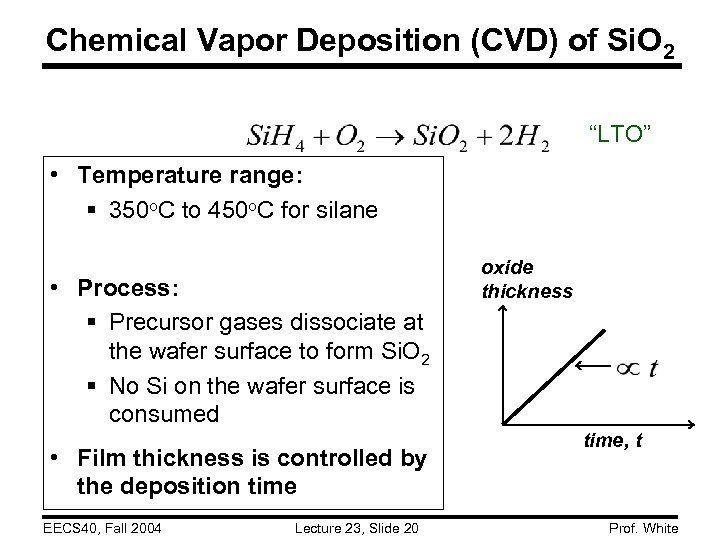 Chemical Vapor Deposition (CVD) of Si. O 2 “LTO” • Temperature range: § 350 o. C to 450 o. C for silane • Process: § Precursor gases dissociate at the wafer surface to form Si. O 2 § No Si on the wafer surface is consumed • Film thickness is controlled by the deposition time EECS 40, Fall 2004 Lecture 23, Slide 20 oxide thickness time, t Prof. White
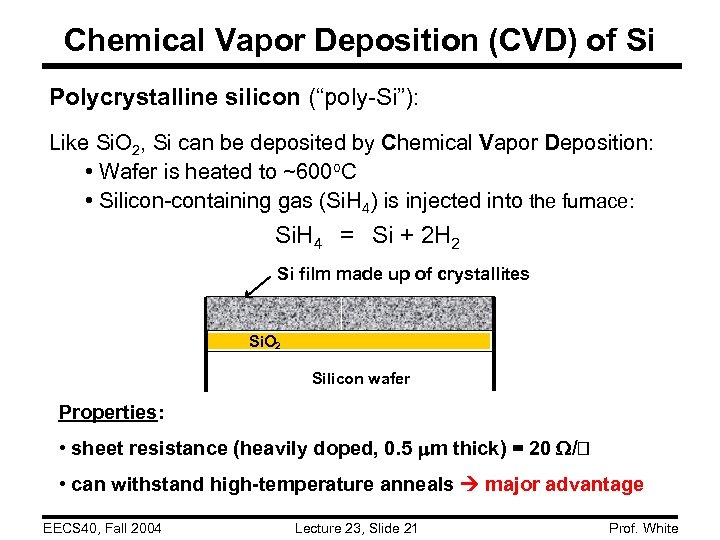 Chemical Vapor Deposition (CVD) of Si Polycrystalline silicon (“poly-Si”): Like Si. O 2, Si can be deposited by Chemical Vapor Deposition: • Wafer is heated to ~600 o. C • Silicon-containing gas (Si. H 4) is injected into the furnace: Si. H 4 = Si + 2 H 2 Si film made up of crystallites Si. O 2 Silicon wafer Properties: • sheet resistance (heavily doped, 0. 5 m thick) = 20 / • can withstand high-temperature anneals major advantage EECS 40, Fall 2004 Lecture 23, Slide 21 Prof. White
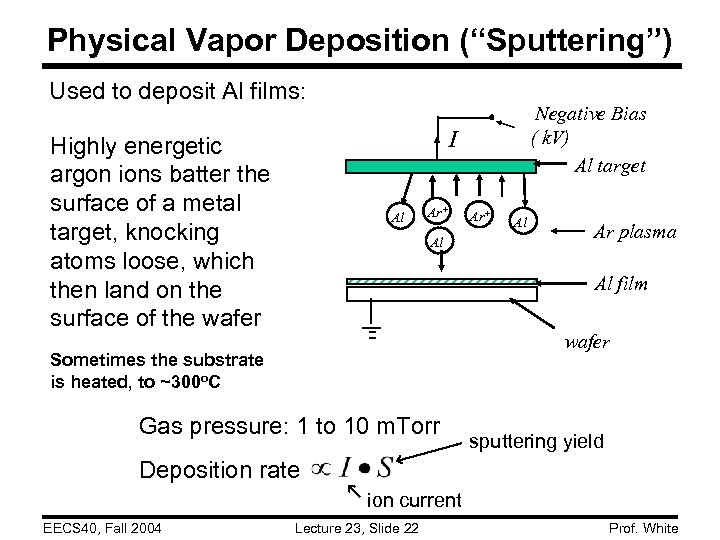 Physical Vapor Deposition (“Sputtering”) Used to deposit Al films: Negative Bias ( k. V) Al target I Highly energetic argon ions batter the surface of a metal target, knocking atoms loose, which then land on the surface of the wafer Al Ar+ Al Ar plasma Al film wafer Sometimes the substrate is heated, to ~300 o. C Gas pressure: 1 to 10 m. Torr sputtering yield Deposition rate ion current EECS 40, Fall 2004 Lecture 23, Slide 22 Prof. White
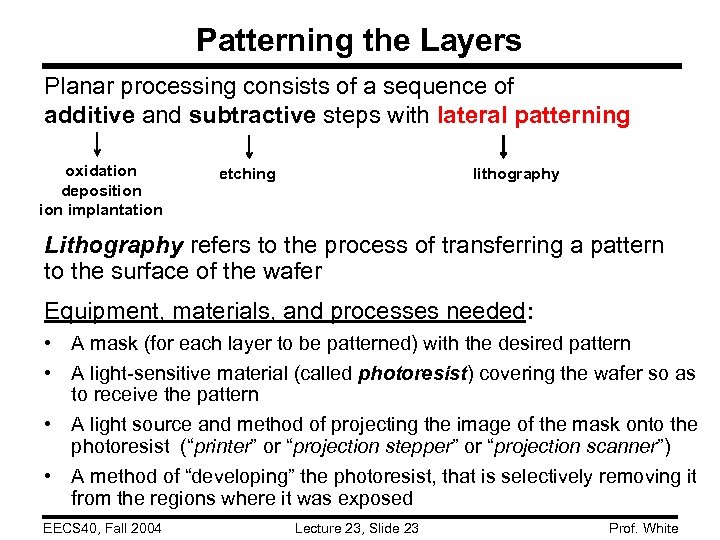 Patterning the Layers Planar processing consists of a sequence of additive and subtractive steps with lateral patterning oxidation deposition implantation etching lithography Lithography refers to the process of transferring a pattern to the surface of the wafer Equipment, materials, and processes needed: • A mask (for each layer to be patterned) with the desired pattern • A light-sensitive material (called photoresist) covering the wafer so as to receive the pattern • A light source and method of projecting the image of the mask onto the photoresist (“printer” or “projection stepper” or “projection scanner”) • A method of “developing” the photoresist, that is selectively removing it from the regions where it was exposed EECS 40, Fall 2004 Lecture 23, Slide 23 Prof. White
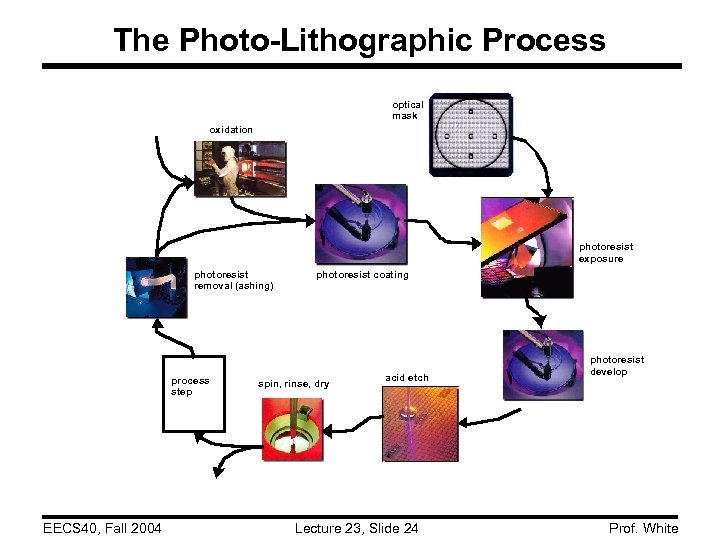 The Photo-Lithographic Process optical mask oxidation photoresist exposure photoresist removal (ashing) process step EECS 40, Fall 2004 photoresist coating spin, rinse, dry acid etch Lecture 23, Slide 24 photoresist develop Prof. White
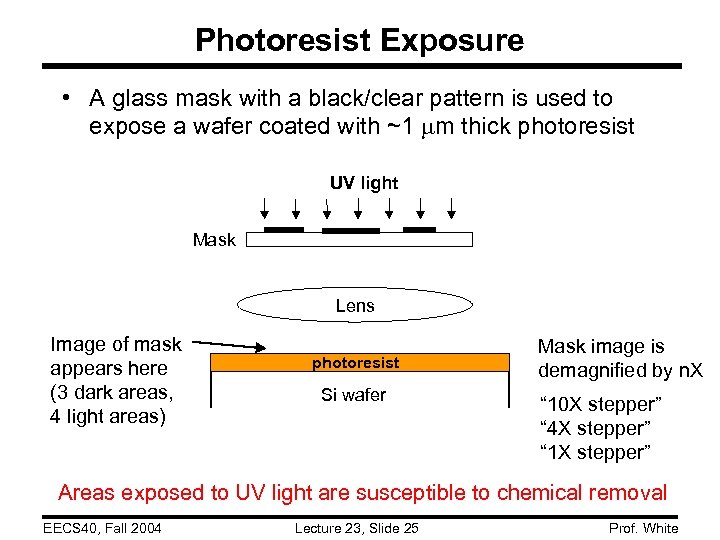 Photoresist Exposure • A glass mask with a black/clear pattern is used to expose a wafer coated with ~1 m thick photoresist UV light Mask Lens Image of mask appears here (3 dark areas, 4 light areas) photoresist Si wafer Mask image is demagnified by n. X “ 10 X stepper” “ 4 X stepper” “ 1 X stepper” Areas exposed to UV light are susceptible to chemical removal EECS 40, Fall 2004 Lecture 23, Slide 25 Prof. White
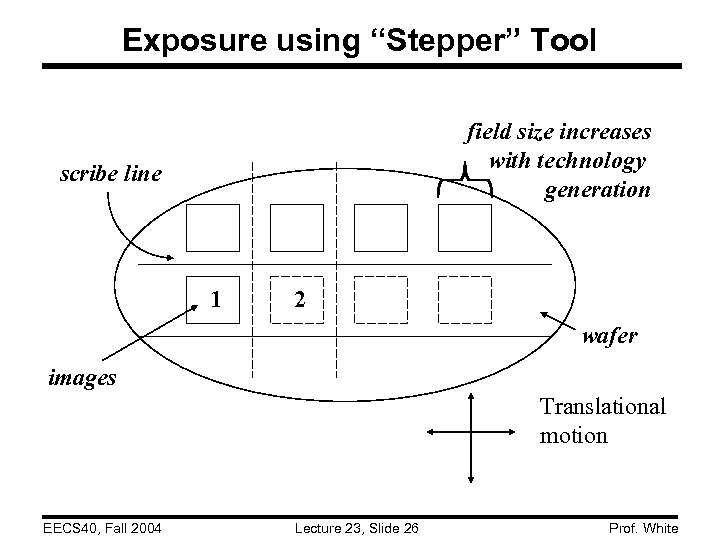 Exposure using “Stepper” Tool field size increases with technology generation scribe line 1 2 wafer images Translational motion EECS 40, Fall 2004 Lecture 23, Slide 26 Prof. White
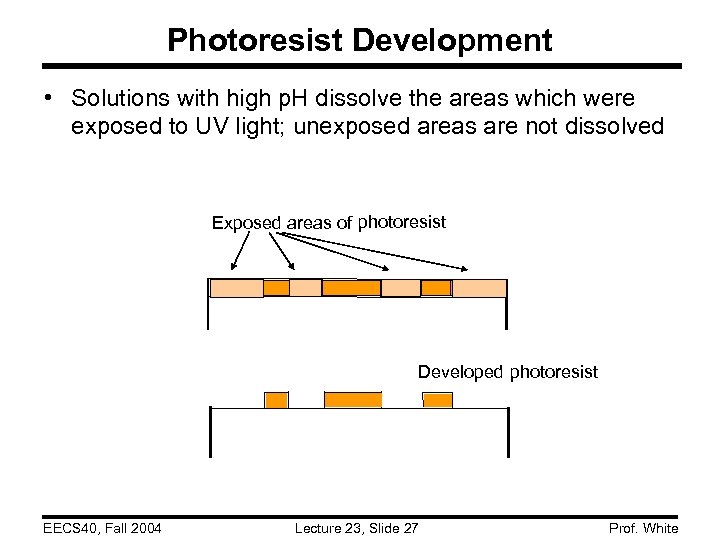 Photoresist Development • Solutions with high p. H dissolve the areas which were exposed to UV light; unexposed areas are not dissolved Exposed areas of photoresist Developed photoresist EECS 40, Fall 2004 Lecture 23, Slide 27 Prof. White
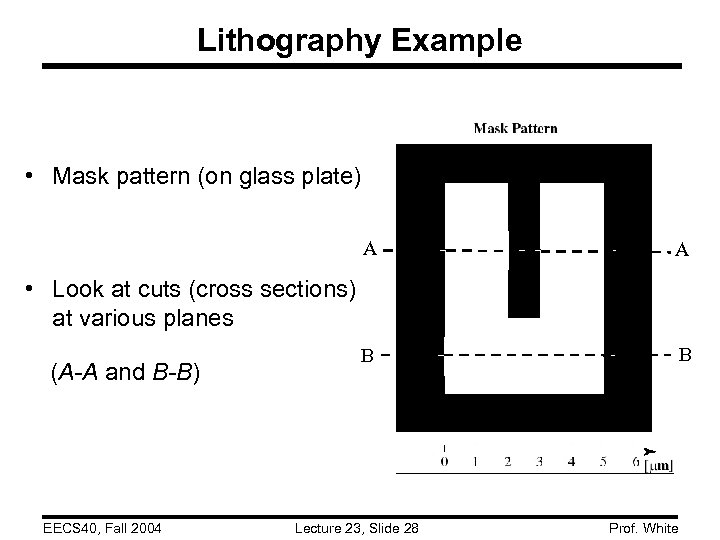 Lithography Example • Mask pattern (on glass plate) A A B B • Look at cuts (cross sections) at various planes (A-A and B-B) EECS 40, Fall 2004 Lecture 23, Slide 28 Prof. White
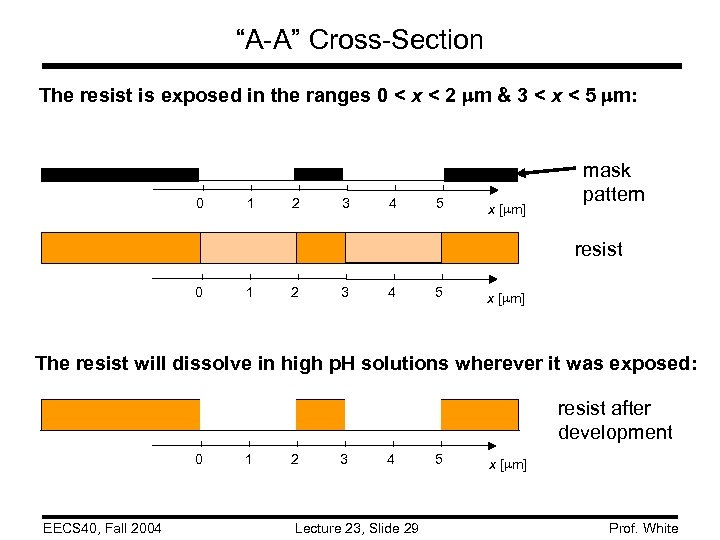 “A-A” Cross-Section The resist is exposed in the ranges 0 < x < 2 m & 3 < x < 5 m: 0 1 2 3 4 5 x [ m] mask pattern resist 0 1 2 3 4 5 x [ m] The resist will dissolve in high p. H solutions wherever it was exposed: resist after development 0 EECS 40, Fall 2004 1 2 3 4 Lecture 23, Slide 29 5 x [ m] Prof. White
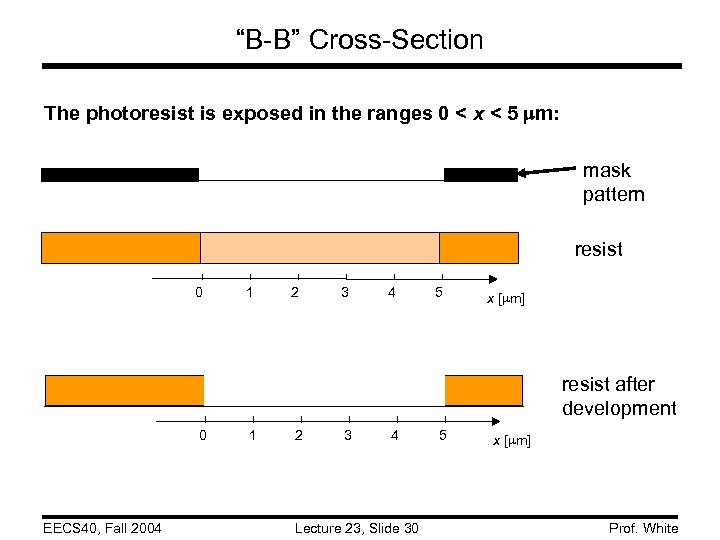 “B-B” Cross-Section The photoresist is exposed in the ranges 0 < x < 5 m: mask pattern resist 0 1 2 3 4 5 x [ m] resist after development 0 EECS 40, Fall 2004 1 2 3 4 Lecture 23, Slide 30 5 x [ m] Prof. White
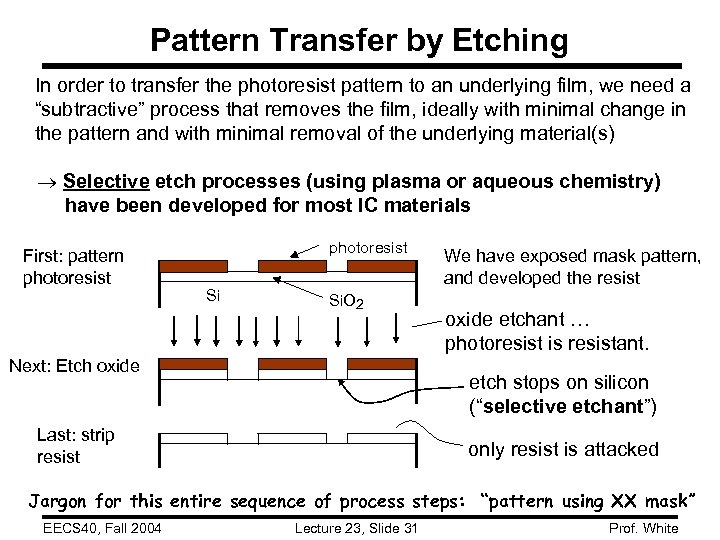 Pattern Transfer by Etching In order to transfer the photoresist pattern to an underlying film, we need a “subtractive” process that removes the film, ideally with minimal change in the pattern and with minimal removal of the underlying material(s) ® Selective etch processes (using plasma or aqueous chemistry) have been developed for most IC materials First: pattern photoresist Si Si. O 2 Next: Etch oxide We have exposed mask pattern, and developed the resist oxide etchant … photoresist is resistant. etch stops on silicon (“selective etchant”) Last: strip resist only resist is attacked Jargon for this entire sequence of process steps: “pattern using XX mask” EECS 40, Fall 2004 Lecture 23, Slide 31 Prof. White