


 Скачать презентацию Lecture 23 Internet Authentication Applications modified from slides
2eafb6d32004cb3bcf8695893e3d35b6.ppt
- Количество слайдов: 24
 Lecture 23 Internet Authentication Applications modified from slides of Lawrie Brown
 Kerberos Overview • initially developed at MIT • software utility available in both the public domain and in commercially supported versions • issued as an Internet standard and is the defacto standard for remote authentication • overall scheme is that of a trusted third party authentication service • requires that a user prove his or her identity for each service invoked and requires servers to prove their identity to clients
 Kerberos Protocol • involves clients, application servers, and a Kerberos server – designed to counter a variety of threats to the security of a client/server dialogue – obvious security risk is impersonation – servers must be able to confirm the identities of clients who request service
 Kerberos Protocol • use an Authentication Server (AS) – user initially negotiates with AS for identity verification – AS verifies identity and then passes information on to an application server which will then accept service requests from the client • need to find a way to do this in a secure way – if client sends user’s password to the AS over the network an opponent could observe the password – an opponent could impersonate the AS and send a false validation
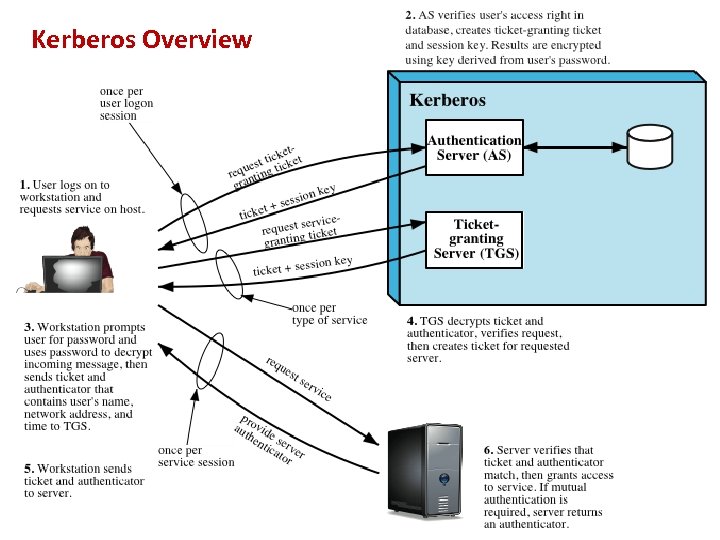 Kerberos Overview
 Kerberos Realms • a Kerberos environment consists of: – a Kerberos server – a number of clients, all registered with server – a number of application servers, sharing keys with server • this is referred to as a realm – networks of clients and servers under different administrative organizations generally constitute different realms
 Kerberos Realms • if multiple realms: – their Kerberos servers must share a secret key and trust the Kerberos server in the other realm to authenticate its users – participating servers in the second realm must also be willing to trust the Kerberos server in the first realm
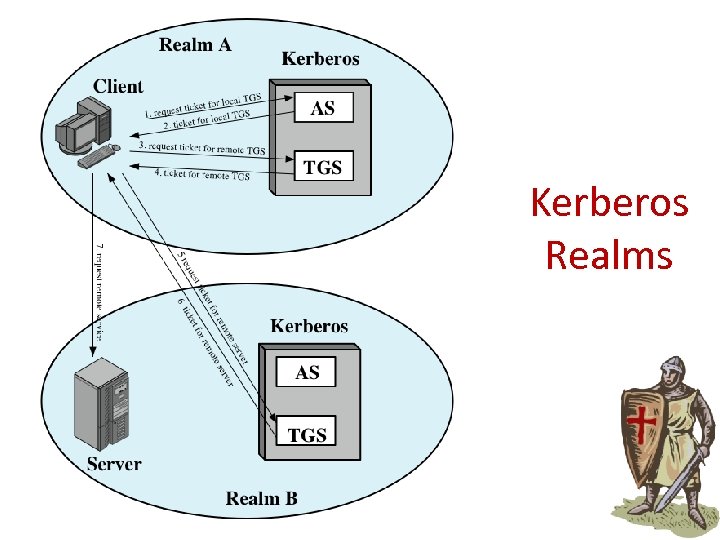 Kerberos Realms
 Kerberos Versions 4 and 5 • Kerberos v 4 is most widely used version • improvements found in version 5: – an encrypted message is tagged with an encryption algorithm identifier • this enables users to configure Kerberos to use an algorithm other than DES – supports authentication forwarding • enables a client to access a server and have that server access another server on behalf of the client • supports a method for interrealm authentication that requires fewer secure key exchanges than in version 4
 Kerberos Performance Issues • see larger client-server installations • Kerberos performance impact in a large-scale environment: – very little if system is properly configured – tickets are reusable which reduces traffic • Kerberos security is best assured by placing the Kerberos server on an isolated machine • motivation for multiple realms is administrative – not performance related
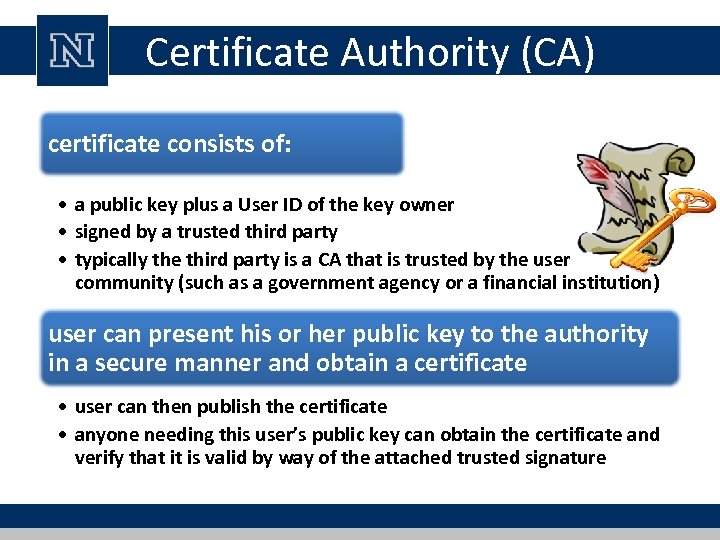 Certificate Authority (CA) certificate consists of: • a public key plus a User ID of the key owner • signed by a trusted third party • typically the third party is a CA that is trusted by the user community (such as a government agency or a financial institution) user can present his or her public key to the authority in a secure manner and obtain a certificate • user can then publish the certificate • anyone needing this user’s public key can obtain the certificate and verify that it is valid by way of the attached trusted signature
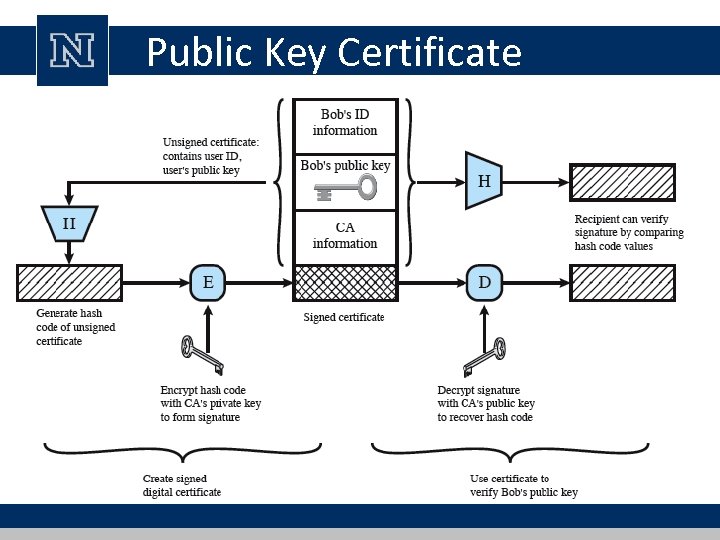 Public Key Certificate
 X. 509 • Specified in RFC 5280 • The most widely accepted format for publickey certificates • Certificates are used in most network security applications, including: – IP security (IPSEC) – Secure sockets layer (SSL) – Secure electronic transactions (SET) – S/MIME – e. Business applications
 X. 509 Authentication Service • universally accepted standard formatting public-key certificates – widely used in network security applications, • including IPsec, SSL, SET, and S/MIME – part of CCITT X. 500 directory service standards • uses public-key crypto & digital signatures – algorithms not standardized • but RSA recommended
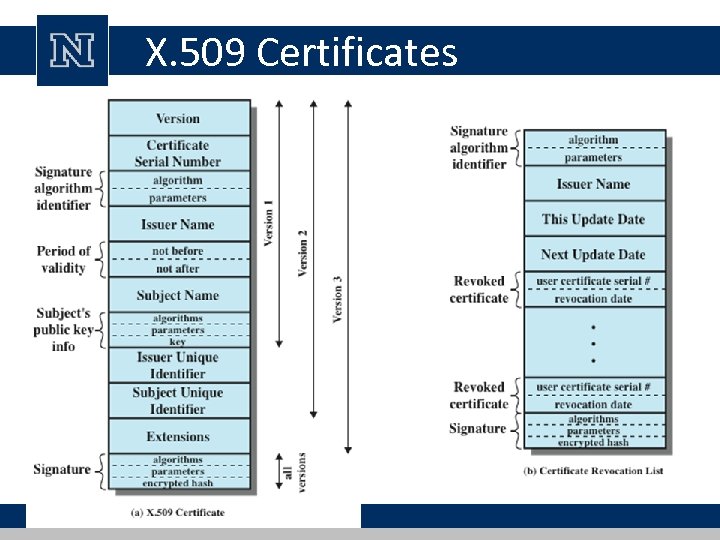 X. 509 Certificates
 A number of specialized variants also exist, distinguished by particular element values or the presence of certain extensions: • Conventional (long-lived) certificates – – CA and “end user” certificates Typically issued for validity periods of months to years • Short-lived certificates – – – Used to provide authentication for applications such as grid computing, while avoiding some of the overheads and limitations of conventional certificates They have validity periods of hours to days, which limits the period of misuse if compromised Because they are usually not issued by recognized CA’s there are issues with verifying them outside their issuing organization • Proxy certificates – – – Widely used to provide authentication for applications such as grid computing, while addressing some of the limitations of short-lived certificates Defined in RFC 3820 Identified by the presence of the “proxy certificate” extension They allow an “end user” certificate to sign another certificate Allow a user to easily create a credential to access resources in some environment, without needing to provide their full certificate and right • Attribute certificates – – Defined in RFC 5755 Use a different certificate format to link a user’s identity to a set of attributes that are typically used for authorization and access control A user may have a number of different attribute certificates, with different set of attributes for different purposes Defined in an “Attributes” extension
 Public-Key Infrastructure (PKI) • The set of hardware, software, people, policies, and procedures needed to create, manage, store, distribute, and revoke digital certificates based on asymmetric cryptography • Developed to enable secure, convenient, and efficient acquisition of public keys • “Trust store” – A list of CA’s and their public keys
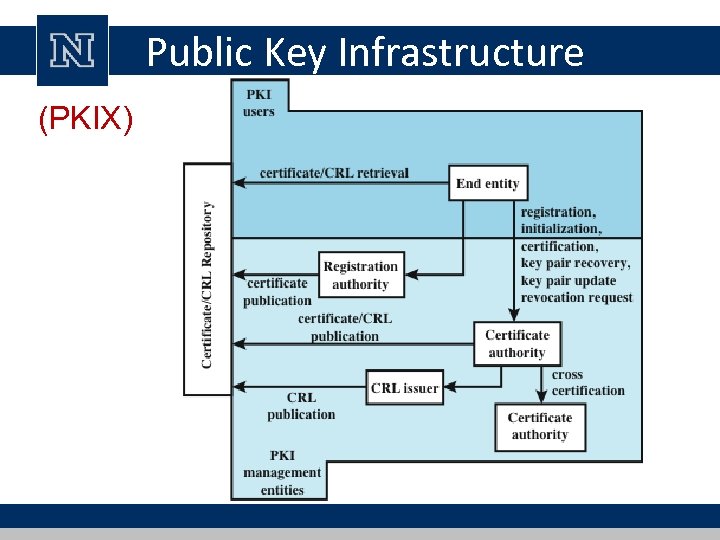 Public Key Infrastructure (PKIX)
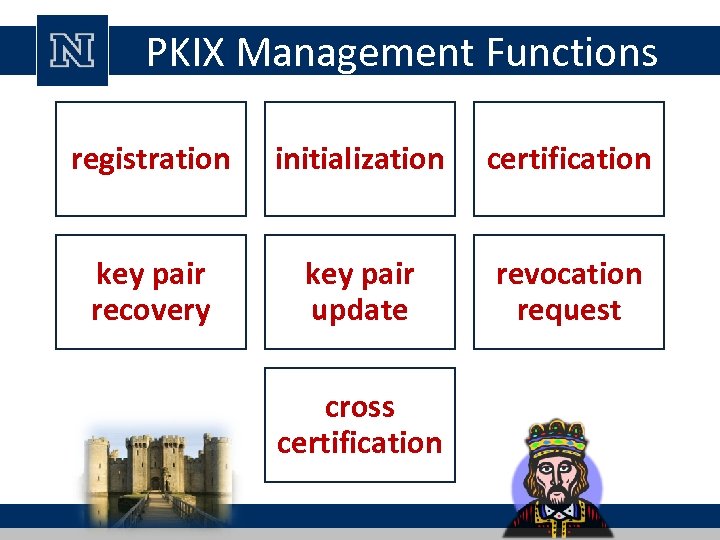 PKIX Management Functions registration initialization certification key pair recovery key pair update revocation request cross certification
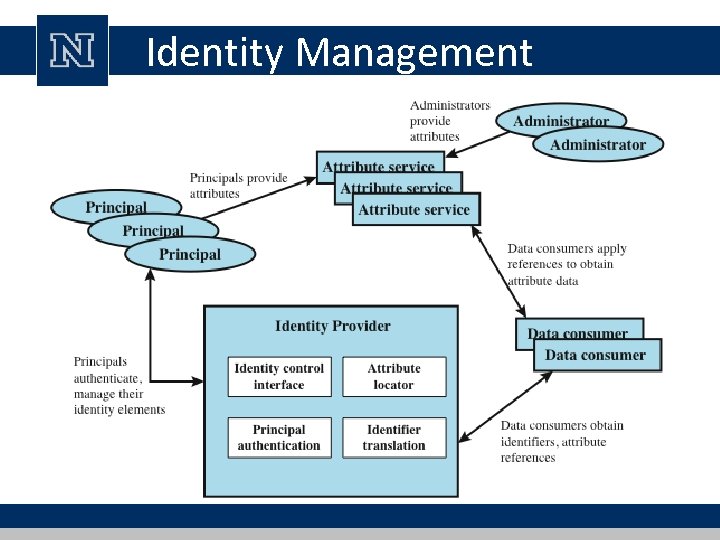
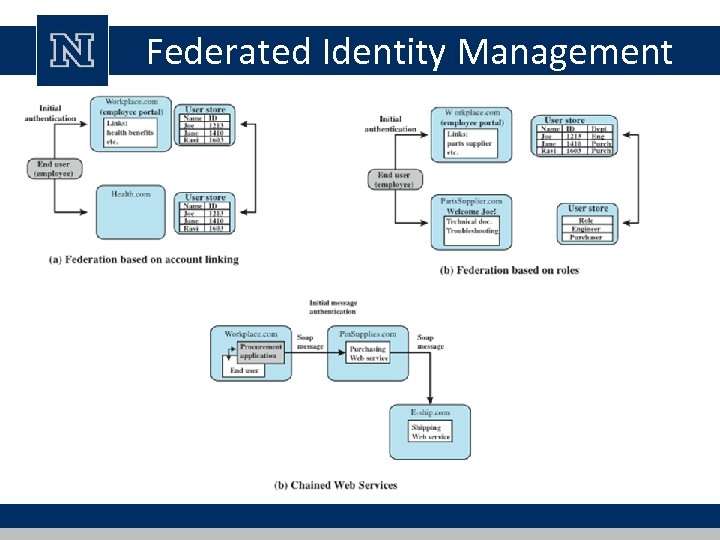
 Federated Identity Management • use of common identity management scheme – across multiple enterprises and numerous applications – supporting many thousands, even millions of users • principal elements are: – authentication, authorization, accounting, provisioning, workflow automation, delegated administration, password synchronization, self-service password reset, federation
 Identity Management
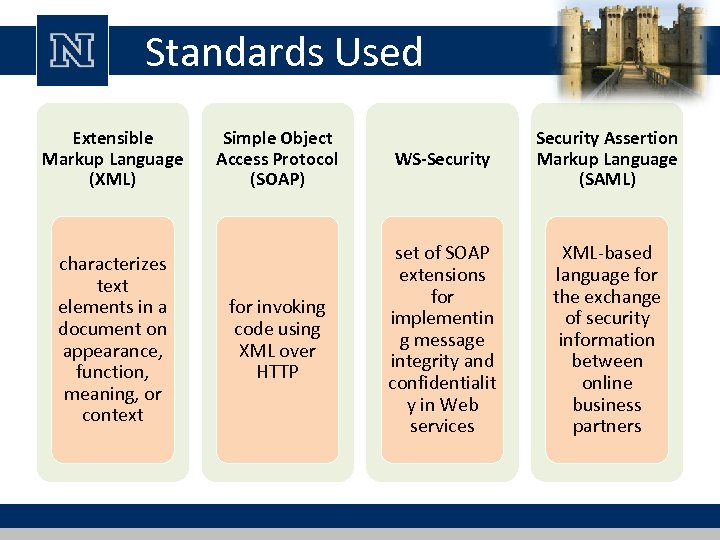 Standards Used Extensible Markup Language (XML) characterizes text elements in a document on appearance, function, meaning, or context Simple Object Access Protocol (SOAP) WS-Security Assertion Markup Language (SAML) for invoking code using XML over HTTP set of SOAP extensions for implementin g message integrity and confidentialit y in Web services XML-based language for the exchange of security information between online business partners
 Federated Identity Management
 Summary • • • Kerberos protocol Kerberos realms Kerberos versions 4 and 5 Kerberos performance issues X. 509 • • public-key infrastructure PKIX management functions PKIX management protocols federated identity management