


 Скачать презентацию Lecture 22 Goals Chapter 15 v Use
f32d04ed88e4272a9f12cf0caea68789.ppt
- Количество слайдов: 25
 Lecture 22 Goals: • Chapter 15 v Use an ideal-fluid model to study fluid flow. v Investigate the elastic deformation of solids and liquids • Chapter 16 v Recognize and use the state variables that characterize macroscopic phenomena. v Understand the idea of phase change and interpret a phase diagram. v Use the ideal-gas law. v Use p. V diagrams for ideal-gas processes. • Assignment v HW 10, Due Wednesday, Apr. 14 th v Tuesday: Read all of Chapter 17 Physics 207: Lecture 22, Pg 1
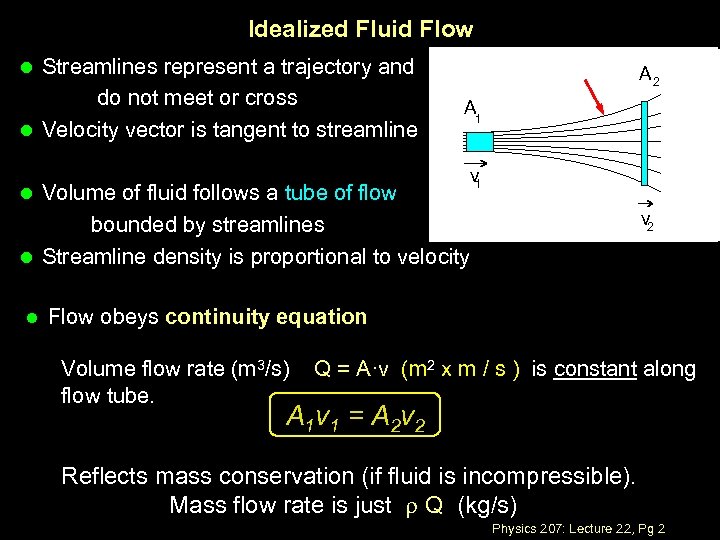 Idealized Fluid Flow l Streamlines represent a trajectory and do not meet or cross l Velocity vector is tangent to streamline l Volume of fluid follows a tube of flow A 2 A 1 v 2 bounded by streamlines l Streamline density is proportional to velocity l Flow obeys continuity equation Volume flow rate (m 3/s) flow tube. Q = A·v (m 2 x m / s ) is constant along A 1 v 1 = A 2 v 2 Reflects mass conservation (if fluid is incompressible). Mass flow rate is just Q (kg/s) Physics 207: Lecture 22, Pg 2
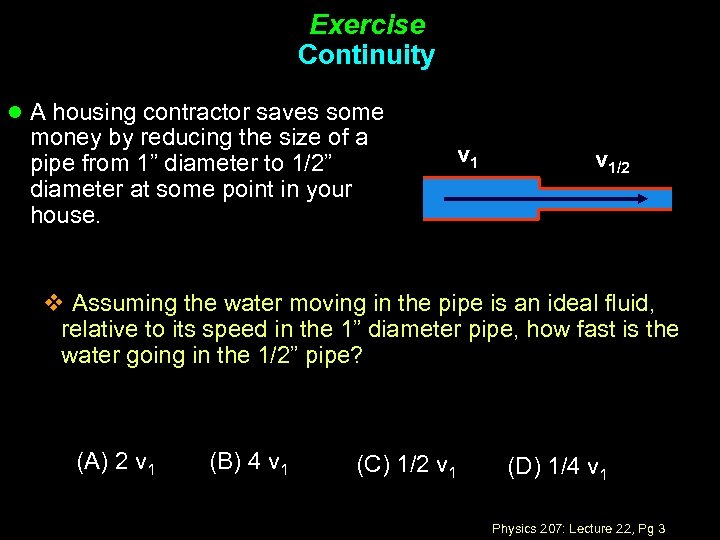 Exercise Continuity l A housing contractor saves some money by reducing the size of a pipe from 1” diameter to 1/2” diameter at some point in your house. v 1/2 v Assuming the water moving in the pipe is an ideal fluid, relative to its speed in the 1” diameter pipe, how fast is the water going in the 1/2” pipe? (A) 2 v 1 (B) 4 v 1 (C) 1/2 v 1 (D) 1/4 v 1 Physics 207: Lecture 22, Pg 3
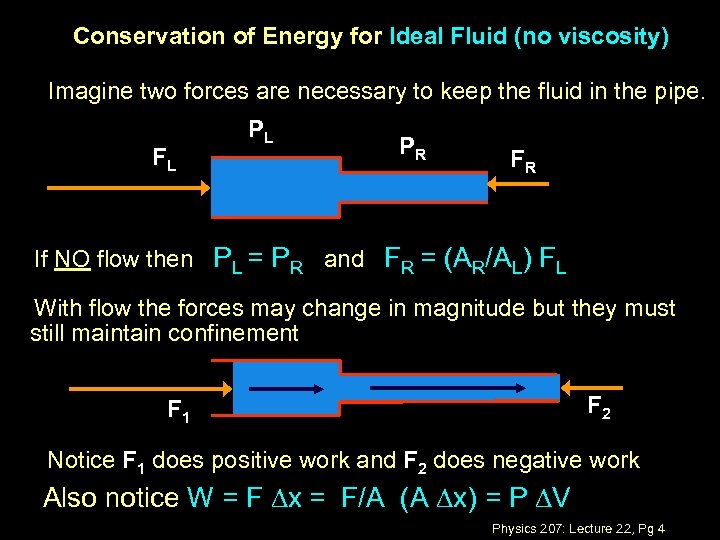 Conservation of Energy for Ideal Fluid (no viscosity) Imagine two forces are necessary to keep the fluid in the pipe. FL PL PR FR If NO flow then PL = PR and FR = (AR/AL) FL With flow the forces may change in magnitude but they must still maintain confinement F 2 F 1 Notice F 1 does positive work and F 2 does negative work Also notice W = F Dx = F/A (A Dx) = P DV Physics 207: Lecture 22, Pg 4
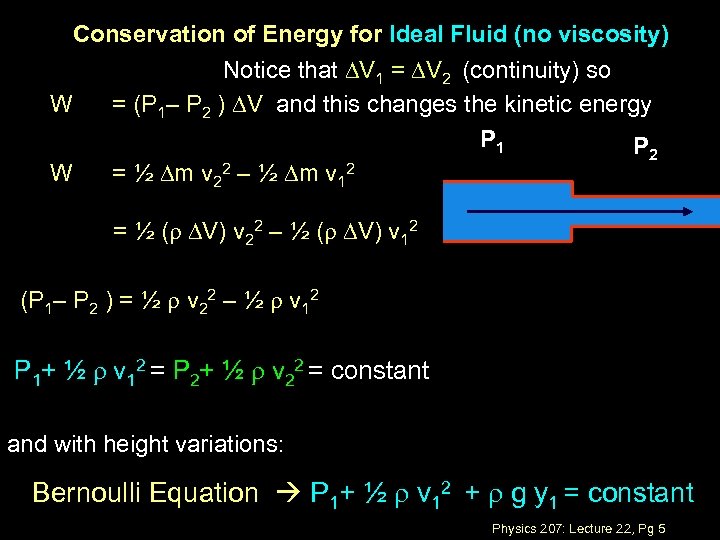 Conservation of Energy for Ideal Fluid (no viscosity) Notice that DV 1 = DV 2 (continuity) so W = (P 1– P 2 ) DV and this changes the kinetic energy P 1 P 2 W = ½ Dm v 22 – ½ Dm v 12 = ½ ( DV) v 22 – ½ ( DV) v 12 (P 1– P 2 ) = ½ v 22 – ½ v 12 P 1+ ½ v 12 = P 2+ ½ v 22 = constant and with height variations: Bernoulli Equation P 1+ ½ v 12 + g y 1 = constant Physics 207: Lecture 22, Pg 5
 Human circulation: Vorp et al. in Computational Modeling of Arterial Biomechanics l This (plaque) is a serious situation, because stress concentration within the plaque region increases the probability of plaque rupture, which can lead to a sudden, catastrophic blockage of blood flow. As atherosclerosis progresses, the buildup of plaque can lead to a stenosis, or partial blockage, of the arterial lumen. Blood flowing through a stenosis experiences a pressure decrease due to the Bernoulli effect, which can cause local collapse of the artery and further stress concentration within the artery wall. Physics 207: Lecture 22, Pg 6
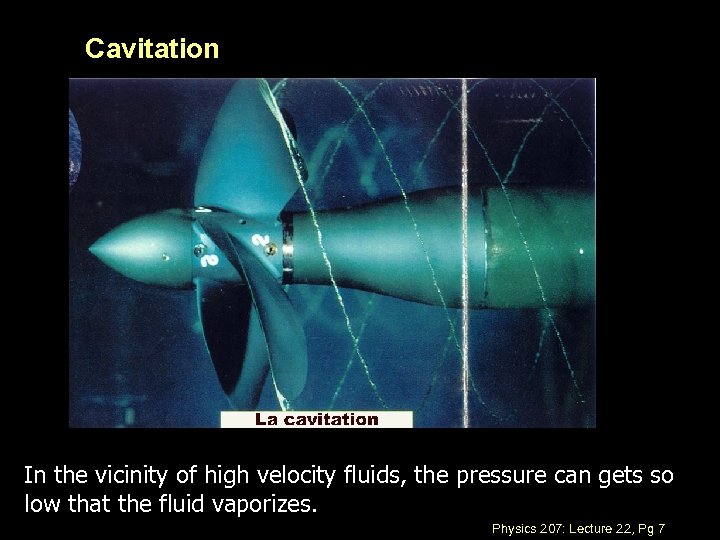 Cavitation In the vicinity of high velocity fluids, the pressure can gets so low that the fluid vaporizes. Physics 207: Lecture 22, Pg 7
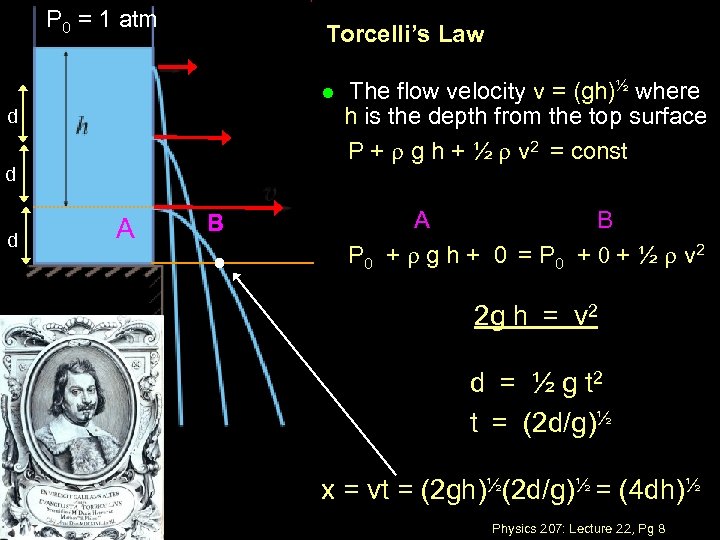 P 0 = 1 atm Torcelli’s Law l d d d A B The flow velocity v = (gh)½ where h is the depth from the top surface P + g h + ½ v 2 = const A B P 0 + g h + 0 = P 0 + ½ v 2 2 g h = v 2 d = ½ g t 2 t = (2 d/g)½ x = vt = (2 gh)½(2 d/g)½ = (4 dh)½ Physics 207: Lecture 22, Pg 8
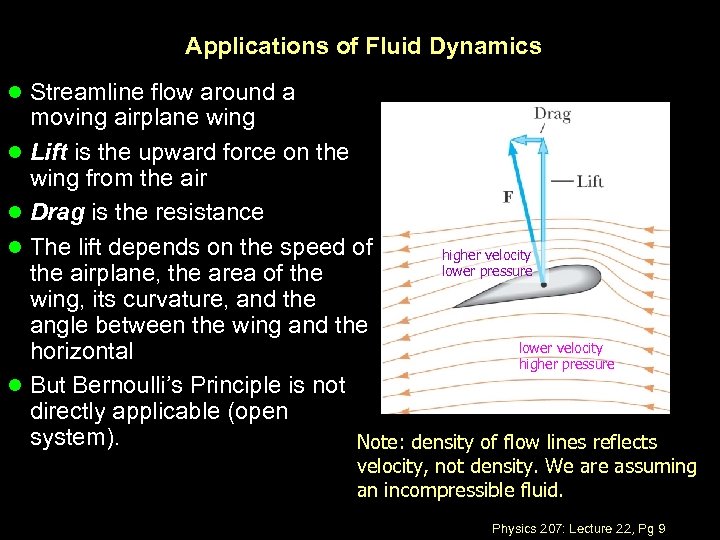 Applications of Fluid Dynamics l Streamline flow around a moving airplane wing l Lift is the upward force on the wing from the air l Drag is the resistance l The lift depends on the speed of higher velocity lower pressure the airplane, the area of the wing, its curvature, and the angle between the wing and the lower velocity horizontal higher pressure l But Bernoulli’s Principle is not directly applicable (open system). Note: density of flow lines reflects velocity, not density. We are assuming an incompressible fluid. Physics 207: Lecture 22, Pg 9
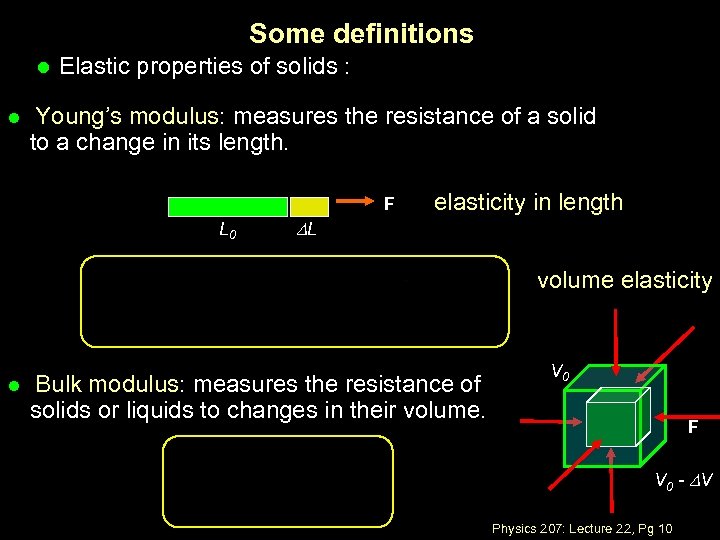 Some definitions l l Elastic properties of solids : Young’s modulus: measures the resistance of a solid to a change in its length. F L 0 elasticity in length L volume elasticity l Bulk modulus: measures the resistance of solids or liquids to changes in their volume. V 0 F V 0 - V Physics 207: Lecture 22, Pg 10
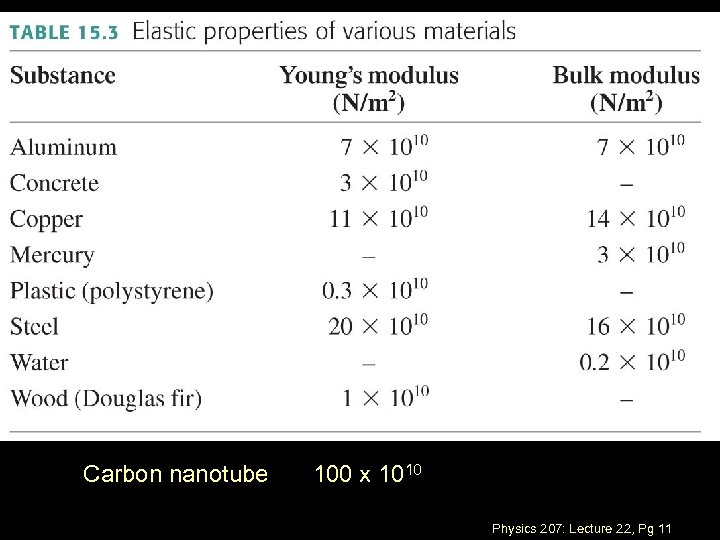 Carbon nanotube 100 x 1010 Physics 207: Lecture 22, Pg 11
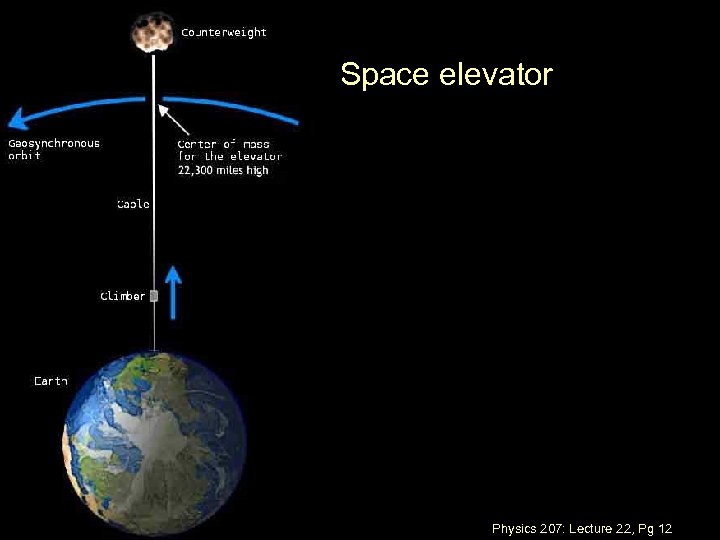 Space elevator Physics 207: Lecture 22, Pg 12
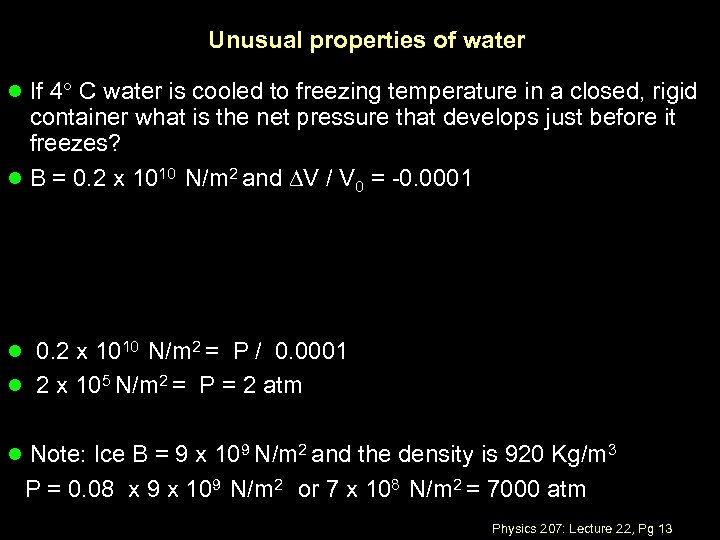 Unusual properties of water l If 4° C water is cooled to freezing temperature in a closed, rigid container what is the net pressure that develops just before it freezes? l B = 0. 2 x 10¹⁰ N/m 2 and DV / V 0 = -0. 0001 l 0. 2 x 10¹⁰ N/m 2 = P / 0. 0001 l 2 x 10⁵ N/m 2 = P = 2 atm l Note: Ice B = 9 x 10⁹ N/m 2 and the density is 920 Kg/m 3 P = 0. 08 x 9 x 109 N/m 2 or 7 x 10⁸ N/m 2 = 7000 atm Physics 207: Lecture 22, Pg 13
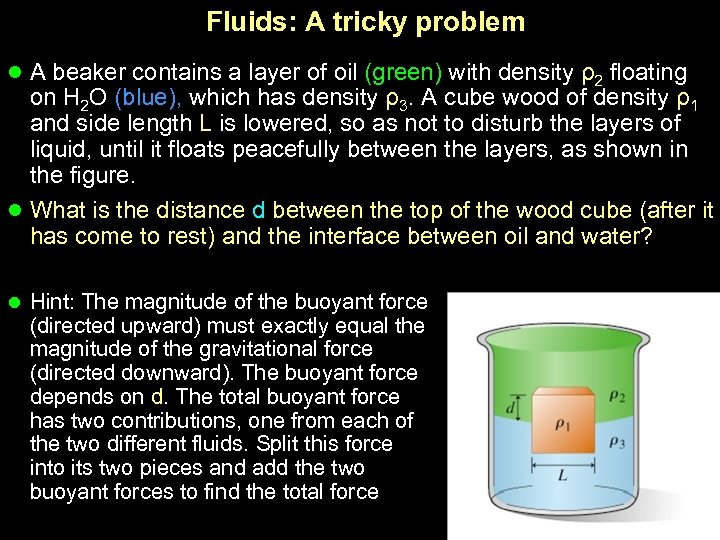 Fluids: A tricky problem l A beaker contains a layer of oil (green) with density ρ2 floating on H 2 O (blue), which has density ρ3. A cube wood of density ρ1 and side length L is lowered, so as not to disturb the layers of liquid, until it floats peacefully between the layers, as shown in the figure. l What is the distance d between the top of the wood cube (after it has come to rest) and the interface between oil and water? l Hint: The magnitude of the buoyant force (directed upward) must exactly equal the magnitude of the gravitational force (directed downward). The buoyant force depends on d. The total buoyant force has two contributions, one from each of the two different fluids. Split this force into its two pieces and add the two buoyant forces to find the total force Physics 207: Lecture 22, Pg 14
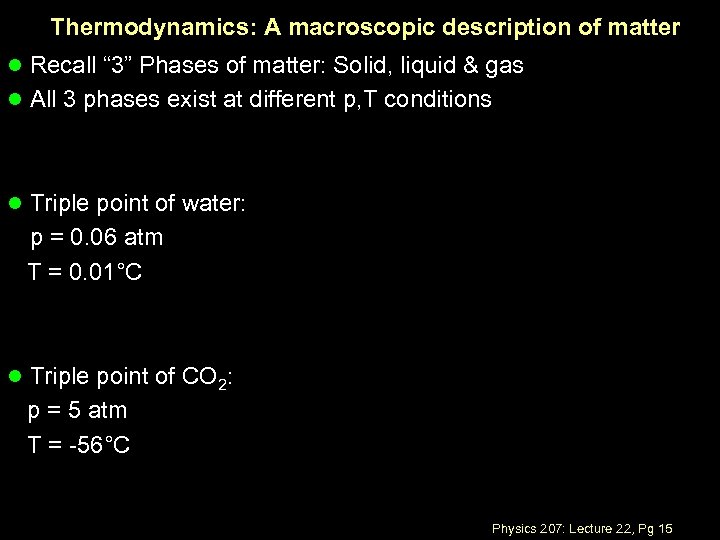 Thermodynamics: A macroscopic description of matter l Recall “ 3” Phases of matter: Solid, liquid & gas l All 3 phases exist at different p, T conditions l Triple point of water: p = 0. 06 atm T = 0. 01°C l Triple point of CO 2: p = 5 atm T = -56°C Physics 207: Lecture 22, Pg 15
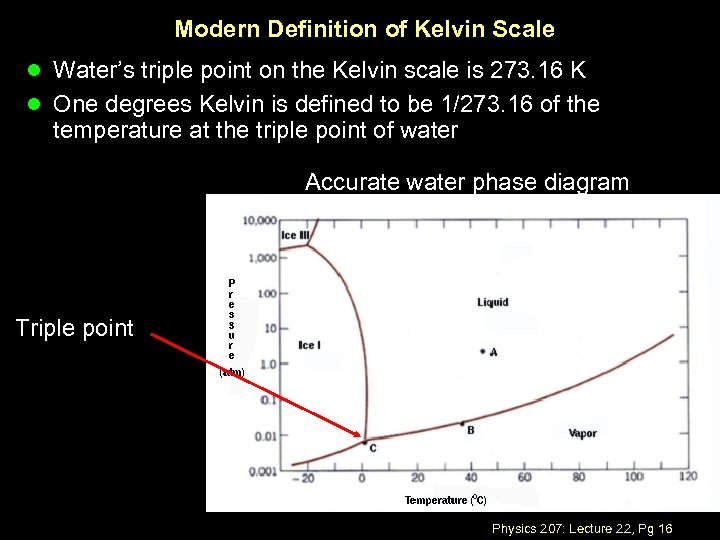 Modern Definition of Kelvin Scale l Water’s triple point on the Kelvin scale is 273. 16 K l One degrees Kelvin is defined to be 1/273. 16 of the temperature at the triple point of water Accurate water phase diagram Triple point Physics 207: Lecture 22, Pg 16
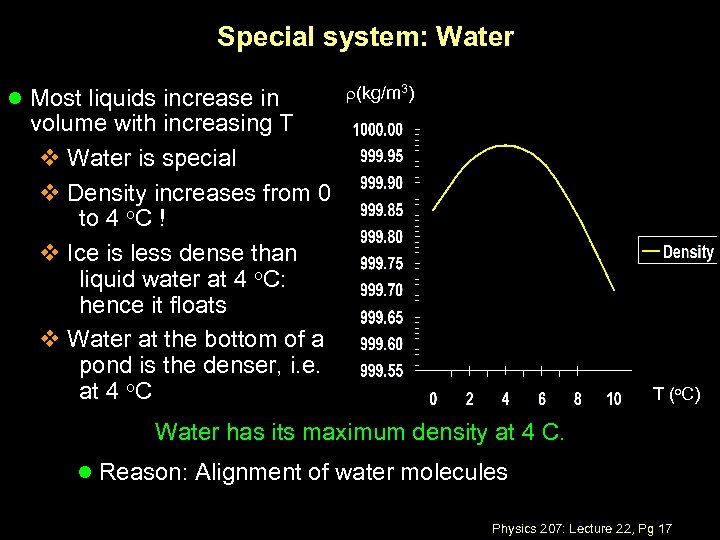 Special system: Water l Most liquids increase in (kg/m 3) volume with increasing T v Water is special v Density increases from 0 to 4 o. C ! v Ice is less dense than liquid water at 4 o. C: hence it floats v Water at the bottom of a pond is the denser, i. e. at 4 o. C T (o. C) Water has its maximum density at 4 C. l Reason: Alignment of water molecules Physics 207: Lecture 22, Pg 17
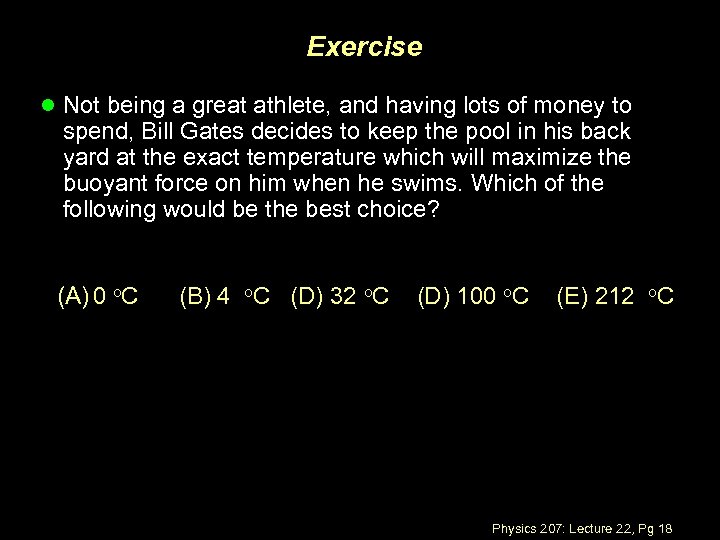 Exercise l Not being a great athlete, and having lots of money to spend, Bill Gates decides to keep the pool in his back yard at the exact temperature which will maximize the buoyant force on him when he swims. Which of the following would be the best choice? (A) 0 o. C (B) 4 o. C (D) 32 o. C (D) 100 o. C (E) 212 o. C Physics 207: Lecture 22, Pg 18
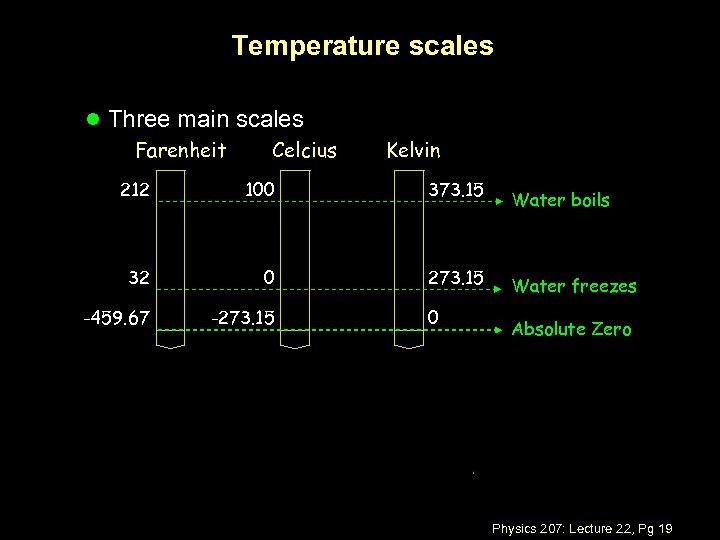 Temperature scales l Three main scales Farenheit Celcius Kelvin 212 100 373. 15 32 0 273. 15 -459. 67 -273. 15 0 Water boils Water freezes Absolute Zero Physics 207: Lecture 22, Pg 19
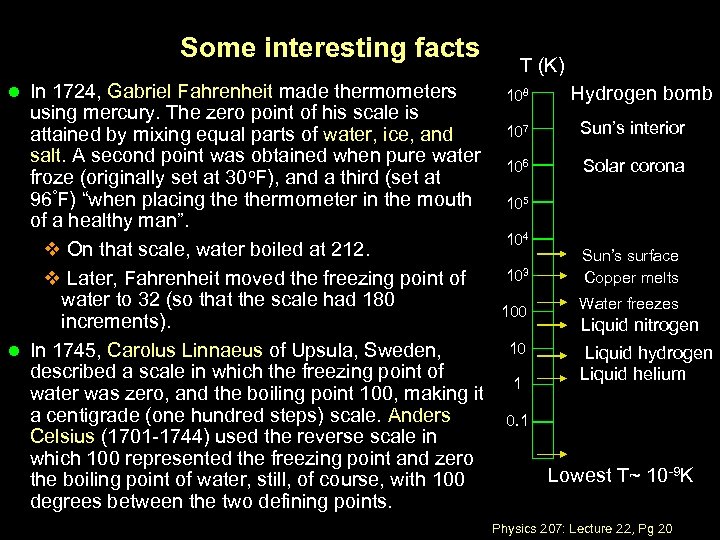 Some interesting facts l In 1724, Gabriel Fahrenheit made thermometers using mercury. The zero point of his scale is attained by mixing equal parts of water, ice, and salt. A second point was obtained when pure water froze (originally set at 30 o. F), and a third (set at 96°F) “when placing thermometer in the mouth of a healthy man”. v On that scale, water boiled at 212. v Later, Fahrenheit moved the freezing point of water to 32 (so that the scale had 180 increments). l In 1745, Carolus Linnaeus of Upsula, Sweden, described a scale in which the freezing point of water was zero, and the boiling point 100, making it a centigrade (one hundred steps) scale. Anders Celsius (1701 -1744) used the reverse scale in which 100 represented the freezing point and zero the boiling point of water, still, of course, with 100 degrees between the two defining points. T (K) 108 Hydrogen bomb 107 Sun’s interior 106 Solar corona 105 104 103 100 10 1 Sun’s surface Copper melts Water freezes Liquid nitrogen Liquid hydrogen Liquid helium 0. 1 Lowest T~ 10 -9 K Physics 207: Lecture 22, Pg 20
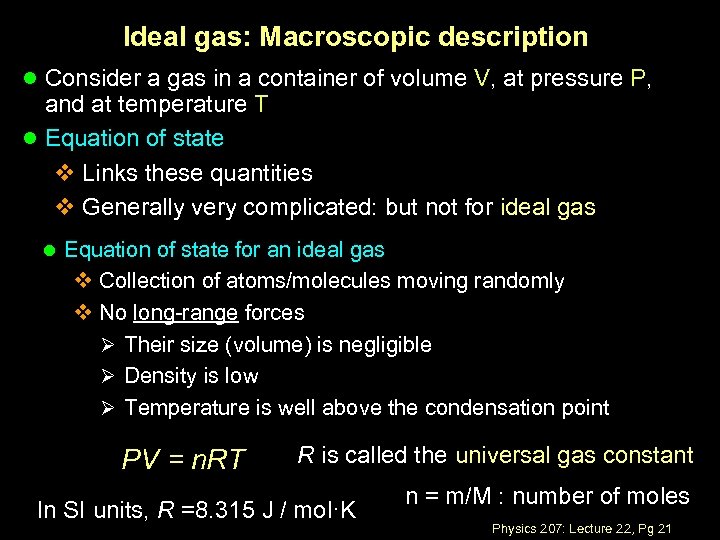 Ideal gas: Macroscopic description l Consider a gas in a container of volume V, at pressure P, and at temperature T l Equation of state v Links these quantities v Generally very complicated: but not for ideal gas l Equation of state for an ideal gas v Collection of atoms/molecules moving randomly v No long-range forces Ø Their size (volume) is negligible Ø Density is low Ø Temperature is well above the condensation point PV = n. RT R is called the universal gas constant In SI units, R =8. 315 J / mol·K n = m/M : number of moles Physics 207: Lecture 22, Pg 21
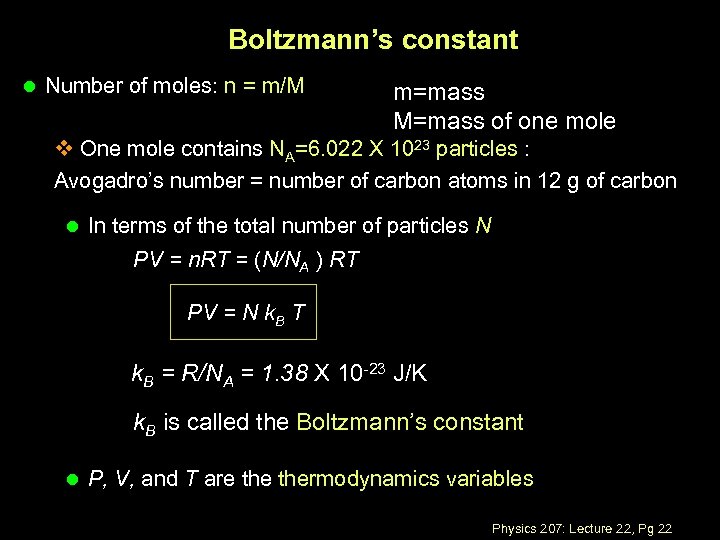 Boltzmann’s constant l Number of moles: n = m/M m=mass M=mass of one mole v One mole contains NA=6. 022 X 1023 particles : Avogadro’s number = number of carbon atoms in 12 g of carbon l In terms of the total number of particles N PV = n. RT = (N/NA ) RT PV = N k. B T k. B = R/NA = 1. 38 X 10 -23 J/K k. B is called the Boltzmann’s constant l P, V, and T are thermodynamics variables Physics 207: Lecture 22, Pg 22
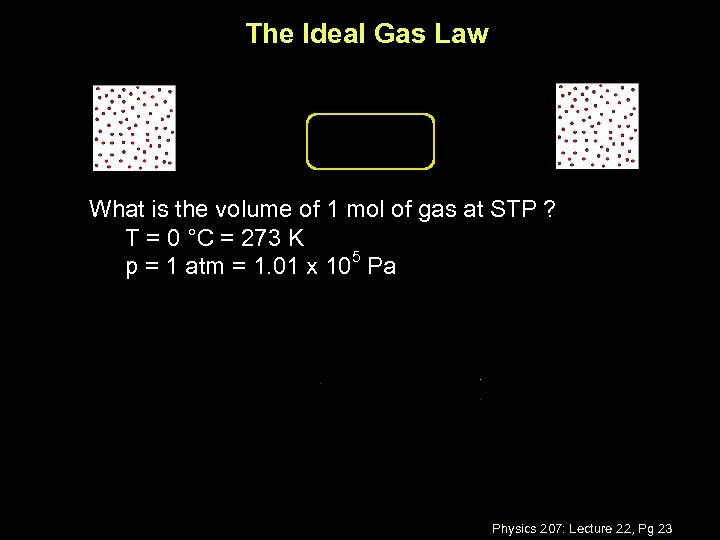 The Ideal Gas Law What is the volume of 1 mol of gas at STP ? T = 0 °C = 273 K 5 p = 1 atm = 1. 01 x 10 Pa Physics 207: Lecture 22, Pg 23
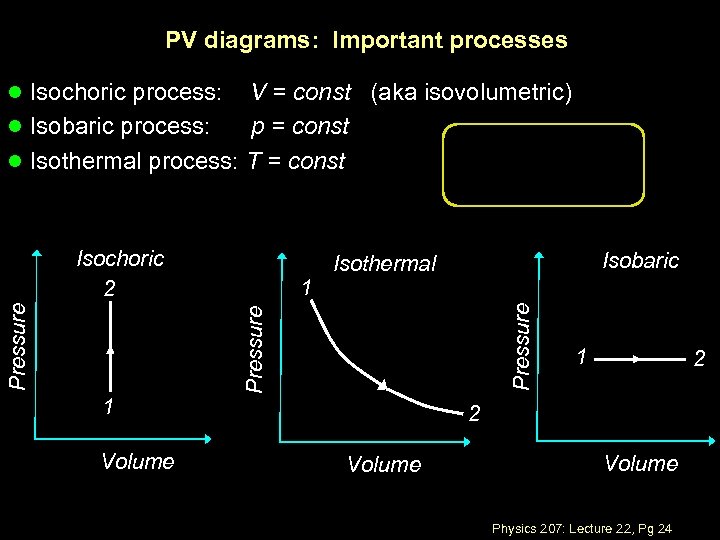 PV diagrams: Important processes l Isochoric process: V = const (aka isovolumetric) l Isobaric process: p = const l Isothermal process: T = const Pressure 1 Isobaric Isothermal Pressure Isochoric 2 1 Volume 1 2 2 Volume Physics 207: Lecture 22, Pg 24
 Lecture 22 • Assignment v HW 10, Due Wednesday, Apr. 14 th v Tuesday: Read all of Chapter 17 Physics 207: Lecture 22, Pg 25