


 Скачать презентацию Lecture 21 Overview What is a Trusted
822b7619ae83ea85996a6a2d28c03bab.ppt
- Количество слайдов: 48
 Lecture 21 Overview
 What is a Trusted System? • Functional correctness • Enforcement of integrity • Limited privilege • Appropriate confidence level CS 450/650 Fundamentals of Integrated Computer Security 2
 Security Policy • A security policy is a statement of the security we expect the system to enforce • A system can be trusted only in relation to its security policy – that is, to the security needs the system is expected to satisfy CS 450/650 Lecture 21: Trusted Operating System 3
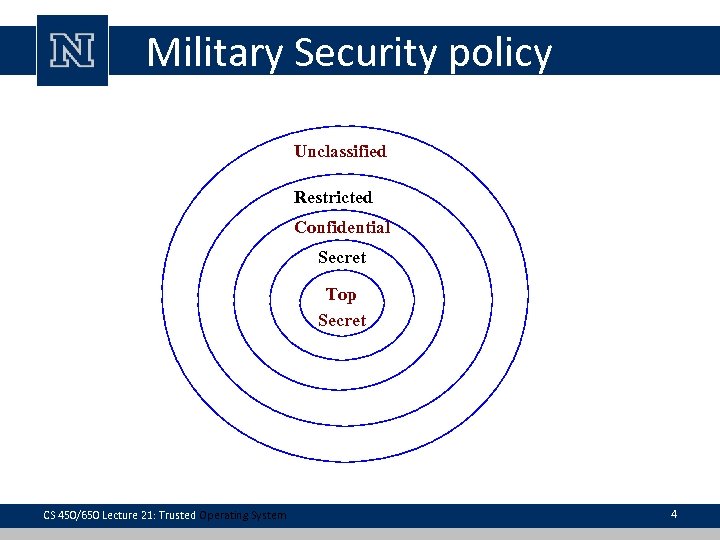 Military Security policy Unclassified Restricted Confidential Secret Top Secret CS 450/650 Lecture 21: Trusted Operating System 4
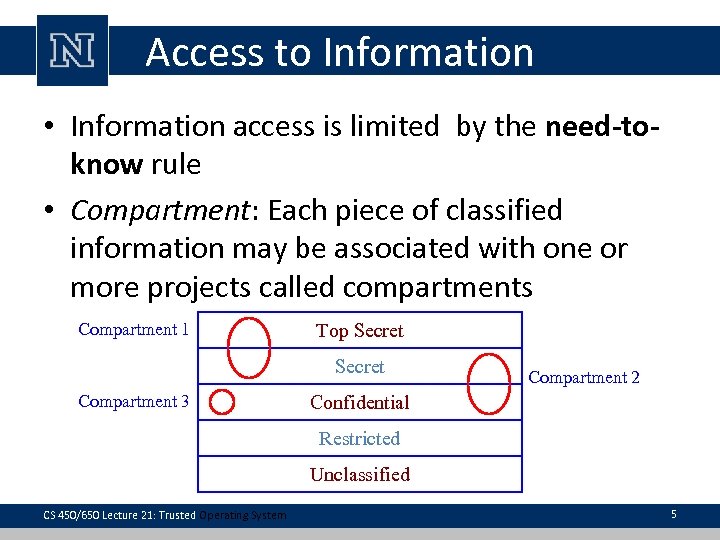 Access to Information • Information access is limited by the need-toknow rule • Compartment: Each piece of classified information may be associated with one or more projects called compartments Compartment 1 Top Secret Compartment 3 Compartment 2 Confidential Restricted Unclassified CS 450/650 Lecture 21: Trusted Operating System 5
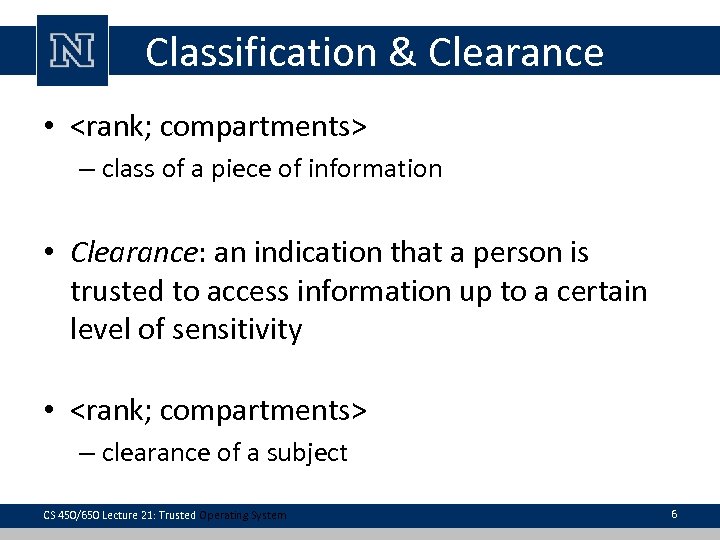 Classification & Clearance •
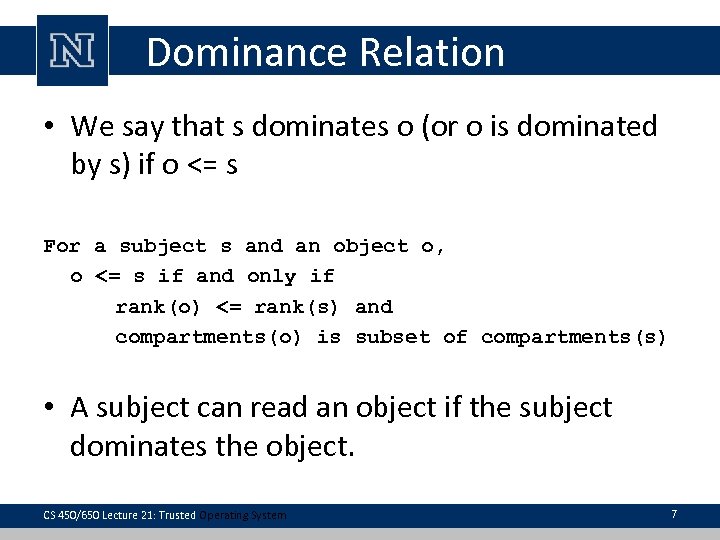 Dominance Relation • We say that s dominates o (or o is dominated by s) if o <= s For a subject s and an object o, o <= s if and only if rank(o) <= rank(s) and compartments(o) is subset of compartments(s) • A subject can read an object if the subject dominates the object. CS 450/650 Lecture 21: Trusted Operating System 7
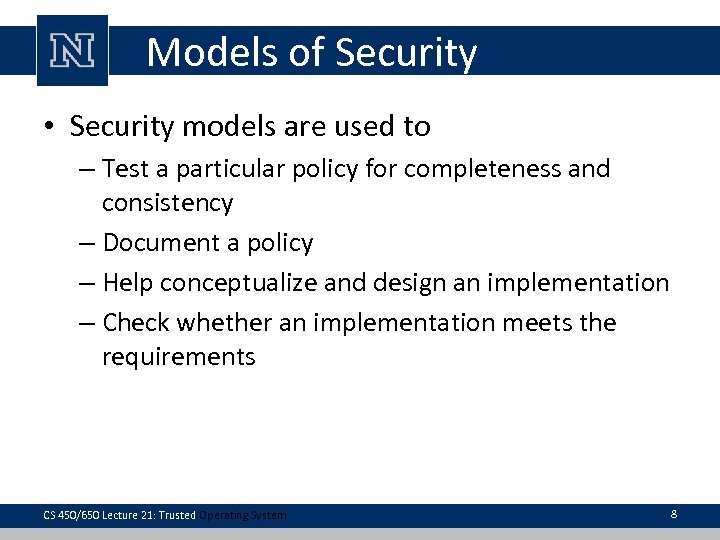 Models of Security • Security models are used to – Test a particular policy for completeness and consistency – Document a policy – Help conceptualize and design an implementation – Check whether an implementation meets the requirements CS 450/650 Lecture 21: Trusted Operating System 8
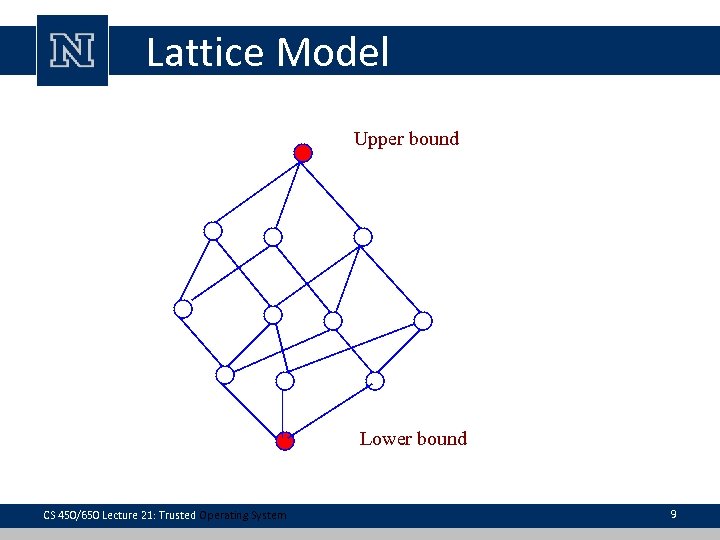 Lattice Model Upper bound Lower bound CS 450/650 Lecture 21: Trusted Operating System 9
 Bell-La Padula Model • Formal description of the allowable paths of information flow in a secure system • Set of subjects and another set of objects • Each subject s has a fixed security clearance C(s) • Each object o has a fixed security class C(o) CS 450/650 Lecture 21: Trusted Operating System 10
 Bell-La Padula Model • Two properties characterize the secure flow of information: – A subject s may have read access to an object o only if C(o) <= C(s) – A subject s who has read access to an object o may have write access to an object p only if C(o) <= C(p) • Prevents write-down CS 450/650 Lecture 21: Trusted Operating System 11
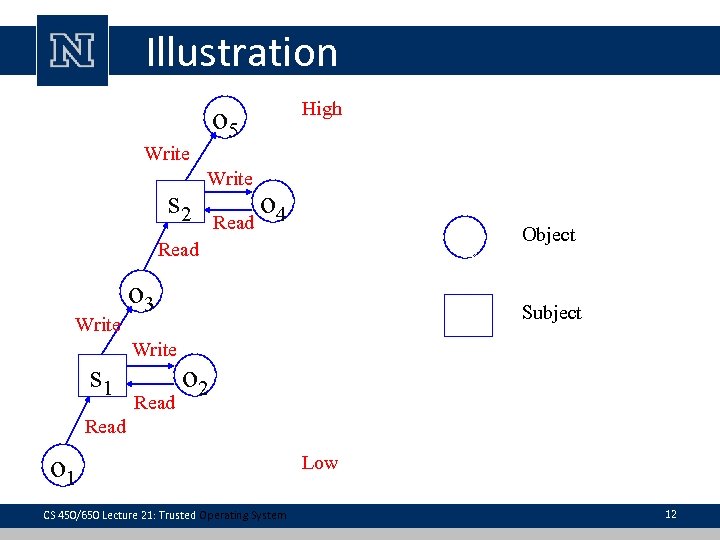 Illustration High o 5 Write s 2 Write Read o 4 o 5 s 2 Read Write s 1 o 3 Write Read Object Subject o 2 Read o 1 CS 450/650 Lecture 21: Trusted Operating System Low 12
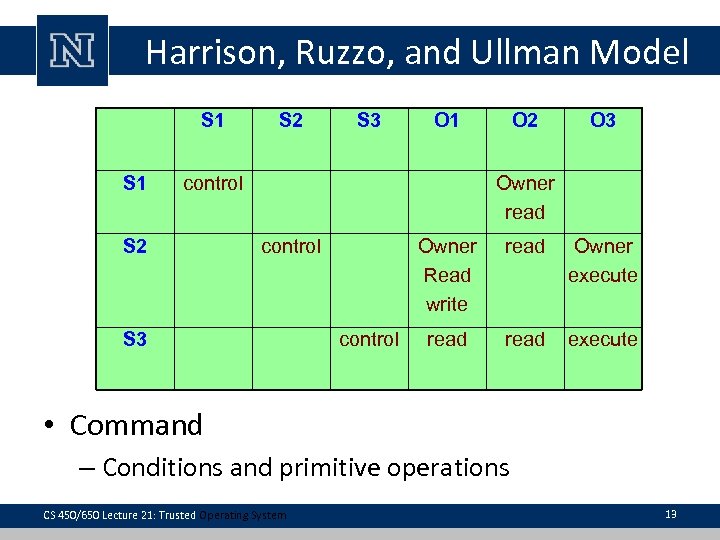 Harrison, Ruzzo, and Ullman Model S 1 S 2 S 3 O 1 control S 2 O 3 Owner read control S 3 Owner Read write control read Owner execute read execute • Command – Conditions and primitive operations CS 450/650 Lecture 21: Trusted Operating System 13
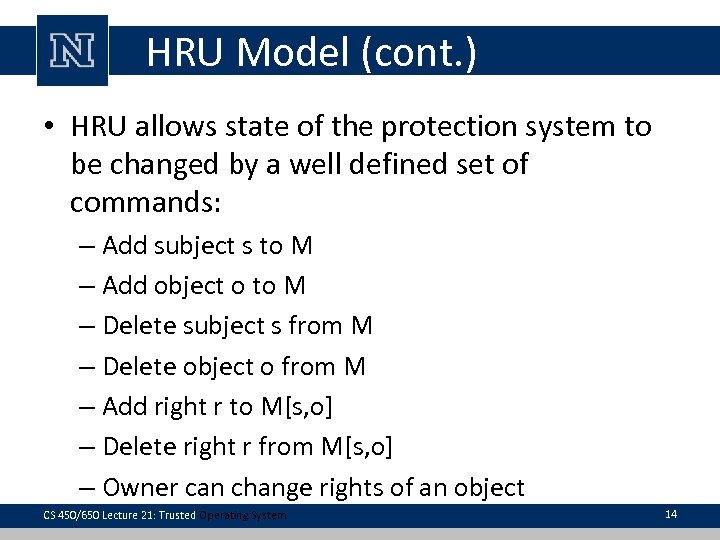 HRU Model (cont. ) • HRU allows state of the protection system to be changed by a well defined set of commands: – Add subject s to M – Add object o to M – Delete subject s from M – Delete object o from M – Add right r to M[s, o] – Delete right r from M[s, o] – Owner can change rights of an object CS 450/650 Lecture 21: Trusted Operating System 14
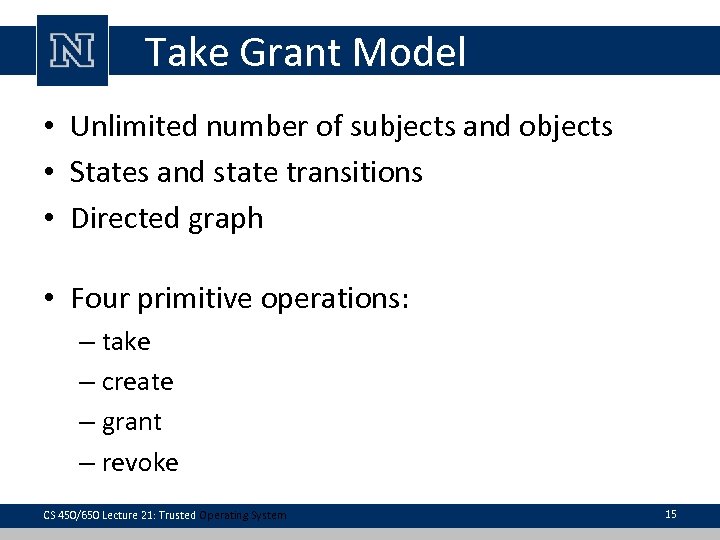 Take Grant Model • Unlimited number of subjects and objects • States and state transitions • Directed graph • Four primitive operations: – take – create – grant – revoke CS 450/650 Lecture 21: Trusted Operating System 15
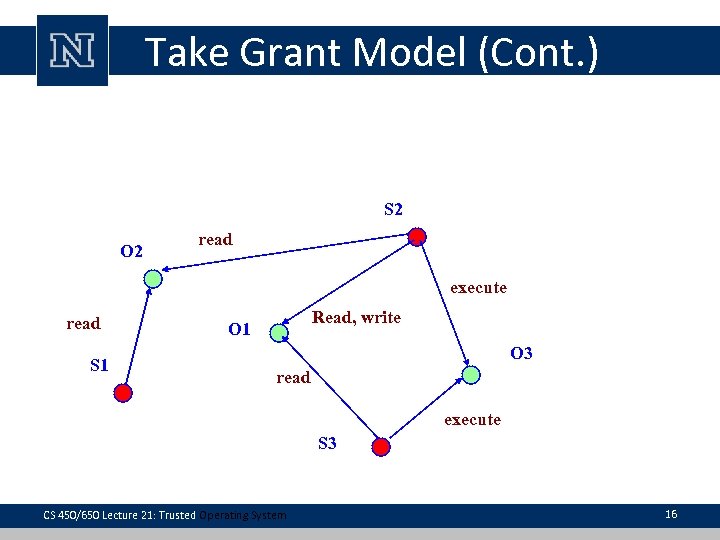 Take Grant Model (Cont. ) S 2 O 2 read execute read S 1 Read, write O 1 O 3 read execute S 3 CS 450/650 Lecture 21: Trusted Operating System 16
 Trusted OS Design • OS is a complex system – difficult to design – Adding the responsibility of security enforcement makes it even more difficult • Clear mapping from security requirements to the design • Design must be checked using formal reviews or simulation • Requirements design testing CS 450/650 Lecture 21: Trusted Operating System 17
 Security Design Principles • Least privilege – users, programs, fewest privilege possible • Economy of mechanism – small, simple, straight forward • Open design – extensive public scrutiny • Complete mediation – every attempt must be checked CS 450/650 Lecture 21: Trusted Operating System 18
 Security Design Principles • Permission based – denial of access is the default • Separation of privilege – more than one condition • Least common mechanism – the risk of sharing • Ease of use – unlikely to be avoided CS 450/650 Lecture 21: Trusted Operating System 19
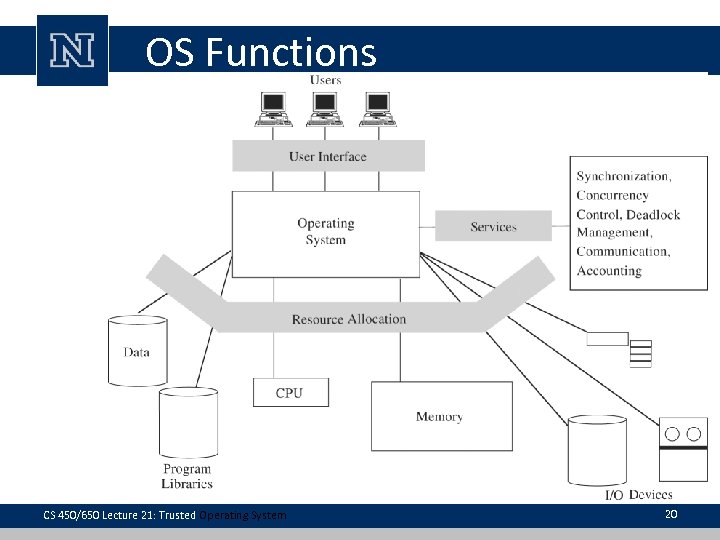 OS Functions CS 450/650 Lecture 21: Trusted Operating System 20
 Security features in ordinary OS • Authentication of users – password comparison • Protection of memory – user space, paging, segmentations • File and I/O device access control – access control matrix • Allocation & access control to general objects – table lookup CS 450/650 Lecture 21: Trusted Operating System 21
 Security features in ordinary OS • Enforcement of sharing – integrity, consistency • Fair service – no starvation • Interprocess communication & synchronization – table lookup • Protection of OS protection data – encryption, hardware control, isolation CS 450/650 Lecture 21: Trusted Operating System 22
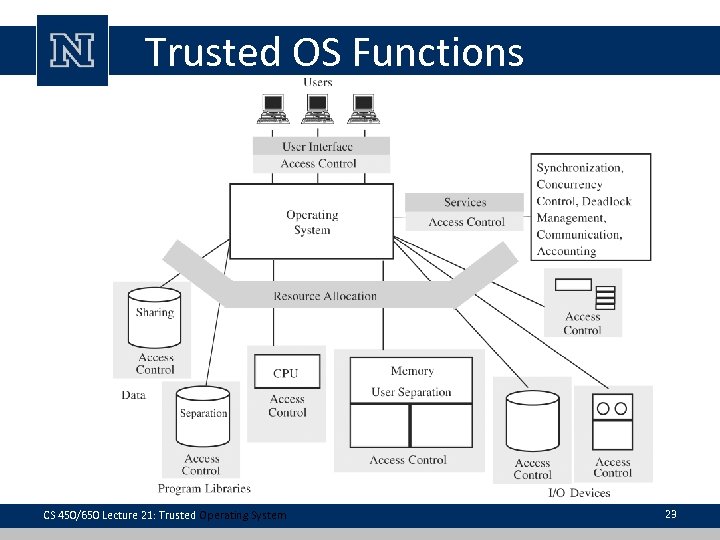 Trusted OS Functions CS 450/650 Lecture 21: Trusted Operating System 23
 Security features of Trusted OS • • Identification and Authentication Mandatory and Discretionary Access Control Object reuse protection Complete mediation (all accesses are checked) Trusted path Accountability and Audit (security log) Audit log reduction Intrusion detection (patterns of normal system usages, anomalies) CS 450/650 Lecture 21: Trusted Operating System 24
 Lecture 22 Trusted Operating Systems (cont) CS 450/650 Fundamentals of Integrated Computer Security Slides are modified from Hesham El-Rewini
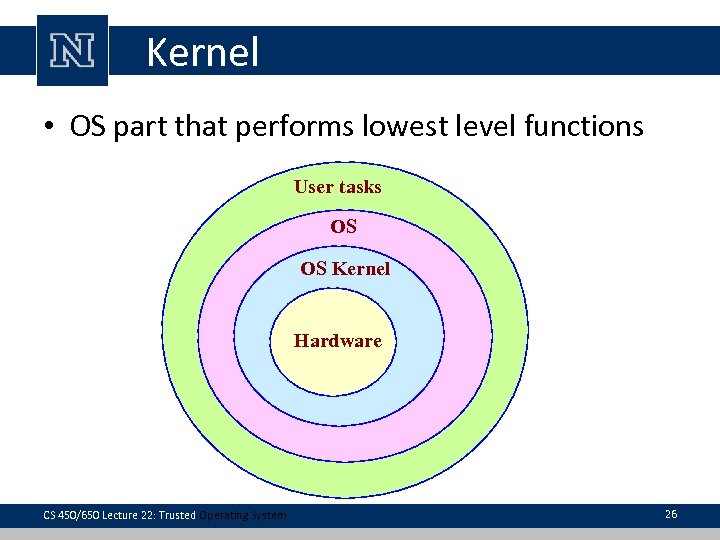 Kernel • OS part that performs lowest level functions User tasks OS OS Kernel Hardware CS 450/650 Lecture 22: Trusted Operating System 26
 Security Kernel • responsible for enforcing security mechanisms of the entire OS • Coverage – ensure that every access is checked • Separation – security mechanisms are isolated from the rest of OS and from user space easier to protect • Unity – all security mechanisms are performed by a single set of code easier to trace problems CS 450/650 Lecture 22: Trusted Operating System 27
 Security Kernel • Modifiability – security mechanism changes are easier to make and test • Compactness – relatively small • Verifiability – formal methods , all situations are covered CS 450/650 Lecture 22: Trusted Operating System 28
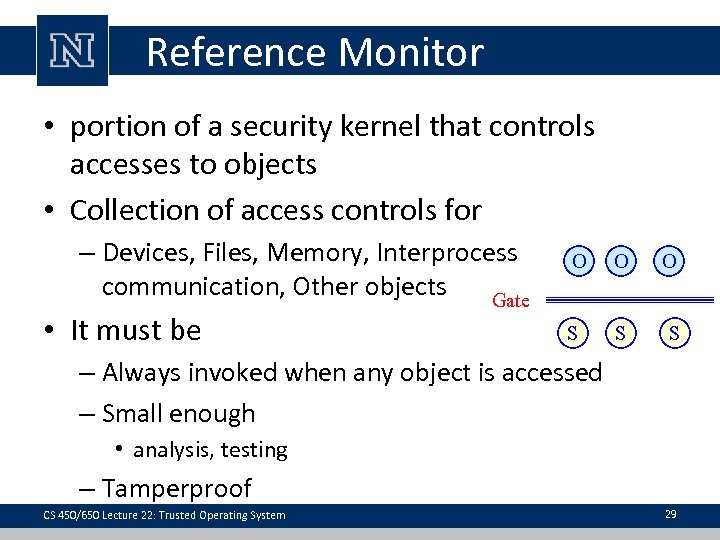 Reference Monitor • portion of a security kernel that controls accesses to objects • Collection of access controls for – Devices, Files, Memory, Interprocess communication, Other objects Gate • It must be O O O S S S – Always invoked when any object is accessed – Small enough • analysis, testing – Tamperproof CS 450/650 Lecture 22: Trusted Operating System 29
 Trusted Computing Base (TCB) • Everything in the trusted OS necessary to enforce security policy • System element on which security enforcement depends: – Hardware • processors, memory, registers, and I/O devices – Processes • separate and protect security-critical processes CS 450/650 Lecture 22: Trusted Operating System 30
 Trusted Computing Base (TCB) • System element on which security enforcement depends (cont): – Primitive files • security access control database, identification/authentication data – Protected memory • reference monitor can be protected against tampering – Interprocess communication • e. g. , reference monitor can invoke and pass data securely to audit routine CS 450/650 Lecture 22: Trusted Operating System 31
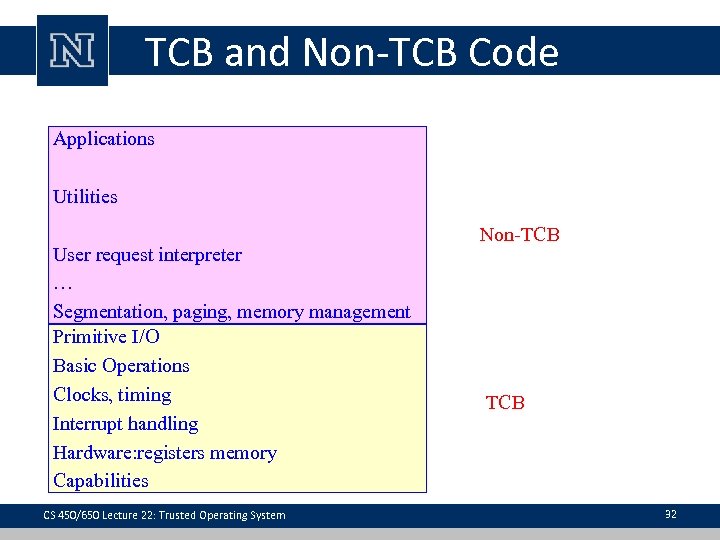 TCB and Non-TCB Code Applications Utilities User request interpreter … Segmentation, paging, memory management Primitive I/O Basic Operations Clocks, timing Interrupt handling Hardware: registers memory Capabilities CS 450/650 Lecture 22: Trusted Operating System Non-TCB 32
 TCB monitors basic interactions • Process activation • Execution domain switching • Memory Protection • I/O operation CS 450/650 Lecture 22: Trusted Operating System 33
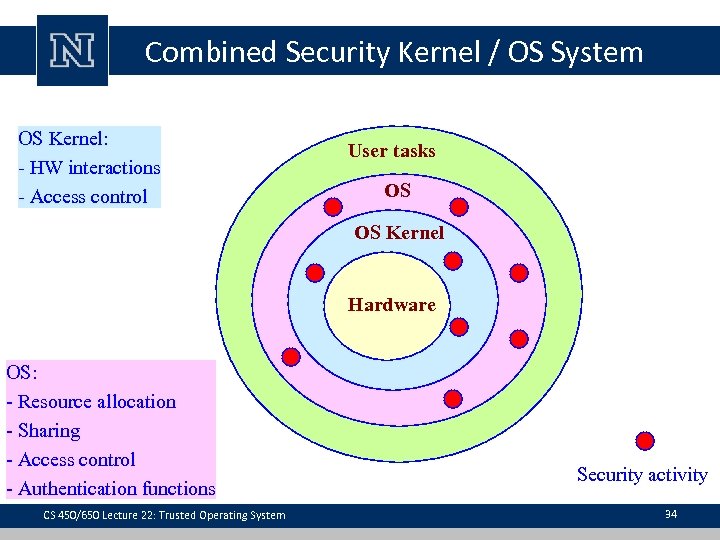 Combined Security Kernel / OS System OS Kernel: - HW interactions - Access control User tasks OS OS Kernel Hardware OS: - Resource allocation - Sharing - Access control - Authentication functions CS 450/650 Lecture 22: Trusted Operating System Security activity 34
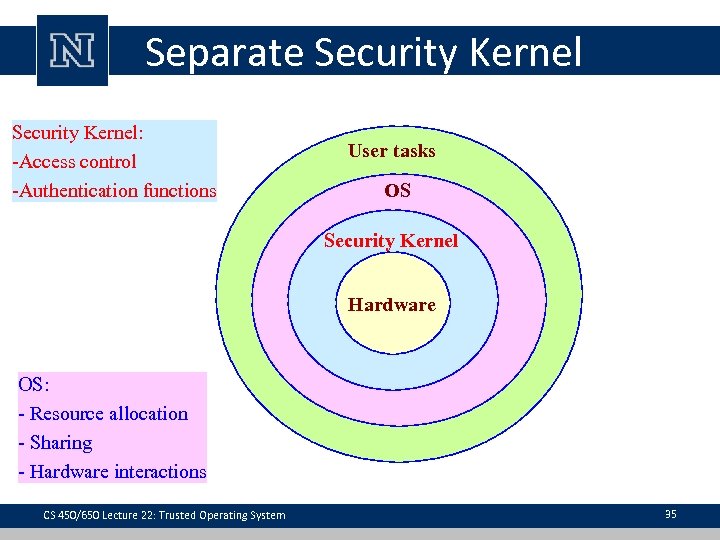 Separate Security Kernel: -Access control -Authentication functions User tasks OS Security Kernel Hardware OS: - Resource allocation - Sharing - Hardware interactions CS 450/650 Lecture 22: Trusted Operating System 35
 Separation • Physical Separation • Temporal Separation • Cryptographic Separation • Logical separation (isolation) CS 450/650 Lecture 22: Trusted Operating System 36
 Virtualization • OS emulates or simulates a collection of a computer system’s resources • Virtual Machine: Collection of real or simulated hardware facilities – processor, memory, I/O devices CS 450/650 Lecture 22: Trusted Operating System 37
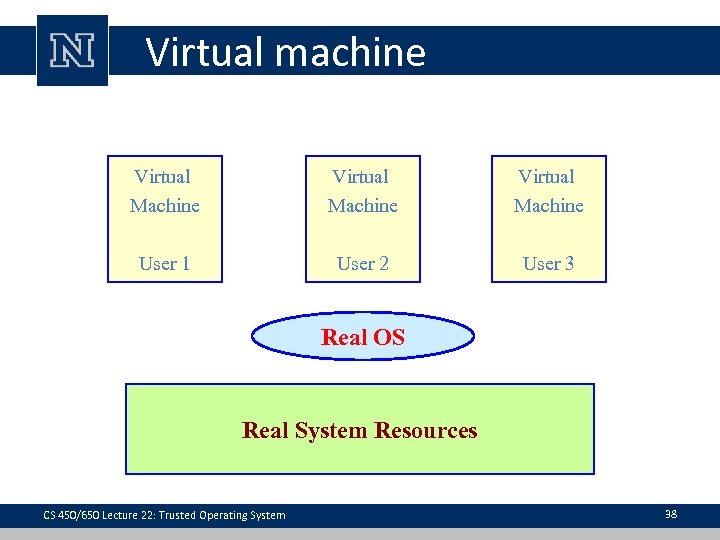 Virtual machine Virtual Machine User 1 User 2 User 3 Real OS Real System Resources CS 450/650 Lecture 22: Trusted Operating System 38
 IBM MVS/ESA • Virtualization is used to provide logical separation that gives the user the impression of physical separation – Each user feels that he/she has a separate machine • Paging System – Each user’s virtual memory space can be as large as the total addressable space CS 450/650 Lecture 22: Trusted Operating System 39
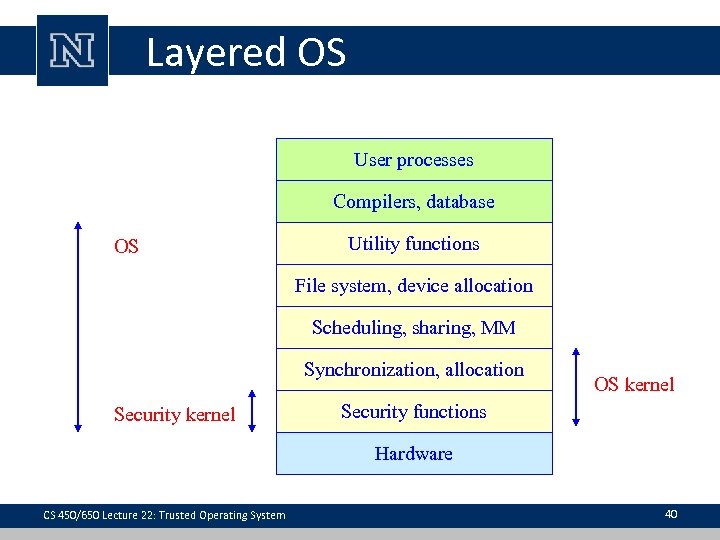 Layered OS User processes Compilers, database OS Utility functions File system, device allocation Scheduling, sharing, MM Synchronization, allocation Security kernel OS kernel Security functions Hardware CS 450/650 Lecture 22: Trusted Operating System 40
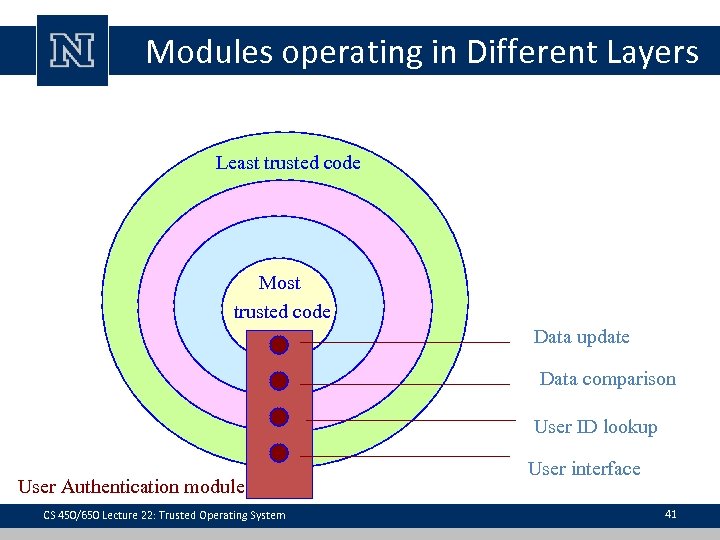 Modules operating in Different Layers Least trusted code Most trusted code Data update Data comparison User ID lookup User Authentication module CS 450/650 Lecture 22: Trusted Operating System User interface 41
 Assurance • Testing – based on the actual product being evaluated, • not on abstraction • Verification – each of the system’s functions works correctly • Validation – developer is building the right product • according to the specification CS 450/650 Lecture 22: Trusted Operating System 42
 Testing • Observable effects versus internal structure • Can demonstrate existence of a problem, – but passing tests does not imply absence of any • Hard to achieve adequate test coverage within reasonable time – inputs & internal states • hard to keep track of all states • Penetrating Testing – tiger team analysis, ethical hacking • Team of experts in design of OS tries to crack system CS 450/650 Lecture 22: Trusted Operating System 43
 Formal verification • The most rigorous method • Rules of mathematical logic to demonstrate that a system has certain security property • Proving a Theorem – Time consuming – Complex process CS 450/650 Lecture 22: Trusted Operating System 44
![Example: find minimum Entry min A[1] i 1 i i+1 yes i>n Exit no](https://present5.com/presentation/822b7619ae83ea85996a6a2d28c03bab/image-45.jpg "Example: find minimum Entry min A[1] i 1 i i+1 yes i>n Exit no") Example: find minimum Entry min A[1] i 1 i i+1 yes i>n Exit no yes min < A[i] no min A[i] CS 450/650 Lecture 22: Trusted Operating System 45
Example: find minimum Entry min A[1] i 1 i i+1 yes i>n Exit no yes min < A[i] no min A[i] CS 450/650 Lecture 22: Trusted Operating System 45
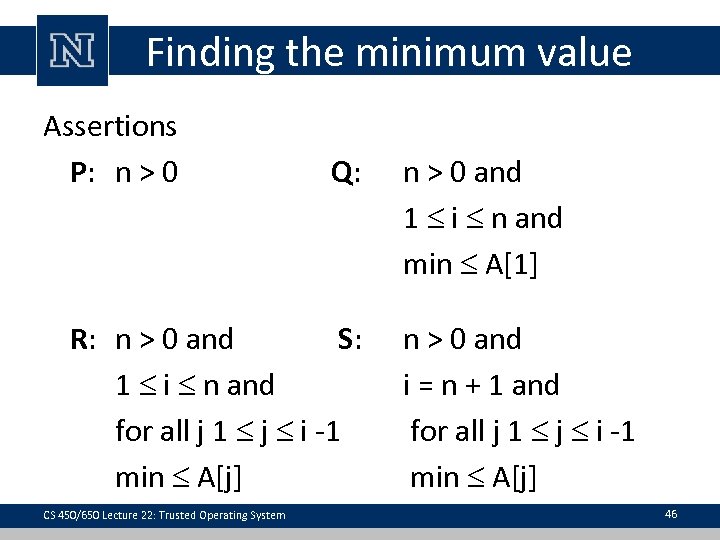 Finding the minimum value Assertions P: n > 0 Q: R: n > 0 and S: 1 i n and for all j 1 j i -1 min A[j] CS 450/650 Lecture 22: Trusted Operating System n > 0 and 1 i n and min A[1] n > 0 and i = n + 1 and for all j 1 j i -1 min A[j] 46
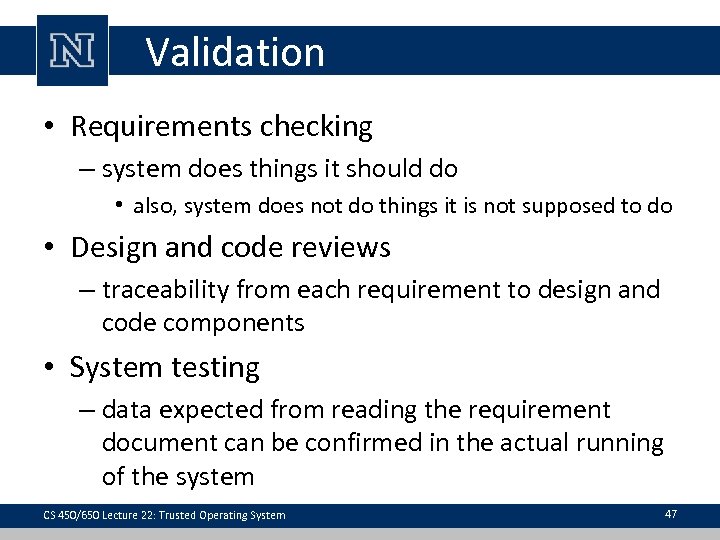 Validation • Requirements checking – system does things it should do • also, system does not do things it is not supposed to do • Design and code reviews – traceability from each requirement to design and code components • System testing – data expected from reading the requirement document can be confirmed in the actual running of the system CS 450/650 Lecture 22: Trusted Operating System 47
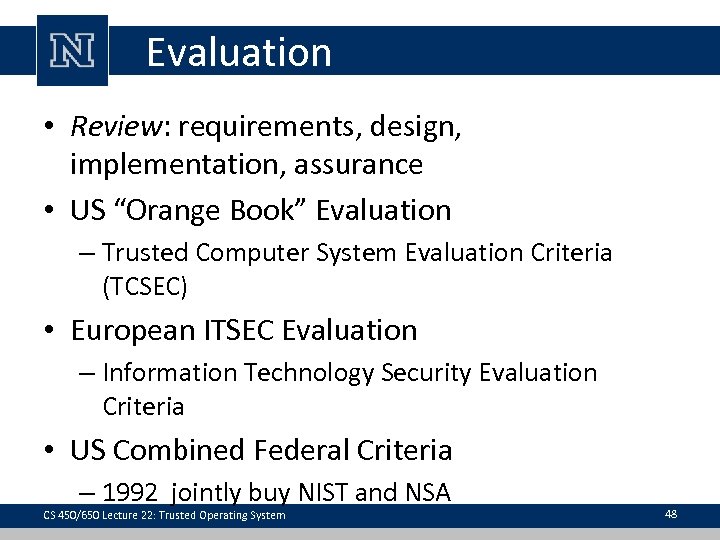 Evaluation • Review: requirements, design, implementation, assurance • US “Orange Book” Evaluation – Trusted Computer System Evaluation Criteria (TCSEC) • European ITSEC Evaluation – Information Technology Security Evaluation Criteria • US Combined Federal Criteria – 1992 jointly buy NIST and NSA CS 450/650 Lecture 22: Trusted Operating System 48