


 Скачать презентацию Lecture 2 Regular Expressions and Automata in Language
868355ddb2356a39fc7e8cd102a79705.ppt
- Количество слайдов: 20
 Lecture 2 Regular Expressions and Automata in Language Analysis CS 4705
 Statistical vs. Symbolic (Knowledge Rich) Techniques • How much linguistic knowledge do our representations and algorithms need to have to do ‘successful’ NLP? – Bill hit John. – John, Bill hit. • 80/20 Rule: when do we need to worry about the other 20%?
 Today • Review some of the simple representations and ask ourselves how we might use them to do interesting and useful things – Regular Expressions – Finite State Automata • Think about the limits of these simple approaches: when do we need more?
 Uses of Regular Expressions in NLP • Simple but powerful tools for large corpus analysis -- ‘shallow’ processing – What word is most likely to begin a sentence? – What word is most likely to begin a question? – How often do people end sentences with prepositions? • With other simple statistical tools, allow us to – Obtain word frequency and co-occurrence statistics – Build simple interactive applications (e. g. Eliza) – Authorship: Who wrote Shakespeare’s plays? The Federalist papers? The Unibomber letters?
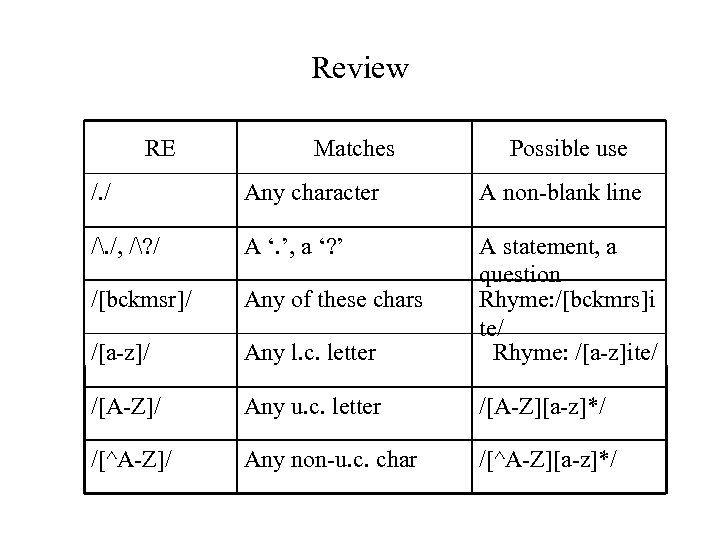 Review RE Matches Possible use /. / Any character A non-blank line /. /, /? / A ‘. ’, a ‘? ’ /[bckmsr]/ Any of these chars /[a-z]/ Any l. c. letter A statement, a question Rhyme: /[bckmrs]i te/ Rhyme: /[a-z]ite/ /[A-Z]/ Any u. c. letter /[A-Z][a-z]*/ /[^A-Z]/ Any non-u. c. char /[^A-Z][a-z]*/
![RE Description Uses? /a*/ Zero or more a’s /(very[ ])*/ /a+/ One or more](https://present5.com/presentation/868355ddb2356a39fc7e8cd102a79705/image-6.jpg "RE Description Uses? /a*/ Zero or more a’s /(very[ ])*/ /a+/ One or more") RE Description Uses? /a*/ Zero or more a’s /(very[ ])*/ /a+/ One or more a’s /(very[ ])+/ /a? / Optional single a /(very[ ])? / /cat|dog/ ‘cat’ or ‘dog’ /[a-z]* (cat|dog)/ /^[Nn]o$/ A line with only ‘No’ or ‘no’ in it Prefixes /bunB/ Words prefixed by ‘un’ (nb. union)
RE Description Uses? /a*/ Zero or more a’s /(very[ ])*/ /a+/ One or more a’s /(very[ ])+/ /a? / Optional single a /(very[ ])? / /cat|dog/ ‘cat’ or ‘dog’ /[a-z]* (cat|dog)/ /^[Nn]o$/ A line with only ‘No’ or ‘no’ in it Prefixes /bunB/ Words prefixed by ‘un’ (nb. union)
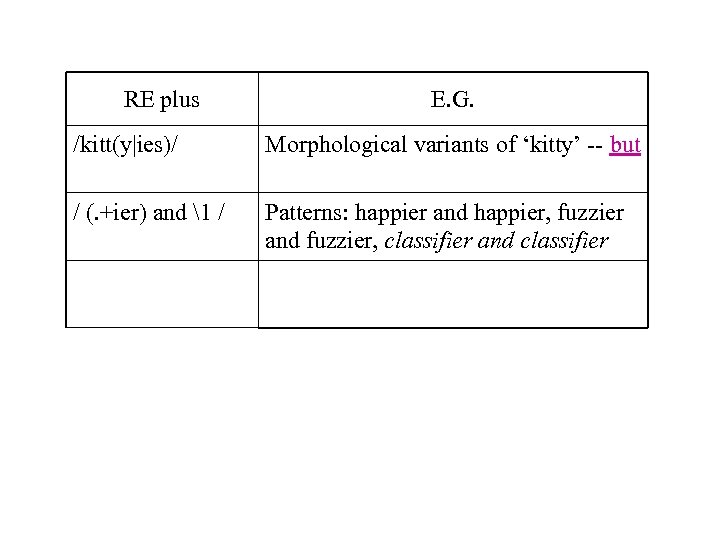 RE plus E. G. /kitt(y|ies)/ Morphological variants of ‘kitty’ -- but / (. +ier) and 1 / Patterns: happier and happier, fuzzier and fuzzier, classifier and classifier
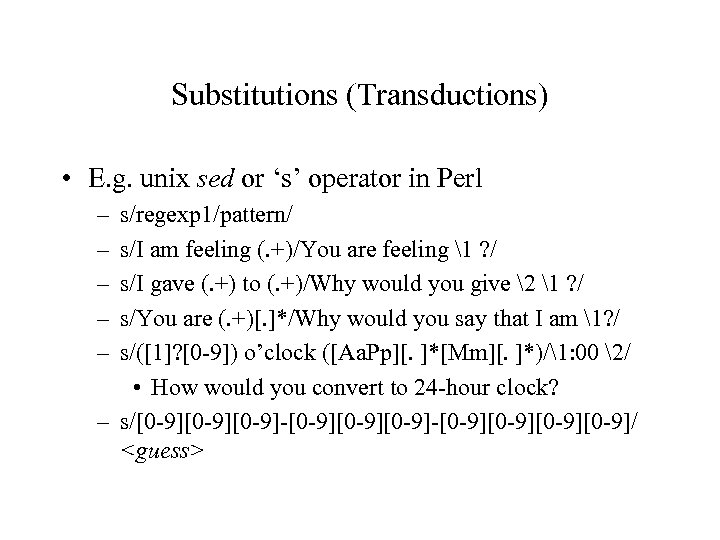 Substitutions (Transductions) • E. g. unix sed or ‘s’ operator in Perl – – – s/regexp 1/pattern/ s/I am feeling (. +)/You are feeling 1 ? / s/I gave (. +) to (. +)/Why would you give 2 1 ? / s/You are (. +)[. ]*/Why would you say that I am 1? / s/([1]? [0 -9]) o’clock ([Aa. Pp][. ]*[Mm][. ]*)/1: 00 2/ • How would you convert to 24 -hour clock? – s/[0 -9][0 -9][0 -9]-[0 -9][0 -9]/
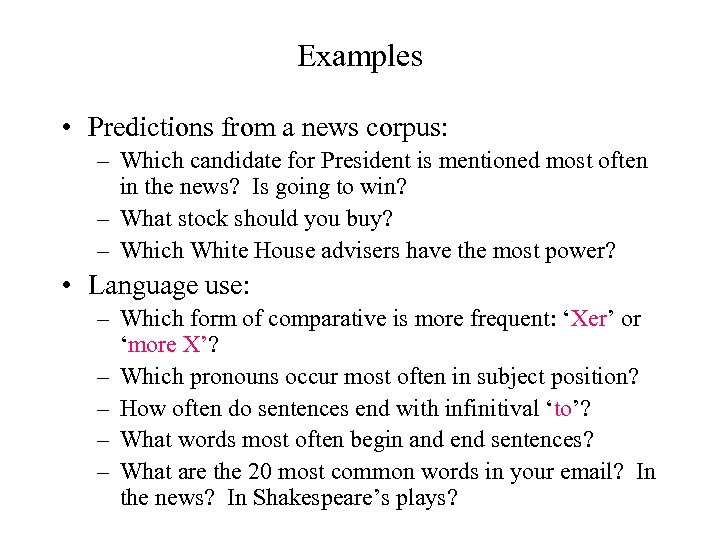 Examples • Predictions from a news corpus: – Which candidate for President is mentioned most often in the news? Is going to win? – What stock should you buy? – Which White House advisers have the most power? • Language use: – Which form of comparative is more frequent: ‘Xer’ or ‘more X’? – Which pronouns occur most often in subject position? – How often do sentences end with infinitival ‘to’? – What words most often begin and end sentences? – What are the 20 most common words in your email? In the news? In Shakespeare’s plays?
 • Emotional language: – What words indicate what emotions? • Happiness • Anger • Confidence • Despair – How can we identify emotions automatically?
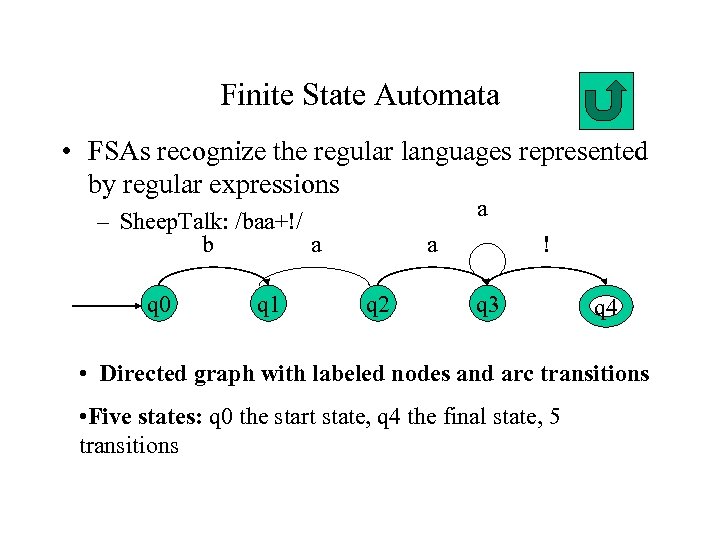 Finite State Automata • FSAs recognize the regular languages represented by regular expressions a – Sheep. Talk: /baa+!/ b a q 0 q 1 a q 2 ! q 3 q 4 • Directed graph with labeled nodes and arc transitions • Five states: q 0 the start state, q 4 the final state, 5 transitions
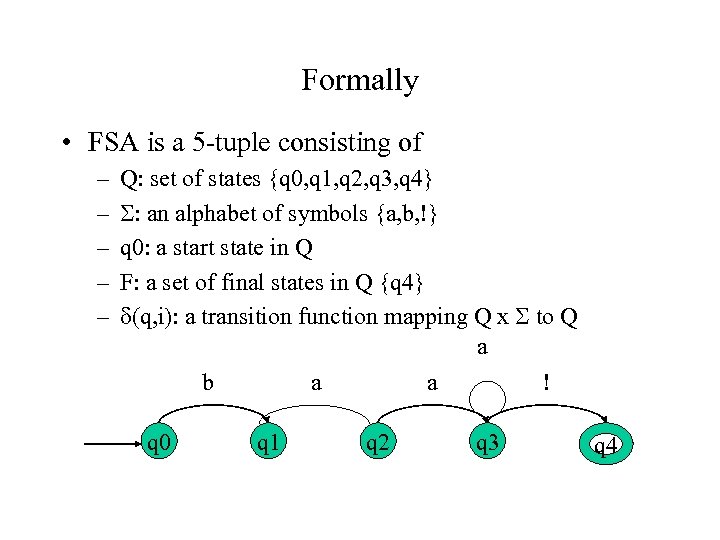 Formally • FSA is a 5 -tuple consisting of – – – Q: set of states {q 0, q 1, q 2, q 3, q 4} : an alphabet of symbols {a, b, !} q 0: a start state in Q F: a set of final states in Q {q 4} (q, i): a transition function mapping Q x to Q a b a a ! q 0 q 1 q 2 q 3 q 4
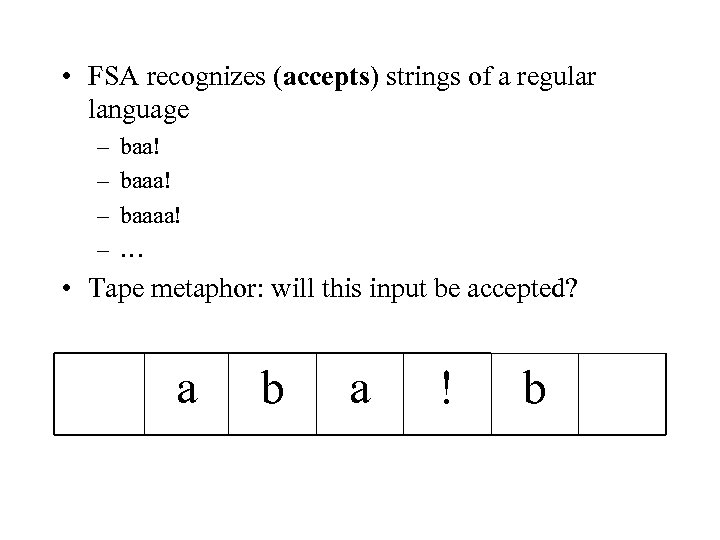 • FSA recognizes (accepts) strings of a regular language – – baa! baaaa! … • Tape metaphor: will this input be accepted? a b a ! b
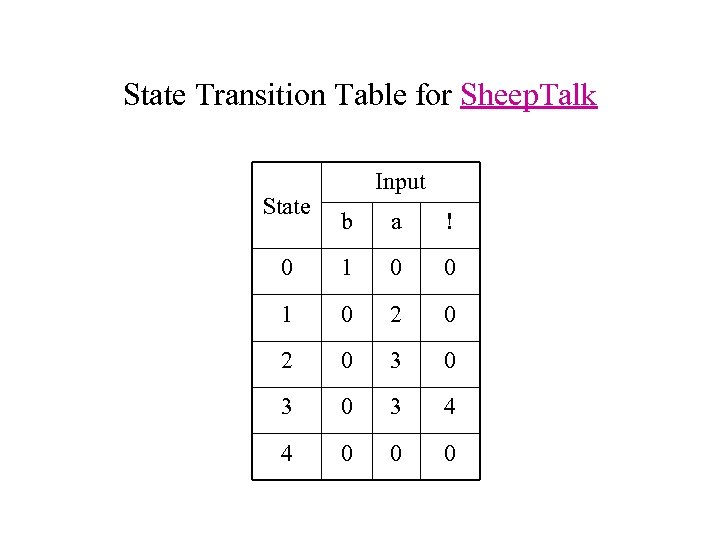 State Transition Table for Sheep. Talk State Input b a ! 0 1 0 2 0 3 0 3 4 4 0 0 0
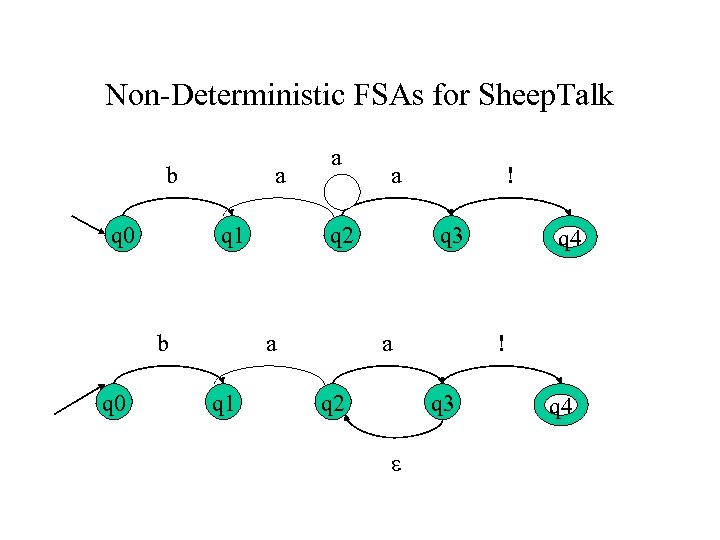 Non-Deterministic FSAs for Sheep. Talk b q 0 a q 1 b q 0 a q 2 a q 1 a ! q 3 a q 2 ! q 3 q 4
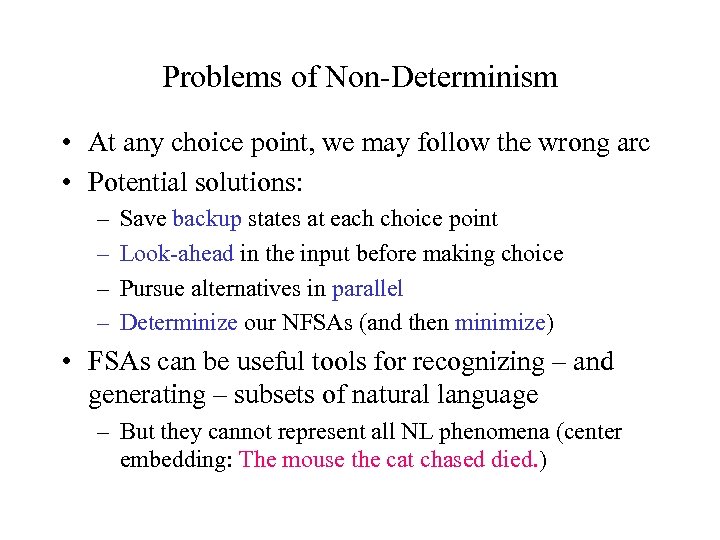 Problems of Non-Determinism • At any choice point, we may follow the wrong arc • Potential solutions: – – Save backup states at each choice point Look-ahead in the input before making choice Pursue alternatives in parallel Determinize our NFSAs (and then minimize) • FSAs can be useful tools for recognizing – and generating – subsets of natural language – But they cannot represent all NL phenomena (center embedding: The mouse the cat chased died. )
 – Simple vs. linguistically rich representations…. – How do we decide what we need?
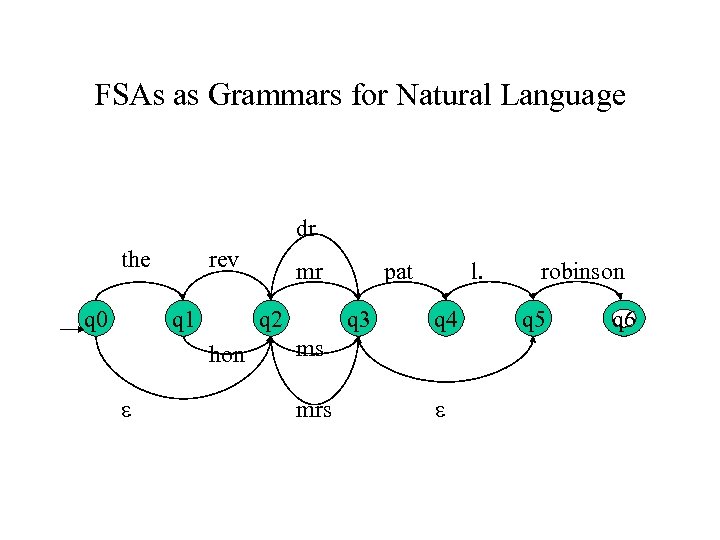 FSAs as Grammars for Natural Language dr the q 0 rev q 1 q 2 hon mr pat q 3 l. q 4 ms mrs robinson q 5 q 6
 • If we want to extract all the proper names in the news, will this work? – What will it miss? – Will it accept something that is not a proper name? – How would you change it to accept all proper names without false positives? – Precision vs. recall….
 Summing Up • Regular expressions and FSAs can represent subsets of natural language as well as regular languages – Both representations may be impossible for humans to understand for any real subset of a language – But they are relatively easy to use for small subsets – Can be hard to scale up: when many choices at any point (e. g. surnames) • Next time: Read Ch 3