


 Скачать презентацию Lecture 19 Externalities Health Richard Smith Reader
3fd40bda54e7149b4379d6111bc74b35.ppt
- Количество слайдов: 48
 Lecture 19: Externalities & Health Richard Smith Reader in Health Economics School of Medicine, Health Policy & Practice Health Economics – SOCE 3 B 11 – Autumn 04/05
 Overview of lecture What are ‘externalities’? n Positive externalities and health n Negative externalities and health n ‘Global’ externalities and health n Externalities and public goods n Health Economics – SOCE 3 B 11 – Autumn 04/05
 What are ‘externalities’? n n n Costs and/or benefits of actions by one party which affect other parties Externalities exist wherever a transaction affects an uncompensated party Policy issue – design of appropriate institutions & legislation to align individual incentives & social welfare Externalities (with public goods) are main reason for public health care systems worldwide Health Economics – SOCE 3 B 11 – Autumn 04/05
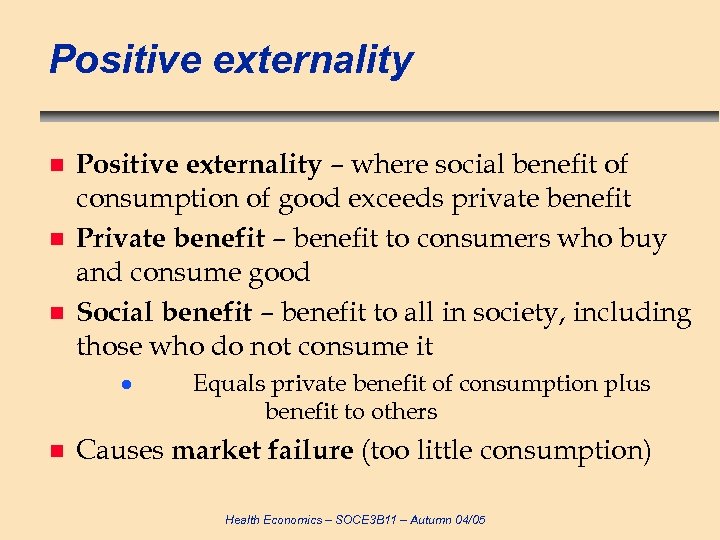 Positive externality n n n Positive externality – where social benefit of consumption of good exceeds private benefit Private benefit – benefit to consumers who buy and consume good Social benefit – benefit to all in society, including those who do not consume it n Equals private benefit of consumption plus benefit to others Causes market failure (too little consumption) Health Economics – SOCE 3 B 11 – Autumn 04/05
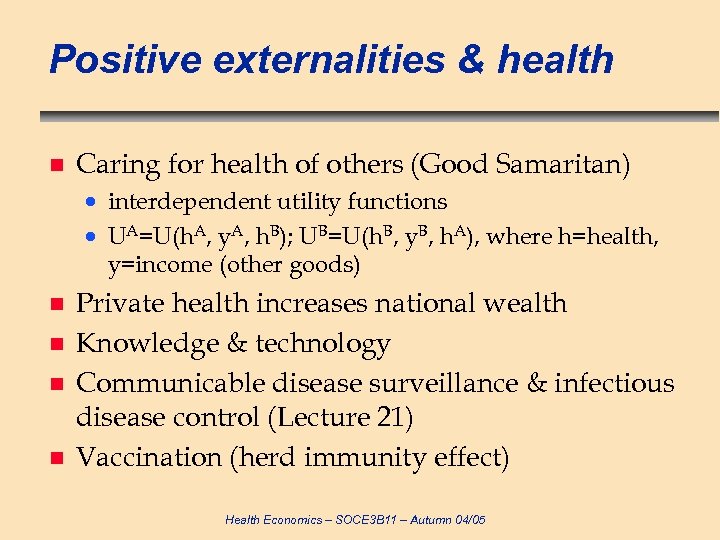 Positive externalities & health n Caring for health of others (Good Samaritan) interdependent utility functions UA=U(h. A, y. A, h. B); UB=U(h. B, y. B, h. A), where h=health, y=income (other goods) n n Private health increases national wealth Knowledge & technology Communicable disease surveillance & infectious disease control (Lecture 21) Vaccination (herd immunity effect) Health Economics – SOCE 3 B 11 – Autumn 04/05
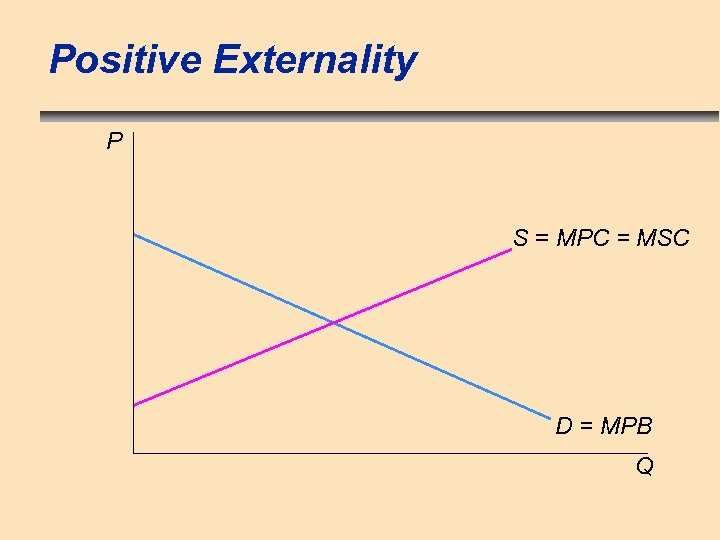 Positive Externality P S = MPC = MSC D = MPB Q
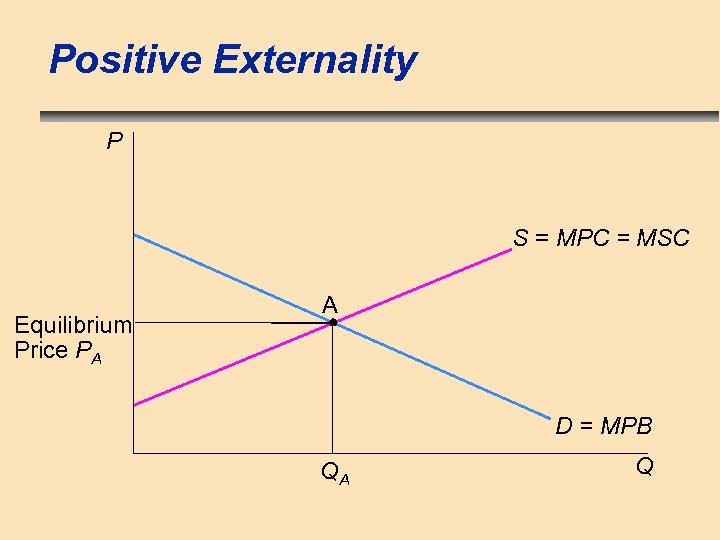 Positive Externality P S = MPC = MSC Equilibrium Price PA A D = MPB QA Q
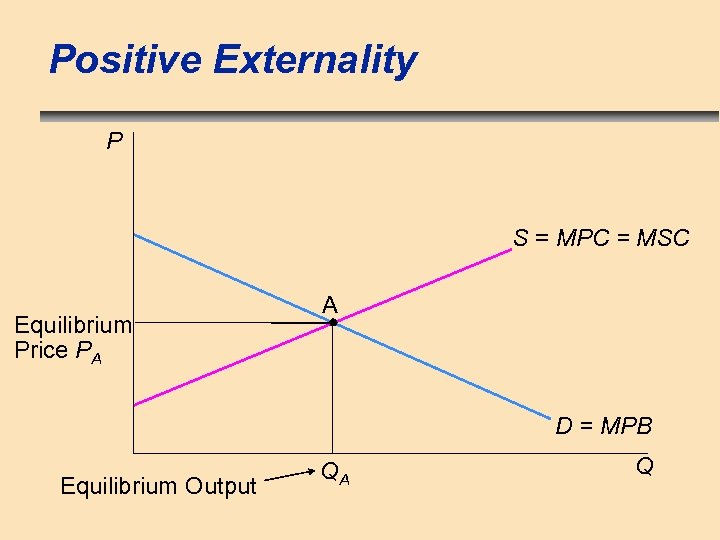 Positive Externality P S = MPC = MSC Equilibrium Price PA A D = MPB Equilibrium Output QA Q
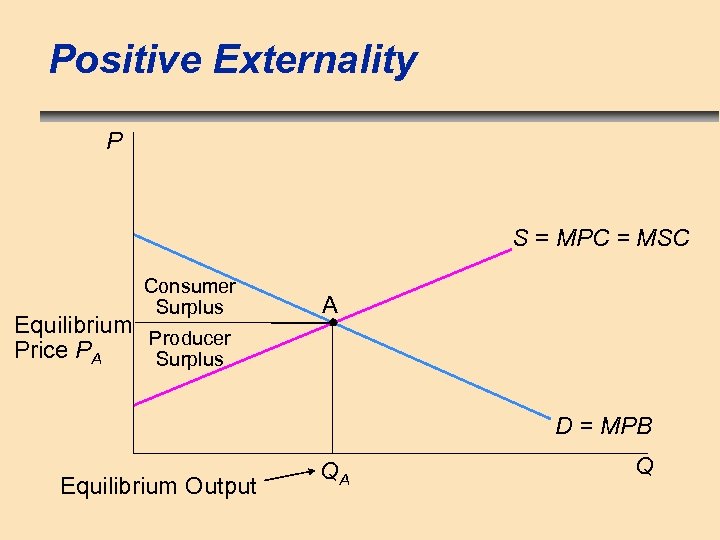 Positive Externality P S = MPC = MSC Consumer Surplus Equilibrium Producer Price PA Surplus A D = MPB Equilibrium Output QA Q
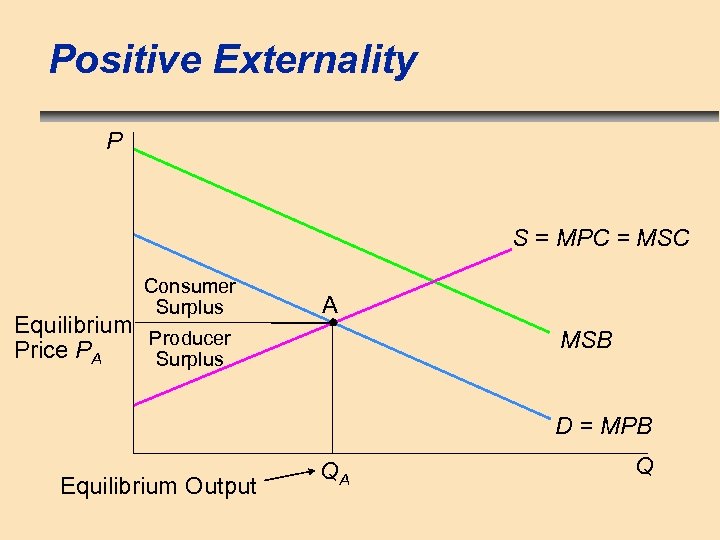 Positive Externality P S = MPC = MSC Consumer Surplus Equilibrium Producer Price PA Surplus A MSB D = MPB Equilibrium Output QA Q
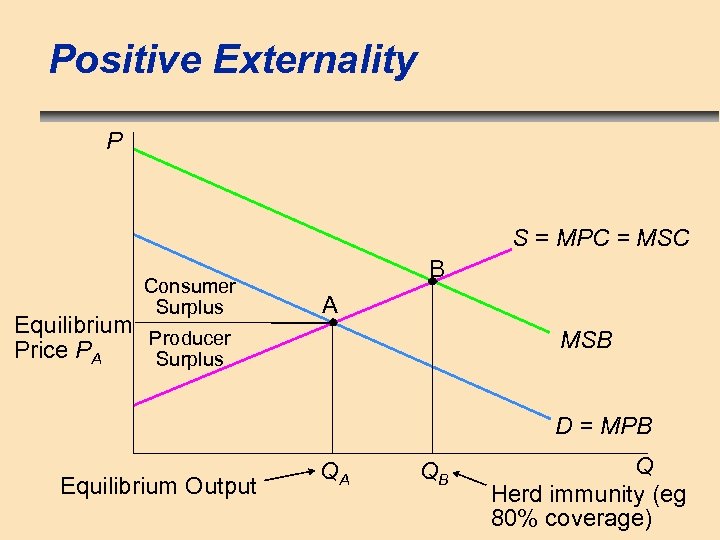 Positive Externality P S = MPC = MSC Consumer Surplus Equilibrium Producer Price PA Surplus B A MSB D = MPB Equilibrium Output QA QB Q Herd immunity (eg 80% coverage)
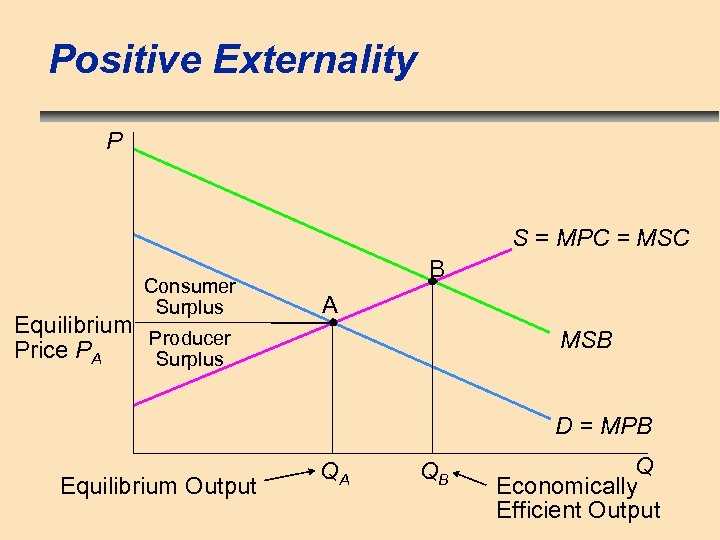 Positive Externality P S = MPC = MSC Consumer Surplus Equilibrium Producer Price PA Surplus B A MSB D = MPB Equilibrium Output QA QB Q Economically Efficient Output
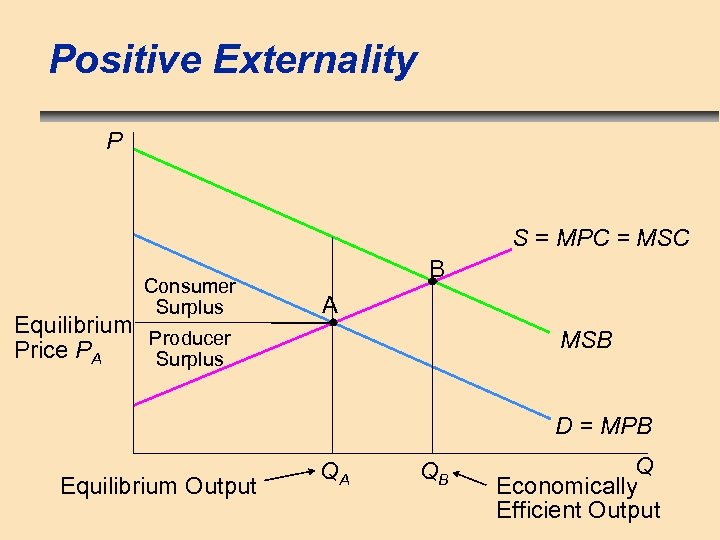 Positive Externality P S = MPC = MSC Consumer Surplus Equilibrium Producer Price PA Surplus B A MSB D = MPB Equilibrium Output QA QB Q Economically Efficient Output
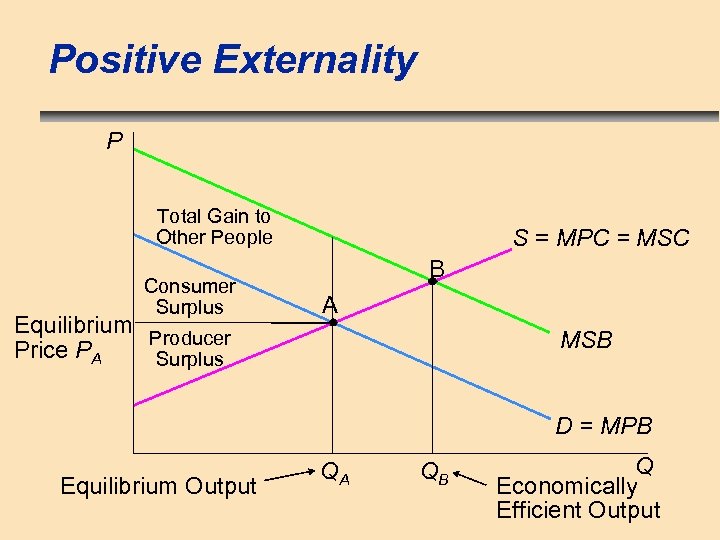 Positive Externality P Total Gain to Other People Consumer Surplus Equilibrium Producer Price PA Surplus S = MPC = MSC B A MSB D = MPB Equilibrium Output QA QB Q Economically Efficient Output
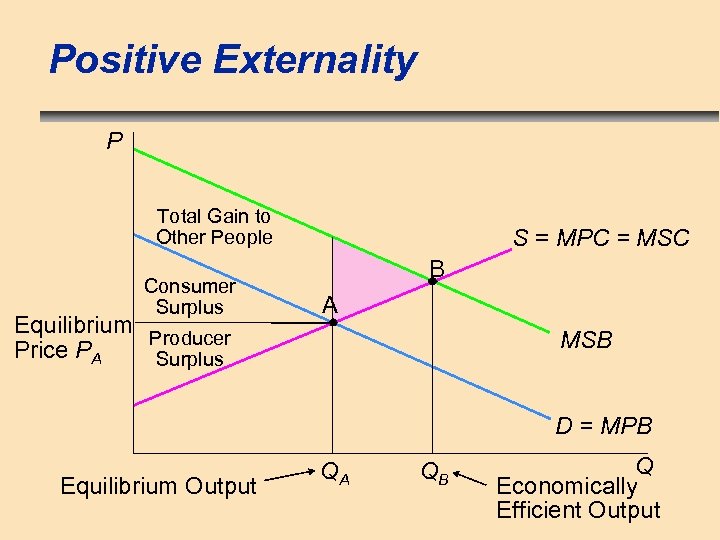 Positive Externality P Total Gain to Other People Consumer Surplus Equilibrium Producer Price PA Surplus S = MPC = MSC B A MSB D = MPB Equilibrium Output QA QB Q Economically Efficient Output
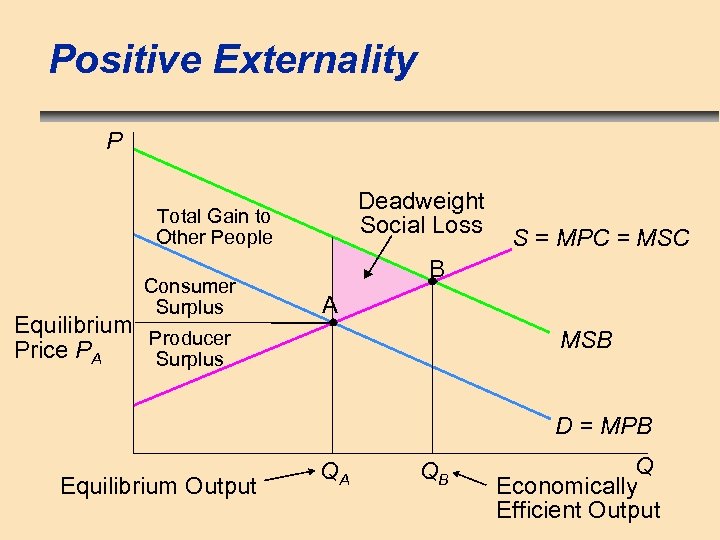 Positive Externality P Deadweight Social Loss Total Gain to Other People Consumer Surplus Equilibrium Producer Price PA Surplus S = MPC = MSC B A MSB D = MPB Equilibrium Output QA QB Q Economically Efficient Output
 Policy options n (Pigouvian) subsidies to ‘internalize’ external benefit changing private benefits so they equal social benefits, such as providing ‘free’ vaccines Direct provision of good, such as vaccine n Property rights to ‘correct’ market (e. g A ‘owns’ right not to be vaccinated, or B owns right to vaccinate) – UK vs USA schools n Health Economics – SOCE 3 B 11 – Autumn 04/05
 Negative externality n n n Negative externality – where social cost of consumption of good exceeds private cost Private cost – cost to consumers who buy and consume good Social cost – cost to all in society, including those who do not consume it others n Equals private cost of consumption plus cost to Causes market failure (too much consumption) Health Economics – SOCE 3 B 11 – Autumn 04/05
 Negative externalities & health n Infectious disease Large part of reason behind public health movement in 19 th Century (UK=PHLS/HPA; USA=PHS/CDC) n n n Lecture 21 – antibiotic resistance Environmental degradation (vehicle emissions) Child day care individual vs social costs and benefits n Tobacco & passive smoking Health Economics – SOCE 3 B 11 – Autumn 04/05
 Equilibrium with a Negative Externality Price/ Cost Quantity
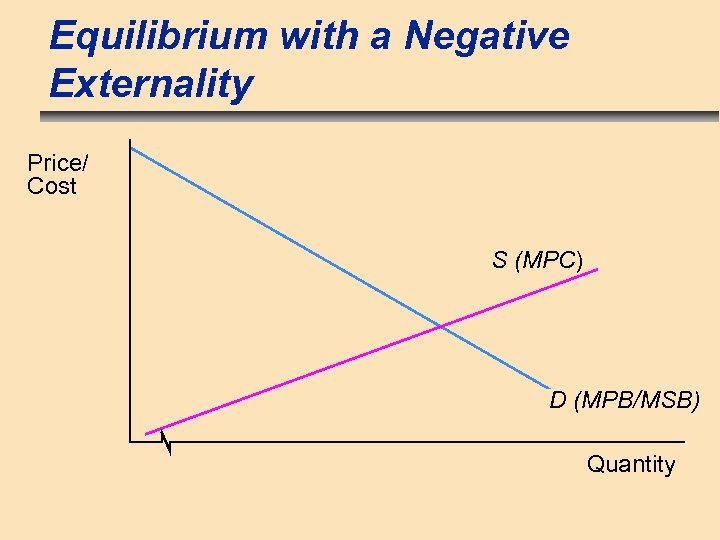 Equilibrium with a Negative Externality Price/ Cost S (MPC) D (MPB/MSB) Quantity
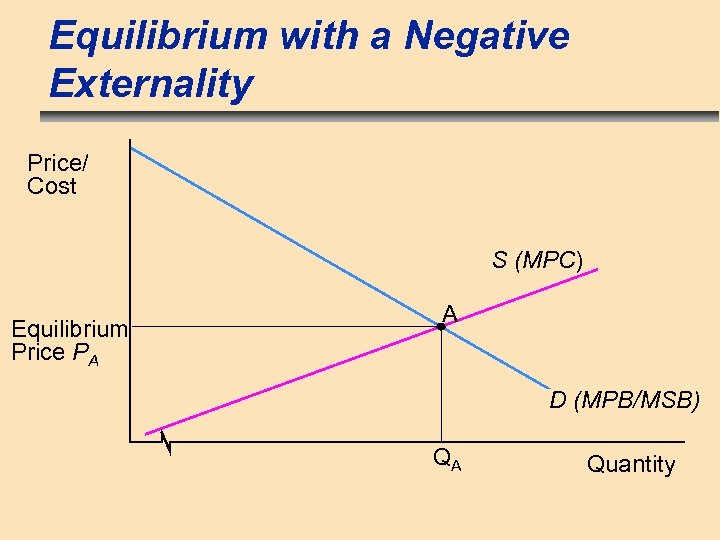 Equilibrium with a Negative Externality Price/ Cost S (MPC) Equilibrium Price PA A D (MPB/MSB) QA Quantity
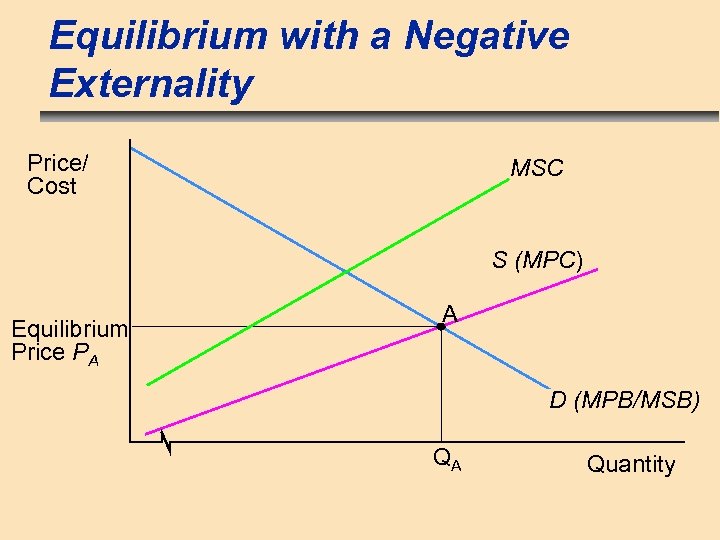 Equilibrium with a Negative Externality Price/ Cost MSC S (MPC) Equilibrium Price PA A D (MPB/MSB) QA Quantity
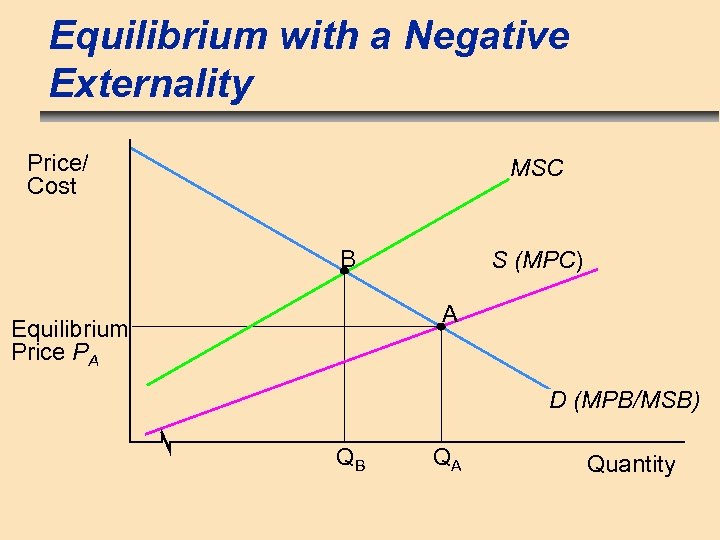 Equilibrium with a Negative Externality Price/ Cost MSC B S (MPC) A Equilibrium Price PA D (MPB/MSB) QB QA Quantity
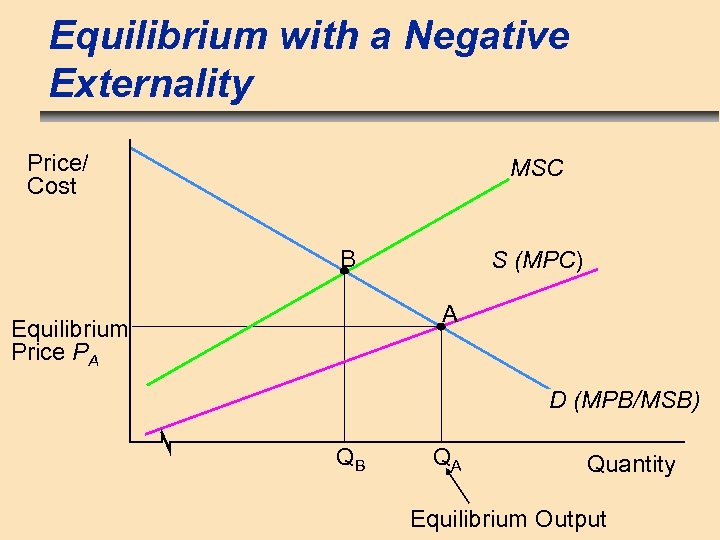 Equilibrium with a Negative Externality Price/ Cost MSC B S (MPC) A Equilibrium Price PA D (MPB/MSB) QB QA Quantity Equilibrium Output
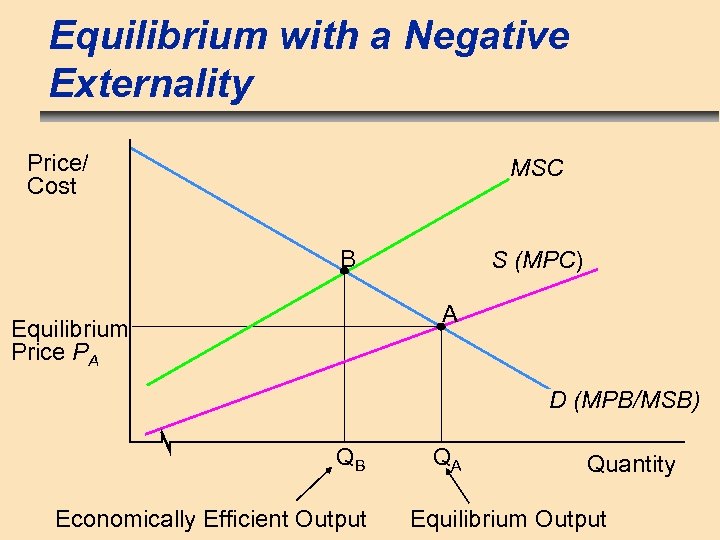 Equilibrium with a Negative Externality Price/ Cost MSC B S (MPC) A Equilibrium Price PA D (MPB/MSB) QB Economically Efficient Output QA Quantity Equilibrium Output
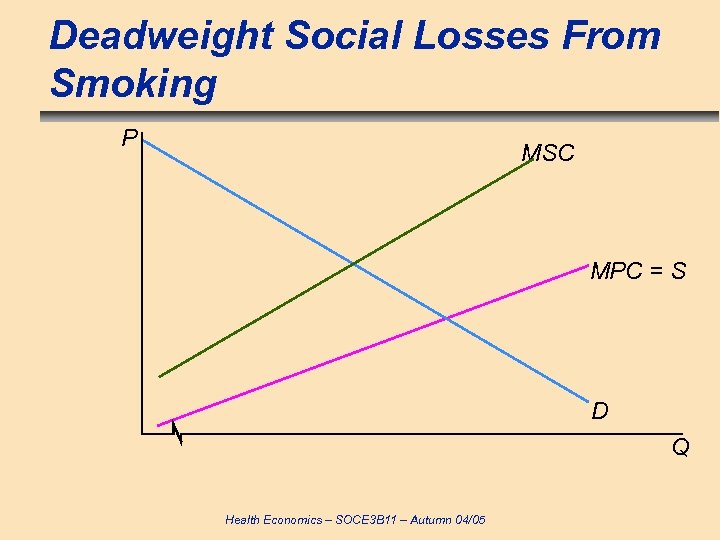 Deadweight Social Losses From Smoking P MSC MPC = S D Q Health Economics – SOCE 3 B 11 – Autumn 04/05
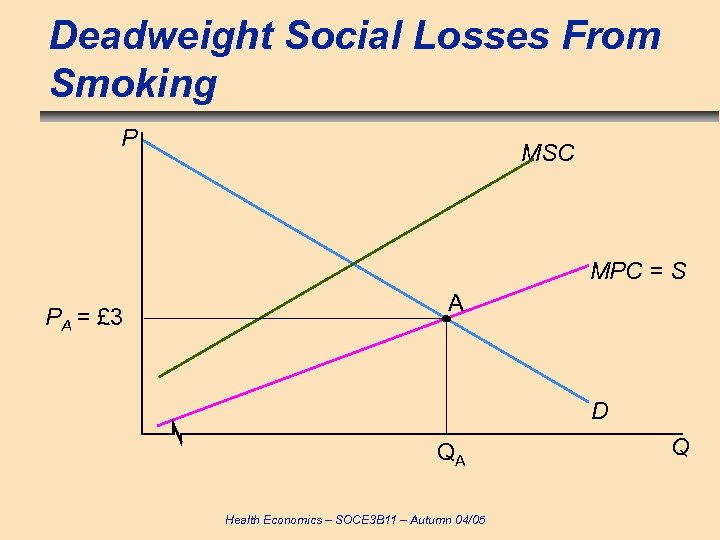 Deadweight Social Losses From Smoking P MSC MPC = S PA = £ 3 A D QA Health Economics – SOCE 3 B 11 – Autumn 04/05 Q
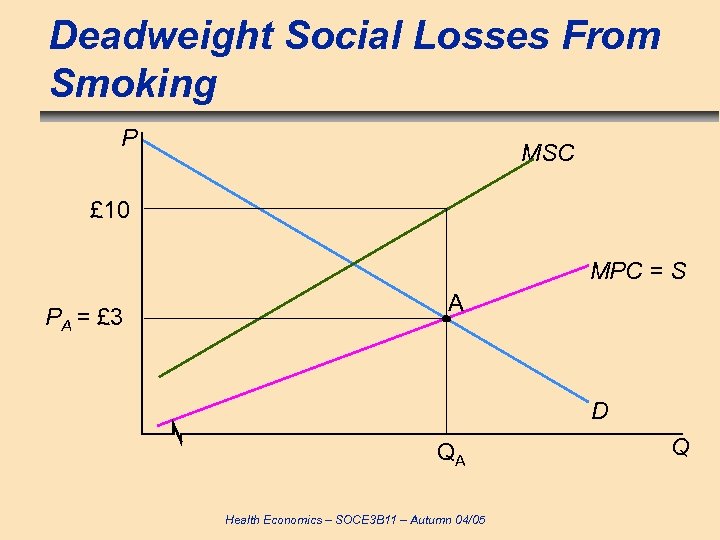 Deadweight Social Losses From Smoking P MSC £ 10 MPC = S PA = £ 3 A D QA Health Economics – SOCE 3 B 11 – Autumn 04/05 Q
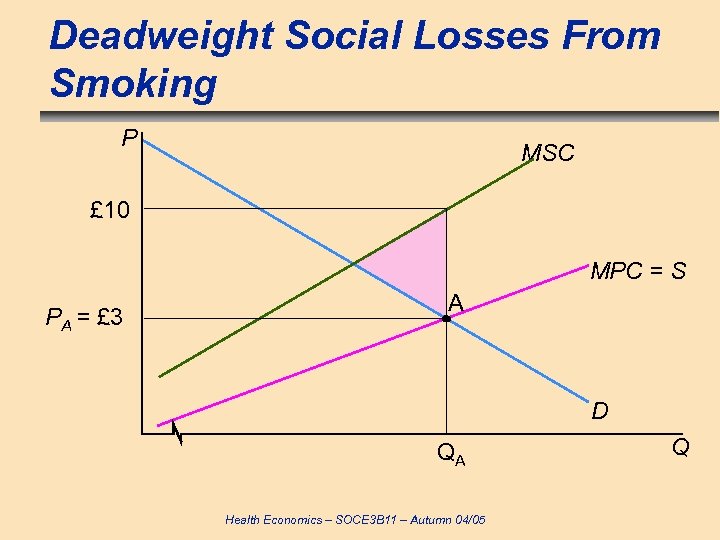 Deadweight Social Losses From Smoking P MSC £ 10 MPC = S PA = £ 3 A D QA Health Economics – SOCE 3 B 11 – Autumn 04/05 Q
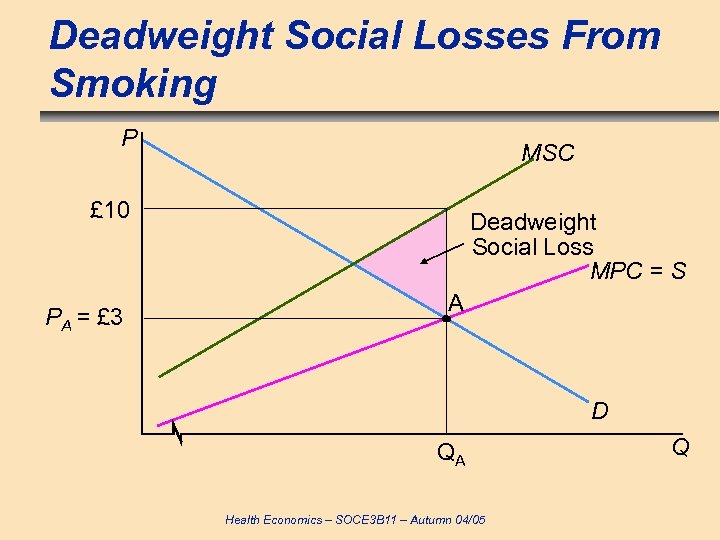 Deadweight Social Losses From Smoking P MSC £ 10 PA = £ 3 Deadweight Social Loss MPC = S A D QA Health Economics – SOCE 3 B 11 – Autumn 04/05 Q
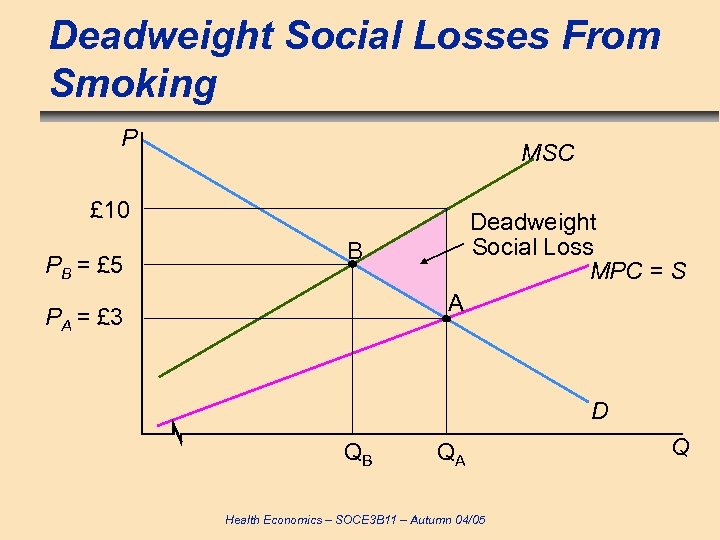 Deadweight Social Losses From Smoking P MSC £ 10 PB = £ 5 Deadweight Social Loss MPC = S B A PA = £ 3 D QB QA Health Economics – SOCE 3 B 11 – Autumn 04/05 Q
 Deadweight Social Losses From Smoking – the economically efficient level of production is not zero! n NOTE It would mean doing completely without goods yielding some benefit n Economically efficient level occurs when marginal benefit of reducing externality equals the marginal cost of reducing it n Policy issue is how to achieve this level Health Economics – SOCE 3 B 11 – Autumn 04/05
 Policy options n (Pigouvian) taxation to ‘internalize’ external cost (e. g. cigarettes, petrol) changing private costs so they equal social costs n n Regulation of overall quantity produced (rationing e. g. cigarettes, petrol) Property rights to ‘correct’ market (e. g. A ‘owns’ right to clean air, or B owns right to pollute air – determines flow of compensation, subsidy, tax etc) Health Economics – SOCE 3 B 11 – Autumn 04/05
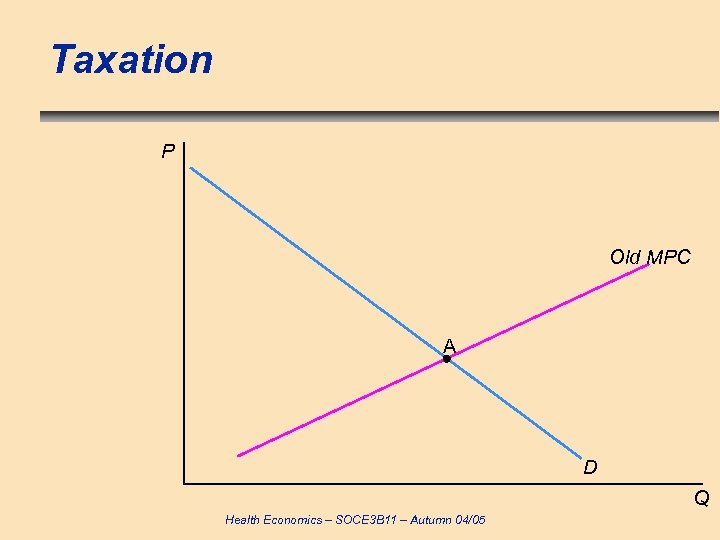 Taxation P Old MPC A D Q Health Economics – SOCE 3 B 11 – Autumn 04/05
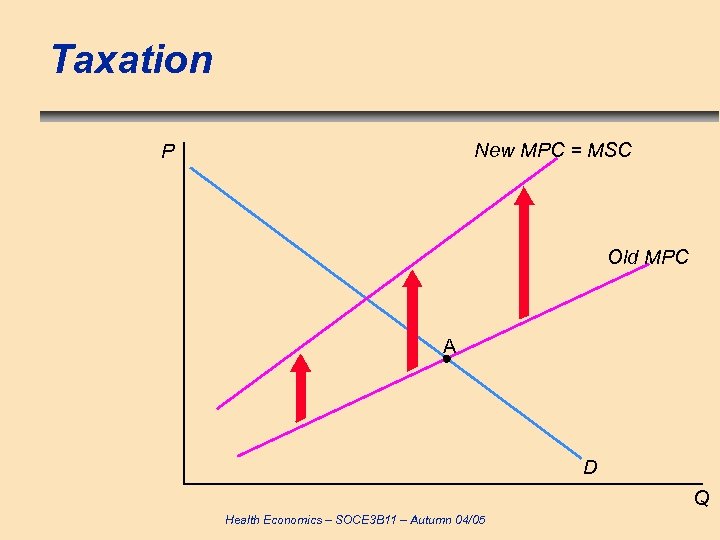 Taxation New MPC = MSC P Old MPC A D Q Health Economics – SOCE 3 B 11 – Autumn 04/05
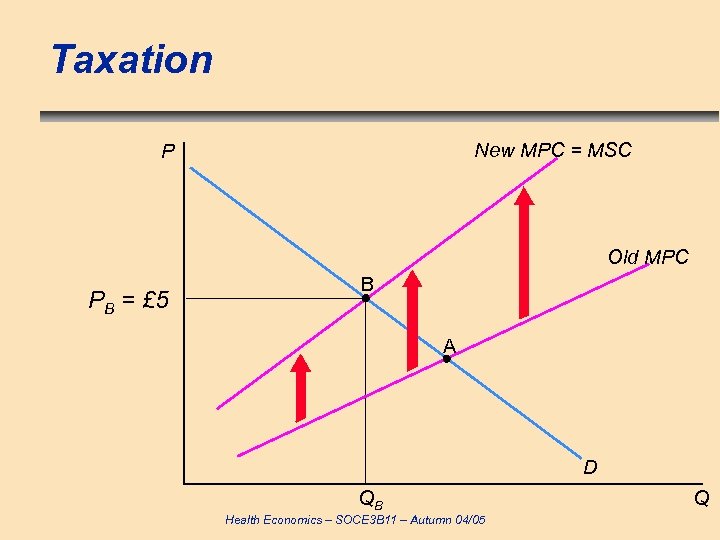 Taxation New MPC = MSC P Old MPC PB = £ 5 B A D QB Health Economics – SOCE 3 B 11 – Autumn 04/05 Q
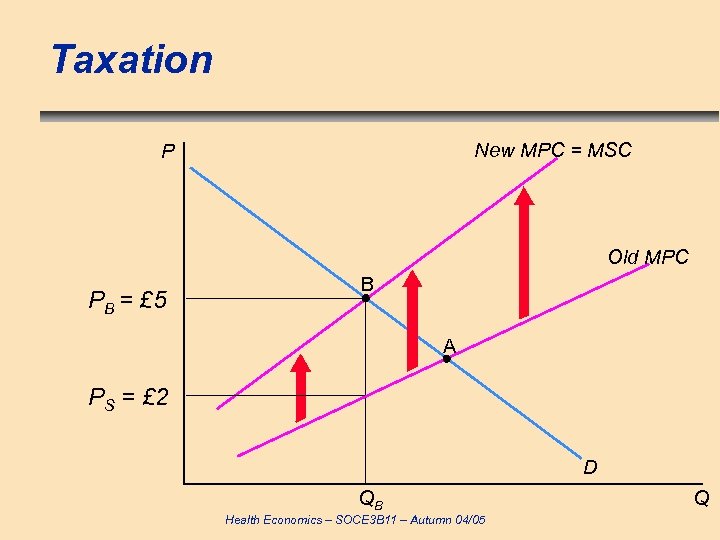 Taxation New MPC = MSC P Old MPC PB = £ 5 B A PS = £ 2 D QB Health Economics – SOCE 3 B 11 – Autumn 04/05 Q
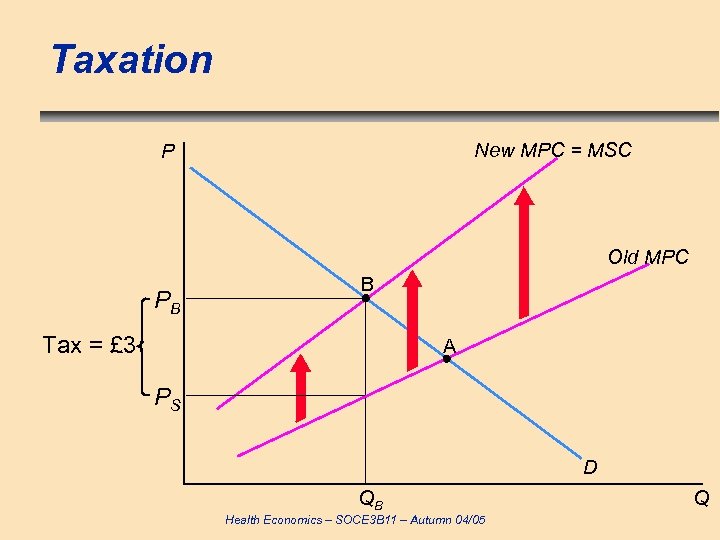 Taxation New MPC = MSC P Old MPC PB B Tax = £ 3 A PS D QB Health Economics – SOCE 3 B 11 – Autumn 04/05 Q
 Problems with taxation Taxation may not internalize all externalities (demand subject to other influences) n Taxation can internalize externalities only if transactions costs (implementing the taxation system) are sufficiently low n Coase theorem Health Economics – SOCE 3 B 11 – Autumn 04/05
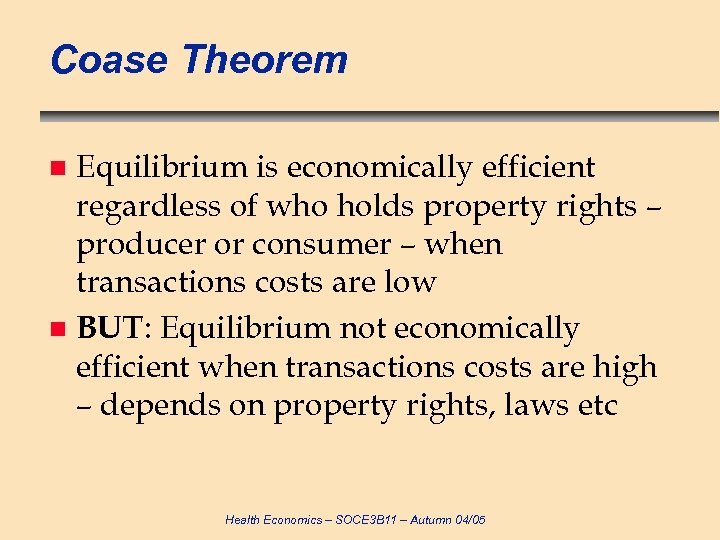 Coase Theorem Equilibrium is economically efficient regardless of who holds property rights – producer or consumer – when transactions costs are low n BUT: Equilibrium not economically efficient when transactions costs are high – depends on property rights, laws etc n Health Economics – SOCE 3 B 11 – Autumn 04/05
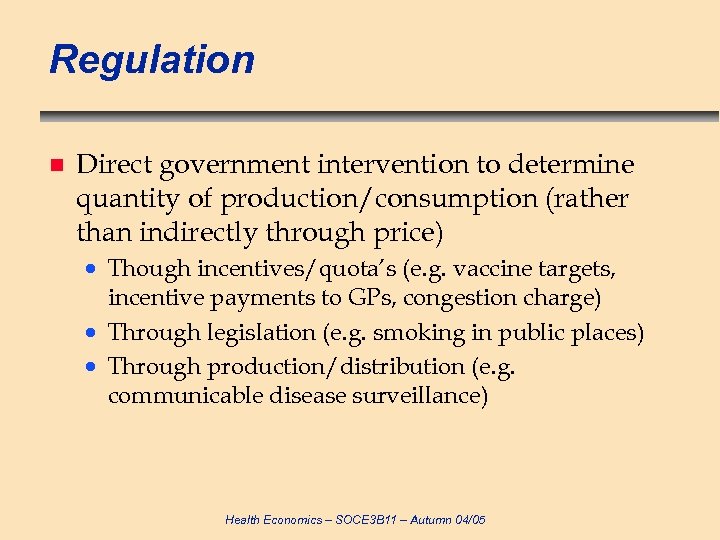 Regulation n Direct government intervention to determine quantity of production/consumption (rather than indirectly through price) Though incentives/quota’s (e. g. vaccine targets, incentive payments to GPs, congestion charge) Through legislation (e. g. smoking in public places) Through production/distribution (e. g. communicable disease surveillance) Health Economics – SOCE 3 B 11 – Autumn 04/05
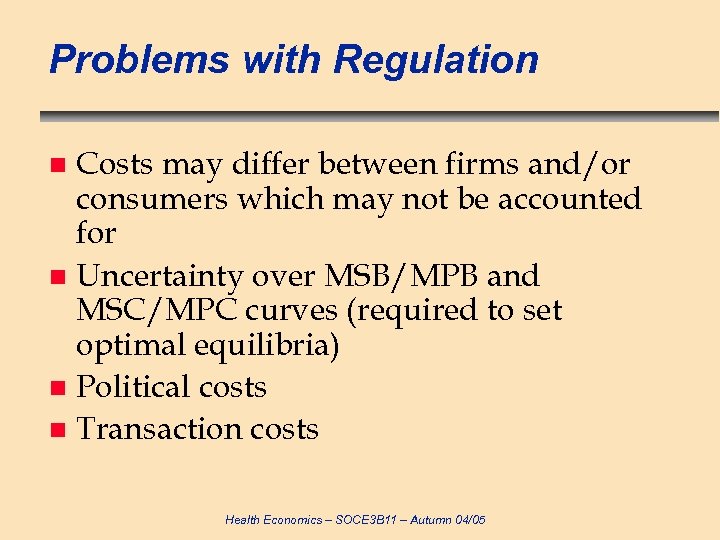 Problems with Regulation Costs may differ between firms and/or consumers which may not be accounted for n Uncertainty over MSB/MPB and MSC/MPC curves (required to set optimal equilibria) n Political costs n Transaction costs n Health Economics – SOCE 3 B 11 – Autumn 04/05
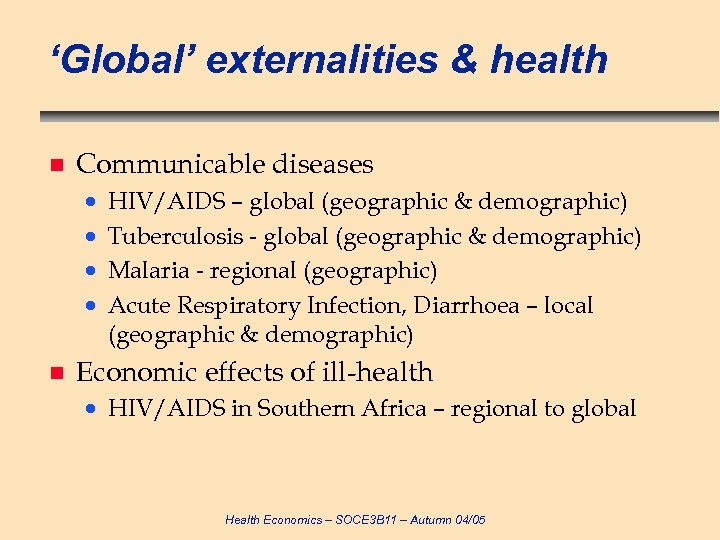 ‘Global’ externalities & health n Communicable diseases n HIV/AIDS – global (geographic & demographic) Tuberculosis - global (geographic & demographic) Malaria - regional (geographic) Acute Respiratory Infection, Diarrhoea – local (geographic & demographic) Economic effects of ill-health HIV/AIDS in Southern Africa – regional to global Health Economics – SOCE 3 B 11 – Autumn 04/05
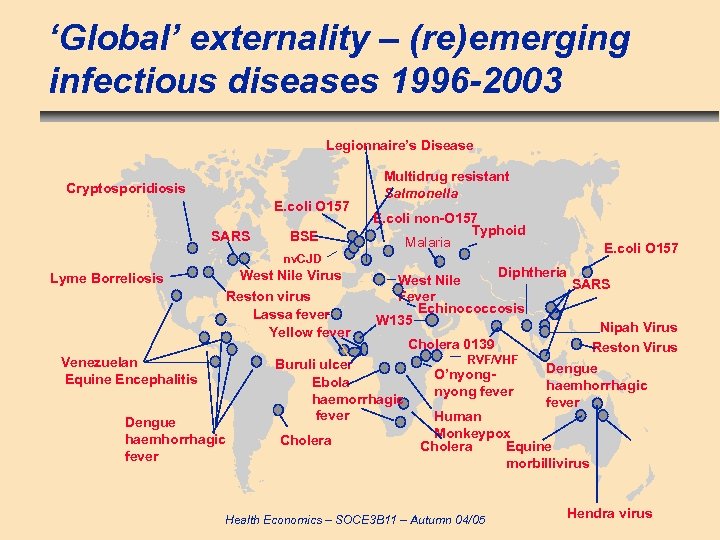 ‘Global’ externality – (re)emerging infectious diseases 1996 -2003 Legionnaire’s Disease Cryptosporidiosis E. coli O 157 SARS BSE nv. CJD West Nile Virus Lyme Borreliosis Reston virus Lassa fever Yellow fever Venezuelan Equine Encephalitis Dengue haemhorrhagic fever Multidrug resistant Salmonella E. coli non-O 157 Typhoid Malaria Diphtheria West Nile SARS Fever Echinococcosis W 135 Nipah Virus Cholera 0139 Reston Virus Buruli ulcer Ebola haemorrhagic fever Cholera E. coli O 157 RVF/VHF O’nyong fever Dengue haemhorrhagic fever Human Monkeypox Cholera Equine morbillivirus Health Economics – SOCE 3 B 11 – Autumn 04/05 Hendra virus
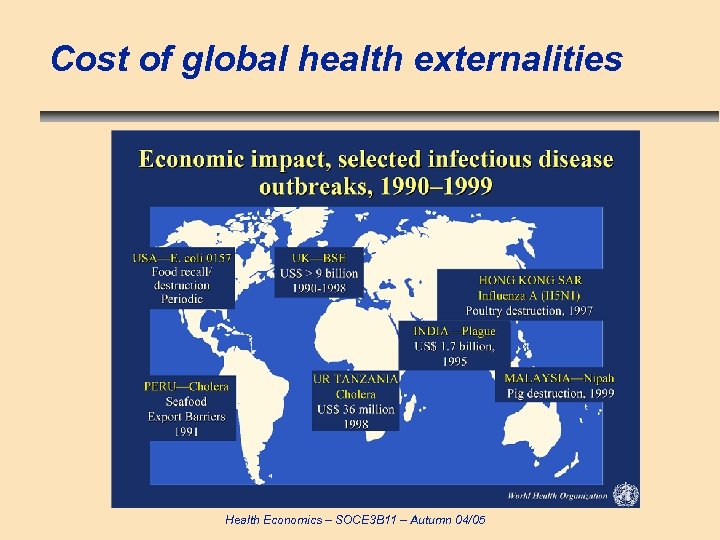 Cost of global health externalities Health Economics – SOCE 3 B 11 – Autumn 04/05
 Externalities & public goods Goods with significant positive externalities are often public goods n Goods with significant negative externalities are, conversely, public ‘bads’ n Public goods (bads) are under (over) consumed for additional reasons n Lecture 20! n Health Economics – SOCE 3 B 11 – Autumn 04/05
 Further references n n n Mc. Pake B, Kumaranayake L, Normand C (2002), Health Economics: an International Perspective. London: Routledge. Chapter 8. Getzen T (2004). Health Economics: fundamentals and flow of funds. New York: Wiley. Chapter 15. Smith RD, Coast J. Controlling antimicrobial resistance: a proposed transferable permit market. Health Policy, 1998; 43: 219 -232. Coast J, Smith RD, Millar MR. An economic perspective on policy to reduce antimicrobial resistance. Social Science & Medicine, 1998; 46: 29 -38. For future ref: Smith, RD, Drager N. Cross-border risks and public health security. Oxford University Press. Smith RD, Drager N, Hardimann M. The rapid assessment of the economic impact of public health emergencies of international concern. World Health Organization. Yeung RYT, Smith RD. Can we use contingent valuation to assess the private demand for childhood immunization in developing countries? Applied Health Economics and Health Policy. Health Economics – SOCE 3 B 11 – Autumn 04/05