


 Скачать презентацию Lecture 16 Policy Learning and Markov Decision Processes
96d4fb986a31fda6deb7c1725cc59df0.ppt
- Количество слайдов: 18
 Lecture 16 Policy Learning and Markov Decision Processes Thursday 24 October 2002 William H. Hsu Department of Computing and Information Sciences, KSU http: //www. kddresearch. org http: //www. cis. ksu. edu/~bhsu Readings: Chapter 17, Russell and Norvig Sections 13. 1 -13. 2, Mitchell CIS 732: Machine Learning and Pattern Recognition Kansas State University Department of Computing and Information Sciences
 Lecture Outline • Readings: Chapter 17, Russell and Norvig; Sections 13. 1 -13. 2, Mitchell • Suggested Exercises: 17. 2, Russell and Norvig; 13. 1, Mitchell • This Week’s Paper Review: Temporal Differences [Sutton 1988] • Making Decisions in Uncertain Environments – Problem definition and framework (MDPs) – Performance element: computing optimal policies given stepwise reward • Value iteration • Policy iteration – Decision-theoretic agent design • Decision cycle • Kalman filtering • Sensor fusion aka data fusion – Dynamic Bayesian networks (DBNs) and dynamic decision networks (DDNs) • Learning Problem: Acquiring Decision Models from Rewards • Next Lecture: Reinforcement Learning CIS 732: Machine Learning and Pattern Recognition Kansas State University Department of Computing and Information Sciences
![In-Class Exercise: Elicitation of Numerical Estimates [1] • Almanac Game [Heckerman and Geiger, 1994;](https://present5.com/presentation/96d4fb986a31fda6deb7c1725cc59df0/image-3.jpg "In-Class Exercise: Elicitation of Numerical Estimates [1] • Almanac Game [Heckerman and Geiger, 1994;") In-Class Exercise: Elicitation of Numerical Estimates [1] • Almanac Game [Heckerman and Geiger, 1994; Russell and Norvig, 1995] – Used by decision analysts to calibrate numerical estimates – Numerical estimates: include subjective probabilities, other forms of knowledge • Question Set 1 (Read Out Your Answers) – Number of passengers who flew between NYC and LA in 1989 – Population of Warsaw in 1992 – Year in which Coronado discovered the Mississippi River – Number of votes received by Carter in the 1976 presidential election – Number of newspapers in the U. S. in 1990 – Height of Hoover Dam in feet – Number of eggs produced in Oregon in 1985 – Number of Buddhists in the world in 1992 – Number of deaths due to AIDS in the U. S. in 1981 – Number of U. S. patents granted in 1901 CIS 732: Machine Learning and Pattern Recognition Kansas State University Department of Computing and Information Sciences
In-Class Exercise: Elicitation of Numerical Estimates [1] • Almanac Game [Heckerman and Geiger, 1994; Russell and Norvig, 1995] – Used by decision analysts to calibrate numerical estimates – Numerical estimates: include subjective probabilities, other forms of knowledge • Question Set 1 (Read Out Your Answers) – Number of passengers who flew between NYC and LA in 1989 – Population of Warsaw in 1992 – Year in which Coronado discovered the Mississippi River – Number of votes received by Carter in the 1976 presidential election – Number of newspapers in the U. S. in 1990 – Height of Hoover Dam in feet – Number of eggs produced in Oregon in 1985 – Number of Buddhists in the world in 1992 – Number of deaths due to AIDS in the U. S. in 1981 – Number of U. S. patents granted in 1901 CIS 732: Machine Learning and Pattern Recognition Kansas State University Department of Computing and Information Sciences
![In-Class Exercise: Elicitation of Numerical Estimates [2] • Calibration of Numerical Estimates – Try](https://present5.com/presentation/96d4fb986a31fda6deb7c1725cc59df0/image-4.jpg "In-Class Exercise: Elicitation of Numerical Estimates [2] • Calibration of Numerical Estimates – Try") In-Class Exercise: Elicitation of Numerical Estimates [2] • Calibration of Numerical Estimates – Try to revise your bounds based on results from first question set – Assess your own penalty for having too wide a CI versus guessing low, high • Question Set 2 (Write Down Your Answers) – Year of birth of Zsa Gabor – Maximum distance from Mars to the sun in miles – Value in dollars of exports of wheat from the U. S. in 1992 – Tons handled by the port of Honolulu in 1991 – Annual salary in dollars of the governor of California in 1993 – Population of San Diego in 1990 – Year in which Roger Williams founded Providence, RI – Height of Mt. Kilimanjaro in feet – Length of the Brooklyn Bridge in feet – Number of deaths due to auto accidents in the U. S. in 1992 CIS 732: Machine Learning and Pattern Recognition Kansas State University Department of Computing and Information Sciences
In-Class Exercise: Elicitation of Numerical Estimates [2] • Calibration of Numerical Estimates – Try to revise your bounds based on results from first question set – Assess your own penalty for having too wide a CI versus guessing low, high • Question Set 2 (Write Down Your Answers) – Year of birth of Zsa Gabor – Maximum distance from Mars to the sun in miles – Value in dollars of exports of wheat from the U. S. in 1992 – Tons handled by the port of Honolulu in 1991 – Annual salary in dollars of the governor of California in 1993 – Population of San Diego in 1990 – Year in which Roger Williams founded Providence, RI – Height of Mt. Kilimanjaro in feet – Length of the Brooklyn Bridge in feet – Number of deaths due to auto accidents in the U. S. in 1992 CIS 732: Machine Learning and Pattern Recognition Kansas State University Department of Computing and Information Sciences
![In-Class Exercise: Elicitation of Numerical Estimates [3] • Descriptive Statistics – 50%, 25%, 75%](https://present5.com/presentation/96d4fb986a31fda6deb7c1725cc59df0/image-5.jpg "In-Class Exercise: Elicitation of Numerical Estimates [3] • Descriptive Statistics – 50%, 25%, 75%") In-Class Exercise: Elicitation of Numerical Estimates [3] • Descriptive Statistics – 50%, 25%, 75% guesses (median, first-second quartiles, third-fourth quartiles) – Box plots [Tukey, 1977]: actual frequency of data within 25 -75% bounds – What kind of descriptive statistics do you think might be informative? – What kind of descriptive graphics do you think might be informative? • Common Effects – Typically about half (50%) in first set – Usually, see some improvement in second set – Bounds also widen from first to second set (second system effect [Brooks, 1975]) – Why do you think this is? – What do you think the ramifications are for interactive elicitation? – What do you think the ramifications are for learning? • Prescriptive (Normative) Conclusions – Order-of-magnitude (“back of the envelope”) calculations [Bentley, 1985] – Value-of-information (VOI): framework for selecting questions, precision CIS 732: Machine Learning and Pattern Recognition Kansas State University Department of Computing and Information Sciences
In-Class Exercise: Elicitation of Numerical Estimates [3] • Descriptive Statistics – 50%, 25%, 75% guesses (median, first-second quartiles, third-fourth quartiles) – Box plots [Tukey, 1977]: actual frequency of data within 25 -75% bounds – What kind of descriptive statistics do you think might be informative? – What kind of descriptive graphics do you think might be informative? • Common Effects – Typically about half (50%) in first set – Usually, see some improvement in second set – Bounds also widen from first to second set (second system effect [Brooks, 1975]) – Why do you think this is? – What do you think the ramifications are for interactive elicitation? – What do you think the ramifications are for learning? • Prescriptive (Normative) Conclusions – Order-of-magnitude (“back of the envelope”) calculations [Bentley, 1985] – Value-of-information (VOI): framework for selecting questions, precision CIS 732: Machine Learning and Pattern Recognition Kansas State University Department of Computing and Information Sciences
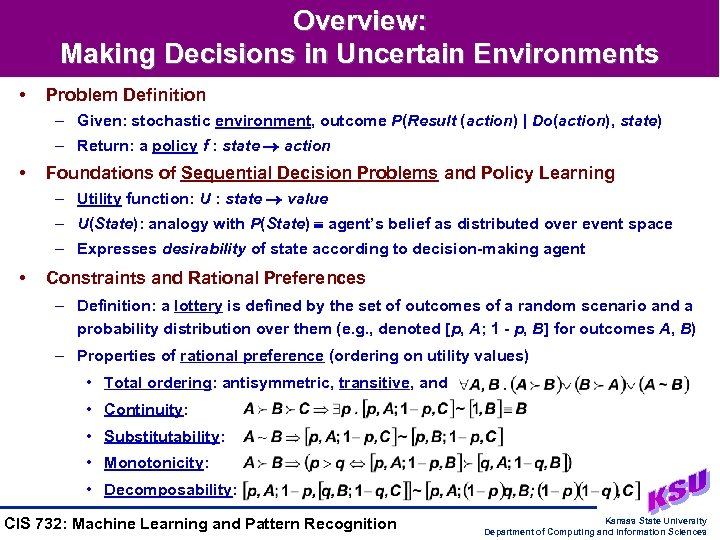 Overview: Making Decisions in Uncertain Environments • Problem Definition – Given: stochastic environment, outcome P(Result (action) | Do(action), state) – Return: a policy f : state action • Foundations of Sequential Decision Problems and Policy Learning – Utility function: U : state value – U(State): analogy with P(State) agent’s belief as distributed over event space – Expresses desirability of state according to decision-making agent • Constraints and Rational Preferences – Definition: a lottery is defined by the set of outcomes of a random scenario and a probability distribution over them (e. g. , denoted [p, A; 1 - p, B] for outcomes A, B) – Properties of rational preference (ordering on utility values) • Total ordering: antisymmetric, transitive, and • Continuity: • Substitutability: • Monotonicity: • Decomposability: CIS 732: Machine Learning and Pattern Recognition Kansas State University Department of Computing and Information Sciences
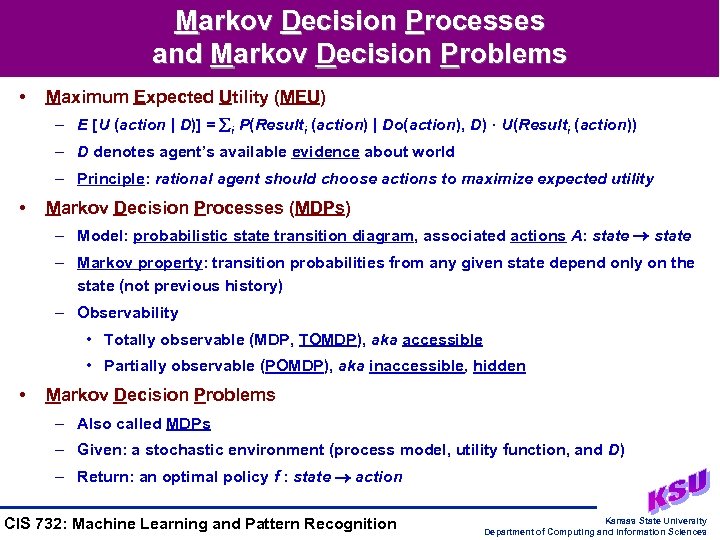 Markov Decision Processes and Markov Decision Problems • Maximum Expected Utility (MEU) – E [U (action | D)] = i P(Resulti (action) | Do(action), D) · U(Resulti (action)) – D denotes agent’s available evidence about world – Principle: rational agent should choose actions to maximize expected utility • Markov Decision Processes (MDPs) – Model: probabilistic state transition diagram, associated actions A: state – Markov property: transition probabilities from any given state depend only on the state (not previous history) – Observability • Totally observable (MDP, TOMDP), aka accessible • Partially observable (POMDP), aka inaccessible, hidden • Markov Decision Problems – Also called MDPs – Given: a stochastic environment (process model, utility function, and D) – Return: an optimal policy f : state action CIS 732: Machine Learning and Pattern Recognition Kansas State University Department of Computing and Information Sciences
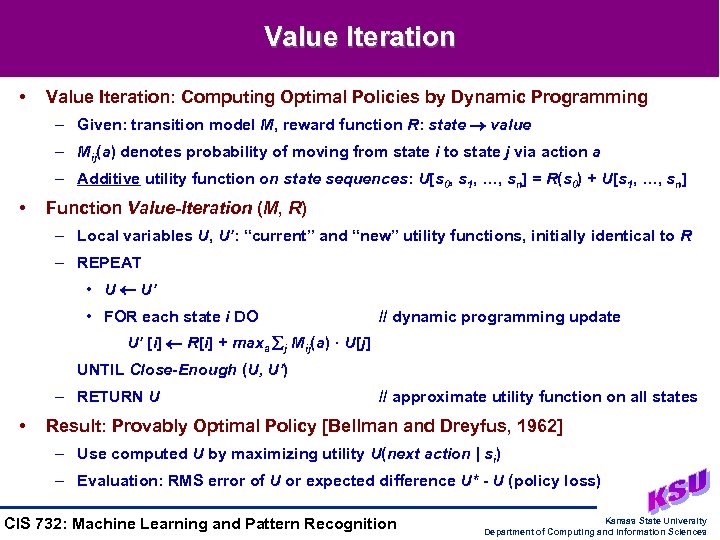 Value Iteration • Value Iteration: Computing Optimal Policies by Dynamic Programming – Given: transition model M, reward function R: state value – Mij(a) denotes probability of moving from state i to state j via action a – Additive utility function on state sequences: U[s 0, s 1, …, sn] = R(s 0) + U[s 1, …, sn] • Function Value-Iteration (M, R) – Local variables U, U’: “current” and “new” utility functions, initially identical to R – REPEAT • U U’ • FOR each state i DO // dynamic programming update U’ [i] R[i] + maxa j Mij(a) · U[j] UNTIL Close-Enough (U, U’) – RETURN U • // approximate utility function on all states Result: Provably Optimal Policy [Bellman and Dreyfus, 1962] – Use computed U by maximizing utility U(next action | si) – Evaluation: RMS error of U or expected difference U* - U (policy loss) CIS 732: Machine Learning and Pattern Recognition Kansas State University Department of Computing and Information Sciences
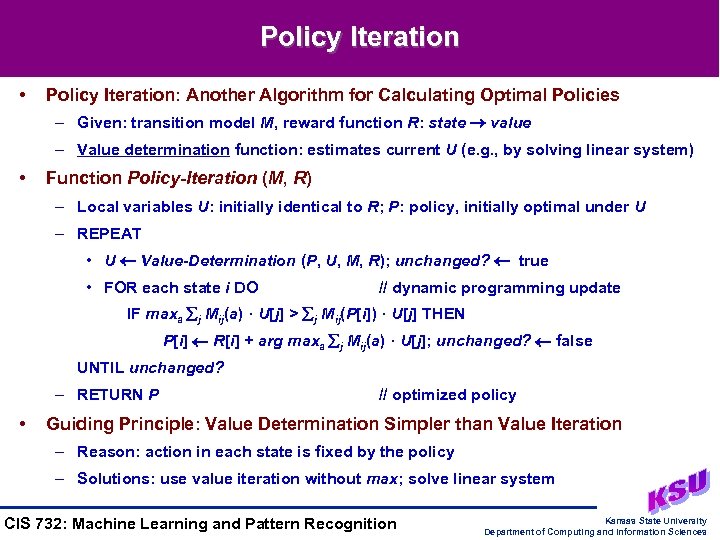 Policy Iteration • Policy Iteration: Another Algorithm for Calculating Optimal Policies – Given: transition model M, reward function R: state value – Value determination function: estimates current U (e. g. , by solving linear system) • Function Policy-Iteration (M, R) – Local variables U: initially identical to R; P: policy, initially optimal under U – REPEAT • U Value-Determination (P, U, M, R); unchanged? true • FOR each state i DO // dynamic programming update IF maxa j Mij(a) · U[j] > j Mij(P[i]) · U[j] THEN P[i] R[i] + arg maxa j Mij(a) · U[j]; unchanged? false UNTIL unchanged? – RETURN P • // optimized policy Guiding Principle: Value Determination Simpler than Value Iteration – Reason: action in each state is fixed by the policy – Solutions: use value iteration without max; solve linear system CIS 732: Machine Learning and Pattern Recognition Kansas State University Department of Computing and Information Sciences
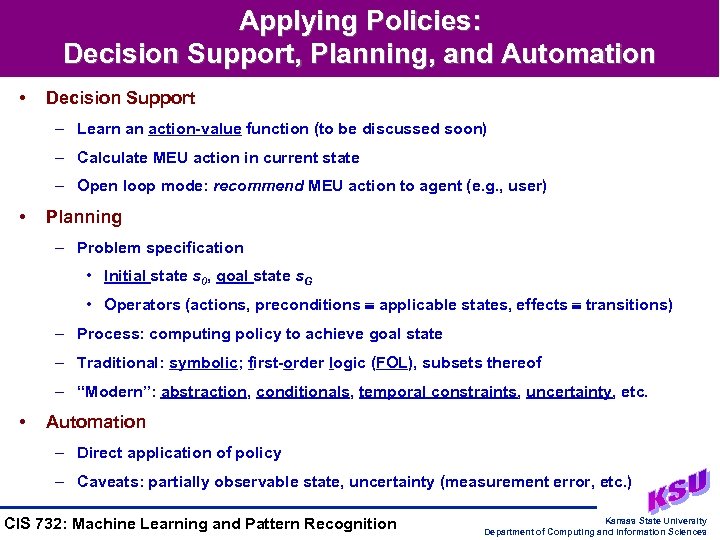 Applying Policies: Decision Support, Planning, and Automation • Decision Support – Learn an action-value function (to be discussed soon) – Calculate MEU action in current state – Open loop mode: recommend MEU action to agent (e. g. , user) • Planning – Problem specification • Initial state s 0, goal state s. G • Operators (actions, preconditions applicable states, effects transitions) – Process: computing policy to achieve goal state – Traditional: symbolic; first-order logic (FOL), subsets thereof – “Modern”: abstraction, conditionals, temporal constraints, uncertainty, etc. • Automation – Direct application of policy – Caveats: partially observable state, uncertainty (measurement error, etc. ) CIS 732: Machine Learning and Pattern Recognition Kansas State University Department of Computing and Information Sciences
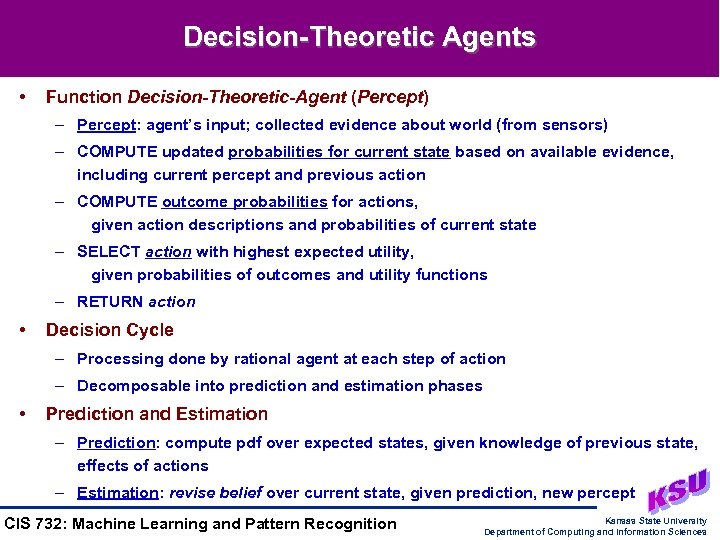 Decision-Theoretic Agents • Function Decision-Theoretic-Agent (Percept) – Percept: agent’s input; collected evidence about world (from sensors) – COMPUTE updated probabilities for current state based on available evidence, including current percept and previous action – COMPUTE outcome probabilities for actions, given action descriptions and probabilities of current state – SELECT action with highest expected utility, given probabilities of outcomes and utility functions – RETURN action • Decision Cycle – Processing done by rational agent at each step of action – Decomposable into prediction and estimation phases • Prediction and Estimation – Prediction: compute pdf over expected states, given knowledge of previous state, effects of actions – Estimation: revise belief over current state, given prediction, new percept CIS 732: Machine Learning and Pattern Recognition Kansas State University Department of Computing and Information Sciences
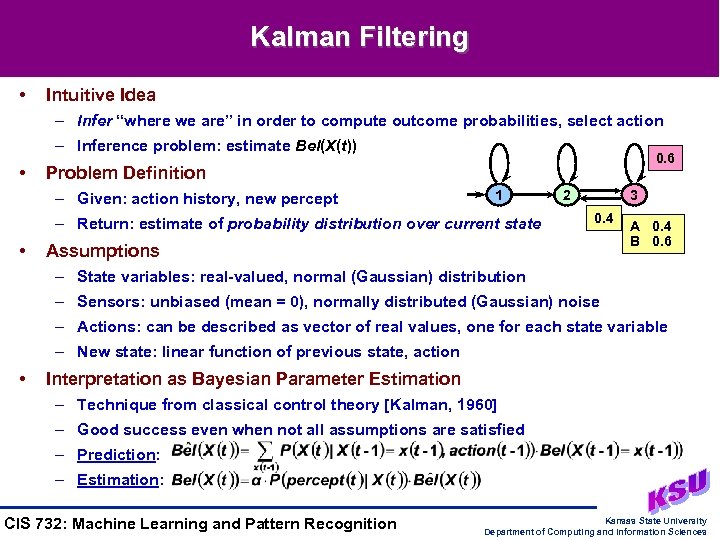 Kalman Filtering • Intuitive Idea – Infer “where we are” in order to compute outcome probabilities, select action – Inference problem: estimate Bel(X(t)) • 0. 6 Problem Definition – Given: action history, new percept 1 – Return: estimate of probability distribution over current state • 2 3 0. 4 Assumptions A 0. 4 B 0. 6 – State variables: real-valued, normal (Gaussian) distribution – Sensors: unbiased (mean = 0), normally distributed (Gaussian) noise – Actions: can be described as vector of real values, one for each state variable – New state: linear function of previous state, action • Interpretation as Bayesian Parameter Estimation – Technique from classical control theory [Kalman, 1960] – Good success even when not all assumptions are satisfied – Prediction: – Estimation: CIS 732: Machine Learning and Pattern Recognition Kansas State University Department of Computing and Information Sciences
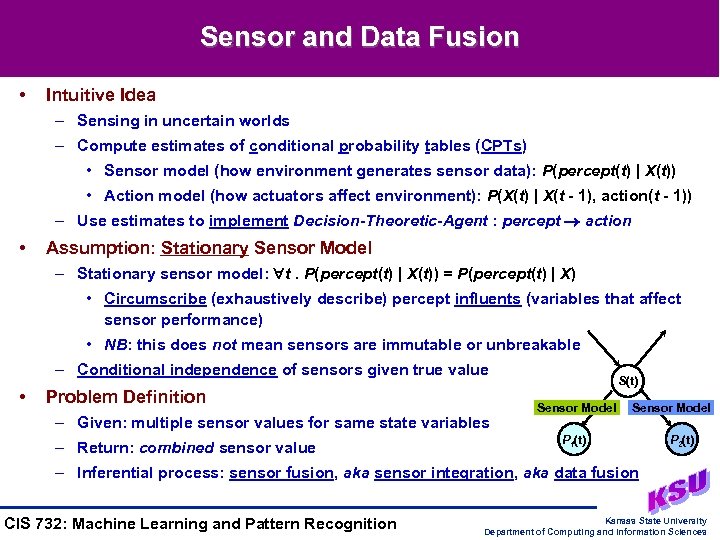 Sensor and Data Fusion • Intuitive Idea – Sensing in uncertain worlds – Compute estimates of conditional probability tables (CPTs) • Sensor model (how environment generates sensor data): P(percept(t) | X(t)) • Action model (how actuators affect environment): P(X(t) | X(t - 1), action(t - 1)) – Use estimates to implement Decision-Theoretic-Agent : percept action • Assumption: Stationary Sensor Model – Stationary sensor model: t. P(percept(t) | X(t)) = P(percept(t) | X) • Circumscribe (exhaustively describe) percept influents (variables that affect sensor performance) • NB: this does not mean sensors are immutable or unbreakable – Conditional independence of sensors given true value • Problem Definition – Given: multiple sensor values for same state variables – Return: combined sensor value S(t) Sensor Model P 1(t) P 2(t) – Inferential process: sensor fusion, aka sensor integration, aka data fusion CIS 732: Machine Learning and Pattern Recognition Kansas State University Department of Computing and Information Sciences
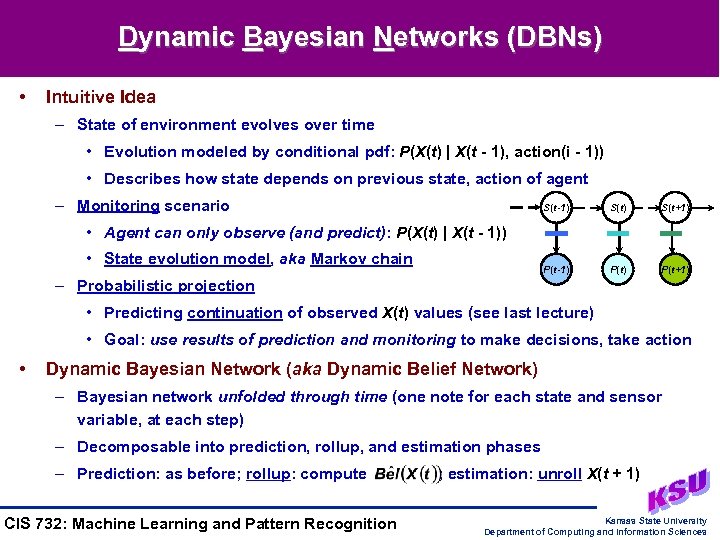 Dynamic Bayesian Networks (DBNs) • Intuitive Idea – State of environment evolves over time • Evolution modeled by conditional pdf: P(X(t) | X(t - 1), action(i - 1)) • Describes how state depends on previous state, action of agent – Monitoring scenario S(t-1) S(t+1) P(t-1) P(t+1) • Agent can only observe (and predict): P(X(t) | X(t - 1)) • State evolution model, aka Markov chain – Probabilistic projection • Predicting continuation of observed X(t) values (see last lecture) • Goal: use results of prediction and monitoring to make decisions, take action • Dynamic Bayesian Network (aka Dynamic Belief Network) – Bayesian network unfolded through time (one note for each state and sensor variable, at each step) – Decomposable into prediction, rollup, and estimation phases – Prediction: as before; rollup: compute CIS 732: Machine Learning and Pattern Recognition ; estimation: unroll X(t + 1) Kansas State University Department of Computing and Information Sciences
![Dynamic Decision Networks (DDNs) • Augmented Bayesian Network [Howard and Matheson, 1984] – Chance](https://present5.com/presentation/96d4fb986a31fda6deb7c1725cc59df0/image-15.jpg "Dynamic Decision Networks (DDNs) • Augmented Bayesian Network [Howard and Matheson, 1984] – Chance") Dynamic Decision Networks (DDNs) • Augmented Bayesian Network [Howard and Matheson, 1984] – Chance nodes (ovals): denote random variables as in BBNs – Decision nodes (rectangles): denote points where agent has choice of actions – Utility nodes (diamonds): denote agent’s utility function (e. g. , in chance of death) • Properties – Chance nodes: related as in BBNs (CI assumed among nodes not connected) – Decision nodes: choices can influence chance nodes, utility nodes (directly) – Utility nodes: conditionally dependent on joint pdf of parent chance nodes and decision values at parent decision nodes Toxics – See Section 16. 5, Russell and Norvig • Serum Calcium Cancer Dynamic Decision Network – aka dynamic influence diagram Smoke? Lung Tumor – DDN : DBN : : DN : BBN Micromorts – Inference: over predicted (unfolded) sensor, decision variables CIS 732: Machine Learning and Pattern Recognition Kansas State University Department of Computing and Information Sciences
Dynamic Decision Networks (DDNs) • Augmented Bayesian Network [Howard and Matheson, 1984] – Chance nodes (ovals): denote random variables as in BBNs – Decision nodes (rectangles): denote points where agent has choice of actions – Utility nodes (diamonds): denote agent’s utility function (e. g. , in chance of death) • Properties – Chance nodes: related as in BBNs (CI assumed among nodes not connected) – Decision nodes: choices can influence chance nodes, utility nodes (directly) – Utility nodes: conditionally dependent on joint pdf of parent chance nodes and decision values at parent decision nodes Toxics – See Section 16. 5, Russell and Norvig • Serum Calcium Cancer Dynamic Decision Network – aka dynamic influence diagram Smoke? Lung Tumor – DDN : DBN : : DN : BBN Micromorts – Inference: over predicted (unfolded) sensor, decision variables CIS 732: Machine Learning and Pattern Recognition Kansas State University Department of Computing and Information Sciences
 Learning to Make Decisions in Uncertain Environments • Learning Problem – Given: interactive environment • No notion of examples as assumed in supervised, unsupervised learning • Feedback from environment in form of rewards, penalties (reinforcements) – Return: utility function for decision-theoretic inference and planning • Design 1: utility function on states, U : state value • Design 2: action-value function, Q : state action value (expected utility) – Process • Build predictive model of the environment • Assign credit to components of decisions based on (current) predictive model • Issues – How to explore environment to acquire feedback? – Credit assignment: how to propagate positive credit and negative credit (blame) back through decision model in proportion to importance? CIS 732: Machine Learning and Pattern Recognition Kansas State University Department of Computing and Information Sciences
 Terminology • Making Decisions in Uncertain Environments – Policy learning • Performance element: decision support system, planner, automated system • Performance criterion: utility function • Training signal: reward function – MDPs • Markov Decision Process (MDP): model for decision-theoretic planning (DTP) • Markov Decision Problem (MDP): problem specification for DTP • Value iteration: iteration over actions; decomposition of utilities into rewards • Policy iteration: iteration over policy steps; value determination at each step – Decision cycle: processing (inference) done by a rational agent at each step – Kalman filtering: estimate belief function (pdf) over state by iterative refinement – Sensor and data fusion: combining multiple sensors for same state variables – Dynamic Bayesian network (DBN): temporal BBN (unfolded through time) – Dynamic decision network (DDN): temporal decision network • Learning Problem: Based upon Reinforcements (Rewards, Penalties) CIS 732: Machine Learning and Pattern Recognition Kansas State University Department of Computing and Information Sciences
 Summary Points • Making Decisions in Uncertain Environments – Framework: Markov Decision Processes, Markov Decision Problems (MDPs) – Computing policies • Solving MDPs by dynamic programming given a stepwise reward • Methods: value iteration, policy iteration – Decision-theoretic agents • Decision cycle, Kalman filtering • Sensor fusion (aka data fusion) – Dynamic Bayesian networks (DBNs) and dynamic decision networks (DDNs) • Learning Problem – Mapping from observed actions and rewards to decision models – Rewards/penalties: reinforcements • Next Lecture: Reinforcement Learning – Basic model: passive learning in a known environment – Q learning: policy learning by adaptive dynamic programming (ADP) CIS 732: Machine Learning and Pattern Recognition Kansas State University Department of Computing and Information Sciences