


 Скачать презентацию Lecture 16 Institutional Investing Migration of Capital
5e9161a65f0522208cfd52b17f360b5c.ppt
- Количество слайдов: 38
 Lecture 16: Institutional Investing
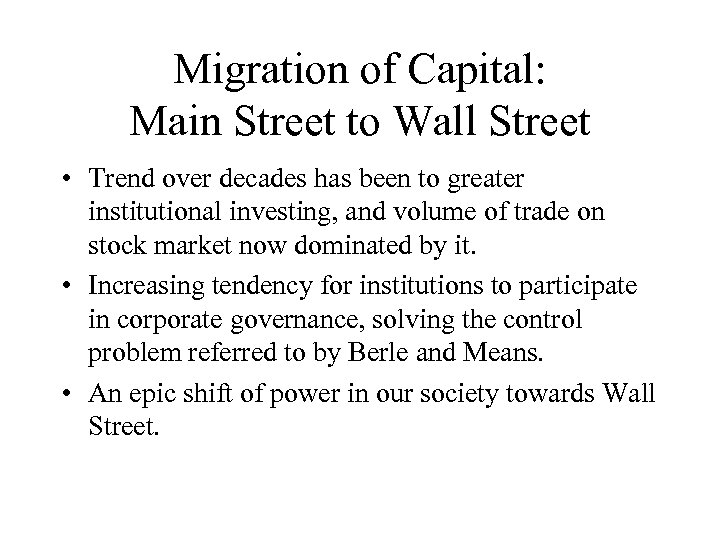 Migration of Capital: Main Street to Wall Street • Trend over decades has been to greater institutional investing, and volume of trade on stock market now dominated by it. • Increasing tendency for institutions to participate in corporate governance, solving the control problem referred to by Berle and Means. • An epic shift of power in our society towards Wall Street.
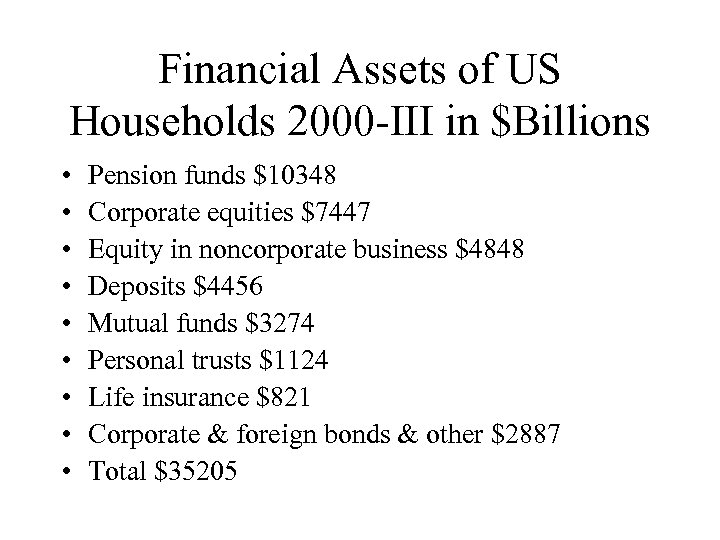 Financial Assets of US Households 2000 -III in $Billions • • • Pension funds $10348 Corporate equities $7447 Equity in noncorporate business $4848 Deposits $4456 Mutual funds $3274 Personal trusts $1124 Life insurance $821 Corporate & foreign bonds & other $2887 Total $35205
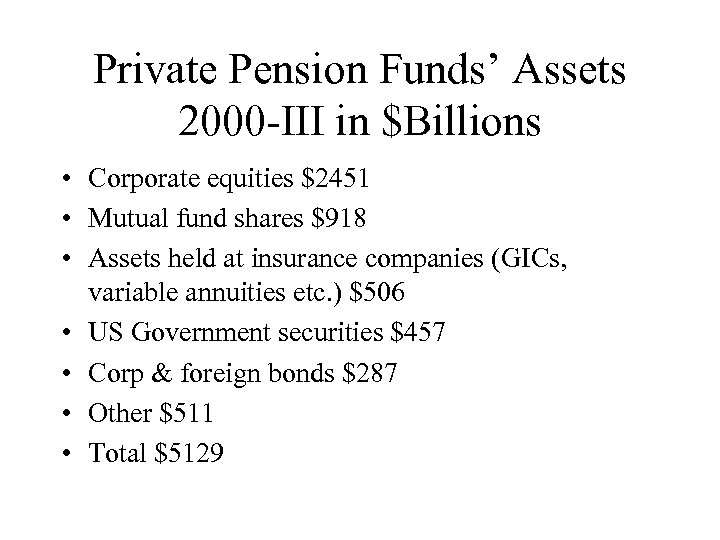 Private Pension Funds’ Assets 2000 -III in $Billions • Corporate equities $2451 • Mutual fund shares $918 • Assets held at insurance companies (GICs, variable annuities etc. ) $506 • US Government securities $457 • Corp & foreign bonds $287 • Other $511 • Total $5129
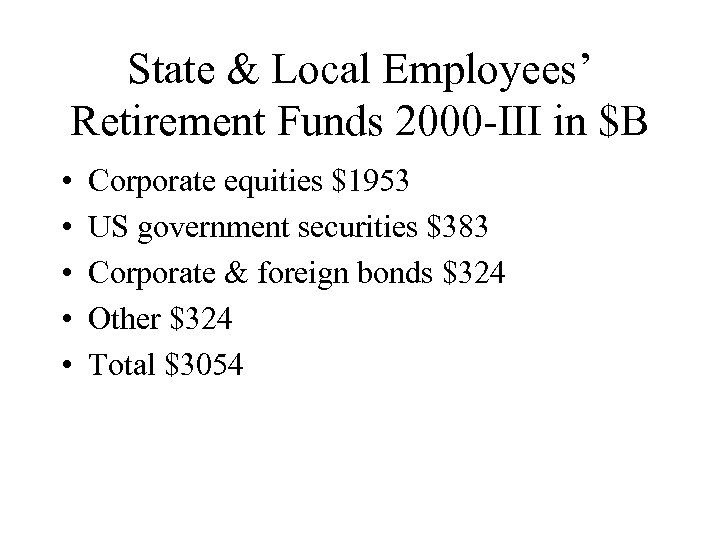 State & Local Employees’ Retirement Funds 2000 -III in $B • • • Corporate equities $1953 US government securities $383 Corporate & foreign bonds $324 Other $324 Total $3054
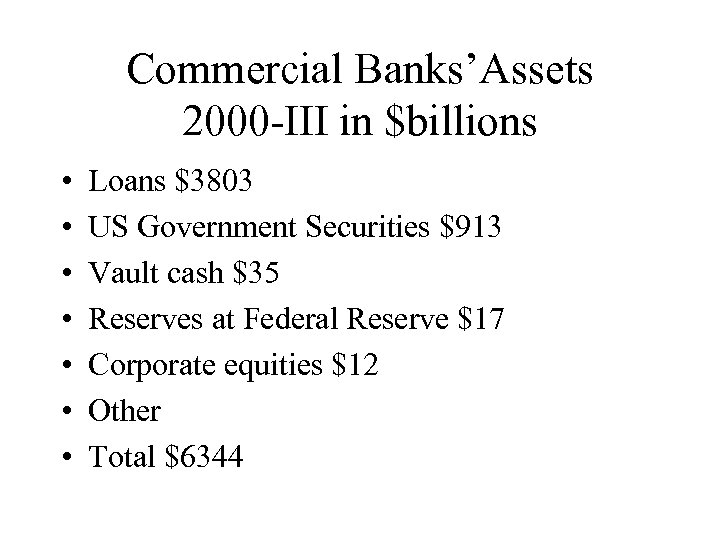 Commercial Banks’Assets 2000 -III in $billions • • Loans $3803 US Government Securities $913 Vault cash $35 Reserves at Federal Reserve $17 Corporate equities $12 Other Total $6344
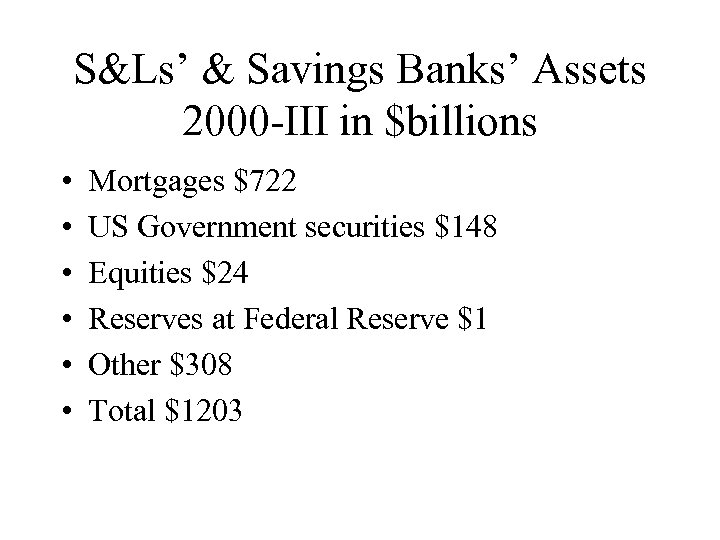 S&Ls’ & Savings Banks’ Assets 2000 -III in $billions • • • Mortgages $722 US Government securities $148 Equities $24 Reserves at Federal Reserve $1 Other $308 Total $1203
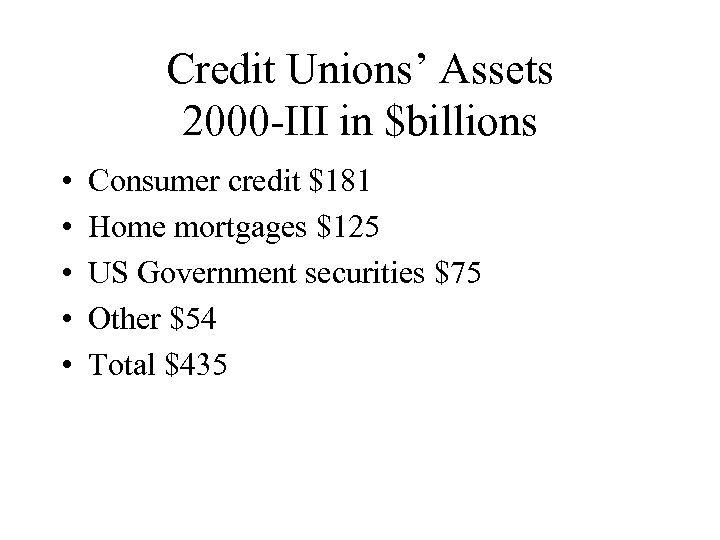 Credit Unions’ Assets 2000 -III in $billions • • • Consumer credit $181 Home mortgages $125 US Government securities $75 Other $54 Total $435
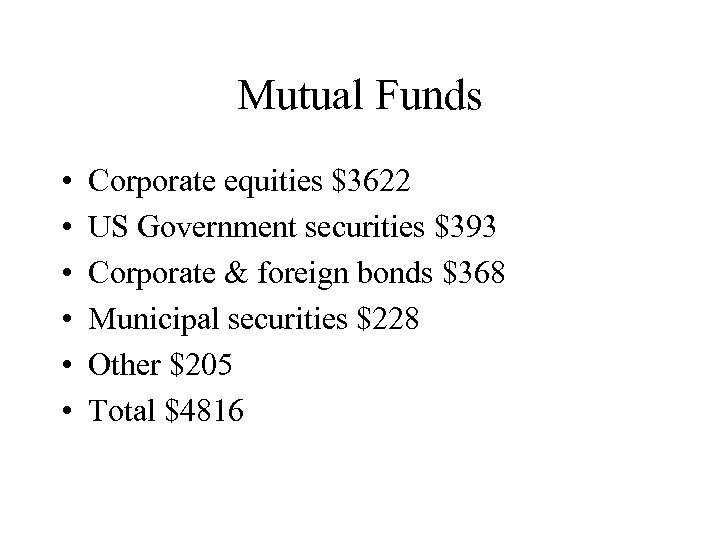 Mutual Funds • • • Corporate equities $3622 US Government securities $393 Corporate & foreign bonds $368 Municipal securities $228 Other $205 Total $4816
 Mutual Fund History • In 1920 s, many investment companies bilked small investors • Massachusetts Investment Trust (MIT) in 1920 s had only one class of investors, published portfolio, redeemed on demand • Became model for mutual fund industry • Investment Company Institute
 Structure of Mutual Fund • Assets of mutual fund are held in common • Purchases and redemptions are made at prices as of 4 pm market close on that day • Other people’s purchases and redemptions affect you
 Recent Mutual Fund Scandals • Late trading: mutual funds accept orders at 4 pm prices even though orders were made after 4 pm • Market timing: mutual fund investors wait until almost 4 pm to buy in or redeem their shares in foreign funds, such as Japan fund.
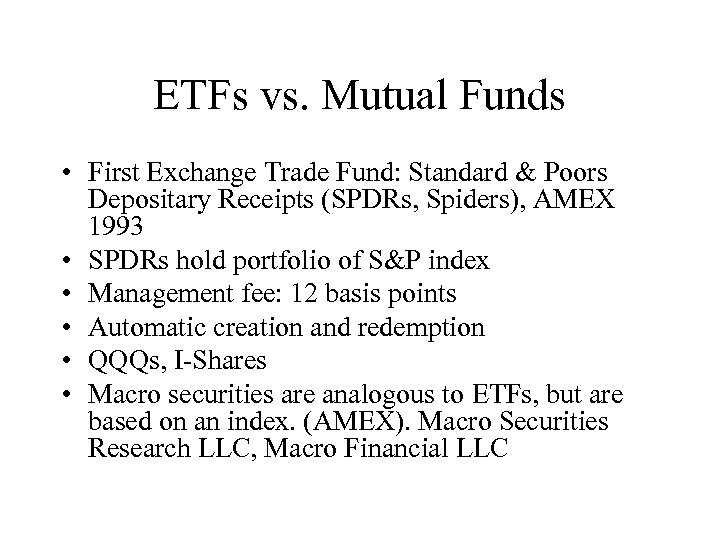 ETFs vs. Mutual Funds • First Exchange Trade Fund: Standard & Poors Depositary Receipts (SPDRs, Spiders), AMEX 1993 • SPDRs hold portfolio of S&P index • Management fee: 12 basis points • Automatic creation and redemption • QQQs, I-Shares • Macro securities are analogous to ETFs, but are based on an index. (AMEX). Macro Securities Research LLC, Macro Financial LLC
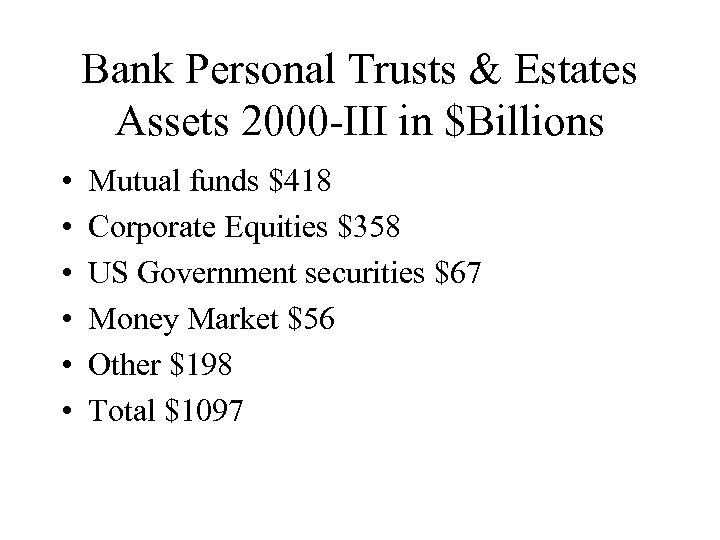 Bank Personal Trusts & Estates Assets 2000 -III in $Billions • • • Mutual funds $418 Corporate Equities $358 US Government securities $67 Money Market $56 Other $198 Total $1097
 Trusts Not Always Institutional • Common law countries allow individuals to appoint friends as trustees. • Spendthrift trust increasingly common form of inheritance. Planning for divorces decades hence.
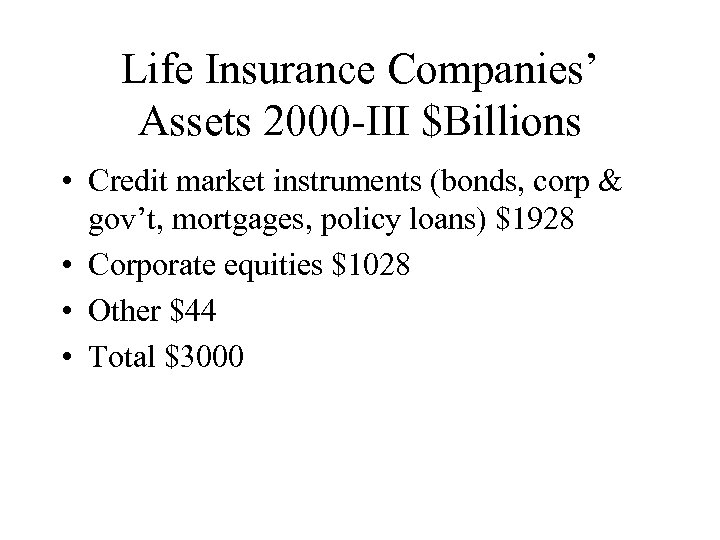 Life Insurance Companies’ Assets 2000 -III $Billions • Credit market instruments (bonds, corp & gov’t, mortgages, policy loans) $1928 • Corporate equities $1028 • Other $44 • Total $3000
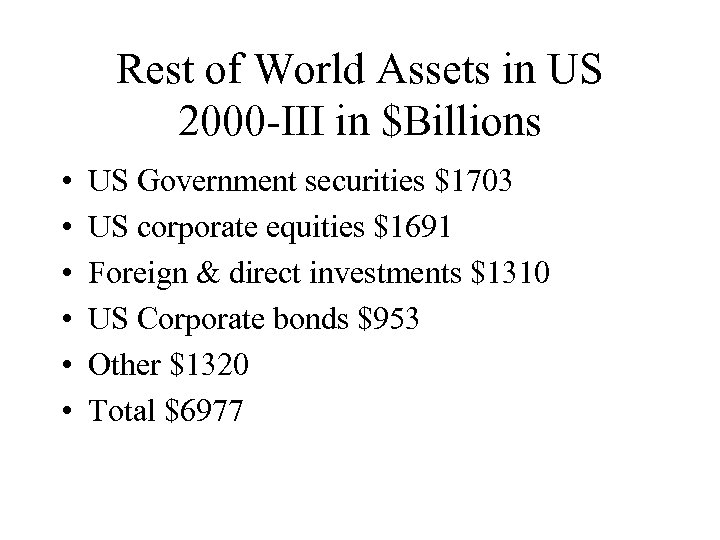 Rest of World Assets in US 2000 -III in $Billions • • • US Government securities $1703 US corporate equities $1691 Foreign & direct investments $1310 US Corporate bonds $953 Other $1320 Total $6977
 Pension Funds • First pension funds in world: late 19 th Century. • Retirement was not invented until then. • Increase in life expectancy in 20 th Century brought large numbers of elderly people for first time in human history.
 Milestones in US Pension History • 1875 American Express Co. (then a shipping co. ) establishes first US corporate pension plan: for employees who worked there 20 years, passed age 60, and were disabled, 50% of average of last ten years’ pay. Few employees qualified.
 Carnegie Steel Pension 1901 • First large industrial pension fund • Andrew Carnegie: The Gospel of Wealth, Carnegie Institute of Technology, Carnegie Endowment for Peace • By 1929, 329 industrial firms had pension plans, and these covered 10% of labor force. • Pension benefits were not a contractual right.
 Union Pension Funds • Patternmakers 1900 • Granitecutters & Cigarmakers 1905 • Locomotive Engineers 1912 was first to to grant contractual right to pension
 Collapse of Pensions after 1929 • Plans almost all unfunded, benefits paid out of profits now nonexistent. With Great Depression, benefits were cut sharply. Those funded were often invested in company stock. • Union plans failed disastrously, leading to their near extinction • Failures were impetus to Social Security Act of 1935.
 Why Were Early Pension Plans So Badly Designed? • Pension benefits not yet perceived as a right or standard • Plans were viewed as incentive for longterm company loyalty, which few achieved. • Reflects general slowness for financial innovation.
 General Motors Pension Plan 1950 • In labor negotiations, GM Chairman Charles Wilson proposed fully funded plan managed by financial professionals. • Proposed investing in the stock market, rather than fixed incomes, but no more than 5% in any one stock. Diversification. • Wilson made stunning proposal that funding not be invested in GM stock.
 Studebaker Pension Default, 1963 • UAW accused of acquiescing in underfunding of pension plan so that it could obtain a false “victory” in prior negotiations with management. • After default, UAW negotiated full benefits for senior workers, little or nothing for others. • Scandal led to Employee Retirement Income Security Act (ERISA) 1974.
 Employment Retirement Income Security Act (ERISA) 1974 • Act was in response to abuses in earlier defined benefit pensions • Prohibits pay-as-you-go pension plans, defined benefit plans must be fully funded. • Funds must be adequate: sound actuarial principles. • Created Pension Benefits Guarantee Corp. • Prudent person standard for managers • Minimum vesting standards. An employee for ten years has complete vesting
 Prudent Person Rule • ERISA: Investments must be made with “the care, skill prudence and diligence under the circumstances then prevailing that a prudent man acting in a like capacity and familiar with such matters would use in the conduct of an enterprise of a like character and with like aims. ”
 Problems with Prudent Person Rule • Legislates conventional wisdom. • Decisions cannot be based on individual judgment.
 Pension Funds Types • Defined Benefit: Traditional, old-line manufacturing, supported by labor unions. Now in decline. Not usually indexed. • Defined Contribution: Employee contributes to own account. 401(k) plans begun in 1981 in US. • In defined contribution, individuals choose allocations across broad asset classes.
 O’Barr & Conley Study • O’Barr & Conley (Fortune & Folly, 1992) “questions [about pension strategy] elicited lengthy narratives about such cultural issues as history, politics, and relationships, but little talk about economics or finance. ” (p. 75) • Fund executives “rarely rise above their personal perspectives to articulate a corporate vision. ” “too busy living through an event to stop and analyze it. ” (p. 76)
 O’Barr & Conley Cont. • Creation myths prominent. The great founder • Displacing responsibility. • Outside managers used to shift possible blame. • Blaming the law
 Nonprofit Organizations • Non distribution constraint. Effectively, there are no owners. Tax exempt. Board of trustees appoints own successors. • 900, 000 tax-exempt nonprofits in the US • 120, 000 non-profit charities in the UK • Many other countries • Nonprofits contribute 4% of US national income
 Economics of Nonprofits • Donations are usually only a minor source of income. • Nonprofit hospitals compete alongside forprofit hospitals, look similar.
 Endowments and Foundations • Not completely tax free • Grantmaking foundations must give away 5% of wealth each year, or else lose taxexempt status. (Does not apply to operating foundations. ) • Two-tier excise tax on income, 1% if they maintain or increase giving, 2% otherwise.
 Fragility & Importance of University Endowments • Yale University and Eagle Bank 1825 Yale lost virtually its entire endowment in this bank. • Boston University John Silber and Seragen $90 million in one company, lost 90%. • University of Bridgeport & Reverend Sung Myung Moon Unification Church 1992
 Yale University’s Independence • Yale initially supported by Colony of Connecticut. Yale mostly supported by CT • 1755 CT refused annual grant to Yale over religious controversy. • 1792 CT made legislators fellows of Yale Corporation. Elected officials govern Yale • 1871 CT terminates all support for Yale
 Endowment Investing Strategy Differences • Endowments have very long-term focus, so can invest in illiquid assets • No risk of clients pulling money after poor performance • Endowments can earn liquidity premium • University endowments have higher purpose, can generate loyal support.
 “Illiquidity’s Attractions” (Swensen) • Less info available on illiquid assets, so universities better able to find nuggets. • High market cap stocks are too well known. Microsoft mentioned 19, 899 times in 1998 in the Wall Street Journal alone. • Illiquid investments accord with “value investing, ” which is inherently a long-term strategy