


 Скачать презентацию LECTURE 11 The WTO and PTAs Copyright
16960610df197dfe1fe5381f5940c05c.ppt
- Количество слайдов: 30
 LECTURE 11 The WTO and PTAs Copyright © 2006 Pearson Addison-Wesley. All rights reserved. 1
 The Cases against Protection • Protection either redistributes income across countries (TT) or across groups within a country • Fighting for TT can lead to trade wars • Redistributing income through trade policy is generally both inefficient and regressive. • Hence, one needs rules to prevent countries entering into trade wars and to tie the hands of governments against being hijacked by lobbies. Copyright © 2006 Pearson Addison-Wesley. All rights reserved. 2
 International Negotiations of Trade Policy • The average tariff rate on dutiable imports is now quite low in most industrial countries. • Since 1944, much of the reduction in tariffs and other trade restrictions came about through international negotiations. ¨ The General Agreement of Tariffs and Trade was begun in 1947 as a provisional international agreement and was replaced by a more formal international institution called the World Trade Organization in 1995. Copyright © 2006 Pearson Addison-Wesley. All rights reserved. 3
 International Negotiations of Trade Policy • Multilateral negotiation mobilize exporters to support free trade if they believe export markets will expand. ¨ This support would be lacking in a unilateral push for free trade. ¨ This support counteracts the support for restricted trade by import-competing groups. Copyright © 2006 Pearson Addison-Wesley. All rights reserved. 4
 International Negotiations of Trade Policy • Multilateral negotiations also help avoid a trade war between countries, where each country enacts trade restrictions. • If each country has a political interest (due to political pressure) to protect domestic producers, regardless of what other countries do, ¨ then all countries could enact trade restrictions, even if it is in the interest of all countries to have free trade. • Let’s use a simple example to illustrate this point. Copyright © 2006 Pearson Addison-Wesley. All rights reserved. 5
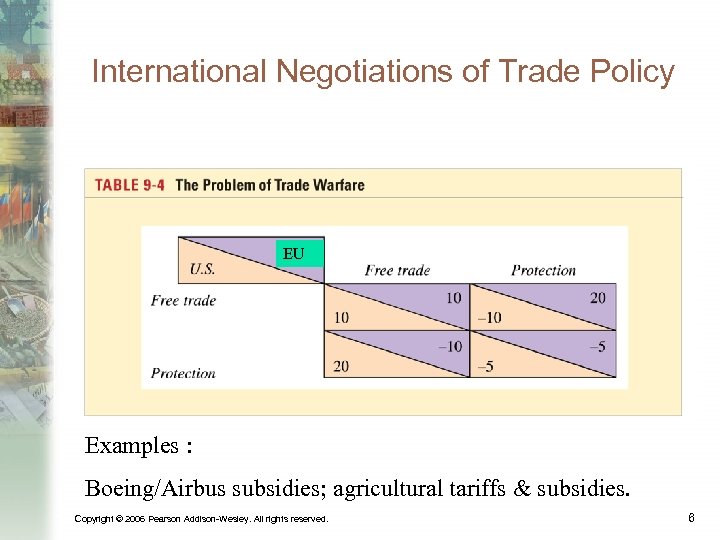 International Negotiations of Trade Policy EU Examples : Boeing/Airbus subsidies; agricultural tariffs & subsidies. Copyright © 2006 Pearson Addison-Wesley. All rights reserved. 6
 International Negotiations of Trade Policy • In this simple example, each country acting individually would be better off with protection, but both would be better off if both chose free trade. • If the EU and the US can establish a binding agreement to maintain free trade, both can avoid the temptation of protection and both can be made better off. Copyright © 2006 Pearson Addison-Wesley. All rights reserved. 7
 World Trade Organization • The WTO negotiations addresses trade restrictions in at least 3 ways: 1. Reduction of tariff rates through multilateral negotiations. 2. Binding: a tariff is “bound” by having the imposing country agree not to raise it in the future. Copyright © 2006 Pearson Addison-Wesley. All rights reserved. 8
 World Trade Organization 3. Prevention of non-tariff barriers: quotas and export subsidies are changed to tariffs because the costs of tariff protection are more apparent. ¨ Subsidies for agricultural exports are an exception. ¨ Exceptions are also allowed for “market disruptions” caused by a surge in imports. Copyright © 2006 Pearson Addison-Wesley. All rights reserved. 9
 World Trade Organization • The WTO is not only a forum for trade negotiations. • It is also and foremost a set of rules: rights and obligations. Copyright © 2006 Pearson Addison-Wesley. All rights reserved. 10
 World Trade Organization • The World Trade Organization was founded in 1995 on a number of agreements ¨ General Agreement on Tariffs and Trade: covers trade in goods ¨ General Agreement on Tariffs and Services: covers trade in services (e. g. , insurance, consulting, legal services, banking). ¨ Agreement on Trade-Related Aspects of Intellectual Property: covers international property rights (e. g. , patents and copyrights). Copyright © 2006 Pearson Addison-Wesley. All rights reserved. 11
 World Trade Organization ¨ The dispute settlement procedure: a formal procedure where countries in a trade dispute can bring their case to a panel of WTO experts to rule upon. ¨ The cases are settled fairly quickly: even with appeals the procedure is not supposed to last more than 15 months. ¨ The panel uses previous agreements by member countries to decide which ones are breaking their agreements. ¨ Decisions by the panel can be appealed. Copyright © 2006 Pearson Addison-Wesley. All rights reserved. 12
 World Trade Organization ¨ The Appellate Body makes final decisions. ¨ A country that refuses to adhere to the AB’s decision may be punished by allowing other countries to impose trade restrictions on its exports (retaliation. Examples: EU-bananas; EU-beef hormones; US-tax credit). Copyright © 2006 Pearson Addison-Wesley. All rights reserved. 13
 World Trade Organization • The GATT (and the GATS) is based on two fundamental principles: ¨ Non-discrimination ¨ Reciprocity (multilateral, not bilateral, not sectoral) • Non-discrimination comes in two parts: ¨ Most-favored-nation (MFN) principle (Art I) ¨ National treatment (Art III) Copyright © 2006 Pearson Addison-Wesley. All rights reserved. 14
 GATT - Article I • Paragraph 1 says: “…any advantage, favor, privilege or immunity granted by any contracting party to any product originating in or destined for any other country shall be accorded immediately and unconditionally to the like product originating in or destined for the territories of all other contracting parties. ” Copyright © 2006 Pearson Addison-Wesley. All rights reserved. 15
 GATT - Article III • Paragraph 2 says: “The products of the territory of any contracting party imported into the territory of any other contracting party shall not be subject, directly or indirectly, to internal taxes or any internal charges of any kind in excess of those applied, directly or indirectly, to like domestic products. Copyright © 2006 Pearson Addison-Wesley. All rights reserved. 16
 Two exceptions to the MFN rule • Non-reciprocal preferential access for developing countries to industrial country markets ¨ 1979 Enabling Clause (no time limit): GSP ¨ Waivers (limited in time) • Lomé, Cotonou for EC-ACP trade relations • Reciprocal preferential trading arrangements (PTAs or RTAs) under GATT Art XXIV Copyright © 2006 Pearson Addison-Wesley. All rights reserved. 17
 GATT - Article XXIV • Paragraph 5 says: “…the provisions of this Agreement shall not prevent as between the territories of contracting parties, the formation of a customs union or of a free-trade area…; Provided that…” certain conditions are met. Copyright © 2006 Pearson Addison-Wesley. All rights reserved. 18
 Preferential Trading Agreements • Free trade area: an agreement that allows free trade among members, but each member can have its own trade policy towards non-member countries ¨ An example is the North America Free Trade Agreement (NAFTA). ¨ Another example is the FTA between the EU and Mexico or the EU and South Africa. Also the Economic Partnership Agreements (EPAs) with ACP countries. Copyright © 2006 Pearson Addison-Wesley. All rights reserved. 19
 Preferential Trading Agreements • Customs union: an agreement that allows free trade among members AND requires a common external trade policy towards nonmember countries. ¨ An example is the European Union. ¨ Another example is the CU between the EU and Turkey Copyright © 2006 Pearson Addison-Wesley. All rights reserved. 20
 Preferential Trading Agreements • Are preferential trading agreements necessarily good for national welfare? • No, it is possible that national welfare decreases under a preferential trading agreement. • How? Rather than gaining tariff revenue from inexpensive imports from world markets, a country may import expensive products from member countries but not gain any tariff revenue. Copyright © 2006 Pearson Addison-Wesley. All rights reserved. 21
 Preferential Trading Agreements • Preferential trading agreements increase national welfare when new trade is created, but not when existing trade from the outside world is diverted to trade with member countries. • Trade creation ¨ occurs when high cost domestic production is replaced by low cost imports from other members. • Trade diversion ¨ occurs when low cost imports from non-members are diverted to high cost imports from member nations. Copyright © 2006 Pearson Addison-Wesley. All rights reserved. 22
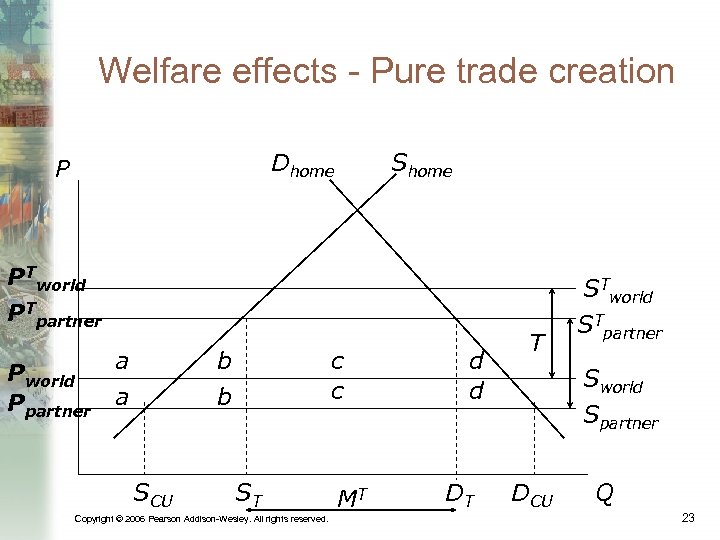 Welfare effects - Pure trade creation Dhome P Shome PTworld PTpartner Pworld Ppartner a a b b SCU c c ST Copyright © 2006 Pearson Addison-Wesley. All rights reserved. MT d d DT T STworld STpartner Sworld Spartner DCU Q 23
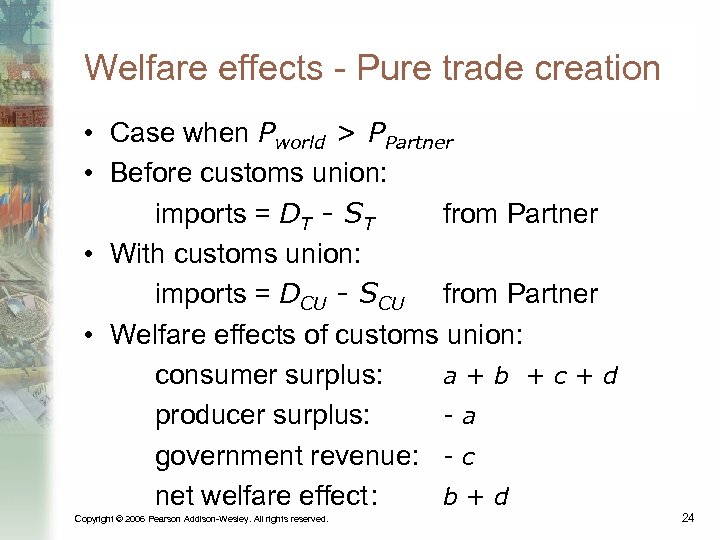 Welfare effects - Pure trade creation • Case when Pworld > PPartner • Before customs union: imports = DT - ST from Partner • With customs union: imports = DCU - SCU from Partner • Welfare effects of customs union: consumer surplus: a+b +c+d producer surplus: -a government revenue: - c net welfare effect : b+d Copyright © 2006 Pearson Addison-Wesley. All rights reserved. 24
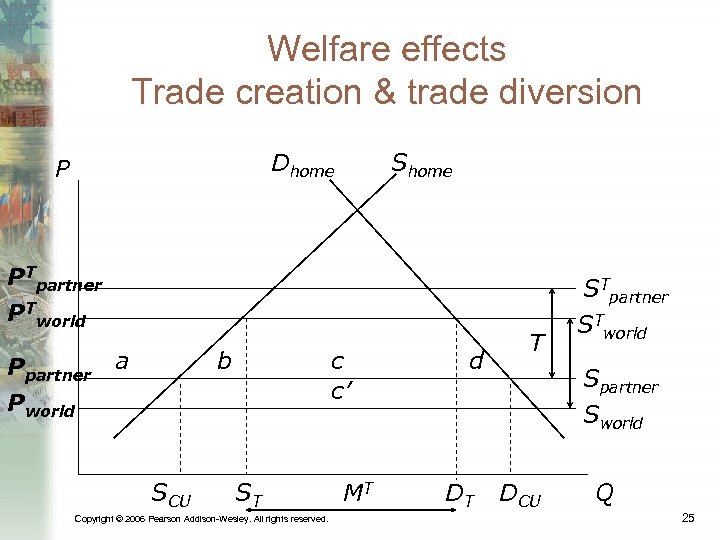 Welfare effects Trade creation & trade diversion Dhome P Shome PTpartner PTworld Ppartner Pworld a b SCU c c’ ST Copyright © 2006 Pearson Addison-Wesley. All rights reserved. MT d DT T STpartner STworld Spartner Sworld DCU Q 25
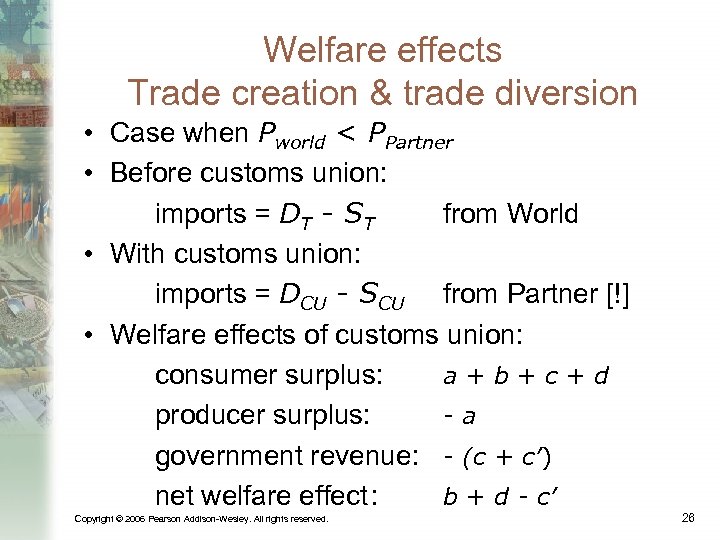 Welfare effects Trade creation & trade diversion • Case when Pworld < PPartner • Before customs union: imports = DT - ST from World • With customs union: imports = DCU - SCU from Partner [!] • Welfare effects of customs union: consumer surplus: a+b+c+d producer surplus: -a government revenue: - (c + c’) net welfare effect : b + d - c’ Copyright © 2006 Pearson Addison-Wesley. All rights reserved. 26
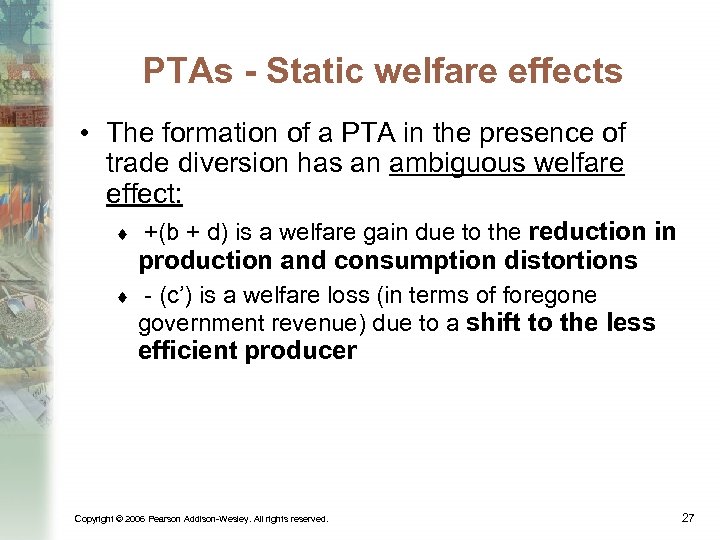 PTAs - Static welfare effects • The formation of a PTA in the presence of trade diversion has an ambiguous welfare effect: ¨ +(b + d) is a welfare gain due to the reduction in production and consumption distortions ¨ - (c’) is a welfare loss (in terms of foregone government revenue) due to a shift to the less efficient producer Copyright © 2006 Pearson Addison-Wesley. All rights reserved. 27
 PTAs - Other static welfare effects • i. Terms-of-trade effects: ¨ Individually, the members of a customs union may be small relative to world markets ¨ However, together they may become large, i. e. be able to influence their terms of trade ¨ It may be optimal for the customs union to restrict trade with non-members by imposing a CET equal to the optimum tariff Copyright © 2006 Pearson Addison-Wesley. All rights reserved. 28
 PTAs - Other static welfare effects • ii. Pro-competitive effects: ¨ If markets are imperfectly competitive, economic integration leads to a reduction in market power of each firm, leading to a reduction in average markups • ii. Product variety effects: ¨ If there are economies of scale, economic integration allows consumers to buy more varieties Copyright © 2006 Pearson Addison-Wesley. All rights reserved. 29
 Economic Partnership Agreements • The WTO waiver for Cotonou expires on 31/12/07. • Options: ¨ Try to obtain a new waiver ¨ Use another form of preferential access. Nonreciprocal: GSP/EBA ¨ Art XXIV FTA Copyright © 2006 Pearson Addison-Wesley. All rights reserved. 30