


 Скачать презентацию Lecture 11 Inflation essence types reasons
Lecture_11.ppt
- Количество слайдов: 15
 Lecture 11 Inflation: essence, types, reasons
 • Inflation is a process when purchasing ability of money is decreasing because of price increasing
 • inflation is a persistent increase in the general price level of goods and services in an economy over a period of time • When the general price level rises, each unit of currency buys fewer goods and services. Consequently, inflation reflects a reduction in the purchasing power per unit of money – a loss of real value in the medium of exchange and unit of account within the economy. [
 According to price level changes inflation can be differentiated as • Creeping or mild inflation is when prices rise 3% a year or less. • Walking Inflation. This type of strong, or pernicious, inflation is between 3 -10% a year. It is harmful to the economy because it heats up economic growth too fast. People start to buy more than they need, just to avoid tomorrow's much higher prices. This drives demand even further, so that suppliers can't keep up. More important, neither can wages. As a result, common goods and services are priced out of the reach of most people.
 • Galloping Inflation When inflation rises to ten percent or greater, it wreaks absolute havoc on the economy. Money loses value so fast that business and employee income can't keep up with costs and prices. Foreign investors avoid the country, depriving it of needed capital. The economy becomes unstable, and government leaders lose credibility. Galloping inflation must be prevented.
 • Hyperinflation is when the prices skyrocket more than 50% -- a month. It is fortunately very rare. In fact, most examples of hyperinflation have occurred when the government printed money recklessly to pay for war. Examples of hyperinflation include Germany in the 1920 s, Zimbabwe in the 2000 s, and during the American Civil War.
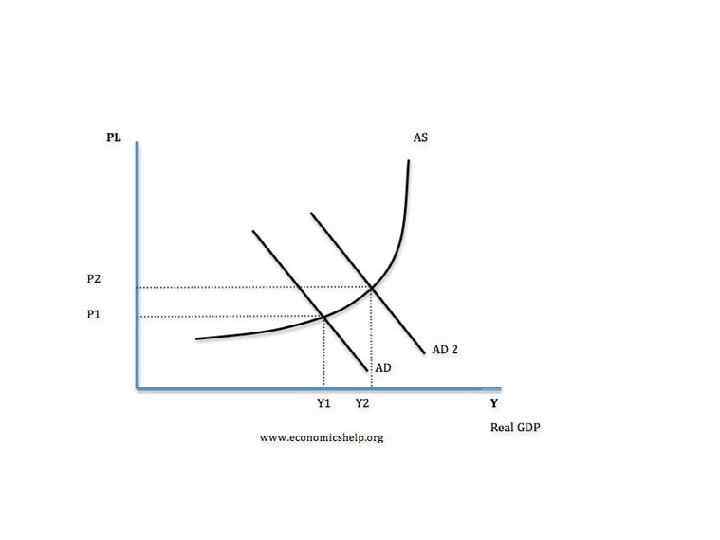
 Reasons of inflation • Demand pull inflation • If the economy is at or close to full employment then an increase in AD leads to an increase in the price level. As firms reach full capacity, they respond by putting up prices leading to inflation.
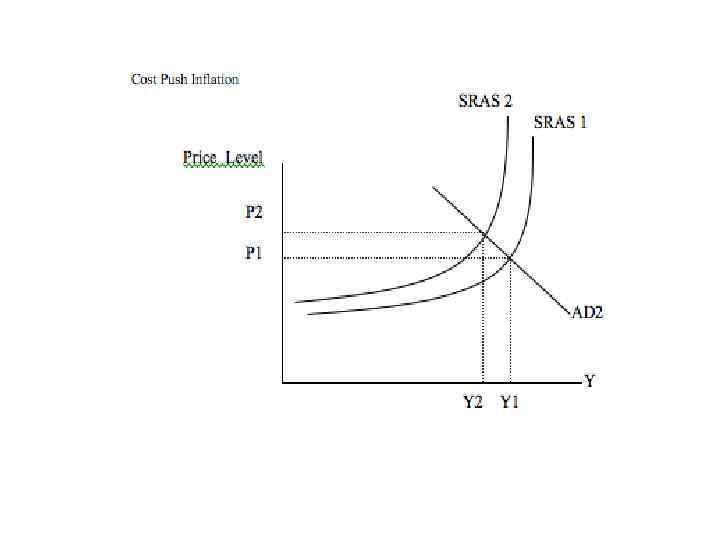
 Cost Push Inflation • If there is an increase in the costs of firms, then firms will pass this on to consumers. There will be a shift to the left in the AS.
 • Cost push inflation can be caused by many factors • The Labour Market • If trades unions can present a common front then they can bargain(выгодная сделка) for higher wages, this will lead to wage inflation. • 2. Import prices • the most part of all goods are imported in Kazakhstan. If there is a devaluation then import prices will become more expensive leading to an increase in inflation • E. G. a German car costs DM 40, 000. If the exchange rate is DM £ 1: 3 DM then it will be priced at £ 13, 333. If the E. R falls to £ 1 : 2 DM then it will be priced at £ 20, 000
 • 3. Raw Material Prices, • The best example is the price of oil, if the oil price increase by 20% then this will have a significant impact on most goods in the economy and this will lead to cost push inflation. • E. g. in early 2008, there was a spike in the price of oil to over $150 causing a rise in inflation.
 4. Declining productivity • If firms become less productive and allow costs to rise, this invariably(неизменно) leads to higher prices.
 Continuing Inflation • Once inflation sets in it is difficult to reduce it • For example, higher prices will cause workers to demand higher wages causing a wage price spiral. • The attitude of the monetary authorities is important for example if there was an increase in AD and the monetary authorities accomodated this by increasing the money supply then there would be a rise in the price level
 Read more: • David Begg, Foundations of Economics, Mc. Graw. Hill Higher Education, 2009. • Andrew Gillespie, Foundations of Economics, OUP Oxford, 2011. • Internet resources • http: //www. oup. com/uk/orc/bin/978019958654 7/ • http: //www. investorwords. com/1641/economic _cycle. html#ixzz 2 GQLPed. ZF