


 Скачать презентацию LECTURE 10 THE ADJECTIVE 1 Lexico-grammatical Morphological and
Lecture 10.pptx
- Количество слайдов: 19
 LECTURE 10 THE ADJECTIVE 1. Lexico-grammatical, Morphological and Syntactic Characteristics of the Adjective. 2. Subclasses of Adjectives. 3. The Category of Degrees of Comparison. The problem of Analytical Forms of Degrees of Comparison. 4. Substantivized Adjectives.
 1. Lexico-grammatical, Morphological and Syntactic Characteristics of the Adjective Categorial Semantics: property of a substance. Derivational features: -ful (hopeful), -less (flawless), -ish (bluish), -ous (famous),
 Derivational features (continued): -ive (decorative), -ic (basic); un- (unprecedented), in- (inaccurate), pre- (premature).
 Syntactic characteristics: - combinability with a noun (usu in preposition: a clever child); - combinability with link-verbs (is wonderful); - combinability with modifying adverbs (insanely dangerous).
 • • • When used as predicatives or postpositional attributes, adjectives acquire a complementive combinability with nouns (effected with the help of preposiitons). preposiitons fond of jealous of curious of suspicious of angry with, happy about, etc.
 2. Subclasses of Adjectives Traditional subdivision: relative and qualitative adjectives. Relative adjectives express properties of a substance determined by the direct relation of the substance to some other substance. • colour – coloured pictures; • wood – wooden house; • literature – literary mastery, etc.
 Qualitative adjectives denote various qualities of substances which admit of a quantitative estimation. • an awkward situation - a very awkward situation; • a difficult question - too difficult a question, etc. Formal feature: the ability to build the forms of degrees of comparison.
 Exceptions: 1) Qualitative adjectives incompatible with the idea of comparison (specificative function): • deaf, blind, extinct, etc. 2) Relative adjectives can occasionally form the degrees of comparison (evaluative function): • a grammatical topic • a purely grammatical topic • the most grammatical of the suggested topics
 3. Degrees of Comparison Categorial Meaning: quantitative characteristic of the quality of a nounal referent. Formal representation: gradual ternary opposition of three forms: strong – stronger – the strongest.
 Semantics of Degrees of Comparison Positive degree: no semantics of comparison. Comparative degree: expresses restricted superiority (comparison of two memebers). Superlative Degree: semantics of unrestricted superiority.
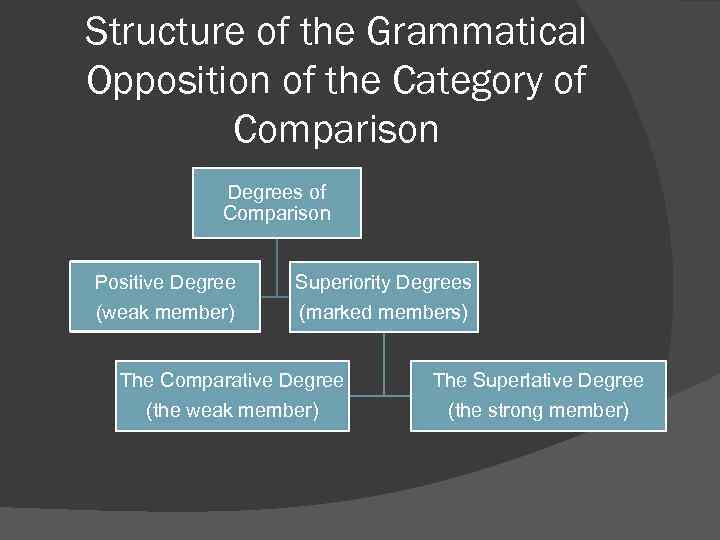 Structure of the Grammatical Opposition of the Category of Comparison Degrees of Comparison Positive Degree (weak member) Superiority Degrees (marked members) The Comparative Degree (the weak member) The Superlative Degree (the strong member)
 Analytical Degrees of Comparison more / most + adjective; categorial complementary distribution with the synthetic comparison forms: • two-syllable words with the stress on the first syllable not ending in -er, -y, -le, -ow; • words of more than two-syllable composition.
 Arguments in favour of exclusion of these forms from the category of comparison: 1) the more/most-combinations are semantically analogous to less/least + adjective (syntactic combinations of notional words); 2) the most-combination, unlike the synthetic superlative, can take the indefinite article, expressing the elative meaning (a high, not the highest degree of the respective quality).
 Objections (M. Y. Blokh): 1) The elative superlative, is still a kind of a specific, grammatically featured construction. Cf. common elative constructions (syntactic combinations of an intensely high estimation): • an extremely important amendment.
 2) Forms of Reverse Comparison. • The formula ascertains the categorial equality of the forms compared (positive and reverse comparison). • If two forms express the opposite meanings, they can only belong to units of the same general order.
 The whole category includes not three, but five different forms, making up the two series - direct and reverse. • beautiful – more beautiful – the most beautiful – less beautiful – the least beautiful.
 Non-comparable qualitative adjectives: 1) Adjectives that deny the very idea of comparison: deaf, blind, dead, etc. 2) Adjectives of indefinitely moderated quality: whitish, tepid, half-eaten, etc. 3) Adjectives of extreme quality: final, ultimate, etc.
 4. Substantivized Adjectives Conversion, zero-derivation. Substantivized adjectives: - are determined by articles; - have the category of number; - convey the mixed adjectival-nounal semantics of property.
 Pluralia Tantum SA (express sets of people): the rich, the poor, etc. Singularia Tantum SA (express abstract ideas of various types): the invisible, the abstract, etc.