



 Lecture 10
 Text as a unit of the highest level manifests itself as discourse in verbal communication. Therefore actual text in use may be defined as discourse. Discourses are formed by sequence of utterances. It is obvious that many utterances taken by themselves are ambiguous. They can become clear only within a discourse. Utterances interpretation, or discourse analysis, involves a variety of processes, grammatical and pragmatic.
 Pragmatics is the study of meaning of words, phrases and full sentences that words in fact convey when they are used, or with intended speaker meaning as it is sometimes referred to. NB! Semantics: objective meaning
 As frequently the meaning of discourse is context-dependant, pragmatics examines the devices used by language users (ex. deictic expressions, or anaphora) in order to express the desired meaning and how it is perceived.
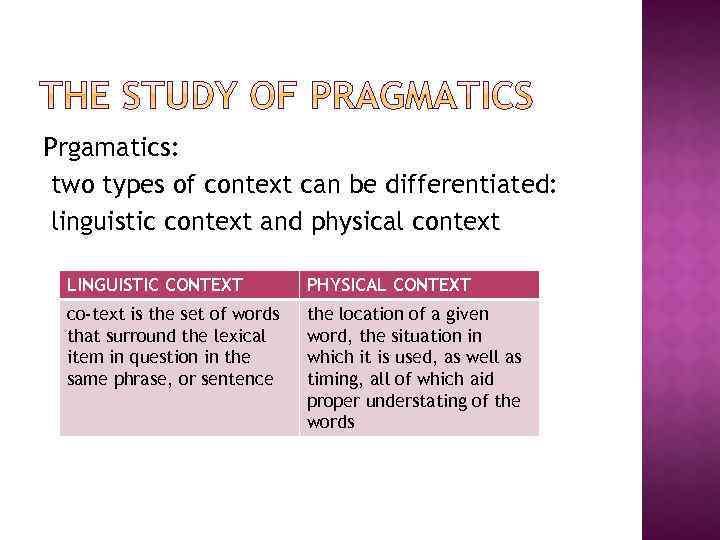 Prgamatics: two types of context can be differentiated: linguistic context and physical context LINGUISTIC CONTEXT PHYSICAL CONTEXT co-text is the set of words that surround the lexical item in question in the same phrase, or sentence the location of a given word, the situation in which it is used, as well as timing, all of which aid proper understating of the words
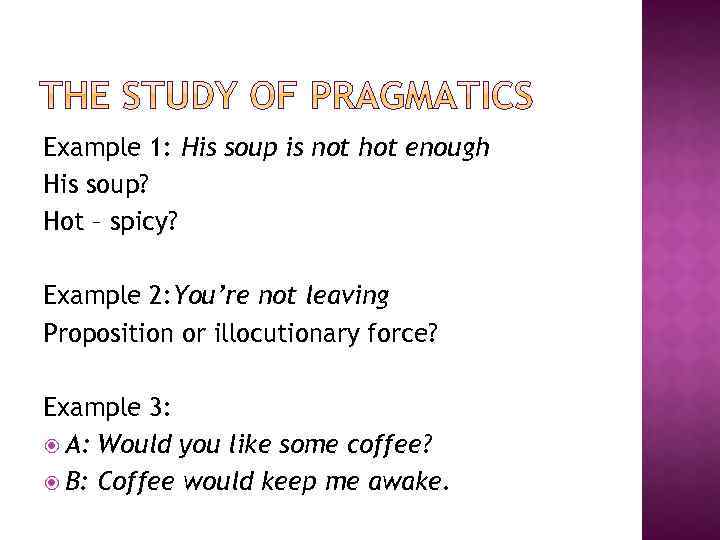 Example 1: His soup is not hot enough His soup? Hot – spicy? Example 2: You’re not leaving Proposition or illocutionary force? Example 3: A: Would you like some coffee? B: Coffee would keep me awake.
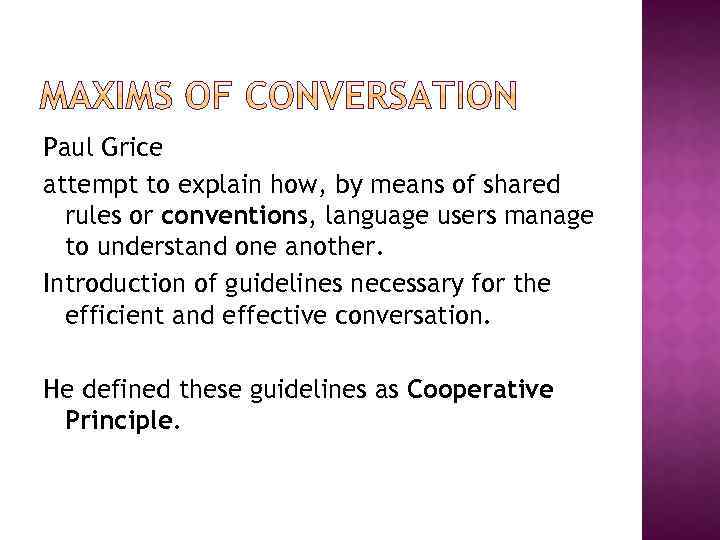 Paul Grice attempt to explain how, by means of shared rules or conventions, language users manage to understand one another. Introduction of guidelines necessary for the efficient and effective conversation. He defined these guidelines as Cooperative Principle.
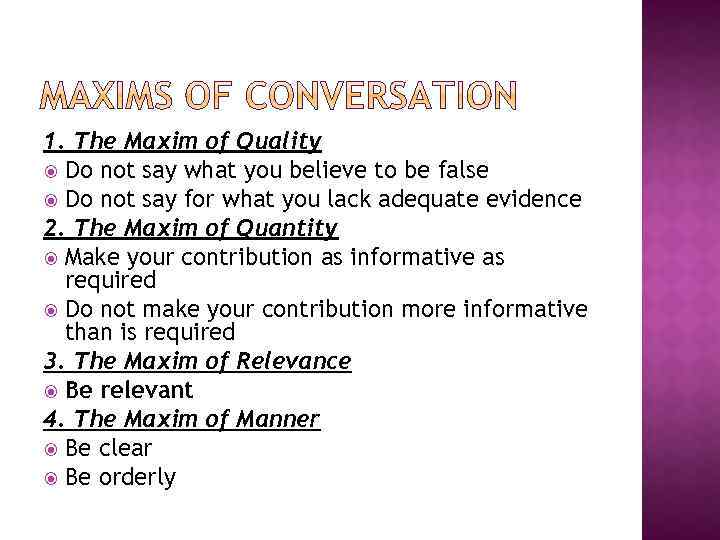 1. The Maxim of Quality Do not say what you believe to be false Do not say for what you lack adequate evidence 2. The Maxim of Quantity Make your contribution as informative as required Do not make your contribution more informative than is required 3. The Maxim of Relevance Be relevant 4. The Maxim of Manner Be clear Be orderly
 Communicative maxims make it possible to generate inferences which are defined as conversational implicatures and conventional implicatures.
 Conversational implicatures are such components of an utterance that are not expressed semantically but are understood by communicants in the process of communication: Eg. : Was it you who broke the cup? This question presupposes: Someone has broken the cup. What cup? – you are not aware I didn’t do that – you know about the fact. Conversational implicatures are universal, they do not depend on the language used.
 Conventional implicatures, are derived from a definite lexical or grammatical structure of an utterance: I saw only John (conventional implicature – I didn’t see anyone else), Even Bill is smarter than you (Everybody is smarter than John, John is stupid).
 Both kinds of implicatures are of great interest for discourse analysis. When there is a mismatch between the expressed meaning and the implied meaning we deal with indirectness. Indirectness is a universal phenomenon: it occurs in all natural languages. Let us see how conversational implicatures arise from Maxims of Conversation and thus create indirectness.
 In the following example Polonius is talking to Hamlet: Polonius: What do you read, My Lord? Hamlet: Words, words. In this dialogue Hamlet deliberately gives less information than is required by the situation and so flouts the Maxim of Quantity. At the same time he deliberately fails to help Polonius to achieve his goals, thereby flouting the Maxim of Relevance. The Maxim of Quantity is also flouted when we say: Law is law, woman is woman, students are students. This makes us look for what these utterances really mean.
 In the utterance You’re being too smart! the Maxim of Quality is flouted and the hearer is made to look for a covert sense. Similarly, the same maxim is flouted with metaphors. If I say: He is made of iron, I am either noncooperative or I want to convey something different.
 The Maxim of Relevance can also be responsible for producing a wide range of standard implicatures: A: Can you tell me the time? B: The bell has gone. It is only on the basis of assuming the relevance of B’s response that we can understand it as an answer to A’s question.
 D). A number of different kinds of inference arise if we assume that the Maxim of Manner is being observed. The utterance The lone ranger rode into the sunset and jumped on his horse violates our expectation that events are recounted in the order in which they happen because the Maxim of Manner is flouted.
 D)A number of different kinds of inference arise if we assume that the Maxim of Manner is being observed. The utterance The lone ranger rode into the sunset and jumped on his horse violates our expectation that events are recounted in the order in which they happen because the Maxim of Manner is flouted.
 Geoffrey Leech “Principles of Pragmatics” Politeness Principle Minimize the expression of impolite beliefs; Maximize the expression of polite beliefs. Politeness Principle is as valid as Cooperative Principle because it helps to explain why people do not always observe Maxims of Conversation. Quite often we are indirect in what we say because we want to minimize the expression of impoliteness: A: Would you like to go to theatre? B: I have an exam tomorrow. B is saying ‘no’, but indirectly, in order to be polite.
 Psycholinguistics a branch of study which combines the disciplines of psychology and linguistics. concerned with the relationship between the human mind and the language as it examines the processes that occur in brain while producing and perceiving both written and spoken discourse. What is more, it is interested in the ways of storing lexical items and syntactic rules in mind, as well as the processes of memory involved in perception and interpretation of texts. the processes of speaking and listening are analyzed, along with language acquisition and language disorders.
 Psycholinguistics emerged in the late 1950 s and 1960 s as a result of Chomskyan revolution. The ideas presented by Chomsky became so important that they quickly gained a lot of publicity and had a big impact on a large number of contemporary views on language. Consequently also psycholinguists started investigating such matters as the processing of deep and surface structure of sentences. In the early years of development of psycholinguistics special experiments were designed in order to examine if the focus of processing is the deep syntactic structure. On the basis of transformation of sentences it was initially discovered that the ease of processing was connected with syntactic complexity.
 principle of minimal attachment means that when processing a sentence which could have multiple meanings people most frequently tend to choose the simplest meaning, or the meaning that in syntactic analysis would present the simplest parse tree with fewest nodes. ‘Mary watched the man with the binoculars’ by most language users would be interpreted that it was Mary, and not the man, who was using binoculars.
 One other principle worth noting is the principle of late closure which states that there is a tendency to join the new information to the current phrase, or clause, which explains why in a sentence such as ‘John said he will leave this morning’ the phrase ‘this morning’ would be understood as relating to the verb ‘leave’ and not to ‘said’.