


 Скачать презентацию Lecture 1 Production stimulation and enhanced oil recovery
Lecture 1.pptx
- Количество слайдов: 23
 Lecture 1 Production stimulation and enhanced oil recovery methods
 Enhanced oil recovery methods classification Primary methods (the introduction of flooding on the newly developing objects) Secondary methods (the events, produced for the extraction of the remaining oil reserves from the depleted deposits by flooding) Tertiary methods (technologies to recover remaining oil reserves from the flooded zones)
 Other methods of enhanced oil recovery Rational wells pattern The regulation of the process of water boundary tightening Bottom-hole stimulation
 Enhanced oil recovery methods are based on: The application of the reservoir fluids filtration laws; Physical, chemical phenomena taking place in the reservoir; The interaction of solid particles and fluids Two-way influence of the injected chemicals and oil.
 The choice of the method depends on: The geological structure of the deposit; Exploration of the deposit; Pool-reservoir properties; The technologies, applied from the beginning of the development; Oil withdrawal rate and fluid injection.
 Enhanced oil recovery methods are divided into: Oil production stimulation methods (PS) Enhanced oil recovery methods (EOR)
 PS (production stimulation) methods Technologies that increase the fluid inflow to the bottom of the producing well
 The PS methods include: Re-perforation Perforation of additional intervals of undrilled oil-saturated formations BHHAT (bottom-hole hydrochloric acid treatment) BHMAT (bottom-hole mud acid treatment) TAT (thermal acid treatment) TGCFT (thermal-gas-chemical formation treatment) HSBP (hydrosandblast perforation) SARBHT (surface-active reagent bottom-hole treatment) Electro-hydraulic and acoustic effect on the bottom-hole Bottom-hole cyclic steam soaking
 The goal of the PS methods: To improve pool-reservoir properties of the bottomhole To increase the productivity of the individual wells
 EOR methods: Affect the development object or its part, thus it allows to involve in the development the remaining, bypassed oil that were not extracted by means of project water flooding system.
 EOR methods can be divided (according to the properties) into 3 groups: 1 st – increases oil displacement coefficient by water; 2 nd – increases the sweep efficiency 3 rd – increases both factors and oil recovery factor in general
 EOR methods include: Physical-chemical methods – the use of aqueous solutions: SAR, polymers, micellar solutions, alkalis, acids, conformance control. Hydrodynamic methods – cyclic flooding, change of filtration flow direction, high injection pressure creation, forced fluid withdrawal, combined nonstationary flooding.
 EOR methods include: Gas methods – oil displacement by high pressure gas, water-alternated-gas injection. Thermal, thermic methods – oil displacement by heattransfer agents (hot water, steam), in-situ combustion Other methods – the well grid compaction, the transition from one development system to another (spot, selective flooding, block-closed system), hydraulic fracturing of formation, location and operation of lateral and horizontal well bores; microbiological, wave, electromagnetic methods
 EOR methods are based on: Reduction of interfacial tension on the boundary of oil -displacement agent; Decrease of the mobility ratio of the displaced and displacing fluids Redistribution of oil, water and gas in the reservoir with the aim of oil reserves consolidation
 The forms of residual oil condition The residual oil reserves (100%)are quantitatively distributed as follows: 1. Oil, remaining in low-permeability formations (interlayers) and areas that are not water flooded – 27% 2. Oil in stagnant zones of homogeneous formations – 19% 3. Oil, remaining in the lenses and impermeable screens, not drilled by the well – 24% 4. Capillary hold-up oil and film-type oil – 30%
 The reasons of residual oil condition. Oil and water immiscibility; The hydrophobization of the reservoir-rocks due to the absorption of heavy crude oil components on the surface of the rocks’ grains; The difference of viscosities of displacing and displaced fluids, resulting hydrodynamic instability of oil-water contact.
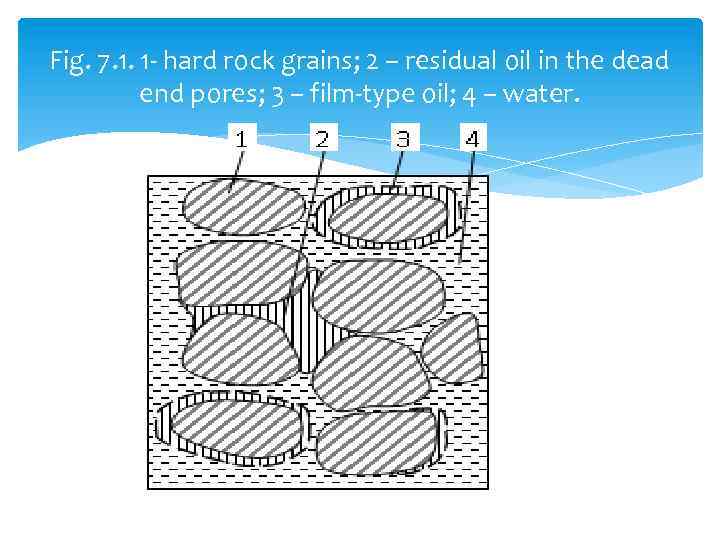 Fig. 7. 1. 1 - hard rock grains; 2 – residual oil in the dead end pores; 3 – film-type oil; 4 – water.
 The conditions of effective EOR methods use. There are defined 3 categories of methods’ criteria application: 1. Geological-physical; 2. Technological; 3. Material-technical.
 Oil deposits management Is the set of actions to bring to conformation of the actual data with the project.
 Oil deposits management can be occurred by: Technological methods without development system changing (without drilling of new wells that are planned in the project documentation) are production (inflow) stimulation methods; they are the change of the wells’development drive by the increase of production rates, interval bottom-hole stimulation). Enhanced oil recovery methods include cyclic flooding, change of filtration flows direction, forced fluid withdrawal (FFW), the use of physical-chemical methods and others). )
 Oil deposits management can be occurred by: Partial change of the development system include the spot and selective flooding, enlargement or breaking up into smaller units of the production facilities, followed by the application of physical-chemical and hydrodynamic methods of enhanced oil recovery.
 Summary Thus, the application of EOR methods promotes the harmonization of actual and project development indicators.
 Thanks for your attention!!!