


 Скачать презентацию Lecture 1 Introduction T Peterson SLAC National Accelerator
5a2d816e1ab2a1fd88a156a5d8be9c82.ppt
- Количество слайдов: 19
 Lecture 1 Introduction T. Peterson SLAC National Accelerator Laboratory J. G. Weisend II European Spallation Source ESS USPAS January 16, 2017
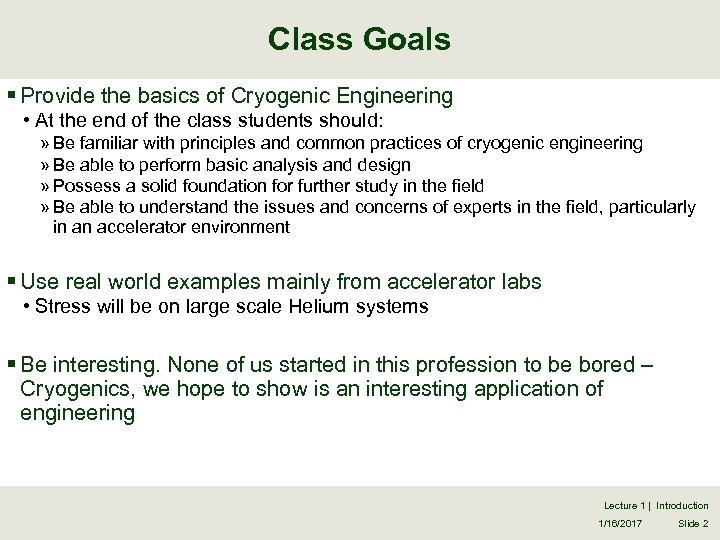 Class Goals § Provide the basics of Cryogenic Engineering • At the end of the class students should: » Be familiar with principles and common practices of cryogenic engineering » Be able to perform basic analysis and design » Possess a solid foundation for further study in the field » Be able to understand the issues and concerns of experts in the field, particularly in an accelerator environment § Use real world examples mainly from accelerator labs • Stress will be on large scale Helium systems § Be interesting. None of us started in this profession to be bored – Cryogenics, we hope to show is an interesting application of engineering Lecture 1 | Introduction 1/16/2017 Slide 2
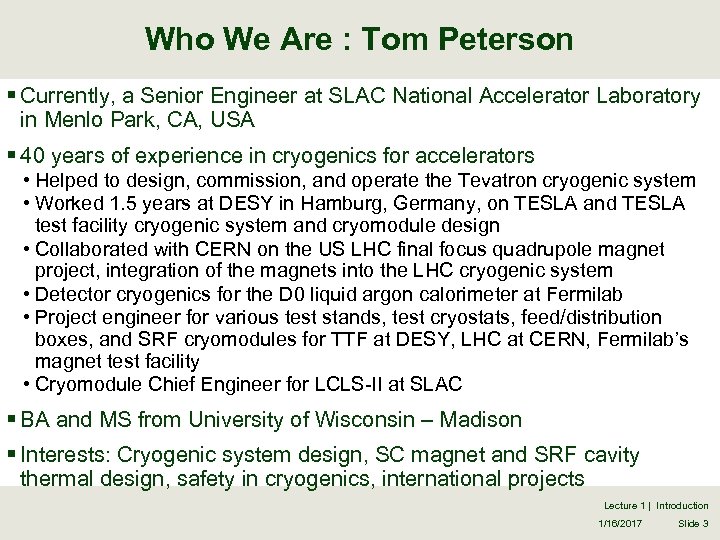 Who We Are : Tom Peterson § Currently, a Senior Engineer at SLAC National Accelerator Laboratory in Menlo Park, CA, USA § 40 years of experience in cryogenics for accelerators • Helped to design, commission, and operate the Tevatron cryogenic system • Worked 1. 5 years at DESY in Hamburg, Germany, on TESLA and TESLA test facility cryogenic system and cryomodule design • Collaborated with CERN on the US LHC final focus quadrupole magnet project, integration of the magnets into the LHC cryogenic system • Detector cryogenics for the D 0 liquid argon calorimeter at Fermilab • Project engineer for various test stands, test cryostats, feed/distribution boxes, and SRF cryomodules for TTF at DESY, LHC at CERN, Fermilab’s magnet test facility • Cryomodule Chief Engineer for LCLS-II at SLAC § BA and MS from University of Wisconsin – Madison § Interests: Cryogenic system design, SC magnet and SRF cavity thermal design, safety in cryogenics, international projects Lecture 1 | Introduction 1/16/2017 Slide 3
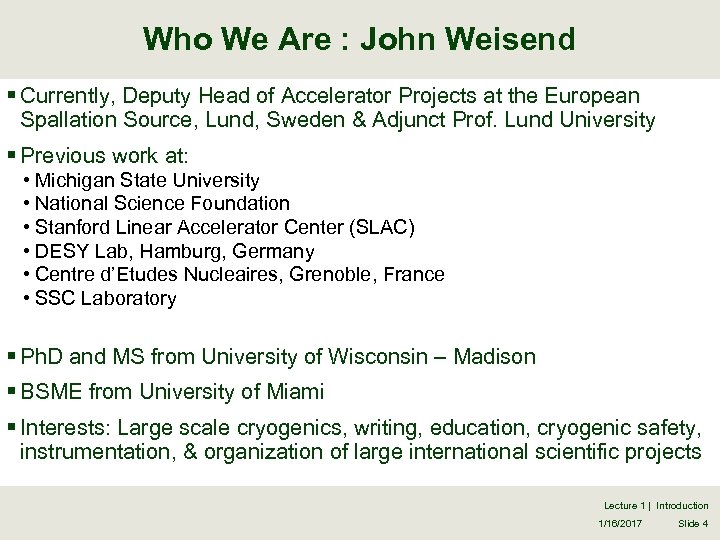 Who We Are : John Weisend § Currently, Deputy Head of Accelerator Projects at the European Spallation Source, Lund, Sweden & Adjunct Prof. Lund University § Previous work at: • Michigan State University • National Science Foundation • Stanford Linear Accelerator Center (SLAC) • DESY Lab, Hamburg, Germany • Centre d’Etudes Nucleaires, Grenoble, France • SSC Laboratory § Ph. D and MS from University of Wisconsin – Madison § BSME from University of Miami § Interests: Large scale cryogenics, writing, education, cryogenic safety, instrumentation, & organization of large international scientific projects Lecture 1 | Introduction 1/16/2017 Slide 4
 Evaluation § Problem Sets 70% § Design Project 30% Lecture 1 | Introduction 1/16/2017 Slide 5
 Resources § Class slides § Textbook Cryogenic Systems by R. Barron (2 nd Edition) § List of Suggested Additional Reading § Ask lots of questions! • During class • During the week • After the class is finished • Instructors contact information Tom Peterson John Weisend - tjpete@slac. stanford. edu - john. weisend@esss. se Lecture 1 | Introduction 1/16/2017 Slide 6
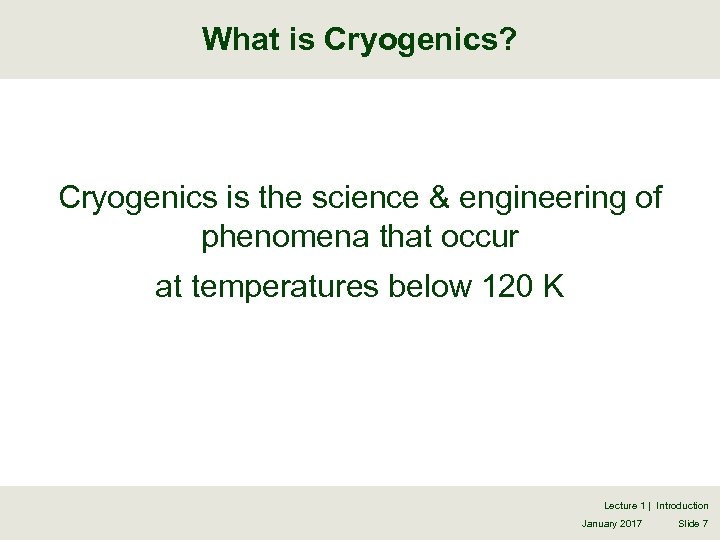 What is Cryogenics? Cryogenics is the science & engineering of phenomena that occur at temperatures below 120 K Lecture 1 | Introduction January 2017 Slide 7
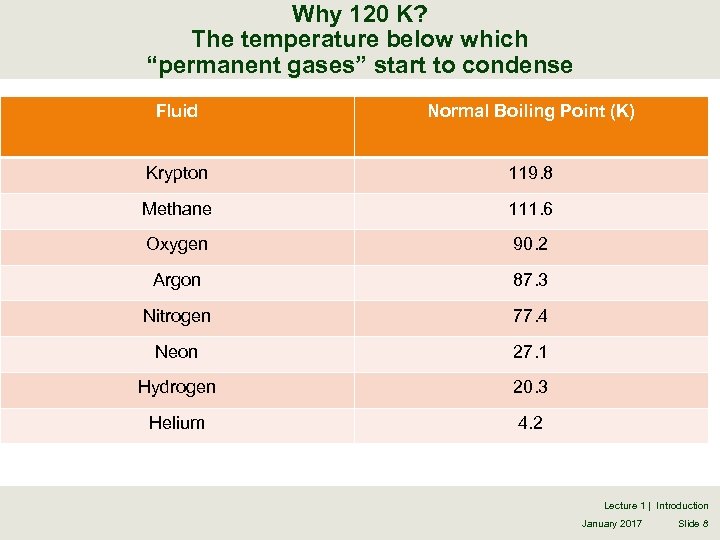 Why 120 K? The temperature below which “permanent gases” start to condense Fluid Normal Boiling Point (K) Krypton 119. 8 Methane 111. 6 Oxygen 90. 2 Argon 87. 3 Nitrogen 77. 4 Neon 27. 1 Hydrogen 20. 3 Helium 4. 2 Lecture 1 | Introduction January 2017 Slide 8
 Cryogenics & Accelerators § Cryogenics plays a major role in modern particle accelerators • Enables superconductivity » Beam bending and focusing magnets (1. 8 K – 4. 5 K) » Magnets for particle identification in large detectors (4. 2 – 4. 5 K) » Superconducting RF cavities for particle acceleration (1. 8 K – 4. 2 K) • Allows dense pure liquids » LAr calorimeters (87 K) » LH 2 targets, moderators and absorbers (20 K) • Provides sub-Kelvin cooling for certain types of dark matter searches § Since the Tevatron (1983) accelerator cryogenic systems have become larger, more reliable, more efficient, industrialized and much more widespread Lecture 1 | Introduction January 2017 Slide 9
 Cryogenics & Accelerators § Accelerator requirements have played a significant role in pushing cryogenic technology • Automated, efficient & reliable large scale Helium refrigeration plants • Development & industrialization of cold compressors • Studies on He II two-phase flow • Radiation resistant cryogenic temperature sensors • Production of reliable high field superconducting magnets » MRI has also had a significant impact here • Production of high gradient SRF cavities Lecture 1 | Introduction January 2017 Slide 10
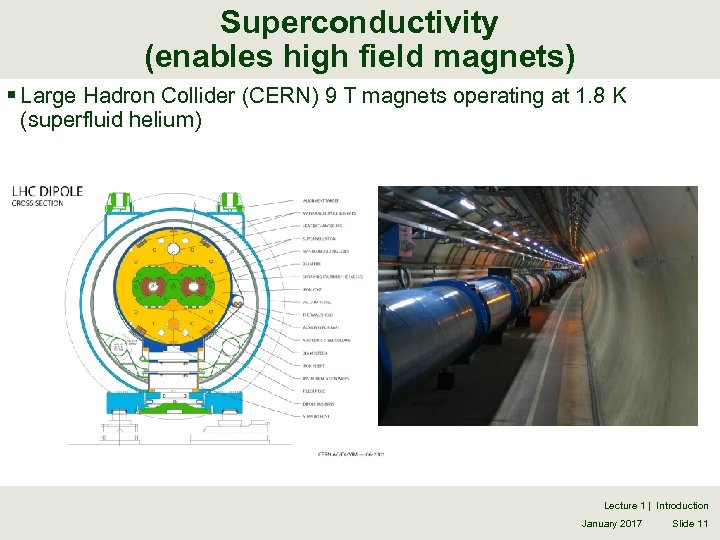 Superconductivity (enables high field magnets) § Large Hadron Collider (CERN) 9 T magnets operating at 1. 8 K (superfluid helium) Lecture 1 | Introduction January 2017 Slide 11
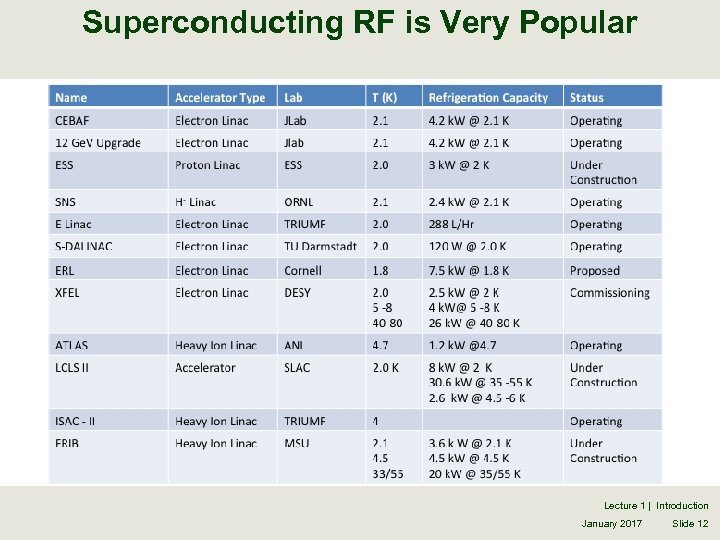 Superconducting RF is Very Popular Lecture 1 | Introduction January 2017 Slide 12
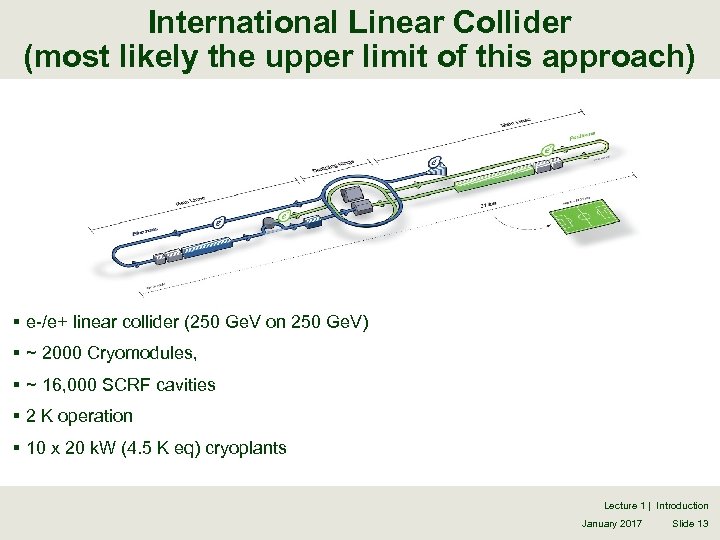 International Linear Collider (most likely the upper limit of this approach) § e-/e+ linear collider (250 Ge. V on 250 Ge. V) § ~ 2000 Cryomodules, § ~ 16, 000 SCRF cavities § 2 K operation § 10 x 20 k. W (4. 5 K eq) cryoplants Lecture 1 | Introduction January 2017 Slide 13
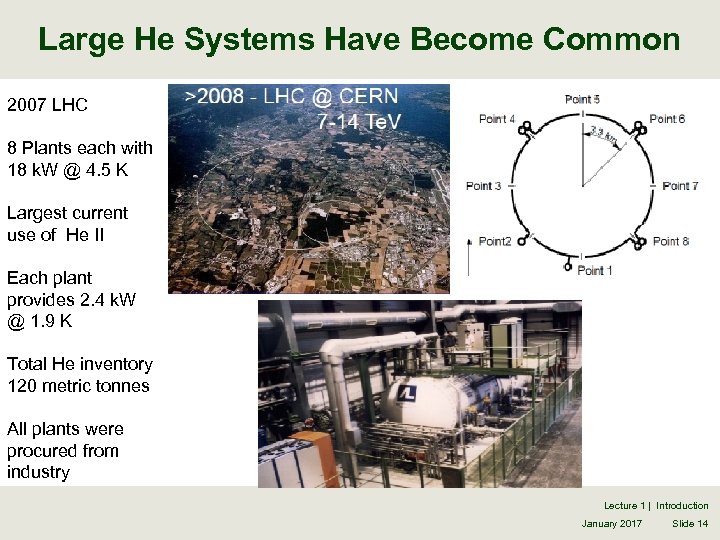 Large He Systems Have Become Common 2007 LHC 8 Plants each with 18 k. W @ 4. 5 K Largest current use of He II Each plant provides 2. 4 k. W @ 1. 9 K Total He inventory 120 metric tonnes All plants were procured from industry Lecture 1 | Introduction January 2017 Slide 14
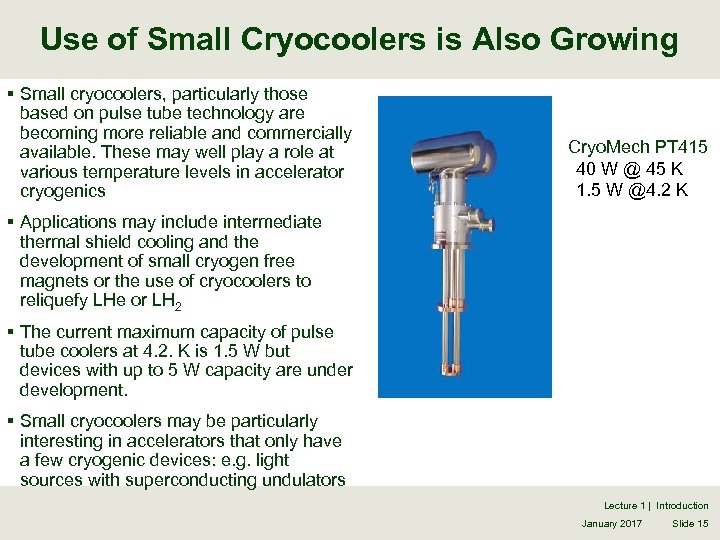 Use of Small Cryocoolers is Also Growing § Small cryocoolers, particularly those based on pulse tube technology are becoming more reliable and commercially available. These may well play a role at various temperature levels in accelerator cryogenics Cryo. Mech PT 415 40 W @ 45 K 1. 5 W @4. 2 K § Applications may include intermediate thermal shield cooling and the development of small cryogen free magnets or the use of cryocoolers to reliquefy LHe or LH 2 § The current maximum capacity of pulse tube coolers at 4. 2. K is 1. 5 W but devices with up to 5 W capacity are under development. § Small cryocoolers may be particularly interesting in accelerators that only have a few cryogenic devices: e. g. light sources with superconducting undulators Lecture 1 | Introduction January 2017 Slide 15
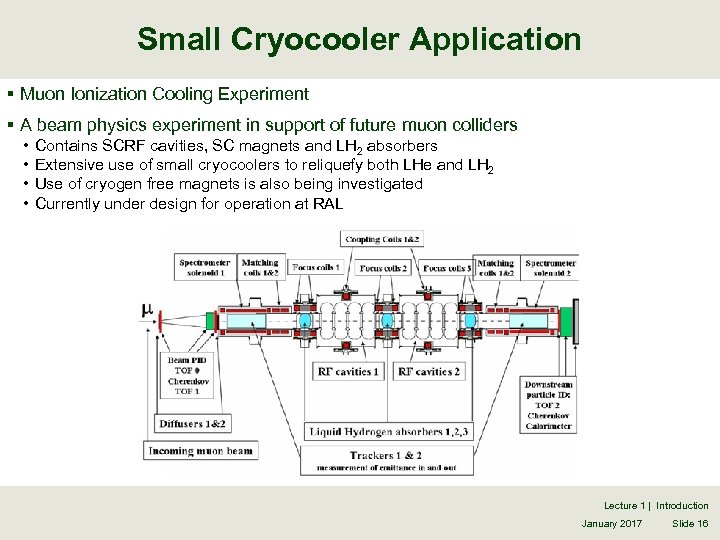 Small Cryocooler Application § Muon Ionization Cooling Experiment § A beam physics experiment in support of future muon colliders • • Contains SCRF cavities, SC magnets and LH 2 absorbers Extensive use of small cryocoolers to reliquefy both LHe and LH 2 Use of cryogen free magnets is also being investigated Currently under design for operation at RAL Lecture 1 | Introduction January 2017 Slide 16
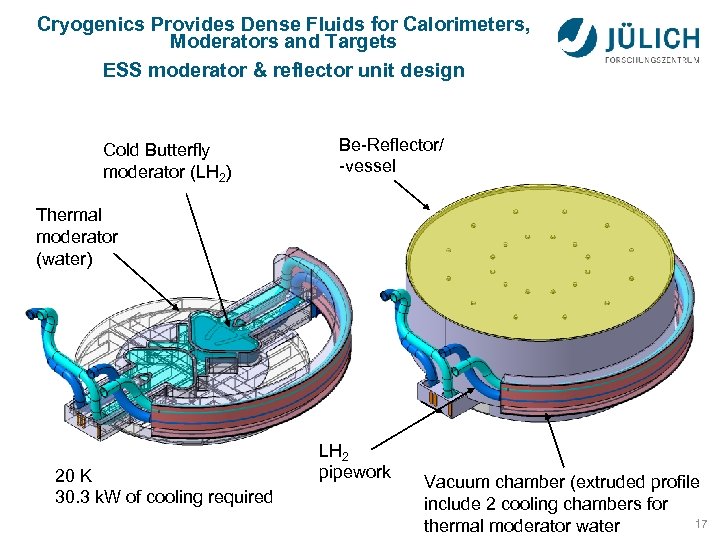 Cryogenics Provides Dense Fluids for Calorimeters, Moderators and Targets ESS moderator & reflector unit design Cold Butterfly moderator (LH 2) Be-Reflector/ -vessel Thermal moderator (water) 20 K 30. 3 k. W of cooling required LH 2 pipework Vacuum chamber (extruded profile include 2 cooling chambers for 17 thermal moderator water
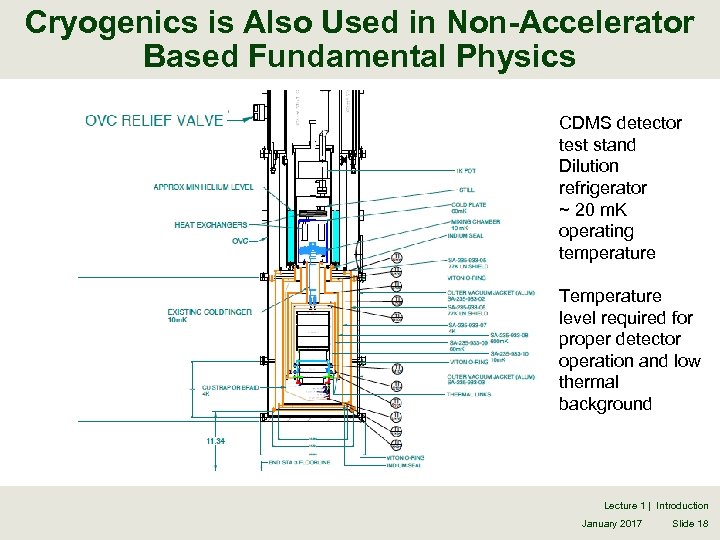 Cryogenics is Also Used in Non-Accelerator Based Fundamental Physics CDMS detector test stand Dilution refrigerator ~ 20 m. K operating temperature Temperature level required for proper detector operation and low thermal background Lecture 1 | Introduction January 2017 Slide 18
 Summary § Cryogenics is an important enabling technology in accelerator and fundamental physics § Cryogenic applications cover a wide range from the very small to the very large and from 120 K to m. K § Cryogenics also plays a major role in astronomy, solid state physics and medicine § The study of cryogenics involves many disciplines including: thermodynamics, heat transfer, fluid mechanics, mechanical design, material science, instrumentation and quantum mechanics § There’s lots to learn Let’s Get Started Lecture 1 | Introduction January 2017 Slide 19