


 Скачать презентацию Lecture 1 Introduction Prof Tatiana Levina Vladimir State
Introduction.ppt
- Количество слайдов: 16
 Lecture 1 Introduction Prof. Tatiana Levina Vladimir State University 1
 Introduction n n n 1. A brief historical outline. 2. The role of phonetics in foreign language teaching 3. Phonetics as a branch of linguistics. Its application to other areas of science. 4. Branches of phonetics. 5. Aspects of speech sounds. 6. Methods of investigation in phonetics. 7. Types of transcription. 2
 A Brief Historical Outline phonetics – phōnē (gr. ) n discipline n Panini (4 th century B. C. ) n to decipher Veda hymn [him] n sanscrit n Rig-veda 3
 The Role of Phonetics in Foreign Language Teaching n D. Abercrombie: “I would reply that all language teachers willy-nilly are phoneticians. It is not possible for practical purposes to teach a foreign language to any types of learners, for any purpose, by any method without giving some attention to pronunciation. And any attention to pronunciation is phonetics. ” 4
 Phonetics as a Branch of Linguistics. Its Application to Other Areas of Science n Lexicology Grammar Linguistics Phonetic units(the subject matter of phonetics): 1). Speech sounds (phonemes) 2). The syllabic structure of words 3). The accentual structure of words (word-stress) 4). Intonation 5
![n 2 levels of investigation: a content level; an expression level. [k t-n t]](https://present5.com/presentation/166147877_445960742/image-6.jpg "n 2 levels of investigation: a content level; an expression level. [k t-n t]") n 2 levels of investigation: a content level; an expression level. [k t-n t] There’s no room for you in my heart. There’s no room for you in my hut. [ha: t-h t] carrier 6
n 2 levels of investigation: a content level; an expression level. [k t-n t] There’s no room for you in my heart. There’s no room for you in my hut. [ha: t-h t] carrier 6
 The Fields of Study n n n 1). Communication engineering 2). Medical sciences 3). Dialectology 4). Social sciences (sociolinguistics, sociophonetics) 5). Psychology to convert to design orthography to appreciate to interact (mutually depend) extralinguistic (concerns everything that is beyond language) 7
 The Process of Speech Production 1) 2) 3) 4) The concept is formed in the brain. The message formed in the brain is transmitted through the nervous system to the speech organs. The human brain controls the behavior of the articulatory organs. The acoustic stage. The movements of the speech organs produce sound waves. The sound waves come to the listener’s ear. The spoken message is transmitted to the brain and then comes the linguistic interpretation of the information. 8
 The Branches of Phonetics to overlap to correlate n 1). Special phonetics n 2). Comparative phonetics n 3). General phonetics n 4). Descriptive (synchronic) phonetics n 5). Historical (diachronic) phonetics n 6). Segmental phonetics a sound cluster 9
 The Branches of Phonetics 7). Super-segmental phonetics to super-impose n 8). Acoustic phonetics n 9) Auditory (perceptive, perceptional) phonetics to perceive n 10). Functional phonetics (phonology) n 11). Applied phonetics n 10
 Aspects of Speech Sounds 1). Articulatory phonetics n 2). Acoustic phonetics (pitch, intensity, timbre) n 3). Functional phonetics n 11
 Methods of Investigation 1). Direct observation n 2). Theoretical research n 3). Experimental research Rousselot V. A. Bogoroditzky L. V. Shcherba a procedure a minimal pair of opposition an informant n 12
 Techniquesin A rticulatory Phonetics 1). Palatography (palate) n 2). Photography n 3). X-ray photography n 4). Cinematography n 5). X-ray cinematography n 6). Computer programmes n 13
 Techniques in. A coustic Phonetics 1). Oscillograph n 2). Spectrograph n 3). Intonograph a synthesizing machine n 14
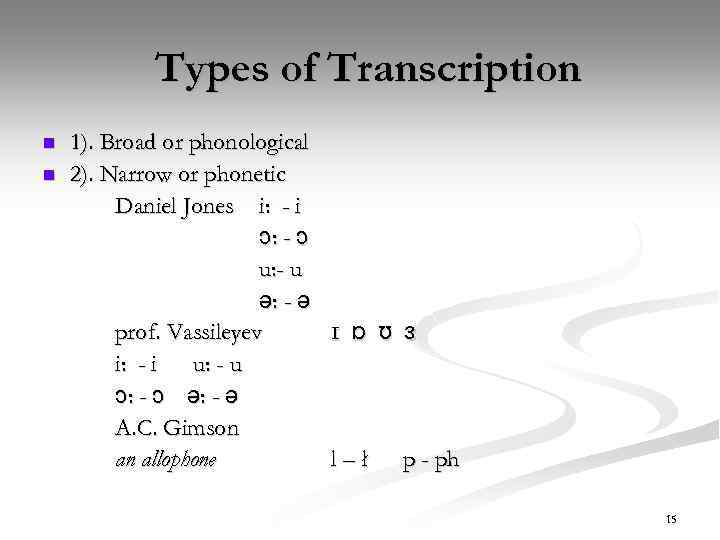 Types of Transcription n n 1). Broad or phonological 2). Narrow or phonetic Daniel Jones i: - i : - u: - u : - prof. Vassileyev i: - i u: - u : - A. C. Gimson an allophone l – ł p - ph 15
 Thank you! 16