


 Скачать презентацию Lecture 1 Introduction into Theoretical Phonetics Plan
Lecture 1.ppt
- Количество слайдов: 30
 Lecture 1 Introduction into Theoretical Phonetics
 Plan 1. 2. 3. 4. 5. 6. Language and Speech The Phonetic system of a Language Aspects of Sound Phenomena Phonetics as a Science Branches of Phonetics Methods of Phonetic Analysis
 List of Terms the phonetic system n the segmental level of the phonetic system n the prosodic level of the phonetic system n articulatory aspect of sound phenomena n acoustic aspect of sound phenomena n auditory aspect of sound phenomena n linguistic aspect of sound phenomena n constitutive function of sound phenomena n distinctive function of sound phenomena n identificatory function of sound phenomena n phonetics n phonology n
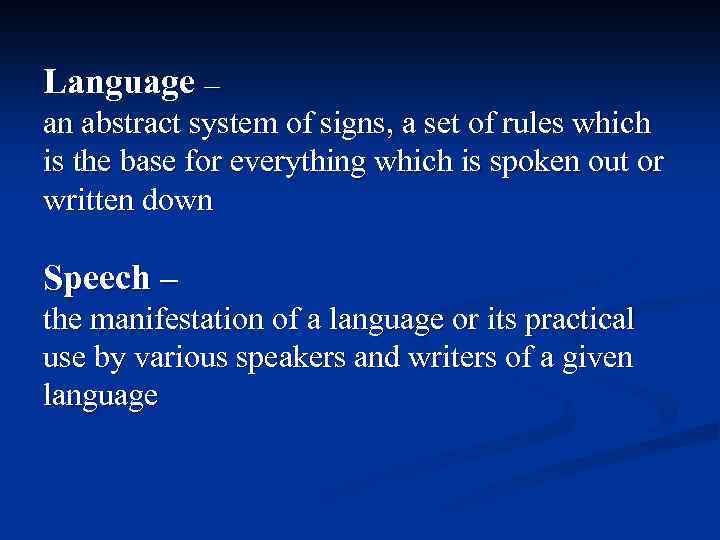 Language – an abstract system of signs, a set of rules which is the base for everything which is spoken out or written down Speech – the manifestation of a language or its practical use by various speakers and writers of a given language
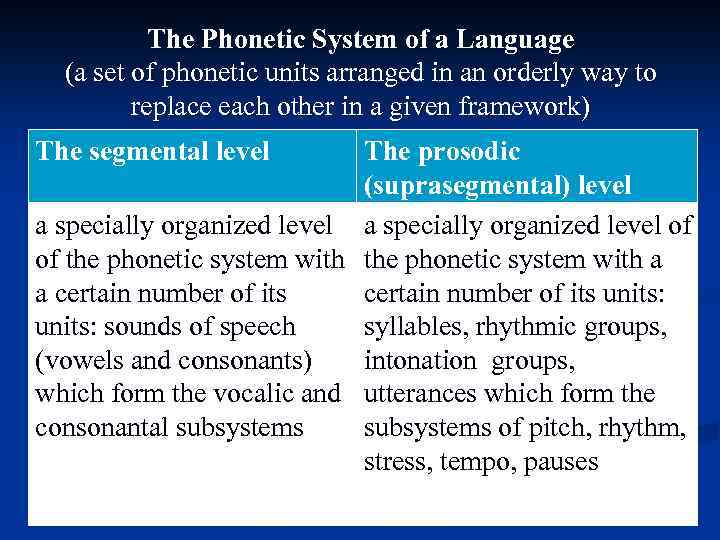 The Phonetic System of a Language (a set of phonetic units arranged in an orderly way to replace each other in a given framework) The segmental level The prosodic (suprasegmental) level a specially organized level of of the phonetic system with a a certain number of its units: sounds of speech syllables, rhythmic groups, (vowels and consonants) intonation groups, which form the vocalic and utterances which form the consonantal subsystems of pitch, rhythm, stress, tempo, pauses
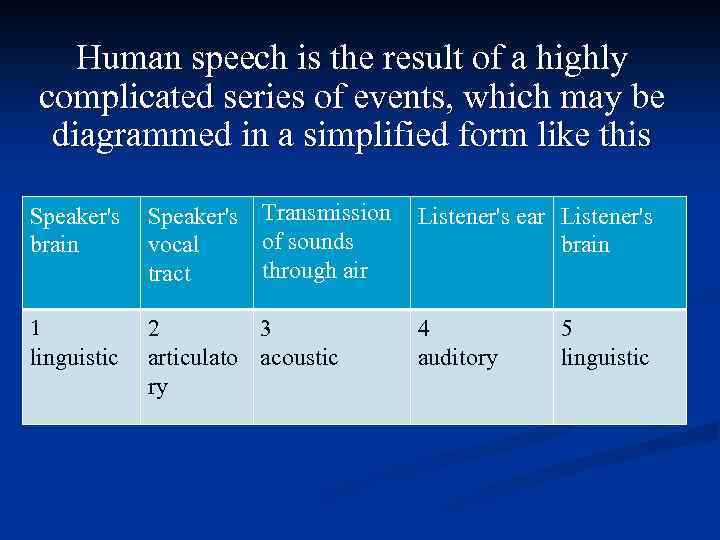 Human speech is the result of a highly complicated series of events, which may be diagrammed in a simplified form like this Speaker's Transmission Listener's ear Listener's of sounds brain vocal brain through air tract 1 linguistic 2 3 articulato acoustic ry 4 auditory 5 linguistic
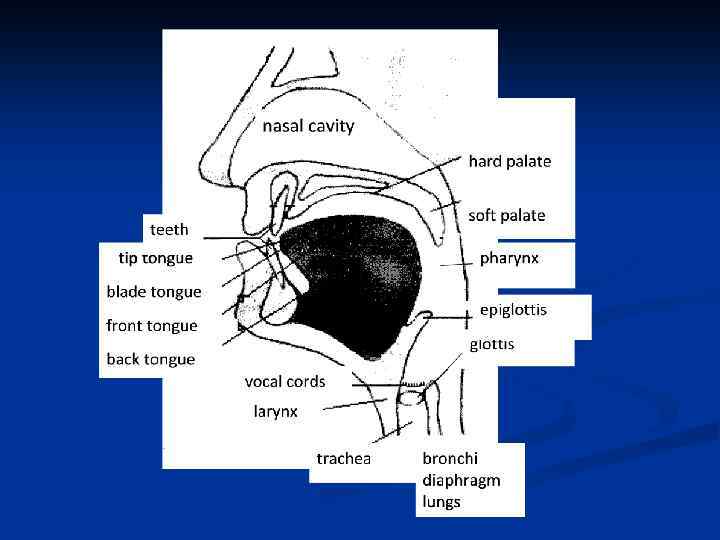
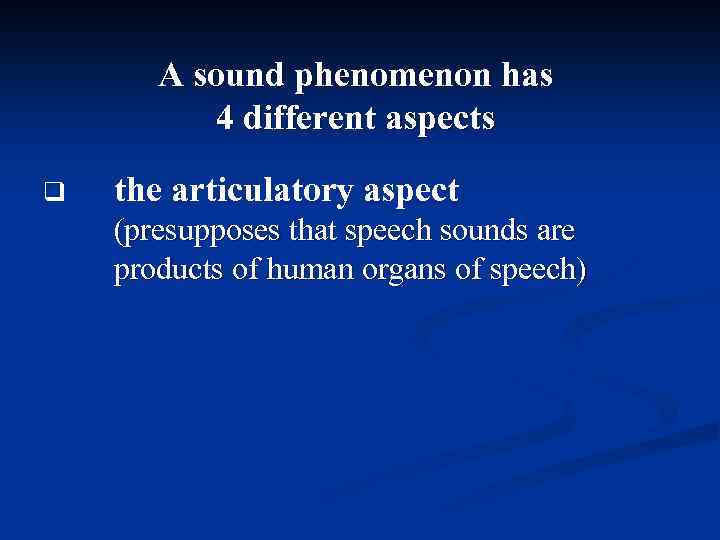 A sound phenomenon has 4 different aspects q the articulatory aspect (presupposes that speech sounds are products of human organs of speech)
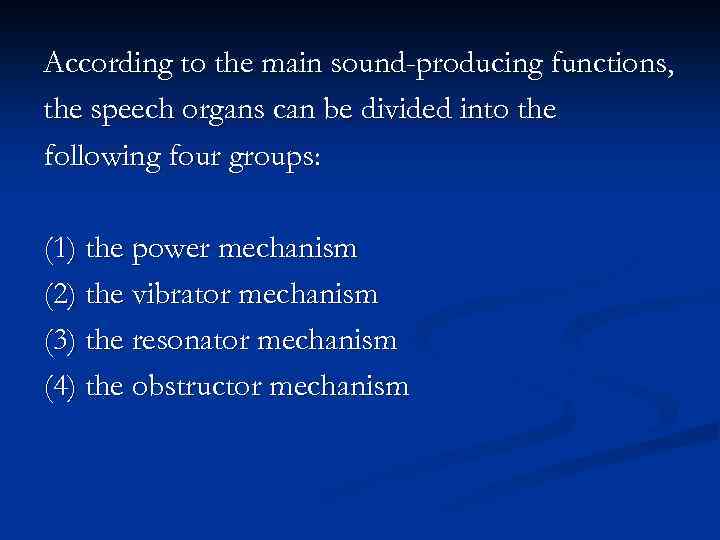 According to the main sound-producing functions, the speech organs can be divided into the following four groups: (1) the power mechanism (2) the vibrator mechanism (3) the resonator mechanism (4) the obstructor mechanism
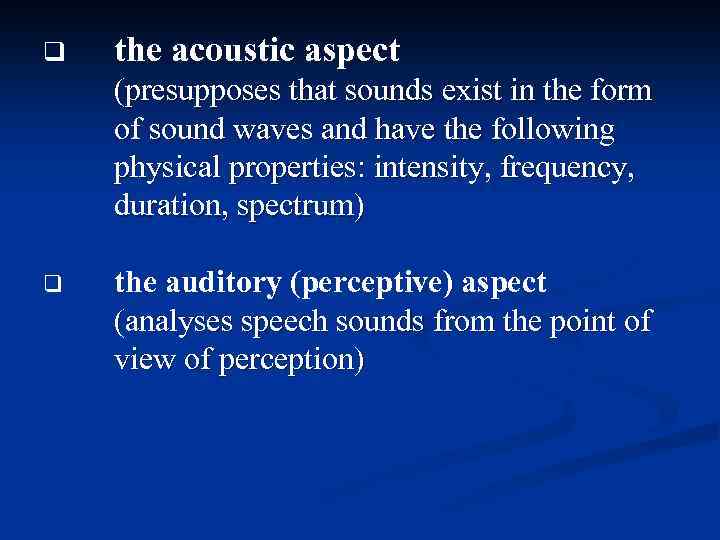 q the acoustic aspect (presupposes that sounds exist in the form of sound waves and have the following physical properties: intensity, frequency, duration, spectrum) q the auditory (perceptive) aspect (analyses speech sounds from the point of view of perception)
 q the linguistic (functional) aspect (segmental sounds and prosodic units are linguistic phenomena because they constitute meaningful units and perform 3 main linguistic functions: constitutive, distinctive, identificatory)
 Functions of phonetic units n Constitutive function of phonetic units: they constitute units of the upper levels of a language: morphemes, word-forms, utterances Distinctive function of phonetic units: phonetic units when opposed to each other differentiate lexical and grammatical meanings of other language units (ex. ask – asks, man-men, eat-each, a name-an aim) n n Identificatory function of phonetic units: the sound phenomena enable the listener to identify them as concrete words, word – forms or utterances
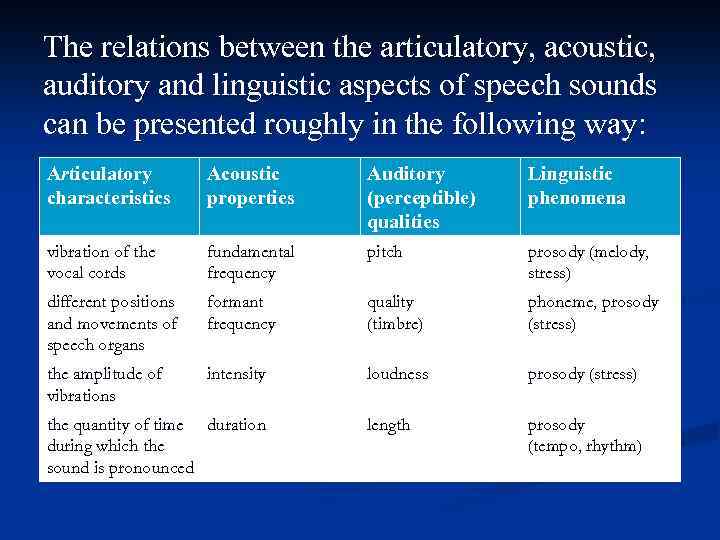 The relations between the articulatory, acoustic, auditory and linguistic aspects of speech sounds can be presented roughly in the following way: Articulatory characteristics Acoustic properties Auditory (perceptible) qualities Linguistic phenomena vibration of the vocal cords fundamental frequency pitch prosody (melody, stress) different positions and movements of speech organs formant frequency quality (timbre) phoneme, prosody (stress) the amplitude of vibrations intensity loudness prosody (stress) length prosody (tempo, rhythm) the quantity of time duration during which the sound is pronounced
 Phonetics is a branch of Linguistics that studies: q sounds in the broad sense, comprising segmental sounds (vowels and consonants) and prosodic units q ways in which sounds are organized into a system of units
 q variation of the units in all types and styles of a spoken language q acoustic properties of sounds q physiological basis of sound production (taking into account individual peculiarities of a speaker)
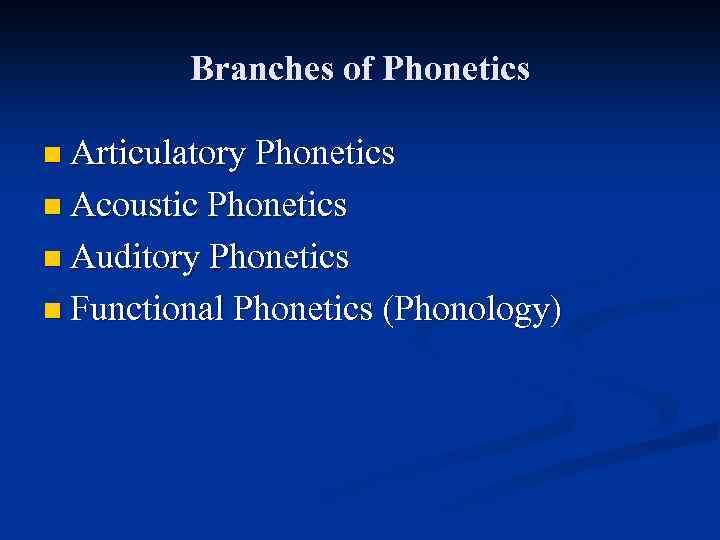 Branches of Phonetics n Articulatory Phonetics n Acoustic Phonetics n Auditory Phonetics n Functional Phonetics (Phonology)
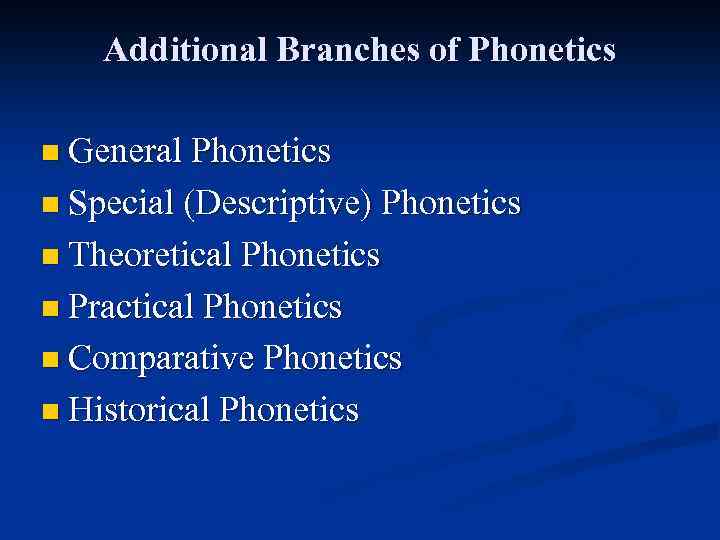 Additional Branches of Phonetics n General Phonetics n Special (Descriptive) Phonetics n Theoretical Phonetics n Practical Phonetics n Comparative Phonetics n Historical Phonetics
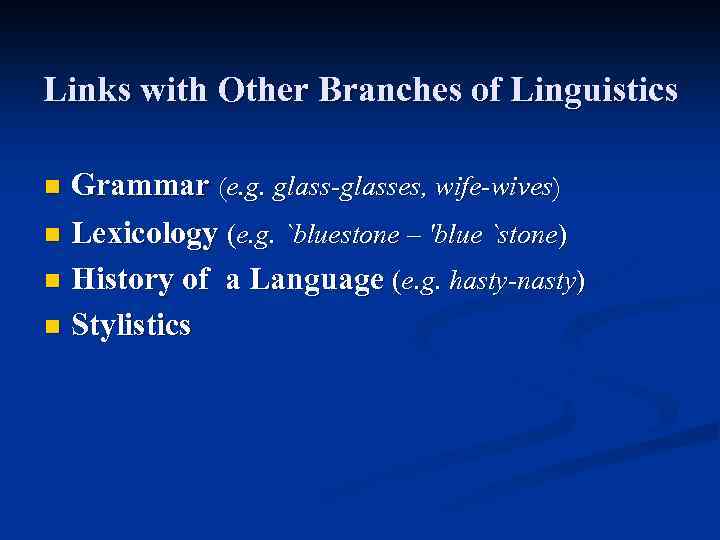 Links with Other Branches of Linguistics Grammar (e. g. glass-glasses, wife-wives) n Lexicology (e. g. `bluestone – 'blue `stone) n History of a Language (e. g. hasty-nasty) n Stylistics n
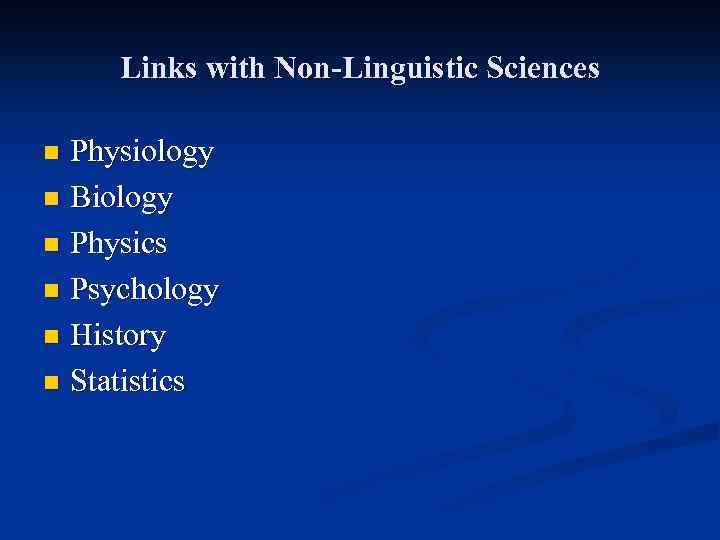 Links with Non-Linguistic Sciences Physiology n Biology n Physics n Psychology n History n Statistics n
 Methods of Phonetic Analysis Subjective (introspective) n Objective n
 List of Literature n n Борисова, Л. В. Теоретическая фонетика английского языка: учеб. пособ. для ин-тов и фак. иностр. яз. / Л. В. Борисова, А. А. Метлюк; под ред. Л. В. Борисовой. – Минск: Выш. шк. , 1980. – 144 с. Леонтьева, С. Ф. Теоретическая фонетика современного английского языка: учеб. для студентов педагогических вузов и университетов / С. Ф. Соколова. – М. : Издательство «Менеджер» , 2004. – 336 с.
 Summing-up Choose among the alternatives 1. Elementary sounds, vowels and consonants, are. . a) segmental units b) suprasegmental units c) prosodic units
 2. The phonetic system of a language comprises the following levels: . . a) segmental, suprasegmental, prosodic b) segmental, prosodic c) suprasegmental, prosodic
 3. Phonetic units perform the following functions: . . a) constitutive, prosodic, identificatory b) constitutive, segmental, identificatory c) constitutive, distinctive, identificatory
 4. Functional phonetics is called in other words. . a) prosody b) general phonetics c) phonology
 5. In oral speech the substance is …. a) phonic b) sounds c) graphic
 Insert the necessary word 1. The units of the _____ level of a language do not have any lexical or grammatical meaning. 2. The articulatory aspect of sounds includes three components: respiration, ____ , articulation.
 3. Phonetic units can differentiate lexical and grammatical meanings of the other language units. Thus, phonetic units perform the _____ function. 4. _____ is a purely linguistic branch of phonetics that deals with the functional aspect of sound phenomena.
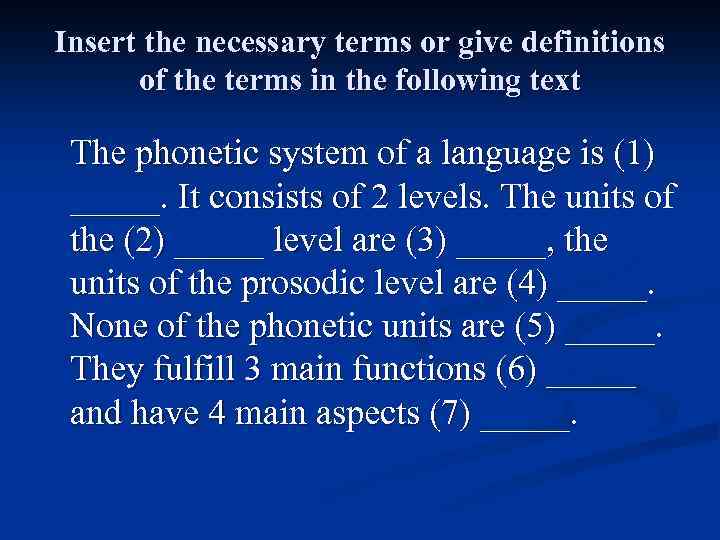 Insert the necessary terms or give definitions of the terms in the following text The phonetic system of a language is (1) _____. It consists of 2 levels. The units of the (2) _____ level are (3) _____, the units of the prosodic level are (4) _____. None of the phonetic units are (5) _____. They fulfill 3 main functions (6) _____ and have 4 main aspects (7) _____.
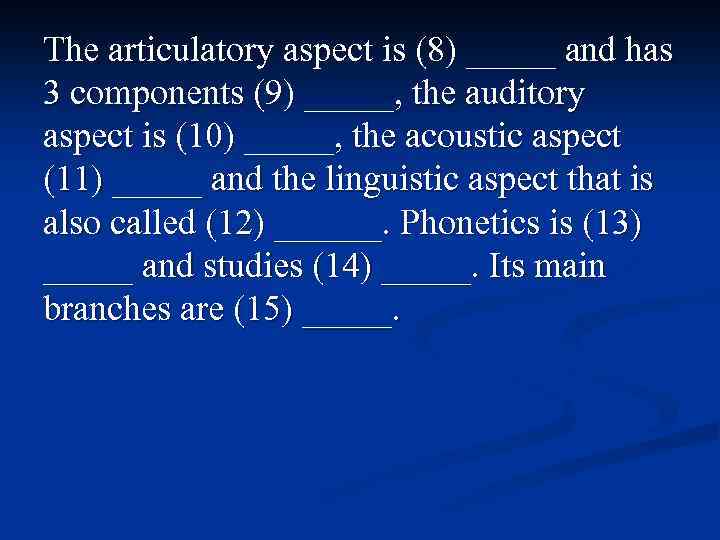 The articulatory aspect is (8) _____ and has 3 components (9) _____, the auditory aspect is (10) _____, the acoustic aspect (11) _____ and the linguistic aspect that is also called (12) ______. Phonetics is (13) _____ and studies (14) _____. Its main branches are (15) _____.