


 Скачать презентацию Lecture 1 International Finance ECON 243 Summer
53ec6ef09395d571df8a662f57b590da.ppt
- Количество слайдов: 37
 Lecture 1 International Finance ECON 243 – Summer I, 2005 Prof. Steve Cunningham
 The New World Economy n The world economy has become increasingly interconnected: n n Globalization: markets exceed national boundaries; increased mobility of workers, products, and information. Integration: people of different countries choose to function jointly in governance, economic interests, currency, etc.
 Developments n The possibility of such a global economy has been brought about by: n n n Collapse of communism Lower transportation costs Advances in telecommunications (internet, etc. ) related technological innovations Economic need These have led to reductions in trade barriers n n n General barriers Integration and free trade zones—Europe, North America, etc. The relaxation of bank and capital market regulations
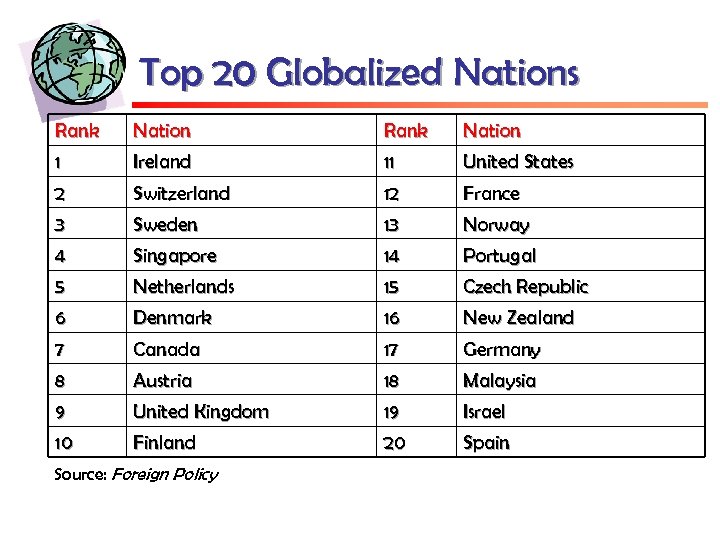 Top 20 Globalized Nations Rank Nation 1 Ireland 11 United States 2 Switzerland 12 France 3 Sweden 13 Norway 4 Singapore 14 Portugal 5 Netherlands 15 Czech Republic 6 Denmark 16 New Zealand 7 Canada 17 Germany 8 Austria 18 Malaysia 9 United Kingdom 19 Israel 10 Finland 20 Spain Source: Foreign Policy
 Sectors n Economists typically separate the production and sale of goods and services from the exchanges of financial assets. n n n Real Sector: production and sale of goods and services. Financial Sector: transactions in global, foreign, or domestic financial assets. Measurement is difficult because trade may include services (invisibles) and electronic commerce.
 Balance of Payments n n n A record of international transactions between residents of one country and the rest of the world International transactions include exchanges of goods, services or assets “Residents” means businesses, individuals and government agencies, including citizens temporarily living abroad but excluding local subsidiaries of foreign corporations
 Double-entry Accounting in the BOP n n All transactions are either debit or credit transactions Credit transactions result in receipt of payment from foreigners n n n Merchandise exports (valued f. o. b. ) Transportation and travel receipts Income received from investments abroad Gifts received from foreign residents Aid received from foreign governments
 Double-entry Accounting (Cont’d) n Debit transactions involve to payments to foreigners n n n n Merchandise imports Transportation and travel expenditures Income paid on investments of foreigners Gifts to foreign residents Aid given by home government Overseas investments by home country residents Each credit transaction has a balancing debit transaction, and vice versa, so the overall balance of payments is always in balance.
 Accounts Overview (Level 1) n Current Account (all real transfers) n n Merchandise trade Service trade Transfers Capital and Financial Account (transfers of ownership and financial assets and liabilities) n n n Changes in private assets Changes in holdings of official international reserves Statistical Discrepancy
 Current Account n The current account is that balance of payments account in which all short-term flows of payments are listed: n Goods and services balance (exports – imports) n n Merchandise trade balance (exports – imports) Services balance (exports – imports) Net Investment income Unilateral transfers n n Private transfer payments Governmental transfers
 What are Services? n n n n Travel and tourism Trade transportation Insurance Education Financial, technical, and marketing services Telecommunication Use of property rights (royalties) Other professional and consulting services
 What is Investment Income? n Payment to holders of foreign financial assets, including: n n n Interest on bonds and loans Dividends and other claims on profits by owners of foreign businesses Payments made to temporary (nonresident) workers
 Unilateral Transfers n n n Official government grants in aid to foreign governments Charitable giving (e. g. , famine relief) Migrant workers transfers to families in their home countries
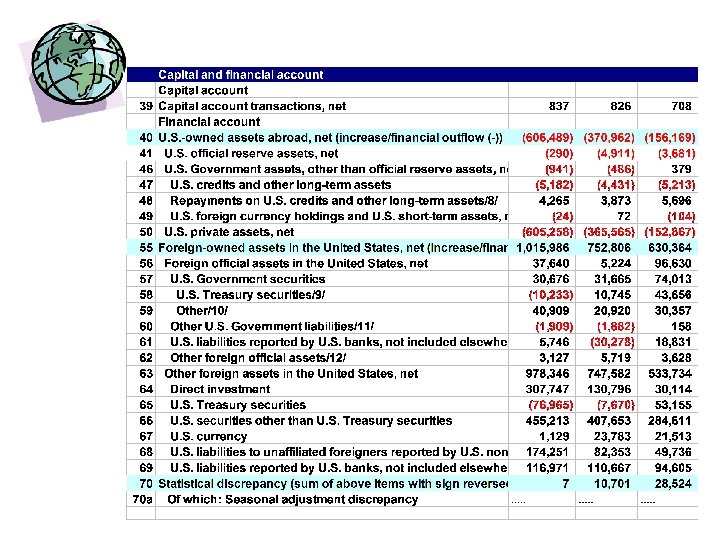
 Capital Account n The capital and financial account is that balance of payments account in which all cross-border transactions involving financial assets are listed. This includes transactions between foreign and domestic residents, and foreign and domestic governments. n All purchases or sales of assets, including: n n n Direct investment Securities (debt) Bank claims and liabilities Official reserves transactions When U. S. citizens buy foreign securities or when foreigners buy U. S. securities, they are listed here as outflows and inflows, respectively.
 Foreign Direct Investment (FDI) n Any flow of lending to, or purchases of ownership in, a foreign enterprise that is largely owned by residents of the investing country. n n n Securities (stocks and bonds) Loans Bank deposits Minority ownership positions FDI is the purchase of assets to establish financial control of a foreign entity. Generally ownership of 10% or more of a company’s outstanding stock is considered FDI. Portfolio investment involves little management control or interest, and is solely for financial gain.
 Official Reserve Assets n n Early on in this century, this was primarily gold Now primarily financial assets denominated in a foreign currency that is widely accepted in international transactions: n n n Euro assets (heavily used by U. S. ) Yen assets (heavily used by U. S. ) U. S. dollar assets (key currency worldwide) Reserve positions in IMF SDRs (created by IMF)
 Official Reserves Transactions n n Governments can influence exchange rates by buying and selling official reserves. The buying and selling of official reserves is recorded in the “official transactions” account. n n Also referred to as “changes in holdings of official international reserves” or “official settlements balance”. It is the part of the balance of payments accounts that records the amount of its own currency or foreign currencies that a nation buys or sells.
 Statistical Discrepancy? n n It is the net result of errors and omissions on both the credit and debit sides. Where do these errors come from? n n Under-reporting merchandise imports Under-reporting investment incomes Under-reporting capital exports Basically, people succeed in hiding their imports, foreign investment incomes, capital flight from their governments for tax and other purposes.
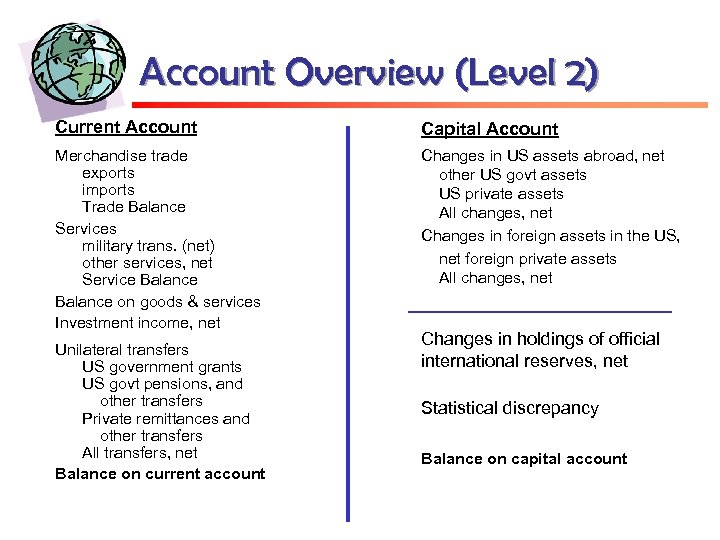 Account Overview (Level 2) Current Account Capital Account Merchandise trade exports imports Trade Balance Services military trans. (net) other services, net Service Balance on goods & services Investment income, net Changes in US assets abroad, net other US govt assets US private assets All changes, net Changes in foreign assets in the US, net foreign private assets All changes, net Unilateral transfers US government grants US govt pensions, and other transfers Private remittances and other transfers All transfers, net Balance on current account Changes in holdings of official international reserves, net Statistical discrepancy Balance on capital account
 Current Account n The difference between the import and export of goods is sometimes called the balance of merchandise trade. n n Although the popular press often uses this measure, the merchandise trade balance is not a good summary because services are an important component of trade. The balance on goods and services includes trade in services. This includes visible and invisible trade.
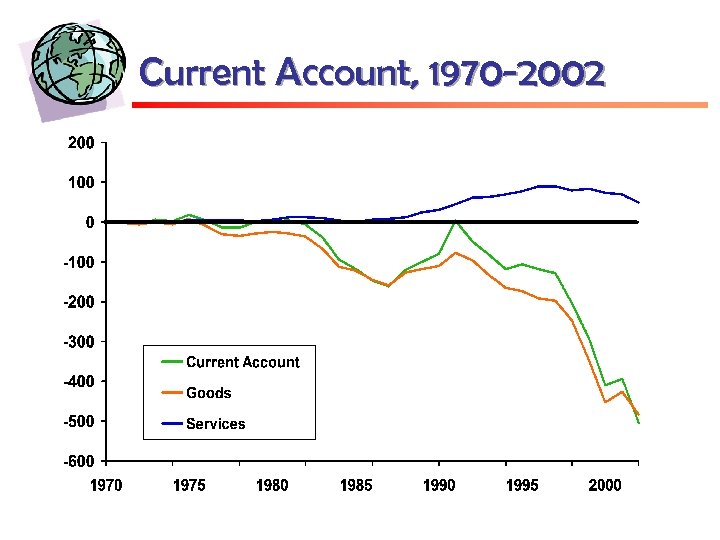 Current Account, 1970 -2002
 Current Account Surplus and Deficit n n A current account surplus means exports of goods and services, investment income and transfers exceed imports and outflows. A current account deficit means imports of goods and services, and outflows are greater than exports and inflows; must be financed by borrowing (capital account inflows).
 Linkage to NIPA and the Domestic Economy n Current Account (CA) surplus equals net foreign investment (If ). CA = If. n n n If If > 0, the country has net foreign investment, so the country must be investing part of its saving abroad, and S = Id + If. That means If = S – Id. Recall that Y = C + Id + G + (X – M). Also, CA = X – M. Domestic Expenditures E = C + Id + G, and Y – E = X – M = CA C + Id + G is sometimes referred to as absorption.
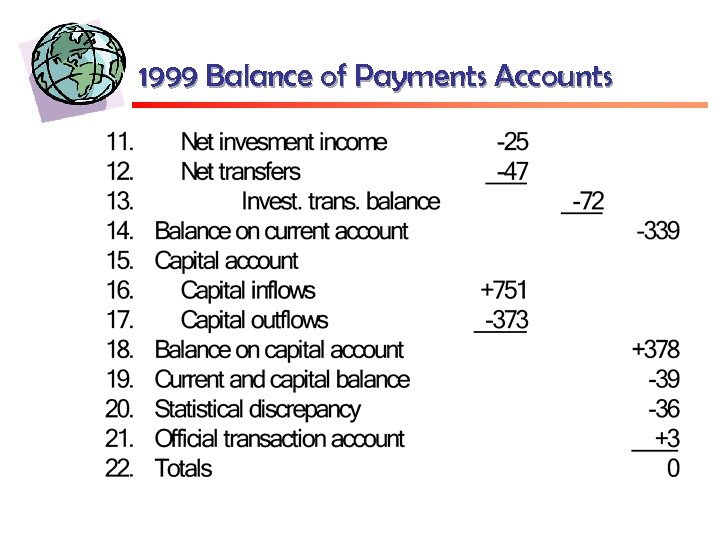
 Meaning of Overall Balance n n n The current account and the capital account measure the private and non-U. S. government supply of and demand for dollars. Official Settlements Balance: B = CA + KA Because the balance of payments must sum to zero, any imbalance in the official settlements balance must be financed (paid for) by official reserves flows: B + OR = 0
 BOP Surplus and Deficit n n The Official Settlements Balance (B ) is sometimes referred to as the net sum of the items above the line or autonomous transactions, and The Official Reserves Transactions (OR ) are referred to as the sum of the items below the line, also called nonautonomous or accommodating transactions. n n n When B = 0, there is said to be a BOP equilibrium, and if B 0, a BOP disequilibrium. When B > 0, there is said to be a BOP surplus. When B < 0, there is said to be a BOP deficit.
 BOP Surplus and Deficit (Continued) n In terms of the supply and demand of a nation’s currency, there is: n n A balance of payments surplus if quantity demanded for a currency exceeds quantity supplied, putting upward pressure on the value of the nation’s currency. A balance of payments deficit if quantity supplied of a currency exceeds quantity demanded, putting downward pressure on the value of the nation’s currency.
 Official Transactions Account n n Most of the Official Reserves flows are official interventions by the country’s monetary authorities in the foreign exchange markets. When a government buys its own currency to hold up the currency’s price, we say that the government has supported its currency. n n It is holding the exchange rate higher than that rate otherwise would have been. When it sells its currency, it is attempting to depress the value of its currency. n It is forcing the exchange rate to be lower than that rate would otherwise have been.
 Official Transactions Account n n Because they are an accounting identity, the current, capital, and official transactions accounts must sum to zero—in total, the balance of payments balances. The supply of currency, including government’s, must equal the demand for currency, including government’s.
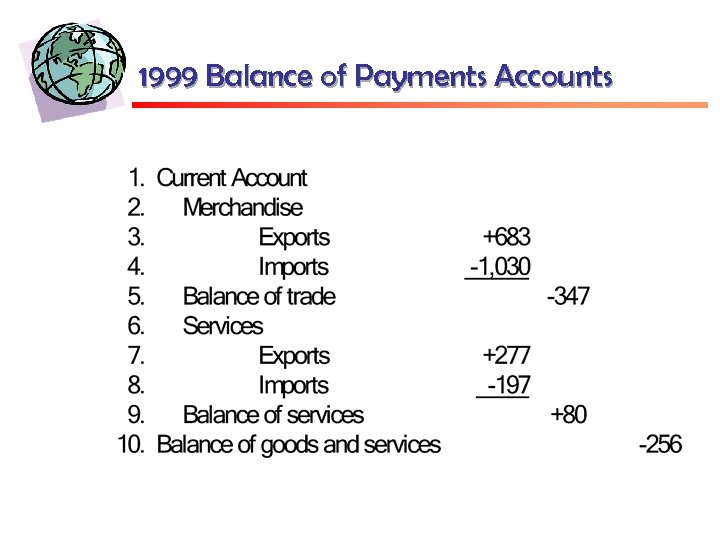 1999 Balance of Payments Accounts
 1999 Balance of Payments Accounts
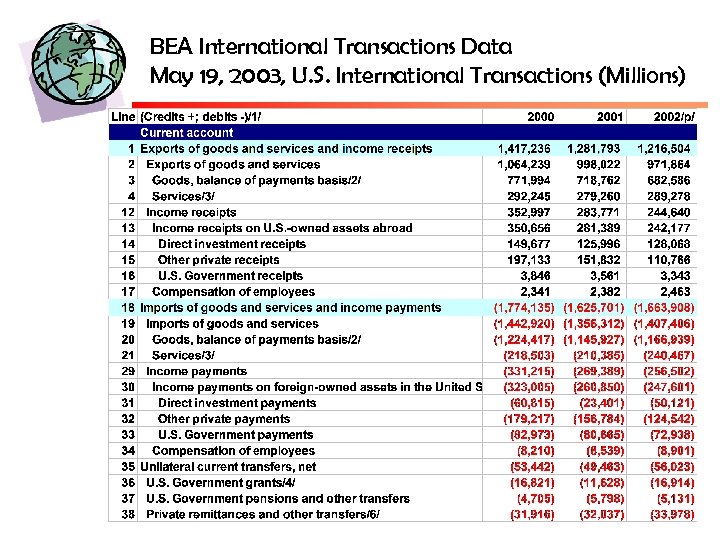 BEA International Transactions Data May 19, 2003, U. S. International Transactions (Millions)
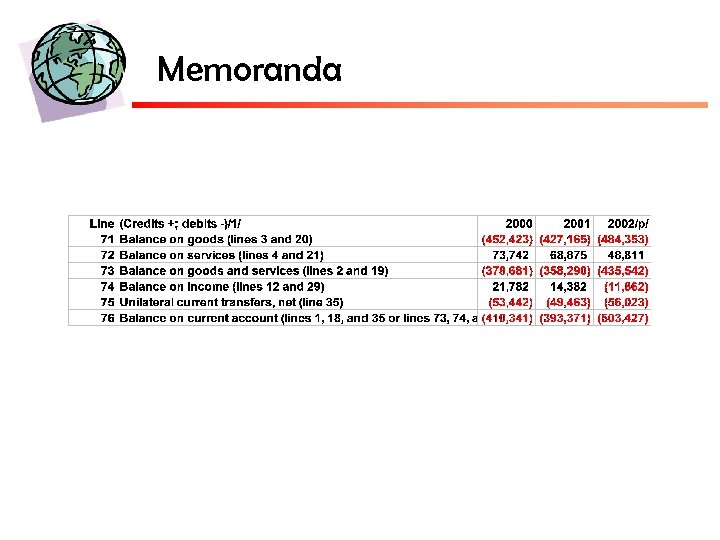 Memoranda
 Int’l Investment Position n In order to buy U. S. assets foreigners need dollars, so net capital inflows represent a demand for dollars. n n The demand for dollars comes from the demand to buy goods and services and the demand to buy (capital) assets. In the 1980 s, the inflow of capital into the U. S. greatly exceeded the outflow of capital from the U. S. , and this trend has continued into the late 1990 s. (KA > 0, CA < 0)
 Int’l Investment Position (continued) n n International Investment Position (IIP) is another related balance sheet. It is a statement of the stocks of a nation’s international assets and foreign liabilities at a point in time, usually the end of a year. Any capital flows (related to a current account imbalance) creates a change in the IIP.
 Int’l Investment Position (continued) We say that a nation is a lender or a borrower depending on whether its current account is in surplus or deficit during a time period. n We say that a nation is a creditor or debtor depending on whether its net stock of foreign assets is positive or negative. ØThe first refers to flows over time, the second to stocks at a point in time. n
 Int’l Investment Position (continued) n n Prior to WWI, the U. S. was a net debtor. From WWI through 1983, the U. S. was a net creditor (the world’s leading creditor). Since 1983, the U. S. has run large current account deficits, requiring int’l borrowing. By 1989, the U. S. was a net debtor, and continues to be so until the present.